



Abstract
Objectives
To address the lack of up-to-date published data, the present study assessed the prevalence of intestinal parasites in breeding catteries in Japan.
Methods
Fresh faecal samples were randomly collected from 342 cats (aged 1 month to 12 years) in seven breeding catteries in Japan, located in prefectures of Nagano (n = 2), Saitama (n = 1), Aichi (n = 2), Gifu (n = 1) and Miyagi (n = 1), on a single occasion. The samples were tested for the presence of Giardia species copro-antigen using a commercially available enzyme-linked immunosorbent assay kit. Other intestinal parasites were identified microscopically using the formalin–ethyl acetate sedimentation technique.
Results
The total prevalence of intestinal parasites was 20.8%; only two genera of protozoa (Giardia species: 18.7% and Cystoisospora species: 5.0%) were detected. Coinfections of both protozoans were recorded in 2.9% of cats. In contrast, no helminths were detected. The presence of total infection, Giardia species, Cystoisospora species and multiple infections in cats <1 year old were significantly more prevalent than in cats ⩾1 year old. There were no significant differences among faecal conditions with or without intestinal parasites. Giardia species infection was present in samples from all breeding catteries, except for one facility. Cystoisospora species and coinfections were shown in four and two breeding catteries, respectively. The prevalence of intestinal parasites was markedly variable among the breeding catteries.
Conclusions and relevance
The present study demonstrates the significance of Giardia species and Cystoisospora species infections in breeding cattery cats. Additionally, it is suggested that environmental contamination is the most important factor influencing the prevalence of protozoal infections in breeding catteries.
Introduction
Intestinal parasites are commonly recognised to be one of the pathogens that induce obstruction of the digestive tract in cats and some have an additional zoonotic potential.1–3 Considering these factors and the recent evolution of close contact between cats and humans, estimating the prevalence of intestinal parasites in domesticated cats is obviously significant for the welfare of both cats and humans. Previously, researchers have demonstrated the prevalences of intestinal parasites in private household cats and pet shop kittens in Japan.4,5 Many private cat owners likely obtain their animals from pet shops, and breeding catteries are the major sources of kittens for pet shops. However, to our knowledge, there was only one available report regarding the prevalence of intestinal parasites in breeding cattery cats, 6 and no new reports have been published worldwide, including Japan, during the past 10 years. To address the lack of up-to-date published data, the present study determined the prevalence of intestinal parasites in 342 cats of seven breeding catteries, located in the prefectures of Nagano (n = 2), Saitama (n = 1), Aichi (n = 2), Gifu (n = 1) and Miyagi (n = 1) in Japan.
Materials and methods
Between March 2013 and February 2014, fresh faecal samples were randomly collected on a single occasion from 342 cats (aged 1 month–12 years; 101 males, 241 females) kept in seven breeding catteries (A–G), located in the prefectures of Nagano (n = 2; A and C), Saitama (n = 1; B), Aichi (n = 2; D and F), Gifu (n = 1; E) and Miyagi (n = 1; G), in Japan. All faecal samples were donated by the breeding cattery owners, who granted permission to include their cats in the investigation. The samples were collected immediately after natural defecation and were stored at 4°C until examination (within 2 days). The presence of Giardia-specific coproantigens was determined using a commercially available enzyme-linked immunosorbent assay kit (SNAP Giardia; IDEXX Laboratories). Other intestinal parasites were identified microscopically using the formalin–ethyl acetate sedimentation technique.4,7 The data were analysed according to the following categories: age (<1 year or ⩾1 year), faecal condition (normal, soft or diarrhoea) and the breeding cattery (A–G). Unfortunately, it was impossible to obtain the detailed data for the anthelmintic treatment owing to the refusal of breeding cattery owners and/or no records of deworming. Data were analysed using Fisher’s exact probability test, and the significant level was P <0.05.
Results
Of the 342 breeding cattery cats, 20.8% (n = 71) cats were positive for at least one genus of intestinal parasites (see Table 1). Two genera of protozoa, Giardia and Cystoisospora (Cystoisospora felis and Cystoisospora rivolta) were identified in 18.7% (n = 64) and 5.0% (n = 17) of cats (C felis, n = 16; C felis plus C rivolta, n = 1), respectively. Coinfections of both protozoans were recorded in 2.9% (n = 10) of cats. In contrast, no helminths were detected. There were no significant differences among faecal conditions with or without intestinal parasites.
Prevalence of intestinal parasites in breeding cattery cats in Japan

Data are n (%) unless otherwise indicated
This total number is smaller than sum of each parasite because of multiple infections
NS = not significant
Giardia species infection was present in samples from all breeding catteries, except for one facility (F) (see Table 2). Cystoisospora species and coinfections were shown in four (A, C, E, G) and two (C, E) breeding catteries, respectively. In addition to the total prevalence, the presences of Giardia species, Cystoisospora species and coinfections were markedly variable among the breeding catteries. However, there was no correlation between the high prevalence (breeding cattery A, C, E) and the percentage of young cats (0–61.5%) that had high prevalences in each facility.
Prevalence of intestinal parasites in individual breeding cattery cats in Japan
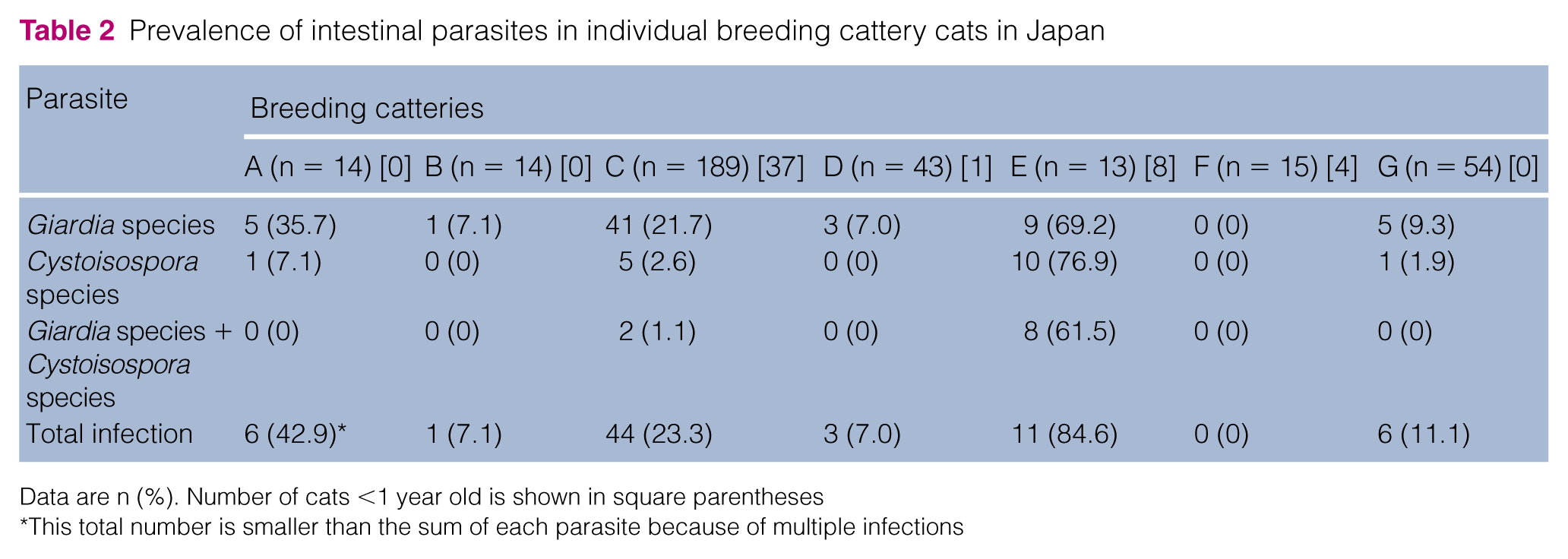
Data are n (%). Number of cats <1 year old is shown in square parentheses
This total number is smaller than the sum of each parasite because of multiple infections
Discussion
Because only two genera of protozoa, Giardia and Cystoisospora, were detected in the present study, it was demonstrated that protozoan infections were more significant than helminth infections in breeding cattery cats. Giardia species were especially important because of their prevalence in all catteries (except for one facility) and high presence without relation to the age of cats, although the prevalence was significantly higher in cats aged <1 year. Considering the high prevalence in cats aged <1 year, Cystoisospora species should also be noted in some catteries. These results were expected because there have been recent reports that Giardia species and Cystoisospora species infections are highly prevalent in pet shop kittens (aged 1–3 months) in Japan, 5 and almost all pet shop kittens are doubtlessly derived from breeding catteries. Although information on intestinal parasites in breeding cattery cats has been limited, McGlade et al showed a high prevalence of Giardia species infection in cats in Australia. 6 It is believed that cats kept in high-density facilities are commonly infected with Giardia species and Cystoisospora species as these pathogens can transmit easily among animals in a limited space.6,8–10 Eradication of contaminated Giardia cysts and Cystoisospora oocysts from breeding catteries is likely to be difficult owing to their stability in the environment and the lack of effective disinfectants.11–13
In the present study, higher prevalences of Giardia species and Cystoisospora species were recorded in cats aged <1 year. Previous studies indicated that a higher prevalence of parasite infections often occurred in young animals because of their immature immune systems.14–16 The significantly decreased prevalences of Giardia species and Cystoisospora species in cats aged ⩾1 year were likely associated with the development of immune systems and/or the history of treatments, although there was no available information in this study on whether treatment had been performed. In contrast to very low levels of infection of Cystoisospora species in cats aged ⩾1 year, Giardia species maintained markedly high levels of infection. It is suggested that animals, including cats, can develop strong and lasting immunity to coccidian parasites.9,16 Concerning Giardia species infection, previous studies demonstrate that this protozoa can escape from the host’s immune systems via changes in its antigenicity.17,18 Therefore, it is believed that Giardia species reinfection frequently occurs at various ages.17,18 Infected adult cats are likely to play an important role in the persistent preservation of environmental contamination in breeding catteries. The additional possible reason for the difference between the infections of Giardia species and Cystoisospora species are found in their biological characteristics. These protozoans infect via a simple faecal–oral transmission route.1,11–13,16 The oocysts of feline Cystoisospora species shed to the environment in an immature non-infectious stage and have to develop to a mature infectious stage before they can be transmitted; they need a few days with adequate moisture and temperature.9,16 The cysts of Giardia species are already infectious when they are shed into the environment.8,13 Giardia species transmission is likely easier than Cystoisospora species transmission. In addition, the behaviour of grooming, characteristic for cats, seems to contribute to Giardia specis transmission, especially in mother cats that care for their infected kittens.
Approximately 30% and 20% of cases found to be positive for Giardia species and Cystoisospora species, respectively, had abnormal (soft or diarrhoea) faecal conditions. This suggested that these protozoa have a pathogenic potential in some infected cases. However, in the present study, the faecal conditions had no effect on the prevalences of Giardia species or Cystoisospora species. Many previous studies also demonstrated that protozoal infections are not always affected by the faecal conditions.8,9,12,13,16 Conversely, these findings strongly suggest the existence of subclinical (normal faecal condition) carriers that can remain undetected, and which breeding cattery managers have no chance to treat. Therefore, the carriers likely contribute to the spread of these pathogens in breeding cattery environments via the continuous shedding of cysts and/or oocysts.
Among the breeding catteries, there were remarkable differences in the presence of Giardia species and Cystoisospora species. Although there is no information regarding the sanitary management and deworming histories, these findings suggest that environmental contamination is the most important factor that influences the differential prevalences of protozoan infections among breeding catteries.
No helminth infections were detected in the present study. Our previous study also revealed a low level of helminth infections in pet shop kittens. 5 Similar to oocysts of the feline Cystoisospora species, the shedding of helminth eggs in faeces generally need to develop for a certain duration before they reach the infectious stage, which is usually longer than that of Cystoisospora species. 1 In addition, breeding cattery cats have no chance to intake the paratenic and/or intermediary hosts of helminths from the environment as the cats are always kept indoors. Another reason for the lack of parasitisation of helminths is most likely regular treatment with anthelmintics as the cattery managers are likely to have a good understanding regarding helminth infections and anthelmintics are easily obtained and administered freely in Japan.
The present study demonstrates the significance of Giardia species and Cystoisospora species infections in breeding cattery cats in Japan. Although there is no potential of zoonotic transmission in feline Cystoisospora species,9,16 Giardia species harboured in cats have the potential of zoonotic transmission.11,13,19 Therefore, further investigation into the genotyping of Giardia species isolates is needed to evaluate the zoonotic transmission.
Conclusions
The present study demonstrates the significance of Giardia species and Cystoisospora species infections in breeding cattery cats in Japan. Additionally, it is suggested that environmental contamination is the most important factor influencing the prevalence of protozoan infections in breeding catteries.
Footnotes
Conflict of interest
The authors do not have any potential conflicts of interest to declare.
Funding
This research received no specific grant from any funding agency in the public, commercial or not-for-profit sectors.