



Abstract
Objectives
The objective of this study was to compare the prevalence of different types of injuries caused by various types of projectiles among urban, suburban and rural cats of different ages in order to predict the type of injury sustained.
Methods
For the period 1 January 2012 to 30 April 2014, the medical records of cats with metal projectile injuries (PIs) were searched from the archive of the university’s small animal diagnostic imaging centre. Age, sex, owner address, admission during a weekend or on a working day, month of admission, projectile position (head and neck; thoracic region; abdominal region, including lumbosacral spine; forelimbs; and hindlimbs, including tail), number of projectiles, presence of a wound and fracture related to the projectile, and the type of projectile were recorded for each cat.
Results
Sixty-five cats with PIs were admitted during the defined period. In 38.5% of cats the projectiles found upon radiography were incidental findings. The frequency of PIs peaked in March. Airgun projectiles were found in 80.0% of the cats. PIs in two or more body regions were found in 29.2% of the cats. Among the cats that had only been shot in one body region, the projectile was most frequently found in the abdominal region, including the lumbosacral spine (41.3%).
Conclusions and relevance
These results might prompt clinicians to evaluate closely and screen for feline PIs in emergency situations.
Introduction
Projectile injuries (PIs) to cats are not uncommon in rural and peripheral urban areas. Air-powered projectiles have often been observed in feline radiographs to be the cause of PI. Despite their modest size, moderate velocity and poor aerodynamic design, air-powered projectiles can cause serious injuries. The head and torso are the most vulnerable areas, and injury to these areas can result in incapacitation due to central nervous system disruption or massive organ destruction and haemorrhage. 1
In many cases, the time of shooting remains unknown. Most injuries occur when the cat escapes or is allowed to roam unsupervised. Without accurate histories, the injuries might be mistaken for bite wounds or vehicular trauma. Knowledge of the weapon can aid the veterinarian in determining the potential tissue damage and the appropriate surgical management of the injuries. Wounds present on both sides of the body (ie, entry and exit wounds) should raise the suspicion of projectile wounds. 2
The aim of this study was to compare the prevalence of the types of injuries caused by different types of metal projectiles in urban, suburban and rural cats.
Material and methods
In the period 1 January 2012–30 April 2014, the medical records of cats with PIs were studied from an archive of our university’s small animal diagnostic imaging centre. Cases were included if there was the presence of a metal foreign body (projectile) upon radiograph (both as an incidental finding or a finding following an observed suspicious skin wound). If one or more metal foreign bodies were observed on the first radiograph, additional radiographs of entire body were obtained. Cases were excluded if there was no evidence of metal foreign body as a part of projectile upon radiograph. Cats with trauma suspected to have been caused by projectiles were excluded if this could not be verified on the radiographs.
An incidental finding was defined as a radiographically confirmed projectile without entrance and/or exit wounds, without any clinical signs caused by the projectile, and without data regarding a projectile accident in the cat’s history. An acute PI was defined as a radiographically recorded projectile connected with an entrance and/or exit wound, and with clinical signs related to projectile wounds. Age, sex, owner address, admission during the weekend or on a working day, admission date, projectile position (ie, head and neck [HN]; thoracic region, including thoracic spine [TR]; abdominal region, including lumbosacral spine [AB], forelimbs [FL]; and hindlimbs, including tail [HL]), projectile number, the presence of a wound and fracture related to the projectile, and projectile type (ie, air-powered projectile, unknown projectile fragment, shotgun, homemade arrow) were recorded for each cat. The recorded findings (admission during a weekend or on a working day, and admission date) from the cats with accidental findings of projectiles were not considered. After diagnosis, treatment was provided in different clinics, and follow-up data were not available for all cats. The owners’ addresses found in the computer database were used as criteria to determine the area (ie, urban, suburban and rural). Urban areas were defined as settlements with >50,000 citizens, suburban areas as settlements with between 5000 and 50,000 citizens, and peripheral urban and rural areas as settlements with <5000 citizens. The cats were divided into three groups according to projectile type found on the radiographs. The first group consisted of cats with airgun projectile(s), the second group consisted of cats with unknown projectile fragments and the third group consisted of cats with shotgun projectiles.
Statistical analyses were performed using Statistica version 12 for Windows (StatSoft). Differences between frequencies among groups, based on owner address and projectile type, were evaluated with the χ2. Kolmogorov–Smirnov tests was used to examine the distributions. Kruskal–Wallis tests were used as non-parametric tests. When statistically significant differences were found, Tukey’s honest significant difference test was applied as post-hoc tests for multiple comparisons. P values <0.05 were considered statistically significant.
Results
During the defined period, 3156 cats were admitted to the university diagnostic imaging centre, and PI was diagnosed in 2.1% (65/3156) of the cases. The mean ± SD age of the cats was 5.78 ± 4.79 years range 5 months–17 years). Of the cats, 55.4% (36/65) were male (9/36 neutered) and 44.6% (29/65) were female (12/29 spayed). In 38.5% (25/65) of the cats, the projectiles found upon radiograph were incidental findings. In 61.5% (40/65) of the cats, an acute PI was recorded. In the period between March and September, 30/40 cats were admitted (P = 0.001). The highest number of admitted cats per month was recorded from February to May, and again in August. Forty percent (16/40) of the cats with PIs were admitted on weekends, and 60.0% (24/40) were admitted on working days.
PIs in two or more regions were found in 29.2% (19/65) of the cats, and 70.8% (46/65) of the cats had only one PI (in the HN in 7/46 cats, the TR in 6/46 cats, in the AB in 19/46 cats, in the FL in 6/46 cats and in the HL in 8/46 cats; P <0.05). All of the found projectiles are shown in Figure 1.
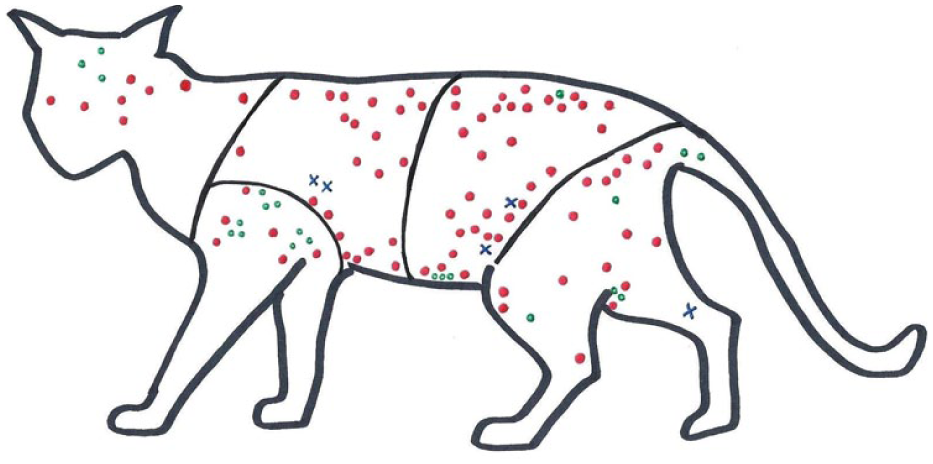
Schematic of the positions and the distribution of radiographic projectile findings in the cats. Red dot = air gun pellet; green dot = unknown projectile fragment; cross = shotgun pellet
Projectiles in the AB were observed in 29 cats (single or multiple injuries). Abdominal ‘loss of detail’, indicating peritoneal effusion, was radiographically observed in 17.2% (5/29) of the cats. No radiographic signs of pneumoperitoneum and/or pneumothorax were found in any of the cats.
Fractures were observed in 39.9% (24/65) of the cats. In two cats, multiple fractures were observed (femoral and tibial fractures in the same leg and fractures in the sternum and ribs). Among the cats with single fractures, humeral fractures were observed in five cats (Figure 2), femoral fractures in four cats, sternal fractures in three cats, rib fractures in three cats, tibial fractures in two cats, and radioulnar fracture, single bone metacarpal fracture, twelfth thoracic vertebra fracture, tail fracture/luxation and a projectile in the nasal bone were observed in one cat each. In 24.0% (6/25) of the cats with incidental findings of projectiles upon radiograph, healed fractures were observed.
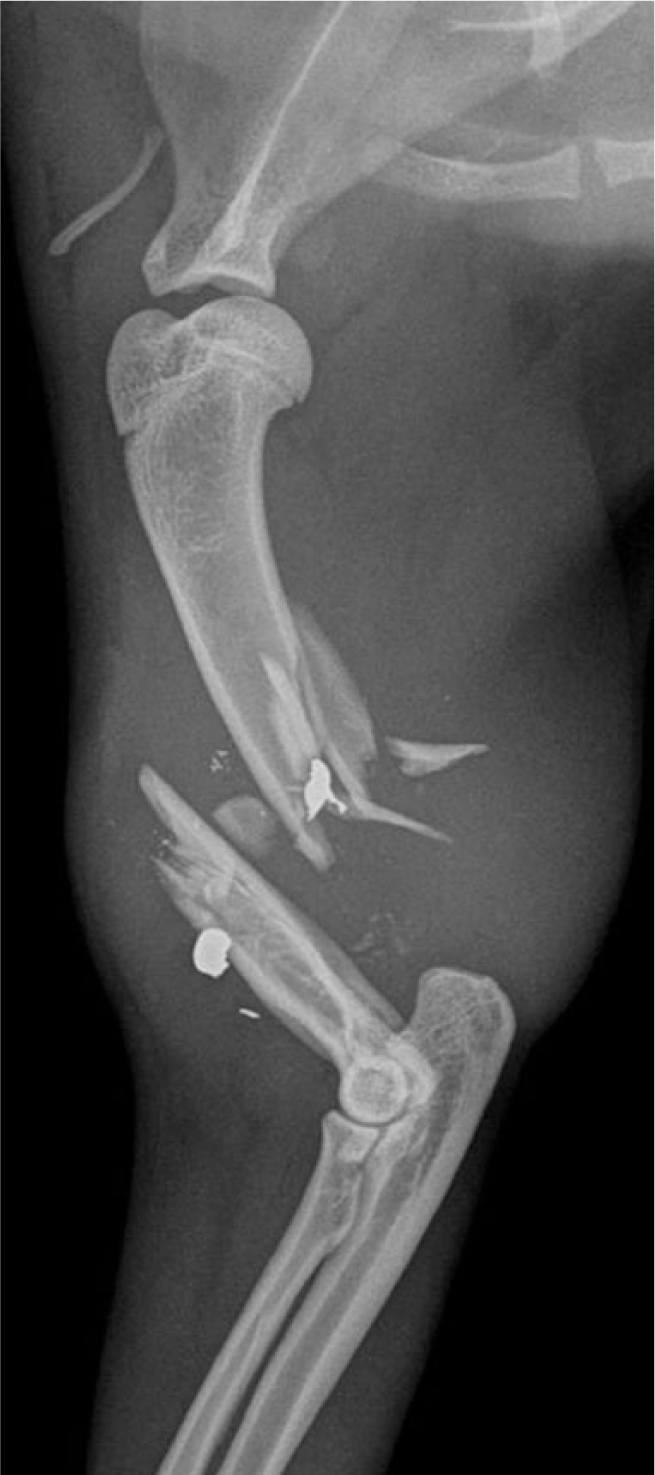
Lateral view of a left humerus showing a comminuted diaphyseal fracture due to acute projectile injury. The projectile caused severe soft tissue injury in addition to the fracture. There are multiple metal fragments in the affected region
Urban, suburban and rural cats
Of the sampled cats, 50.8% (33/65) were classified as urban cats, 32.3% (21/65) were classified as suburban cats and 16.9% (11/65) were classified as rural cats (P <0.01) (see Table 1).
Distribution of projectile injuries in urban, suburban and rural cats

Data are given as % (n) unless otherwise indicated
In the period from October to December, only 5.0% (1/20) of urban cats were admitted to clinics. Among the 13 suburban cats, 53.8% (7/13) were admitted to the clinic between February and April, and 46.2% (6/13) between June and August. No suburban cats were admitted between September and January, or in May.
Types of projectile
Airgun projectile(s) were found in 52/64 cats, unknown metal projectile fragments were found in 10/64 cats and shotgun projectiles were found in 2/64 cats (Table 2). The cat that was shot with a homemade arrow is excluded from Table 2. The numbers of projectiles found per injured cat were between one and 13. Both cats with shotgun projectiles were admitted during a weekend.
Distribution of the injuries to cats shot by different projectiles
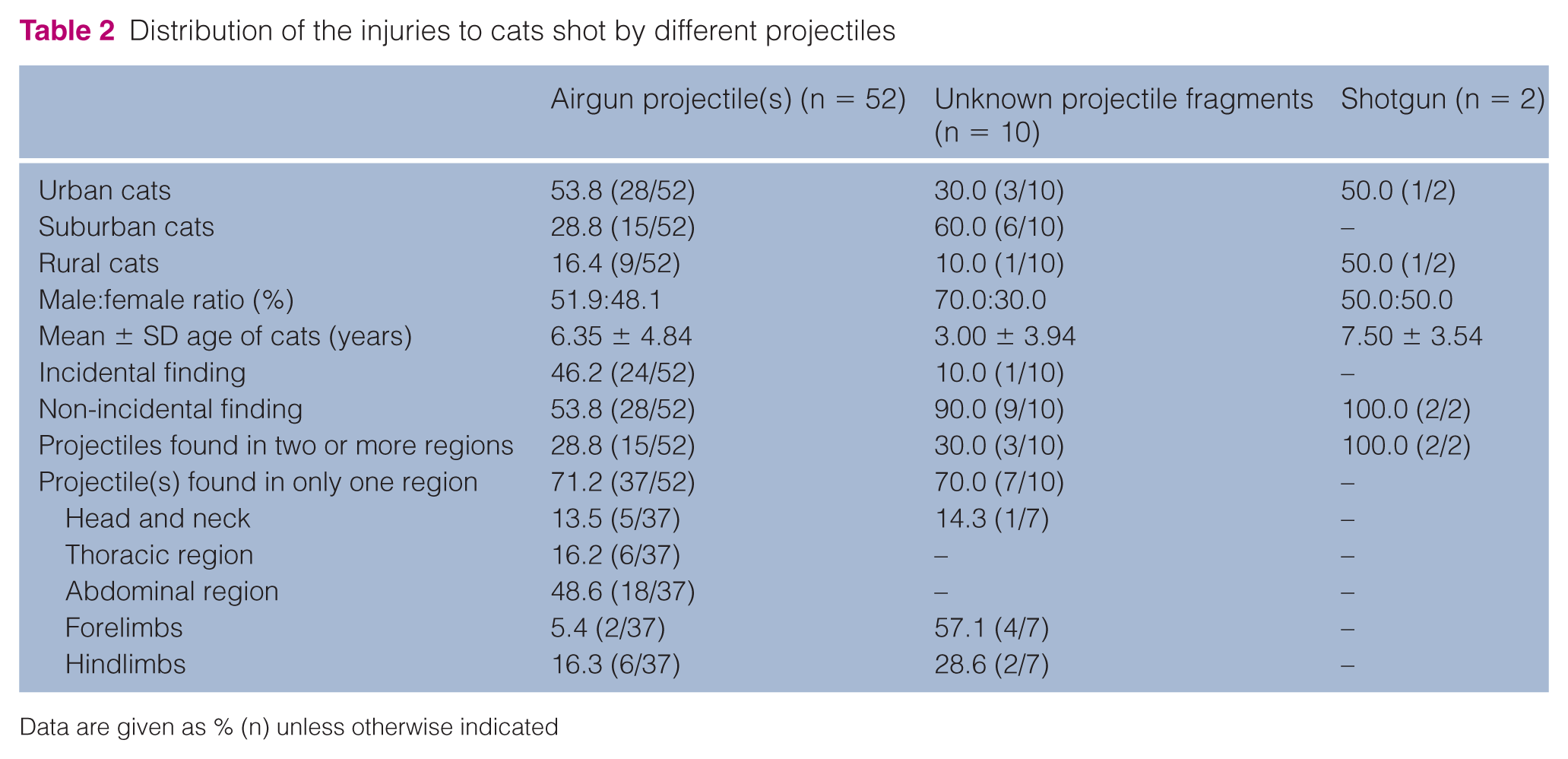
Data are given as % (n) unless otherwise indicated
Discussion
Gunshot injuries are not commonly observed in veterinary medicine, and the likelihood of such injuries depends on the location of the practice (ie, locations with higher crime rates have higher incidences of PI). 3 There are very few retrospective studies in the literature concerning PIs in cats, and the available studies involve a maximum of 10 cats.4–6 PIs are more frequently found in dogs. Saunders and Tobias observed that the causes of traumatic pneumoperitoneum in 35.7% (5/14) dogs and cats were gunshot injuries, and that the dog to cat ratio was 4:1. 7 In another study, penetration of the abdomen and/or thorax was observed in 15 dogs and only one cat. Those penetrations were caused by projectiles in four animals and by fighting accidents in 12 animals, and the dog to cat ratio was 3:1. 8 Fullington and Otto reported 84 cases of PI with 97.6% of the injuries in dogs. 9 One possible reason for this dog to cat ratio is that cats have quicker reflexes and are better able to avoid projectiles. We observed that 38.5% of the cats in this study had incidental findings of projectiles, which indicates that many projectiles do not cause serious discernible injuries.
PIs are not among the four most prevalent causes of traumatic injuries to cats, 5 although we recorded PIs in 2.06% of the cats admitted to our university’s diagnostic imaging centre. This observed prevalence of PI is similar to the 1.7% recorded in 1970. 6 The difference of 44 years between these publications and the changes in shotgun regulations that have occurred in this time period appear to have made little difference, which might indicate that PIs remain a relevant cause of injuries in veterinary medicine.
Post-mortem radiographic examinations of animals are commonly performed in judicial investigations to rule out gunshots. However, there were no available data regarding the radiographic post-mortem gunshot injuries for 41 feline cadavers following scheduled euthanasia. 10 In contrast, for 38.5% of the cats in our study, the finding of a projectile upon radiography was incidental and indicative of previous trauma. Airgun projectiles were found in 52 cats, and unknown projectile fragments were found in 10 cats. We were not able to classify the unknown projectile fragments, but we assumed that these fragments were likely dissipated airgun projectiles. Our results are in agreement with the results of another study in which the authors observed 10 cat shootings (seven involving airgun pellets and three involving shotgun pellets). 11 Both of the cats that had sustained shotgun injuries in our study were admitted as acute cases, which might indicate that shotgun injuries are more likely to cause serious trauma, particularly when taking into account that shotgun projectiles are typically disseminated across vast body areas. Projectiles were found in two or more regions in both of the cats with shotgun projectiles, in 28.8% of the cats with airgun projectiles and in 30.0% of the cats with unknown projectile fragments; these findings indicate that approximately one-third of the cats were shot several times. We observed few cases of PIs to the area of neck, liver and heart, suggesting that such shots are more likely to be fatal. The prevalence of airgun projectiles recorded in our study can be explained by the characteristically low level of noise produced by such shots. This lack of noise makes the use of airguns suitable for individuals who seek to avoid detection, especially in more crowded urban areas. Furthermore, the purchase of airguns is not subject to any legal regulations and they are therefore easy to obtain, particularly in urban and suburban areas in which other types of guns are primarily associated with professionals and crime. Both of the cats with shotgun injuries were admitted during a weekend, a time at which hunting typically occurs. One of these cats was from a rural area, which might indicate that this cat was roaming in a hunting area during a hunting time. We did not record any injuries due to high-velocity projectiles, and this finding might be explained by the high mortality associated with such injuries and the low incidence of high-velocity PIs. Moreover, the inclusion criteria for this study included the presence of a metal foreign body upon radiograph. High-velocity projectiles (particularly jacketed bullets) are more likely to exit through the soft tissues without leaving obvious metallic debris on the radiographs; however, occasionally even lower-velocity handgun rounds do not cause obvious radiographic changes.
Airgun pellets do not exit the bodies of humans and thus should always be identifiable as whole or fragmented pellets. 12 Similarly, airgun pellets rarely penetrate the body walls of animals. One study found that 71.4% of airgun pellets were in the subcutaneous tissue or superficial muscles. 11 In our study only one pellet (14.3%) penetrated the thoracic wall, and one pellet (14.3%) fractured the humeral bone. Cases of open pneumothorax were not recorded, and possible abdominal penetration was observed in only five cats. The humeral bones, ribs and sternum protect against thoracic wall penetration. Humeral, sternal and rib fractures were observed in 12 cats. Airguns pellets can achieve velocities comparable with many types of handguns, but, owing to their shapes and lighter weights, the rounds rapidly lose velocity over comparatively shorter distances. Airgun projectiles slow down upon impact with elastic skin; consequently, their penetration is limited to the hypodermis and underlying musculature. However, when fired at close range, these projectiles can penetrate deeply into the body. 5 We conclude that the shooting of cats is unlikely to occur at short range because cats are distrustful of strangers. Long-range shootings are unlikely to result in body cavity penetrations. Moreover, in humans, airgun PI traumas are the cause of 25.0% of all enucleations, as reported by Marshall et al, 13 and are the cause of fatal injuries to both children and adults when used in contact range.12,14
The number of injured body regions due to PI was found to be two in one study, which is similar to the percentage caused by animal interaction traumatic injuries, sharp injuries and motor vehicle injuries. 5 In our study, 19 cats had injuries to two or more body regions, and the average number of injured body regions was 1.34. This large difference might be a consequence of the differential division of body regions. The regions most frequently injured by projectiles are the thorax, abdomen and neck. 5 In our study, the AB was observed to be the most frequently injured by projectiles followed by the TR and the HL. The AB has a large surface to body surface ratio and is frequently shot by individuals aiming at the hearts of moving cats.
In our study, the incidence of admission was highest in the period between February and May. The highest numbers of admitted cats per month were recorded in March and August. In one study, the authors also recorded the greatest frequencies of maxillomandibular injuries during the spring (36.0%) and the lowest incidence of same injuries in the winter (9.0%). 15 The periods with the highest incidences of injuries coincide approximately with the mating season of cats. 16 During queen oestrus, cat behaviour tends to annoy humans because of pronounced vocalisations; furthermore, tom cat fights are also more intense during this time. Moreover, during this period, cats stay outdoors most of the time, are looking for partners and are at an elevated risk of being shot. We conclude that these are the main reasons for the increase in the shooting of cats at this time of year.
However, the limitation of our study lies in our inability to assess fatal cases that were possibly caused by high-velocity projectiles. Those cats would have died before making it to a hospital. For each case, only the lateral radiographs were evaluated, as the orthogonal radiographs were not available for each case. It was impossible to report the depth of projectile penetration on the lateral radiographs, but the clinical and radiographic signs were indicative of whether the projectile penetrated the thoracic and/or abdominal cavity (pneumothorax, haemothorax, haemoabdomen, peritonitis, etc). As our selected data were based on only the diagnostic imaging centre’s archive, the lack of valuable overview of the outcome of the cats is a limitation of this study. Although the cats could have been shot elsewhere we considered the owner address as the dividing criterion as the mean roaming range for owned cats was found to be 2 ha, 17 which could not influence our chosen geographical category. The case selection of this study was based on feline population in the 100 km area surrounding a European capital city, and different findings may have been found should other areas be studied.
Conclusions
Although PIs are not among the most common traumatic injuries to cats, they remain an actual cause of trauma in veterinary medicine. The remarkable number of cats with PIs recorded in urban areas indicates that gunshot injuries have still a significant incidence in highly populated cities. In the current study, airgun projectiles were the most commonly recorded projectile type. The notable number of incidental findings of PIs in cats demonstrates that most of the gunshot injuries were caused by low-velocity projectiles that rarely caused fatal injuries. As MRI has become an essential tool in veterinary diagnostics, the high percentage of incidental findings of metal projectiles in cats emphasises the need for total body radiography before MRI in order to avoid possible metal migration as a result of magnetic attraction. Further retrospective studies involving dogs over the same period and from the same locations would provide a more precise ratio of cats to dogs with PIs.
Footnotes
Conflict of interest
The authors do not have any potential conflicts of interest to declare.
Funding
This research received no specific grant from any funding agency in the public, commercial or not-for-profit sectors.