



Abstract
Objectives:
Despite the common use of rectal temperature for assessing health and identifying infectious diseases in cats, there is little evidence to support frequently cited feline reference intervals for rectal temperature. Body temperature measurements are most commonly performed indoors in animal shelters and veterinary clinics. In these facilities, cats are often inactive and housed in small enclosures in a climate-controlled environment. The purpose of this study was to establish a new reference interval for rectal temperature in healthy confined adult cats.
Methods:
Rectal temperatures were measured in 200 healthy adult indoor cats in animal shelters, veterinary clinics and private homes. The reference interval was established using the method of the Clinical and Laboratory Standards Institute.
Results:
The reference interval for healthy adult cat rectal temperature was determined to range from 36.7°C (confidence interval [CI] = 36.6–36.8°C; 98.1°F [CI = 97.9–98.3°F]) at the lower limit to 38.9°C (CI = 38.8–39.1°C; 102.1°F [CI = 101.9–102.3°F]) at the upper limit. The ambient temperature ranged from 20.3–30.8°C (68.5–87.5°F). Rectal temperature was not significantly correlated with ambient temperature.
Conclusions and relevance:
A range of 36.7–38.9°C (98.1–102.1°F) should be considered the new reference interval for healthy adult cats for rectal temperature measured indoors in climate-controlled conditions. This range is lower than commonly reported. Use of previously published ranges could lead to overdiagnosis of hypothermia or underdiagnosis of mild pyrexia.
Introduction
Body temperature is frequently measured to assess the health status of cats. High body temperatures can result from infection, inflammation, neoplasia, exercise, overheating or nervousness.1,2 Low body temperatures can result from septic shock, hypoperfusion, cardiac failure, cold exposure or anesthesia. Temperatures are also measured in healthy cats to assure their fitness for elective procedures such as vaccination and spay or neuter surgery. 3 Rectal thermometry is the most common method used for measuring body temperature in the clinical care of cats. 2
Body temperature measurements are commonly performed in animal shelters and veterinary clinics during routine health examinations and monitoring of sick patients. In these facilities, cats are usually inactive and housed in small enclosures in a climate-controlled environment. The rectal temperature in healthy cats has been reported to range from 37.7–38.1°C (100.0–100.5°F) at the low end to 39.2–39.5°C (102.5–103.1°F) at the high end.1 –6 However, the methods and conditions under which these ranges were determined are not described.
Materials and methods
In order to establish a validated reference interval for adult cats confined indoors under climate-controlled conditions, rectal temperatures were measured for healthy cats (6 months and older) in animal shelters, veterinary clinics and private homes using a digital rectal thermometer (ReliOn; MABIS Healthcare). All of the cats were in the facilities for a minimum of 6 h to allow acclimation following travel. Cats were examined for evidence of illness and eliminated from the study if unhealthy. The ambient room temperature where cats were housed and temperatures were measured was determined with an ambient scanning thermometer (MiniTemp MT6; Raytek). The accuracy of the digital rectal thermometer was confirmed using a laboratory organic column thermometer (Fisherbrand; Fisher Scientific) certified to Scientific Apparatus Makers Association and American Society for Testing and Materials tolerances. The thermometers were immersed in a water bath at temperatures from 31.7–43.3°C (89–110°F).
Mean rectal temperatures of cats at shelters or clinics/homes were compared with the Mann-Whitney Rank Sum Test. P <0.05 was considered significant. The reference interval was established using the method of the Clinical Laboratory and Standards Institute. 7 The correlation between ambient temperature and rectal temperature was determined by Pearson’s correlation coefficient. All analyses were performed with statistical software (SigmaStat 3.5, Systat; MedCalc Statistical Software version 13.3.1, MedCalc Software). The study was approved by the University of Florida Institutional Animal Care and Use Committee.
Results
A total of 200 cats from animal shelters (179 cats), veterinary clinics (three cats) and private homes (18 cats) were enrolled in the study. The median age and interquartile range were 3 years and 1–5 years, respectively, with a total range of 1–16 years.
The mean ± standard deviation of rectal temperature was 37.8 ± 0.6°C (100.1 ± 1.01°F). There was no significant difference in mean temperature among cats from shelters (37.8 ± 0.6°C [100.1 ± 1.0°F]) or clinics/homes (37.7 ± 0.6°C [99.9 ± 0.5°F]) (P = 0.4).
The reference interval for healthy adult cat rectal temperature was determined to range from 36.7°C (confidence interval [CI] = 36.6–36.8°C; 98.1°F [CI = 97.9–98.3°F]) at the lower limit to 38.9°C (CI = 38.8–39.1°C; 102.1°F [CI = 101.9–102.3°F]) at the upper limit (Figure 1). The ambient temperature ranged from 20.3–30.8°C (68.5–87.5°F). Rectal temperature was not significantly correlated with ambient temperature (Figure 2).

Distribution of rectal temperatures in 200 healthy adult cats confined indoors in climate-controlled facilities. Dashed lines indicate the reference range of 36.7–38.9°C (98.1–102.1°F), calculated using the Clinical and Laboratory Standards Institute method
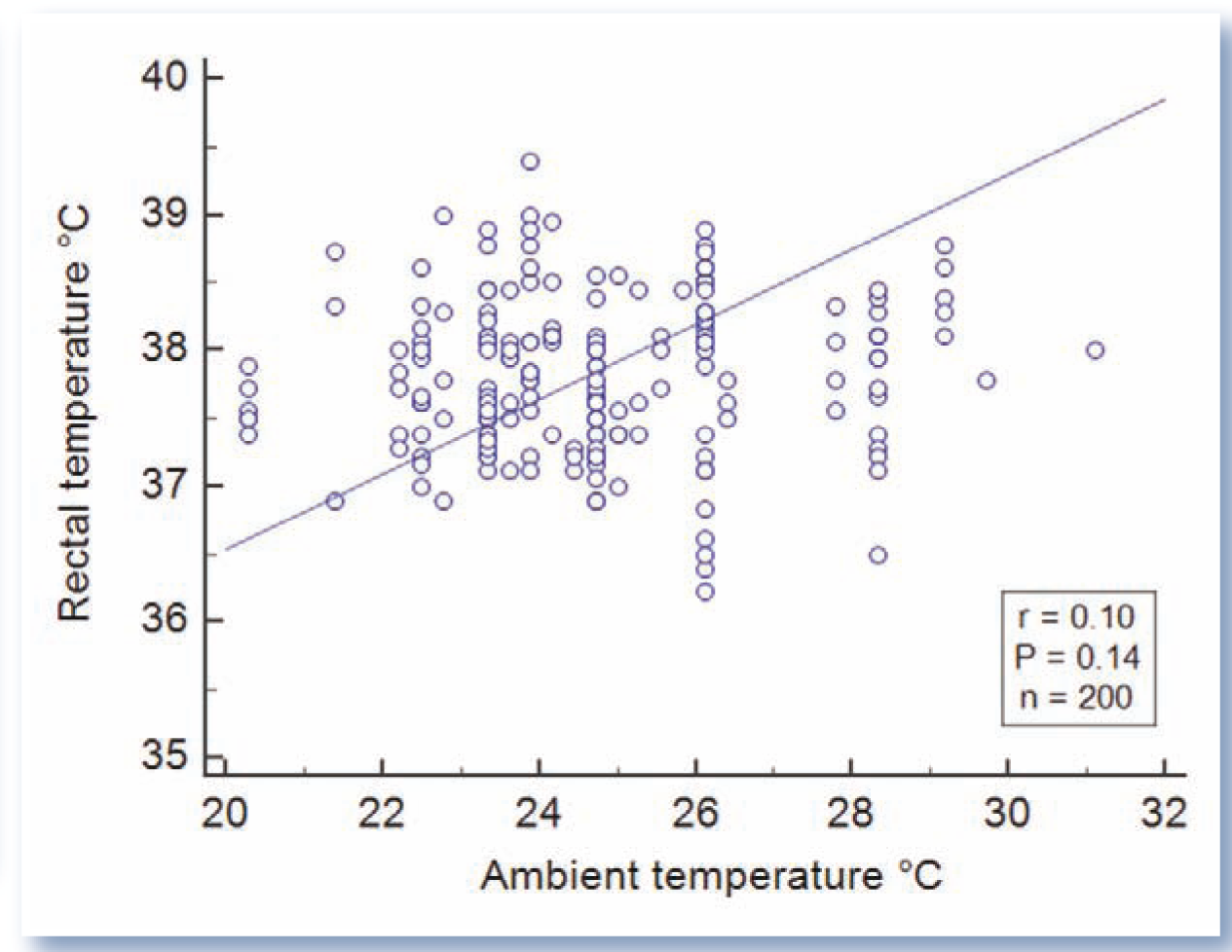
Scatter plot showing poor correlation between ambient and rectal temperatures in 200 cats housed in facilities with ambient temperatures of 20.3–30.8°C (68.5–87.5°F)
Discussion
The normal range of rectal temperature in healthy confined adult cats was found to be 36.7–38.9°C (98.1–102.1°F), which is lower than previously reported.
Given the importance of body temperature measurement in the assessment of feline health, it was surprising to find a wide range of reference intervals published and a lack of documentation regarding how the ranges were established. Veterinary textbooks and published reports variously offer normal reference intervals of: 37.8–39.2°C (100.0–102.6°F); 4 38.1–39.2ºC (100.5–102.5°F);7,8 37.8–39.2°C (100.0–102.5°F); 5 37.8–38.9°C (100.0–102.0°F); 9 38.0–38.5°C (100.4–101.6°F); 10 and 37.2–39.2°C (99.0–102.5°F). 11 Fever has been variably defined as 39.4–41.1°C (103.0–106.0°F); 1 >39.0°C (>102.5°F), 2 >39.2°C (>102.6°F); 4 39.4–40.8°C (103.0–105.5°F); 12 and 39.4–40.6°C (103.0–105.0°F). 13
In addition, some information can be gleaned from reports of body temperature in healthy cats collected for reasons other than determining reference intervals. The reported mean rectal temperature in one study of healthy adult research cats was 38.8°C (101.8°F), with a maximum rectal temperature recorded of 39.8°C (103.6°F). 14 Rectal temperatures in 4-month-old shorthair research kittens ranged from 37.4–39.3°C (99.3–102.7°F). 15
The reasons for this disparity are unclear, but could arise from differences in cat populations studied, such as age and source of cats. Previous studies may also have measured temperatures of cats outdoors or under stressful circumstances, such as following travel, unwelcome handling, or in proximity to dogs. It is also possible that at least some previous temperature ranges were extrapolated from other species, such as dogs, and did not originate from cats at all.
This study was designed to determine the normal rectal temperature range of healthy adult cats under temperature-controlled conditions in a relaxed state. Additional studies should be performed to evaluate body temperatures in healthy juvenile and geriatric cats, in cats under different environmental conditions, and during stressful circumstances, such as traveling in a vehicle followed by handling by a stranger (ie, as would be commonly encountered in a veterinary examination).
Conclusions
A range of 36.7–38.9°C (98.1–102.1°F) should be considered the new reference interval for healthy adult cats for rectal temperature measured indoors in climate-controlled conditions. This range is lower than commonly reported. Use of previously published ranges could lead to overdiagnosis of hypothermia or underdiagnosis of mild pyrexia. We elected to evaluate temperatures only in adult cats to preserve the statistical power of our sample size, so it is unknown if this range is appropriate for juvenile cats. This range was established for the most common scenario for temperature measurement in cats – sedentary cats confined indoors in veterinary clinics and animal shelters. It is possible that cats roaming outdoors, resting in the sunshine or exercising would have a different normal temperature range.
Footnotes
Acknowledgements
The authors thank Laura Adkins, Rose Worobec, Patricia Diskant and Yoonju Cho for technical assistance.
Funding
This study was supported by Maddie’s Fund, the Humane Society Veterinary Medical Association, and the Department of Small Animal Clinical Sciences at the University of Florida College of Veterinary Medicine.
Conflict of interest
The authors declared no potential conflicts of interest with respect to the research, authorship, and/or publication of this article.
Date accepted: 20 March 2015