




Abstract
The incidence of cefotaximase (CTX-M)-type extended-spectrum β-lactamase (ESBL)-producing Escherichia coli has increased dramatically in humans and animals since the middle of the last century. E coli that produce CTX-M β-lactamase represent a major cause of urinary tract infections, and pose a significant therapeutic challenge to both human and veterinary medicine. As data on uropathogenic CTX-M-producing strains in cats are limited, the aim of this study was to describe the genetic character and antibiotic resistance phenotypes of CTX-M-producing E coli isolated from cats with cystitis. Seven of 15 E coli bacteria isolated from 138 urine samples had the CTX-M gene and were therefore included in this study. These isolates were screened by polymerase chain reaction for the presence of 14 extra-intestinal virulence factors, class 1 and class 2 integrons, and to identify their phylogenetic groups. Multi-locus sequence typing (MLST) of the strains and susceptibility testing (disc diffusion method) were also performed. Virulence factor iutA was the most frequent determinant identified (86.7%), and the majority of CTX-M-producing strains (n = 5) carried class 1 integrons. MLST allowed us to discriminate four known sequence types (ST131, ST555, ST602, ST155) and three novel sequence types (ST3847, ST3848, ST4181). To the best of our knowledge, this is the first study to report uropathogenic CTX-M-producing E coli ST131 in cats in Italy. Accurate diagnostics and prudent use of antimicrobials are recommended to avoid the spread of multidrug-resistant pathogens in veterinary medicine and to prevent their transmission to humans.
Introduction
Escherichia coli is a member of the Enterobacteriaceae and commonly found in the gastrointestinal tract of mammals; however, certain strains can cause a wide spectrum of intestinal and extra-intestinal diseases in humans and animals, including cats.1–4 In particular, E coli has been identified as the most frequent pathogen in cat urinary tract infections (UTIs). 5 The strains that cause UTIs, known as uropathogenic E coli (UPEC), are characterised by specialised virulence factors, which are usually encoded on pathogenicity-associated islands (PAIs), genomic regions that may participate in the horizontal transfer of virulence genes. 6 Recently, the role of pathogenic E coli in severe extra-intestinal infections, included UTIs, has been the subject of much research attention because of its importance from a veterinary clinical perspective and its zoonotic potential.6,7 Of particular concern is the increasing presence of extended-spectrum β-lactamase (ESBL)-producing E coli; of these, the cefotaximase (CTX-M) family is the most prevalent type worldwide. 8 CTX-M-encoding genes are located commonly on transferable elements (integrons, transposons, insertion sequences) carried by plasmids that facilitate the fast spread of resistance. 9 Besides the spread through mobile genetic elements, CTX-M dissemination can also be due to epidemic clones associated with specific enzymes, such as CTX-M-15, which is responsible for nosocomial infections and contributes to the current pandemic CTX-M scenario. 10 In particular, a clone of CTX-M-15-producing E coli, named ST131, was identified recently. Thisclone belongs to a highly virulent phylogenetic group and harbours multidrug-resistant (MDR) plasmids, resulting in ST131 becoming a pathogen of significant clinical concern; indeed, a high incidence of both community-onset and hospital-acquired infections has been reported. 11 The aim of this study was to investigate the occurrence of CTX-M-producing E coli obtained from cat urine, and to characterise its genotypic and phenotypic features in order to assess the epidemiological characteristics of these strains in the study area.
Materials and methods
Sample collection and CTX-M-producing E coli identification
Between February and December 2012, urine samples were collected, by cystocentesis, from 138 cats with uncomplicated cystitis. Feline patients and/or urine samples were referred to the Teaching Hospital of the Department of Veterinary Sciences of the University of Turin. Urine samples were cultured on MacConkey agar (Oxoid) and incubated overnight at 37°C. Lactose-fermenting, indole-positive colonies were evaluated using the BBL Crystal test (Becton Dickinson), which allowed the identification of 15 E coli bacteria.
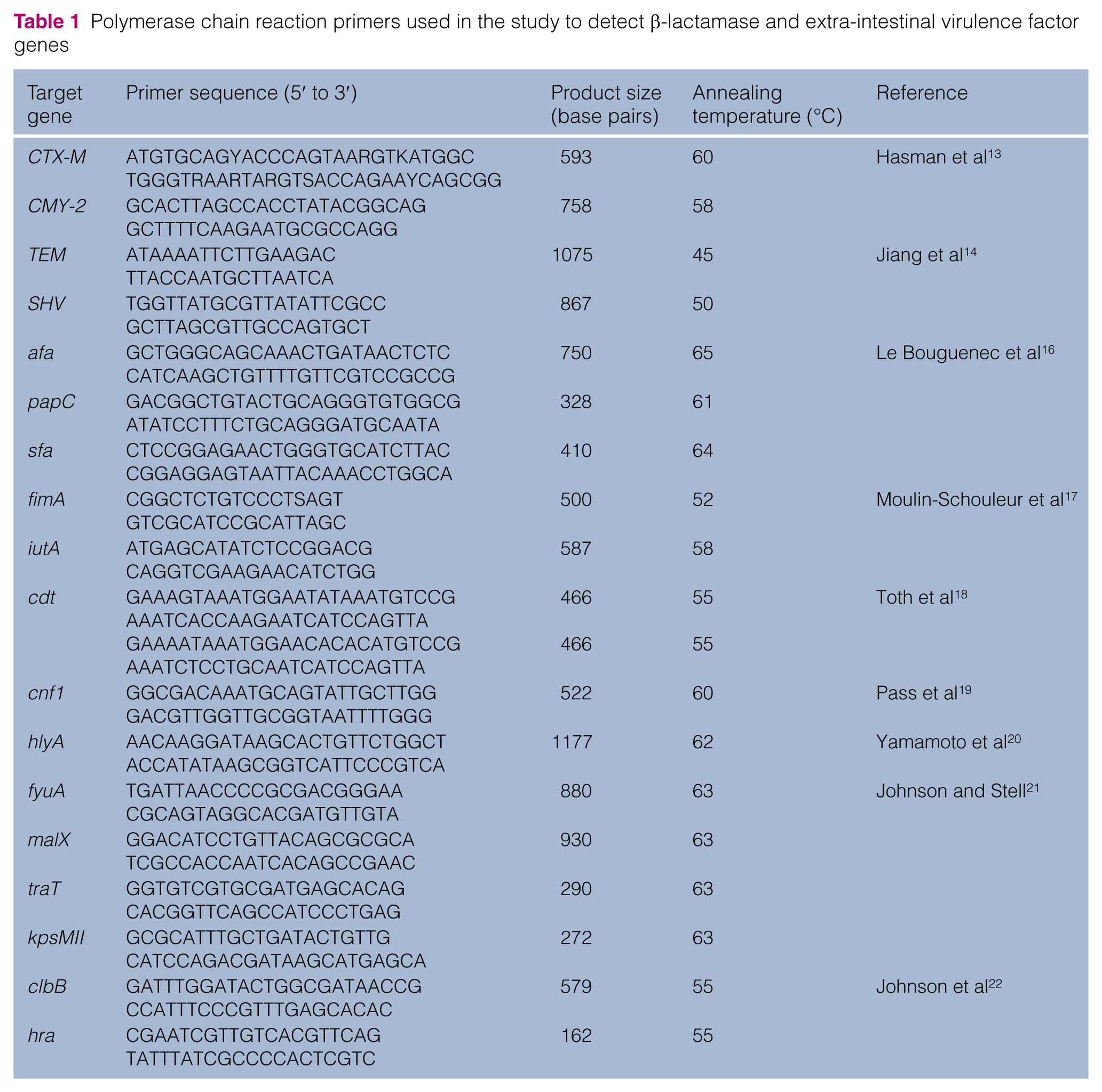
All urinary isolates were assumed to be uropathogenic, as they were associated with UTI. 12 The bacterial genomic DNA of each isolate was extracted using a commercially available kit (InstaGene DNA; BioRad), according to the manufacturer’s instructions, and tested for the CTX-M gene by polymerase chain reaction (PCR) using the primers and conditions described in Table 1. 13
Polymerase chain reaction primers used in the study to detect β-lactamase and extra-intestinal virulence factor genes
Of the 15 E coli isolates identified, seven were CTX-M-positive; these strains were stored in Luria-Bertani broth (Oxoid) containing 15% glycerol at −80°C until further use. The eight isolates confirmed not to be producers of CTX-M β-lactamases were excluded from the study.
Detection of resistance genes and integrons
All CTX-M-positive amplicons were sequenced and analysed using a BLAST search (http://blast.ncbi.nlm.nih.gov) in order to identify the type of CTX-M. The CTX-M-type ESBL-producing strains were then tested by PCR to investigate the presence of other β-lactamase genes: CMY-2, TEM and SHV (primer sequences and amplification conditions are reported in Table 1).13,14 Amplicons positive for TEM and SHV were sequenced and analysed to identify the variants.
Class 1 and class 2 integrons were detected by PCR using primers targeting the Int1 and Int2 genes, respectively. Variable regions were amplified and sequenced to identify gene cassettes. 15
Multi-locus sequence typing
Multi-locus sequence typing (MLST) was carried out; the detailed protocol, including allelic type and sequence type (ST) assignment methods, is available from the MLST Databases at the Environmental Research Institute, University College Cork (http://mlst.ucc.ie/mlst/dbs/Ecoli).
Detection of extra-intestinal virulence genes and phylogenetic group
Each E coli isolate was screened by PCR for the presence of a range of virulence factors (VFs) associated with extra-intestinal pathogenic E coli (ExPEC) (Table 1).16–22
The distribution of isolates across phylogenetic groups (A, B1, B2 and D) was determined by triplex PCR. 23
Antimicrobial susceptibility testing
Susceptibility testing was carried out by the disc diffusion method according to the European Committee on Antimicrobial Susceptibility Testing (EUCAST) criteria guidelines (http://www.EUCAST.org). The following antibiotics (Neo-sensitabs; Rosco) were used: amikacin, 30 µg; amoxicillin clavulanate, 30 µg; ceftriaxone, 30 µg; cefepime, 30 µg; chloramphenicol, 30 µg; enrofloxacin, 10 μg; gentamicin, 10 µg; imipenem, 10 µg; nalidixan, 30 µg; nitrofurantoin, 100 μg; piperacillin, 100 μg; spectinomycin, 200 µg; streptomycin, 10 µg; sulphonamide, 240 µg; tetracycline, 30 µg; and trimethoprim, 5 µg. Results of the antimicrobial susceptibility testing were interpreted according to the EUCAST guidelines on veterinary or human pathogens (the latter guidelines were used for tetracycline, nalidixan and cefepime). Strains resistant to at least three classes of antibiotics (including extended-spectrum cephalosporins, aminoglycosides, carbapenems, quinolones, sulphonamides and trimethoprim) were defined as MDR.
Results
The genetic character of the CTX-M-producing isolates detected in this study are reported in Table 2. The following variants were identified: CTX-M-14 (n = 5), CTX-M-1 (n = 1), and CTX-M-15 (n = 1). Two strains also contained TEM-1 and CMY-2 β-lactamases.
Genetic characterisation of seven Escherichia coli producing cefotaximase (CTX-M) isolated from urine samples of cats

PG = phylogenetic group; ST = sequence type; ESBL = extended-spectrum β-lactamase
New multi-locus sequence typing type
Four isolates were identified as known STs present in the MLST database: ST131, ST555 (clonal complex 538), ST602 (clonal complex 446) and ST155 (clonal complex 155). Three were novel STs (ST3847, ST3848 and ST4181) not yet assigned to a clonal complex.
VF screening revealed the presence of fimA, hlyA, cnf1, iutA and fyuA, typical virulence determinants of UPECs. The iut gene was common in 6/7 strains, and was always associated with other VFs. Moreover, the presence of some virulence genes, such as hlyA, cnf1, fimA, fyuA and malX, suggests the presence of PAIs24–26 in all E coli strains tested, except in one isolate (cat 3).
Five CTX-M-type E coli strains contained class 1 integrons; however, the gene cassettes aadA and dfrA1+aadA (conferring resistance to trimethoprim and streptomycin–spectinomycin, respectively) were found in only two isolates. All the class 1 integron-positive isolates were nalidixic acid-resistant, and one isolate contained class 2 integrons.
With regard to antibiotic susceptibility (Table 3), all strains exhibited an MDR phenotype. The CTX-M-producing isolates were resistant to several β-lactam antibiotics. Moreover, all were susceptible to imipenem and three to amoxicillin clavulanate.
Antibiotic susceptibility patterns of seven Escherichia coli producing cefotaximase isolated from urine samples of cats
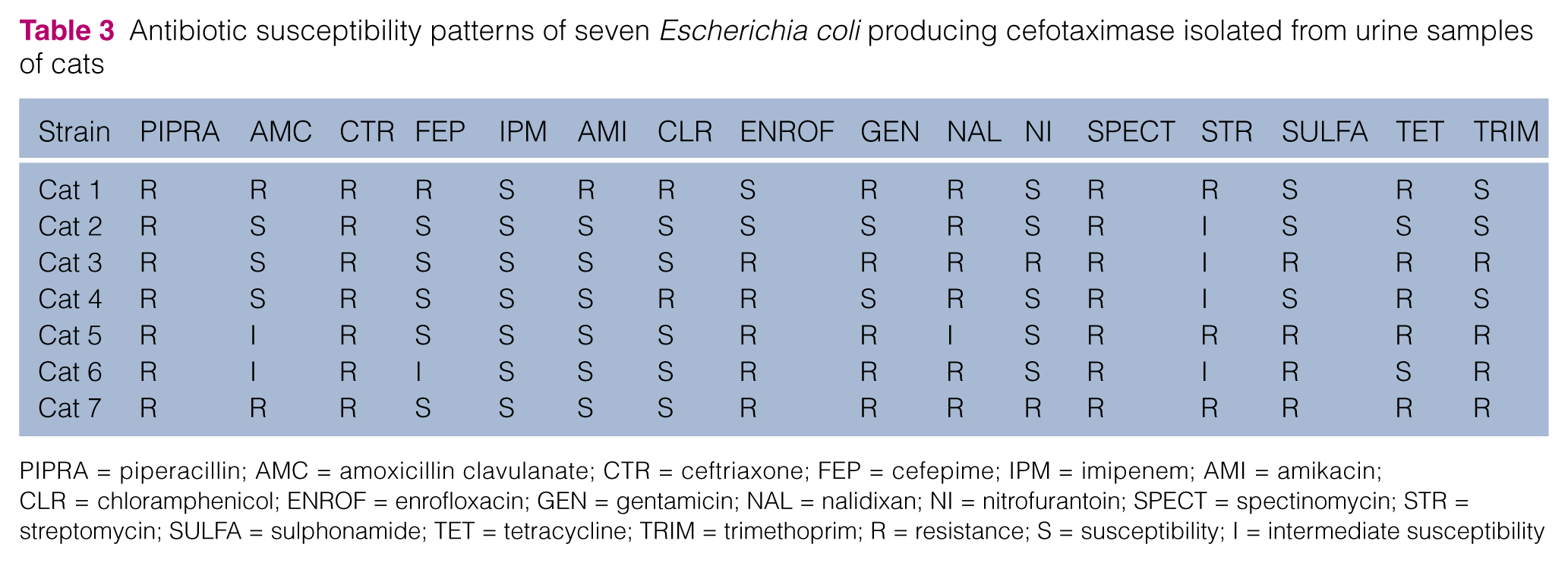
PIPRA = piperacillin; AMC = amoxicillin clavulanate; CTR = ceftriaxone; FEP = cefepime; IPM = imipenem; AMI = amikacin; CLR = chloramphenicol; ENROF = enrofloxacin; GEN = gentamicin; NAL = nalidixan; NI = nitrofurantoin; SPECT = spectinomycin; STR = streptomycin; SULFA = sulphonamide; TET = tetracycline; TRIM = trimethoprim; R = resistance; S = susceptibility; I = intermediate susceptibility
Discussion
This study shows that almost half of the E coli bacteria isolated from cats with UTI were MDR, CTX-M-producing strains. As expected, all CTX-M-positive strains possessed several VFs linked to the pathogenicity of ExPEC, including papC, sfa, fyuA and hlyA, putative contributors of urovirulence.
Besides CTX-M genes, we identified TEM-1 and CMY-2 genes in two strains. This finding confirms that ESBL-producing E coli strains may carry more than one β-lactamase gene. 27 The majority of CTX-M-producing strains had class 1 integrons, suggesting the frequent presence of these integrons in ESBL-producing strains, and that they may influence the level of antibiotic resistance. The aacA7 cassette gene (responsible for resistance to amikacin) was absent in all samples, including the amikacin-resistant isolate, suggesting the existence of other resistance mechanisms of inactivation of aminoglycosides. 28 CTX-M-14 was the most common ESBL resistance gene found. Only one strain (cat 6) contained the CTX-M-15 gene, and this strain belonged to ST131, presenting the typical characteristics of this sequence type, such as the presence of fyuA, iutA, kpsMII and malX, and allocation to the B2 phylogroup. 29
Over the last decade, the ST131 virulent pandemic clone has emerged in hospitals and in the community worldwide, causing outbreaks of MDR infections across the globe. 30 It has been frequently described as a urinary pathogen in humans, 31 and a fatal case of urosepsis associated with a multi-resistant strain of E coli ST131 was reported recently. 30 Although rarely isolated from companion animals, a recent report found E coli ST131 to distribute among human and animal household members in Australia, suggesting serious clinical and public health implications. 32 In Europe, until now, ST131 has only been isolated from dogs, horses, 33 poultry 34 and pigs 35 . Huber et al 3 identified uropathogenic CTX-M-15 E coli in dogs and cats; however, they did not find any ST131 clones in their study. Therefore, to the best of our knowledge, this is the first report of uropathogenic CTX-M-producing E coli ST131 in cats in Italy.
We also detected the presence of ST155, recently isolated in E coli carrying CTX-M-1 from Austrian cats 36 and Swedish broilers, 37 and ST602, recently identified in CTX-M-14 isolates from avian species in Italy 38 and from Swedish broilers. 37 Interestingly, the fourth ST identified (ST555) has been reported in E coli isolated from patients with asymptomatic bacteriuria. 39
In our study, a high rate of quinolone resistance was observed. This finding can be ascribed to the fact that plasmids carrying the CTX-M genes often harbour resistance genes for other antibiotic classes, such as fluoroquinolones and aminoglycosides. 40 Indeed, as expected, the ST131 strain in our study was fluoroquinolone-resistant. Three strains were susceptible to amoxicillin clavulanate. However, despite the fact that ESBL-producing strains may appear susceptible to a penicillin/β-lactamase inhibitor combination and cephalosporins in vitro, the clinical use of these drugs remains controversial and should be approached with caution.
From a clinical point of view, our results recommend the prudent use of antimicrobials in cats affected by UTIs as the emergence of resistant uropathogens is likely to negatively affect the effectiveness of empiric therapy. The antimicrobial agents most commonly used to treat feline uncomplicated UTIs include β-lactams, fluoroquinolones and the drug combination trimethoprim plus sulfamethoxazole. However, according to our results, these drugs should not be used as first-line drug therapy unless susceptibility testing is performed. Moreover, owing to the risk of blindness, the clinical use of fluoroquinolones for feline UTIs should be limited. 41 The administration of last-line antimicrobials from human medicine for veterinary purposes should also be discouraged or avoided despite the demonstrated efficacy of imipenem in the treatment of antimicrobial resistant infections in cats.42,43 In contrast, although the use of nitrofurantoin in cats presents some disadvantages, such as high toxicity and poor pharmacokinetic characteristics, this drug should be considered as a therapeutic option for urinary infections caused by ESBL-producing E coli. 44 However, as nitrofurantoin is not licensed for animal use in Italy, the rationale for its off-label administration could be justified on the basis of its benefit/risk ratio. This should be complemented with a pharmacovigilance report concerning the lack of efficacy of first-line authorised antimicrobials. Feline lower urinary tract diseases are seldom caused by bacteria, but more often by obstructive idiopathic cystitis, urethral plugs or urinary calculi.5,45 Nevertheless, in many instances these conditions are treated with antimicrobials, thus promoting the selection of resistant strains. It is therefore recommended that the necessary diagnostics are performed before starting antimicrobial therapy for feline UTIs. At the very least, initial antimicrobial selection should be based on urine sediment examination to identify the presence of bacteria and on urine pH. 41
Conclusions
This study is the first to report the presence of the uropathogenic E coli ST131 isolate producing CTX-M-15 in cats in Italy. Considering that pets and owners share extra-intestinal E coli, basic hygiene measures and infection control strategies should be implemented, especially in veterinary clinics and teaching hospitals, in order to prevent the spread of this microorganism. Finally, the prudent use of antimicrobials and accurate diagnostic procedures should be emphasised to avoid the further spread of MDR pathogens in veterinary medicine.
Footnotes
Conflict of interest
The authors do not have any potential conflicts of interest to declare.
Funding
This research received no specific grant from any funding agency in the public, commercial, or not-for-profit sectors.