




Abstract
Cats more than 2 months of age have alloantibodies against the blood type antigen that they do not possess. Maternal antibodies, including alloantibodies against blood groups, are transferred to the kittens’ systemic circulation when they suckle colostrum during the first 12–16 h after birth. If kittens with blood group A or AB nurse from a mother with blood group B they may develop neonatal isoerythrolysis (NI). Breeders can prevent kittens at risk of NI from nursing during the first 16–24 h; after this period it is safe to let them nurse. Kittens depend, however, on the passive transfer of antibodies from the colostrum for early protection against infections. Although it is known that kittens deprived of colostrum will also be deprived of passive systemic immunity, it is not known if this will affect their health. Therefore, the aim of this study was to evaluate kitten mortality in litters with B-mothers and A-fathers compared to litters with A-mothers. In addition, the aim was to evaluate the effects of colostrum deprivation on the health of the mothers, and the breeders’ opinions and experiences of these combinations of breedings. A web-based questionnaire was constructed and distributed to breeders. The results indicate that there is no difference in mortality between planned litters that have mothers with blood group A and litters with mothers that have blood group B and fathers that have blood group A. When managing blood group incompatibility in cat all factors affecting the health of the cats, including genetic variation, should be considered.
Introduction
The most significant blood group system in the domestic cat contains three blood groups: A, B and AB. Neonatal isoerythrolysis (NI) occurs in litters where kittens with blood group A are born to a mother with blood group B. Cats more than 2 months of age have alloantibodies against the blood type antigen that they do not possess. Cats with blood group B have higher titres and alloantibodies with higher affinity against the foreign blood group than cats with blood group A. 1 These antibodies are transferred to the kittens’ systemic circulation when they ingest colostrum during the first few hours after birth. 2 Intestinal absorption of antibodies does not seem to occur beyond 16 h after birth. 3
If kittens with blood group A or AB absorb antibodies against their erythrocytes they may develop NI. Typical clinical signs are pigmenturia, sudden death, failure to thrive, anaemia and icterus. The mortality rate is high and the prognosis poor once clinical signs have developed. Some kittens that are less severely affected may develop tail tip necrosis as the only clinical sign. 4 There are no reports of NI in kittens with blood group B born from mothers with blood group A. Not all kittens with blood group A or AB born by mothers with blood group B will, however, be affected. 5 The titres of alloantibodies against blood type A can vary in queens with blood group B, and there may be differences between kittens in the volume of colostrum ingested. 2
Kittens are born with only small or undetectable amounts of immunoglobulins (Igs) in their sera and depend on passive transfer of antibodies from the colostrum for early protection against infections. 6 The amount of immunoglobulins is higher in colostrum than in milk in later phases of lactation. 6 The concentration of maternally-derived antibodies in the kittens’ sera decreases with time, and is lowest around 3–5 weeks of age. Thereafter, there is an increase caused by the kittens’ own immunoglobulin production.2,6 Serum IgG concentrations are significantly lower for the first 4 weeks after birth in kittens deprived of colostrum than in kittens that have ingested colostrum at birth. 6 The maternal immunity, however, interferes with the kitten’s own production of immunoglobulins. Thus, at 7–8 weeks the serum IgG concentration is higher in kittens fed a milk replacer than in kittens that have ingested colostrum. 6
Blood group A is the most frequent blood group, while AB is rare. 5 The frequency of blood group B is low (0–5%) in most populations of cats, but varies geographically and between breeds. In the Abyssinian, the Birman, the British Shorthair, the Devon Rex, the Somali, the Turkish Angora and the Turkish Van breeds, for example, it has been reported to be higher, with as much as 58.5% of cats with blood group B in 85 British Shorthair cats. 7
The A allele in the feline blood group system is dominant over the B allele. A cat with blood group B is thus always homozygous for the B allele, while cats with blood group A can be carriers of the B allele. 5 The rare AB blood type might be dominant over B and recessive to A. 8 Kittens that develop NI are born by B-mothers and have A-fathers (or AB), and are thus always heterozygous for the blood group alleles. Neonatal isoerythrolysis can be prevented by avoiding risky combinations. This may, however, be impractical if the frequency of blood group B is high in the breed and would probably have negative effects on the genetic variation in small breeds. Another alternative that is often practised is to prevent kittens from nursing during the first 16–24 h. After this period it is safe to let them nurse on their mother. Passive immunity can be acquired by letting the kittens nurse from a queen with blood group A in the colostrum phase of lactation or by giving serum subcutaneously. 9 This is, however, not always practical or possible, which is why these kittens are often deprived of passive systemic immunity.
Although it is known that kittens deprived of colostrum will also be deprived of passive systemic immunity, it is not known if this will affect their health. Theoretically, they would be expected to be more sensitive to infectious diseases. If colostrum deprivation has negative effects on the health of kittens this should result in higher kitten mortality during this period of the kittens’ life. Other negative effects of colostrum deprivation might be a higher tendency for the mother to develop problems with mastitis or galactostasis as the kittens will not nurse for the first 16–24 h. The risks for kittens and/or queens in planned risk combinations regarding feline blood groups have not been evaluated.
The aim of the study was to compare the most common non-risk situation (ie, mother with blood group A irrespective of the father’s blood group) with a planned-risk situation (ie, mothers with blood group B combined with fathers with blood group A).
Therefore, kitten mortality in litters with B-mothers and A-fathers was compared to litters with A-mothers. In addition, the aim was to evaluate the effects of the lack of early suckling on the health of the mothers, and the breeders’ opinions about, and experience of, these combinations.
Materials and methods
A web-based questionnaire was constructed and links distributed to breeders through breed clubs and internet forums for cat breeders. Information about the questionnaire was mostly targeted at breeders most likely to be affected by the need to plan breeding based on blood groups because of a high proportion of blood group B in the breed. The questionnaire was divided into the following sections: (1) background data; (2) litters after parents with different blood groups; (3) management of litters after risk combinations; and (4) opinions and reasons for choices made by the breeder regarding breeding from cats with different blood groups. The questionnaire consisted of questions with predetermined alternatives for the breeder to choose between and questions where the breeder should fill in a figure. After all questions the breeder could make a comment or write an alternative not included in the predetermined alternatives. All questions in sections 2 and 3 of the questionnaire referred to the last 10 years. Replies were received between 8 April and 12 June 2012.
Statistics
Kitten mortality (the difference between born and weaned kittens) was treated as binomial data, and comparisons between total kitten mortality in litters with B-mothers and A-fathers and in litters with A-mothers and between different breeds were made with a χ2 test. In comparisons between breeds, the Devon Rex and the Cornish Rex breeds were combined to increase sample size and therefore the power of the statistical tests. Litter sizes were treated as continuous variables on a per breeder basis (ie, the number of kittens divided by the number of litters for each breeder). After evaluation of normal distribution, comparisons between litter sizes in different breeds were made with the non-parametric Mann–Whitney test with Bonferonni’s correction of P values for multiple tests. P <0.05 was considered significant.
Results
A total of 141 answers was received. Not all answers were, however, complete, which is why some questionnaires had to be removed from different evaluations.
Background data
Most breeders had Birman (n = 35), British Shorthair (n = 34), Cornish Rex (n = 26) or Devon Rex (n = 23) breed cats. Other breeds included in the predetermined alternatives were Abyssinian (n = 1), Ragdoll (n = 3) and Sphynx (n = 5). Fourteen breeders had other breeds not included in the predetermined alternatives.
Most breeders were from Sweden (80.9%), but there were also breeders from Finland (9.9%), Denmark (2.8%) and Norway (6.5%). The median number of intact female cats in the catteries was 3.0 (range 0–11) and the median number of intact male cats 1.0 (range 0–5). The breeders had bred from a median of 2.0 (range 0–23) females with blood group A, 1.0 (range 0–6) females with blood group B and a range of 0–8 (median 0, sum 62) females with unknown blood group at the time of breeding.
Litters after different combinations
Of all questionnaires, 30 were removed from calculations on kitten mortality and litter sizes because of incomplete information, making it impossible to perform the calculations, or unlikely data, such as more kittens were weaned than born, or unlikely litter sizes (eg, two litters with 10 kittens each in the Birman).
Most litters were born from mothers with blood group A and the fewest kittens were born from combinations where both parents had blood group B (Table 1). Data from kittens born from two parents with blood group B were not analysed further as the only question about this combination was how many litters that had been born in the cattery.
Frequency of litters born from parents with different blood groups in this study

No significant differences could be detected in mortality between litters with B-mothers and A-fathers and litters with A-mothers (Table 2). The proportion of total kitten mortality in all breeds with both blood groups of the mothers combined was 7.7% (confidence interval 6.8–8.8%).
Total number of kittens alive at weaning, and number of kittens that died between birth and weaning (= the difference between born and weaned kittens) in litters born from a mother with blood group B and a father with blood group A, and in litters with a mother with blood group A (irrespective of the father’s blood group)

Mean litter size and effect of breed on kitten mortality
As there was no effect of blood group, further calculations about litter sizes and comparisons of kitten mortality between breeds were made with the different blood types combined.
The three numerically largest breeds in the study were compared. Mean litter size was significantly smaller in the Birman than in the British Shorthair and Rex breeds, and the frequency of kitten mortality varied significantly with breed, with the lowest mortality in the British Shorthair breed (Tables 3 and 4). Three breeders reported a total kitten mortality of 100% in litters. All these litters (seven litters, 21 kittens) were from mothers with blood group A. However, one of these three breeders also reported, in the comments section, a surviving litter of six kittens from a Birman mother with unknown blood group at the time of breeding, but data from mothers with unknown blood group were not analysed further and therefore not included in the statistics on kitten mortality.
Median litter size (interquartile range, Q1–Q3) at birth and at weaning in three breeds calculated on a per breeder basis (ie, number of kittens born divided by the number of litters reported by each breeder; information was retrieved per breeder not per litter)
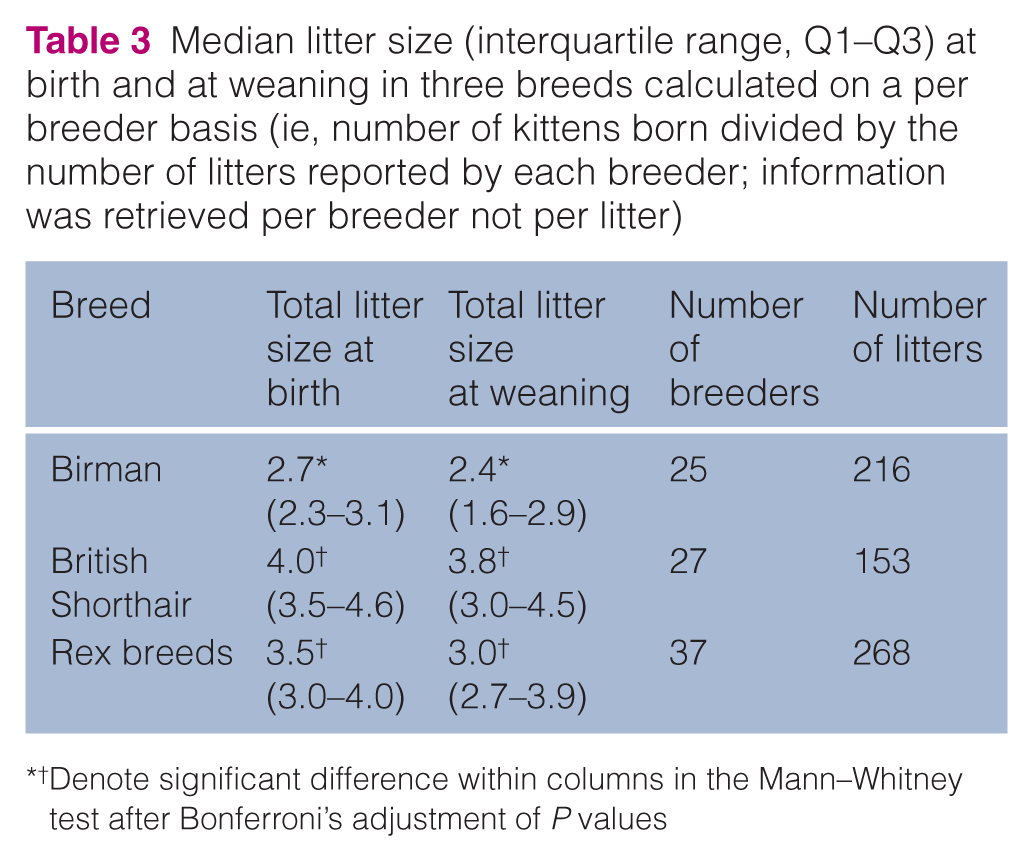
Denote significant difference within columns in the Mann–Whitney test after Bonferroni’s adjustment of P values
Frequency of total kitten mortality in each breed (P = 0.001)
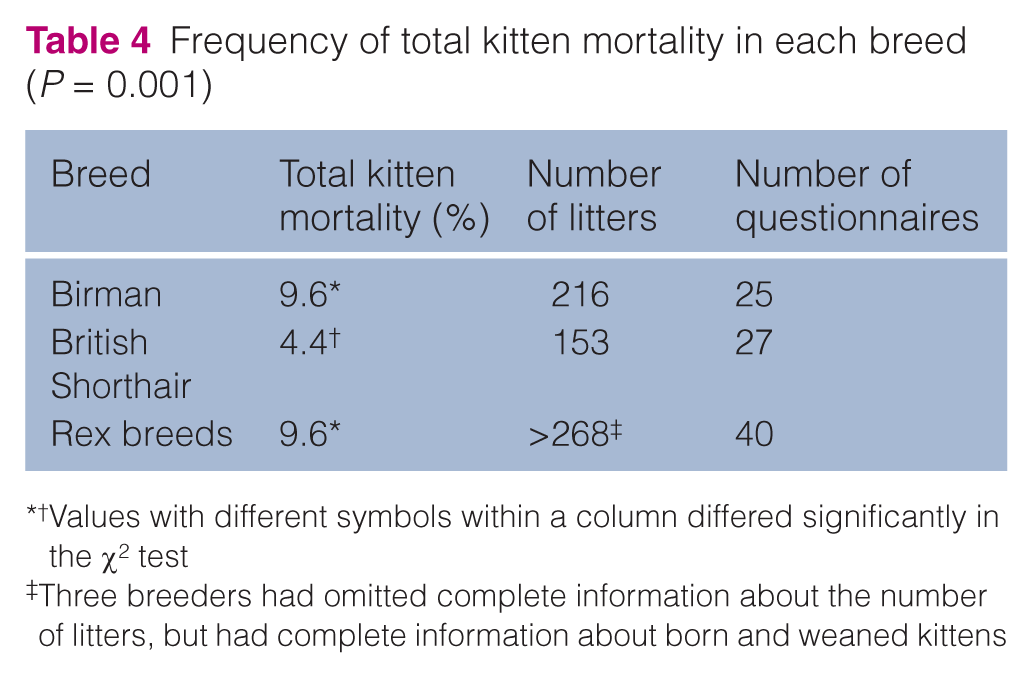
Values with different symbols within a column differed significantly in the χ2 test
Three breeders had omitted complete information about the number of litters, but had complete information about born and weaned kittens
Ingestion of colostrum in risk combinations
Eleven breeders reported that kittens had been able to crawl under the body stocking. Two of these questionnaires were among those that were removed: one because of incomplete information and one because of an incongruous reply (more kittens weaned than born). Three of the remaining breeders commented that the kittens had not been harmed, while the others did not give a specific comment on the effect on the kittens. Two of the breeders who had not commented on the effect on the kittens, however, weaned the same number of kittens that were born, implying that the kittens had not been seriously harmed. The overall kitten mortality in litters with a mother with blood group B in the group of breeders that had experienced that the kittens had sucked was thus not higher than reported for kittens with blood group A in this study.
Management of at-risk litters and effects on lactation
The majority of the breeders (85.4% of 96 breeders who replied) fed the kittens from risky combinations with a milk replacer during the first few hours of their lives. One breeder let the kittens nurse from a female with blood group A, and nine breeders replied that they used this alternative if a foster mother with blood group A was available; otherwise, the kittens were fed a milk replacer. The time breeders prevented kittens from risky combinations from nursing varied between 0 and 36 h (Figure 1).

Frequency of breeders (%) who prevented kittens in at-risk combinations from nursing for different time periods
The question on how kittens were inhibited from nursing was answered by 95 breeders. The majority (77.9%) put a body stocking on the queen. Six breeders kept the kittens away from the mother and other cats. Five breeders replied that they put tape over the nipples. Nine breeders did not stop kittens from nursing their B-mother. Two of these breeders replied that they let kittens nurse mothers with low antibody titres, and in at least two cases the reason was that the breeder had not known that the mother had blood group B at the time of breeding.
Twelve (13.6%) of 88 breeders who replied to the question of whether they had experienced disturbed milk production after colostrum deprivation answered in the affirmative. According to the comments, they observed that it took a longer time for milk production to start. Three of these females had, according to the comments, developed galactostasis. Five of 88 breeders had commented that they milked or massaged the mammary glands to avoid problems. One breeder who had replied ‘no’ to this question commented that they had experienced galactostasis in a female after a B–B combination, probably as the result of a small litter of only one kitten.
Eight (8.8%) of 91 breeders replied that they had experienced that it could be more difficult for kittens to start nursing when they were finally allowed to do so, but the majority did not experience such problems.
Opinions and breeders’ choices
Disposition for infectious diseases
Three of 90 (3.3%) breeders had experienced that kittens that had not been allowed to nurse their mother had a higher disposition for infectious diseases. The majority, however, did not share this experience.
Choice of breeding animals depending on blood group
Fifty-one of 111 breeders replied that they primarily tried to breed B-females with B-males. However, from the comments, the general opinion seemed to be that other qualities in the male were more important than the blood group and that the number of B-males was limited. Twenty-four of 114 breeders tried to avoid using B-males for their A-females to minimise the risk that the resulting offspring would be of blood group B.
Discussion
The results of this questionnaire study indicate that there is no difference in mortality between planned litters that have mothers with blood group A and litters with mothers that have blood group B and fathers that have blood group A. As planned risky combinations regarding blood groups are usually managed by colostrum deprivation during the first few hours of birth to avoid NI, this study also implies that there is no dramatic effect of colostrum deprivation on the health of kittens under the conditions in these private catteries.
We did not ask about the number of kittens that had developed infectious diseases as this parameter would be more difficult to evaluate objectively than the number of born and weaned kittens. It is difficult for a breeder, or even a veterinarian, to be certain about the aetiology of clinical signs in small kittens. Different conditions can give similar clinical signs in neonatal kittens. If colostrum deprivation has an important effect on the health of neonatal kittens it is likely that this would result in higher kitten mortality, and a difference in kitten mortality between the groups would most likely have been caused by the combination of a B-mother and an A-father, irrespective of whether or not the cause would have been suckling and uptake of anti-A antibodies, infections caused by colostrum deprivation or aspiration caused by hand-feeding. We could not, however, detect any differences in kitten mortality depending on the blood groups of the parents. In addition, only a small minority of breeders replied that they experienced a higher predisposition for infectious diseases after colostrum deprivation. It is difficult to know if these experienced problems were, indeed, caused by colostrum deprivation or a coincidence as the number of breeders experiencing this was low.
The questionnaire was preceded by an announcement from the Swedish Board of Agriculture that breeding a female cat with blood group B with a male cat with blood group A is not acceptable according to animal welfare law (Swedish Board of Agriculture Dnr 31-14083/11). This probably increased breeders’ motivation to participate, but might also, to some extent, have biased the answers. This issue also emphasised, however, the need to collect more scientific information about the risks of this type of breeding, as documentation about the welfare of mothers and kittens in these planned combinations is extremely scarce.
The fact that some breeders confessed that they had experienced that the queens may have disturbed milk production and that some kittens may succeed in suckling despite body stockings indicates that breeders were also willing to share the negative experiences.
A majority of the breeders (63/108) reported that all kittens that were born survived. This is consistent with the results of Ström Holst and Frössling, 10 who reported that there was no kitten mortality in most of the litters. The total kitten mortality in this study was lower than reported in most other studies, but within the confidence interval reported by Festing and Bleby 11 in specific pathogen-free (SPF) cats and higher than reported by Addie and Toth 12 for SPF cats. 13 The kitten mortality in different breeds is not consistent between previous studies except that Persian/exotics are often among the breeds with the highest mortality.10–13 Persian/exotics were not included in our study, which may have contributed to a low total mortality for all breeds combined. Another contributing factor for comparably low kitten mortality in this study could be that the breeders who participated were aware of problems with blood group incompatibility and usually knew the blood group of the female. Losses because of unexpected isoerythrolysis were therefore probably low. In this study, the total mortality for British Shorthair kittens was significantly lower than for the Birman and Rex breeds. This difference has not, however, been seen in other studies. The mortality for British Shorthair in our study was lower than previously reported for this breed, while kitten mortality for the Birman was higher than reported by Sparkes et al, 13 but lower than reported by Ström Holst and Frössling. 10 Therefore, the comparison of kitten mortality between breeds should be interpreted with caution. In agreement with previous studies, the Birman had a low litter size.10,13 The Birman had a significantly lower litter size than the Rex breeds and the British Shorthair in this study.
The data indicate that preventing kittens from suckling during the first few hours after birth may, in some cases, cause a slower start of milk production and even galactostasis in a few queens. Although the effects on lactation were not compared with other kinds of litters, it is likely that at least some of these cases of a slower start of milk production and/or galatcostasis might be a direct effect of preventing the kittens from suckling. The majority of the breeders had, however, not experienced problems with lactation in these litters, and one breeder shared an experience of galoctostasis in a B–B mating where the only kitten born was allowed to nurse, demonstrating that galactostasis may also occur in litters where kittens are allowed to nurse from birth. Several breeders replied that they massaged or milked the mammary glands to prevent problems. This seems to be a good routine in cases where kittens are not allowed to nurse because of blood group incompatibility or for other reasons.
A time period of 10 years was arbitrarily chosen to increase the possibility of having enough litters for statistical evaluation, and to have a period of time over which it was reasonable to believe that the owners would have remembered, or have documentation of, their observations. It cannot be excluded that errors could have been made by breeders due to lapse in memory of events that occurred several years ago. Some breeders expressed, however, that they would have wanted a longer period of time to include more of their kittens (personal communication not included in questionnaires).
Although there will always be weaknesses and uncertainties in questionnaire-based studies, this was the only practical method to collecting large quantities of these types of data from the field. As the aim of this study was to evaluate how planned breedings with blood group incompatibility affects the health of kittens and queens in catteries a more controlled study would not have been possible with the same number of kittens and litters included. Conditions under controlled experiments with laboratory animals will differ from the situation when kittens are born in different catteries managed by breeders.
There may be several explanations as to why the kittens in risky combinations that had crawled under the body stocking in this study survived, despite suckling from their mother. Kittens born in risky combinations may have blood group B if the father is a carrier of this recessive allele and may therefore suckle from the mother without risk. If kittens with blood group A suckle after the first 16 h they are also likely to be unharmed as there is no uptake of antibodies to the systemic circulation after this time. 3 One breeder that had experienced kittens crawling under the body stocking commented that this was probably after the critical time. In addition, some female cats with blood group B have very low titres of antibodies against blood group A, and the uptake of antibodies differs between kittens. 2 There is, nevertheless, an obvious risk that such kittens may suffer NI, emphasising the need for close surveillance until the kittens can be allowed to nurse without risk.
In order to manage blood group incompatibility, all the different alternatives must be considered and compared. As the frequency of blood group B differs between different populations the optimal management of blood group incompatibility is likely to differ between different populations of cats. In breeds with a low frequency of blood group B it might be beneficial to avoid breeding from cats with blood group B completely. The interest in testing for blood group before breeding in these breeds is, however, usually low as the breeders do not consider blood groups to be a problem and the risk of NI is very low in these breeds, even without testing. Completely avoiding risky combinations or selection against blood group B is an alternative that is very likely to decrease genetic variation in breeds in which blood type B is common, which, in turn, is likely to cause worse health problems than breeding blood type B queens to blood type A males. Regarding blood group B as something undesirable might lead to a focus on blood groups instead of other tests and selection criteria.
Conclusions
According to the data in this study, planned combinations of females with blood group B and males with blood group A and colostrum deprivation do not seem to have dramatic effects on the health of the kittens, although a possible negative effect on lactation and the mammary glands of the queens must be considered. In a large majority of cases the breeders had not, however, experienced any negative effects on cats’ health caused by breeding females with blood group B to males with blood group A.
Supplemental Material
Supplemental Material
Questionnaire (translated from Swedish)
Footnotes
Acknowledgements
I would like to thank Anneli Pääkkö for highlighting the potential problem with restriction on breeding of different blood groups in relation to breeding pools in pedigree cats and for disseminating the questionnaire to cat breeders. I would also like to thank Professor Jane Morrell for language correction.
Supplementary material
Questionnaire (translated from Swedish).
Conflict of interest
The author does not have any potential conflicts of interest to declare.
Funding
This research received no specific grant from any funding agency in the public, commercial or not-for profit sectors.
References
Supplementary Material
Please find the following supplemental material available below.
For Open Access articles published under a Creative Commons License, all supplemental material carries the same license as the article it is associated with.
For non-Open Access articles published, all supplemental material carries a non-exclusive license, and permission requests for re-use of supplemental material or any part of supplemental material shall be sent directly to the copyright owner as specified in the copyright notice associated with the article.
