




Abstract
The purpose of this report is to describe (1) the training of domestic cats in ejaculation into an artificial vagina (AV), (2) alkaline phosphatase (AP) concentrations in whole ejaculates, and (3) the in vitro effect of a skimmed-milk plus egg yolk (SM-Y) extender on feline spermatozoa incubated at 4ºC. Five post-pubertal cats were trained to ejaculate into an AV three times a week for 20 mins in the presence of a teaser queen. Fifty AV-obtained ejaculates were macro- and microscopically assessed, and the AP therein measured by optimized colorimetry. Eighty AV-obtained ejaculates were pooled, diluted in SM-Y extender [80% (v/v) skimmed milk, 20% (v/v) egg yolk, and antibiotics], stored at 4°C and evaluated daily for 6 days. All the animals could be trained to ejaculate, although the interval up to the first AV ejaculation varied from 1.5 to 5.5 months (mean 3.9 months). The final performance at collection ranged from excellent to poor and was inversely related to the training period required in all cases. The mean AP concentration in whole ejaculates was 20,645.6 ± 4405U/l, which was not correlated with the concentration of spermatozoa. Most seminal parameters [(%); total (77 ± 2.3) and progressive (62.7 ± 3.4) motility, live sperm (91.8 ± 1.2), intact plasmalemma (83.5 ± 2.6), normal acrosomes (83.5 ± 2.6), pH (6.6 ± 0.0) and osmolarity (mOsm/l; 321 ± 5.2)], though decreasing during storage in the cold, remained within values compatible with in vivo fertilization for 2 days.
Introduction
As the domestic cat (Felis catus) is one of the most popular pets worldwide, simple and economically affordable assisted-reproduction technologies become necessary for routine feline veterinary practice. Nevertheless, certain essential aspects of male reproduction have not yet been described in this species.
Because few domestic cats are thought to be trainable in mounting and ejaculating into an artificial vagina (AV), electroejaculation (EE) has been routinely used to collect semen in intact cats. That EE of anesthetized cats causes acute stress as has been demonstrated by an elevation in serum cortisol concentrations immediately after the procedure. 1 Furthermore, certain anesthetics can affect the sperm quality, 2 and EE-obtained seminal samples have lower sperm counts and sperm motility than those collected by paraphysiologic methods, for example, AV ejaculation.3,4 In view of the implications with respect to feline welfare, non-invasive alternatives to EE should be better explored in such a popular domestic animal. Nevertheless, the success rate of AV ejaculation training has not yet been reported in companion cats.
Alkaline phosphatase (AP) – an enzyme that catalyzes the transport of phosphate groups and that is present in the spermatozoa involved in the fertilization process – has been found in seminal plasma from numerous species.5,6 In cats, as in dogs, as AP originates from the epididymis and testicle, 7 the enzyme’s activity could be used as a marker for tubular patency within the ductal network, as well as an indirect indicator of germ-cell function. Information on seminal AP activity in cats is limited, however, as the concentrations have not been measured in whole ejaculates.
Semen can be diluted in extenders, cooled and maintained at 4°C for several days. Extenders protect the spermatozoa, promoting the conservation of motility and fertility over time by stabilizing the plasmalemma, providing energy substrates, and preventing the deleterious effects of progressive changes in pH and osmolarity. 8 Seminal storage in the cold can both replace the transport of breeding animals and facilitate dispersion of varied and superior genetic specimens within the felids. In this regard, most of the published preservation studies involve either epididymal9–11 or EE-ejaculated11–13 semen. Therefore, low-cost, practical and efficient cold-storage diluents that could be used in clinical settings should be tested on AV-ejaculated cat semen.
Milk is a commonly used component of semen extenders in most species, having exhibited good performance both in vitro and in vivo.14,15 Skimmed-milk proteins buffer the seminal pH and may also chelate any heavy metals.14–16 The addition of egg yolk to skimmed-milk extenders further improves the viability of spermatozoa during cold storage, 14 as the yolk phospholipids provide protection to sperm and acrosomal membranes against cold shock. 17
With the aim of contributing to feline welfare and reproduction, the objectives of this study were to describe (1) domestic cat training in ejaculation into an AV; (2) the AP concentrations in whole ejaculates obtained by an AV; and (3) the in vitro effect of a skimmed-milk with egg yolk (SM-Y) extender on feline spermatozoa incubated at 4ºC.
Materials and methods
Animals
In the first experiment, five post-pubertal 5- to 11-month-old mixed-breed male cats were incorporated into our institutional cat colony at the School of Veterinary Medicine, National University of La Plata, Argentina; housed in individual cages (0.80 × 0.80 × 1.0 m); exposed to a 10 h dark, 14 h light photoperiod; fed commercial cat food; and given water ad libitum.
For the second and third experiments, four fertile mixed-breed male cats, born in our cat colony and aged 1–4 years were maintained as in the first experiment. The males were trained to ejaculate into an AV as described below. These studies were approved by the Faculty Institutional Care and Animal Use Committee.
Experiment 1
The cats were trained to ejaculate into an AV 16 in response to manual manipulation of the genitals 3 three times a week for 20 mins in the presence of a teaser queen until the first ejaculation was obtained. Docile queens in our colony, which were in anestrus, interestrus or estrus, were used for this purpose. The AV was made from a 2 ml rubber pipette bulb and a small test tube (Figure 1) as previously described. 16 The AV was slipped over the erect penis as the cat mounted the queen (Figure 2).
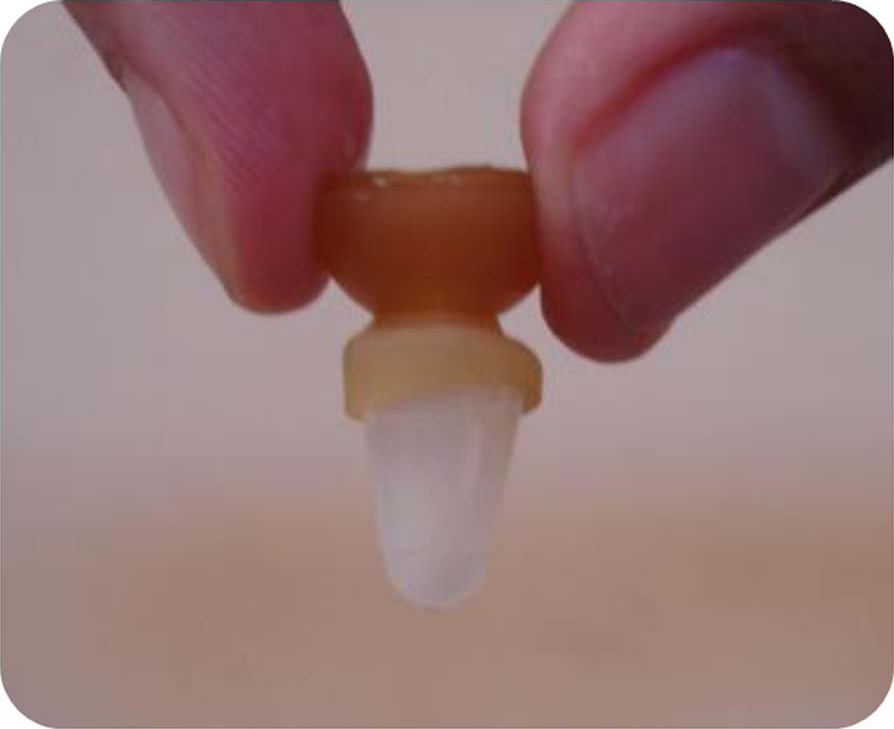
Feline artificial vagina with a semen sample

Erect cat penis from which semen has been recently collected by an artificial vagina
Experiment 2
Semen samples were collected twice a week repeating the procedure two times with the same AV as described in the first experiment. Fifty ejaculates were macro- and microscopically assessed to assure the inclusion of normal specimens.
Color was recorded and the volume measured with a variable micropipette. A drop of semen was placed on a warmed glass slide and the percentage of sperm with total and forward progressive motility subjectively assessed by light microscopy at a magnification of 200×. Vigor was estimated according to an established scale from 0 (absence of movement) to 5 (vigorous movement). The number of sperm was counted by an improved Neubauer hemacytometer chamber. The presence of morphologically normal sperm and sperm with head, midpiece and tail abnormalities were determined by smearing a drop of semen on a glass slide, leaving the slide to dry, staining with Giemsa and examining more than 100 sperm under bright-field microscopy at 1000×. The percentages of live and dead spermatozoa were determined by staining a smear with eosin–nigrosin and examination for eosin uptake at 1000×. Membrane integrity was assessed by the hypo-osmotic swelling (HOS) test 18 and acrosome integrity after Pope et al. 19 The pH was measured with a pH meter (pH-009; ATC) and the osmolality by an osmometer (model 5520; Wescor).
AP was assayed in duplicate in an autoanalyzer (Metrolab plus 1600) by an optimized colorimetric method (Cod 1361003; Weiner) after dilution of sperm suspensions with physiologic saline (approximately 1:100).
Experiment 3
Eighty ejaculates were collected, as described above, three times a week. Semen specimens that showed a sperm motility of 80% and normal morphology of ≥70% were used (day –1). Samples were pilution, 1:3–1:6 with concentrations of 75–100 × 106 sperm/ml) in a SM-Y extender containing 80% (v/v) skimmed milk (0% fat, ultra high temperature; Ilolay), 20% (v/v) egg yolk and antibiotics (1 mg/ml benzylpenicillin 1 mg/ml dihydrostreptomycin sulfate). The tube was placed at 4°C during the study period in a glass container filled with water to prevent both cold shock and temperature variations during the chilling down and cold storage. Samples were analyzed daily for total and progressive motility, the percentage of live versus dead spermatozoa, normal acrosomes, membrane integrity (HOS), osmolarity and pH, as described for the second experiment.
Statistical analysis
In the first experiment, the proportion of trained cats, the interval to the first AV ejaculation and the final resulting performance (defined as libido at semen collection: excellent, good or poor) were recorded and statistically described. Semen parameters were calculated in the second experiment and the correlation between the AP activities and the spermatozoa concentrations analyzed by the Spearman test. In the third experiment, the time course of semen parameters throughout the experiment was analyzed by the repeated-measures analysis of variance. The data were expressed as the means ± SEM, and P-values <0.05 considered significant in all instances (SPSS 15.0 software).
Results
In the first experiment, all the animals (5/5) could be trained to ejaculate, although the interval to the first AV ejaculation varied from 1.5 to 5.5 months (mean, 3.9 months). The final performance at collection ranged from excellent (n = 1) to poor (n = 1), and was inversely related to the required training period in all the probands.
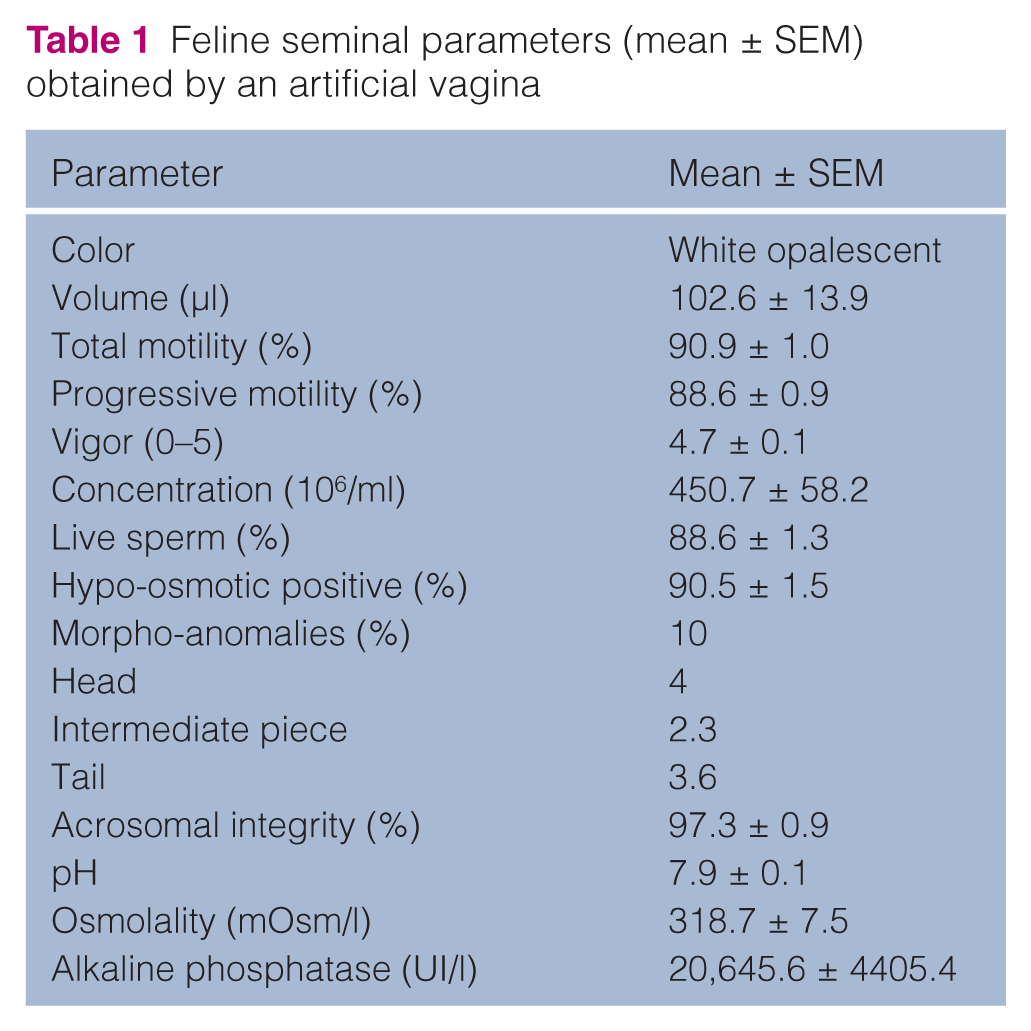
The characteristics of the feline semen obtained through the use of an AV in the second experiment were normal (Table 1). A low, non-significant correlation was found between the AP activities and the concentration of spermatozoa.
Feline seminal parameters (mean ± SEM) obtained by an artificial vagina
In the third experiment, the total (P <0.01; Figure 3) and progressive motility (P <0.01; Figure 3, inset), along with the live sperm count (P <0.05), positive endosmosis (P <0.01) and percent intact acrosomes (P <0.01), decreased throughout the experiment, while the pH and osmolarity underwent no significant change (P >0.05) during the experimental period (Table 2).

Percentage of total (P <0.01) and progressive (P <0.01; inset) motility (mean ± SEM) of feline semen diluted in a milk–egg yolk extender and stored at 4°C during 6 days of observation. Day –1 and day 0 represent the seminal characteristics before and immediately after dilution, respectively
Characteristics (mean ± SEM) of feline semen diluted in a milk–egg yolk extender and stored at 4°C during 6 days of observation

P <0.05; **P <0.01
Day 0 represents the seminal characteristics immediately after dilution. HOS = hypo-osmotic swelling
Discussion
This study describes three essential aspects of male cat physiology and reproductive management that have not been reported to date. These results could be applied in practice to contribute positively to the welfare and reproductive performance of breeding cats.
Although the number of animals studied was low, according to the results obtained, all domestic cats would appear to be trainable in ejaculating into an AV, though, admittedly, with different final performances, thus exemplifying a situation similar to that observed with other domestic animals. In contrast, a successful collection of semen from 3/5 (60%) male cats after 2 weeks of frequent handling has been reported. 17 The difference in the findings of the present study — the failure to train two of the animals in the previous investigation17 — could be explained by the short training period used. Although, in some animals, the training period required by the present protocol can be quite long (up to 5.5 months in this study), the procedure employed would be valid for purebred breeding toms upon consideration of the high quality of the semen samples obtained and the lack of invasiveness of the technique.
In the second experiment the characteristics of the semen were consistent with those previously described for AV semen collection in the species.3,20,21 As the felid physiology is such that cats ejaculate in a single fraction, a knowledge of the total AP concentrations in the whole ejaculate will be useful for seminal analysis interpretation. In this experiment, the AP concentrations were within the values previously reported for seminal plasma (160,355 ± 15,558 U/l) and for prostatic (445 ± 179 U/l) and bulbourethral fluids (281 ± 164). 7 Despite this agreement, in cats, AP originates in the epididymides and testes, 7 but the total levels in the present ejaculates did not seem to be related to the semen concentration, at least in these normal animals. Whether different grades of oligozoospermia could be correlated with seminal AP concentrations remains to be determined.
The SM-Y chilling extender conserved the feline AV-obtained semen in an acceptable condition for subsequent in vivo fertilization for up to 2 days. In this trial, however, motility had to be subjectively estimated as computerized techniques cannot be used with milk-based extenders. This limitation was compensated for by having each sample evaluated by two trained observers. The other in vitro seminal parameters remained within the normal ranges for a further 1 or 2 days. These in vitro results would identify SM-Y as constituting a low-cost, efficient and practical feline semen extender. Furthermore, cat semen could be cooled in this milk- and egg-yolk–based diluent in clinics for subsequent transport to semen banks for freezing. The assessment of pregnancy rates after artificial insemination with these diluted, chilled and frozen–thawed samples, however, would have to be undertaken before such semen preparations could be widely indicated for that purpose.
Conclusions
All domestic cats can be trained to ejaculate into an AV after a variable training period. An AV-obtained semen has a mean AP of 20,645 U/l and samples acquired in this manner can be successfully preserved at 4°C in an SM-Y extender for up to 2 days.
Footnotes
Funding
This study was partially funded University Incentive Program for Teaching and Research (V 195 to CG).
Conflict of interest
The authors do not have any potential conflicts of interest to declare.