



Abstract
Guidelines rationale:
Cats are among the most commonly kept domestic pets, and coexist with humans in a variety of different circumstances. Cats are sentient beings and, as such, humans have a responsibility for cat welfare where humans and cats coexist. Because cats reproduce efficiently, measures to control populations are frequently needed, but these should be based on ethical and humane approaches.
Framework:
These consensus guidelines from the International Society of Feline Medicine’s Welfare Advisory Panel provide a framework for the approach to welfare and population control measures, primarily among unowned cats and those going through a homing programme.

Introduction
Domestic cats (Felis catus) are among the most common companion animals worldwide.1 –9 They are kept under a wide range of different circumstances, and a substantial number of cats simply live alongside people, with varying degrees of interaction between cats and humans.
Whenever there are interactions between humans and cats, we have a responsibility to try to protect the welfare (wellbeing) of cats as far as is practical. Decisions must take into account the nature of the cat, the nature of human interactions with cats, management of cat populations and appropriate homing or rehoming of cats.
This Guidelines document attempts to:
Define the underlying principles that should be considered when trying to promote the welfare of cats (primarily unowned cats), whatever their background.
Define assumptions that underpin recommendations and provide guidance on how we can approach population management and human interactions with cats.
Establish basic welfare assumptions applicable for those that work with unowned cats in any situation and any country, recognising that each situation is different so the emphasis and outworking of these principles will vary accordingly.

The interaction between domestic cats and human beings
Any individual domestic cat falls somewhere on a behaviour and lifestyle spectrum from a completely independent-living individual with no direct human contact (and avoiding any such contact), through to a cat kept in a home where it is dependent on human care (see box below).18–20
Irrespective of where on the behaviour/lifestyle spectrum any cat sits, we have a responsibility to protect the welfare of cats under our care and also to consider how our actions affect all cats.
Cats are an important part of humans’ lives and the interests of cats, humans and other animals need to be taken into account when making decisions that affect cats, including those made on public health grounds.
Human intervention is not always in a cat’s best interests.
Confining a cat or moving it to a new environment may be highly stressful, and may not be in the cat’s best interests.17,21
Humans can assess the welfare of cats, but this takes skill and knowledge. 17
Welfare involves objective determinations of what is in the best interests of the individual cat and/or cat colony/group, and is not about human gratification or how welfare workers may feel.
There are certain basic requirements that pertain to any domestic animal (see left), and cats are no exception.
All advice on welfare and population management should be based on the best currently available evidence, recognising that this may change and improve over time.

Cat populations
Cat populations often grow because cats reproduce efficiently in many environments. 23 Population management is needed wherever there are (or it is anticipated there will be) excessive numbers of cats, health and welfare issues for cats or people, and/or significant nuisance issues.
Wherever cats fall on the behaviour/ lifestyle spectrum (ie, whether feral, street, community, stray, abandoned or household cats), population management may be required. Interventions must take into account a cat’s position on the spectrum, as well as the local environment, and societal and cultural conditions. As a result, management solutions may need to be adapted to the local situation.
Preventing reproduction by ethical surgical (ie, neutering) or non-surgical means has a major role in managing cat populations 23 and in preventing avoidable euthanasia.
Euthanasia is a legitimate welfare option for some cats where significant and/or sustained physical or psychological suffering exists or is anticipated (see glossary on page 816 for definition of euthanasia as used here). In a number of situations, humanely administered euthanasia may be the most appropriate option for an individual cat, although that decision should never be taken lightly and alternative options for healthy cats should always be explored. Failure to administer euthanasia to a cat when needed can be a major welfare issue.
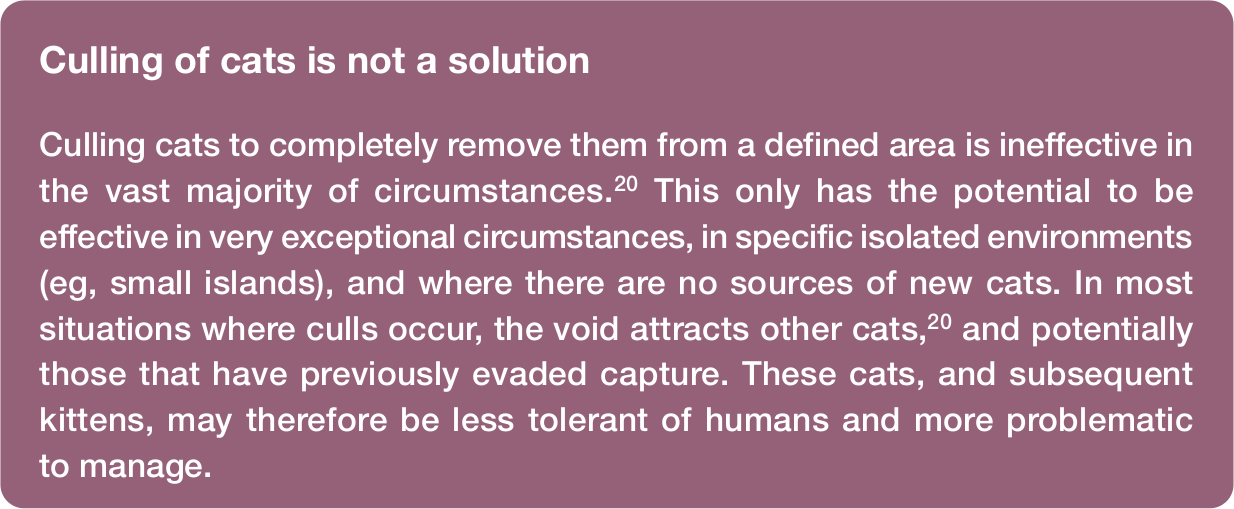
Management of cat populations should be planned, targeted and effective; and consider all potential sources of cats. Where euthanasia (or killing for other reasons) is unavoidable, methods used should be as humane as possible. Practices such as using poison or drowning to kill cats are unacceptable.

Trap, neuter and return of cats
Trap, neuter and return (TNR) is a well documented and researched method of population management. When properly conducted, targeting control of a whole colony, TNR programmes have proved to be effective in managing cat populations over many years and in many locations worldwide. A stable group of neutered cats may help limit others from entering the area, and can be managed successfully to avoid reproduction and nuisance behaviour associated with reproduction. Ongoing TNR and population control is needed to maintain stable cat populations.20,23 –31
For optimum welfare, neutered cats and kittens should be returned to the territory where they were trapped. Cats generally thrive, irrespective of whether there is a care-giver providing for some of their needs. If this cannot be achieved (eg, due to legislature or an immediate and real danger), a suitable alternative environment with a sufficient food source may be used (this is referred to as ‘trap, neuter and release’ or TNRel, rather than TNR). If neither of these is achievable, then euthanasia should be considered rather than confinement (see later).
In TNR programmes, a highly visible (from a distance), consistent, recognisable and permanent sign of neutering is essential, to prevent further intentional trapping or attempts to neuter. This is usually best achieved via the removal of an ear tip (ideally the left ear tip) when the cat is under anaesthesia for neutering.23,32
TNR programmes need to consider additional health care measures (typically vaccination) for individual cats when TNR is performed. Rabies vaccination is critical where disease is endemic, wherever there is an appreciable risk of infection and/or where legislation dictates.33,34
Organisations working collaboratively with veterinary facilities are able to minimise any welfare compromise for cats by returning cats rapidly to the location where they were trapped (usually with no more than one overnight stay, generally within the trap basket). This is a well documented and cost-effective procedure.
Owned cats and population management
For owned cats, there is a responsibility for the owner to ensure neutering is undertaken to avoid unwanted kittens and the associated welfare problems. In many countries the proportion of cats neutered is very low, and in all countries there is room for this to be improved.
Factors affecting the level of neutering include the willingness to neuter, access to vets who can or will undertake neutering, access to appropriate drugs and equipment, local politics, policies or cultural beliefs, and the affordability of neutering.
The timing of neutering is important, to avoid unwanted reproductive activity and the development of undesirable behavioural traits. It is important to routinely neuter both males and females before puberty and there is no benefit in allowing queens to have a heat/season or to have a litter of kittens before neutering. Cats should ideally be neutered before 4 months of age, and there is evidence to show that this can be done safely from as early as 6 weeks of age.35,36
Microchipping and registering of cats is recommended. It can help both in the identification of cats, and in reuniting lost cats with their owners.

Homing/rehoming of cats
For some cats, especially previously owned stray and abandoned cats, placing them in a new home with a new owner (rehoming) may provide an ideal welfare solution.
For many cats, including most feral and many street and community cats, confinement in a home or in a homing/rehoming facility is likely to cause unacceptable stress, 26 and may pose potential health risks to humans (eg, through human-directed aggression). In such cases, alternatives such as TNR, or TNRel if the cats cannot be returned to their environment, should be sought. Euthanasia may have to be considered to avoid long-term confinement if these are not an option.
Where rehoming of previously owned stray or abandoned cats is being undertaken, an organised approach is essential. This may include using a network of well maintained interim foster homes with well trained care-givers, and/or a central homing facility, and/or leaving the cat in situ (with support) until a new home can be found.
In many homing facilities, the potential number of cats entering greatly outstrips resources, space and the availability of new homes. Therefore, organisations should target resources appropriately to home as many suitable cats as possible with a minimum length of stay and adequate quality of life. Organisations must understand the limits of their resources, and the capacity of any facility should not be exceeded in a manner that is detrimental to the quality of care provided and/or increases risks of disease and stress to cats already in the facility.
Where placement of a cat (regardless of its source) with an owner/carer in a human home is being considered, a welfare assessment is critical. The welfare of the individual cat, the viability of the rehoming programme, and potentially human health too, are compromised if the cat is placed in an inappropriate home.
Where cats are (re)homed, organisations thus have a responsibility to match the cat’s temperament, behaviour, health and required lifestyle to the anticipated new environment and resources within it, so that welfare needs are met and the new owner is able to care for it. The presence and number of cats already in a potential new home should be considered. Physical checks of new homes are not necessarily required and can waste valuable resources.
Homing organisations should provide facilities that minimise stress/distress and maximise the control of infectious diseases. Measures should be in place to ensure that cats do not leave a homing facility appreciably less healthy (physically or psychologically) than when they arrived. This can be achieved through rapid homing, careful design of the facilities, adequate resources and careful management of the cats.
Studies have shown that the presence of upper respiratory infections or inappetence/anorexia in cats within a homing facility is frequently a sign of stress, overcrowding and physical discomfort. If a high frequency of upper respiratory infections or inappetence is observed these may be two signs that a careful re-evaluation of the management of the facility should occur. 21
Homing organisations have a responsibility to ensure that all cats and kittens are neutered before they are (re)homed. Pregnancy is not usually a reason to avoid neutering a queen unless doing so would endanger the life of the queen.
Homing organisations also have a responsibility to provide cats and kittens with appropriate preventive care (which may include vaccinations, parasite control and microchipping) before they are (re)homed. Priority should be given to control of zoonotic infections, and rabies vaccination is critical where disease is endemic, wherever there is an appreciable risk of infection and/or where legislation dictates.


Footnotes
Funding
No specific grant from any funding agency in the public, commercial or not-for-profit sectors was received for the preparation of these Guidelines.
Conflict of interest
The ISFM Welfare Advisory Panel members do not have any potential conflicts of interest to declare.