




Abstract
Hyperthyroidism is the most common feline endocrinopathy. Treatment options comprise anti-thyroid medication, iodine-restricted diet, surgical thyroidectomy and radioiodine. One hundred and eleven owners of hyperthyroid cats completed a detailed survey asking about their experiences and views on the management of hyperthyroidism. Male cats were slightly over-represented (60 cats, 54%). Concurrent chronic kidney disease was reported in 27% of the cats. Oral anti-thyroid medication was offered to 92% of owners. The final treatment decision was usually based on the veterinarian’s recommendation or joint decision-making between the owner and the veterinarian. Almost all of the cats (103, 93%) had received oral anti-thyroid medication at some point in the course of their disease. Sixty-nine cats (62%) were receiving oral anti-thyroid medication at the time of survey completion. Management of hyperthyroidism using UK veterinary-licensed oral anti-thyroid medication (Vidalta; MSD Animal Health, Felimazole; Dechra Veterinary Products) was associated with 72–75% success rates in terms of owner-assessed clinical outcome. The most important treatment priorities for owners were the prescription of the most accurate dose of medication and use of the lowest possible dose. None ranked once-daily treatment as most important to them, and 79% of owners said that they were, or would be, happy to dose their cat twice daily to control its hyperthyroidism. For 62% of owners, pilling their cat twice daily was not a problem. These results suggest that most cat owners are not a barrier to prescribing twice-daily anti-thyroid medication, if required.
Introduction
Hyperthyroidism is one of the most common causes of morbidity in older cats and is often cited as the most common feline endocrinopathy.1,2 The treatment options include oral or transdermal anti-thyroid medication, nutritional management (Hill’s Prescription Diet y/d), surgical thyroidectomy and radioiodine. Veterinary-licensed medications for hyperthyroidism available in the UK comprise Felimazole tablets (2.5 mg or 5 mg methimazole; Dechra Veterinary Products) and Vidalta prolonged release tablets (10 mg or 15 mg carbimazole; MSD Animal Health). Although licensed for once-daily administration, it is usually recommended that Felimazole is given twice daily, while Vidalta is licensed for once-daily or alternate day administration.3–7
All treatments for hyperthyroidism have the potential to worsen kidney function. This is because hyperthyroidism increases renal blood flow and glomerular filtration rate (GFR). When hyperthyroidism is treated, the increased blood flow to the kidneys decreases. This results in a decrease in GFR by up to 50% of the pretreatment level.8–10 For many hyperthyroid cats, this return to normality is not associated with kidney problems. However, in a proportion of patients, this reduction in blood flow has the potential to ‘unmask’ kidney disease that was not recognised previously, allowing the pre-existing kidney disease to be manifested clinically. In those cats where renal disease has been documented before treatment is started, treatment has the potential to worsen renal function and may precipitate a crisis. The reported frequency of this complication varies; one article reported a third of their patients developing this complication following treatment with radioiodine, while others have found more cats to be affected.11,12
One study showed that development of post- treatment hypothyroidism is associated with a significantly worse prognosis. 13 A significantly higher proportion of cats with post-treatment hypothyroidism suffered from azotaemia compared with those cats that were euthyroid following treatment. In addition, those hypothyroid cats that did develop azotaemia post-treatment experienced significantly shorter survival times than those that remained non-azotaemic. 13 Given this information, it is now important for all clinicians to consider iatrogenic hypothyroidism in their patients following all treatments for hyperthyroidism. Medical treatment should be titrated to maintain euthyroidism — the aim being to suppress total thyroxine levels to the lower half of the reference interval in treated cats. 14 An advantage of oral anti-thyroid medications over permanent treatments, such as radioiodine or thyroidectomy, is the ability to titrate dosage to achieve this aim.
There are very few publications reporting factors influencing decision-making by cat owners. Published studies include reports of owner attitudes and factors influencing treatment decisions for routine vaccination, neutering, cancer treatment and limb amputation.15–18 No published data currently exist regarding treatment-associated decision-making and other owner experiences pertaining to management of hyperthyroidism. The current survey was designed to obtain more information from owners of hyperthyroid cats and, in particular, their experiences, priorities and opinions relating to the use of oral anti-thyroid medication. Many cats suffering from hyperthyroidism are managed successfully using oral anti-thyroid medications for several years following diagnosis.3,19,20 It is therefore vital to understand more about the factors important to an owner in ensuring concordance and compliance with a treatment recommendation. This survey was interested in learning more about what treatment options the owner was offered, how involved they were in the final treatment decision, what support they received from their veterinary clinic and what they felt would have improved their experience of treating their cat. The survey gathered information about owner experiences and attitudes to a number of treatment factors, including ease of medication, method of pill administration, dosing frequency and dose of medication given.
Materials and methods
A survey was devised to collect data from owners of cats with hyperthyroidism, focusing particularly on aspects related to medical management and decision-making related to this. The survey contained 36 questions. The questions took a variety of forms, including selecting a single option from a dropdown menu (eg, the cat’s age), numerical scoring (eg, giving a score for involvement in decision-making), ticking checklists (eg, what treatment options were offered), agreeing or disagreeing with certain statements and ranking a number of treatment factors. Two questions required an answer only in ‘free text’ form; 20 questions allowed owners to enter free text in addition to the answer they gave using the dropdown menu, score or checklist.
Participants were recruited via two electronic invitations sent to the Cat Professional (www.catprofessional.com) database of cat owners (around 1600 members) in June and July 2012. Cat Professional provides publications, continuing professional development, and information and advice for cat owners and veterinary professionals. The country of residence for the cat-owner database is not known for all members, but, where recorded, is UK (79%) and USA (13%), with smaller numbers from other countries, including Australia, Hong Kong, Republic of Ireland, the Netherlands, Spain, Turkey, Italy, Belgium, Portugal and Czech Republic. Any owner of a hyperthyroid cat was eligible to complete the survey with a maximum of one survey per household, completing the survey for the first eligible cat when listed by name alphabetically. Participants were able to claim a free electronic copy of the author’s book on hyperthyroidism on completion of the survey. 21 The full survey can be viewed online at http://www.vetprofessionals.com/catprofessional/hyperthyroidism-survey.html
Data collected from the online questionnaires were collated and stored using FormSite (Vroman Systems) before being downloaded into a Microsoft Excel spreadsheet for analysis. Descriptive statistical analysis was performed on the data. Free text owner statements were assessed individually and grouped according to the similarity of their contents, as appropriate.
Results
A total of 111 completed surveys were received and analysed between 7 June and 13 August 2012.
The cats ranged in age (where known) from 7 years to more than 20 years, with a mean age of 14 years and 7 months. Eighty-four of the cats (75.7% cats) were non-pedigree shorthair cats and 14 (12.6%) were non- pedigree longhair cats. The remaining cats included two Cornish Rex, two Maine Coon, two Siamese cross and one each of Bengal, Burmese, Manx, Norwegian Forest, Ragdoll, Scottish Fold and Siamese breed. Slightly more males than females were recorded (60 male cats, 54.1%). The mean number of cats in each household was 3.8 cats, with 44.1% (49 cats) coming from one- or two-cat homes. In 81.1% of the households (90 households), hyperthyroidism had only been reported for one cat in the home (the cat surveyed) within a 2-year period leading up to survey completion. The diagnosis of hyperthyroidism had been made within 1 year of completing the survey for 36 owners (32.4%), between 1 and 2 years for 29 owners (26.1%), between 2 and 3 years for 24 owners (21.6%), between 3 and 4 years for 11 owners (9.9%), between 4 and 5 years for five owners (4.5%) and more than 5 years for six owners (5.4%). Additional health problems were reported in 52 (46.8%) of the cats (Table 1).
Additional health problems. Fifty-two of the 111 owners who completed the questionnaire reported additional health problems affecting their cat, with some cats reported to be suffering from multiple problems

Sixty-nine cat owners (62.2%) were using oral anti-thyroid medication to treat their cat’s hyperthyroidism at the time of survey completion (Table 2). Of the remaining cats, treatment included radioiodine (20 cats, 18.0%), surgical thyroidectomy (two cats, 1.8%), transdermal methimazole (six cats, 5.4%), Hill’s Prescription Diet y/d (six cats, 5.4%) and palliative care (two cats, 1.8%). No information was given for one cat (0.9%) and five cats were deceased at the time of survey completion (4.5%). Only eight cats (7.2%) had not received treatment with an oral anti-thyroid medication at any point during their hyperthyroidism.
Medication received by the 69 cats reported to be receiving oral anti-thyroid medication at the time of questionnaire completion

Most cats currently receiving oral anti-thyroid treatment were reported to be receiving this as a long-term strategy, rather than as a treatment prior to more curative options. Only six of the 69 cats currently receiving oral anti-thyroid medication were awaiting further treatment with surgical thyroidectomy or radioiodine. Owners that had used oral anti-thyroid medication at any time in their cats (103 owners, 92.8%) were asked about how the treatment decision was made for their cat (Table 3).
Understanding how the treatment decision had been made. Owners that had used oral anti-thyroid medication at any time in their cats (103 owners, 92.8%) were asked about how the treatment decision was made for their cat. They were asked to select the statement that was most accurate for them

All owners were asked which treatment options their veterinarians had discussed with them. One hundred and two owners (91.9% of those surveyed) had been offered medical management of their cat’s hyperthyroidism using oral anti-thyroid agents. For 33 of the owners (29.7%) this was the only treatment offered. In another seven owners (6.3%) options other than oral anti-thyroid medications had been offered. In 1.8% of owners (two cats) no treatment suggestion was made as the cats were very sick and palliative care was considered most appropriate.
Cat owners were asked to rate from ‘0’ (not involved at all) to ‘5’ (fully involved) how involved they were in the decision-making discussions with their veterinarian regarding treatment. For 84 of the owners (75.7%) the response was that they felt fully involved in the decision-making discussions with their veterinarian. Even so, 14 of these owners (16.7%) would have liked more discussions with their veterinarians. Eleven owners (9.9%) rated their involvement as ‘4’ and five of these (45.5%) would have liked more discussions with their veterinarians. All of those giving very low ratings for their involvement said that they would have liked more discussions regarding decision-making concerning treatment.
Owners were asked why the current treatment had been chosen for their cat. For those cats receiving oral anti-thyroid medication common comments included ‘my cat is very old – this treatment felt most appropriate’ (11 owners), ‘I was concerned about the cost of surgery or radioiodine’ (nine owners), ‘this treatment was deemed most appropriate by the vet’ (seven owners), ‘I was concerned that hospitalisation for radioiodine would be stressful’ (seven owners), ‘my cat is easy to pill and I prefer non-invasive treatments’ (seven owners), ‘I was concerned over anaesthesia and surgical risks’ (five owners), and ‘I was concerned about kidney disease and wanted a reversible treatment’ (five owners).
Owners were asked how successful they felt the current treatment regime was in managing their cat’s disease. For 10 owners (9.0%), it was too early to say as treatment had only recently been started. When these owners were removed from the analysis, radioiodine treatment was reported to have ‘cured’ 94.1% (16/17) cats treated with this therapy, whilst the remaining cat was reported to have been ‘helped a lot’. In 75.0% of Felimazole-treated cats (21/28 cats) and 72.2% of Vidalta-treated cats (13/18 cats) treatment was reported to have ‘helped a lot’ or ‘cured’ the cats. Other options for this question included that the treatment had ‘helped a little’, ‘not made any difference to my cat’s hyperthyroidism’ or ‘made my cat worse’.
Owners were asked to rate a number of statements regarding treatment factors relating to oral anti-thyroid medication. The ratings were from 1 (strongly disagree) to 5 (strongly agree). The statements and results are shown in Table 4.
Results for owner rating of statements related to treatment of hyperthyroidism using oral anti-thyroid medications. All 111 owners completed this question

Owners were asked to rate six treatment factors in order of importance from 1 (most important) to 6 (least important). This question was completed correctly by 52 (46.9%) of owners; the others failed to rank the options, for example, ranking all statements as ‘most important’. Results are shown in Table 5.
Owner rating of treatment factors. Owners were asked to rate the following factors in order of importance to them when treating their hyperthyroid cat with oral medication. The question asked them to rate from 1 to 6, with 1 being the most important factor and 6 being the least important factor. If they were not sure, owners were asked to only rate those statements for which they had an opinion; hence, some statements had no rating (zero rate in the table). Only 52 of the owners completed this question correctly; the remaining owners selected rate 1 for two or more statements

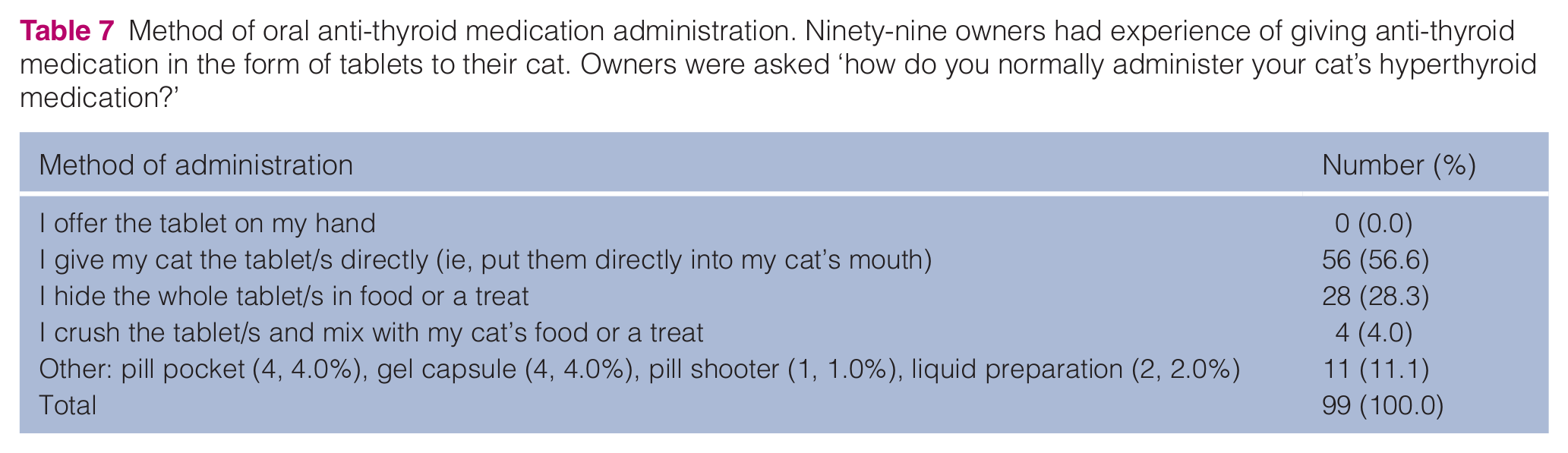
Owners were asked about the ease of dosing their cat with a tablet and how they normally administered their cat’s oral anti-thyroid medication (Tables 6 and 7). Overall treatment administration was reported to be at least 75% reliable. Pill pockets had the best overall success rates (100%), although only four owners were using this as their usual method of pill administration. Worst and most variable success rates were reported in those owners crushing the medication and mixing with food or a treat, although this only applied to four owners.
Ease of medication. One hundred and five owners (94.6%) had experience of dosing their cat with a tablet (not necessarily comprising anti-thyroid medication). They were asked, ‘In general how easy do you find it to dose your cat with a tablet?’

Method of oral anti-thyroid medication administration. Ninety-nine owners had experience of giving anti-thyroid medication in the form of tablets to their cat. Owners were asked ‘how do you normally administer your cat’s hyperthyroid medication?’
Fifty-seven owners completing this survey (51.4%) said that they never struggled to get their cat to take a tablet. The remainder of the owners reported struggles on a monthly (18 owners, 16.2%), weekly (22 owners, 19.8%) or daily basis (14 owners, 12.6%). When the different methods of pill administration were looked at individually, a similar breakdown was reported.
Just over a quarter of owners (32 owners, 28.8%) stated that they were giving pills whole or crushed in food or a treat (Table 7). We asked what treat owners used and 45 (40.5% of the total owners surveyed) commented. Most common were pill pockets [19 owners (42.2% respondents), with five specifically citing Greenies pill pockets (Franklin)], cheese (six owners, 13.3% respondents) and chicken (five owners, 11.1% respondents).
During the course of the survey 21 owners (18.9%) reported concerns or experience of hypothyroidism in their cat. These owners were aware of potential side effects relating to overdose of anti-thyroid medication or following curative treatment such as radioiodine. Eight of the owners praised the Yahoo! hyperthyroid group forum for their help in educating and supporting them in the care of their cat.
The survey asked how many times the cat visited the veterinary clinic for check-ups related to the hyperthyroidism. The number of appointments each year was 1–2 (36, 32.4%), 3–4 (41, 36.9%), 5–6 (19, 17.1%), 7–8 (eight, 7.2%) and ≥9 (seven, 6.3%).
Thirty-eight cat owners completing this survey felt that they would like more information on hyperthyroidism in general (34.2% of owners). Other common topics on which owners would like more information included understanding the different treatment options (22 owners, 19.8%), discussions regarding which treatment was selected (21 owners, 18.9% ) and support on how to give a pill (13 owners, 11.7%).
Owners were asked what support resources they had received from their veterinary clinic and how helpful these had been. The resource options were discussion at the veterinary practice with a veterinarian or nurse; discussion over the telephone with a veterinarian or nurse; printed information, such as leaflets and print-outs from websites, or being provided with a book about hyperthyroidism; being told to visit certain specific websites; and ‘other’, where owners could write free text about their experiences. Owners were invited to grade the usefulness of these resources, where received, as ‘brilliant’, ‘very helpful’, ‘helpful’, ‘slightly helpful’ or ‘unhelpful’. Ninety-eight owners — 94.2% of owners who had this opportunity — felt that discussion at the veterinary practice with their veterinarian was helpful. In 36.5% of cases (38 owners) this was described as ‘brilliant’ and 30.8% (32 owners) it was described as ‘very helpful’. For 6.3% of owners (seven owners), discussion with the veterinarian at the veterinary practice had not occurred. Fifty of the owners completing this survey had experienced telephone support from their veterinarian; 90.0% (45 owners) described this as helpful, most describing it as ’very helpful’. Only 23 (20.7%) owners received information on useful websites, although the majority of these found it helpful, and many categorised this help as ‘brilliant’.
A small number of owners (18 in total) received support at the veterinary practice from a nurse. This was very well received; 83.3% of owners (15 owners) receiving this support described it as helpful. Thirteen owners experienced telephone support from their nurse; 84.6% of these owners (11 owners) described the experience as helpful.
Some owners (42, 37.8%) were given printed information (eg, leaflets, print-outs from websites) by their veterinary clinic; 95.2% (40 owners) described this as helpful, with most describing it as ‘brilliant’ or ’very helpful’. A small proportion of owners (16 owners, 14.1%) was provided with a book about hyperthyroidism; 93.8% of these owners (15 owners) described it as helpful, with most describing it as ‘brilliant’ or ’very helpful’. Almost half of the cat owners (55 owners, 49.5%) felt that they would have liked to have received a book about hyperthyroidism when first being told of their cat’s condition. Leaflets and print-outs from websites were also valued highly, with 46.9% of owners requesting more of these (44 owners, 37.8%, stated that they had received some printed information from their vets).
Almost all of the owners (106, 95.5%) had independently sought out information on hyperthyroidism, primarily from the Internet (100 owners, 94.3%), with an additional five owners citing online discussion forums and one stating that they had borrowed a book on hyperthyroidism. One of the five owners that had not independently sought out information on hyperthyroidism was a veterinarian. Internet-based research was rated as ‘very helpful’ or ‘brilliant’ by the owners who had used this. Half of the owners that had conducted independent research had used online discussion forums pertaining to hyperthyroidism (53 owners, 50.0%). Online discussion forums were rated as ‘very helpful’ or ‘brilliant’ by 79.3% of the 58 owners who had used these.
Other forms of independent research conducted by owners included discussion of hyperthyroidism with friends who also owned hyperthyroid cats, the purchase of a book relevant to this topic, reading leaflets or articles in owner magazines and contacting a specialist vet directly.
Although many owners (61 owners, 54.9%) were happy that their veterinarian did everything possible, a proportion would have liked, in particular, more explanation of the disease (26 owners, 23.4%) and its treatment (21 owners, 18.9%) and printed information to take away (26 owners, 23.4%).
Most owners (62, 55.9%) were happy that their veterinarian did everything possible as far as treatment was concerned. However, a significant proportion of owners (34, 30.6%) wanted more information on the long-term management of their cat’s condition. A smaller number (22, 19.8%) would have liked more explanation of their cat’s test results.
Discussion
This is the first survey to report owner priorities and experiences of the management of hyperthyroidism using oral anti-thyroid medication. In spite of the relatively high prevalence of hyperthyroidism, little is known about owner preferences and most clinicians probably rely on their own experiences and opinions when advising clients. There are four treatment options; each of them has advantages and disadvantages. Successful care of hyperthyroid cats may involve several years of treatment and/or monitoring and therefore often requires significant owner commitment. Therefore, the final treatment decision needs to not only address the patient’s clinical needs but should also be practical for the owner, affordable, and meet their treatment priorities and expectations. The results of this survey provide extensive insight into owner priorities and should help inform future discussions and decision-making.
The hyperthyroid cats described in this survey were of a similar age range to that expected from the published literature. The range of breeds reported was similar to that reported in a population of more than 14,000 insured cats living in the UK. 22 Males were slightly over-represented, which differs from most publications, where either no gender predisposition has been found or females have been slightly over-represented.23–25 Additional health problems were common, especially concurrent chronic kidney disease (CKD), which was reported in 27.0% of cats. A previous study reported that 14% of hyperthyroid cats had evidence of pre-existing CKD at the time of diagnosis of hyperthyroidism. 20 Other publications have shown that around 15–30% of hyperthyroid cats develop azotaemia following stabilisation of their hyperthyroidism.12,13 My data fit well with these publications, although my survey only established owner awareness of CKD and not an actual laboratory diagnosis.
It was interesting to note that almost a fifth of owners in this study (21 owners, 18.9%) had concerns or prior experience of iatrogenic hypothyroidism in their cat. Iatrogenic hypothyroidism is possible with all treatment modalities and is known to have an adverse effect on prognosis, especially through increasing the risk of renal complications. 13 An advantage of oral anti-thyroid medications is that these reversible treatments allow dose titration so that the most appropriate dose of medication can be provided. The UK veterinary-licensed preparations Felimazole (Dechra Veterinary Products) and Vidalta (MSD Animal Health) provide a variety of dose sizes and frequencies to enable dose titration. The most numerous dosing options exist for Felimazole, ranging from 2.5 mg once daily through to 5 mg twice daily. Once-daily or alternate day Vidalta 10 or 15 mg tablets provide fewer dose options, but also facilitate dose titration.
The survey was aimed at owners of cats with hyperthyroidism who had used oral anti-thyroid medication as part of their cat’s management. It was therefore not surprising that almost all of the cats (103 cats, 92.8%) had received oral anti-thyroid medication at some point in the course of their hyperthyroidism. In some of these cases, further curative treatments, such as radioiodine and surgical thyroidectomy, had also been pursued. Of the 69 cats reported to be receiving oral anti-thyroid medication at the time of questionnaire completion, this was a long-term treatment plan for 63 cats. Oral anti-thyroid medication was offered as one of the treatment options to most, but not all, of the owners surveyed (102, 91.9%).
The final treatment decision was usually a result of a joint decision made with the veterinarian or the owner following their veterinarian’s advice. Most owners felt fully involved in the decision-making process regarding treatment; however, a significant number still felt that they would have liked more discussion. The most common factors that the owners felt contributed to choosing an oral anti-thyroid medication for their cat included the cat’s age (11 owners), cost of surgery and radioiodine treatment (nine owners), stress associated with hospitalisation for radioiodine (seven owners), having a cat that was easy to medicate (seven owners), concerns over the invasiveness of other treatments (seven owners) and wanting a reversible treatment in view of renal concerns (five owners).
Overwhelmingly the owners questioned in this survey expressed a strong desire to be fully educated and involved in the decision-making related to treatment of their hyperthyroid cat. Their treatment priorities are to provide the most appropriate and lowest dose of anti-thyroid medication for their cat, and they are not averse to twice daily medication, if required. They appreciate discussion with veterinary professionals, access to relevant books and printed literature and advice on useful websites. Cat-owner forums are especially highly valued as a support resource.
Management with oral anti-thyroid medications was associated with good clinical results. When cats in the early stages of treatment were excluded from analysis, 75.0% of owners of cats treated with Felimazole and 72.2% of those treated with Vidalta reported that the medication helped their cat a lot or cured their condition. These slightly different ‘success rates’ are difficult to interpret given the relatively small number of cats, and this was a subjective assessment by an owner, rather than depending on objective measurements, such as serum thyroxine concentrations.
Around a third of respondents had cats diagnosed with hyperthyroidism within 1 year of completing the survey, but the remainder had been managing their cat for longer than this. It would be interesting to know how owners of newly-diagnosed cats with hyperthyroidism would have answered some of the questions on treatment priorities and dosing preferences, and whether this would have been different to those owners that had been treating their cats for longer.
Clinicians often make assumptions about their clients’ treatment priorities (personal communication). A common assumption is that a lower dosage frequency will be preferred by all cat owners as cats have a reputation for being difficult to administer pills to. However, in this survey, 79.3% of owners said that they were, or would be, quite happy to pill their cat twice daily to control its hyperthyroidism. Only 12.6% of owners disagreed. Similarly, only 14.4% of owners agreed with the statement that ‘Once a day medication is the most important aspect when choosing a medicine’.
The overwhelming majority of cat owners (89.2%) completing this survey agreed with the statement ‘It is more important to me that the vet prescribes the most appropriate dose for my cat than that they provide me with an easy method of administering the medicine’. Most (84.6%) agreed with the statement ‘It is more important that the vet prescribes the most appropriate medicine rather than the one easiest for me to administer’. Of the 52 owners correctly completing the ranking question, 84.6% ranked ‘accuracy of dose in meeting cat’s requirements’ as the most important treatment factor for them. Giving a low dose of medication was also important — 34.6% of the owners ranked ‘lower dose of medication’ as the second most important treatment factor. Fewer tablets to give each day was not ranked highly. Once-daily treatment was not a priority for these cat owners — none ranked this as the most important treatment factor.
Many of the owners were proficient pill-givers with success rates of at least 75.0% for all methods of pill administration. Many owners (62.1%) reported that ‘pilling their cat twice daily is not a problem’ and 82.0% of owners said that they were, or would be, happy to pill their cat twice a day to ensure that the smallest suitable possible dose of medicine was used to manage their cat’s hyperthyroidism.
Cat owners completing this survey probably do not represent the ‘average’ cat owner, but more likely represent the ‘ideal’ cat owner. The database selected for cat owners who had performed an online search and hence found the website. In addition, this survey relied on the owner remembering details of their cat’s hyperthyroidism, which may have biased some of the results recorded. One of the questions (Table 4) may have caused some bias as all of the statements were positive. It is also possible that social acceptability bias may have been an issue with this question, and others, where owners might wish to answer in a way that would reflect best on them. Not all owners of hyperthyroid cats belonging to the database may have responded to this survey, although we have no way of verifying exactly how many owners this applies to.
Conclusions
Clinicians should use their judgement to devise the most appropriate treatment plan for each patient and not be deterred from using particular anti-thyroid preparations solely on the basis of required dosing frequency and perceived owner concerns. The ideal outcome following a diagnosis of hyperthyroidism is obtained through owner education (including discussion with professionals, use of printed material, books and reputable websites) and intelligent discussion between owner and clinician. There should be full involvement of the cat owner at every stage of the decision-making and treatment processes to ensure that the treatment plan is both practical and meets the care provider’s requirements, as well as their cat’s.
Footnotes
Acknowledgements
I would like to thank my friend and colleague Professor Danièlle Gunn-Moore for her assistance with the preparation of the manuscript.
Funding
This survey was funded by Dechra Veterinary Products UK.
Conflict of interest
The author does not have any potential conflicts of interest to declare.