



Abstract
Scratching behaviour in cats is described as a normal expression of the feline ethogram, having different possible purposes related to visual and chemical communication. During behavioural consultations owners often mention scratching as an additional problem. This preliminary study aimed to understand the characteristics of this complex behaviour by examining the variables displayed by a sample of the Italian feline population using multiple correspondence analysis. One hundred and twenty-eight cats were screened by means of a questionnaire to identify features of their scratching behaviour. Our data showed the importance of both the presence/absence of a scratching post in the cat’s living area and its relationship to marking. When a scratching post is present in a cat’s living area, the cat appears to use it. Some aspects related to sex, neutering, age and environmental characteristics may modify the expression of scratching as a marking behaviour. Research has led to increased knowledge of this behaviour and may help veterinarians in describing to owners why it is important for cats to express scratching behaviour in their environment. Such information could help veterinarians and owners to recognise normal and problematic scratching behaviours.
Introduction
The cat is an extremely widespread domestic animal. In Italy, in 2002, the feline population was estimated at about 7,400,000, with approximately one cat for every nine people (the Italian population is estimated at about 60 million people). 1 The popularity of cats as pets lies in the opinion among owners that cats are not demanding, live easily in a restricted environment, do not need to be taken out and are tolerant of spending prolonged periods without humans. 2 For these reasons, many people would choose cats as their preferred pet, 3 and epidemiological data show increases in the household cat population,4 –7 equaling or surpassing that of dogs in certain places, such as the USA 8 and Europe.1,9 Given the increase in the pet cat population, understanding the origins of feline behaviour has become crucial in helping owners to understand the cats’ behavioural needs and to facilitate the feline diagnosis process for a veterinarian during a consultation.
Scratching behaviour in cats is described as a normal expression within the feline ethogram, with different possible purposes related to visual and chemical communication.10,11 In other instances, scratching can also represent a problem to be managed by a veterinarian. 12
Scratching helps remove claw sheaths, 13 but this is not its main purpose. In fact, outer parts of the fore claws could easily be removed with the teeth or would come off naturally. 10 It has been suggested that scratching may re-establish the appropriate sharpness and maintain the system for claw extension and withdrawal used in the usual hunting sequences or during climbing.10,14 Scratching behaviour is also an important means of chemical and visual communication for cats.11,12,15,16 Some authors identify both immediate and long-term social messages in scratching.14,17 Scratching may, in fact, be a means of territorial marking achieved by depositing chemical signals released by plantar pad glands 11 and by leaving visual cues on the scratched surface. 10 The use of scratches as a marking signal is normal in a wide territory, but when it is observed repeatedly inside the house, it is reasonable to conclude that the animal is not feeling safe in that specific environment. 10 Owner punishment may add to anxiety and increase or move scratching to different locations in the environment. 12 Other potential reasons for the behaviour may include attempts to increase territorial marking, conditioning the claws or the development of an attention-seeking response. 12 Veterinary practices are increasingly being consulted about feline behaviour, and referral to behaviourists is no longer unusual. 12 Currently, there is a lack of detailed scientific data about the characteristics of scratching behaviour in cats living in a domestic environment. Without scientific knowledge about the origins of this behaviour it may be harder for a veterinarian to determine a control strategy when the behaviour is inappropriate. It may be relevant within feline medicine to collect more data about the characteristics of scratching in domestic cats to better understand this important means of visual and chemical communication, and to establish new approaches to manage this behaviour when it becomes a reason for veterinary consultation.
With this interest in mind, the aim of this research was to describe the characteristics of scratching behaviour in a sample of Italian domestic cats using a questionnaire-based study analysed with the help of multiple correspondence analysis (MCA). MCA is a means of statistical analysis developed to study various population datasets in research and other contexts (the investigation of customer profiles in marketing, for example). 18 MCA is also used overall as a validated statistical method for describing population features, 19 as well as clinical manifestations and their evaluation in animals.20,21,22,23
Generally, MCA is used in the management of questionnaires (surveys) where answers are qualitative (and where each question calls for a single answer), regardless of the application domain. 19 Descriptive multivariate analysis can help to eliminate some procedural difficulties and to assemble different elements with respect to several previously determined variables. 23
In the present research, we used MCA in order to determine whether this sample could be grouped according to a combination of factors, especially in assessing scratching behaviour according to animal features and domestic environment.
Materials and methods
The questionnaire was filled out by 128 cat owners enrolled via face-to-face contact, both in veterinary clinics and in the schools of Veterinary Medicine and of Psychology in Padua (Italy), during the first half of 2009. In order to enroll a heterogeneous population, no inclusion criteria were used regarding age, indoor or outdoor living, or number of cats present in the household. This was done in order to obtain the best possible sample of the Italian feline population. The questionnaire contained seven descriptive questions focused on sex, age, breed, living environment, presence of a scratching post, frequency of its use and scratching on other surfaces.
An MCA was used to analyse the dataset. MCA is a factorial analysis used when a sample of the population is studied from three or more qualitative variables. A factorial correspondence analysis is carried out from a complete disjunctive table (subjects in rows, variables and categories in columns) or a Burt table. The latter is a presentation of all the contingency tables of the variables, taken two-by-two and combined in a single matrix. However, MCA also allows qualitative and quantitative variables to be integrated simultaneously by breaking the variables down into categories. The analysis produces a multi-dimensional cloud of points which is then projected onto a single plane for ease of interpretation. The plane that is selected retains the greatest possible degree of variability (known as inertia) from the dataset. Thus, it is possible to determine proximities between categories of different variables or between subjects.
As in Guy et al, 19 the variables assessed in the MCA model were chosen in order to minimise multi-collinearity between them. Variables included the cat’s age (older or younger than 1 year old), gender (male or female; neutered or entire) and breed (pure or not); characteristics of the environment in terms of access to the outdoors (living exclusively indoors or with the possibility to go outside); the presence of a scratching post (present or not); the frequency of its use (if the cat used the scratching post often, rarely or not at all); and scratching of other surfaces (present or not).
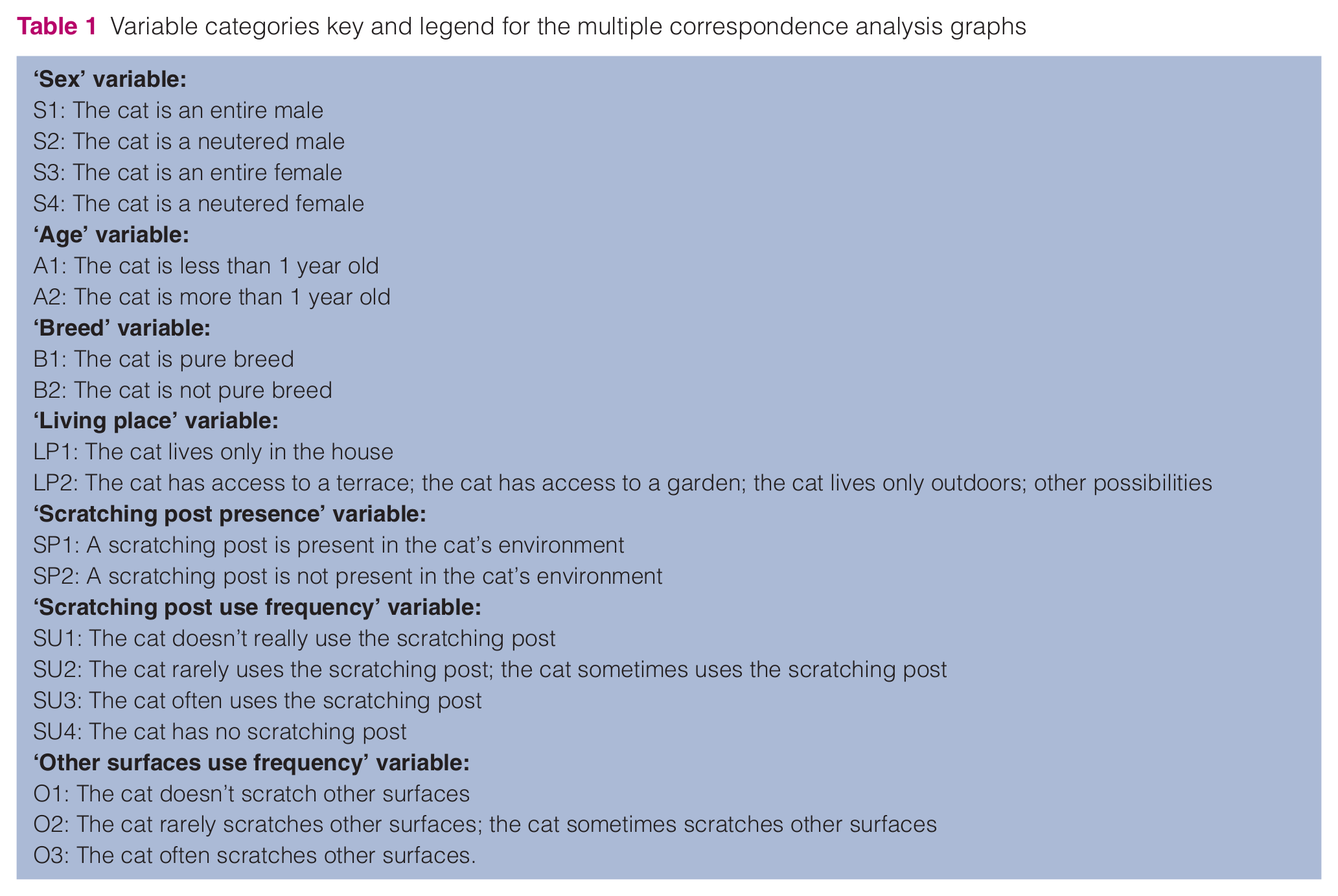
These variables were included in the MCA model, corresponding to 19 categories (Table 1). As only categorical variables can be used in this method, quantitative variables, such as age, were dichotomised using logical cut-off points, fulfilled according to the distribution of responses to each question, after careful examination. The breed variable was broken down into two subgroups: no breed/pure breed.
Variable categories key and legend for the multiple correspondence analysis graphs
Data were analysed by the MCA technique using ADE-4 [Laboratory of Biometrics and Evolutionary Biology (UMR 5558) University of Lyon, France].
Results
The results of the MCA are shown in Figures 1 and 2. These plots represent the proximity between variables in a simultaneous way, illustrating the relationship between them.
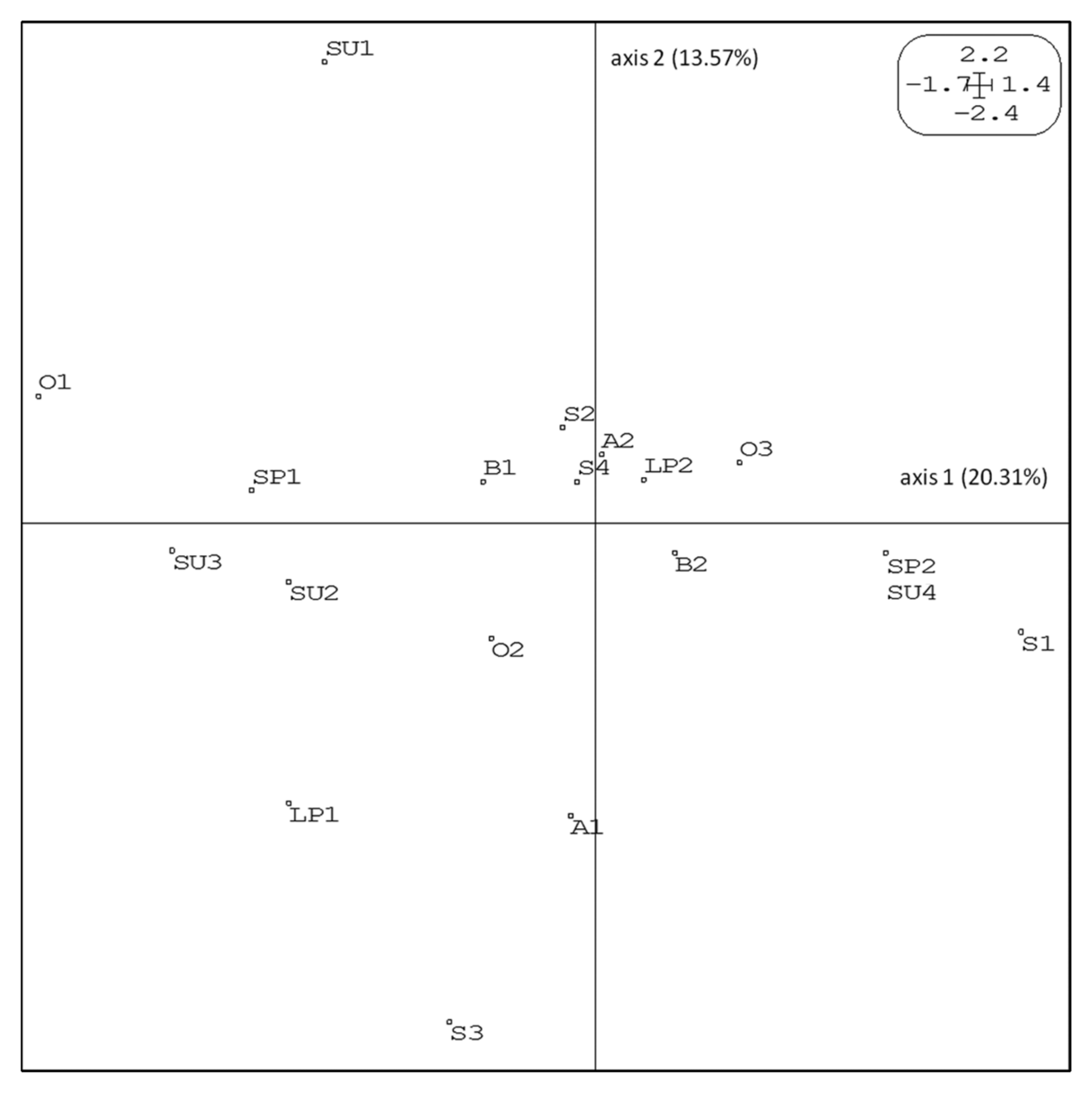
The diagram shows the projection of a multidimensional cloud of points onto the plane retaining the most variability (inertia) from the dataset. The first two axes are described in the results and represented as horizontal and vertical lines; the representation of the variables describes the position and the association (the higher the proximity, the higher the association)

Third and fourth axes are represented in association with the values of their variability
The MCA explained 55.86% of the complete variability in the data, using four axes. However, as per the recommendation of Lebart et al, 24 we collected data regarding the first seven axes. This additional data allowed us to capture 80.15% of total inertia. The first axis explained 20.31% of the variability and was defined by living environment, presence of a scratching post, and frequency of use of the scratching post following the absolute contributions and their position in the MCA graph (see Figure 1). The second axis explained 13.57% of the variability and was defined by living environment, age, sex and frequency of scratching post use. The third axis explained 12.11% of the variability and was defined by sex, frequency of scratching post use, living environment and other surfaces scratched. Finally, the fourth axis explained 9.87% of the variability and was defined by sex, living environment, frequency of scratching post use and breed.
The category (see Table 1) SP1 appears at the left end of axis 1, while the categories SU4 and SP2, S1 and O3 appear at the right end of axis 1. The category A2 appears at the high end of axis 2, while the categories S3, LP1, A1 and O2 are observed at the low end of axis 2. The categories S2 and O1 appear at the right end of axis 3, while the categories S4, SU2 are observed at the left end of axis 3. The categories SU1 and B2 can be found at the low end of axis 4, while the categories SU3, O2 and B1 are observed at the high end of axis 4 (for all categories see Figures 1 and 2, and Table 1).
Entire males with no access to a scratching post (see Figure 1, axis 1) appeared to have a tendency to often scratch others surfaces (see Figure 1, axis 1). Young entire females used to living indoors, without the possibility of going outside, rarely scratch other surfaces (see Figure 1, axis 2). Neutered males did not scratch others surfaces (see Figure 2, axis 3). The use of the scratching post by neutered females appeared to be less frequent or occasional (Figure 2, axis 4). When a scratching post was present in the environment, the cats tended to use it, reducing scratching on other surfaces (see Figure 2, axis 4).
Discussion
Data collection by means of a questionnaire enabled the creation of a graphical MCA representation of the different variables describing the feline scratching behaviour in our domestic cat sample. MCA did not allow us to describe all of the data for the population, but our first analyses described most of the phenomena. MCA served as a useful analytical tool for describing a profile of a population sample and added information about owner perception of this misunderstood behaviour. Using MCA, Guy et al 19 described the profile of biting dogs derived from the various criteria observed. MCA can highlight the characteristics of simple data tables, and may also be used to detect patterns and to look for features in more complex data sets. 25
According to the present preliminary study, the more detailed collection of information about this highly particular behaviour highlighted characteristics correlated with the presence or absence, in the animal’s living environment, of a proper area for effective scratching. Other traits, related to the marking functions of scratching behaviour, as well as sex, neutering, age and the specific characteristics of the cat’s living environment were described.
Our results (Figure 1, axis 1) emphasise the importance of having the option to use or have access to a scratching post: when a scratching post is located in the cat’s environment, the animal is likely to use it. Several authors6,10,17,26 suggest the importance of giving cats access to a scratching post as part of a permanent environmental enrichment, and our data seem to confirm this finding. If provided, owners usually expect the cat to focus its behaviour on the scratching post. However, lack of attention to scratching post location and suitability may cause cats to select walls and more attractive furniture using their own criteria. Such behaviour usually leads to expensive destruction. 27
Numerous authors6,10,11,12,14,15 underline the importance of scratching as a marking behaviour — an intraspecific long-term effective methodology for communication. The scratching locations may serve as landmarks used by the cat for its own orientation, as described in literature with urine marking. 28 No explanations regarding sex, age or other environmental aspects are really described. In the present study, the MCA analysis (related to Figures 1 and 2, axes 2–4) revealed that scratching differs between entire and neutered cats, regardless of sex. Entire males tend to scratch other surfaces, but neutered males, neutered females and entire females rarely choose furniture to display this behaviour, regardless of scratching post availability. Most current literature describes cats as social animals, with a particular social organisation.10,12,29,30,31 Some cats may form colonies, with a matrilineal, co-operative female–female relationship at their core.30,32 –34 However, entire males usually roam from group to group30,32 or join large groups of females 33 during some parts of the year. Communicative chemical signals, correlated with visual (scratching), durable and long-term messages would prove to be very important in entire males when they need to control territory or patrolling paths, preserve personal feedback from their own home ranges and highlight their presence without coming into direct contact with other males. The possibility to communicate and leave information without the direct presence of the animal is presumed to decrease inter-male aggression and resulting injuries, usually occurring from encounters with young wandering males, during the mating season. 15
Adult neutered males tend to not or only rarely scratch when exposed to a scratching post (Figure 1, axis 2). Scratching may be expressed more frequently in young animals in correlation with increased exploratory behaviour and play. 15 From a mechanical point of view, this behavioural pattern is involved in learning how to control the claws, stretch the body, and exercise the muscles and tendons involved in claw protection and reaction. 14 In immature cats, just after separation from the mother, the confidence and feedback from their territory becomes more relevant, and marking signals (and marking behaviour in general) may help the animal discriminate safe places from areas where they must remain vigilant. 12 Assuming individual differences, scratching seems to appear at a very early age. 17 Newborn kittens are not able to withdraw their claws correctly until about 4 weeks after birth, 15 so they start to scratch correctly at 5 weeks of age; there are no reported differences in the expression of this behaviour in older cats. Adult cats will not use a scratching post if it is not well-positioned in their environment or if it is not suitable for them, 12 especially if they have started to scratch other surfaces with more appealing characteristics and in a valuable location. The results shown in Figure 1 (axis 1) seem to support this hypothesis. We use the owner’s perception of scratching instead of the real count of scratching marks in order to quantify this behavioural pattern. In classical and clinical ethology, related to retrospective study 19 or description of the phenomenon, 3 the owner’s evaluation and perception of behavioural changes is considered the analytic reference, mainly from a practical standpoint. 35
Entire male cats will continue indoor scratching behaviour if a scratching post is not present in the environment. Entire males, in particular, often scratch other surfaces in spite of unrestricted outdoor access when they want to leave marks or condition their claws. 12 Scratching sites and other marking signals appear to be more common along regularly used pathways, rather than at the periphery of the territory or home range.29,36
Conclusions
In this preliminary research, MCA analysis allowed us to represent a dataset in a descriptive way. The method gives us the general trends based on features in perceived scratching behaviour in a sample of the Italian domestic feline population. Moreover, the scientific approach using MCA to investigate scratching patterns in cats helps to remove behavioural considerations from the realm of anecdotal observations of a phenomenon. MCA puts an emphasis on the useful results, in order to advance understanding of feline territorial marking and the possible behavioural problems linked to scratching behaviour. This research was not intended to describe all features of scratching, but rather to increase our knowledge of scratching correlates and, because this behaviour is poorly researched, to establish future variables for analysis.
The owners’ observations of scratching should provide interesting information which could produce focused clinical studies with a controlled population. This study highlights why it is important for veterinarians to consider normal behavioural features and to teach owners before starting a protocol of treatment for managing the behaviour. Further studies would be useful to investigate these complex patterns in depth, looking at more variables related to the expression of this neglected behaviour (eg, multi-cat households, environmental resources, different types of scratching posts, etc). Further research should underline different, non-invasive solutions to refocus an undesirable behaviour to a suitable target, thus reducing misunderstanding and inappropriate punishment by owners. A better understanding of the cat’s ethogram, and especially its real needs, by the veterinarian and the owner, would prevent the perception of scratching simply as an unacceptable behaviour. It would, instead, be more helpful to view it as an easily manageable specific behaviour, and to encourage the veterinarian and the owner to use ethical and ethological solutions when an inappropriate behaviour appears.
Footnotes
Funding
The research received no specific grant from any funding agency in the public, commercial, or not-for-profit sectors.
Conflict of interest
The authors do not have any potential conflicts of interest to declare.