




Abstract
Practical relevance:
Physiotherapy is highly valued within human medicine and relatively well established for canine patients. Despite a popular misconception that feline patients will not cooperate with such treatment, physiotherapy is now increasingly being performed with cats. With cat ownership increasing in many countries, and an emergence of specialist physiotherapy practitioners, there is demand for effective postoperative and post-injury rehabilitation for any cat with compromised physical function due to injury, surgery or disease.
Clinical challenges:
While physiotherapy and rehabilitation are potentially beneficial for cats, due to their independent nature feline patients certainly present a greater challenge in the pursuit of effective therapy than their canine counterparts.
Audience:
This two-part review article is directed at the primary care veterinary team. The benefits of physiotherapy and the various treatment modalities available to the qualified veterinary physiotherapist, as well as the non-specialist veterinarian and veterinary nurse or technician, are examined in this first part.
Evidence base:
The benefits of human physiotherapeutic intervention are well documented, and there is good evidence for the effectiveness of most treatment modalities. Animal studies are still in their infancy, although some preliminary studies in dogs have shown good results.

The rise of animal physiotherapy
Physiotherapy (or physical therapy) is concerned with physical function, and considers the value of movement and the optimisation of physical potential as being core to the health and wellbeing of individuals. Although often perceived as an alternative therapy, physiotherapy is actually complementary and best used in conjunction with conventional veterinary treatment. The practice of physiotherapy involves a range of physical modalities used to treat and prevent injuries, restore movement and maximise physical function. For humans, the benefits of physiotherapeutic intervention have been well documented within the realms of health promotion, prevention, treatment and rehabilitation.1,2 Physiotherapists form an important part of the human health care team, using problem solving and clinical reasoning skills, supported by a sound evidence base, to provide high levels of clinical care to ensure optimum outcomes for patients following injury, surgery or disease.
In recent years, physiotherapy for animals has enjoyed an explosion of interest among the veterinary profession and the pet-owning public. While research into the benefits of physiotherapy for animals is still in its infancy, many techniques, treatments and rehabilitation regimens successfully used on human patients have been readily adapted for use in animals, and some preliminary animal studies have shown good results.3–5
In the UK, the practice of physiotherapy on animals is governed by the Veterinary Surgery (Exemptions) Order 1962, which permits the treatment of an animal by physiotherapy as long as that treatment is provided under the direction of a veterinary surgeon who has examined the animal and has prescribed the treatment of that animal by physiotherapy. It is the responsibility, therefore, of the veterinarian to ensure that physiotherapy is carried out by someone fully trained and qualified to do so. Recognised qualifications relating to the practice of physiotherapy on animals are not legally defined in most countries, so many people have taken on the role of the ‘physiotherapist’, often with no formal qualifications in physiotherapy. Within small animal practice both the nurse and the veterinarian have often adopted the role as an adjunct to that for which they have been trained.
In the UK, an increasing number of veterinary practices now collaborate with qualified veterinary physiotherapists, and in most cases decisions regarding appropriate physiotherapeutic and rehabilitative care are best made through a team approach involving the veterinarian, physiotherapist and nurse, to allow different perspectives to be aired with the aim of achieving optimum outcomes for the patient. 6 Veterinary expertise can establish diagnoses and determine appropriate medical or surgical interventions; physiotherapy expertise can identify associated mechanical dysfunctions and develop appropriate treatment plans for restoring physical function. 7

What about cats?
Cat ownership is increasing in many countries, yet, despite this, our understanding and treatment of cats by physiotherapy has lagged behind that of dogs.8–10 With treatment advances and high costs involved in feline veterinary medicine and surgery, cat owners are beginning to expect similar postoperative and post-injury care for their pets as their dog-owning counterparts.
Although cats can benefit from the suitable application of effective physiotherapy techniques and appropriately planned and executed rehabilitation programmes, compliance with treatment is often less predictable than with dogs, and the success of therapy with cats demands a good understanding of feline behaviour, coupled with excellent handling skills. 11 As with dogs, compliance can often be enhanced through the provision of enticing rewards (eg, treats, attention, play opportunities).
Benefits of physiotherapy
Many conditions can benefit from physiotherapeutic intervention (see box). One major application of physiotherapy in animals is for postoperative management following orthopaedic or neurological surgery, 12 although it can also benefit other acute and chronic disorders in which surgery is not required (eg, muscle, tendon or ligament injuries and arthritis).
Postoperatively, physiotherapy helps to:
Control inflammation, swelling and pain;
Promote wound healing and ordered scar formation;
Promote early weightbearing and prevent the development of compensatory gaits;
Maintain/restore range of motion (ROM) and prevent the development of adhesions, fibrosis and contracture;
Restore muscle properties (strength, endurance, speed of activation) and normalise tone following neurological insult;
Restore balance and proprioception;
Promote and restore normal movement patterns and function;
Improve cardiovascular fitness;
Prevent the development of hyperalgesia and chronic pain;
Maintain bronchial hygiene, eliminate secretions from airways, re-expand atelectatic lung segments, improve oxygenation and reduce the incidence of pneumonia;
Return the animal to optimal function.
Although valuable postoperatively, physiotherapy can also have a useful role in preoperative rehabilitation.7,13 In this context it can be used to:
Prepare the animal physically for the forthcoming surgery (improving muscle strength and joint stability, ROM, balance and proprioception);
Familiarise the animal (and owner) with the exercises required following surgery;
Provide the owner with a sense of involvement and a good feel for the commitment that is going to be required following surgery.
In some cases, the animal may improve to such a degree that surgery is no longer required.
Modalities used in physiotherapy
The techniques and modalities used in physiotherapy are numerous and varied. Physiotherapists select, prescribe and implement appropriate modalities when the examination findings, diagnosis and prognosis indicate the use of specific approaches. Often a combination of modalities is used, coupled with expert advice (to owners and fellow veterinary professionals), to maximise outcomes and return the patient more quickly to optimal function.
The primary techniques fall into three categories: manual therapy, electrophysical and thermal treatments, and therapeutic exercise. The benefits of these are discussed in turn in the following sections. Importantly, the performance of any of these techniques demands a thorough understanding of the respective indications, contraindications, physiological effects and practical application. It is outside the scope of this article to cover all these elements in detail, but further information regarding the use of these modalities with animals (together with their contraindications) is readily available in other texts.7,9,14,15
Manual therapy
There are many manual therapies that can be used on cats. To achieve the most beneficial effects they all demand a degree of calmness and cooperation on the part of the cat so that tissues are relaxed during treatment. Cats that are fearful or stressed are likely to benefit less from these techniques, although in many cases relaxation can be achieved as an effect of the technique itself. Some of the basic techniques (such as massage, passive movements, stretches and heat/cold therapy) can be readily learnt by veterinarians and veterinary nurses, following suitable CPD training, and incorporated into daily practice. Many other techniques, however, demand specialised physiotherapy training.
Joint mobilisations and manipulations
‘Physiological’ joint movements (such as shoulder flexion, extension, abduction, adduction, medial and lateral rotation) are routinely tested in respect of ROM, pain and laxity. Although essential for normal physiological movements to occur, the so-called ‘accessory’ movements (such as the spins, slides and glides that occur between joint surfaces) are rarely tested, yet can often be the cause of joint restriction and pain. Accessory movements are unique to each individual joint. Physiotherapists assess these movements and treat any identified dysfunctions to ensure pain-free movement is achieved. Treatment comprises the techniques of mobilisation and manipulation, which should only be performed by someone specifically trained and experienced in using them.

Mobilisations performed on the cervical spine for pain relief
Soft tissue techniques
A wide range of techniques are used to mobilise and restore extensibility to tissues, improve circulation, reduce swelling and pain, and provide sensory stimulation. These include massage, soft tissue release, acupressure, myofascial release, trigger pointing, passive movements, stretches, neural mobilisations, reciprocal innervation, and proprioceptive neuromuscular facilitation (PNF) techniques.
– Static stretching utilises a low force that is held for a minimum of 30 s (and repeated several times). This is a comfortable stretch which should not cause tissue damage, and which allows realignment of collagen fibres. A total treatment time of 20–30 mins daily has been identified as the optimum to achieve improvement.21,22
– Prolonged mechanical stretching also utilises a low intensity stretch with the aid of casts or splints (often used serially). This can be continued for longer periods of time (from 20 mins to several hours daily).

Description of various massage techniques

Benefits of various massage techniques

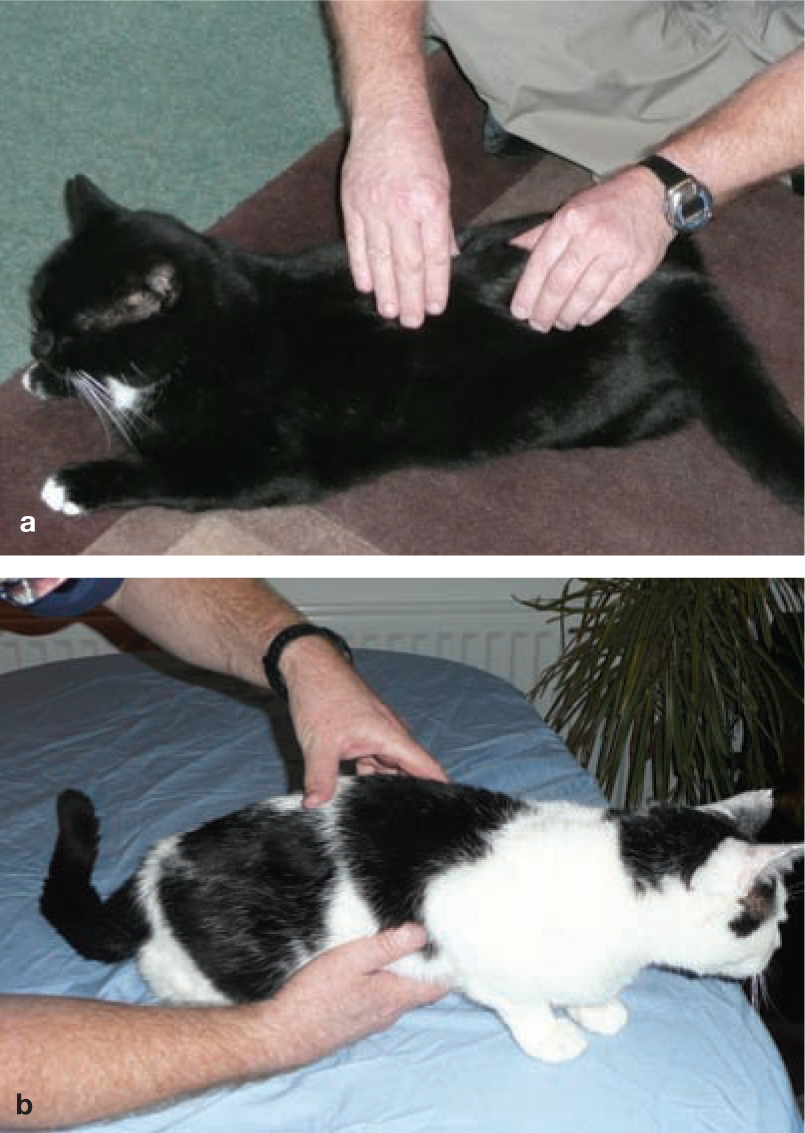
(a) Stroking massage is used to calm and relax cats. (b) Kneading massage to the paravertebral muscles increases circulation and relaxes the muscles

Passive movements – in this case, to the left shoulder joint into extension. These are gentle, safe movements that just touch onto initial resistance or point of discomfort

Stretch being applied to the hip flexor muscles
Electrophysical and thermal treatments
Many electrophysical agents can be used on animal patients, including laser, ultrasound, neuromuscular electrical stimulation (NMES) and transcutaneous electrical nerve stimulation (TENS). These are all non-painful forms of treatment and cats are generally tolerant of their use. However, all these modalities possess inherent dangers and should only be used by operators who have received specialised training. By contrast, the basic techniques of applying heat (thermotherapy) and cold (cryotherapy) can be readily learned and incorporated into daily practice by veterinary staff.
Laser therapy
The laser is a form of light amplifier, enhancing particular properties of light energy. Many different types of laser are available, but for therapeutic purposes class 3A or 3B lasers are used with typical wavelengths of 600–1000 nm. The treatment device may be a single emitter (or probe) or a cluster of several emitters (cluster probe) with a combination of lasers and light-emitting diodes (Figure 5). Much of the laser light energy is absorbed in the superficial tissues, and penetration is rarely greater than a few millimetres. However, it is believed that deeper effects can be achieved as a secondary consequence via a chemical mediator system whereby the cell membrane acts as the primary absorber of the energy, and then generates intracellular effects by means of a cascade-type response. 24 It has been reported in horses that penetration can be improved following clipping and cleaning of the area. 25

Laser therapy is predominantly used for pain relief and to improve wound healing. The cluster probe pictured contains a combination of lasers and light-emitting diodes
Laser application is predominantly used for its effects on wound healing, inflammatory arthropathies and soft tissue injury, and for the relief of pain. There is a growing body of evidence supporting the clinical use of laser therapy in humans,26–28 but, as with many treatment modalities, evidence of its value with animals remains limited at the present time.
Therapeutic ultrasound
Ultrasound produces mechanical vibrations that are the same as sound waves but at higher frequencies, beyond the range of human hearing (Figure 6). In therapy the frequencies used are typically between 1.0 and 3.0 MHz. Deeper treatments (4 cm average) benefit most from a 1 MHz frequency whereas 3 MHz is used for more superficial treatment (2 cm average), although actual levels of penetration depend on the type of tissue being treated. As the ultrasound waves pass through the body tissues, energy is absorbed, particularly by tissues with a high collagen content such as ligament, tendon, fascia, joint capsule and scar tissue.29,30 Animal hair absorbs much of the transmitted energy so clipping and use of a coupling medium is always required. 31 Coupling can be achieved in various ways to suit the requirements of the individual animal: direct contact using ultrasound gel; water bag application using a plastic or rubber bag filled with warm water together with ultrasound gel; and water immersion, whereby the part is treated under water and water acts as the couplant. 32
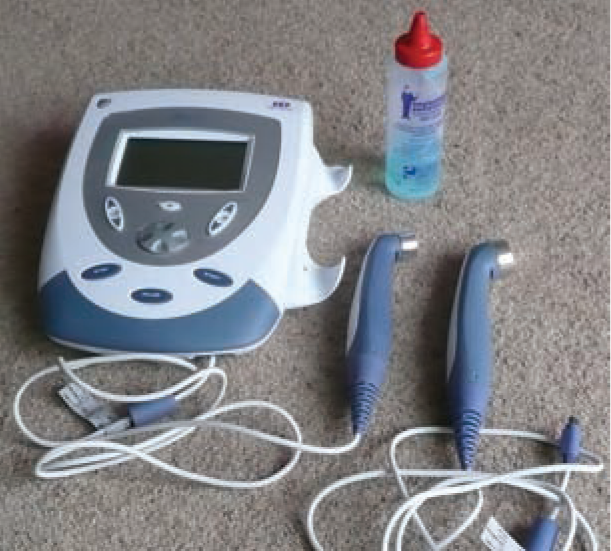
Therapeutic ultrasound can be applied using different size treatment heads. Coupling mediums can include ultrasound gel (pictured), water or a water-filled coupling cushion (plastic or rubber bag)
Ultrasound can be used to produce thermal, as well as non-thermal, effects to the body tissues. Pulsed or continuous modes are available, with pulsed modes used for healing purposes and continuous modes used for thermal effects. 32 If used for its thermal effects, ultrasound should not be used over metallic surfaces, as this may intensify and prolong the heating effects.
Application of ultrasound during the inflammatory, proliferative and repair phases of tissue healing is of value because it stimulates or enhances the normal sequence of events and thus increases the efficiency of the repair process. It can influence the remodelling of scar tissue by enhancing the appropriate orientation of the newly formed collagen fibres and also triggering a collagen profile change from mainly type III to a more dominant type I construction, thus increasing tensile strength and enhancing scar mobility. 33
There is published evidence to show that low intensity pulsed ultrasound accelerates fracture healing,34–36 and can benefit many bone-related disorders, including normally healing fractures, stress fractures, and delayed and non-unions. Several of these studies have been performed on animals.37–39
Neuromuscular electrical stimulation
The technique of NMES stimulates the motor nerves and evidence exists for its ‘strengthening’ effect and for its ability to prevent disuse muscle atrophy. 40 This is particularly useful for animals that cannot generate useful voluntary contraction on demand, and for those that find active exercise difficult.41,42 There is no evidence that NMES provides any significant benefit over active exercise, and the treatment is generally stopped once the animal is able to exercise actively. This modality can also be useful for muscle re-education and facilitation of muscle control, improving sensory awareness, decreasing spasticity and muscle spasm, and reducing oedema. In a normal muscle contraction, type I (slow twitch) postural muscle fibres tend to be recruited first, followed by type II (fast twitch) fibres. With NMES this is reversed, and so it preferentially prevents atrophy of type II fibres.43–45
To date there have been no studies determining optimal parameters for NMES in cats, though best practice guidelines have been produced in the medical field. 46 The use of NMES requires clipping of fur, cleaning of skin and the use of conductivity gel to maximise contact between the electrodes and the skin.
Transcutaneous electrical nerve stimulation
TENS provides symptomatic pain relief by specifically exciting sensory nerves and thereby stimulating the ‘pain gate’ mechanism and/or the endogenous opioid system. Pain relief by means of the pain gate mechanism involves activation (excitation) of the A? sensory fibres, and subsequent reduction of noxious stimuli transmission from the ‘c’ pain fibres. The A? fibres respond most effectively to a relatively high rate of stimulation (90–130 Hz). The alternative approach is to stimulate the A? fibres, which respond preferentially to a much lower rate of stimulation (2–5 Hz). This provides pain relief by causing the release of an endogenous opiate (encephalin) in the spinal cord, which in turn reduces the activation of the noxious sensory pathways. 47
As with NMES, the use of TENS requires clipping of fur, cleaning of skin and the use of gel. TENS electrodes can variously be located around the painful site, at the relevant nerve root, along the peripheral nerve supplying the painful area, and over trigger/acupuncture points. 48
Heat and cold therapy
Heat can be applied superficially (1–2 cm) via hot packs, baths/spas and hosing, or more deeply (4 cm or more) using therapeutic ultrasound. In small animal practice, superficial heating is most commonly used. This is particularly useful for subacute and chronic conditions where there is a reduced ROM due to stiffness or contracture; to relieve pain; and as a prelude to passive movements, stretches or exercise by improving collagen extensibility. Hot packs should be used at a comfortable temperature, wrapped in towelling to avoid burns and should be applied for 10–20 mins.
Cold penetrates deeper and lasts longer than heat and is most effective when used in the first few days after trauma (accidental or surgical). During this acute phase of inflammation it provides analgesia, reduces inflammation and swelling, controls bleeding and reduces muscle spasm. Cold can be applied using cold packs and cold compression units (Figure 7), and treatment should be limited to 10–15 min sessions. This can be repeated every 2 h if necessary (for severe injuries), but for most postoperative/injury applications it is suggested that cold therapy is given every 3–4 h. Superficial tissues show the most rapid cooling and rewarming effects; the deeper intramuscular tissues respond more slowly and may take as long as 60 mins to return to baseline temperature after a 10 min application of a cold pack. 49


Cold compression units are generally regarded as more effective than most other forms of cold therapy as they combine cold with compression. The sleeve is fitted snugly around the cat’s limb and filled with ice-cold water from the container. The hose can be disconnected after filling, and reconnected after treatment to empty the sleeve
Therapeutic exercise
Exercise represents the final element in the process of helping an animal achieve optimum function following injury, surgery or disease and is used to:
Prevent long-term physical impairment;
Enhance function;
Reduce the risk of injury and re-injury;
Optimise overall health;
Enhance fitness and wellbeing.
Types of exercise
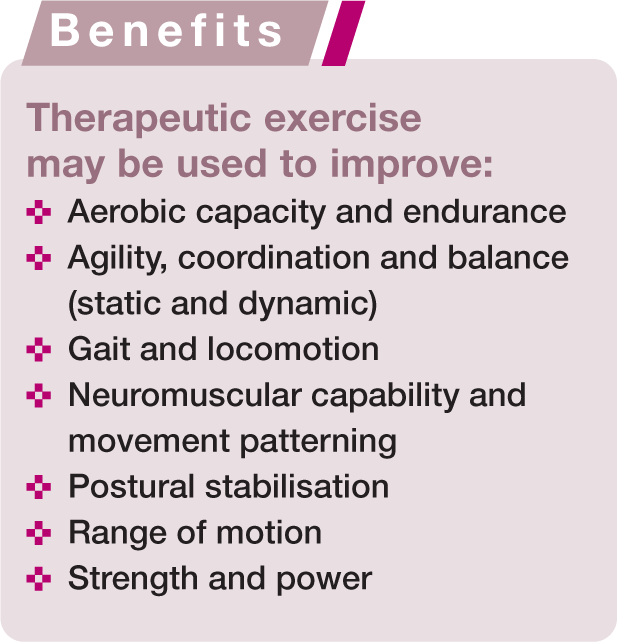
Exercise can be divided into four principal types (see box on page 629):
Strengthening (Figure 8);
Flexibility (suppleness) (Figure 9);
Balance and proprioception (Figure 10);
Endurance (stamina).

Strengthening exercises such as dancing (a) and wheelbarrowing (b) allow limbs to be exercised against the cat’s bodyweight

Flexibility exercises such as baiting (a) and step-overs (b) help restore or improve ROM to joints. Baiting primarily exercises the spinal joints, and assists balance retraining; step-overs also assist with balance and gait re-education

Balance is especially important for cats, and exercises to improve static balance include the use of unsteady surfaces such as bean bags, trampolines or wobble cushions (a). Playing with toys (b) provides dynamic balance training, while treats (c) can be used to offer particular challenges
All therapeutic exercise programmes should be tailored to the animal and comprise a combination of the four types, dependent on the individual’s needs.
Land-based exercise
Land-based exercises should form the major component of exercise programmes designed for cats because, being land animals, they must obviously be able to cope with life on land. In many cases cats may be more accepting of exercises that involve less manual contact from the therapist (or owner) – see Part 2 for examples.
Water-based exercise
Hydrotherapy is one of the most useful forms of rehabilitation therapy, and has become a very popular modality for dogs to help in the recovery of musculoskeletal and neurological conditions. Water provides an ideal environment for performing non-concussive active exercise, and through its natural properties (buoyancy and resistance) can help improve limb mobility, strength and joint ROM. 50
In practice, hydrotherapy is performed less often with cats, but it should not be automatically dismissed as an option as it is certainly achievable in some cases (Figure 11). There are several forms of hydrotherapy, including pools and water treadmills. The therapist should accompany the cat into the water to provide assistance and reassurance until it is accustomed to the activity (Figure 12). 51 In the author’s experience a cat may be more accepting of water if it is initially introduced to it in the home environment (bath or sink), as a gradual progression from being bathed to being rehabilitated is often more acceptable (Figure 13). Additionally, the presence of the owner can often provide confidence and reassurance to nervous cats. At no time should any animal be left unattended during a hydrotherapy session, because water aspiration and drowning are real risks.

Hydrotherapy can be successfully carried out with cats, whether in a pool or a water treadmill. Too weak to support itself on land, this cat is able to mobilise normally in the treadmill due to the buoyancy provided by the water. Courtesy of Simon Jacobs

Comfort and reassurance can be very beneficial when introducing cats into water. Courtesy of Sam Jacobs

Accustoming a cat to the normal processes of bathing and drying can aid eventual introduction to more formal hydrotherapy sessions. Courtesy of Sam Jacobs
Postoperatively, hydrotherapy may be employed as soon as the surgical incision has established a fibrin seal (generally 48–72 h post-surgery), although in practice most hydrotherapy with dogs is started 2–3 weeks following surgery.4,5


The use of a physio-roll (a) and harness (b) provides sufficient support to allow the cat to perform exercises and activities it would otherwise be unable to do
Conclusion
The recent surge of interest in physiotherapy and rehabilitation within small animal practice has provided the veterinarian with many challenges and among these is the potential to provide therapy to cats. A belief that cats will not cooperate with therapy is restricting its use and, although evidence of the value of physiotherapy and rehabilitation for cats is limited at present, there is an increasing evidence base in the canine field, and a sound evidence base for the use of these modalities in humans. There seems no moral justification, therefore, in withholding these therapies for cats in the absence of species-specific clinical trials.
To treat cats effectively and safely requires a good knowledge and skill base in physiotherapy and rehabilitation techniques, coupled with a good understanding of feline behaviour.
Footnotes
Funding
The author received no specific grant from any funding agency in the public, commercial or not-for-profit sectors for the preparation of this review.
Conflict of interest
The author does not have any potential conflicts of interest to declare.