



Abstract
The objective of this study was to use interval-level metrics to code a random sample of body worn camera footage from a large (N ∼ 700) municipal police department in 2019. Just over 1,100 videos were coded for (1) community member factors; (2) officer behaviors—including an overall “performance” score; and (3) encounter outcomes. Our goal was to answer the following: Do police receive higher overall performance scores when interacting with some types of community members compared to others? Which community member factors significantly predict specific officer behaviors? Which community member factors significantly predict encounter outcomes? We found that officers received higher performance scores when interacting with women, and with community members with mental illness. We found that socio-economic-status and gender were the most common predictors of officer behaviors, while race and ethnicity, socio-economic-status, gender, and armed status predicted encounter outcomes. The policy implications of these findings are discussed.
Keywords
Introduction
The question of what predicts how officers treat community members has long been debated in the criminal justice literature (Crawford & Burns, 1998; Engel et al., 2000; Hine et al., 2019; Lee, 2016; Madon & Murphy, 2021; Nix et al., 2017; Terrill & Reisig, 2003). Most of this research has investigated how community member factors (e.g., race, socio-economic-status, demeanor), environmental factors (e.g., neighborhood context, presence of weapons), or officer factors (e.g., race, gender, fatigue) influence outcomes such as use of force, injuries, arrests, or community-member complaints. A growing body of research however is examining predictors of officer performance or behavior, for example whether officers are more inclined to use de-escalation, crisis intervention, or procedural justice with some types of community members versus with others (Broussard et al., 2010; James et al., 2018; Mazerolle et al., 2013). In the pursuit of holding officers accountable, it is important to not just consider the outcomes of police-community member encounters—which an officer may or may not have control over—but to examine the specific things an officer did or said during the encounter.
Most of the prior research on what predicts both outcomes of police-community member encounters or officers’ actions within those encounters relies upon incident report data (Gau et al., 2010; James et al., 2019; Lange et al., 2005), observations from police ride alongs (Terrill & Reisig, 2003; Todak & James, 2018; Worden & McLean, 2014), or laboratory-based studies (Correll & Keesee, 2009; James et al., 2016). Each of these data-collection methods offers advantages, however they suffer from potential lack of contextual information (incident report data), substantial resources required, observer effects (ride alongs), and limited real-world applicability (laboratory studies). Body Worn Cameras (BWCs) provide an alternative approach for analyzing how police perform during encounters with the public, as well as investigating what factors might influence the outcomes of these encounters. Researchers are starting to take advantage of BWC footage to assess officer behavior such as incivility (Holladay & Makin, 2021) and adherence to procedural justice standards (Sytsma et al., 2021).
Although BWC footage offers a potentially rich data source for police researchers, it is not without its limitations, and depends heavily on the coding tool by which to “score” or “rate” officer behavior. One such tool was developed by Vila and colleagues (2018). Our goal here was to use this tool to code BWC footage of police-community interactions for three distinct groups of factors: community member factors, officer behaviors (from which we calculated an overall “performance” score), and encounter outcomes. 1 Before describing our methodology and results we provide a summary of the research literature that has led to this point. This includes a brief review of: (1) the findings on which community member factors (such as race, socio-economic-status, or demeanor) and situational factors (such as neighborhood, or presence of a weapon) tend to be the most influential for predicting officer behavior and encounter outcomes; (2) the research using BCCs as a data source; and (3) the existing tools for measuring police behavior.
Literature Review
The question of what predicts police behavior during police-community member encounter and the consequent outcomes of those encounters is broad, and the literature amassed on this topic vast. Although a comprehensive review of this literature is outside the scope of this paper, a summary of key methodological approaches and their resulting findings follows. This summary is organized by influential research on predictors of police behavior and encounter outcomes; prior research using BWCs as a data source; and different types of tools for coding/rating police behavior and encounter outcomes.
Which Factors Predict Police Behavior and Encounter Outcomes?
Prior research on how police respond to different types of people in different types of situations can be generally categorized by type of predictor examined. Studies have typically focused on either community member level predictors such as race or situational level predictors such as neighborhood. Increasingly researchers are paying attention to officer level predictors of performance, either characteristics such as race or gender, or influential states such as fatigue. The research on community member level predictors of police behavior dates back to seminal studies such as Skolnick (1966) and Van Maanen (1978). In Skolnick’s book “Justice Without Trial” he describes a “Symbolic Assailant” who is typically young, male, Black, and lower income. This symbolic assailant structured what the police looked for, whom they profiled, and how they developed stereotypes and biases. He haunts the police profession to this day, is the “boogie man” in police academies, and drives a vast body of scholarly research on police discrimination. Van Maanen describes a distinctly different character “The Asshole” who is not a hardened criminal, nor do they necessarily pose any threat to the police or to society (beyond their reluctance to submit to police authority). Van Maanen believed that police were even more likely to discriminate against this group of community members than they were to persons suspected of committing a crime, due to their failure to meet police expectations about police-community member interactions. Arguably this character has also driven police stereotypes, biases, and “us versus them” cultural foundations.
Since the 60 s and 70 s a large body of research has attempted to discover whether and to what extent community member level factors influence both police behaviors and the outcomes of police-community member encounters. This literature has been dominated by race, with most studies finding that officers disproportionately engage with black community members, including stopping (Lange et al., 2005), searching (Braga, 2016), arresting (Crawford, 2000), escalating force (Terrill & Mastrofski, 2002), and the use of conductive electronic weapons (Fridell & Lim, 2016). The research on the impact of community member race on police use of deadly force is more varied in its findings, with some studies showing clear racial discrimination (Nix et al., 2017), some showing no evidence of racial discrimination (Fryer, 2016), and some showing unexpected effects such as greater hesitancy to shoot black community members (James et al., 2016). Other community member level predictors of police behavior that have been explored include combative demeanor (James et al., 2018), socio-economic status (Mastrofski et al., 2016), gang affiliation (Fagan et al., 2016), and prior arrest history (Fagan et al., 2016). All of these appear to influence disproportionate police involvement and echo if not Skolnick’s “Symbolic Assailant” then certainly Van Maanen’s “The Asshole.”
Many studies have focused on situational or environmental level predictors of police behavior and the outcomes of police-community member encounters. Most have focused on neighborhood, and consistently found that officers tend to use more force and make more arrests in lower socio-economic-status and racial minority neighborhoods, even when controlling for violent crime rates (Lee, 2016; Smith, 1986; Sun et al., 2008). Other researchers have looked at the impact of type of encounter on police action. For example, Hine and colleagues (2019) found that police academy recruits were more likely to use a higher level of force in domestic violence training scenarios than any other type, which is echoed in Klinger’s (2012) interview data. Not surprisingly, presence of a weapon plays a big role in officers’ likelihood of using force (James, 2018). Finally, research suggests that encounters occurring at night and those where police arrive code three (with lights and sirens) also increase likelihood of police force (Crawford & Burns, 2008).
The third category of predictors of police behavior and police-community member encounter outcomes is officer-level factors. Less research has been conducted in this area, although it is growing in popularity as police departments diversify. For example, an assumption exists that female officers and racial minority officers will use less force than white male officers. Some of the research supports this assumption, with data showing female officers and racial minority officers are less likely to receive complaints about coercive force or misconduct (Brandl et al., 2001; Lersch et al., 2008; Sun et al., 2008). However, other studies show no differences between how female or racial minority officers and white male officers treat people (Crawford, 2000; Paoline and Terrill, 2007; Sun et al., 2008). Years of police experience has been examined, and generally found to be predictive of less or lower levels of force (McElvain & Kposowa, 2004; Terrill and Mastrofski, 2002; Paoline and Terrill, 2007). More recently, studies have tested the impact of sleep restriction, working night shifts, fatigue, and stress on police behavior, and have consistently shown that officers who are tired and stressed have degraded decision making, more evidence of bias, and less control over their responses (Anderson et al., 2019; Di Nota et al, 2020; Gutshall et al., 2017; James, 2018; James et al., 2017; Ma et al., 2013).
BWCs as a Data Source for Analyzing Police Behavior and Encounter Outcomes
The research described in the section above has used the methodological approaches of gathering data from police incident reports, direct observations of police-community member interactions, or laboratory-based experiments of police behaviors. Another option available to researchers wishing to investigate motivators of police behavior is to access and code BWC footage of police-community member interactions. This footage can contain information that is more thorough and objective than incident reports or direct observations and is more generalizable than data collected in a laboratory (White, 2014; Stanley, 2015). It can contain information about the context of an encounter, the dynamic interplay of officer and community member actions, and the consequent appropriateness of an encounter outcome. Much of the existing research (especially that using incident reports) struggles with the “denominator problem” of not knowing how many situations an officer was involved in that did not devolve into a use of force encounter for example. This makes judgements about motivators of police decision making challenging as counts are relied upon with benchmarks such as “proportion of the population” or “arrest rates.” BWC data on the other hand has the potential to be used to assess officer behaviors by establishing what optimal behaviors officers could have reasonably engaged in within an encounter, what behaviors they actually did engage in, and what outcomes resulted given their behavior and the actions of the community member.
It is critical to note that BWC footage is not without its limitations. As with direct observations, gaining access can be challenging, especially if BWC footage is not stored in an online cloud platform such as Axon’s Evidence.com. It is time consuming to review and code BWC footage, although substantially less so than via direct observation, where an entire 8–12 hour ride along might result in less than an hour of useable data. Unlike direct observation however, a large amount of information on the officer wearing the BWC is entirely missing (for example body language). Thus, judgements about officer behaviors—or at least those of the wearer—are limited to what can be heard on the video such as what the officer says or what can be seen by the camera such as an officer putting hands on a community member (White, 2014). Although BWC offers substantially more detail than other options, police-community member encounters can be exceptionally complex and challenging to reduce to simple distinctions between what an officer should have done and what they did (Vila et al., 2016, 2018).
Tools for Coding Police Behaviors and Encounter Outcomes
The adage of “a craftsperson is only as good as their tools” can apply to police scholarship. Having access to data on police behavior is of limited value without appropriate and reliable tools for coding that behavior. Although the coding of BWC footage by researchers is relatively new, the broader coding of police-community member interactions has existed for decades. For example, systematic social observation (SSO) was developed by Albert J. Reiss Jr. in the 1960s for observing police in a natural setting. SSO has been used extensively in police research, such as Mastrofski’s (1998) Project on Policing Neighborhoods (POPN). Although SSO is an extremely valuable tool, it requires the researcher taking extensive field notes and later reconstructing what transpired within a police-community member encounter. It is time intensive and requires great experience interpreting the contextual nuance of police-community interactions. Furthermore, it requires subjective judgements about the appropriateness of officer behavior. For these reasons, it can be challenging to widely use by research assistants or police practitioners for example. That said, SSO has been used to code BWC footage of use-of-force encounters for officer adherence to procedural justice standards (Systma et al., 2021).
Others have developed custom methods for coding BWC footage. For example, Holladay and Makin’s (2021) coded BWC footage of police-community member actions for key measures of incivility include interruptions, directed profanity, directed slurs, and proven deception. Vila and colleagues (2016; 2018) developed interval level metrics for coding police performance generally, that Elkins‐Brown and colleagues (2023) adapted specifically for coding BWC footage. The benefit of this tool is that it requires very little subjective judgment in coding due to binary (yes/no) coding items, representing an advance in our ability to reliably code police behaviors during interactions with community members captured via BWC. The coder is not making a subjective judgement of how well an officer performs a task, just if they did or did not attempt a behavior. From these coded behaviors, an overall “performance score” can be generated, expressed as a percentage of the number of desirable behaviors an officer did out of all the desirable behaviors it would have been feasible for them to have done (see Methods section for more details). Using tools such as these, research on the predictors of police behavior and the outcomes of police-community member encounters becomes more accessible, which brings us to the purpose of the current study.
The Current Study
The current study used the coding tool adapted by Elkins‐Brown and colleagues (2023) from the Vila interval-level metrics (2016; 2018) to code a random sample of BWC from a large (N ∼ 700) municipal police department. Just over 1,100 videos were coded from the calendar year of 2019 (approximately three videos per day—one from each of the departments work shift). BWC videos were coded for (1) community member factors; (2) officer behaviors—including an overall “performance” score; and (3) encounter outcomes. Our goal was to answer the following research questions: a) Do police receive higher overall performance scores when interacting with some types of community members compared to others? b) Which community member factors significantly predict specific officer behaviors in police-community interactions? c) Which community member factors significantly predict the outcomes of police-community interactions?
We hypothesized that community member characteristics such as race, ethnicity, socio-economic-status, gender, and age would significantly influence both how officers treat them and the outcomes of these encounters. We further hypothesized that community member “states” such as indicators of mental illness, being in crisis, displaying contempt of cop, being armed, or indicating threat would significantly influence both how officers treat them and the outcomes of these encounters.
Methodology
Research Design and Sample
We collaborated with a large municipal police department of just over 700 sworn officers serving a municipal jurisdiction of greater than 400 000 residents located in the western United States. The department used Axon Body 2™ cameras, which uploaded footage to an online cloud storage platform (Evidence.com) hosted by Axon Enterprise™. Department policy is that officers activate their cameras prior to arriving on scene in response to all calls (without discretion) and deactivate their cameras after leaving the scene. Axon cameras continuously capture visual footage even when not activated. Upon activation, the camera starts capturing audio and backtracks to capture 30 seconds before the camera was activated. All officers within this department have been trained on BWC usage.
From Evidence.com, we randomly sampled BWC videos from the approximate 500 000 videos within the sampling period of the 2019 calendar year. One BWC video was randomly selected from each of the three department patrol shifts: day (06:00–16:00), evening (14:30–00:30), and night (21:00–07:00) for each day of 2019. We intended to code 1,095 videos across the data collection period, but in the end 1,108 videos were coded due to administrative error. These videos were randomly sampled and stratified by date and time of the recording to control for time of day and seasonal effects on either community member or officer behavior. These videos represented 389 individual officers. Of these officers, 137 were recorded once and 252 were recorded twice or more.
Coding BWC Footage
Coding Tool Used in the Current Study.
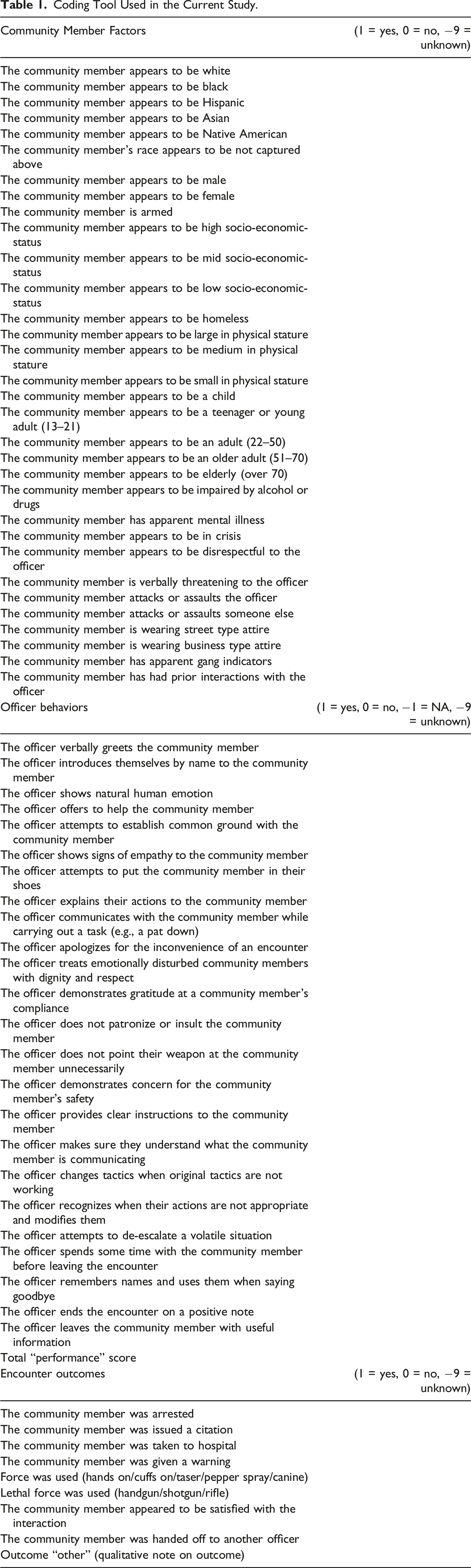
Coders (n = 5) were instructed that if the randomly sampled video contained multiple officers and/or community members, they were to select an interaction between one officer and one community member that contained the most information to code in order to obtain a complete as possible understanding of it. Coders were also advised that officers themselves might have access to contextual information that the coder did not.
For a detailed description of the validation of the coding tool used, please see Elkins‐Brown et al. (2023). In brief, five coders were trained on what the items meant, and participated in an iterative inter-rater reliability exercise to increase their agreement for items, allow for the specification and adjustment of item meanings among raters, and address potential threats to content validity within the items. Krippendorf’s alphas and a multilevel simultaneous component analysis were used to assess inter-rater reliability and the component structure of ratings, respectively. The lower bound of unweighted means of bootstrapped alphas ranged from .67 to .96 depending upon item type, and 21.60% of the total variance in raters was between-subjects.
Hypotheses
Community member characteristics (race and ethnicity, socio-economic status, gender, age, physical stature, attire, and gang indicators) will significantly influence overall officer performance score.
Community member characteristics (race and ethnicity, socio-economic status, gender, age, physical stature, attire, and gang indicators) will significantly influence specific officer behaviors.
Community member characteristics (race and ethnicity, socio-economic status, gender, age, physical stature, attire, and gang indicators) will significantly influence outcomes.
Community member mental/emotional states (mental illness, being in crisis, being substance impaired, being disrespectful) will significantly influence overall officer performance score.
Community member mental/emotional states (mental illness, being in crisis, being substance impaired, being disrespectful) will significantly influence specific officer behaviors.
Community member mental/emotional states (mental illness, being in crisis, being substance impaired, being disrespectful) will significantly influence outcomes.
A community member being armed, assaulting the officer or another person, or indicating threat will significantly influence overall officer performance score.
A community member being armed, assaulting the officer or another person, or indicating threat will significantly influence specific officer behaviors.
A community member being armed, assaulting the officer or another person, or indicating threat will significantly influence outcomes.
Analytical Strategy
Descriptive statistics were generated to investigate averages, variance, frequencies, and cross tabulations within the data. All inferential analyses were conducted in SPSS (v25) using the MIXED and GLM functions. To account for heteroskedastic, non-spherical, and missing data, multilevel mixed-effects models were calculated for all analyses.
Linear models were generated for officer performance scores, and separate binary logistic models were generated for specific officer behaviors, and encounter outcomes. Nesting scores within officers, all models used a restricted maximum likelihood method for fitting and an unstructured covariance matrix and Satterthwaite method to estimate random intercepts for each officer for all fixed effects.
Results
Frequencies of Community Member Factors, Officer Behaviors, and Encounter Outcomes
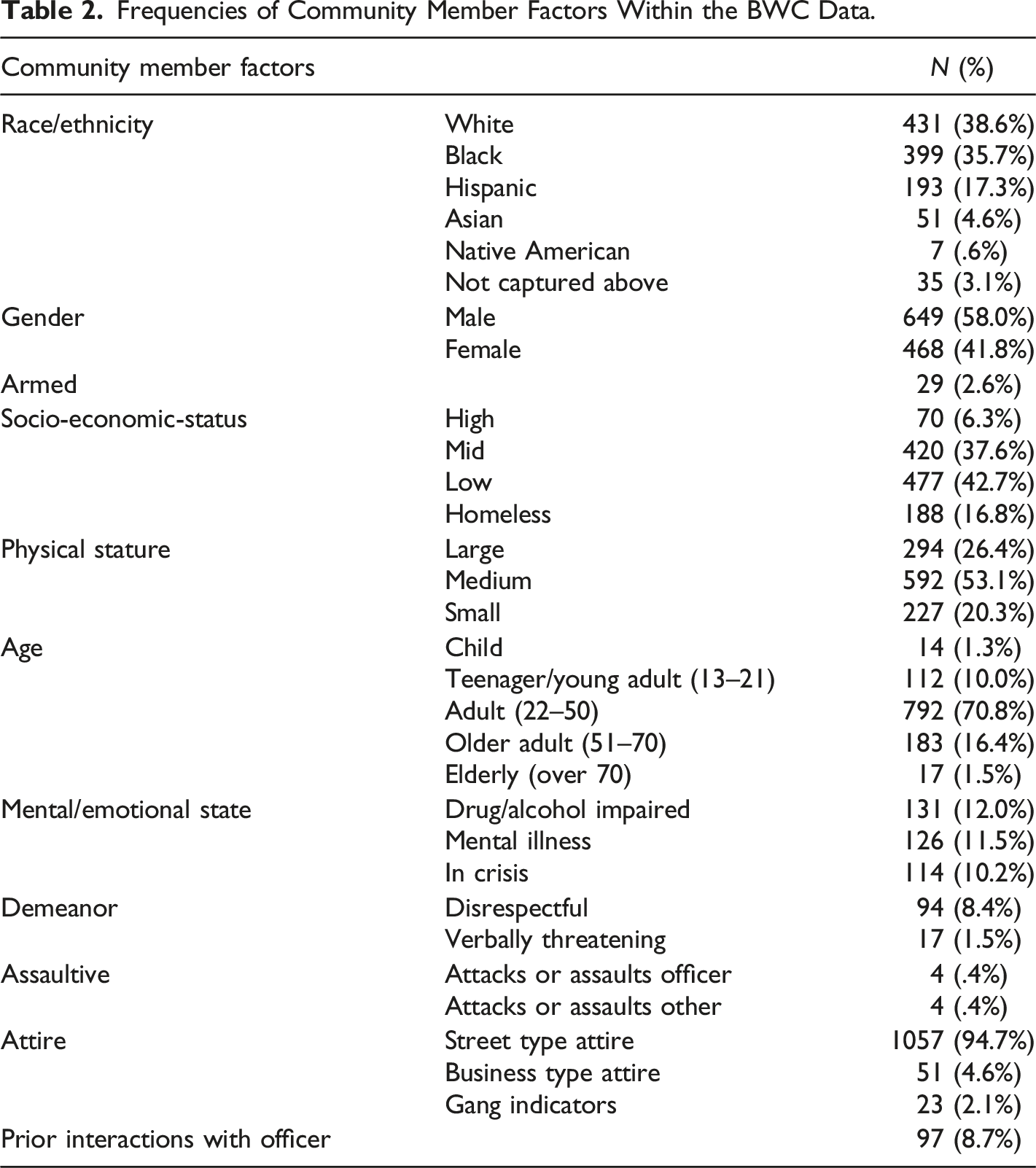
Frequencies of Community Member Factors Within the BWC Data.
Frequencies of Officer Behaviors Within the BWC Data.
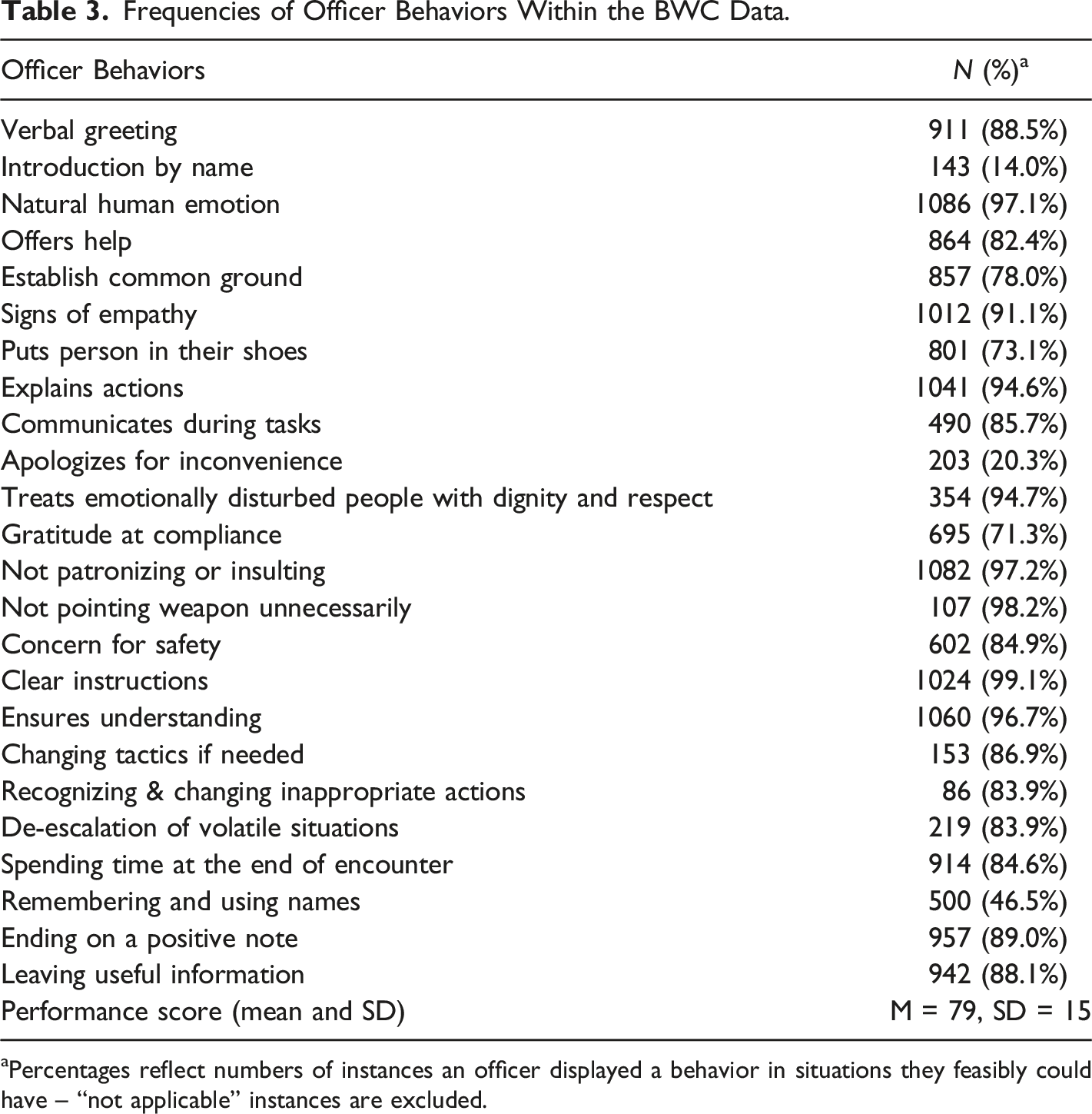
aPercentages reflect numbers of instances an officer displayed a behavior in situations they feasibly could have – “not applicable” instances are excluded.
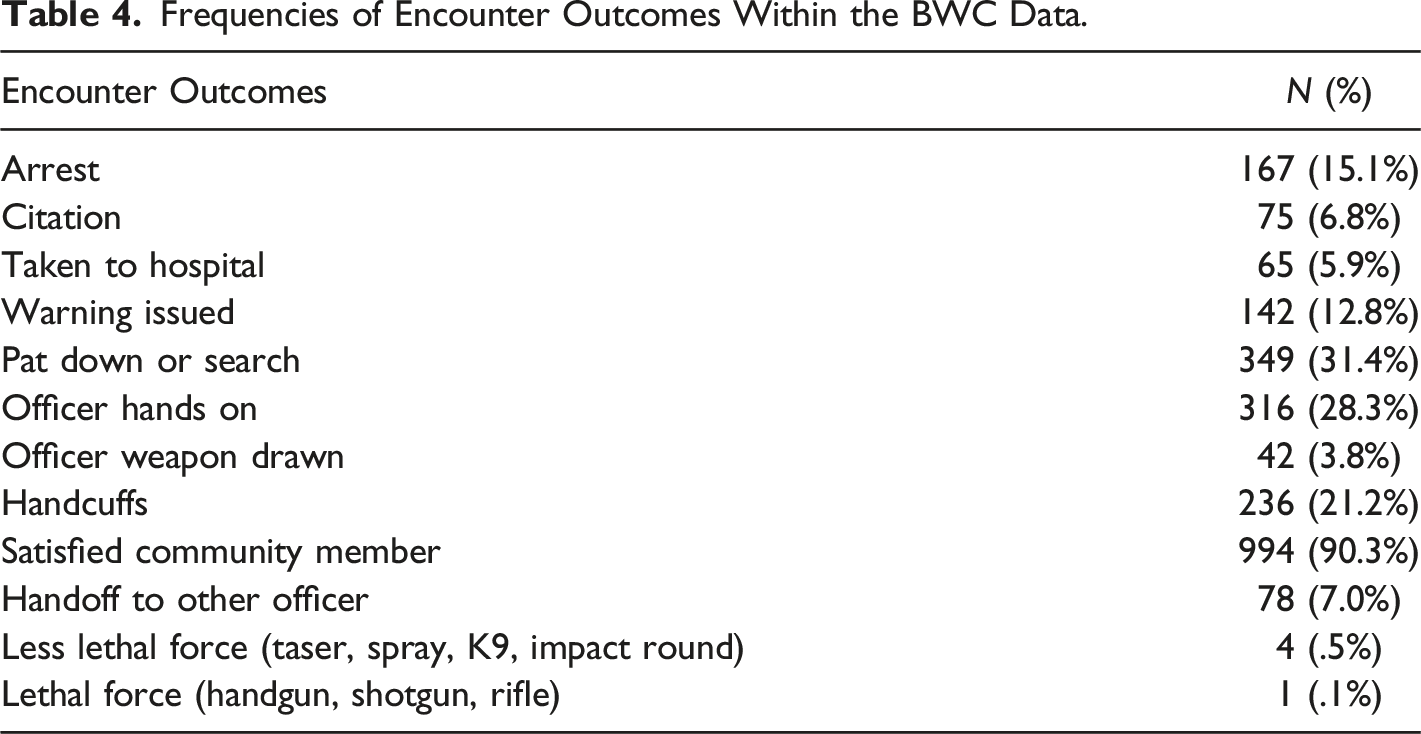
Frequencies of Encounter Outcomes Within the BWC Data.
Mixed Model Results by Research Hypothesis
Significant Predictors for Each Research Hypothesis.
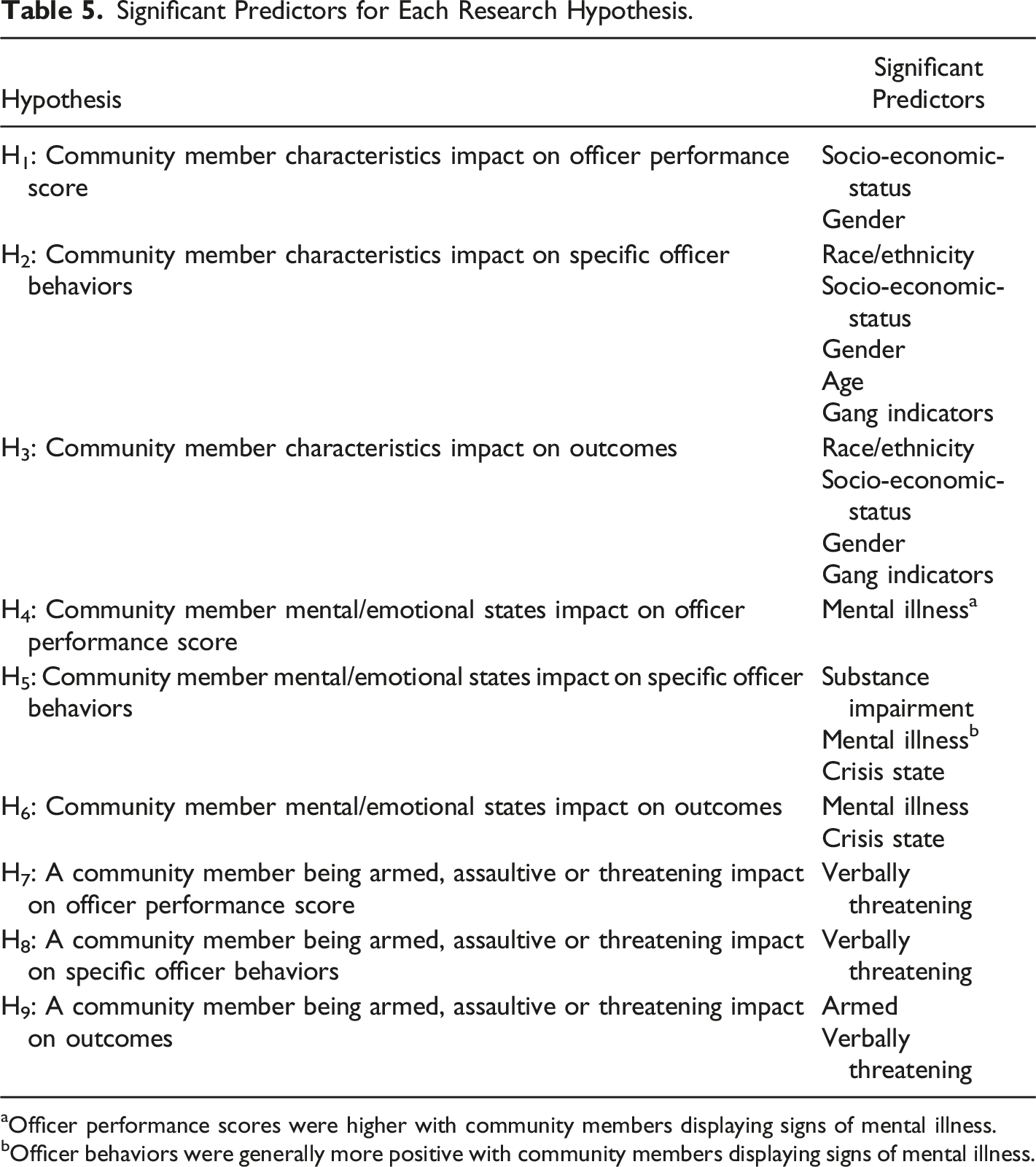
aOfficer performance scores were higher with community members displaying signs of mental illness.
bOfficer behaviors were generally more positive with community members displaying signs of mental illness.
Linear models revealed that the impact of community member race and ethnicity was not significant on overall officer performance score (p > .05 for all fixed race effects). Officers’ performance scores were similar across interactions with White (M = 80%, SD = 14%), Black (M = 79%, SD = 15%), Hispanic (M = 77%, SD = 14%), Asian (M = 81%, SD = 12%), and Native American (M = 79%, SD = 22%) community members. It is important here to note that several officer behaviors that were coded as outcomes (such as patting down or searching a community member) were significantly influenced by community member race and ethnicity—see H3 below. Socio-economic-status (SES) was predictive of officer performance, with officers performing significantly worse in encounters with low SES community members (M = 78%, SD = 15%, B = −.03, p < .001) and community members suffering homelessness (M = 73%, SD = 18%, B = −.08, p < .001), compared to middle SES (M = 81%, SD = 13%) or high SES (M = 85%, SD = 10%) community members. The impact of gender was also significant on officer performance (B = .03, p < .01) with officers receiving higher performance scores in encounters with women (M = 81%, SD = 14%) than with men (M = 77%, SD = 15%). Age, physical stature, attire, and gang indicators did not predict officer performance. Thus, our first hypothesis was partially supported, as SES and gender both significantly predicted officer performance, while race, ethnicity, age, physical stature, attire, and gang indicators did not.
Very few officer behaviors were significantly influenced by the race or ethnicity of the community member they were interacting with. The exceptions were that officers were less likely to provide instructions to Native American community members (Wald = 8.9, p < .01), less likely to de-escalate volatile situations with Asian community members (Wald = 8.0, p < .01), and less likely to remember Hispanic community member names (Wald = 8.1, p < .01) or leave them with useful information at the end of an encounter (Wald = 3.9, p < .05). SES however had a broader impact of police behaviors, with officers being significantly less likely to do each of the following in encounters with community members suffering homelessness: • Greet the community member (Wald = 5.6, p < .05) • Offer to help the community member (Wald = 14.4, p < .001) • Establish common ground (Wald = 12.5, p < .001) • Show signs of empathy (Wald = 18.3, p < .001) • Put the community member in the officer’s shoes (Wald = 5.3, p < .05) • Apologize for the inconvenience of the encounter (Wald = 28.1, p < .001) • Express gratitude for compliance (Wald = 17.5, p < .001) • Not patronize the community member (Wald = 22.9, p < .001) • Express concern for the community member’s safety (Wald = 8.9, p < .01) • Recognize when actions are inappropriate and change them (Wald = 5.5, p < .05) • De-escalate volatile situations (Wald = 6.7, p < .05) • End the encounter on a positive note (Wald = 22.2, p < .001) • Leave the community member with useful information (Wald = 23.4, p < .001)
The other community member factor that significantly predicted officer behavior was gender, with officers significantly more likely to do each of the following in interactions with women: • Greet the community member (Wald = 4.1, p < .05) • Offer to help the community member (Wald = 18.2, p < .001) • Apologize for the inconvenience of the encounter (Wald = 7.4, p < .01) • Express concern for the community member’s safety (Wald = 8.9, p < .01) • Spending time with the community member at the end of the encounter (Wald = 6.0, p < .05) • Leave the community member with useful information (Wald = 5.6, p < .05)
Interestingly, attire significantly predicted several officer behaviors, with officers being less likely to do the following in interactions with people dressed in business attire: • Establish common ground (Wald = 13.2, p < .001) • Apologize for the inconvenience of the encounter (Wald = 4.8, p < .05) • Put the community member in their shoes (Wald = 11.8, p < .001) • Spending time with the community member at the end of the encounter (Wald = 7.3, p < .01)
Community member age, physical stature, and gang indicators for the most part did not significantly influence officer behaviors, with exceptions being that officers were more likely to introduce themselves by name to children (Wald = 4.6, p < .05), and less likely to express concern for community members with any gang indicators (Wald = 10.8, p < .001). Overall, SES and gender predicted many officer behaviors, offering partial support for our second research hypothesis.
Too few encounters resulted in use of force, either less lethal (n = 4) or lethal (n = 1) for statistical modeling. Race and ethnicity significantly predicted several outcomes of police-community member interactions, even when controlling for whether the community member was armed, threatening, or assaultive. 4 Black (Wald = 8.9, p < .01) and Hispanic (Wald = 4.9, p < .05) community members were significantly more likely to be patted down or searched. Black community members were significantly more likely to have officers put their hands on them (Wald = 8.2, p < .01). Black (Wald = 10.1, p < .01) and Hispanic (Wald = 4.6, p < .05) community members were significantly more likely to get handcuffed. Black community members were significantly less likely to be satisfied with the encounter outcome (Wald = 4.0, p < .05). Finally, Hispanic community members were significantly less likely to be taken to hospital (Wald = 4.1, p < .05). SES also predicted several outcomes, with community members suffering homelessness being more likely to be arrested (Wald = 18.2, p < .001), issued a citation (Wald = 11.8, p < .001), issued a warning (Wald = 17.7, p < .001), be patted down or searched (Wald = 87.3, p < .001), have officers put their hands on them (Wald = 60.8, p < .001), have officers draw weapons on them (Wald = 4.1, p < .05), and be handcuffed (Wald = 27.3, p < .001). They were also less likely to be satisfied with the encounter outcome (Wald = 12.5, p < .001). Gender consistently affected encounter outcome, with women being less likely to be arrested (Wald = 15.3, p < .001), receive citations (Wald = 6.1, p < .05), receive warnings (Wald = 5.9, p < .05), get patted down or searched (Wald = 57.2, p < .001), have officers put their hands on them (Wald = 63.8, p < .001), or get handcuffed (Wald = 51.2, p < .001). Women were also significantly more likely to be satisfied with the outcome of an encounter (Wald = 9.9, p < .01). The only other community member characteristics that predicted encounter outcomes were community members with gang indicators were more likely to get patted down or searched (Wald = 7.5, p < .05) and arrested (Wald = 6.3, p < .05). Overall, these findings support our third research hypothesis that community member characteristics such as race/ethnicity, SES, and gender influence the outcomes of police-community member encounters.
The sole community member mental or emotional state that significantly predicted officer performance was the community member showing signs of mental illness (B = .04, p < .01), with officers on average receiving higher performance scores during interactions with community members showing signs of mental illness (M = 81%, SD = 14%) than during interactions with community members not showing signs of mental illness (M = 79%, SD = 15%). For the most part, our fourth research hypothesis is not supported.
Officers were less likely to offer to help (Wald = 4.6, p < .05), more likely to patronize (Wald = 6.7, p < .05), and less likely to end the encounter on a positive note (Wald = 6.1, p < .05) with community members who were substance impaired. Officers were more likely to show concern for community members showing signs of mental illness (Wald = 7.6, p < .01), as well as spend time with them at the end of the encounter (Wald = 6.3, p < .05), and remember their names and use them when saying goodbye (Wald = 19.2, p < .001). When interacting with people in crisis, officers were less likely to greet the community member (Wald = 6.8, p < .01), try to establish common ground (Wald = 7.6, p < .01), apologize for the encounter (Wald = 5.2, p < .05), express gratitude at compliance (Wald = 8.5, p < .01), or remember the community member’s name and use it when saying goodbye (Wald = 8.0, p < .01). However, they were more likely to de-escalate volatile situations with community members in crisis (Wald = 6.1, p < .05). Community members being disrespectful significantly predicted several officer behaviors: they were less likely to have officers attempt to establish common ground (Wald = 5.2, p < .05), show empathy (Wald = 5.4, p < .05), show concern (Wald = 11.4, p < .001), express gratitude at compliance (Wald = 12.3, p < .001), end the encounter on a positive note (Wald = 11.4, p < .001), or leave them with useful information (Wald = 5.4, p < .05). Furthermore, officers were more likely to be patronizing to disrespectful community members (Wald = 4.4, p < .05). These results offer some support for our fifth research hypothesis that community member mental or emotional states will significantly influence officer behaviors.
Being arrested, receiving a citation, or receiving a warning were not significantly influenced by any community member mental or emotional states. Officers were significantly more likely to go hands on with community members showing signs of mental illness (Wald = 6.1, p < .01), yet less likely to go hands on with community members in crisis (Wald = 10.5, p < .01). Community members in crisis (Wald = 5.2, p < .05) were more likely to end up in handcuffs. Community members in crisis (Wald = 8.6, p < .01) and disrespectful community members (Wald = 14.7, p < .001) were less likely to be satisfied by the encounter outcome. Community members in crisis were less likely to get patted down or searched (Wald = 7.4, p < .01). Both community members in crisis (Wald = 29.5, p < .001) and community members showing signs of mental illness (Wald = 38.2, p < .001) were more likely to get taken to the hospital. Finally, community members in crisis were significantly more likely to get handed off to another officer (Wald = 7.6,p < .01). These results indicate limited support for our sixth research hypothesis.
Too few instances of community members assaulting officers (N = 4) or other people (N = 4) were observed to allow for statistical modelled. Of the remaining two variables, a community member being armed did not predict officer performance, while a community member being verbally threatening did (B = −.14, p < .001). Officers receiving an average score of 65% (SD = 19%) when faced with verbally threatening community members and an average score of 79% (SD = 14%) when faced with non-threatening community members. This offers partial support for our seventh research hypothesis, however the numbers of armed (2.6%) and verbally threatening (1.5%) community members are too low to be reliable.
A community member being armed did not significantly predict any officer behaviors. Models revealed that officers were less likely to do the following with community members who were verbally threatening: • Show natural human emotion (Wald = 9.3, p < .01) • Establish common ground (Wald = 4.3, p < .05) • Show signs of empathy (Wald = 21.8, p < .001) • Put the community member in their shoes (Wald = 7.6, p < .01) • Express gratitude for compliance (Wald = 5.5, p < .05) • Not be patronizing to the community member (Wald = 9.9, p < .01) • Provide clear instructions (Wald = 4.1, p < .05) • End the encounter on a positive note (Wald = 14.7, p < .001) • Leave the community member with useful information (Wald = 9.4, p < .01)
These results offer partial (but unreliable) support for our eighth research hypothesis.
Finally, community members who were armed were significantly more likely to be patted down or searched (Wald = 15.7, p < .001), have officers go hands on (Wald = 11.5, p < .001), have officers draw weapons on them (Wald = 18.6, p < .001), be handcuffed (Wald = 13.7, p < .001), and get arrested (Wald = 14.1, p < .001). Community members who were verbally threatening were less likely to be satisfied with the encounter outcome (Wald = 34.1, p < .001), and more likely to be patted down or searched (Wald = 7.3, p < .01), have officers go hands on (Wald = 5.2, p < .05), be handcuffed (Wald = 15.0, p < .001), and be taken to hospital (Wald = 8.0, p < .01). These results offer some support for our final hypothesis, although given the very small numbers of community members who were armed or verbally threatening in the data set, they are of limited use.
Discussion
From the large number of hypotheses tested, a picture of sorts emerged. On average, officers tended to perform reasonably well across encounters, demonstrating 79% of desirable, achievable behaviors. Many behaviors were extremely common (demonstrated over 90% of the time when feasible to do so), such as showing natural human emotion, showing signs of empathy, explaining actions taken, not patronizing or insulting community members, providing clear instructions, and ensuring community members understood instructions. These findings align with several studies using Strategic Social Observation (Terrill & Reisig, 2003; Todak & James, 2018) that have generally found that officers tend to treat people civilly. Other behaviors were less frequently observed however, and notably rare were instances of officers introducing themselves by name, or apologizing for the inconvenience of encounters. In addition, officers were consistently influenced by socio-economic-status (SES) and gender, treating individuals suffering homelessness worse than higher SES individuals and treating women better than men. These findings align with previous researchers’ assertions that SES is a leading predictor of police behavior (Mastrofski et al., 2016).
Although community member race and ethnicity did not predict overall officer performance, several behaviors that were coded as outcomes (such as patting down or searching a community member) were influenced by race and ethnicity and are discussed below. In addition, certain routine actions that were coded as behaviors were influenced by community member race and ethnicity, such as officers being less likely to remember Hispanic community member names or leave them with useful information at the end of an encounter. This echoes prior studies that have highlighted specific discrimination against Hispanic community members (Solis et al., 2009). The mental or emotional states of community members also factored into how officers treated them, most notable was that officers tended to perform better with individuals displaying signs of mental illness. Here our findings diverge from previous literature, which tends to suggest officers discriminate against community members with mental illness (Johnstone, 2001). All the patrol division in the test department had received Crisis Intervention Team (CIT) training, potentially influencing this particular result. Specific officer behaviors that were influenced by community member mental illness included an increased likelihood to show concern, spend time with them, and remember their names and use them when saying goodbye. From a policy perspective, CIT training efforts that emphasize these caring behaviors might continue to promote more positive interactions between police and community members suffering with mental illness.
The impact of community member characteristics on encounter outcomes was broader than their impact on officer behavior. For example, community member race and ethnicity predicted several encounter outcomes, with Black and Hispanic community members being more likely to be to be patted down and to get handcuffed (even controlling for armed status and verbal threat). These findings align with the majority of the policing scholarly literature (Braga, 2016; Crawford, 2000; Fridell & Lim, 2016; Lange et al., 2005; Terrill & Mastrofski, 2002). As with many previous studies, our race and ethnicity findings highlight the challenge of extracting police discrimination or bias from disparate outcomes. For example, we found that officers received similar overall performance scores with Black compared to non-Black community members during encounters, however Black community members were more likely to end up in handcuffs, even when not armed, threatening, or assaultive. In other words, officers were equally civil, friendly, and professional, and yet outcomes for Black community members remained worse, suggesting discrimination of some kind might still be at play. From a policy perspective, perhaps education efforts that highlight the importance of police accountability for discriminatory impact (and not just discriminatory intentions) is warranted. Many implicit bias training programs, racial healing initiatives, and community engagement efforts incorporate this distinction. Of note, at the time of this study, officers in this department had not received implicit bias training, however they were scheduled to complete it in the months following the study.
Other community member characteristics that consistently predicted the outcomes police-community interactions were SES and gender, with individuals suffering homelessness being more likely and women being less likely to be arrested, issued a citation or warning, patted down, have weapons drawn on them, or handcuffed. Many bias training programs focus predominantly or exclusively on community member race and ethnicity, and these results suggest that an increased focus on SES is warranted, particularly around how officers treat people suffering homelessness. This was the only variable that significantly predicted an officer pointing a weapon at a community member unnecessarily, and (together with substance impairment) patronizing or insulting the community member. Most officer behaviors were significantly influenced by homelessness, suggesting that officers in this sample did indeed discriminate against members of this community. Policy implications include increased anti-bias training efforts that focus on (or at least include) attitudes and behaviors towards people suffering homelessness. Community members who showed signs of mental illness or were in crisis did have several disparate outcomes, the most notable (and perhaps most encouraging) of which was that they were more likely to be taken to hospital. Again, given this department’s CIT training this was to be expected. The final variable worth noting was the impact of being armed, which unsurprisingly influenced the outcomes of many police-community encounters. Community members who were armed were more likely to be patted down, have weapons drawn on them, handcuffed, and arrested. Worth reiterating however was that the proportion of community members who were armed was tiny (2.6%), limiting the reliability of these findings.
Study results need to be interpreted in light of several limitations. First, these data were collected in 2019, before the Covid-19 pandemic and the civil unrest following the murder of George Floyd, both of which greatly impacted police-community interactions. Generalizability of these findings to today is consequently challenging, and additional data collection efforts post 2020 are important to determine whether the influences of police behaviors and the outcomes of police-community encounters have changed. Second, our over 1,100 BWC videos from a 12-month time frame included only 5 uses of force (approximately half a percent) above either an officer drawing a weapon or putting their hands on a community member. This made it impossible to statistically model the impact of community characteristics on lethal force for example. These numbers of force incidents are low both because use of force at the level of Taser, impact round, or lethal force is rare, but it is also possible that several uses of force were not included in our sample due to active Internal Affairs investigations. We had access to BWC footage of force incidents only once the cases were closed. Based on our knowledge of the city we sampled from, we anticipate the number of missing BWC videos based on open investigation was low. Third, some contextual information around the police-community interactions we had access to might have been missing. For example, information from dispatch regarding the nature of the call or any underlying offenses that were not discussed or captured on BWC. Forth, several metric items used in the current study are inherently subjective. Despite extensive rater training and reliability testing, this needs to be acknowledged as a study limitation. For example, community member items such as suffering homelessness might not be entirely clear during an encounter, whereby one rater might code it as “yes” and another rater might code it as “unknown.” To try and limit subjectivity, in any instance with ambiguity, we encouraged an “unknown” response. This same rule applied for community member race and ethnicity. Similarly, several police performance items are not cut and dry either. For example, “pointing a gun at a community member unnecessarily.” It is possible that our RA (student) raters might not consider a situation to warrant a draw and direct where a police officer would. In any case when weapons were drawn we asked the raters to check in with the study investigators to ensure consistency with department protocols and procedures. Despite these steps to try and reduce subjectivity in responses, there is little doubt that many items are up to at least some interpretation, and that is a limitation of the coding tool. We argue that their inclusion is important for understanding and scoring the nuances of police-community member interactions, however this limitation does need to be acknowledged.
Conclusions
In this study, we used interval level metrics to code a random sample of BWC to establish the impact of community level factors on police behaviors and the outcomes of police-community member interactions. Our goal was to determine whether police receive higher overall performance scores when interacting with some types of community members compared to others, whether community member factors predict specific officer behaviors, and whether community member factors influence the outcomes of police-community interactions. We found that officers received higher performance scores when interacting with women and lower scores when interacting with community members suffering homelessness. We also found that officers tended to receive higher performance scores when interacting with community members with mental illness. We found that community member socio-economic-status (SESs) and gender tended to be the most common predictors of officer behaviors, while community member race and ethnicity, SES, gender, and whether they were armed tended to predict encounter outcomes. We suggest implicit bias training programs (and other anti-bias efforts) expand their focus on SES, particularly to address discrimination against members of the homeless community. We also suggest that such programs incorporate education on the importance of discriminatory racial impact—which was evident within our data—and not just intentional racial discrimination, which appeared to be rare within this study.
Footnotes
Declaration of Conflicting Interests
The author(s) declared no potential conflicts of interest with respect to the research, authorship, and/or publication of this article.
Funding
The author(s) disclosed receipt of the following financial support for the research, authorship, and/or publication of this article: Funded by National Institute of Justice (NIJ) grant # 2017-R2-CX-0024
