



Abstract
This paper presents the results of a multi-method case study with a British police force carried out over a 2-year period examining the impacts of introducing body-worn cameras (BWCs). Our findings show that despite a broad enthusiasm for the potential of BWCs, police officers and staff in a British police force reported a series of unintended and undesirable consequences resulting from the introduction of BWCs. These impacts appear to have partly undermined some of the original intentions of introducing BWCs, such as improving policing standards, aiding prosecutorial processes thanks to improved evidential capture and reducing police officer workloads.
Introduction
In recent years, a series of high-profile policing incidents in the US and elsewhere have brought considerable tension to public-police relations. Such incidents, including police brutality and the deaths of citizens in police custody, have at times resulted in large-scale protests and contributed to the growth of movements such as Black Lives Matter and Reclaim the Streets. This tension has been partly induced by the new visibility of the police (Goldsmith, 2010), facilitated by the rapid proliferation of affordable mobile video capture devices and the wide dissemination opportunities available via social media (Spiller and L’Hoiry, 2019). Video captures of alleged police misconduct are now commonplace on social media and have often prompted public discussions concerning the policing of some groups including ethnic minorities and women. Within this challenging context, Body-Worn Cameras (BWCs) appear to have been treated by some police organisations as the panacea to the challenges of police legitimacy and public (dis)trust in a climate of financial austerity. This is particularly so in the UK where the National Police Chiefs’ Council has emphasised the potential for BWCs to deliver ‘swifter, fairer and more importantly cheaper justice’ (National Police Chiefs’ Council, 2015). These lofty ambitions are reflected in the relentless uptake of BWCs in England and Wales where all 43 police forces have now initiated BWC programmes (Ng and Skinns, 2021). Despite some dissenting views, the added attraction of BWCs is the considerable police and public support for this technology (White and Malm, 2022). It is against this backdrop that this paper draws on a range of qualitative data from a study of a British police force to show that according to police practitioners, the introduction of BWCs in one British police force appears to have in some instances unintentionally undermined the very goals it was intended to achieve.
The data presented in this paper focus on the concerns raised by police officers and staff about negative consequences of introducing BWCs, according to their experiences at the time of the study. However, we wish to note at the outset of this paper that participants in this study expressed generally positive attitudes towards BWCs and a belief in their potential benefits. Participants were therefore, in the main, supportive of the use of BWCs. We discuss these findings in greater detail elsewhere (see Harrison et al., 2022) but we can note here that participants expressed a belief that BWCs ought to afford officers greater protection from unfounded public complaints and held the potential to improve policing standards thanks to the apparent transparency and accountability BWCs would bring. Participants also frequently referenced their beliefs in the evidential value of BWC footage in supporting prosecutions. Belief in these benefits are echoed in several (but by no means all) existing studies which have reported attitudes among police officers that BWCs can, echoing the views of participants in this study, protect the police from unfounded public complaints (Koen, 2016; Pelfrey and Keener, 2016), provide stronger evidence (Jennings et al., 2014) and improve various aspects of police performance (Davies, 2022; McLean et al., 2015). What is perhaps interesting is the fact that the positive attitudes of participants in this study appear to rely on a belief that the benefits of BWCs will emerge in time, despite participants’ experience at the time of the study suggesting that these benefits had not yet fully materialised (or had not materialised at all). This arguably speaks to the disjunction between the ‘desired futures’ (Kester et al., 2020: 88) to be brought about by the introduction of new technology and the lived reality of participants in this study.
Impacts of body-worn cameras on policing: A mixed picture
Despite BWCs initially being rolled out across many policing organisations in a relatively ‘low research environment’ (Lum et al., 2019: 95), research concerning BWCs has rapidly expanded in recent years. Such work has demonstrated a series of benefits to emerge following the introduction of this technology but has also raised concerns about the impacts of BWCs across several aspects of policing and criminal justice processes. In this section, we discuss some of this research as relevant to the themes explored later in the paper. It should be noted that a considerable body of research on BWCs is not discussed below because it is not relevant to the themes explored in this paper. This includes literature concerning the impact of BWCs on officer use of force, citizens’ perceptions of BWCs and impacts on public complaints against the police following the introduction of BWCs.
One strand of BWC research concerns the extent to which the introduction of this technology has impacted non-violent interactions with the public. For instance, studies have examined the rates of citations 1 and arrests as related to the presence of BWCs although results appear to be mixed. Some studies report an increase in arrests and citations (Braga et al., 2018) while others found decreases in such outcomes (Ariel, 2016). Others found no discernible difference in arrests and citations before and after the deployments of BWCs (Grossmith et al., 2015; White et al., 2018). Reflecting more broadly on police-public encounters, Rowe et al. (2018) suggest that during their ethnographic observations of officers wearing BWCs, interactions with the public were at times negatively impacted by the presence of BWCs, with officers acting robotically when dealing with members of the public, turning such interactions from ‘a relaxed exchange’ to something more ‘constrained and scripted’ (2018: 88). Relatedly, they predicted that these new interactions together with the overt surveillant nature of BWCs may mean that the police are ‘much less likely to gather intelligence [from the public] than previously’. On this point, Lum et al. (2015) have queried whether privacy concerns may dissuade citizens from disclosing information to officers wearing BWCs although research has not conclusively demonstrated this concern in practice (see, for example, Grossmith et al., 2015).
Exploring another aspect of police-public interaction, Ng and Skinns’s (2021) study in the UK critiqued the impact of BWCs in the context of voluntary at-scene interviews (VASI) with suspects. They argue that BWCs have at times induced officers to take part in a variety of poor interview practices which may have been avoided had interviews taken place in police interview rooms, as they did prior to the introduction of BWCs. Poor practices included conducting interviews in settings unsuitable for full and accurate recording of conversations, basic errors made by officers concerning suspects’ legal rights during VASIs, and in one case, conducting an interview with an individual who appeared to be intoxicated. These practices were deemed by the authors as potentially leading to the gradual erosion of legal protections (2021: 653).
Research has also examined the impact of BWCs on another aspect of police officers’ everyday practice, report writing. Dawes et al. (2015) found that BWC footage acted as a valuable memory aid, and that officers were able to note and correct errors in their reports after viewing footage. Several studies have echoed these findings (see Boivin and Gendron, 2022; Koen et al., 2019; Koen and Mathna, 2019), although it is worth noting that several participants in these studies explained that the improvement in their report writing practices was partly induced by concerns that inconsistencies between officers’ reports and BWC footage would be picked up by supervisors or defence attorneys. In Newell and Koen’s (2023) study, viewing BWC footage prior to writing reports was not common practice. Importantly however, officers chose to review BWC footage if they anticipated that reports and footage may later be subject to scrutiny by supervisors or lawyers. This practice was linked to frustration and suspicion among some officers that BWC footage could be used to undermine officers’ reports and recollections of incidents, with one participant lamenting that an officer’s ‘word means nothing anymore’ (2023: 10) without corroborating BWC footage. Similar reflections are found in Pickering’s (2020: 397–398) study, where police officers expressed frustration that their ‘word is not good enough’ unless it is supported by BWC footage. A related issue was the consequent impact on prosecutorial decision-making, with Pickering’s (2020) participants arguing that BWC evidence had superseded officers’ testimony in the eyes of prosecutors to such an extent that they believed charges would not be brought against suspects without video evidence. This caused officers to feel disheartened and led to ‘strained relationships’ (2020: 399) with prosecutors. Similar concerns were reported by officers in Makin’s (2016) study, who added that watching BWC footage to improve the accuracy of their written reports had also increased their workloads.
The evidentiary value of BWCs and impacts on prosecutorial processes have also been explored although results appear to be mixed once more. Concerning domestic/intimate partner abuse, Owens et al.’s (2014) study in the UK reported that decisions to charge suspects were more likely when BWC footage was available. Similarly, Morrow et al. (2016: 313) found that the availability of BWC footage was ‘significantly more likely’ to result in arrests, charges, early guilty pleas and guilty verdicts at trial. Pimley et al. (2022) reported small increases in charges brought against suspects and in guilty verdicts following the introduction of BWCs, while Petersen et al. (2023) similarly found that for both domestic abuse offences and crimes committed against police officers, the presence of BWC evidence was associated with higher rates of conviction and/or adjudication withheld outcomes. 2 Elsewhere however, Yokum et al. (2017) found no statistically significant changes in judicial outcomes whether BWC footage was present or not. In the context of misdemeanour cases, White et al. (2021) similarly reported no impact linked to BWCs concerning guilty verdicts, although they noted that BWC evidence was linked to reduced case processing times. Moreover, White et al. (2021: 759) noted that BWC footage can both ‘implicate’ and ‘exonerate’, a reminder that the evidentiary benefits of BWCs should not be measured by guilty verdicts alone. Todak et al. (2022), also exploring misdemeanour cases, found that the presence of BWC footage significantly decreased case processing time for some types of incidents, such as driving offences, but also resulted in fewer guilty outcomes in court for these cases. The authors speculate that BWCs may have induced a new ‘CSI effect’ whereby juror expectations are that conclusive evidence of guilt ought to appear in BWC footage and without such evidence, jurors are less likely to find defendants guilty. This argument has been mentioned in research gathering the views of court users such as prosecutors and public defenders (Gaub et al., 2021). For instance, 66.9% of prosecutors surveyed in Merola et al.’s (2016: 7) study ‘feared that jurors might come to expect BWC evidence and that a lack of footage might lead jurors to question an account given by an officer or witness’. Moreover, although these studies reported largely positive attitudes concerning the evidentiary value of BWCs, respondents also raised concerns regarding increased workloads linked to reviewing and redacting BWC footage (see also McCluskey et al., 2019).
In the context of domestic/intimate partner abuse, Ellison (2018) has cautioned against the risk of victim alienation when BWC evidence is relied upon to bring prosecutions in cases where the alleged victim does not wish to attend court. She argues that ignoring the wishes of victims by relying on BWC footage may lead to fewer reports of domestic abuse (DA) (see also Saulnier et al., 2022). Drawing from focus groups with police officers in the UK, Lister et al. (2018) have also noted the potential for undermining DA prosecutions if BWCs capture footage which may be interpreted negatively in a courtroom, such as victims’ demeanour immediately after a violent incident. Smith et al. (2019: 2) have made similar claims in relation to other potentially prejudicial BWC footage, such as the contents of a victim’s home or other ‘case irrelevant background’ which may lead to victim-blaming assumptions being made by jurors. Harris (2020: 397) has echoed these concerns, explaining that BWCs are ‘incident-focused and cannot capture the history and context of [DA], but instead, one moment of a victim/survivor’s life’. She argues that this inherent limitation means BWC footage may exacerbate damaging stereotypes of DA victims if BWC evidence is unreflexively treated as ‘truth’. Similarly, Barlow (2023) has argued that many of these risks are particularly prominent in the context of coercive control where the impacts of such offences are often physically ‘invisible’ and therefore will be unlikely to be captured on BWC footage. Vakhitova et al.’s (2023) study in Australia echoes many of the discussions above. While police respondents in this study were broadly positive about the evidentiary value of BWCs in domestic and family abuse contexts, they also raised concerns as to the discretion exercised by officers in their use of BWCs and the nature of BWC footage which may lead to misidentification of victims should they not act as ‘ideal victims’.
We situate our paper within this growing corpus of research which is raising concerns as to the impacts of BWCs in certain settings. In this paper, we add to the work outlined above by drawing on police officers’ reflections of the unintended consequences to emerge from the roll-out of BWCs in a British police force, and whether these consequences work against the initial stated intentions of introducing this technology.
Methods
The paper takes a qualitative multi-methods design approach (Bryman, 2012) involving ethnographic observations, a qualitative-oriented survey and one-to-one interviews with serving police officers and staff. Synthesising these methods, we present a case-centred study that focuses on the rollout of BWCs in a British police force in the North of England, referred to as Northern Police. 3 Two researchers collected data and are employed by academic institutions and therefore have no formal affiliation to Northern Police. Based on the number of serving officers, Northern Police may be described as a medium-sized force in the UK; however, the geographical footprint of the force is comparable to large forces and includes rural as well as densely populated urban areas. BWCs were first introduced by Northern Police in late 2016, with full implementation occurring in early 2018. Data collection took place between July 2018 and February 2020. BWCs are used by Northern Police across all policing activities.
Interview participants and their job roles.
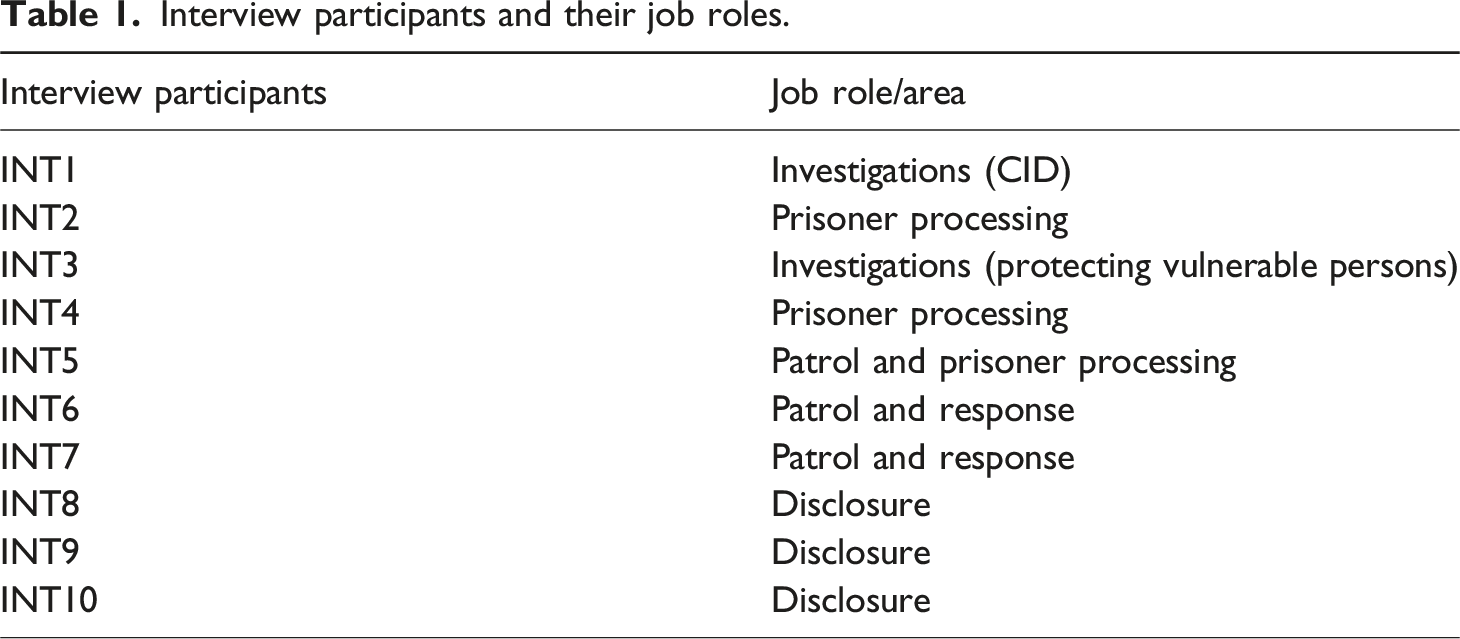
All data were thematically analysed and coded to identify meaningful and repetitive patterns in interviewees’ responses, revealing common experiences across different participants (Clark and Braun, 2013). Northern Police’s own BWC policy document was used to identify the force’s stated intentions for introducing BWCs. This provided a framework against which we sought to determine whether, according to participants, the aims of introducing BWCs had been achieved at the time of the study. Northern Police’s BWC policy identified six intended benefits: (1) Provide transparency, trust and confidence in the police leading to increasing legitimacy. (2) Enhance opportunities for evidence capture at incidents of crime and disorder. (3) Reduce the reliance upon a victim's evidence; particularly those who may be vulnerable or reluctant to attend court. (4) Provide independent evidence to improve the quality of prosecution cases. (5) Reduce various police workloads (by, for instance, increasing early guilty pleas and/or reducing officers case preparation and court time attendance. (6) Reduce complaints and protracted complaint investigations.
These are the categories against which participants’ responses were analysed and coded. Participants were not asked specifically about these benefits but were asked broader questions such as ‘What have been the advantages of introducing BWCs’? ‘Have you experienced any challenges following the introduction of BWCs’? Participants’ responses were then analysed and coded according to the intended benefits listed above. Participants did not make mention of any impacts arising from the introduction BWCs outside of the six intended benefits listed above despite being given the opportunity to do so (e.g. they were asked ‘Is there anything we have not discussed that you think is important’?). Participants were unable to offer reflections on the final benefit listed above, reduction in complaints, as they had not experienced this. We were not able to obtain data from Northern Police which evidenced a reduction (or otherwise) in complaints against the police following the introduction of BWCs during this case study and hence this is not discussed below. It should be noted that the benefits identified by Northern Police’s BWC policy are remarkably similar to those listed in other British police forces’ BWC policies. 4
To ensure the anonymity of all research participants, no police ranks are included in the data below. For the same reason, the gender, race or length of service of individuals is not referenced either. Rather, each participant is given an anonymised unique identifier which follows the primary data. The discussion below synthesises the various data collected in the study to present the dominant views of police officers across our sample concerning the impact of BWCs on their working practices. 5
Research findings
In the following section, we draw on police officers’ reflections on the use and impacts of BWCs in Northern Police and analyse these against the stated aims of introducing BWCs according to Northern Police’s own BWC policy. 6
Benefit 1 - Provide transparency, trust and confidence in the police leading to increased legitimacy
Northern Police, like many other forces, detail their belief in their BWC policy that BWCs will help to improve police standards, and therefore engender greater public trust and confidence in the police. Despite this ambition, participants detailed various instances in which they felt the presence of BWCs had detrimentally affected police practices. First, participants reflected that BWCs had given some officers misplaced new confidence and belief that they should carry out tasks beyond their capability and training. In one example which recalls Ng and Skinns’s (2021) reports of poor interviewing practices induced by the availability of BWCs, an officer expressed her belief that the introduction of BWCs in Northern Police had led some officers to conduct interviews with vulnerable witnesses despite not having received Achieving Best Evidence (ABE) training: ... instead of [following correct practice by] asking minimal questions in order to be able to know which way the investigation is going and what kind of offence is being disclosed, we’ve found they’ve started asking too many questions and almost conducting what we would do during an ABE. The difficulty that poses for us is that if there’s any variation in what the child initially says to what they tell us during an ABE… that then becomes an issue if it should go to court. (INT3)
Second, echoing the work of Rowe et al. (2018), participants described the presence of BWCs as stymieing officers’ use of discretion when interacting with the public. As a result, public-police interactions were described as more ‘wooden’ (SUR7163) than prior to the introduction of BWCs and some respondents explained that BWCs had made them feel ‘less confident and more apprehensive about [exercising discretion] … because big brother is watching us’ (SUR3830). One respondent even reflected that the presence of BWCs meant they had become less ‘fair’ since their ability to use appropriate discretion was limited due to the presence of BWCs and another officer reported being more ‘wary’ when interacting with the public than previously: I feel I am more formal in how I deal with people whereas before I felt I was fair and used discretion, I feel like I need to be more official and therefore prosecute more people for minor offences. (SUR2704) [Wearing BWCs] does make you question your own discretion and what you’ve done with the job. It does make you a bit more wary of what you’re doing, of your actions a bit more. (INT6)
Survey respondents also reported that BWCs had disrupted efforts to gather intelligence from the public: I spend more time trying to speak people around to give evidence, even when it is obvious they won’t... because it is on camera it has to be justified better. (SUR4519) [The camera] often has a negative effect as members of the public are less likely to speak and give information and intel whilst wearing BWV. (SUR9114)
These reflections align to Rowe et al.’s (2018: 88) predictions that the overt surveillant gaze of BWCs could make public-police interactions increasingly ‘constrained and scripted’, as well as officers being ‘much less likely to gather intelligence’ from the public. Thirdly, participants also noted a series of relatively minor ways in which the presence of BWCs had seemingly lowered existing working standards amongst some officers, particularly concerning evidential practices and report writing. A lot of officers think they don’t have to write statements, and [BWC footage is] the only evidence they need, and they take it as a bit of an excuse to be lazy and not do exactly what they should. (INT4) BWV has changed working practice regarding investigation. [Officers] are now failing to record basic evidence such as statements from victims. (SUR4032)
These reflections are contrary to existing studies concerning report writing which have reported positive impacts induced by BWCs (see Boivin and Gendron, 2022; Koen et al., 2019; Koen and Mathna, 2019). Though such issues could likely be remedied with improved training and greater familiarity with new working practices, participants explained that these problems did contribute to ‘confrontations’ (INT10) and resentment between colleagues.
Benefit 2 - Enhance opportunities for evidence capture
Participants expressed their belief that the introduction of BWCs had impacted the value afforded to existing forms of evidence by the Crown Prosecution Service (CPS), creating a new evidential hierarchy which negatively affected prosecutorial processes. Specifically, BWC footage is increasingly viewed as the most valuable type of evidence, with other evidence often treated as insufficient to proceed with prosecutions. This belief among officers in our study closely aligns to the views expressed in Pickering’s (2020) and Newell and Koen's (2023) work. Participants explained the following in the context of charging decisions made by the CPS: Before we had BWV, the officer’s statements were good enough, and now they’re saying: if we haven’t got the BWV, your statements are no longer enough. (INT9)
Another officer expressed his frustration at the lengthy delays incurred due to the CPS’s reluctance to make charging decisions without first viewing BWC footage: If you’ve got a [domestic assault] and you’ve got body-worn footage that you need as evidence, CPS won’t make a decision… you end up waiting 3 or 4 months for a copy of the BWV, for CPS to make a decision. (INT2)
Similarly, officers explained that any evidence gathered at the scene of an incident was expected by the CPS to have been captured on camera, despite the reality that this often isn’t possible. This in turn led to officer frustrations: If [police officers previously] had no BWV and stood outside a scene and somebody came and made a comment to them, that evidence would have previously been good enough, but because we’ve now got the BWV, it’s almost as if we expect that backup to [an officer’s statement] every time. (INT8) For almost every case we deal with now, a request for body-worn footage is submitted by the prosecution service, and if there is no footage, people ask why not. This can damage the case. (SUR6459)
This latter point on the absence of footage as causing ‘damage’ to prosecutions can be problematic in cases where no footage exists due to the fact that an officer may have simply forgotten to put their camera on. Examples of such oversights were witnessed several times during our ethnographic observations, with the observer believing these to be genuinely unintentional. The emphasis placed on BWC footage as the primary form of evidence required to proceed with a prosecution even led some officers to say that they had at times been tempted not to disclose the existence of such footage to the CPS. One explained: [Don’t] mention the body-worn footage when you’re trying to get a charging decision. That isn’t really how you should do it [but] if you can’t get [BWC footage] that day, you don’t mention it. (INT2)
Though officers confirmed they had never followed through with this temptation, the pressure on officers and the perceived hurdles linked to BWC footage as the only evidence deemed good enough to support prosecutions appears to be leading to considerable frustration among officers (Pickering, 2020).
Benefits 3 and 4 - Reduce reliance upon a victim's evidence, particularly those who may be vulnerable or reluctant to attend court; and provide independent evidence to improve the quality of prosecution cases
Northern Police, like many other forces, have championed the use of BWC evidence as a pathway to secure more convictions, with a particular emphasis on prosecutions in DA cases. However, several participants in our study reported that the introduction of BWCs had in some cases held back prosecutions for reasons including disclosure problems and lengthy delays in BWC footage being produced. Echoing concerns raised in existing research (see Harris 2020; Lister et al., 2018; Smith et al., 2019), participants argued that BWC footage itself could undermine the prosecution case. As one survey respondent explained: Recordings of comments or opinions given by officers (credibility of witnesses/beliefs) may undermine the integrity of the force or worst-case scenario undermine the case. (SUR7705)
Officers explained that lengthy delays in producing BWC footage were frequently due to redaction requirements meaning it was often several months before footage became available for the CPS to view. At this point, incompatible IT systems between the police and CPS could lead to further delays. Whilst most participants estimated normal delays of 3–4 months before BWC footage was appropriately redacted and available to disclose, one survey participant reported having waited 8 months for this in the past. These delays at times meant prosecutions were discontinued by the CPS and, according to one officer, ‘cases have been lost’ (INT5). Another interviewee explained: What we’re finding more and more is either cases are being dropped, which is the worst-case scenario, or [we’re] getting court orders that we must produce it. (INT8)
Another officer stated that while none of his own cases had been discontinued a number had come ‘quite close’ (INT4) and the long delays in obtaining redacted footage had placed him under exceptional pressure to produce BWC footage to avoid a prosecution being dropped. The sheer volume of BWC footage which some participants were required to review, redact and disclose was also highlighted by a survey respondent as ‘causing cases to be discontinued’ (SUR3372).
The apparent belief that BWC footage represents a new golden standard of evidence appears to have created a new layer of expectation on the police and the CPS to produce incontrovertible video evidence of alleged offences. Concerns as to this ‘new CSI effect’ have previously been raised by Todak et al. (2022) as well as, more broadly, concerns among officers that failure to capture all possible evidence on BWC footage will undermine prosecutions (Barlow, 2023; Pickering, 2020).
Benefit 5 - Reduce various police workloads
Despite the fifth intended benefit being to reduce workloads, Northern Police officers reported that the introduction of BWCs had brought significant new workload pressures and ‘was causing far more work’ (SUR3372). Uploading, reviewing and selecting relevant and disclosable footage during case preparation and redacting and sanitising footage for use in court were all tasks which took considerable time. When performing these tasks, officers were frequently under immense time pressure, working to custody and other timelines. One participant described footage sanitisation as ‘a complete nightmare. It’s so time-consuming’ (INT7), while another described this as ‘a mammoth job’ which ‘takes hours and hours for a ten-minute bit of footage’ (INT5). During one ethnographic observation, response officers wearing BWCs explained that the introduction of BWCs had not replaced any existing duties – they still had to respond to calls, arrange to meet witnesses and write everything up. Tasks associated with processing BWC footage were simply added to existing workloads but were often relegated to the bottom of their list of priorities.
Officers reflected that the promise of BWCs had perhaps blinded police leaders to the considerable infrastructure required to properly support the rollout of BWCs and the accompanying workload increases: I feel like BWV was implemented before there was enough back-office staff or training, I feel like they need to be switched off before that is improved. (INT10) It has become more of a burden than a blessing… I’m really disappointed that as a whole, we haven’t got to grips with it. (INT9)
These reflections align to workload concerns raised by prosecutors in Merola et al.’s (2016) study and echo the experiences of officers in Gaub et al.’s (2020) study who reported difficulties keeping up with BWC ‘tagging’ requirements within their existing workloads. Further, participants in our study specifically refuted Northern Police’s intention that the increased use of BWC footage in court would reduce the need for officers to attend court proceedings. One interviewee summarised the view of others in the study: No... you will always need an officer attending court, potentially, to give evidence or to clarify points because even body-worn doesn’t necessarily show everything, or how the officer felt or acted at the time. (INT1)
It appears therefore that while Northern Police’s BWC policy emphasises the hope that the use of BWCs would reduce (some) workloads for officers, the reverse seems to have occurred.
Discussion and conclusion
As with all research, this study has limitations. Relative to the size of Northern Police, a 15% response rate to our survey is relatively low. Likewise, a sample of 10 interviews is small but the purpose of the interviews was always to build on survey and observational data and thus the interviews are only one element of our mixed methods study. Like most qualitative studies, issues may be raised about the size of the sample more broadly with respect to generalisation of the findings. Moreover, the study also took place in a single agency, further limiting generalisability. We argue however that this study was deliberately designed to deliver a case study approach to understand the experiences and reflection of officers following the introduction of BWCs and to capture data at a specific place and time. We are also mindful of reflecting on why participants chose to take part in the study, especially as our sampling strategy was one of self-selection. It may have been that only those who had had negative experiences with BWCs volunteered to take part in the study and therefore the views expressed in the data above are skewed towards negativity. While we accept this as a limitation, our findings do correlate with other academic studies meaning that while the views of officers may not have been wholly representative of Northern Police, they are nonetheless valid. Our findings are therefore not generalisable, but offer valuable qualitative reflections from front-line officers, representing the type of data which scholars have previously argued should be afforded greater value in shaping police practice and research (Wood et al., 2008).
Notwithstanding these limitations, we situate our study as contributing to the body of work which has raised concerns as to the impacts of BWCs on policing practices. It is noteworthy that the key limitations of BWCs identified by participants echo the reflections of police officers in several existing studies. According our participants, the presence of BWCs appears to have negatively impacted some policing practices including officers’ use of discretion (Rowe et al., 2018); de-valued some forms of evidence such as officers’ accounts (Newell and Koen, 2023; Pickering, 2020); disrupted prosecutorial processes (Pickering, 2020); and increased workloads (Merola et al., 2016). In doing so, BWCs appear to be working directly against five of Northern Police’s six stated intentions of introducing this technology.
We draw particular attention to the feted status seemingly afforded to BWC footage as the new evidential standard par excellence. This deification of BWC footage suggests a ‘fetishization of technology’ (Cheeseman et al., 2018: 1397) and a belief that digital evidence is infallible. Two concerns emerge here. First, as Endicott-Popovski and Horowitz (2012) have previously warned, increasingly relying on digital evidence to secure convictions requires that all actors involved – the police, CPS, defence lawyers, judges and, critically, jurors – understand the benefits and limitations of this type of evidence. As they caution, ‘without an institutionalized understanding of the nature and use of digital evidence, we seriously risk a justice system increasingly subject to confusion and inaccuracy’ (2012: 80). This concern is echoed by BWC research focused on gendered violence and the ways in which uncritical viewing of BWC footage may exacerbate victim-blaming narratives in a court setting (Harris, 2020; Vakhitova et al., 2023). Second, we urge caution in the treatment of BWC footage as a form of impartial and incontrovertible evidence. Such beliefs fail to account for technological limitations and the role of the ‘human element’ (Smith, 2004: 377), including failure to follow correct practices, personal biases and discriminatory attitudes, and simple human error, all of which remain inherent features of all surveillance systems. Northern Police’s stated belief that BWC footage will deliver impartial and objective evidence (a belief repeatedly expressed by other police forces in the UK) is therefore troublingly uncritical and fails to account for the considerable potential for ‘differential and discriminatory policing’ (Norris and Armstrong, 1999: 8) imbued in all surveillance technologies. BWC research has explored many of these concerns with Newell (2021: 1) in particular arguing that viewing BWCs as impartial tools which can equalise power and oversight in the police-public relationship remains a ‘dangerous assumption. And in many cases it is wrong’. Treating BWC footage as the ‘objective truth’ (Fan, 2017: 951) is therefore fraught with considerable perils which may not have been fully appreciated by some police forces, including Northern Police.
It is clear that police organisations and associated stakeholders have invested considerable hopes and expectations in BWCs. Faced with ongoing financial constraints, public distrust and dissatisfaction, and increased challenges to police legitimacy, the prevailing hope among policing leaders in the UK was that BWCs could address many of these problems (NPCC, 2015). This appears to have led police forces into the reductive trap of believing that complex social problems could be resolved by new technological applications (Morozov, 2013). These hopes in turn may have blinded some police forces to the possibility that the impacts of new technologies in practice can be some distance from their intended visions (Latour, 1996). Acknowledging the concerns raised by front-line practitioners and working collaboratively with them to develop improved BWC training protocols and embed good practices may be a useful first step for a force such as Northern Police. In doing so, the involvement of front-line officers as key ‘knowledge workers’ (Wood et al., 2008) will be important, and the concerns of those individuals tasked with delivering the intended benefits of BWCs should not be dismissed merely as obstacles to be overcome (Lofstrand and Backman, 2021). More broadly, as Alpert and McLean (2018: 681) have stated, too many benefits of BWCs appear to be ‘assumed’ by police organisations including, arguably, Northern Police. As this paper and others have shown, expected benefits do not always translate into reality. The stated aims of introducing BWCs into police settings may therefore benefit from being less ambitious, and the re-drawing of expectations may be a useful step in bridging the gap between expectations and reality in the use of BWCs.
Footnotes
Acknowledgements
The authors would like to thank Dr Ros Williams (University of Sheffield) for commenting on a previous draft of this paper. We would also like to thank Danica Darley (University of Sheffield) for support in analysing data on this project. Finally, we wish to thank the two anonymous reviewers for their feedback on this paper.
Declaration of conflicting interests
The author(s) declared no potential conflicts of interest with respect to the research, authorship, and/or publication of this article.
Funding
The author(s) disclosed receipt of the following financial support for the research, authorship, and/or publication of this article: This work was supported by the N8 Policing Research Partnership (N8PRP Staff Exchange Fund 975700).
