




Abstract
Programmatic advertising has come to dominate the landscape of digital media planning. To prepare ad majors for their future careers in the industry, it is essential to teach students programmatic buying and provide them with hands-on experience. In this article, the authors present their approach of integrating teaching programmatic buying into a media planning course. A key feature of their educational package is a custom digital media buying tool developed by the authors. They hope this article will benefit other college educators in this field and spark further discussions on best teaching practices of programmatic buying and digital media planning.
Introduction
Programmatic advertising refers to “an automated big data system that allows organisations … to bid for the privilege to publish personalized online advertising in the right place, to the right people, at the right time” (Samuel et al., 2021, p. 2). Since its inception, programmatic advertising has revolutionized the digital advertising ecosystem by significantly reducing the expense and risks associated with traditional mass communication advertising, while greatly increasing targeting precision (Samuel et al., 2021). With the rapid advancement of artificial intelligence and computational advertising techniques, programmatic advertising has transformed the media planning process from purchasing exposures to a broad audience to fostering engagement with specifically targeted consumers (Araugo, Araujo, et al., 2020; McGuigan, 2019). Programmatic advertising is projected to account for 91.3% of total US digital display advertising in 2024, with spending reaching $157.35 billion (Lebow, 2024). The primary driving force behind programmatic advertising is programmatic video ads which largely challenge traditional TV advertising (Malthouse et al., 2018), while out-of-home (OOH) ads are also increasingly becoming programmatic (Lebow, 2024).
Given the significance and widespread adoption of programmatic advertising in today’s advertising industry, it’s crucial to prepare ad majors for this digital media planning trend, regardless of whether they pursue careers as digital media buyers. However, the major media planning textbooks on the market lack a detailed introduction to programmatic advertising and do not offer up-to-date digital media planning tools that include programmatic buying. The lead author of this article has been working to update his media planning course to emphasize programmatic buying but struggled to find a suitable tool that integrates programmatic buying into students’ media plan projects. With the significant assistance of the co-author, a digital media planner who engages in programmatic advertising extensively, the lead author has developed an educational package to systematically teach programmatic buying to advertising majors. This package, detailed in this article, includes lectures, guest speakers, the Trade Desk certification programs, and a digital media planning tool invented by the authors that incorporates both social media buying and programmatic buying. Presented as Excel files, this user-friendly tool includes digital media rates based on real-life data. This educational package not only introduces the technology, concepts, and principles of programmatic advertising but also provides hands-on experience in practicing programmatic buying with no additional financial burden on students.
Course Description
The lead author teaches programmatic buying in an undergraduate media planning course, a required course for ad majors at his institute. Seniors or juniors take this course after completing account planning and creative strategy and execution courses. The media planning course aims to equip students with the knowledge and skills necessary to strategically place advertising messages in traditional and digital media. The course focuses on analyzing various advertising media and developing strategies to address clients’ problems in the current media environment. The course is divided into two stages. In the first stage (i.e., the first half of the semester), students learn the basics of media planning, such as media math, audience analysis, competitive analysis, and media scheduling. In the second stage (i.e., the second half of the semester), students apply what they learned in the first stage to create a comprehensive media plan for an existing brand.
The most important assignment in this class is the media plan project, which is a team effort. Students work in groups of four or five. The project consists of two parts. In the first part, students conduct secondary research using various databases, such as IBISWorld, Mintel, Winmo, MRI Simmons, and SRDS, to understand the brand, industry, target audience, and competitors. The second part focuses on the planning process, where students propose a six-month media plan incorporating effective media strategies and tactics based on insights from their research. Each team must include both traditional and digital media in their plan, with the specific media mix and selection of vehicles determined by audience analysis, media analysis, and the unique needs and objectives of each brand. Traditional media planning is conducted using the simulation software associated with Media Flight Plan (8th edition) textbook (Martin & Coons, 2019), while digital media planning is performed using a tool developed by the authors. The lead author meets with students multiple times during the semester to discuss their projects, and students have opportunities to revise their media plans based on instructor feedback.
Teaching Programmatic Buying
Given the prominence of programmatic advertising in today’s digital media landscape, programmatic buying is a crucial part of the media planning course. The education package of programmatic buying in this course includes several key components: lectures on digital media buying, the Trade Desk Certificate assignments, guest speakers, and a custom digital media planning tool developed by the authors. These elements are designed to both teach students the fundamentals of programmatic buying and provide practical experience for their media plan projects.
Lectures on Digital Media Buying
Three lectures on digital media buying are given during the semester. The first lecture covers the basics of digital media buying, using paid search as an example. It emphasizes audience targeting as a crucial aspect of digital advertising and discusses several mainstream targeting techniques, such as contextual targeting, behavioral targeting, retargeting, and look-alike targeting. The second lecture focuses on programmatic buying. It introduces various types of programmatic ads, such as display, video, OTT/CTV, native, and OOH ads, and explains the mechanics of programmatic buying. Key components of the programmatic buying process, including data management platforms (DMPs), demand side platforms (DSPs), and supply side platforms (SSPs), are also covered, as well as real-time bidding and second-price auctions. The lecture concludes with tips for placing programmatic media purchases and a discussion on the pros and cons of programmatic buying. The third lecture centers on over-the-top (OTT) advertising. It explains the differences between OTT and linear TV, various types of OTT, and the process of purchasing OTT ads.
Trade Desk Certificates
In addition to in-class learning, students must also obtain certifications in two courses offered by the Trade Desk: Marketing Foundation and Data-Driven Planning. The Marketing Foundation course introduces “the concepts, language, and skills required to master programmatic advertising,” while the Data-Driven Planning course focuses on “the practice of media buying through data-driven marketing strategies” (The Trade Desk Edge, nd). Both courses feature self-paced eLearning videos, quizzes, and exams. To achieve certification, students must complete all video modules and pass the quizzes and exams at their convenience. Beyond earning credits in their media planning course, students receive industry-recognized certification badges for each online course completed, which highlight the specific skills acquired. These badges can be added to resumes, LinkedIn profiles, Facebook pages, and Twitter (X) accounts.
Getting students certified through the Trade Desk is a strategically important component of teaching programmatic buying in the media planning course. The Trade Desk is a leading “American multinational technology company that specializes in real-time programmatic marketing automation technologies, products, and services, designed to personalize digital content delivery to users” (The Trade Desk, nd). They provide business solutions to many media agencies for purchasing programmatic advertisements. Having students take the two online courses provides them with systematic training in programmatic buying, complementing classroom discussions, and preparing them for future job tasks.
Guest Speakers
Each semester, the lead author invites one or two guest speakers, all seasoned media buying professionals, to discuss programmatic buying. This group includes the co-author, who brings a wealth of experience in programmatic advertising. Inviting guest speakers is essential for teaching programmatic buying to ad majors, as they offer invaluable insights beyond the classroom, such as sharing real-life experiences with clients and offering tips of career development in the media industry.
Digital Media Planning Tool
Given the practical nature of media planning, it is essential for students to gain hands-on experience in creating media plans. As previously mentioned, the media plan group project is the most important assignment in this course. Students are required to incorporate both traditional and digital media into their plans. The planning of traditional media is carried out using the web-based simulation software provided by Media Flight Plan (8th edition) (Martin & Coons, 2019). While this software effectively demonstrates the complexities of buying traditional media, its digital media section is relatively simplified and outdated. The available digital options in the software contain general sites/ad networks, targeted sites/ad networks, video networks, publisher video sites, social, and mobile. This typology does not align with the current programmatic advertising landscape and fails to account for the complexities of social media advertising. Therefore, the authors created a custom digital media planning tool based on the co-author’s real-life experiences of purchasing digital media for the advertising purpose. The tool consists of two Excel files: a digital media plan template and a digital media rate sheet (see Web Appendix). Additionally, the lead author provides students with a step-by-step guide on how to use the tool. Figure 1 presents an example purchase using the tool. The following sections provide a detailed introduction of the tool based on this example. Digital media planning example.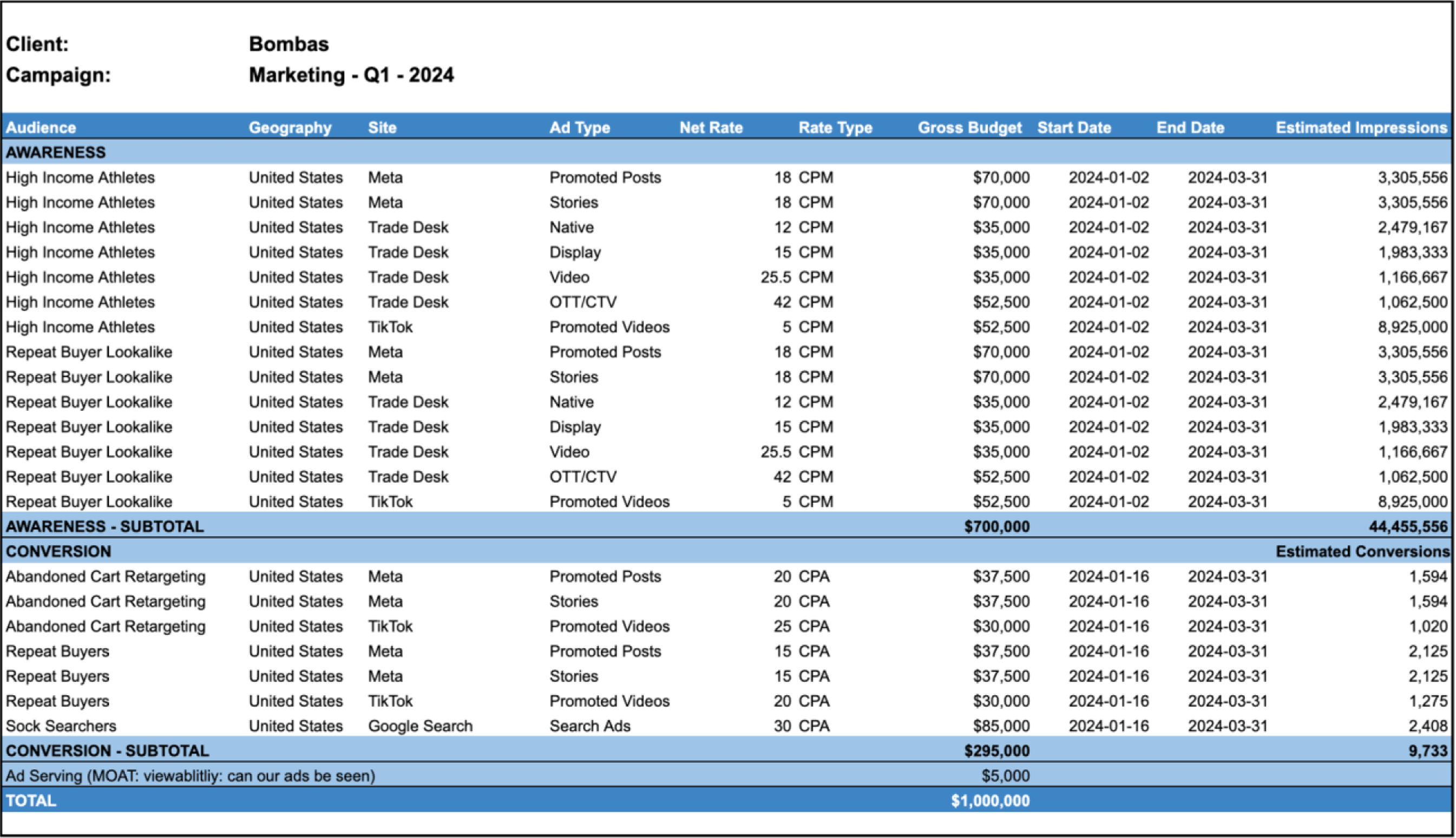
Decide Digital Budget
Before using the tool, students need to determine their digital budget for each quarter. This allocation must be made within the context of the entire media plan. Students are instructed to allocate the budget based on plan objectives, media use habits of the target audience, historical media buying patterns of their own brands and competitors, etc. In their media plan reports, students must indicate and explain the percentage of the budget allocated to traditional media and digital media, as well as the percentage of the digital budget allocated to each quarter.
The digital budget of each quarter is divided between the
Define Audience Groups
The next step is to define audience groups for digital media buying. During the first half of the semester, students have conducted a comprehensive target audience analysis using data from MRI Simmons. This analysis includes detailed information on the target audience’s demographics, lifestyles, and media use habits (covering both broad media categories and specific media vehicles). When defining digital audience groups, students are instructed to select specific segments within their overall target audience. They are advised to combine demographic and lifestyle indicators to name these groups. For example, “high income athletes” in Figure 1 combines the demographic indicator “high income” with the lifestyle descriptor “athletes.” Additionally, students are encouraged to use audience targeting terminology to create target audience groups, such as “repeat buyer lookalike” and “abandoned cart retargeting,” as illustrated in Figure 1. Students have the flexibility to create specific audience groups for digital media buying, provided these groups fall within the overall target audience of the entire media plan. In the media plan report, students must describe and justify the specific audience groups they defined.
Select Digital Sites and ad Types
After defining audience groups, students need to select digital sites and ad types for each audience group. They can select multiple sites for one audience group and multiple ad types for one site. These selections must be based on the media use habits of each audience group. A digital media rate sheet, provided to students as their shopping list (see Web Appendix), contains estimated CPM and CPA information for six mainstream social media platforms (Meta, LinkedIn, TikTok, Snapchat, Pinterest, and Twitter (X)), Google Ads (including search, YouTube, app download, and shopping), Amazon Ads (including sponsored product, sponsored brand, stores, posts, Amazon live, Amazon video, and Amazon audio), and the Trade Desk DSP (including display, video, native, and OTT/CTV). Among these options, the Trade Desk DSP represents programmatic advertising. While other DSPs exist, like Google’s DV360 and StackAdapt, companies typically choose one DSP to simplify internal employee onboarding, enabling employees to contribute to their teams more quickly. Sticking to one DSP also increases the amount of experience employees have with that software, in contrast with splitting that experience across multiple DSPs. This reduces the possibility for human error when building ads, since employees are more familiar with the software. The Trade Desk was chosen for this tool because it has the most functionality and features among all DSPs, and their customer service is responsive and helpful when troubleshooting in-platform issues. It is also because students in this class are familiar with the Trade Desk due to the certification assignments. To best reflect actuality, there is only one DSP included as an option in the rate sheet. The rate sheet also includes links to examples of each ad type.
While these CPM and CPA rates are derived from mean values formulated from extensive research conducted over the past five years, encompassing various industries and multiple advertising agencies, it should be noted that these costs are estimates. When these buys are made using real-time bidding, these rates are influenced by competition, ad quality, bid floors and ceilings, second-price auction bidding, and more. These additional variables prevent advertisers from knowing the exact rate before purchase. However, these discrepancies between estimated and actual rates are addressed in lectures so students are fully aware of how programmatic buying rates work.
Fill in Net Rates
After selecting the appropriate sites and ad types for each audience group, students must fill in the net rate for each ad type based on the digital media rate sheet. Each ad type has two net rates: one for CPM and one for CPA. Students need to ensure they fill in CPM rates in the awareness section and CPA rates in the conversion section. Please note that there are no CPA rates for Trade Desk display and native, so these two ad types are not applicable for the conversion session. And due to the extremely high CPM rate of Google Search, it is not recommended for achieving awareness goals.
Decide the Gross Budget
Students then need to determine the gross budget for each ad type, reflecting its importance in the digital media plan. They must provide justifications for their budget allocations. The total gross budget for all ad types in each section (awareness or conversion) must equal the total budget allocated to that section and factor in ad agency commission.
While commission is only applicable for advertising agencies and freelancers, its importance cannot be overstated. If commission is not factored into the budget, the agency will not generate revenue on that media plan (excluding any clients on a time-based retainer for paid media). Excluding commission can result in losses ranging from thousands to millions of dollars. Commission is the percentage of the total media plan cost that is allocated to the advertising agency as their compensation for their efforts. The commission amount may vary depending on the agreed-upon percentage, the volume or value of the sale, or any other predetermined factors. In a media plan, the net budget is the cost of media that is paid directly to vendors like Meta, the Trade Desk, and TikTok. The gross budget is inclusive of net costs, commission, and any additional fees.
Calculate Estimated Impressions and Conversions
Estimated impressions or conversions of each ad type are calculated to report the performance of the digital media plan using the following formulas.


It should be noted that 0.15 in the above formulas represents 15% agency commission fee. While different ad agencies may charge different commissions, the authors used 15% as a baseline to reflect standard agency costs in this tool. The template file (see Web Appendix) includes the programmed formulas in the first few rows of each section. Students should apply these formulas to additional rows as needed. The total estimated impressions or conversions are the sum of all individual impressions or conversions.
Geography and Time
Since students are required to create a national media plan, the geography column is filled with “United States.” The “start date” and “end date” reflect the specific period of the media plan. For example, in Figure 1, a digital media plan for Q1 of 2024 has a start date of 1/2/2024 and an end date of 3/31/2024.
Conclusion
This approach to teaching programmatic buying in a media planning course has received positive feedback from students. While they are not expected to master the underlying technologies of programmatic advertising, most students in the class feel comfortable discussing and practicing it by the end of the semester. Anecdotal feedback collected by the lead author indicates that students’ self-efficacy increased because they (1) learned key terminologies of programmatic buying, (2) heard real-life experiences in this field from guest speakers, (3) obtained certification from a major platform in the digital advertising industry, and (4) practiced programmatic buying in their class projects.
This teaching method, with a unique combination of getting certified with the Trade Desk and using the custom tool, lays a strong foundation for programmatic media learning. By teaching the fundamentals of how programmatic ads are bought and sold, as well as best practices for programmatic media planning, students will pick up channel-specific nomenclature and planning approaches that they can use in their advertising careers, providing them with knowledge that most companies spend weeks or even months teaching to new hires. Additionally, it lays the groundwork for further class discussion around minutiae of private marketplace deals, brand safety features, and other concepts yet to be developed within the industry. Digital media are constantly evolving, and this approach builds a solid base for programmatic media studies.
In writing this article, the authors do not claim that their practices are perfect. Several limitations exist, such as the tool including only a limited number of sites and ad types, rates being generalized across all industries, and only addressing two stages of the purchase funnel (awareness and conversion). The authors acknowledge that many college educators in this field have likely developed and adopted other effective approaches to teaching programmatic buying and/or digital media planning. They hope this article will inspire a broader discussion on best practices for teaching in this domain.
Eventually, the authors aim to design interactive digital media planning software where students can create their own media plans and experiment with the relationship between media rates and budget. Ideally, this software would be a collaboration between educators and industry leaders in the digital media planning and programmatic spaces. By providing students with a simplified version of existing software, they will both learn the fundamentals of programmatic media and how to utilize commonly used media planning platforms, better preparing them for the day-to-day needs of advertising agencies.
Supplemental Material
Supplemental Material - Teaching Programmatic Buying in a Media Planning Class
Supplemental Material for Teaching Programmatic Buying in a Media Planning Class by Linwan Wu and Allyssa Andrews in Journal of Advertising Education
Supplemental Material
Supplemental Material - Teaching Programmatic Buying in a Media Planning Class
Supplemental Material for Teaching Programmatic Buying in a Media Planning Class by Linwan Wu and Allyssa Andrews in Journal of Advertising Education
Footnotes
Declaration of conflicting interests
The author(s) declared no potential conflicts of interest with respect to the research, authorship, and/or publication of this article.
Funding
The author(s) received no financial support for the research, authorship, and/or publication of this article.

Supplemental Material
Supplemental material for this article is available online.
References
Supplementary Material
Please find the following supplemental material available below.
For Open Access articles published under a Creative Commons License, all supplemental material carries the same license as the article it is associated with.
For non-Open Access articles published, all supplemental material carries a non-exclusive license, and permission requests for re-use of supplemental material or any part of supplemental material shall be sent directly to the copyright owner as specified in the copyright notice associated with the article.
