




Abstract
The present study analyzes the effect on tipping when a gift is offered by servers, and shows that customers generously reciprocate that gift by significantly increasing gratuity. Making the norm of reciprocity focal by offering the identical gift at an opportunity to directly reciprocate, that is, concurrently with bringing the bill, even doubles this effect, indicating that service personnel can substantially—and effortlessly—raise their tips just by leveraging this reciprocity norm.
Introduction
Servers in German restaurants receive tips in the amount of up to €2.2 billion a year (Federal Census Bureau, 2018; Gössling et al., 2020). Since most of these servers only earn low wages, those tips are a substantial source of their income (Payscale, 2015). Understanding why customers tip and how to influence tipping has therefore important economic ramifications for those employed in the service industry (e.g., Azar, 2007). Aggregating empirical evidence gathered in the past decades, it becomes clear that more rational criteria such as food quality, service quality, service quantity, or expectation of future service actually affect tips very little (but see Lynn & Sturman, 2010). Instead, tipping behavior seems to be largely determined by social norms (e.g., Azar, 2007; Conlin et al, 2003; Gössling et al., 2020; Seiter et al., 2011; also see Lynn & McCall, 2009, 2016; or Banks et al., 2018, for comprehensive reviews of antecedents of tipping behavior). As suggested by Futrell (2015), tipping based on social norms can be further differentiated by norms based on obligation, and norms based on gratitude.
Indeed, Crespi (1947) found that fear of disapproval is the main reason why most people tip, which might explain why rational reasons like poor food or service quality do not decrease tips in a substantial way (Futrell, 2015). Likewise, Roberts et al. (2018) state that when dining in a local restaurant, people feel obliged to comply with social norms to maintain social acceptance. Similarly, Conlin et al. (2003) argue that tipping is largely due to an internal norm, that is not enforced through direct social sanctions, but by internalized feelings of guilt and shame. The results of Lynn’s and McCall’s (2016) meta-analysis that bill-size is the largest predictor of tip-size, accounting for twice as much variability as all other factors combined can also be interpreted in this way: since meeting the social norm of tipping means tipping a defined percentage, one is—given the bill-size—obligated to tip that specific amount. To strengthen this argument, Lynn (2014) shows that different perceptions of that obligatory tipping norm explain much of the variability of tip amount, further emphasizing the strong influence of obligation. However, if customers solely (or at least mainly) tip because they are complying with the social norm of tipping, they will generally give the nominal amount; but feel awkward (Futrell, 2015, also see Azar, 2007). This is potentially detrimental to the overall service experience, and might serve as a disincentive for repeat patronage (Futrell, 2015).
Instead of banking on customers to feel obligated to tip, we would rather argue that restaurateurs as well as servers should be inclined to evoke gratitude in their customers: Gratitude is not only an interpersonal emotional reaction to a specific benevolent act (Tsang, 2006), but, based on the social norm of reciprocity, should reliably trigger an equally well-meaning response in return (Gouldner, 1960). For restaurateurs, customers’ feelings of gratitude should lead to place attachment and thus longer lasting relationships and repeat patronage (Ryu & Lee, 2017; also see Line & Hanks, 2019). For servers, this gratitude should lead to reciprocal behavior by customers and therefore increased tips (Futrell, 2015). And indeed, the research that focused on benevolent acts like writing a helpful message on the back of the bill (Rind & Strohmetz, 1999), boxing customers’ leftovers (Seiter & Wenger, 2018), or providing a small gift of candy (Strohmetz et al., 2002) found significantly increased tips.
However, as extensively researched by Cialdini et al. (1991), the focus theory of normative conduct suggests that a social norm is unlikely to influence behavior, unless it is focal (i.e., salient) for an individual at the time of behavior. This suggests that customers will only leave an “appropriate” tip, if either the obligatory norm of tipping, or the norm of reciprocity based on gratitude are in focus at the time the customer is presented with the bill. Indeed, Seiter et al. (2011) showed that tipping guidelines printed on the bill (i.e., salient when paying) increased tips. Likewise, Schindler et al. (2013) report a simulation study in which customers only leave higher tips after receiving a benevolent act if they are in an emotional state in which they are highly motivated to comply to social norms, that is, social norms are in focus. However, as shown by Flynn (2003), the saliency of the reciprocity norm is fleeting: As time passes, receivers of the original benevolent act no longer feel pressure to adhere to the norm, that is, they feel less compelled to express gratitude (also see Burger et al., 1997).
To summarize, evoking gratitude should be a reliable strategy for servers to increase customers’ tipping: Providing a benevolent act is entirely under the server’s control, and should work irrespective of the interpersonal connection between server and customer (Regan, 1971). However, based on the focus theory of normative conduct (Cialdini et al., 1991), the benevolent act should have the strongest effect when it activates feelings of gratitude (and reciprocity) at the moment of the behavioral decision. In a restaurant setting, that is, when the customer is paying the bill.
The aims of the present research are twofold. Our first goal is to replicate and therefore generalize the results of Strohmetz et al.’s (2002, p. 302) experiment 1 in a different setting: Instead of gifting “a fancy, foil wrapped piece of chocolate” when delivering the check (resembling our experimental Condition c, see below), servers offered an alcoholic beverage free of charge to each guest. Given the rather low number of replications in hospitality publications in general (Kahn, 2019) and in the tipping literature specifically (Lynn, 2018), the conceptual replication with an altered gift already makes a worthwhile contribution on its own. Our first hypothesis (Hypothesis 1a) thus states that customers who receive a gift (as a form of a benevolent act) will show more gratuity compared to customers who do not receive a gift (Hypothesis 10: customers who receive a gift will show less or equal gratuity compared to customers who do not receive a gift).
The second goal is to extend this finding by employing the focus theory of normative conduct and hypothesizing (Hypothesis 2a) that customers who receive a gift concurrently with the bill (i.e., making the norm focal at the time when customers have the chance to reciprocate by tipping) will show even more gratuity compared to customers who receive an identical gift at an earlier point in time (Hypothesis 20: customers who receive a gift concurrently with the bill will show equal or less gratuity compared with customers who receive an identical gift at an earlier point in time). To test our hypotheses, we conducted two field-experiments in which an alcoholic beverage was offered to restaurant patrons free of charge. In Experiment 1, this gift was offered either during dinner (eliciting the norm of reciprocity), concurrently with the bill (bringing the norm of reciprocity in focus), or after paying the bill (control group). Experiment 2 centers on putting the norm in focus, while controlling for a number of variables that studies have shown to influence tipping.
Experiment 1
Method
In Germany, the typical situation is for the bill to be paid directly to the server in charge of the table. The customer typically increases the amount by 5% to 10% (Gössling et al., 2020) and announces the total amount she is going to pay when handing over payment. Participants in the experiment were guests of 403 dinner parties at a Greek restaurant in a large city in northern Germany. Each participating server had a sheet with the three experimental conditions and a marker on it. When a new dining party entered the restaurant and was assigned to a server, this server was asked to treat the guests according to the experimental condition marked on the sheet and move the marker to the next experimental condition. The three experimental conditions were as follows:
The server offered an alcoholic beverage (a 0.2 cl shot of ouzo) free of charge to each guest after collecting payment. This served as control condition and provides a tipping-baseline, since a gift given after the bill (and the tip) had been paid would have no effect on tipping at all.
The server offered the free-of-charge ouzo during dinner. Receiving a gift should elicit the norm of reciprocity and result in increased tips (Hypothesis 1a).
The server offered the free-of-charge ouzo concurrently with bringing the bill. Offering gift and bill concurrently was expected to make the norm focal at the time when customers have the chance to reciprocate and thus result in even higher tips (Hypothesis 2a).
When customers accepted the free alcoholic beverage, the servers recorded the total bill amount, tip amount, and experimental condition.
Results and Discussion
Of the 403 dinner parties, 54 received their ouzos after the servers collected payment, 273 received their ouzos during dinner, and 76 received their ouzo concurrently with the bill. As brining a free-of-charge ouzo during dinner was the common practice in this restaurant, it’s ration is disproportionately high. However, as discussed below, this seems to have no qualitative effect on the results. On average, the bill amount was €52.26 and customers tipped €3.87 (7.9 percentage points, which is well in line with German tipping culture [Gössling et al., 2020]).
As shown in Figure 1, a one-way analysis of covariance revealed a significant effect of experimental condition on tip percentage, F(2, 399) = 4.15, p < .02, while controlling for bill size, F(1, 399) = 28.68, p < .001. Planned one-sided Holm–Bonferroni-corrected post hoc test indicated that offering an ouzo during dinner compared to after collecting the bill increased tips by 10.4% from 7.1 percentage points to 7.8 percentage points (p = .049), supporting Hypothesis 1a. Moreover, offering an ouzo when the bill was brought further increased tips by another 9.3% compared with offering the ouzo during dinner from 7.8 percentage points to 8.6 percentage points (p = .023), supporting Hypothesis 2a.
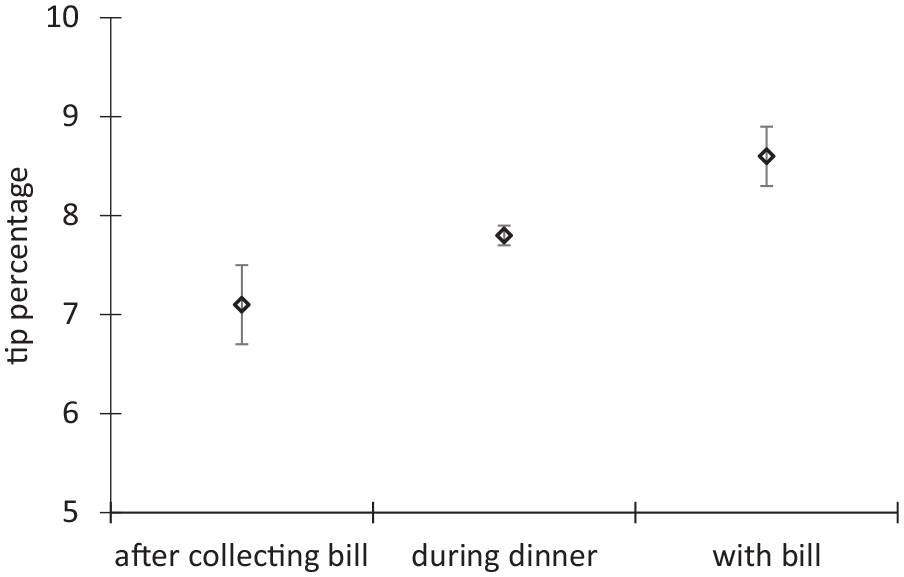
Adjusted Tip Percentage by Experimental Condition of Experiment 1
Of course, as a field experiment, the present study has a number of caveats one should keep in mind when interpreting the results. The most obvious one being the unequal group sizes for the three experimental conditions. At the restaurant in question, the “during dinner condition” was the modus operandi, that is, servers were used to bringing the ouzo during dinner and might have done so out of habit, even if the randomization plan told them otherwise. However, the disproportion in group size does not qualitatively influence our results: The supplementary data-repository (available as supplementary material) also includes a reduced data set consisting of only 54 dinner parties per experimental condition, matched by propensity scores using bill amount as an input variable. As with the full data set, offering an ouzo during dinner compared to after collecting payment increased tips (13.5%); offering an ouzo when the bill was brought again further increased tips (another 11.5%).
However, a further caveat is that the current field experiment did not record a number of control variables that are also associated with tip size. Combined with the relatively small effect size, it might be that the results reported above are at least partly due to systematic influences of one or more confounding variables. The propensity score matching tries to counteract this issue. However, as no other information was collected, we could only use bill amount as an input variable for the matching. To address this more directly, we ran a second experiment as a conceptual replication of our field experiment in a different restaurant. As described below, this additional experiment focused on the two most relevant conditions, that is, “during dinner” and “with bill,” which both offered the free alcoholic beverage, and additionally controlled for a number of variables previously shown to influence tipping.
Experiment 2
Method
Participants were guests of 237 dinner parties at a country-side restaurant serving traditional German food in northern Germany. Each shift, the participating server performed one of the two experimental conditions “during dinner” or “with bill” (i.e., Conditions b and c from Experiment 1) on all dinner parties he or she was serving that shift. Immediately after the dinner party paid, the server printed a duplicate bill receipt. This bill receipt included date and time which allowed us to determine weather conditions (Lynn & McCall, 2016), whether it was a workday or weekend (Saunders & Lynn, 2010), and whether guests were eating lunch or dinner (Davis et al., 1998). Second, we collected information on all ordered foods and drinks with their respective costs which allowed us to calculate the amount of alcohol consumed (Sanchez, 2002, for contrary findings, see Lynn & McCall, 2016), as well as the total bill amount. The server additionally recorded the number of adults within the dinner party (e.g., Conlin et al., 2003), number of children within the dining party (Sanchez, 2002), gender of the person paying (Lynn & McCall, 2016), tip size as well as the particular experimental condition.
Results and Discussion
Out of the 237 dinner parties, 121 received their gift during dinner and 116 received their gift concurrently with the bill. On average, bill amount was €47.43 and customers tipped €3.79 (8.0 percentage points). Thus, the overall descriptive results of Experiment 2 closely resemble the results of Experiment 1.
As shown in Figure 2, offering the free alcoholic beverage concurrently with the bill compared with offering it during dinner raised tipping from 7.2 percentage points to 8.8 percentage points, that is, an increase of 24%. A one-way analysis of covariance again revealed the significance of this effect, F(1, 227) = 5.4, p < .02, while this time controlling for the previously shown influences of bill size, F(1, 227) = 12.1, p = .01; temperature, that is, weather conditions, F(1, 227) = 3.0, p = .09; workday/weekend, F(1, 227) = .01, p = .93; lunch/dinner, F(1, 227) = 0.45, p = .50; alcohol consumption, F(1, 227) = 1.3, p = .25; number of adults, F(1,227) = 2.76, p = .10; children, F(1,227) = 0.2, p = .66; and gender of the person paying, F(1, 227) = 3.0, p = .09. Thus, Experiment 2 confirms that the saliency of the reciprocity norm (manipulated by offering the gift concurrently to the customers’ chance to reciprocate by tipping) strongly influences gratuity.
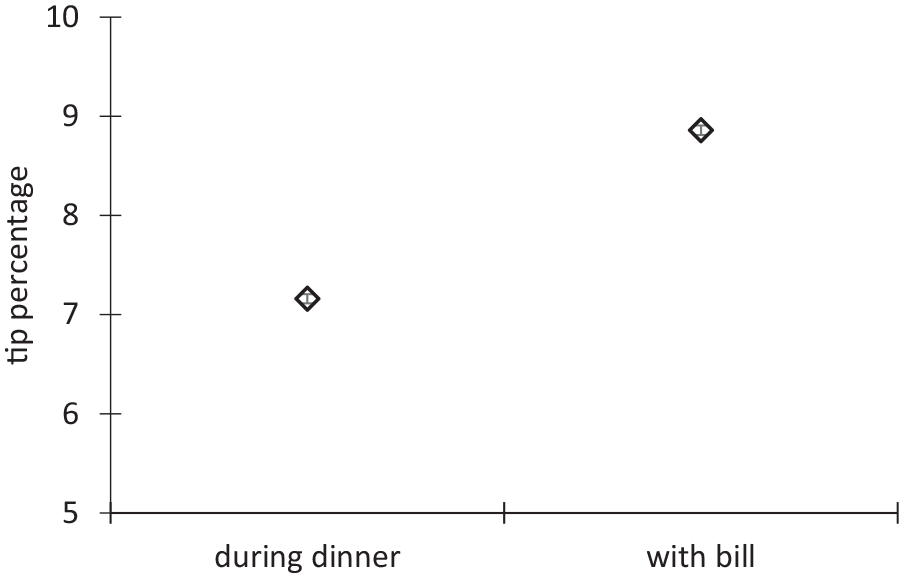
Adjusted Tip Percentage by Experimental Condition of Experiment 2
General Discussion
As we could replicate and extend previous findings on the norm of reciprocity on tipping behavior, our research makes two main contributions: First, in line with Strohmetz et al. (2002) and our Hypothesis 1a, we provided further evidence that offering a gift significantly increases the amount of tipping, presumably because customers feel grateful and are willing to express their gratitude in a reciprocal way. Second, it was shown that in line with the focus theory of normative conduct (Cialdini et al., 1991) and our Hypothesi 2a, this effect strongly depends on the norm of reciprocity being in focus at the time of the behavioral act: offering the identical gift at an opportunity to directly reciprocate nearly doubles the effect size. Experiment 2 confirms the robustness of this effect, even when controlling for a number of previously shown influences on tipping.
Therefore, our results—albeit the rather small absolute effect sizes—have clear practical implications for those employed in the service industry. Servers can substantially raise their incomes just by providing small gifts to their customers. In a typical month in the participating Greek restaurant (Experiment 1), servers serve about 500 dining parties. Just by offering all dining parties a free ouzo during dinner servers could presumably increase their monthly tips by more than €200. Should servers then decide to offer the ouzo concurrently with the bill, they can additionally increase their monthly income by another €200 without any additional efforts but just by making the reciprocity norm more salient. Likewise, in the participating German restaurant (Experiment 2) monthly tips can be increased by about €225 when offering the gift concurrently with the bill instead of during dinner.
Manifold research has proven that most other factors that increase tips and that servers have some control over depend on an interpersonal connection between server and customer (e.g., Azar, 2007), which is facilitated by touching the customer, reducing the physical distance (Jacob & Gueguen, 2012), or squatting next to the table (see Lynn & McCall, 2009, for the comparatively large effect sizes of these interventions). However, in line with results of Schroeder et al. (2019), all of these activities that are meant to establish a stronger interpersonal connection could in the aftermath of the recent COVID-19 pandemic actually be detrimental, as they all heighten the risk of infection. The identical behavior that before COVID-19 would have been interpreted positively, could now be seen as thoughtless and therefore actually decrease interpersonal connection and thus gratuity. Therefore, providing customers a gift could potentially be one of the few remaining options for servers to increase their incomes.
Most research on tipping—just like the one presented here- focuses on ways servers can earn larger tips (Lynn, 2018), whereas the influence on the restaurant as a whole is seldom discussed. In the present study, the gift was paid by the restaurateurs, who, unlike their servers, did not see an immediate financial benefit as the underlying bill amount did not alter by offering a gift, that is, customers did not order something extra; bill amount €51.29 to €52.41, F(1, 401) = 0.6, p = .81 in Experiment 1; and €45.3 to €49.6, F(1, 235) = 0.96, p = .327 in Experiment 2. Notwithstanding, one could argue that the long-term benefits of providing a gift should greatly outweigh the restaurateurs’ costs: First, by reliably increasing servers’ tips and therefore uplifting their overall income and job satisfaction, the restaurateurs will enhance their retention rate (Banks et al., 2018), particularly as dissatisfaction with compensation is one of the main drivers to resign in the restaurant industry (Pizam & Thornburg, 2000). Moreover, it is reasonable to assume that the gift should have a positive effect on the likelihood of returning guests as it increases customers’ satisfaction (e.g., Ryu & Lee, 2017).
Conclusion
While it would certainly be interesting to investigate these long-term economic effects of gifts on the restaurant as a whole in future empirical research, the present article clearly shows the short-term benefits of such gifts for servers: Customers generously reciprocate a gift by significantly increasing gratuity. Importantly, the increase in gratuity even doubles when the norm of reciprocity is salient to the customers while expressing their gratitude, even when controlling for a number of previously shown influences on tipping. This indicates that service personnel can substantially—and effortlessly—raise their tips just by leveraging the norm of reciprocity.
Supplemental Material
sj-sav-1-jht-10.1177_10963480211019841 – Supplemental material for In Focus: Effects of an Opportune Gift on Tipping
Supplemental material, sj-sav-1-jht-10.1177_10963480211019841 for In Focus: Effects of an Opportune Gift on Tipping by Frederic Hilkenmeier and Sascha Hoffmann in Journal of Hospitality & Tourism Research
Supplemental Material
sj-sav-2-jht-10.1177_10963480211019841 – Supplemental material for In Focus: Effects of an Opportune Gift on Tipping
Supplemental material, sj-sav-2-jht-10.1177_10963480211019841 for In Focus: Effects of an Opportune Gift on Tipping by Frederic Hilkenmeier and Sascha Hoffmann in Journal of Hospitality & Tourism Research
Supplemental Material
sj-sav-3-jht-10.1177_10963480211019841 – Supplemental material for In Focus: Effects of an Opportune Gift on Tipping
Supplemental material, sj-sav-3-jht-10.1177_10963480211019841 for In Focus: Effects of an Opportune Gift on Tipping by Frederic Hilkenmeier and Sascha Hoffmann in Journal of Hospitality & Tourism Research
Footnotes

SUPPLEMENTAL MATERIAL
Supplemental material for this article is available online.
References
Supplementary Material
Please find the following supplemental material available below.
For Open Access articles published under a Creative Commons License, all supplemental material carries the same license as the article it is associated with.
For non-Open Access articles published, all supplemental material carries a non-exclusive license, and permission requests for re-use of supplemental material or any part of supplemental material shall be sent directly to the copyright owner as specified in the copyright notice associated with the article.
