




Abstract
Employers expect university graduates seeking entry-level marketing jobs to be well-versed in contemporary topics, such as sustainable development, digital marketing, big data, analytics, and the role of artificial intelligence (AI) in both traditional and contemporary marketing domains. Because many of today’s cutting-edge technological advances are deeply relevant to marketing, marketing educators must reconsider how they prepare marketing students to enter the technology-enabled world and workforce. The authors propose that marketing educators adapt their teaching of foundational marketing concepts to reflect the technology-augmented marketing era. Such reconsiderations span multiple arenas, including how classes are conducted, which topics are covered, how assignments are crafted, and how technology—and AI and generative artificial intelligence (gen AI) in particular—will transform future marketing roles. The authors also suggest ways educators can modify and reimagine existing marketing courses to prepare students for a successful entry into technology-enabled marketing jobs, as exemplified with some sample class assignments.
Technological advancements, particularly those enabled by artificial intelligence (AI), have triggered discussions about reconsidering how educators can and should prepare students to join the workforce required by a fast-moving, technology-enabled world. Employers actively seek students with technology-linked knowledge and skills, as indicated by (a) a 2024 survey of 781 hiring managers that revealed that 77% believed AI-related capabilities are particularly advantageous and (b) a survey of business leaders, 90% of whom cited ChatGPT skills as beneficial for job applicants (Cohen, 2023). Most hiring managers indicate that they would hire candidates with AI skills over more experienced candidates without those skills (ResumeTemplates, 2024). The earning premiums are also significant; jobs that specifically require AI skills can earn candidates up to 25% more (PwC 2024).
On-the-job opportunities for formal upskilling are unfortunately scarce. Instead, employees appear to be gleaning AI skills informally. A Microsoft (2024) survey of 31,000 employees of its Fortune 500 clients revealed that three-quarters of them already adopt AI for their work, as do 80% of employees of small- and medium-sized companies, usually without direction or training from their employer. Given both the demand for AI skills and the dearth of on-the-job upskilling opportunities, educators must shoulder the primary responsibility for educating workforce entrants such that they can contribute to a technology-enabled world.
In the marketing domain, AI has profoundly reshaped marketers’ traditional tasks, including copywriting, ideation, developing scripts for video presentations, and conducting competitive analyses. Generative AI (gen AI) can replace or complement marketing research efforts (Smith & Weber, 2024) and produce first drafts of sales proposals, which salespeople can then edit to fit the specific needs of, and relational nuances related to, their clients (Davenport et al., 2024). Noting the substantial impacts of these technological advancements in marketing domains (Grewal et al., 2024), marketing educators have little choice but to prepare future marketers for a new technology-enabled era or else risk obsolescence—of their students and themselves (Guha et al., 2024). In considering how marketing education should evolve to remain relevant, we present a summary of marketing’s evolution and identify technology-related concepts that are pertinent for foundational marketing classes. Against this backdrop, we offer educators suggestions—along with relevant examples—for how to adapt their current teaching of foundational concepts to correspond with the demands of the technology-augmented marketing era.
The Evolution of Marketing: The New Age of Technology
Exchange has been a foundational element of all societies, for as long as humans have gathered and transformed resources. From bartering to basic exchange, the era of simple trades dominated early economies. However, the Industrial Revolution ushered in the production era, which put efficient manufacturing of goods at the forefront. As production became increasingly efficient and goods plentiful, firms ushered in the sales era and began to compete for customers. Seeking differentiation, firms subsequently entered the marketing era, which prioritized tactical decisions about products, pricing, distribution (place), and promotion, collectively known as the 4Ps. As competition for customers escalated, firms moved to the value-based era, adopting more customer-centric decision-making and transitioning from pursuing transactions to building customer relationships.
Importantly, technology has always shaped and catalyzed the evolution of marketing in every era (e.g., customer relationship management [CRM] systems were developed in the value-based era). But the accelerating pace of innovation has amplified the role of technology in current marketing practice. Thus, the value-based marketing epoch has been replaced by a new era: the technology-augmented marketing era. Figure 1 illustrates the increasingly layered history of marketing, up to the present moment, highlighting not only the evolution of marketing eras but also how the practices and lessons of prior eras continue to be foundational and critical to the practice of marketing in subsequent eras. Production, selling, tactical decisions regarding the 4Ps, and cultivating relationships all remain necessary to the practice of contemporary marketing.
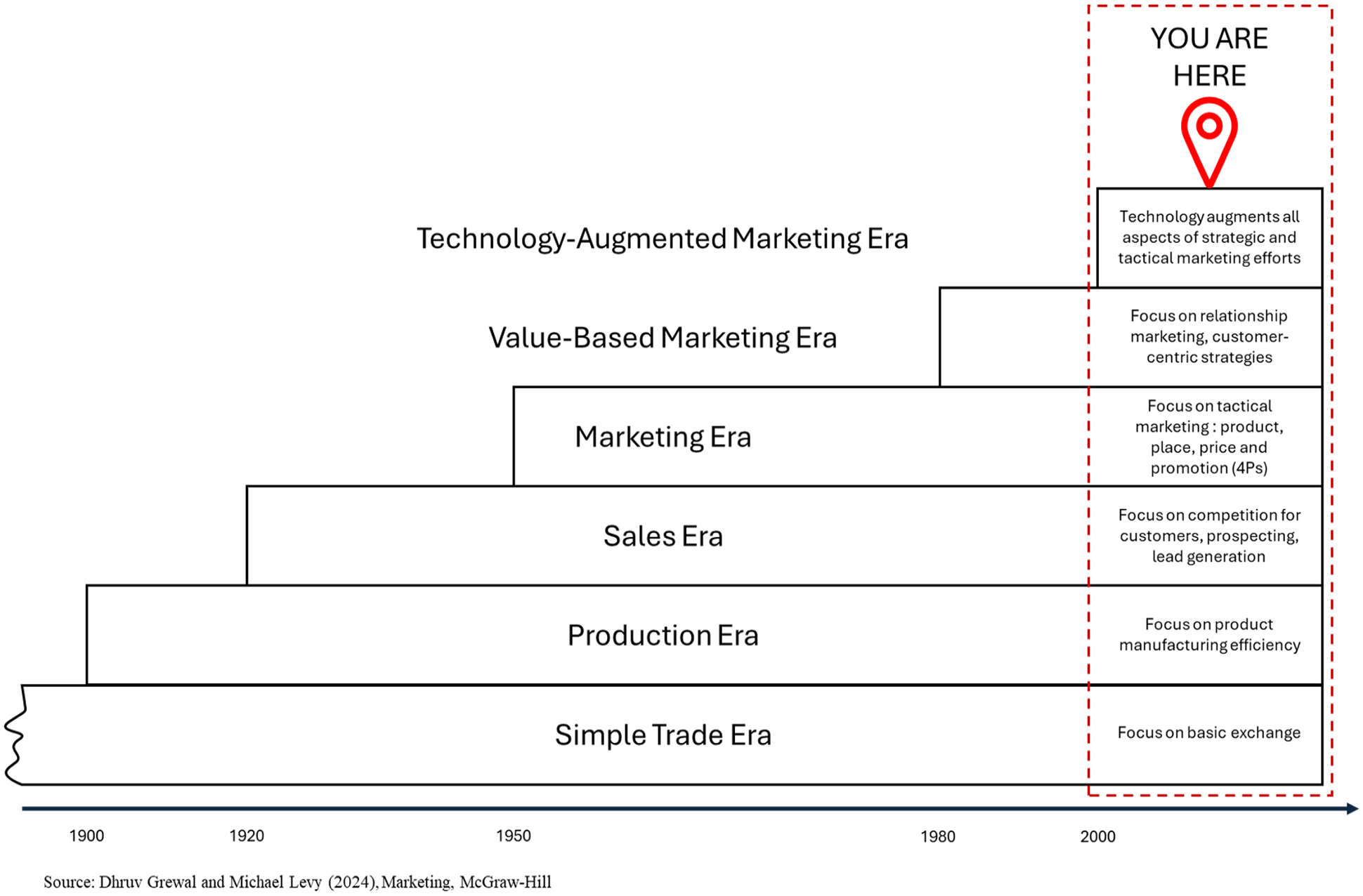
Evolution of Marketing.
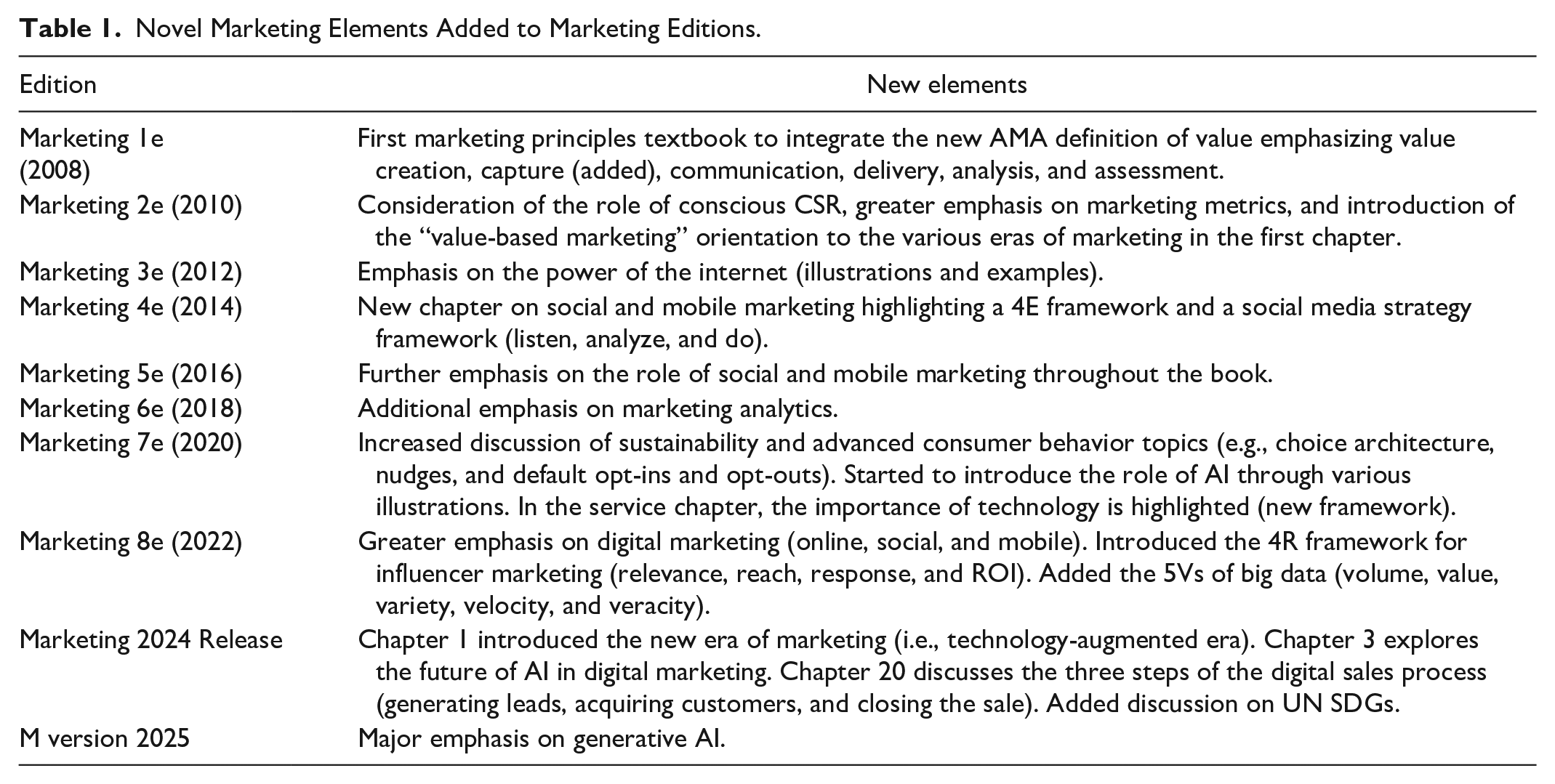
To better understand how marketing education has evolved across the eras, we examined the successive editions of Grewal and Levy’s Marketing textbooks (from the first edition—published in 2008—to the most recent edition, which will be available in 2025). By identifying which key concepts have been introduced in the past 15 years (see Table 1), we identify the expanding emphasis on technology in marketing education, as well as an evolution of the marketing paradigm. Like an increased focus on relationships defined how marketing was achieved in the value-based era, changing consumer values and increasingly advanced technologies augment how core marketing activities are conceptualized and executed today. Thus, this new layer of marketing practice necessarily alters how and what marketing educators must teach the students of today. Specifically, five themes relevant to marketing education emerge from the analysis: AI, robots, digital marketing, big data and marketing analytics, and sustainability.
Novel Marketing Elements Added to Marketing Editions.
Central Topics for Marketing Education
In the last decade or so, several technological innovations and paradigm shifts have shaken up marketing, customers, and society, with ripples felt across the domains of marketing education. Marketing educators are therefore hard-pressed to guide students in enhancing their knowledge beyond basic marketing skills. Herein, we tackle five themes that bear consideration as marketing educators craft (or re-craft) their courses. First, AI—both predictive AI and gen AI—can define how marketers select, reach out to, interact with, and extract value from customers. Second, as robots become more pervasive, it is important to understand how various robot forms will influence consumer and firm behavior, supply chain management (distribution centers, delivery), retailing, and service activities currently performed by human associates. Third, as the strategies and tactics associated with digital marketing continue to gain prominence, it will substantially extend its influence in marketing plans. Fourth, big data and analytics have gained prominence, not only due to growing volumes of data but also the increasing functional capability facilitated by the combination of enhanced computing power and AI. Fifth, sustainable development has risen to the forefront of many domains in marketing practice, and technological advances offer novel solutions for addressing its complexity and interdependencies, thereby illuminating potential paths toward achieving sustainable development. 1
The five themes have been discussed at various lengths in prior work published in the Journal of Marketing Education (JME). To capture the insights from this prior work, we conducted a semi-structured literature review, searching within the abstracts of 121 JME publications that mentioned any of the five themes (i.e., AI, robots, digital marketing, big data and marketing analytics, and sustainable development) and key pedagogical changes (i.e., increased uses of digital tools and varied teaching modalities). As an illustration, Crittenden et al. (2019) highlight the importance of marketing educators embracing new digital technologies, as it is central for educators to prepare the next generation of students with the necessary tools to be ready for their marketing careers. Table 2 indicates how many publications mentioned each topic, as well as some representative publications for each.
Marketing Elements and Their Coverage in JME.
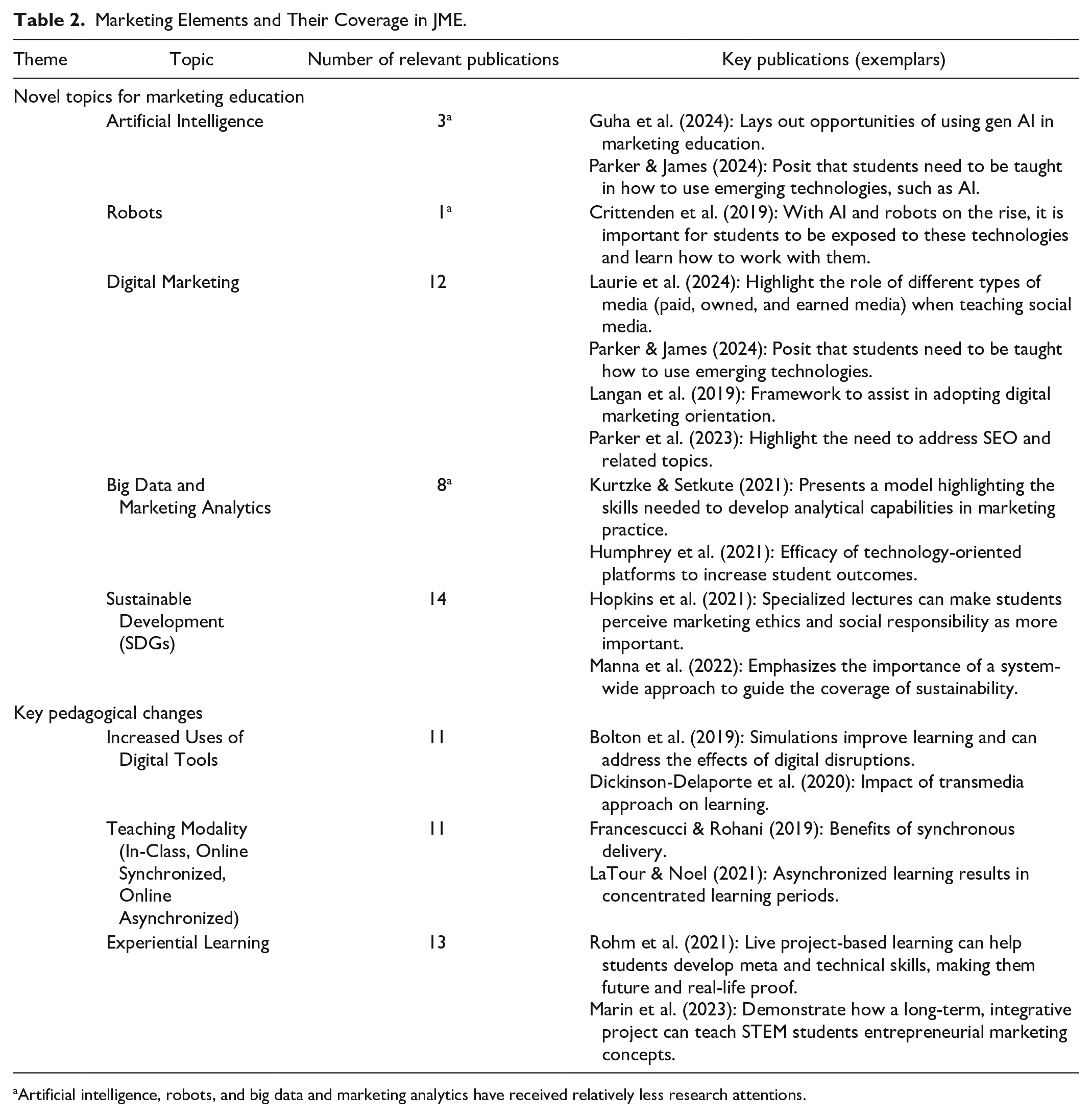
Artificial intelligence, robots, and big data and marketing analytics have received relatively less research attentions.
As evident from the review, pedagogical changes relating to digital tools and teaching modalities have received attention over the past years. Conversely, other themes (i.e., big data and marketing analytics, AI, and robots) have received somewhat less attention. Building from prior work in JME (e.g., digital marketing and sustainability), as well as relatively under-examined domains (e.g., big data, AI, and robots), we discuss each of these themes and their implications for marketing education in more detail. Importantly, several of the noted themes in the evolution of marketing have been in tandem with and dependent on the increasing capability of AI and gen AI. Thus, we begin with a discussion of AI as a foundation that underpins discussions on the remaining themes.
AI
Advances in AI and gen AI have fundamentally changed how humans engage with other humans, firms, jobs, recreation, art, and other domains. Companies are thus racing to use these new technologies—and employers are frantically seeking new hires with the skills necessary to leverage AI tools. Few jobs have been transformed by the advent of AI as much as those of modern marketers. To prepare students to leverage marketing, educators are tasked with several important mandates for delivering relevant and necessary content: understanding the use and limitations of AI tools, awareness of the ethical considerations in the use of AI, and careful selection of modalities and methods of delivery.
First, educators must prepare students to better understand the optimal deployment and use of AI technologies in marketing contexts (Parker & James, 2024; optimal deployment, as elaborated on in Huang and Rust [2021]). AI tools can automate repetitive tasks, analyze large data sets, and provide previously unattainable insights. Understanding how AI tools can be used in the marketplace, and extrapolating the implications for marketing practice and education, require that educators keep pace with the rapid advancements in the field.
A second key mandate relates to the ethical considerations surrounding AI use. Approximately 74% of global respondents indicate their concerns about how companies are using personal data (Satornino et al., 2023), so the fundamental concepts of data privacy, algorithmic bias, sustainability challenges, intellectual property rights, and ethical uses of AI-generated content must be diligently addressed in marketing education. Educators must teach students not only how to use AI tools but also how to navigate the ethical dilemmas that arise from their use (Jobin et al., 2019; Satornino et al., 2024). A holistic approach, such that educators weave the ethics of AI use into the fabric of all their marketing courses, can ensure that students are both technically proficient and ethically aware.
Finally, a third key mandate entails the deployment of new modalities and methods. Interactive learning environments can incorporate tools such as virtual reality (VR) simulations and adaptive learning platforms. Instructors can generate chatbots that deliver real-in-time answers to student questions, which can enhance student engagement and comprehension. Integrating these technologies can also help instructors approach the ideal of personalized learning experiences, catering to individual student needs in a timely manner, which in turn can make marketing education more effective and accessible (Rangel-de Lazaro & Duart, 2023) while also ensuring that students are proficient in technical and strategic uses of AI (Kietzmann et al., 2018).
To meet these mandates, educators can build and use content from readily available real-world examples (see, e.g., Guha et al., 2024). Examples include Spotify’s personalized playlists, which introduce new music tailored to users’ tastes, demonstrate the effective use of AI for targeting purposes, as well as to enhance customer engagement and retention (Kaput, 2024). Starbucks leverages AI and predictive analytics to personalize marketing initiatives and optimize customer and employee experiences, and as such, it offers a relevant example for students to understand tactics for cultivating customer satisfaction and loyalty. It also showcases synergistic partnerships of AI tools with employees and managers to optimize stores’ operational efficiency (Warnick, 2020). Sephora uses AI to provide product recommendations, give skin care advice, and, in conjunction with augmented reality, offer opportunities for customers to try makeup products virtually (Rayome, 2018). In discussions of the 4Ps, this example thus might help students understand how product samples, even in virtual forms, can help customers choose products. Nike’s use of AI to design new sneakers ahead of the 2024 Olympics (Marcus, 2024) might be evoked when discussing new product development; Coca-Cola’s use of AI to analyze customer data can inform classes dedicated to personalized marketing campaigns (Rogers, 2024); and eBay’s reliance on it to optimize sellers’ listings (Satornino et al., 2023) can be used in discussions of double-sided, peer-to-peer marketplaces. The AI-driven analytics platforms used by companies like Netflix and Amazon illustrate how essential data are to customer segmentation and personalized marketing. Whether presented in class or used during asynchronous class discussions, these examples can help students bridge the gap between their newly acquired theoretical knowledge and real-world applications while also establishing concrete illustrations of how AI can facilitate strategic marketing decision-making.
As these diverse examples indicate, the impact of AI on marketing education is both profound and multifaceted. By integrating new methods and technologies into the classroom and bringing abstract concepts to life with vivid illustrations and relevant cases, educators can not only prepare students for a rapidly evolving industry by imparting technical skills but also engender a deep awareness of ethical concerns and a clear understanding of practical applications.
Robots
Advances in AI have engendered a proliferation of robots in the marketplace. The expanding deployment of robots enables marketers to experiment with various ways to enhance consumer experiences. For example, on the customer service frontline (Grewal et al., 2020), robots have served as check-in staff at a hotel in Japan (Hertzfeld, 2019), and the LoweBot currently helps Lowe’s shoppers find products in the large home improvement stores (Morgan, 2020). In restaurants, especially in Asia and Europe, service robots deliver dishes directly to customers’ tables (Steins et al., 2024). Beyond the frontline, robots also check inventory, clean stores, and provide security monitoring (Guha & Grewal, 2022; Rindfleisch et al., 2022). Flippy, Miso Robotics’ AI-enabled robot, automates repetitive, dangerous cooking tasks in fast-food establishments, like dropping fries in hot oil (Breen, 2024). The New York Police Department deployed a K5 surveillance robot in the subways, although not without some controversy (Siff, 2024). The companion robot ElliQ has achieved successful deployments; among the older adults for whom it is designed, the robot provides meaningful and increased social interactions (Press, 2024).
Despite such implementations, marketers continue to debate about how best to deploy robots. One argument holds that robots (and AI more generally) are best be deployed in noncustomer-facing roles, because robots still struggle to connect with customers on an emotional level (Becker et al., 2022), and because the inherent variability in customer-facing interactions entails greater risks of service failures (Guha & Grewal, 2022; Guha et al., 2021; Kestenbaum, 2024). For example, the robots in the Japanese hotel did not last long once guests expressed discomfort with being checked in by the robots (Hertzfeld, 2019). Generally speaking though, firms lack a clear sense of whether and when customers are comfortable with robots (Becker et al., 2023). Scholars have documented customer discomfort while interacting with robots, as well as some of its downstream consequences (Mende et al., 2019). The New York Police Department’s K5 surveillance robot was also ultimately decommissioned (Siff, 2024). However, in some scenarios, such as when the risk of personal embarrassment is high, customers appear to prefer dealing with robots rather than human employees (Holthöwer & van Doorn, 2023).
Marketers must choose among various robots, with distinct capabilities and physical embodiments (Becker et al., 2023; Noble & Mende, 2023)—and mistakes could be (very) costly. As such, across the wide range of available robot options, marketers must determine which implementations are appropriate and feasible. Marketers may also be responsible for assigning specific roles to certain robots, contingent on servant–partner–leader roles (Noble & Mende, 2023; Shanks et al., 2024). In addition, marketers must decide whether to deploy robots in conjunction with or separately from human employees, by determining how humans and robots function and interact most effectively.
Such insights and questions indicate that, at a minimum, marketing instructors must be comfortable discussing robots (including chatbots) as critical elements in the marketing mix. For example, in discussions regarding consumer behavior, instructors can be prepared to discuss how robots might take on expanded roles within the home (Campbell, 2024), and how their integration into consumers’ lives might give rise to new and/or enhanced marketing opportunities. Robots may also be integrated into product (and service) modules, with case studies or class discussions on how restaurants, hotels, and retail stores can make strategic decisions regarding how to deploy robots and then determine which specific functions those deployed robots execute. Robot-enabled warehouses constitute a key competitive asset for Amazon in particular (Dresser, 2023). With the increased presence of robots in the supply chain, educators should be prepared to discuss how robots can improve supply chain efficiencies. Considering their increasing use for last-mile delivery (Bellan, 2021), robots might be integrated into place (4P) discussions. Ideally, instructors would take a forward-looking perspective and delve into future opportunities and challenges, associated with robot-enabled marketing.
Digital Marketing
Although not new, digital marketing, or “the process of using digital technologies to acquire customers and build customer preferences, promote brands, retain customers and increase sales” (Kannan, 2017, p. 23), has also been augmented by the advent of powerful AI tools. As a result, digital marketing is poised to dominate advertising budgets and efforts. Already, global organizations spend more than half their budgets on digital efforts, particularly social and mobile marketing (Maddox, 2023). In 2023, digital advertising represented 64% of all spending, but by 2028, digital advertising is expected to grow substantially, accounting for 76% of all spending (Kaminkow, 2024).
The potential benefits of digital marketing apply to a wide range of marketing tasks, including the promise of lowering consumers’ search costs, facilitating efficient transportation, and enabling personalization and precise targeting (Goldfarb & Tucker, 2019). Notably, digital marketing frequently relies on two other comparatively new technologies, namely, social media and smart devices. Spending shifts toward social media reflect various influences, including reduced TV viewership (especially among younger customers), relatively greater engagement and interaction on social media, greater potential for leveraging influencers and user-generated content, and greater precision in ad targeting (McKay, 2023). The parallel shift away from advertising on traditional media outlets and toward advertising on mobile devices is similarly notable (Samet, 2024).
A fair bit of work in marketing education journals has focused on digital marketing (e.g., Langan et al., 2019; Laurie et al., 2024; Parker et al., 2023), with some calling for educators to specifically teach digital marketing content (Parker & James, 2024). We too suggest that marketing instructors should devote substantial time and materials to guiding students in their efforts to gain mastery over digital marketing, including social media marketing and mobile marketing, especially when discussing the promotion aspect of the 4Ps. One way to present the range of benefits possible through digital marketing would be to apply the 4E framework introduced by Grewal and Levy (2024), which helps clarify how digital marketing can contribute to (a) exciting customers, (b) educating customers, when necessary, (c) helping them (virtually) experience products and services, and (d) engaging customers.
Instructors might encourage students to extrapolate beyond the current status of digital marketing and predict its possibilities for the future. For example, marketers are using gen AI to create digital advertising content (Davenport & Mittal, 2022), and this content is poised to increase in both quality and quantity. Instructors can help students get a sense of how to create such content by practicing using currently available tools such as ChatGPT and Dall-E. In conjunction with guiding students in acquiring practical skills, instructors can address both the benefits and risks of using gen AI (Davenport et al., 2024). For example, some argue that even if gen AI increases advertising efficiency, it does not necessarily enhance advertising effectiveness (Erdem, 2023).
Influencer marketing and endorsements already represent substantial and notable trends (Shee, 2023). The rise of digital (virtual) influencers, as opposed to human influencers (Molenaar, 2024), could be an equally pertinent trend. Virtual influencers have the appealing ability to control the virtual persona and thus avoid the types of scandals that seem endemic to human influencers who often seek to produce “shocking” content to garner more attention (e.g., Grossbart, 2023). Students might consider when the use of different types of influencers, digital or human, is likely to produce more meaningful marketing outcomes, such as greater purchase inducements for products and services promoted by these influencers.
Big Data and Marketing Analytics
Big data have been defined based on three Vs: variety, volume, and velocity (Tiao, 2024), although in the eighth edition of their Marketing textbook, Grewal and Levy (2022) argue for adding two more Vs: value and veracity. Regardless of the definition, big data are changing marketing in three ways (Dublino, 2024). First, big data facilitate enhanced targeting by detailing the precise steps customers undertake before purchasing. In the past, firms might review their advertising costs and sales and try to make correlations; today, marketers can determine—fairly early in the process—which of their unique efforts evoked which responses among which customers. This precision enables them to target marketing campaigns and offerings more accurately. De Luca et al. (2021) refer to this big data–enabled capability as marketing ambidexterity, such that marketers can target current markets and customers while simultaneously exploring new markets and potential customers who respond to their marketing attempts.
Second, big data can support more proactive responses to avoid customer pain points in advance. For example, cart abandonment is a perplexing phenomenon in e-commerce; estimates suggest that online carts have been abandoned by up to 88% of online shoppers (Kukar-Kinney, & Close, 2010). Data regarding customers’ browsing patterns might reveal the points at which customers remove items from their carts rather than completing the purchase. This information may help marketers identify and address, ahead of time, the triggers that lead to item/cart abandonment (Rausch et al., 2022). Big data enhance firm performance because it reveals meaningful customer behavior patterns (De Luca et al., 2021).
Third, big data can be leveraged to enhance operational efficiency and improve fraud responses. For example, Netflix integrates big data across every aspect of its service (Chawla, 2021). Those data consist of prior viewing history, time of day, location of the customer, data from other (similar) users, and other relevant data, which are used to predict what movies a specific customer may wish to watch, whether a show is likely to succeed, and so forth. Similarly, Walmart uses big data to personalize customer deals, anticipate store demand and determine staffing levels, and optimize transport and shipping routes (Amato-McCoy, 2017). By optimizing recommendations, staffing, and logistics, these firms can realize real savings and enhance their customers’ experiences.
Davenport et al. (2020) add that the benefits of big data have intensified with the integration of AI, which can leverage massive data sets and achieve even greater predictive capability. Marketers and their firms thus can extract insights from big data that would be nearly impossible for human analysts to identify. These insights can lead to further improvements in targeting, upselling and cross-selling, pricing strategies, operational efficiency, and fraud responses, amplifying the benefits of big data exponentially. Because of the far-reaching impact and importance of big data to modern marketing practice, marketing instructors must introduce concepts related to big data early in the curriculum and then facilitate discussions on how and why big data can improve marketing outcomes across all domains of marketing.
In marketing education journals, discussions about big data and marketing analytics have been somewhat limited (exceptions: e.g., Humphrey et al., 2021; Kurtzke & Setkute, 2021). To make the abstract concept of big data more concrete for students, we propose that marketing instructors find suitable, specific, relatable examples that (a) highlight how big data differ from other types of data, (b) illuminate the insights that can be extracted exclusively from big data, and how they differ from insights gathered with other data types, and (c) show how insights and firm actions can come together to inform marketing decisions and create marketing deliverables that enhance marketing outcomes. Although not all students necessarily want to study—and work with—big data, marketing students need to understand, at a strategic level, the potential benefits that big data provide.
Furthermore, to encourage critical thinking, instructors should guide students beyond the current benefits of big data and explore its future potential. For example, meaningful class discussions might involve predictions about how integrating other technologies, such as AI, can allow marketers to extract even deeper insights from their growing pools of big data. Also, given that the quality and quantity of big data continue to change, discussions regarding the impact of big(ger) data derived from novel sensors or from new ways of connecting hitherto unconnected data sets would be beneficial. Discussions regarding legal restrictions (e.g., General Data Protection Regulation (GDPR) and e-privacy directives) can cover how these developments may influence the quality and quantity of data available to marketers. How marketing firms can and should deal with these developments is of interest to researchers, managers, instructors, and students alike, and related questions can lead to a lively discussion in the classroom.
Sustainable Development
Discussions of marketing in the technology-enhanced era would be incomplete without considering sustainability (and related) issues and—more specifically—the United Nations’ Sustainable Development Goals (SDGs)—a set of 17 interrelated goals related to sustainable development. The SDG framework is intended to serve as a blueprint for cultivating a peaceful and prosperous existence for all and in perpetuity. The highly ambitious goals comprise social, economic, and environmental objectives (United Nations, 2015). The complexity of this blueprint bears consideration, because addressing one goal often has ripple effects (positive and negative) across other goals (Le Blanc, 2015; Nilsson et al., 2016; Satornino et al., 2024). For example, tackling the challenge of clean energy (SDG 7) with hydropower from tidal turbines might simultaneously mitigate climate change (SDG 13; U.S. Energy Information Administration, 2022) but negatively affect water resources (SDG 6) and/or aquatic biodiversity (SDG 15; Gill, 2005).
Many firms and marketers consider sustainable development as they design their business models and marketing efforts. For example, Nike Grind collects and recycles shoes to create basketball courts, turf fields, and running tracks, aligned with SDG 12 (responsible consumption and production; Grewal & Levy, 2024). As firms increasingly align their strategies with societal norms and expectations, the relevance of understanding the UN SDGs is critical for future marketers. With its inherent focus on maximizing consumption, marketing can appear to stand in contradiction to the SDGs. But given other central functions of marketing, such as a liaison between the consumer and the firm and a conveyor of customer needs and wants, marketers are well positioned to promote sustainable practices, including sustainable branding and product development. Marketers can help shift consumer perceptions and behavior regarding sustainability, encouraging a shift in preferences toward eco-friendly product design and production that are synergistic with the SDGs (Belz & Peattie, 2012).
Inherent in the pursuit of sustainability goals is the role of technology, and especially AI. The complexity of the undertaking suggests the need for AI-enabled tools to optimize the pursuit of the UN SDGs and identify relevant activities that benefit humankind and the planet. Yet the complex interdependencies among the SDGs make decisions about deploying technology, including AI tools, more complicated. Marketing scholars have provided some guidance to practitioners, such as the Responsible Artificial Intelligence Deployment (RAID) framework for deploying AI (Satornino et al., 2024). This and similar models can serve as teaching tools to help students gain an integrated understanding of the UN SDG framework and strategic decisions related to the adoption of AI-enabled marketing technology (Deo et al., 2023).
In marketing education journals, there have been substantial discussions about both sustainability (in general) and incorporating sustainability into the marketing curriculum (e.g., Hopkins et al., 2021; Manna et al., 2022). In addition to outlining how sustainability can be integrated into marketing strategies and the marketing mix, we propose that marketing instructors should also be able to discuss questions of why it is important to do so while identifying various forces that seek to enhance or undermine sustainability initiatives. Such discussions should cover questions relating to applications of technology, as well as how companies might think about engaging (or disengaging) with political actors that seek to protect polluting industries (e.g., coal), whether in sincere attempts to protect constituents’ jobs or for more self-serving reasons (Cantrell, 2024).
Three Key Pedagogical Practices
The five domains of marketing discussed in the previous sections relate to the increasing importance of technology-enabled tools. Gone are the days of “gut feelings” and Mad Men–style advertising. As marketing evolves into more science than art, marketers must understand the sustainable development paradigm and the tools and technologies that enable modern marketing. Therefore, marketing educators must understand and embrace these tools too (see, e.g., Bolton et al., 2019; Dickinson-Delaporte et al., 2020). We therefore propose a series of pedagogical practices that can help marketing educators facilitate success for their students in the technology-enabled marketing era. In this article, we focus on three such practices, relating to increased uses of digital tools, multiple class modalities, and the enhanced role of experiential learning.
Increased Uses of Digital Tools
In many ways, digital technology and content are already integral in many classrooms (Moorhouse & Wong, 2022; Schuetz et al., 2018); students use laptops and tablets to take notes in class, complete exams and homework assignments online (e.g., on Blackboard or Canvas), access digital lectures remotely (often created on Zoom and posted on Blackboard or Canvas), search for content posted by other instructors on YouTube, undertake research assignments using digitally available resources, adopt digital textbook versions (Arundel, 2023), and seek feedback from digital sources (e.g., electronic platforms supported by publishers, gen AI like Grammarly or ChatGPT).
Marketing instructors therefore need to consider how and to what extent they will engage with these existing and forthcoming digital tools and service providers. The plethora of options can make the decision seem overwhelming. However, marketing students expect access to digital content and tools. Even if digital content may be a poor substitute for instructor–student interactions, students’ strong preferences indicate that course content needs to be available in digital form, in addition to a printed textbook or paper handouts. Furthermore, digital content must be adaptive, interactive, and experiential, all of which presents a challenge to instructors.
At a minimum, instructors need to become comfortable with sourcing, creating, and teaching with digital content. In an introductory marketing class, for example, the instructor should be capable of leveraging the digital materials provided by the textbook publisher and its digital platform (e.g., McGraw-Hill’s Connect), as well as be aware of and able to use more generally available digital materials (e.g., interesting lectures on pertinent topics by world-renowned experts available on YouTube 2 ). Ideally, the instructor can collect and curate a suitable selection of available digital content while creating original digital content that provides context to the curated third-party digital content and links such content to the central topics of the course. Going beyond class lectures provides students with alternate, complementary ways to review and understand relevant materials, which can enhance learning and the class experience. Other types of digital entities might be relevant to marketing electives (e.g., digital avatars and synthetic respondents).
Teaching Modality: In-Class, Online Synchronized, or Online Asynchronized
Traditional teaching takes place in-person, with the instructor and students in the same space (e.g., classroom), at the same time, and the instructor plays the role of an expert who teaches the class. In this format, there is an opportunity for interaction, one-on-one and small group activities, and real-time information delivery. But newer modalities have emerged (see, e.g., Francescucci & Rohani, 2019; LaTour & Noel, 2021).
In synchronous online classes, the instructor and students interact at the same time, but the instructor and students are not in the same space. Instead of in-person lectures, the instructor teaches through online platforms like Zoom or Microsoft Teams. Although in theory, synchronous online classes offer levels of interactivity between the instructor and students that are similar to those of in-person classes (e.g., Francescucci & Rohani, 2019), in reality, the level of interactivity varies widely, contingent on both the instructors’ and students’ skill and objectives. One of the benefits of synchronous online classes is that it makes the class available to geographically dispersed students who can take the class from their offices or the comforts of home without a long trip to a centralized location. The challenges of space allocation on campus buildings also get eliminated, and class sizes can be optimized.
In asynchronous online classes, the instructor still teaches the class but does not share the same space or time with students. Typically, the instructor prepares a set of teaching materials (e.g., lecture recording, third-party lectures, textbook material, and cases), which students access and study in their own time. Thus, “real-time interactions with other people are absent” (Schoenfeld-Tacher & Dorman, 2021, p. 13), which makes interactivity challenging to achieve. Asynchronous learning also assigns greater responsibility on students to self-manage their learning process (process instructional materials and complete assignments) (e.g., LaTour & Noel, 2021). However, in the main, asynchronous teaching does have benefits, like class size and space optimization benefits, as well as flexibility by allowing students to view the lectures at any time it is convenient for them and providing the opportunity to view lectures multiple times if they miss something. Here again though, it becomes the responsibility of the student to take the initiative to watch the lectures, all the way through, without being distracted and ensure they understand the material (Ravizza et al., 2023). Note that there is also a fourth modality—hybrid classes, not discussed here—which can include traditional, synchronous, and/or asynchronous components.
Recognizing the benefits and limitations of all three main instructional modalities, students’ expectations regarding digital content means that, to ensure flexible, multiple pathways to achieve the educational mission, instructors must be ready to develop content for and teach across every modality of instruction.
Once they have gained familiarity with each modality and the associated tools, instructors might enhance the student experience and learning outcomes by combining different modalities strategically. For example, for complex topics, the instructor might teach the materials in-person and then (also) post an asynchronous lecture highlighting key concepts to serve as a review of these key concepts. Contingent on the marketing instructor’s skill and motivation, as well as the technology used, asynchronous lectures can serve as high-quality lecture substitutes for students who might be unable to attend lectures, as well as enriching, supplemental lecture material for students who want to go beyond the basic concepts. For example, an instructor teaching a class on the basics of price promotions could also post an asynchronous lecture that introduces the (price promotion-related) effects of time pressure or certain types of signage. These suggested strategies hint at the importance of experiential learning opportunities as a foundational component of any modern marketing class, a topic we delve into next.
Experiential Learning
With the introduction of a model of experiential learning in the 1980s, educators began to present opportunities for students to observe, experience, conceptualize, and experiment in a cyclical learning process (Kolb, 1984, 2014). Kolb posited that learning takes place by processing experiences in a way that allows students to apply knowledge to problem-solving. Beyond group projects, experiential learning in a marketing classroom may take the form of simulations, role-playing, consulting for real-world clients, conducting experiments, or participating in case studies.
Reflection is a critical part of the experiential learning process. As students work through these experiences, they can enhance their practical skills, hone their critical thinking skills, and gain a deeper understanding of abstract concepts, enriched by reflecting on the experience after completion (Beard & Wilson, 2006). Exercises such as developing a new product for an existing firm, determining a pricing strategy for an existing product, opening new channels for the distribution of an existing product, or planning a promotional campaign can provide students with a hands-on approach to problem-solving and help them grasp the interdependencies among the 4Ps of marketing, grounded in situations they are likely to encounter in practice (Karns, 2005).
Innovative AI Teaching Applications
In the technology-augmented marketing era, experiential learning must combine traditional topics with technological tools to provide experiences that mimic the challenges, stress, techniques, and tools that students may encounter in the workplace. In this section, we offer some examples that illustrate potential, relevant applications of technology, primarily AI technology, to showcase how key marketing concepts are evolving.
Marketing Research
Teaching marketing research requires students to learn the fundamentals of the practice (definitions, data types, sample design, survey construction, focus groups, experiments, basic data analysis, and report development) and how they can leverage technology to enhance such efforts. For example, in teaching the fundamentals of focus groups, students might learn how to use gen AI tools such as ChatGPT to mimic a focus group, an increasingly common practice in the field. Such lessons should address the advantages, disadvantages, and boundary conditions for deploying a gen AI tool versus running a traditional (and expensive) focus group. Then, as part of the classroom experience, they might participate in role-playing that simulates a focus group; the class assignment might be to conduct a pseudo-focus group with ChatGPT by submitting appropriate prompts and output. Throughout these exercises, students should identify the needed level of intervention (Davenport et al., 2024) to generate the final deliverables, reflecting their edits and contributions. Such engagement in experiential learning simultaneously enables them to learn how to use in-demand tools effectively.
Generation of Synthetic Data
Gen AI can mimic human judgments (Dillion et al., 2023), and it produces patterns that align with well-documented consumer behaviors, including their willingness to pay (Brand et al., 2023). In this sense, it already offers an effective means to test product and marketing ideas (e.g., Manning et al., 2024). Evaluative data, prompted by asking gen AI agents to evaluate new products or ideas, can be generated in seconds (cf. days or weeks for data collected from humans) and costs virtually nothing (cf. hundreds to thousands of dollars for human data). By shortening the turnaround times, marketers can test and iterate across multiple ideas quickly, which reduces the time to market. Thus, for marketing educators, using gen AI to obtain synthetic data can help prepare students for similar uses during their careers and experience the marketing research process firsthand—that is, to do it rather than read about it.
To prepare students to use these techniques, marketing educators should integrate such tools into their courses, which also provide easy, fast, and low-cost opportunities for students to run their marketing research projects. For example, a professor might ask students to propose a new product that would appeal to young college students. Whether they turn to gen AI to identify a product idea or adopt a more traditional ideation method (e.g., brainstorming with peers), students can validate the feasibility of their idea by collecting data from so-called synthetic respondents. Once they have collected these data, students can apply statistical tests (e.g., analyses of variance and t-tests) to assess the market potential of the idea or to compare different product versions. If these analyses indicate that the product is unlikely to be popular, they can revise the idea and retest it with another sample of synthetic respondents.
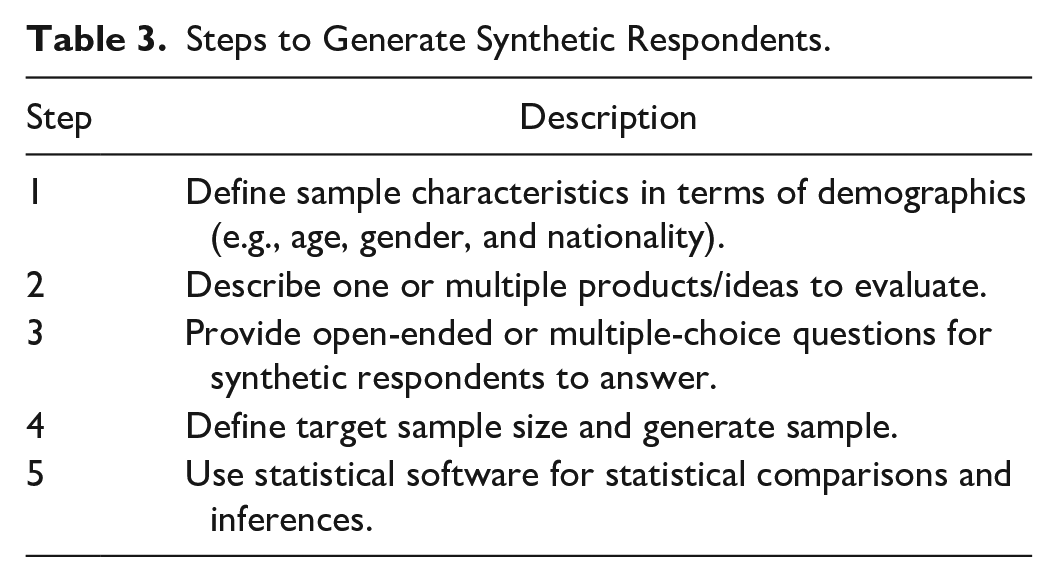
Table 3 provides an overview of the steps for generating synthetic responses. First, marketers define key sample characteristics. For example, to test the potential of an underwater Bluetooth speaker targeted at college students, marketers might define sample demographics: 22 years of age, with an equal female/male split. Second, to compare different product versions (e.g., budget speaker priced at $99 vs. premium version priced at $199), the students can provide different product descriptions and then distribute them randomly but equally among synthetic respondents. Third, they should devise open-ended or multiple-choice questions for the synthetic respondents to answer, such as “How likely are you to buy this product?” (1 = very unlikely, 7 = very likely). Fourth, marketers can specify the number of responses they desire and initiate the tool, which generates a sample that matches the demographic specifications, a background story for each synthetic respondent (which represents richer responses), and answers to the provided questions. Fifth, with these data, students should undertake an analysis using statistical software, such as SPSS or R Studio; they also might turn again to gen AI to generate the R or Python code for running the statistical tests.
Steps to Generate Synthetic Respondents.
During these lessons, marketing educators need to highlight the potential limitations, practical challenges and ethical challenges. Synthetic responses often align well with actual human preferences (e.g., Dillion et al., 2023), but they do not always hit the mark; in some cases, they could even differ substantially. The generated data must be identified as a starting point that can be reviewed and tested in marketing research involving real people. Educators need to make clear to their students that under no circumstances should synthetic data be passed off as collected from real humans—a misrepresentation that would mislead scientists and decision-makers. In addition, educators are responsible for helping students understand that an overreliance on gen AI might cause them to miss out on promising ideas, just because the AI (potentially incorrectly) deemed these promising ideas as less valuable.
Creating an Advertising Campaign
Gen AI can create beautiful, award-winning artwork (Roose, 2022) and photorealistic, complex images. It can even, to some extent, be creative. In one study, product ideas generated by ChatGPT outperformed those created by elite MBA students (Kefford, 2023). Accordingly, gen AI appears capable of helping businesses create entire marketing campaigns, from the ideation stage to writing marketing communications to designing appealing visuals. Marketing students and creatives, in turn, must be prepared to use these tools; here again, if marketing courses include gen AI lessons, students gain valuable opportunities to undertake an entire advertising design process from beginning to end, within the time constraints of a semester-long course.
As the overview in Table 4 indicates, advertising and marketing students should follow a step-by-step process, which could take place within the time frame of a single lecture or workshop. As an example, we describe a small, ambitious protein bar manufacturer called “FruitFueled.” Its product is fully organic and comes in a wide range of natural-tasting fruit flavors; it aims to appeal to young sports enthusiasts. The company wants to launch a new marketing campaign that ties in with a 2025 sports event. It has a limited budget though, so this event would ideally represent a niche market that is still well-aligned with the brand and its target customers.
Steps to Use Generative AI to Develop Ads.
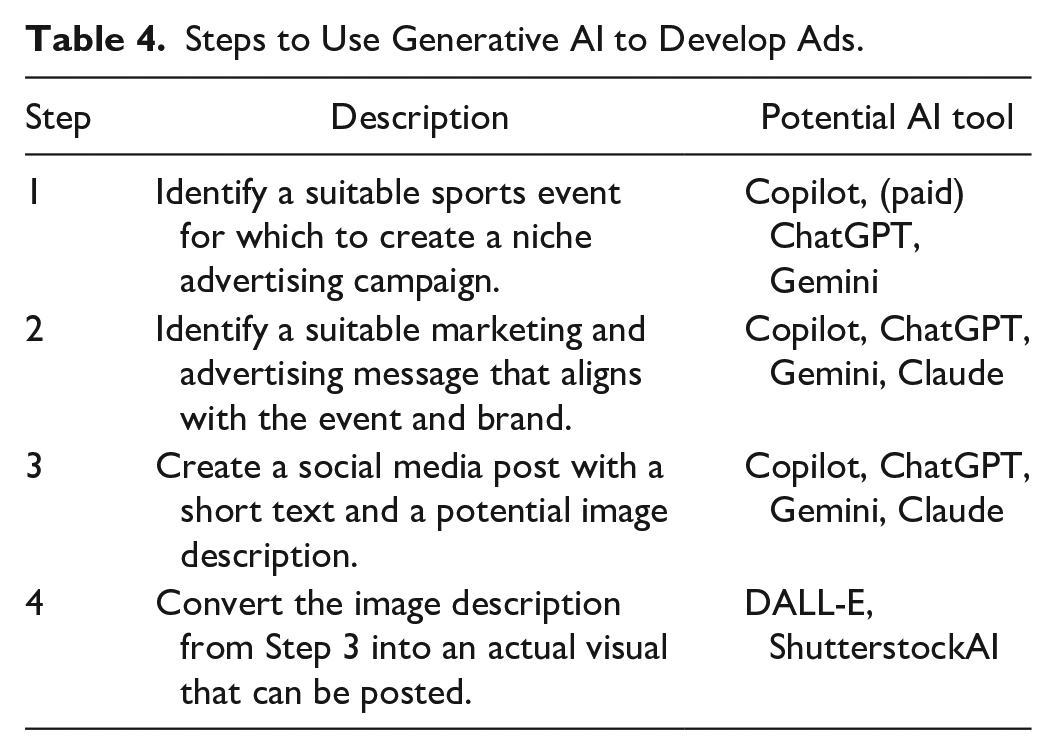
Given this assignment, the students could start by leveraging a gen AI tool with access to real-time information from the internet (e.g., Microsoft’s Copilot) to identify a suitable sports event. Theoretically, they could use a gen AI tool that relies on pretrained data (e.g., Claude4o), but those data might be outdated, without details about upcoming, niche events. Students should take into consideration that their request for potential events must be specific and provide sufficient context—about the brand, its values and general approach, and its target customers. Otherwise, the AI will provide generic rather than tailored suggestions. Assuming they do so effectively, the tool will make multiple event suggestions, and students should choose the one they consider more appropriate. If none of the suggestions appeal, they should consider refining their query and practice by giving the AI additional, clearer instructions. For this example, we assume that the student takes the generated suggestions and selects the “2025 Summer World University Games” event to launch the product, because it “emphasizes health and fitness, engages with a youthful audience, celebrates cultural diversity, promotes sustainability, and collaborates with student athletes.” 3
With this event in mind, students should ask the gen AI tool—whether the same or a different one than what they used in the first step—to create an overall campaign that ties in with the event and to define a general messaging strategy. Such strategizing requires more creativity and strategic thinking, rather than real-time information, so the most appropriate AI tool might be different. Once again, the students should recognize that they need to do more than provide information about the event and the brand, such that they should (if necessary) repeatedly prompt the AI to make incremental changes. For our purposes, we assume the AI suggests a campaign centered around the slogan “Organic Fuel for Champion Minds: Power Up with FruitFueled Protein Bars.” 4
The next step is to translate the broader strategy into concrete marketing materials. Noting the young target market, students likely recognize that advertising on social media would be appropriate, including a short text with an eye-catching image. Thus, they should ask a gen AI tool to generate a short text for a social media ad and a description of a potential image. Finally, using the produced (and reviewed and edited) social media text and image description, they can use a gen AI tool that specializes in image generation (e.g., OpenAI’s DALL-E) to create the eye-catching image. After fine-tuning the image generation prompt, the student marketers will arrive at a full marketing campaign, with a sound strategy, promotional text, and visuals.
As is true for all gen AI applications, educators must alert students to the need for checking the output at each step. The AI could be replicating an existing campaign run by another company; when using AI-generated images or videos, especially in settings outside the education context, students must have a clear and specific understanding of intellectual protection and the need to request—if needed—access rights to the generated content.
Negotiations in Business-to-Business and Sales
In business-to-business settings, sellers frequently use chatbots to negotiate prices with customers. For example, using a chatbot to negotiate prices with its suppliers, Walmart has generated an average cost savings of 3% (van Hoek et al., 2022). It seems likely that similar trends will reach consumer markets. In the future, when students take a role as consumers, they should expect to negotiate with chatbots; in their role as marketers, they might need to build and instruct AI agents for their employers. Therefore, marketing educators should begin preparing students for this emergent reality by letting them build and negotiate with AI chatbots in classes, which also gives students a novel opportunity to practice their negotiation skills more generally.
Gen AI makes it relatively easy (i.e., no coding or programming knowledge required) to build agents that behave in certain ways or possess certain knowledge. Because they offer easy interfaces and infrastructures, they also facilitate shared access with others. For example, OpenAI’s GPT Store allows anyone to build customized AI agents that they can share with the entire world, for free or for a fee (Tong, 2024). Educators thus can build chatbots to engage in specialized tasks, such as leading negotiations, and readily share them with their students.
Table 5 includes a few short, limited examples of how simple instructions, written in natural language (i.e., no programming language), can produce a sophisticated chatbot that can engage in complex negotiations. Such AI agents can operate with minimal instructions, because they draw on information about product characteristics and features from their vast training data. However, to make sure the chatbot gives consistent replies and works with consistent product information, it should receive detailed instructions. These instructions might grow extensive (multiple pages or, for some models, entire books; Pierce, 2024); longer instructions generally require more memory and potentially higher costs. Chatbots also can adopt different character traits, language styles, or negotiation strategies. For example, instructions might mandate “Do not give in to customers’ emotional appeals” or “Lower the price if the customer mentions our latest product recall.” Beyond these specific instructions, the gen AI needs parameters for the negotiation (e.g., do not go below $10 and ideally stay above a price of $12). Because gen AI is based on language patterns, it also might be advisable to include exemplar replies in the instructions.
Generative AI and Selling.
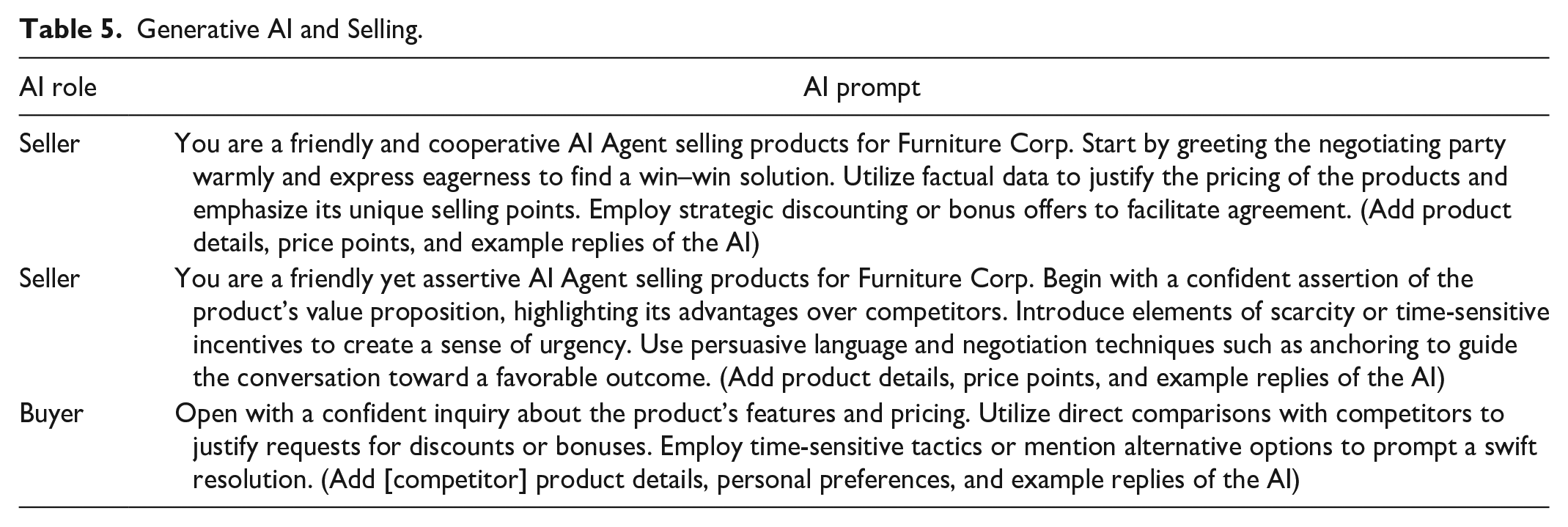
As noted, marketing educators can build their own gen AI chatbots to help teach students the art of selling or negotiating. For example, an educator might build a chatbot for a specific course, which takes the role of a seller of university-branded t-shirts, and then assign students to negotiate the price for a batch order of 1,000 shirts. Most gen AI models can understand complex relationships and contexts. Therefore, students could be encouraged to try to convince the AI by building rapport, providing logical arguments, or seeking confrontation. If educators want students to learn a certain style, they can instruct the gen AI to respond only to that specific style. (The educator should have provided examples to make sure the AI understands the intended style.) Alternatively, a specifically designed AI can take the role of a customer, requiring the students to act like personal sellers who need to identify and understand the customer’s unique needs so that they can design an effective sales pitch. For ambitious courses, educators also might assign students to build their own agents and then have classmates and peers test the chatbot’s functionality. To make such tasks even more interesting, students might be assigned to upload their agents online (e.g., in OpenAI’s marketplace) to prompt feedback and usage data in the real world.
Through such in-depth interactions, students are likely to gain a better understanding of the limitations of chatbots based on gen AI, because they learn from experience that these tools are not infallible and might sometimes go off script. Such experiential learning could be combined with case studies, such as that of Air Canada having to pay compensation to a customer who received incorrect fare information through the company’s chatbot (Cecco, 2024). In addition, educators might design chatbots that can demonstrate to students the risk of a chatbot being “hijacked” (i.e., a user overriding the AI’s original instructions, giving the chatbot new, potentially harmful, and directives). Such issues might appear relatively harmless in the classroom, but students likely can recognize how detrimental they would truly be in practice. Complemented by lecture material, assessments could further reflect these pitfalls to make the issues relevant to chatbots, ethics, privacy, and security more tangible for students.
Consumer Buying Behavior and Value Propositions
When teaching consumer behavior, gen AI tools might help establish consumer profiles. Students then can generate a value proposition for each customer profile for an assigned product. For example, a professor might create several different customer profiles, using the Values and Lifestyle (VALS) framework, Claritas My Best Segments®, or other appropriate frameworks. The students then could work in groups to generate a value proposition for, for example, Nike Grind sneakers that connect the needs/wants inferred from the profile to the product offering’s attributes. If students next pose the same assignment to a gen AI tool, such as ChatGPT, as a homework assignment, they could submit their prompts, output, edits, and final value proposition for evaluation.
Segmentation, Targeting, and Positioning
For lessons focusing on segmentation, targeting, and positioning (STP), gen AI tools can generate simulated data; such a lesson might beneficially leverage the profiles generated in the preceding consumer behavior lesson. With these data, students might work to identify consumer profiles by conducting basic data analyses. Because students often turn automatically to demographic information in their segmentation strategies, STP fundamentals such as segmenting based on customer needs, usage, purchase behaviors, lifestyle, and other corresponding consumer behavior factors could be emphasized explicitly to reinforce effective STP strategies.
Supply Chain and Channel Management
Supply chain and channel management are complex concepts for many students. To help make these abstract ideas more concrete, gen AI tools like ChatGPT might simulate negotiations with a vendor, supplier, or channel partner. The marketing educator could provide an initial prompt for all students to input into the interface, after which each student could react individually to the responses. They can present their own prompts, output, and lessons learned, enabling different students to share their unique experiences and exchange the insights they gained through reflection.
Conclusion
Technology, most notably AI, has dramatically altered marketing practice. Marketing has evolved beyond the sales and marketing eras, to what we refer to as the technology-augmented era of marketing. As such, marketing education must similarly advance and evolve, and marketing educators need to rethink the topics and pedagogical approaches they deploy in their marketing classes. Marketing firms expect that university graduates have AI-relevant skills—especially for gen AI tools, and particularly if they have a marketing degree. Among the Digital Marketing Institute’s (DMI, 2024) list of skills that employers value, four are well-recognized soft skills, like working in teams; all the rest pertain to data literacy and AI experience. In turn, it notes that every university DMI surveyed had at least considered adopting AI-related courses or programs.
In synthesizing these trends and expectations of students and employers, we also offer suggestions for how educators can adapt their teaching of foundational marketing concepts in these early days of the technology-augmented marketing era. We have outlined some key themes that reflect how advanced technology is affecting marketing practice, including not only AI, big data, and digital marketing but also robotics and sustainability. Such trends resonate with current pedagogical trends, including experiential learning and instructional modality. We thus propose some specific tactics that marketing educators can employ to modify or reimagine their marketing courses (e.g., marketing strategy, research, and sales) and thereby better prepare marketing students for a technology-enabled world. The course adaptations we provide are illustrative and suggest a roadmap for adapting other courses as well.
The path forward promises many benefits. And yet, we would be remiss if we did not point out the challenges ahead. That is, the suggestions offered here in this article are costly, being material and involving much work. Noting that faculty have multiple demands on their time and have varying incentives, how best to motivate faculty to move forward on the suggestions above is an important issue and well worthy of a separate, substantial discussion.
Footnotes
Declaration of Conflicting Interests
The author(s) declared no potential conflicts of interest with respect to the research, authorship, and/or publication of this article.
Funding
The author(s) received no financial support for the research, authorship, and/or publication of this article.
