




Abstract
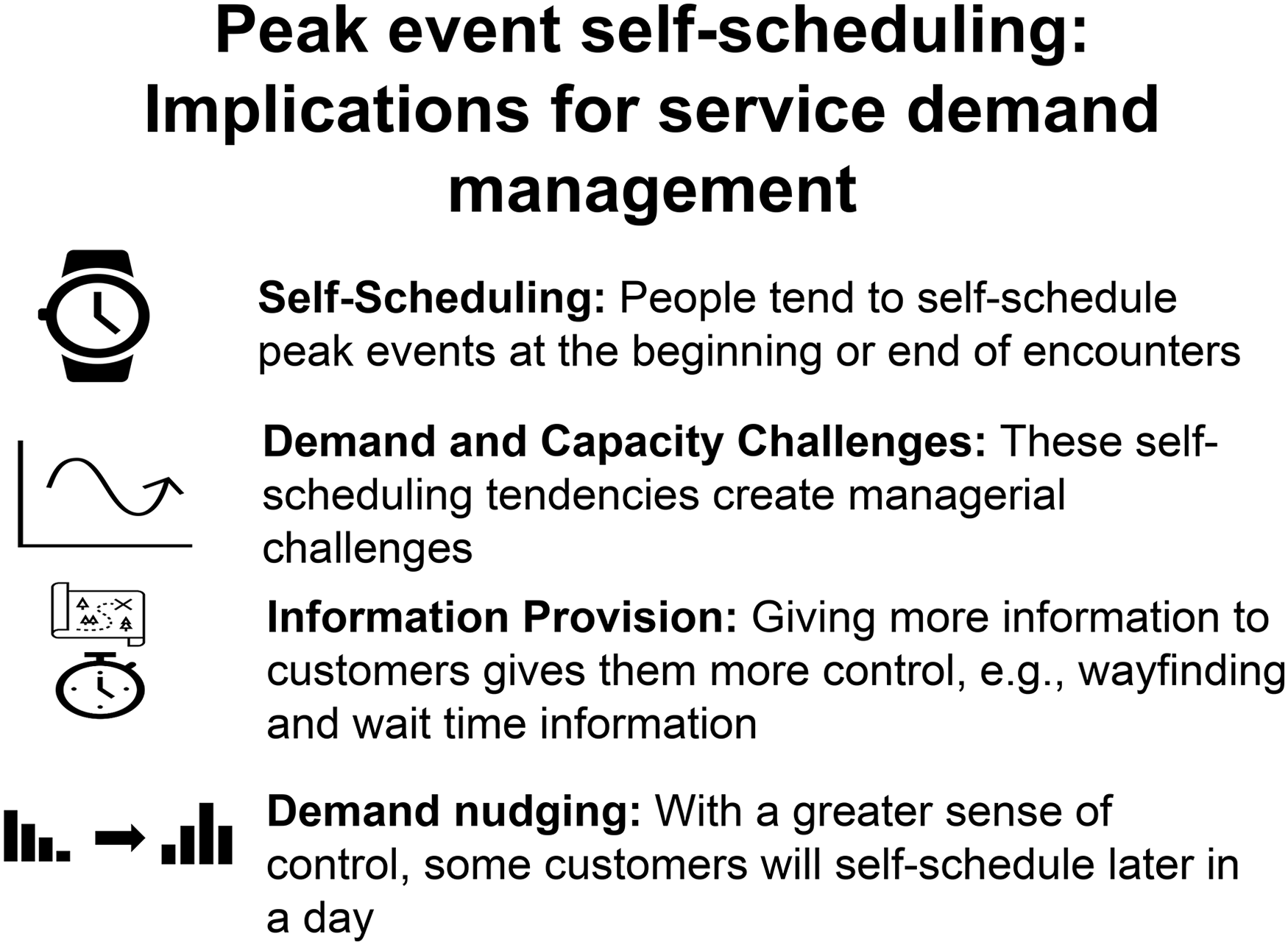
Services are often segmented into discrete events, allowing customers to self-schedule their own itinerary. We term this behavior as self-scheduling. We theorize that customers self-schedule peak events—those they predict will be their most salient—at predictable points, primarily for the bookends (i.e., at the beginning or the end). This behavior can create demand fluctuations and pose challenges for demand management. To examine this phenomenon, we conducted two exploratory studies. First, a survey using a tour context revealed a preference for self-scheduling the peak event at the beginning. A more balanced distribution between bookends emerged when information promoting the peak event was provided. Second, wait-time data from three major theme parks in the United States was collected during the summer of 2024 and validated that customers predominantly self-schedule peak events for the beginning. Next, we hypothesized how information provision may influence customers’ self-scheduling behavior of a peak event. A scenario-based experiment and a conjoint study in a theme park context found that practices enhancing perceived control (i.e., wayfinding and wait line management information) effectively shifted some of the demand from the beginning to later in a visit. We discuss insights to support demand management in self-scheduling service contexts.
Get full access to this article
View all access options for this article.
References
Supplementary Material
Please find the following supplemental material available below.
For Open Access articles published under a Creative Commons License, all supplemental material carries the same license as the article it is associated with.
For non-Open Access articles published, all supplemental material carries a non-exclusive license, and permission requests for re-use of supplemental material or any part of supplemental material shall be sent directly to the copyright owner as specified in the copyright notice associated with the article.
