




Abstract
Transformative service systems (TSSs) are designed to uplift human well-being. Yet, paradoxically, by necessity and in design, TSSs can also generate unintended harms for system actors. Our conceptual paper builds on recent service literature, as well as that on unintended consequences from a range of fields, to advance an integrative framework of harms in TSSs. Through the enabling theory of the doctrine of double effect, our framework organizes harms in the transformative service context, identifying that unintended harms can be both foreseen and unforeseen. Additionally, we find that the mechanism underlying these harms is system emergence. Emergence arises from the relative complexity of the service system and the relative dynamism of the issue the TSS aims to address. Our framework demonstrates that greater service system complexity increases the likelihood of foreseen harms, while greater relative dynamism increases the likelihood of unforeseen harms arising. Furthermore, we show how these two factors combine to promulgate the emergence of harms. We find that in instances where harm arises, greater service system adaption is required to mitigate such harms. However, some TSS harms are an inevitable and unfortunate secondary outcome of doing good, and these harms necessitate acknowledgment and acceptance by service designers.
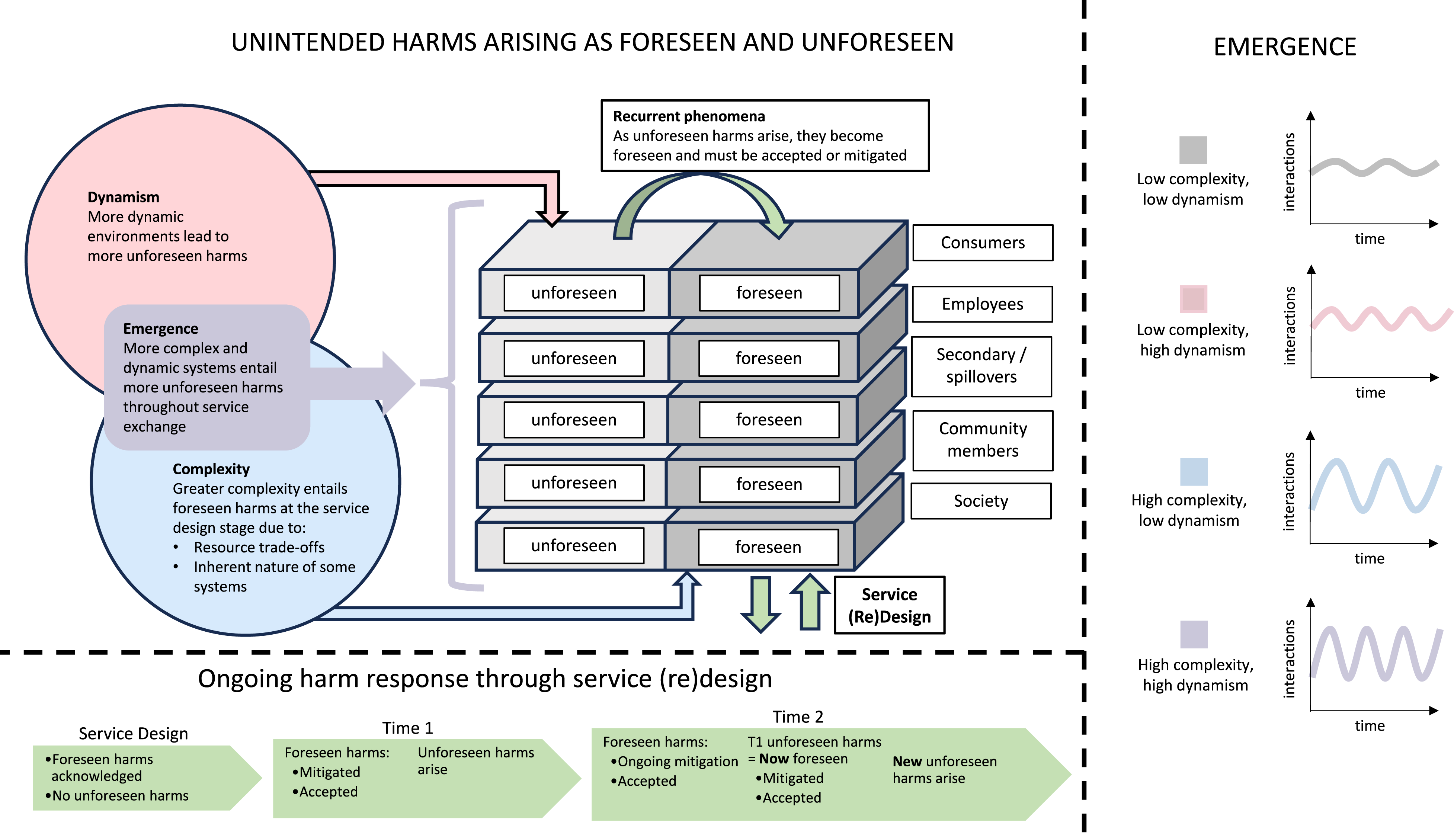
Transformative service systems (TSSs) intend to enhance human well-being and reduce suffering (Fisk et al. 2018), thereby limiting harm (Rosenbaum et al. 2011). Nonetheless, when designing and implementing TSSs, harm, defined as when individuals are made worse off or set back in terms of their well-being/welfare (Zhou 2022), may arise (Monge and Hsieh 2020). This situation requires greater academic insight (Blocker, Davis, and Anderson 2022) for policymakers and institutions to improve human well-being (Anderson et al. 2013), while also limiting harm to service system actors (Berry et al. 2022).
Some scholars note that certain harms are anticipated when designing TSSs (Blocker, Davis, and Anderson 2022), referred to as intended harm (Finsterwalder Jörg & Kuppelwieser Volker, 2020). We problematize this concept in transformative service research (TSR), drawing on the doctrine of double effect (DDE) to theoretically distinguish “intended harm” and “foreseen harm” (FitzPatrick 2012). We argue that no intended harms exist in the TSS context. This is because, while harm may be foreseen and/or known to exist in TSS design or may emerge through the service exchange and value co-creation process (Vargo et al. 2023), this is a secondary consequence. The intent of the TSS is not to create this harm. This distinction is important, as it enables TSS actors to allocate resources effectively to mitigate (Turcotte-Tremblay, Gali Gali, and Ridde 2021) or accept harms as undesirable but unavoidable outcomes (Berry et al. 2022). This distinction also supports the ongoing review of systems to identify and address emerging harms (Hills Alison, 2007), which some authors have suggested is under-considered in the broader business domain (Monge and Hsieh 2020).
Harms in Transformative Service Systems: Glossary of Key Concepts.
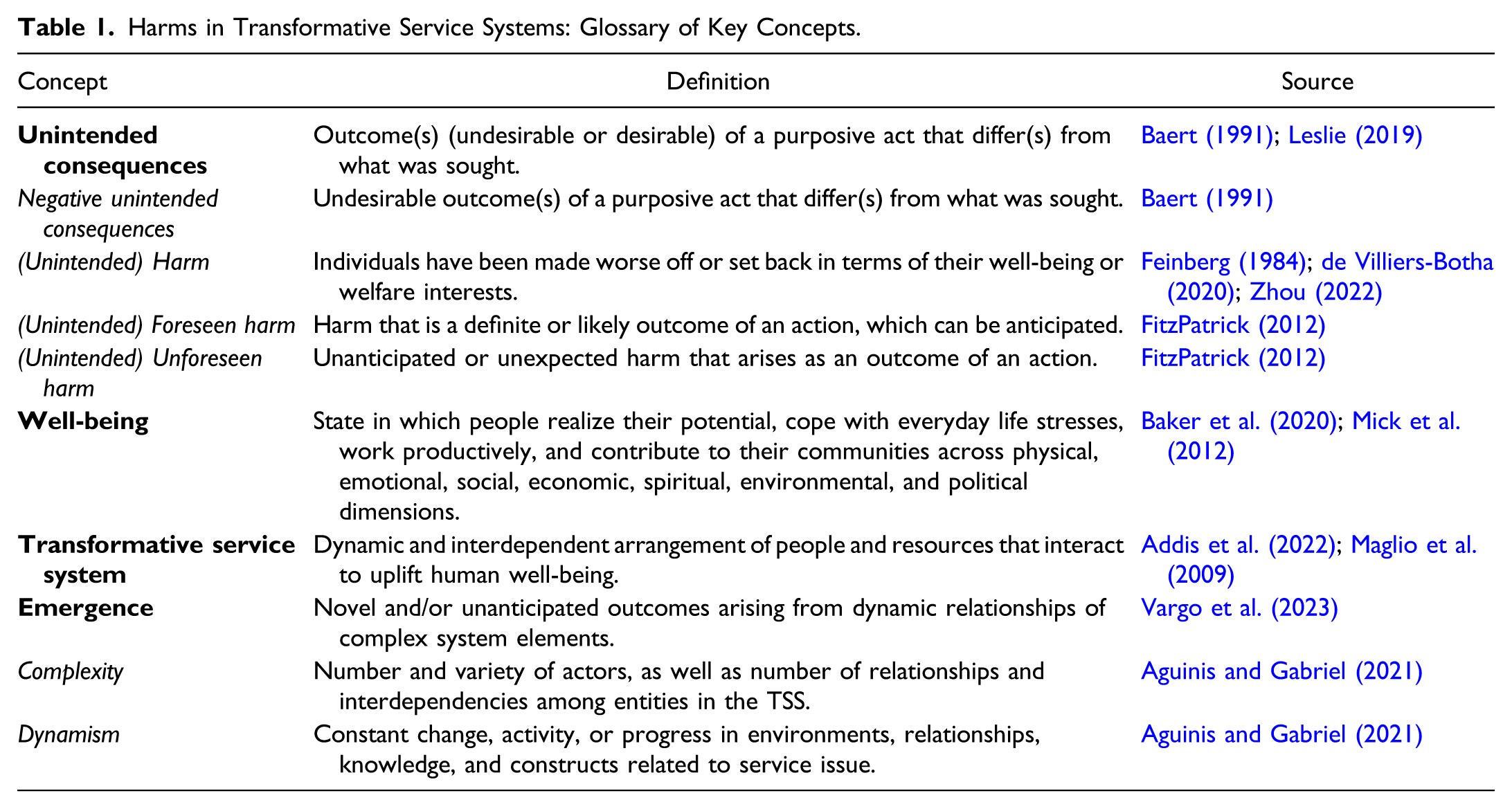
Our research provides three novel contributions. First, we present an integrative framework that delineates underexplored foreseen and unforeseen harms in TSSs. This is achieved by drawing on and combining several distinct streams of literature on unintended consequences. Our framework builds on the important and developing literature on unintended consequences in TSR (Blocker, Davis, and Anderson 2022; Fisk et al. 2018; Varman, Vijay, and Skålén 2022) and marketing (Peattie, Peattie, and Newcombe 2016), along with foundational work in sociology (e.g., Baert 1991; Merton 1936), economics (e.g., Mica 2017), and philosophy (e.g., De Zwart 2015). While unintended consequences have been discussed in many literature streams, their further consideration and theoretical integration can help to address gaps in our understanding of the manifestation of harms in TSSs. Consequently, this work more clearly defines the overarching concept of unintended consequences, and harms that fall within it, including foreseen and unforeseen harms. It also illuminates how harms manifest and the actors they can affect. This opens a clearer path to mitigating harms by designing more adaptive TSSs (Anderson et al. 2013; Blocker, Davis, and Anderson 2022). In doing so, we distinguish harm from other related concepts, including conflict (Varman, Vijay, and Skålén 2022) and co-destruction (Echeverri and Skålén 2021), and consider how harms are not always unforeseen. We further argue that the distinction between “intend” and “foresee” is critical for a discussion of harm in TSR, with the DDE providing a structured approach to analyzing unintended negative outcomes of TSSs. Given the growing interest in unanticipated (i.e., unforeseen) consequences of TSSs, better understanding these harms is important to progress TSR (see special issue of JSR 25:1).
Second, TSR parallels Service-Dominant (S-D) logic (Kuppelwieser and Finsterwalder 2016). This suggests “organizations, markets, and society are fundamentally concerned with exchange of service—the applications of competences (knowledge and skills) for the benefit of a party” (S-D logic 2023). Accordingly, S-D logic and TSR have mostly focused on favorable actor outcomes. For example, Lusch and Vargo (2014) and Maglio et al. (2009) refer to service systems, based on S-D logic, as constructive resource integrating entities that always create mutual actor value. Consequently, relative to the emphasis on positive outcomes, there has been less attention dedicated to negative outcomes, including unintended harms (for exceptions see: Blocker, Davis, and Anderson 2022; Kuppelwieser and Finsterwalder 2016; Parkinson, Schuster, and Mulcahy 2022; Sandberg et al. 2022; Varman, Vijay, and Skålén 2022). Our framework thus builds on the S-D logic and TSR literatures by integrating TSS harms.
Third, we identify that harms are emergent TSS properties (Peters 2016; Vargo et al. 2023). We discuss system complexity and issue dynamism as two important mechanisms of emergence, which have rarely been examined concurrently. We examine how greater TSS complexity gives rise to foreseen harms for actors at the point of service design (Blocker, Davis, and Anderson 2022), which have to be accepted or mitigated. Furthermore, we highlight how relatively greater complexity interacts with the relative degree of issue dynamism to increase the likelihood of unforeseen harms emerging in TSS exchange. This results in unforeseen harms (i.e., second-order emergence; Vargo et al. 2023) in the ongoing service process, subsequently becoming foreseen. We also build on service redesign work (Koskela-Huotari et al. 2021; Vargo et al. 2023) to show that the recursive review and redesign process is critical in identifying, acknowledging, mitigating, or accepting harms (Turcotte-Tremblay, Gali Gali, and Ridde 2021). This includes the learning that arises as organizations and actors experience the system and adapt accordingly (Ozanne and Ozanne 2021). Thus, our framework sheds light on when more resources are needed to create adaptive TSSs, which has implications for policymakers and system designers.
In the following sections, we offer a theoretical foundation for our work by reviewing research on unintended consequences and the DDE. We then elucidate when and why foreseen and unforeseen harms are more likely to arise—that is, under conditions of high complexity (foreseen) and high dynamism (unforeseen). We argue that these are the mechanisms underpinning the emergent properties of service ecosystems (Peters 2016; Vargo et al. 2023). Finally, we present our integrative framework of harms, enabled by the DDE and understood through the lens of service design (Koskela-Huotari et al. 2021) and emergence (Vargo et al. 2023). In doing so, we outline two types of harm (unforeseen and foreseen) that affect focal consumers, service employees, secondary consumers, and community in TSSs.
Theoretical Foundations
Transformative Service Research, Harm, and Unintended Consequences
TSR has the potential to enhance individual, community, and system well-being (Boenigk et al. 2021), with several dimensions of well-being considered. The dimensions most commonly include hedonic (subjectively determined positive mental states, such as pleasure and happiness) and eudaimonic (realization of full potential, such as development of capabilities) well-being (Anderson et al. 2013) in the context of TSSs (Anderson, Nasr, and Rayburn 2018; Boenigk et al. 2021; Fisk et al. 2018; Sandberg et al. 2022). As the focal concept in TSR, we acknowledge the complexity of well-being, its dimensions and alternative definitions of it. We adopt Baker et al.’s (2020, p. 221) definition of well-being as a state “in which people realize their potential, cope with everyday life stresses, work productively, and contribute to their communities” across physical, emotional, social, economic, spiritual, environmental, and political domains (Mick et al. 2012).
TSR focuses on the role of TSSs in affecting individual and collective well-being (Rosenbaum et al. 2011), including factors that influence well-being outcomes of targeted actors (Edgar et al. 2017). These various well-being outcomes include enhanced service inclusion (Fisk et al. 2018), service literacy (Anderson et al. 2013), capacity building and consumer agency (Boenigk et al. 2021), and health and welfare (Berry et al. 2022; Rosenbaum et al. 2011). However, TSR is beginning to recognize that designing TSSs poses challenges as “service entities are sometimes forced to choose between focusing more on one consumer entity’s well-being than another’s well-being, especially when they conflict with each other” (Anderson et al. 2013, p. 1206). For example, Sandberg et al. (2022) highlight how a health TSS affects primary and secondary consumers, noting both well-being and harm for multiple (focal and secondary) actors. Thus, “there are few circumstances in which we have certainty about what [well-being or harm] will happen” (Monge and Hsieh 2020, p. 16).
To understand the ways actors are harmed within TSSs, a clear definition of harm is necessary. Various descriptions of harm exist in the literature (de Villiers-Botha 2020), with many applying only a broad depiction of harm, such as “negative outcomes” (Blocker, Davis, and Anderson 2022) or “undesired consequences” (Bieler et al. 2022, p. 32). Others refer to “negative value” or a service interaction that has a negative consequence for actors (e.g., Guan et al. 2022).
We contend that distinguishing harm from simply any undesired outcome (i.e., inconvenience and minor discomfort) is important, with other research areas having also grappled with forming a clear definition of harm (Nescolarde-Selva, Gash, and Usó-Domenech 2019). The medical, biomedical, and bioethical literature streams all highlight the importance of “assessing harm and distinguishing it from offenses, minor hurts, or non-harmful instances of lacking benefit” (Encyclopedia of Bioethics 2018). Therefore, harm refers not just to simple disappointment or inconvenience such as that caused by a minor service failure, but to “a non-normative setback to interests” (Nescolarde-Selva, Gash, and Usó-Domenech 2019, p. 17). This notion is particularly relevant as much of TSR explores harm and well-being within health contexts (Berry et al. 2022; Finsterwalder Jörg & Kuppelwieser Volker 2020; Sandberg et al. 2022; Varman et al. 2022) in which consequential harm can have a major impact on one’s physical and mental health. For example, medicines designed to improve well-being can simultaneously have substantial adverse side-effects (e.g., Masek 2000; Masek 2006; Tully 2005).
Drawing from these perspectives and literature streams, we define harm as occurring when individuals have been made worse off or set back in terms of their well-being or welfare interests (Feinberg 1984; Zhou 2022) relative to their state before the service exchange (de Villiers-Botha 2020). These interests include health and vigor, as well as an absence of pain and suffering (Feinberg 1984). Functionally, this definition contends that harm occurs only when there is injury or damage (which may include loss and suffering) pertaining to the well-being or welfare interests of the individual.
Harms are not necessarily objective, such that two individuals who experience objectively the same event may differ in terms of whether they have been harmed. Thus, harm should be understood in subjective terms, depending on what constitutes a setback to one’s critical welfare interests (Hanser 2008). For instance, an extremely wealthy person and an individual living in poverty will be impacted differently by a loss of $500. For an extremely wealthy person this does not diminish the individual’s critical welfare, whereas this is likely to be a serious harm to an individual living in poverty. Thus, the harms examined are subjective but nonetheless constitute critical setbacks, involving material outcomes related to a decrease in well-being. This definition of harm thus includes experiences such as personal suffering or losing out on something that would improve one’s well-being (Feinberg 1984; Hanser 2008).
This concept of harm contrasts with that of co-destruction, which may overlap with harm in some cases but is distinct as co-destruction includes both the diminishment of value and perceptions of poor service (Echeverri and Skålén 2021). These are not necessarily harms per se, as they are not related to critical well-being or welfare interests (Zhou 2022). Harm is similarly distinguished from conflicts in perspectives or conventions between actors that may arise in TSSs (Varman, Vijay, and Skålén 2022). Conflicts do not inherently constitute harm, although harm may arise from conflicts.
Harms in TSSs are unintended consequences (Sandberg et al. 2022). While policy, service, and individual trade-offs can create unintended outcomes (Kuppelwieser and Finsterwalder 2016; Sandberg et al. 2022), TSR has only recently focused on these unintended and unforeseen consequences (Finsterwalder Jörg & Kuppelwieser Volker 2020; Parkinson et al. 2022). Accordingly, Blocker, Davis, and Anderson (2022, p. 3) note that “TSR lacks integrative frameworks, theory, and empirical insight about unintended consequences.” Varman, Vijay, and Skålén (2022) similarly highlight the need for more perspectives and paradigms to understand conflict and its resolution in TSR. A Google Scholar search conducted in March 2024 found that the terms “well-being” and “transformative service” have appeared together in 608 service journal articles, a high rate of alignment, which may partly relate to many works using the term well-being when defining transformative service. Importantly, the terms “transformative service” and “harm(s)” arose together in only 201 articles (with almost all these works also using the term well-being). This highlights that, in the context of TSR, harm is less frequently explored than well-being.
Scholars have identified unintended consequences that can arise in TSS contexts (Berry et al. 2022; Kaartemo and Känsäkoski 2018; Sandberg et al. 2022). They subsequently argue that there is a critical need to anticipate, avoid, and correct these. More narrowly, some of these studies discuss the trade-off decision when a harm to one actor or group of actors is known but the TSS is maintained as-is. Russell-Bennett et al. (2020) examined this in terms of how individuals make trade-offs regarding their own well-being. Nonetheless, insights into the trade-offs of well-being of actors (focal and secondary) within TSR are limited. This is surprising as TSSs (versus traditional service systems, unrelated to uplifting well-being) are more susceptible to unintended consequences given their relative complexity (Blocker, Davis, and Anderson 2022) and, as we further contend, their relative dynamism.
Unintended Consequences: An Integrative Review
Given the limited work in TSR on unintended consequences, as a prelude to our theorization and framework, we draw from pertinent work in the fields of service, marketing, health, economics, philosophy, sociology, and governmental policy. We used a Google Scholar search given its wide multidisciplinary focus (Gehanno, Rollin, and Darmoni 2013), employing two overlapping search strategies. First, we conducted article title searches using the keywords foreseen OR unforeseen OR unintended OR consequence OR consequences, separately, in journals that had the words “service”/“services,” “marketing,” or “consumer” in the publication title. We restricted the journal articles to those published in English, with no year limit. We excluded books, conference proceedings, editorials, reviews, and commentaries. Second, we included foreseen OR unforeseen OR unintended without any restrictions on journal title, which resulted in locating 10,000+ works. In the focused search of service/services, marketing, and consumer journals, we removed duplicate articles and screened the topic relevance by article titles, keywords, and abstracts (Danaher et al. 2023). Within the broader search (excluding the former discipline specific focus), we reviewed article titles initially and then undertook a secondary screening for relevant abstracts. From our review and mindful of space constraints, we selected representative articles for inclusion. This resulted in a final set of 50 articles within the service, marketing, and consumer domains (see Web Appendix 2) and more than 100 works from the broader set of domains.
To understand unintended consequences, they must first be described. These consequences are due to a “formally organized” and purposive action (i.e., an action that is motivated), and a choice of alternative actions exists (Merton 1936). Unintended consequences thus refer to the outcome of a purposive action that differs from what was sought (Baert 1991; Leslie 2019). Baert (1991) and others note that unintended consequences are not necessarily only those that are undesirable (e.g., Peattie, Peattie, and Newcombe 2016), although policymakers and institutions generally focus on negative unintended consequences (Slemp 2010; for an exception, see Varman, Vijay, and Skålén 2022). However, our theorization pertains only to unintended harms.
Several studies have developed categorizations of unintended consequences on which our work builds. The seminal work of Merton (1936) in sociology conceptualizes the impact of unintended and unanticipated (unforeseen) consequences in terms of the “sum total” of consequences of an action, suggesting that consequences can occur for different groups implicated (e.g., the focal actor, other people, the social structure, and the culture). Merton’s typology was subsequently applied in other domains (e.g., Charles 2017). Peattie, Peattie, and Newcombe (2016) also apply this approach within a marketing context, depicting whether an unintended consequence is foreseen or unforeseen and whether it is positive or negative. We build on Merton’s initial work, which he terms as “the briefest exposition,” by differentiating unintended and (un)foreseen harms and deriving implications for actors at multiple TSS levels. This comprises actors at the core of the service exchange, including service employees, who are largely unconsidered in the TSR literature. The distinction of unintended versus unforeseen harms is critical, as conflating these concepts enables policymakers to “shed responsibility and avoid discussion about hurtful choices” (De Zwart 2015, p. 293).
Baert (1991) classified unintended consequences in terms of their social influence, degree of desirability, effect on the intended action, unanticipated (unforeseen) nature, and their temporality. Our work relates to Baert’s classification and the application of Peattie, Peattie, and Newcombe’s (2016) types, which are particularly relevant given the distinction between unintended and unanticipated (unforeseen) consequences and the impact on actor groups. However, many of these earlier works are largely atheoretical. As such, we use middle-range theorizing (Stank et al. 2017) to explore the mechanisms generating unintended consequences that are (un)foreseen.
Similarly, the service and marketing literature offers limited theoretical discussion on how and why harm arises. Only a few articles located via our review use theory to broadly explain harmful unintended consequences (Blocker et al. 2022; Finsterwalder Jörg & Kuppelwieser Volker 2020; Kuppelwieser & Finsterwalder 2016). Many of the identified articles focus on a particular context (e.g., use of warning messages), most often in health, in which they aim to identify specific unintended consequences that arise. Where extant research uses theory, it is generally to explain a particular consumer response to an intervention, such as to warning messages (e.g., Ringold 2002), rather than to provide a grounding to explain why harmful unintended consequences might occur more broadly (see Blocker, Davis, and Anderson 2022). Some other works consider unintended consequences within a commercial setting, whereby firms’ well-being (i.e., profitability) is used as a justification for other actors’ (unintended) harm (Masek 2000). We suggest that this exchange context is too narrow, and that harm can arise as a wider system effect.
As an exception, Finsterwalder Jörg & Kuppelwieser Volker (2020) is one of the few works to use intentionality theory to develop a taxonomy to understand the pathways that can lead to actors causing (un)intended well-being outcomes for others. However, we contend that if acts are intentionally harmful and reduce well-being, they are not transformative. Thus, we argue that intentionality is an inappropriate theoretical lens to explore unintended consequences.
Outside marketing and sociology, other works examine types of unintended consequences that are both negative and positive. This includes in social policy (Charles 2017), management (Leslie 2019), supply chain management (Carter, Kaufmann, and Ketchen 2020), and public health (Turcotte-Tremblay, Gali Gali, and Ridde 2021). These works are important, but the scope of our work is solely on harmful unintended consequences within TSSs.
While Turcotte-Tremblay, Gali Gali, and Ridde’s (2021) study highlights negative and positive unintended consequences, it makes only an implicit distinction between intend and anticipate (foresee). Extending this work, our explicit distinction between intend and foresee provides a theoretical grounding for this difference, which also brings to the fore its practical importance. Indeed, where others suggest the emergent nature of service systems (Vargo et al. 2023) infers constant evaluation (Oliver, Lorenc, and Tinkler 2020) and redesign of policy and service systems (Morell 2018), we explicitly argue that this is critical. This is especially the case once an emergent unforeseen harm (versus preidentified harm) arises and then becomes foreseen in subsequent service exchange.
Importantly, across literature streams, there is a growing dialogue about the acceptance of harms that are either foreseen or unforeseen within the system. Some studies recognize that harms may arise via service systems (Slemp 2010; Turcotte-Tremblay, Gali Gali, and Ridde 2021), and others acknowledge these harms are inevitable, undesirable but unavoidable outcomes (Sandberg et al. 2022). While policy actions can mitigate or try to manage them (Turcotte-Tremblay, Gali Gali, and Ridde 2021), the natural sciences suggest that in extreme cases, harms can become so major that they cannot be mitigated or managed (Suckling et al. 2021). Even within TSR, work examining conflicts as unintended consequences acknowledges that such negative consequences result in compromise, concession (to one perspective/convention), or dissolution (Varman, Vijay, and Skålén 2022).
Our literature review on harmful unintended consequences finds that harm is rarely distinguished from other consequences. Similarly, research does not theoretically delineate the unintendedness and foreseenness of harm, nor identify when these types of harm arise. We thus argue that TSR, our domain theory, is incomplete regarding the discussion of harm.
Doctrine of Double Effect in Transformative Service Systems: Intend versus Foresee
The service system perspective, part of S-D logic, is fundamentally a general theory of structure and agency that outlines how system actors and resources jointly create value (Lusch and Vargo 2014). Yet general theories, due to their very nature, often leave many questions unanswered (Stank et al. 2017). By contrast, middle-range theorization occurs below the level of general theories to focus on a subset of phenomena relevant to a particular empirical context, illustrating the causal mechanisms at play (Stank et al. 2017). Therefore, given limited insight into how harm emerges in TSSs, we use middle-range theorizing to extend prior work and explain how unintended harms manifest. Middle-range theorizing is about developing practically relevant theories (Brodie and Peters 2020). It is also the foundation for conceptual framework development (Lindgreen et al. 2020), and as such, we use it to develop an integrative framework to examine why, how, and when unintended harms manifest in TSSs. In applying this approach, we introduce the DDE as an enabling theory through which harms arising within TSSs can be classified. This classification occurs via the distinction between “intending” and “foreseeing” harm (Monge and Hsieh 2020).
Like literature on unintended consequences, the DDE argues that to “intend” is to undertake action purposefully and meaningfully as a means or as an end (Masek 2010), to choose a given plan specifically to bring about the intended consequence (Hills Alison 2007). Alison (p. 257) provides the following example explicating the difference between intend and foresee: “You devise your shopping plan to get food: getting food is your intended end. You foresee, but do not intend, that you will wear down the tires of your car, for you did not choose to go out to wear down your tires.” In this example, you know that driving affects your tires, and thus any time you drive your car (i.e., your targeted action), anticipated wear and tear results. Thus, while “wear and tear” was unintended, it was not the primary motivation of your action (De Zwart 2015) or unanticipated.
Accordingly, the DDE distinguishes intending harm—when harm is done as the motivating intention for an action—and foreseeing harm—to reasonably anticipate in advance that harm is a definite or likely outcome of an action (FitzPatrick 2012). The DDE therefore suggests that harm that is secondary, or not the focal goal, is not an intended harm but rather foreseen. As such, we apply the DDE as our enabling theory as it allows us to bridge this observed gap in TSR (Jaakkola 2020). Specifically, the DDE facilitates us theoretically distinguishing “intended” and “foreseen” harm that arises in the transformative service context. It allows us to show that foreseen harms can arise even in TSSs.
We argue that whether a harm is intended or merely foreseen is an essential distinction to make in TSR (FitzPatrick 2012). Existing definitions of negative consequences in TSR that frame harms as intended or unintended (e.g., Finsterwalder Jörg & Kuppelwieser Volker 2020) do not distinguish a harm that is intended and one that is merely foreseen. As the primary aim of TSSs is to increase well-being, harms are never intended. Similarly, current definitions of unintended consequences (e.g., Blocker, Davis, and Anderson 2022) can be expanded to capture the notion that while consequences, including harm, can be unintentional, they can be both foreseen and unforeseen, as well as potentially managed, mitigated, or accepted.
Blocker, Davis, and Anderson’s (2022, p. 3) definition of unintended consequences suggests that within TSSs they are “unforeseen outcomes of intended efforts to create positive change.” Indeed, the primary intent is never to inflict harm on any actor, even though a reduction in well-being (i.e., harm) to one or more actors may be a foreseeable outcome. That is, it is possible for one to “intend” a good effect, given the inherent nature of TSSs, and, at the same time, to “foresee” that harm, which is unintended, may also occur, as well as not to foresee a different harm, similarly unintended.
Importantly, the DDE contends that sometimes it is permissible to bring about harm as a foreseen but unintended side effect of one’s action, though the same harm is impermissible to intend as a means or an end, all else being equal (Hills Alison, 2007). Thus, the DDE allows an act, such as a transformative service exchange, to have more than one effect, with at least one being harmful. It permits the transformative service exchange (i.e., the act) only if it satisfies the following criteria: (1) the transformative service exchange itself is good; (2) the actors involved in the system do not intend the harm; (3) the TSS cannot obtain the good (transformative) effect without the harm; (4) the good effect from the TSS results at least as directly as the harm; and (5) the good effect is assessed as sufficiently good to offset the harm, even though this may affect different actors, that is, proportionality (Masek 2010).
According to the DDE, the harm must be “collateral damage” (i.e., a foreseen but unintended side effect of an action), rather than an intended means to an end (FitzPatrick 2012; Masek 2010). Furthermore, harm that arises as a foreseen side effect of promoting a good (transformative) end needs to be minimized as much as possible (FitzPatrick 2012). Prior TSR studies have highlighted this mitigation of harm. For example, Addis et al. (2022) suggest that multi-actor solutions are required to address harms, as is the inclusion of those negatively affected, which can limit the negative consequences. Edgar et al. (2017) argue that well-being issues associated with susceptible employees can be mitigated with effective human resources practices. However, these works offer little guidance on how harms can be eliminated or suggestions as to how they can be identified or managed. According to the DDE though, if the net effects on well-being are proportionally positive, harm is permissible.
To the extent that harms are never intended within TSSs, foreseen-unintended harm and unforeseen-unintended harm are the only two alternative forms of harm arising. Foreseen-unintended harm is applicable to TSSs due to the inherent nature of policy trade-offs under resource constraints (Ostrom et al. 2021). Furthermore, managing complex systems or dynamic issues precludes evaluating all potential eventualities (Slemp 2010), even when foreseeing that some negative outcomes may arise. Working in the middle range, we, therefore, draw on the DDE to conceptualize foreseen-unintended harm as a necessary permissible cost of achieving a desired good, one that is secondary to the intended outcome. For example, an emergency worker dealing with road trauma may experience post-traumatic stress disorder as a foreseen but undesirable outcome of saving lives.
Conversely, unforeseen-unintended harm includes unanticipated negative outcomes (Addis et al. 2022; Peattie, Peattie, and Newcombe 2016), including harmful service failures (Finsterwalder Jörg & Kuppelwieser Volker 2020). For example, a healthcare provider that makes a medical error can cause harmful outcomes, such as illness or even death (Van de Walle 2016), though this was unforeseen and unintended. In other cases, such as a natural disaster, foreseeing a given harm may also be constrained by the rapidly (dynamically) evolving issue. Thus, in many contexts, harm arises from a lack of foreseenness, or (with insight and time) being able to identify negative consequences, including a reduction in well-being. However, after an unforeseen harm occurs, it is subsequently foreseen in the future, with institutions modifying service processes to try to limit the occurrence of foreseen harms. However, this is not feasible in all situations (Suckling et al. 2021). We propose that the likelihood of both foreseen and unforeseen harms arising in the TSS depends on aspects its design and redesign process. This pertains particularly to the relative system complexity and the relative dynamism of the issue being dealt with, which we turn to next.
Harms as Emergent in Transformative Service Systems
Service Systems and Service Design
Service exchange occurs within a broad ecosystem, which is an interdependent arrangement of people and resources that interact with other service systems to generate joint value (Addis et al. 2022; Maglio et al. 2009). Service system theory, as a general theory, suggests that shared institutional arrangements, or common rules, norms, and beliefs, form interconnected systems called “service ecosystems” (Vargo and Lusch 2011). A service system can be a whole system or part of a larger service ecosystem, depending on the level of aggregation (Siltaloppi, Koskela-Huotari, and Vargo 2016). Indeed, the design of TSSs extends beyond the traditional focus on dyadic service exchanges (Patrício et al. 2020) and is an ecosystem “intentionally shaped by multiple collectives in a value cocreation process of ‘reflexivity and reformation’” (Vink et al. 2021, p. 169). Different processes and actors within service ecosystems influence each other and contribute to overall value co-creation (Vink et al. 2021) and well-being within the network (Patrício et al. 2020). Thus, given the unique nature of TSSs, a contextualized approach offered by middle-range theorizing is necessary to understand how harms arise and how to respond to them.
The actions and perceptions of many actors influence the outcomes of service ecosystems, some of which may not be fully envisaged (Ostrom et al. 2021). Accordingly, TSS design needs to be viewed as an ongoing process and a reflective practice (Vink et al. 2021). Researchers are increasingly recognizing that service systems are constantly reconfiguring and reforming themselves. To be effective, a collective of system actors needs to imaginatively generate possible futures, including envisioning and developing superior service systems (Koskela-Huotari et al. 2021). This process includes recursive feedback loops influencing their self-adjustment, which need to appreciate the complexity and interdependence of multiple service systems and their parts (Vink et al. 2021). Consequently, harm(s) can arise both during the initial TSS design and throughout the recursive reconfiguration process. We contend that while in the initial design of the system an actor may be aware of foreseen harms and consider how best to address them, unforeseen harms will be emergent throughout an ongoing reconfiguration process.
Emergence
Working in the middle range, we argue that unforeseen harms are emergent properties of TSSs. As they are unforeseen, they are inherently novel and unexpected outcomes that arise throughout interactions within the service ecosystem (Nescolarde-Selva, Gash, and Usó-Domenech 2019; Peters 2016; Polese et al. 2021). In accordance, Vargo et al. (2023, p. 3) define emergence as “new, novel, and/or unanticipated outcomes resulting from dynamic relationships of system’s elements” as well as “a phenomenon that arises from the relationships among existing system’s elements” (see also Peters 2016). Emergence arises from both dynamic relationships and relationships among elements, and does so in all complex systems (Vargo et al. 2023). Thus, we assert that emergence is not singular but multiplicative, arising from both the dynamism (dynamic relationships) and complexity (density and arrangement of relationships) in a TSS. We therefore identify service system complexity and issue dynamism as the two underlying mechanisms that promulgate emergence. These can result in TSS upheaval (Polese et al. 2021) and, therefore, harms. These two mechanisms interact to underpin both foreseen and unforeseen harms in different ways.
Complexity
Service system complexity is the number and variety of actors, as well as the number of relationships and interdependencies among entities in the system (Aguinis and Gabriel 2021). In a complex system, any given action “can have wide-ranging effects and the implications for the future are uncertain” (Suckling et al. 2021, p. 2). Both traditional service systems and TSSs include many actors and interactions, multiple levels (from individuals to organizations to national systems), and interdependencies between these actors and levels to realize value co-creation (Addis et al. 2022; Patrício et al. 2020). However, TSSs are generally more complex than traditional service systems (Blocker, Davis, and Anderson 2022). They operate within complex social systems trying to maximize good for individual actors as well as societal stakeholders. This makes their impact difficult to capture (Leslie 2019). TSSs must also balance individual and collective well-being by working with the system complexity rather than its parts in isolation (Patrício et al. 2020; Vink et al. 2021).
We propose that, on its own, increased TSS complexity will result in more foreseen harms. Complex systems are more difficult to manage (Kuppelwieser, Spielmann, and Vega 2023), and their complexity means that critical touchpoints may be overlooked in their design (Varnali 2019). When alignment and cooperation between actors in complex systems is absent, issues such as tensions, conflicts, and trade-offs can arise (Anderson and Ostrom 2015; Varman, Vijay, and Skålén 2022). Trade-offs may be necessary when a difference in actor needs or desired outcomes exists and there are competing interests (Kuppelwieser, Spielmann, and Vega 2023). This is especially the case when resources are scarce, and all actor needs cannot be accommodated (Sandberg et al. 2022). With increased complexity, constraints of a given system component mean that other parts may be unable to deliver to full capacity. This results in negative outcomes such as harms that cannot be mitigated.
Increased complexity can also contribute to increased unforeseen harms. As components of a TSS interact, outcomes are dependent on how components work together. This may lead to creating or destroying transformative value. Complexity provides a greater number of interactions, each of which has the potential to be either positive or negative. This gives rise to the possibility of negative outcomes—including harms—to occur from emergence through interaction (Peters 2016). More actors and greater complexity increases the likelihood of unanticipated service failures (i.e., unforeseen harm) (Anderson, Nasr, and Rayburn 2018). There is also greater potential for different perspectives or conventions to co-occur in the TSS, with a concurrent potential for conflicts between them to emerge (Varman, Vijay, and Skålén 2022).
Dynamism
Issue dynamism is constant change, activity, or progress in environments, relationships, knowledge, and constructs related to the service context (Aguinis and Gabriel 2021). While TSSs are complex, the issue they aim to address is often relatively static. For example, for a TSS addressing homelessness, the well-being issues within the homeless community, which are various, are ideally integrated into the service design. While complexities are associated with the many stakeholders in these systems, each with unique needs that ultimately may change, these tend not to be rapidly evolving. By contrast, some TSSs address issues which evolve fast, such as in crises like natural disasters (Kuppelwieser, Spielmann, and Vega 2023; Ozanne and Ozanne 2021). For example, during Hurricane Katrina, various impacts occurred during the storm, immediately after it, and following the flooding of New Orleans (Klein Kelly et al., 2008). Each of these time points reflects a dynamic evolution of the issue, resulting in new challenges that needed to be addressed at each stage.
We propose that with greater issue dynamism comes increased unforeseen harms due to unpredictability and uncertainty (Kuppelwieser, Spielmann, and Vega 2023). The nature of rapidly evolving dynamic issues means that many harms arise at each stage or interval. This requires a rapid implementation of actions as the immediate human needs are more pressing than anticipating and preparing for, or mitigating subsequent potential harms (Celentano et al. 2019). For example, evacuating people during Hurricane Katrina and its aftermath was time-critical, precluding immediate actions to deal with these individuals’ long-term needs. The dynamic evolution of events meant that these needs, though possible to understand in hindsight or with more time or resources, could not be immediately or prospectively mitigated. This was due to rapidly evolving circumstances, which could only be addressed in the future (Brodie et al. 2006). Thus, institutions can define the scope of the issue to be addressed when issue dynamism is low. However, when dynamism is high, the rapid evolution of knowledge and/or circumstances mean that unexpected outcomes may emerge that cannot be initially anticipated or addressed (Suckling et al. 2021).
Overall, we argue that emergence is the multiplicative outcome of both ecosystem complexity and issue dynamism. We depict these relationships as a waveform (see Figure 1, lower panel). Complexity is represented in the amplitude (height) of the wave. The more interactions among actors in the TSS, the higher is the wave. Dynamism is presented in the frequency (space between intervals) of the wave. As dynamism refers to the speed of unfolding events or changing knowledge, more dynamic issues have a greater number of meaningful changes or meaningful time points (measured in intervals) at which new properties emerge, within the same amount of actual time elapsed (measured in hours, days and weeks). Greater complexity and greater dynamism therefore both contribute to greater emergence, as higher and/or more frequent waves. Underlying mechanism of harm: Complexity × dynamism = emergence.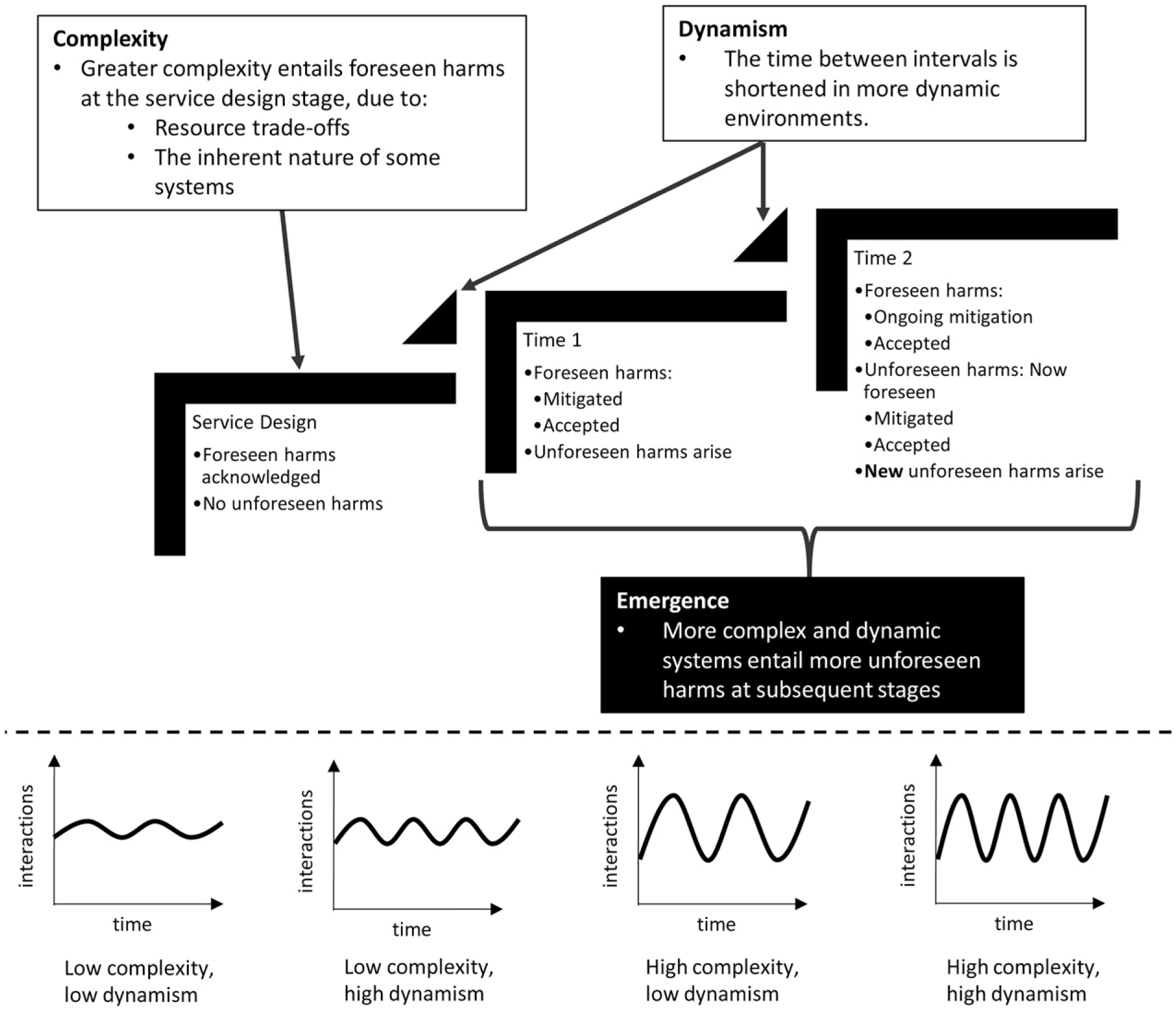
Emergence also pertains to how unforeseen harms arise at one time and then become foreseen at subsequent times (see Figure 1, upper panel), as well as how these emergent harms are addressed (or not) within the TSS as part of a feedback process (Peters 2016). In many cases, institutions may identify an unexpected outcome or a gap in the TSS that has created harm. If the situation permits, they are able to modify the TSS to address what is now a foreseen harm. According to Vargo et al. (2023, p. 9), emergent properties are outcomes of the interactions between actors and resources. However, they are also an input into “recurrent resource integration,” and emergence occurs not only as a singular novel outcome but also as patterns (second-order emergence) and ecosystem properties (third-order emergence). Thus, in Figure 1 we capture the temporal nature of where harms arise, starting at Time 0 with system design. This is when some foreseen harms are identified and accepted or mitigated, depending on the resource trade-offs and complexity of the TSS. Subsequently, at Time 1, service is exchanged, resulting in emergent outcomes due to interactions between actors (Peters 2016), with unforeseen and emergent harms. In each round of exchange is the potential for new unforeseen harms to emerge.
Critically, when novel unforeseen harms emerge, to the extent that they become patterns, they are foreseen but unintended (De Zwart 2015) and must be mitigated or accepted (Turcotte-Tremblay, Gali Gali, and Ridde 2021). However, to the extent that they cannot be mitigated (e.g., emergency workers experiencing trauma; Smith and Roberts 2003), they become system properties (i.e., third-order emergence). In this way, harms can become recurrent and maintained emergent aspects of the system (Peters 2016) as foreseen but unintended outcomes of TSSs. In the next section, we aggregate this theorizing into an integrative framework of unforeseen and foreseen harms in TSSs. Our framework draws on the DDE as an enabling theory to examine ecosystem complexity and issue dynamism as mechanisms underpinning the emergence of harms.
A Framework of Harms in Transformative Service Systems
We build on and integrate prior work on unintended consequences, TSR, and service system design to advance an integrative framework of harms that can arise in TSSs (see Figure 2). Jaakkola (2020) outlines four research design “templates” for conceptual studies: theory synthesis, theory adaptation, typology, and model. We adopt the model approach to describe the concept of harms in TSSs and the issues that need to be considered, including the mechanisms at play (Jaakkola 2020) and their relationship to other entities (MacInnis 2011). This fits with our middle-range theorizing approach (Stank et al. 2017). Integrative Framework of Harms in TSSs.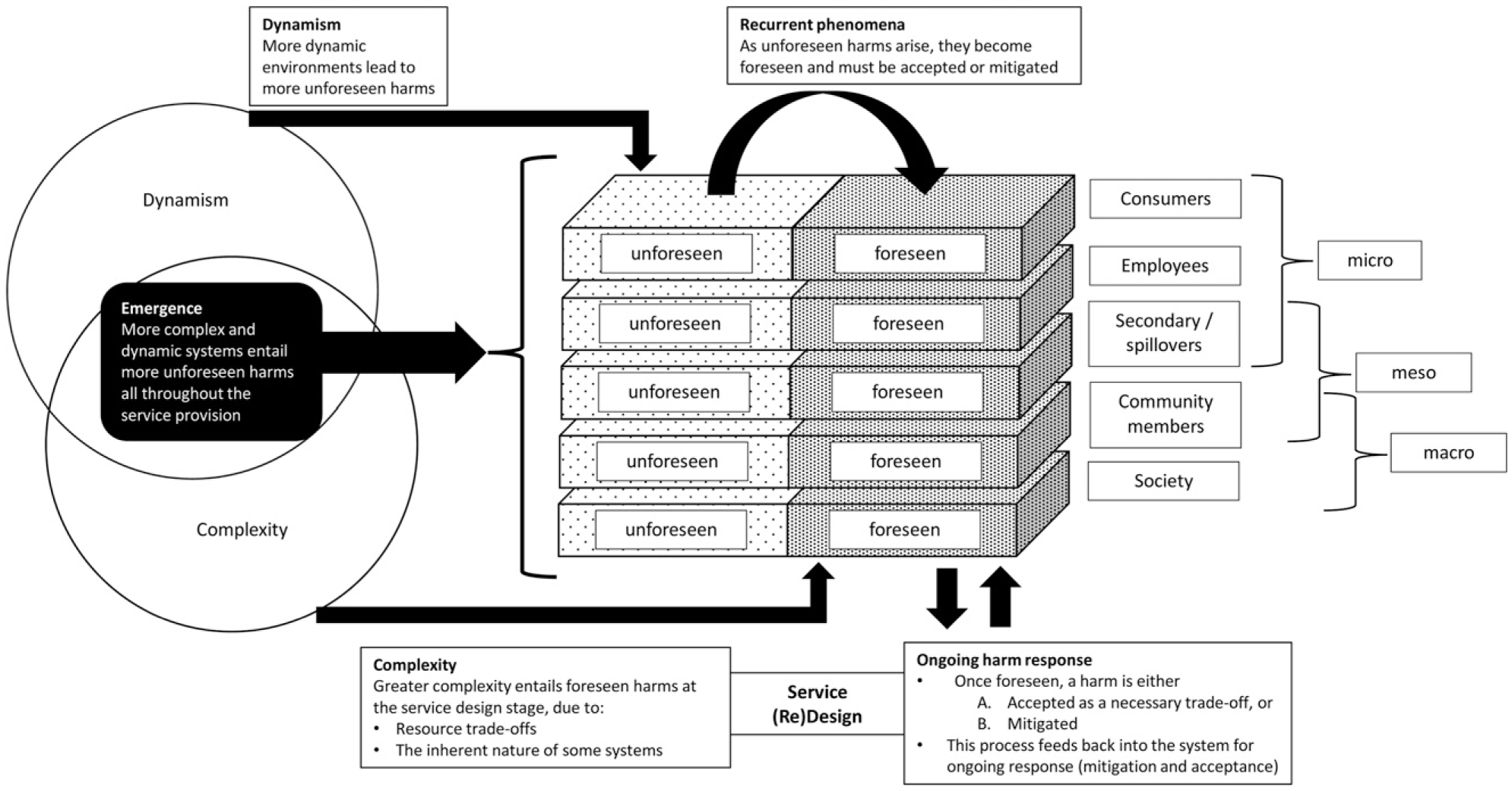
We distinguish types of harm by applying the DDE and, in doing so, provide a theoretical grounding to highlight the importance of differentiating intend and foresee in TSSs. Our integrative framework enhances our understanding of harm by detailing its key types; the focal actor impacts at the micro, meso, and macro levels; the mechanisms at play; and the subsequent practical considerations of and strategic implications for TSS design.
To ensure our framework is practically applicable, we consider a range of different actors who co-create value within TSSs and can also be harmed. This is because harm can occur for several different actors, as what is beneficial to one actor may be detrimental to another. Given that human actors are those who directly experience and must cope with harms and are those for whom TSSs are primarily designed, our unit of analysis is predominately focused on harms arising against human actors.
Consequently, we begin by focusing on individuals within the micro level of the TSS because they serve as the core of the service exchange, whereas operations and institutions at the meso and macro levels are more distal (Chandler and Vargo 2011). At this level, our framework articulates how consumers and service employees experience both foreseen and unforeseen harms in TSSs. Service employees are critical to the service exchange (Anderson, Nasr, and Rayburn 2018), yet TSR work exploring how service employees are affected in their roles is underexplored (Edgar et al. 2017). Indeed, there are limited studies on unintended consequences that treat employees as an important actor group (for an exception, see Sandberg et al. 2022). Despite commercial, public, and nonprofit organizations’ efforts to invest in employee training and other practices to address the negative consequences of service work, risks of harm to service employees are very real.
Diverging somewhat from recent research on unintended outcomes in TSR that often focuses on conflicts at the micro level (e.g., Varman, Vijay, and Skålén 2022), we then discuss harms to proximal actors (e.g., secondary consumers and families). This is at both the micro and meso levels for actors in the broader service network (Chandler and Vargo 2011). We follow this by discussing spillover harms occurring to more distal stakeholders (e.g., communities and institutions); insofar as these harms pertain to the well-being of human actors, they occur at the meso and macro levels. The complex network of service systems, particularly in multi-level service design, invariably means that others beyond service employees and target consumers are involved or affected, directly and indirectly, within a given TSS (Maglio et al. 2009). These secondary consumers and more distal actors have their own specific needs (Leino, Hurmerinta, and Sandberg 2021). Accounting for the interdependencies between actors in the system therefore ensures that a broader set of needs are considered (Patrício et al. 2020). This enables a more comprehensive examination of harms related to the core work of TSSs (see Figure 2).
To elucidate our framework, we use integrated examples to showcase different foreseen and unforeseen harms arising in TSSs. These embedded examples apply across different types of harm and across all spheres (e.g., consumer, employee, and spillover). They also embody varying degrees of complexity and dynamism, with consequently different levels of emergence (see Table A1 in the Web Appendix for a summary of examples).
Consumer Sphere
Foreseen: Excluded Groups
With consumers in need as the foundation of TSR, a key step in TSS design is to determine who specifically the target consumers are (i.e., who will be served) and who, if anyone, may be in need but excluded. In practice, some consumers are excluded because of resource constraints, with policymakers aiming to maximize the social value delivered (Anderson and Ostrom 2015). The exclusion of underserved consumers is recognized, acknowledged, and, in some policies, explicit (Leino, Hurmerinta, and Sandberg 2021); thus, their exclusion is a foreseen harm, as is the potential ongoing harm to this group.
As an elucidating example, while many homeless people may potentially attain value from a homeless shelter, governments are unable to serve all those in need. Governments and institutions frequently design TSSs specifically for a target group, such as those fleeing domestic violence. In such cases, other homeless segments, such as troubled youth or those with mental illness, are not served or are underserved. These excluded and underserved groups are thus at increased risk because resources are not spread evenly across all those experiencing homelessness. The relative lack of prioritization given to excluded groups may exacerbate their experienced harm. For example, they may be further marginalized (Mayock, Sheridan, and Parker 2015) and disenfranchised given their impeded access to uplifting service (Zakour and Harrell 2004). As such, they are harmed by their exclusion from TSSs, as foreseen by service designers. Yet this harm is not intended and is secondary to the well-being of those being served, in line with the DDE.
TSR recognizes that policy trade-offs result in some groups being underserved (Anderson et al. 2013; Edgar et al. 2017), with harm explicitly a built-in foreseen aspect that arises from resource constraints. Thus, all actors’ needs may not be addressed, given that they are various and often conflicting.
Foreseen: Dysfunctional Groups
Some consumers also fall within the scope of TSSs but, for whatever reason, do not appropriately or effectively engage (e.g., Glenn and Goodman 2015). This leads to consumer-generated harms caused by other-consumer service failures and dysfunctional behavior (Harris and Reynolds 2003). For this group of consumers, their disadvantage remains and may even be exacerbated. The inability to effectively engage with these consumers can leave them poorly served (having to exit without accessing the service) or worse (excluded or restricted from other service exchanges).
Continuing the example of homeless shelters, some users may have substance abuse or mental health issues causing them to act dysfunctionally, negatively affecting themselves, service employees, and other consumers (Glenn and Goodman 2015). These dysfunctional consumers may be asked to leave a service or may experience social exclusion due to their actions, thus leading to further harm by exclusion. Furthermore, these dysfunctional consumers may physically harm (e.g., assault) employees or other consumers.
While some research (e.g., Harris and Reynolds 2003) frames harms arising from dysfunctional consumers as unforeseen, we question if this is always so. As noted previously, when an unforeseen harm is acknowledged, it inherently becomes foreseen thereafter. Accordingly, the common occurrence of consumer-generated harm has led to the training of service employees and modification of systems to mitigate or address disruptions when they arise. As such, employee training is evidence that these harms have become foreseen, even though the complex nature of TSSs means that they were potentially unforeseen at the initial service design (Sandberg et al. 2022). Moreover, such instances can be difficult to mitigate entirely even via service redesign, despite the foreseen nature of such harms arising.
Unforeseen
Consumers can also be harmed in unforeseen ways in TSSs. Improved well-being assumes that a TSS is effective; failing to meet this assumption leaves the potential for unforeseen harms. The service literature provides extensive examples of ineffectual outcomes in both transformative and traditional service exchanges, which occur for various reasons, such as service failure (Finsterwalder Jörg & Kuppelwieser Volker 2020). Unforeseen harms may also occur from deliberate and intended aspects of service design that result in unintended and unforeseen outcomes.
As an elucidating example, unforeseen harms to consumers may arise where certain medical treatments intend to help but result in unforeseen negative outcomes for patients. For example, many treatments such as electroconvulsive therapy were later criticized for being ineffective and even harmful (Breggin 1998). Though not a service failure per se, they may have had consequences that were not fully anticipated at the design stage. Ultimately, many critics believed that these treatments failed to uplift well-being and resulted in additional harms (Rose 2008) unforeseen by those who designed the TSS.
A related and more recent example in the context of disaster relief is Critical Incident Stress Debriefing. This is an intervention provided within 72 hours of exposure to a traumatic event; however, this has now been shown to have limited efficacy or even deleterious outcomes for disaster victims (Gheytanchi et al. 2007). These examples illuminate that even those who are served can have negative experiences resulting in unforeseen harms.
Disaster relief also elucidates how a highly dynamic issue contributes to greater emergence, including the potential for unforeseen harms. The nature of rapidly evolving dynamic crises, which may also be highly complex and require coordination across multiple agencies, means that many issues can arise in rapid succession due to quick decision-making. Such issues typically occur in a context in which the immediate crisis needs are more pressing than broader harm-mitigation strategies. As previously mentioned, the quick evacuation of people during Hurricane Katrina prevented immediate actions to deal with the various impacts of the hasty evacuation strategy. For example, people placed in temporary shelter needed to be relocated as the shelters became overburdened (Brodie et al. 2006), and service needed to be implemented to reconnect families that were taken to different relocation centers (Blake and Stevenson 2009). These issues emerged throughout the disaster relief response as unforeseen consequences of the way the evacuation was approached initially. This was due to the immediacy of preserving human life, without the time to consider all the downstream potential outcomes or different courses of action. Given the highly dynamic nature of disaster relief, policymakers and institutions need to vary their responses according to the evolving issue and associated actor needs (Guion, Scammon, and Borders 2007).
Service Employee Sphere
Foreseen
In some TSSs, service employees may experience foreseen harm. This includes harm associated with role-related psychosocial risks (e.g., dealing with trauma; Smith and Roberts 2003), the need to deal with dysfunctional or violent consumers (Harris and Reynolds 2003), or even the distress experienced by secondary consumers (Sandberg et al. 2022). Although these occurrences may not always be anticipated when the system is initially designed, to the extent that they occur and especially when such events are more commonplace, they become foreseen but unintended harms embedded within the TSS.
When foreseeing harm, institutions need to undertake service redesign to mitigate it, such as by introducing changes to the servicescape to protect employees (Mollenkopf, Ozanne, and Stolze 2021). When the harm cannot be avoided, organizations can provide training for and offer psychological counseling to service employees who deal with distressing events in their role. Such training and/or counseling is recognition that these incidents can result in psychological and/or physical harm. Unfortunately, however, such attempts can have variable success as employees may still suffer (Smith and Roberts 2003).
As an elucidating example, various critical emergency workers, such as paramedics and fire department staff, support communities and explicitly assist those facing various harms. The situations that emergency workers respond to can in some instances be traumatic, such as multi-fatality automobile accidents. While these service employees recognize that such traumatic incidents may occur, continually experiencing such shocking events can cause them major distress (Smith and Roberts 2003). Accordingly, there are various selection processes to recruit people for these roles who are best able to cope, as well as psychological support programs, both of which are forms of system adaptation to mitigate foreseen harm. Thus, the harm to emergency workers is clearly foreseen and cannot be eliminated. Thus, the harm is never intended and is secondary to the key aims of the service.
Unforeseen
While foreseen harms to service employees are typically due to the inherent nature of the TSS (e.g., role requirements), unforeseen harms may be those that are exceedingly rare and unexpected. Continuing the example of healthcare, rare unforeseen harms to service employees can occur for reasons not directly related to their role, but that are still part of the system. For example, a doctor asked a visitor not to smoke near a hospital entrance and the visitor lashed out, striking the doctor, who then fell, hit his head, and died (Australian Associated Press 2018). Unforeseen harms adjacent to TSSs also include those related to social dynamics of the workplace that are unexpected (Ember and Marcos 2021).
Another healthcare example demonstrates that unforeseen harms are sometimes less rare and role-related. For example, Sandberg et al. (2022) note that service employees often face negative experiences when dealing with distressed families visiting loved ones in aged-care facilities. They refer to this as spillover on employees, but this can be characterized as an initially unforeseen harm. However, once recognized, if it occurs regularly or may conceivably reoccur, it will ultimately become a foreseen harm, or an emergent pattern (Vargo et al. 2023), within the TSS. Such harms should be accounted for within the system redesign process. As the DDE highlights, foreseen harms need to be mitigated or accepted.
Similarly, service employees may experience unforeseen harms because of social dynamics outside the workplace through discrimination related to their employment. For example, early during COVID-19, some healthcare professionals working in hospitals were evicted from their residences because of landlords’ belief that they were “high risk” in spreading the virus. Hospitals had limited ability to assist staff (i.e., find alternative housing) in these unforeseen situations (Mays 2020), showing that not all unforeseen harms can be effectively mitigated through a system redesign process. This applies especially in cases with limited resources and a complex network of actors with differing needs, such as in healthcare.
Proximal Spillover Harms (Family and Secondary Consumers)
Foreseen
Family and close networks directly connected with a TSS may also experience harms from the system and their own connection with the focal value exchange. Such “spillover” harms to family and close networks can be foreseen insofar as they are anticipated in the service design or acknowledged in training or harm-mitigation strategies embedded in the system after they emerge.
In the elucidating example of emergency workers, service employees who experience psychological harm in their role may bring this stress home to family (Regehr 2005) as spillover harm. Family members can also experience increased stress simply by knowing that these workers are in dangerous situations. While this harm may not have initially been considered in the design phase, it is now well-documented, such that a range of supports are offered to employees as well as to their family to mitigate these effects (e.g., Casas and Benuto 2022). Thus, we consider this an unforeseen harm that has transitioned to a foreseen harm through its recurrent emergence (Vargo et al. 2023). It is unclear whether these adaptive practices will ever truly eliminate such foreseen but unintended harms.
Unforeseen
At times in a TSS, the service exchange may simply be ineffective, or service failure may occur (Berry et al. 2022). While these failures are unintended and typically unforeseen, they nonetheless may have additional negative impacts or exert spillover harm on families or close networks of those at the heart of the service exchange. That is, employees’ distress or dysfunction may spillover to nearby network members, given the multiple interactions occurring in dense or complex TSSs (Sandberg et al. 2022).
Returning to the example of healthcare, exposure to patients in certain contexts can cause additional unforeseen harm to secondary consumers and patients’ families. For example, Sandberg et al. (2022) highlight the distress of other residents and families when the focal resident experienced trauma due to their own condition (e.g., Alzheimer’s disease). Thus, others in the TSS may find the focal consumer’s condition distressing, even though this is not directly influenced by the level of care they are receiving. While such unforeseen harms to families and proximal network actors may become anticipated, as highlighted previously, they are initially unforeseen spillovers occurring within the service system.
Distal Spillover Harms (Community and Broader Institutions)
Foreseen
More distal to the focal actors are broader communities and institutions, which may also experience harms, both foreseen and unforeseen, from TSSs. Communities or their members can be made worse off from the proximity to or connection with the TSS. As an elucidating example, many governments have established safe drug-injecting rooms to prevent those suffering from substance abuse disorders from overdosing. Such TSSs save lives and improve the well-being of those living with addiction (Levengood et al. 2021). However, people living in the communities where these injection facilities are located often raise concerns about the negative consequences of these facilities, such as lower safety due to increased crime and greater psychological stress to community members (i.e., community-level spillover harm) (Kolla et al. 2017). This harm is foreseen, as governments also increase police presence to mitigate it (Kolla et al. 2017), thereby acknowledging these as not intended but anticipated. However, some of these mitigation practices may also make communities feel less safe (e.g., greater police presence signals safety issues). In this situation, TSS planning usually takes years, with extensive consultation with multiple actors, highlighting the complexity of these TSSs and the trade-offs required to implement them.
Unforeseen
TSSs are designed to address societal issues and promote human flourishing, and so by their nature, strive to avoid societal harms. Nonetheless, unforeseen outcomes may arise not only from the initial service design but also from unforeseen challenges of the exchange, and these may result in harms at a broader level, including for institutions and other stakeholders operating in the macro-level sphere of the service system.
Returning to the example of homeless shelters and policies to assist the homeless more generally, unforeseen harms have arisen from early policy efforts intended to alleviate homelessness and help this community. U.S. policies from the 1980s, including assistance, grants, and funding for shelters, helped create a platform for establishing public personas of the homeless. However, these personas have had unintended and unforeseen consequences for these communities, especially for Black Americans facing homelessness (Edwards 2021). Moreover, these policies did not effectively target the root causes of homelessness in Black communities, further entrenching issues facing this group and promulgating harm. Notably, this neglect (i.e., exclusion) was a consequence of efforts to enact a “colorblind” policy rather than foreseen exclusion, making these harms unforeseen outcomes for these communities.
General Discussion
TSR focuses on the good that service systems can have. However, this does not mean that harms do not arise within TSSs, both when the system is initially designed and through its recursive reconfiguration process. Such harms may be foreseen, such as trade-offs in what is needed and what can be provided (Sandberg et al. 2022), or may be unforeseen, such as unexpected or negative outcomes arising throughout the service exchange (Berry et al. 2022). Our work highlights that the more complex a TSS, with a greater number of relationships and interactions among resource integrators, the greater the potential for different perspectives (or conventions; Varman, Vijay, and Skålén 2022). This leads to an increase in foreseen harms. Similarly, the more dynamic the issue being addressed, the greater the likelihood that new and unforeseen harms will emerge. This property of emergence (Vargo et al. 2023) is therefore a multiplicative outcome of both ecosystem complexity and issue dynamism.
Theoretical Contributions
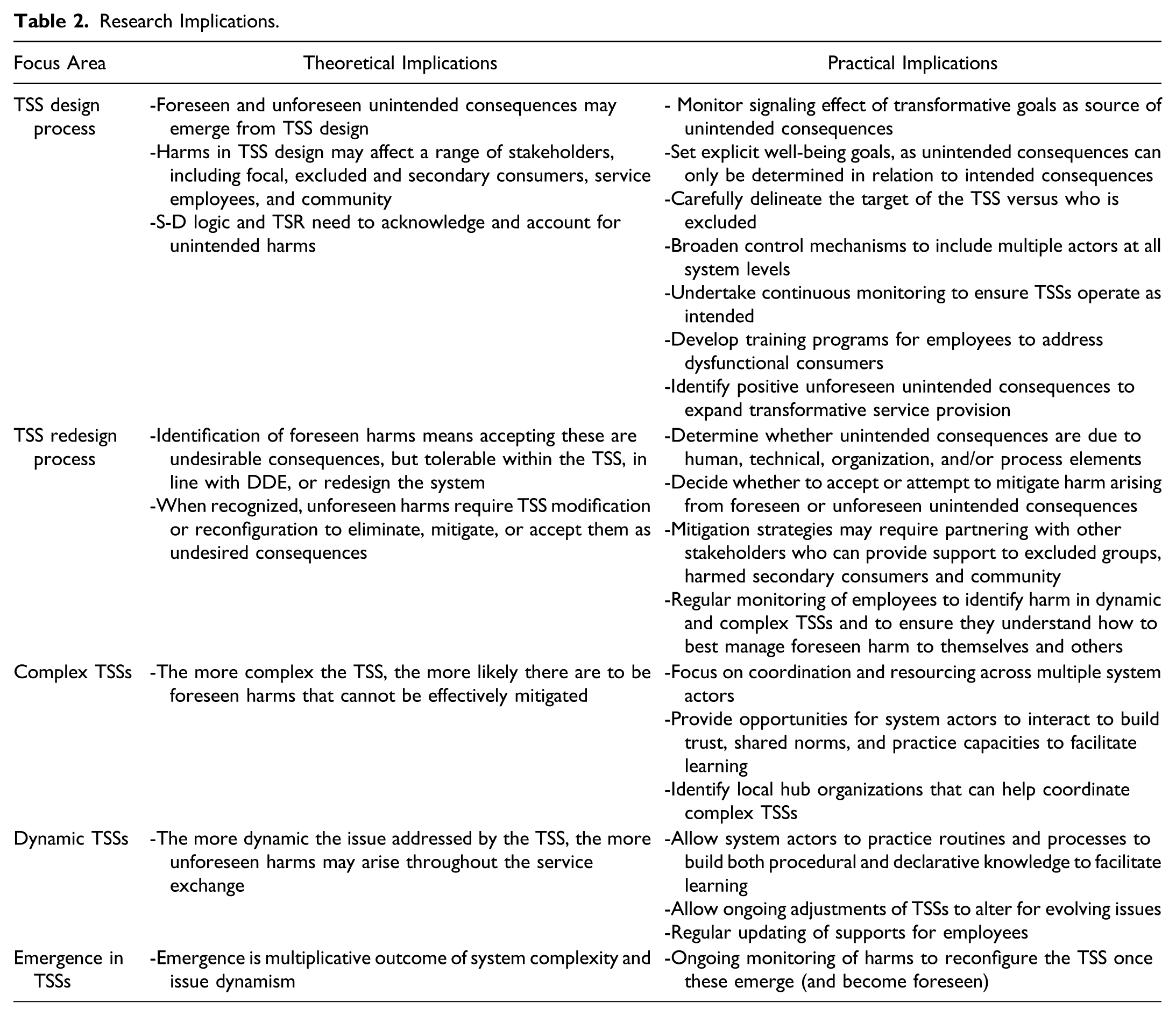
Research Implications.
Practical Implications
Our framework seeks to understand how harms arise within TSSs, rather than focusing on narrow exchanges (Masek 2000). Thus, from a practical and policymaking standpoint, our middle-range theorization enables us to highlight the importance of not only measuring enhanced well-being arising from TSSs, but also monitoring any harms (foreseen and unforeseen) that arise throughout the service exchange process, and which can affect all stakeholders, that is, consumers, service employees, secondary consumers, and communities. In doing so, policymakers can then try to prevent and/or mitigate harms via adaptive TSS (re)design. Furthermore, many TSSs have limited resources or slack to provide them the opportunity for reflection. Our work advocates for systemic evaluation and review as one way that TSS providers can leverage their experiences into ongoing organizational learning.
Policymakers can also use our framework to formally outline existing (foreseen) harms and identify areas where unforeseen harms are more likely to emerge, considering the role of complexity and issue dynamism in promulgating emergence. Stakeholders may also recognize ongoing adjustments to a TSS may be needed, as addressing the immediacy of a given harm in the case of a dynamic issue may cause other harms to ensue. Accordingly, they can also gain a clearer picture of what is at stake and plan the resources required not only to provide value to the TSS, but also to mitigate foreseen and unforeseen harms arising. Doing so should ideally lead to improved resourcing and/or coordination of resources of TSSs.
While proactive harm anticipation and mitigation is achievable in many settings, this is not necessarily possible when there is a high level of emergence (due to either high complexity or high dynamism, or both together). Consequently, the TSS needs to learn from past TSSs to foresee and mitigate harm. For example, unforeseen harms that arise in a past disaster can be used to reconfigure future disaster recovery (Ozanne and Ozanne 2021).
Future Research Agenda
Drawing on our framework, we provide a research agenda to further understand foreseen and unforeseen harms in TSSs. Anderson et al. (2013) advance a model of TSR components that we adapt to outline suggested directions for future research. First, while middle-range theorizing limits generalizing to other types of service systems, future research needs to explore whether foreseen and unforeseen harms are limited to government and nonprofit sectors or whether they also apply to for-profit sectors. Consider, for example, the Airbnb context. When people rent properties in residential communities, the amenity of surrounding homes may be negatively affected (i.e., proximal spillover), or the owners of properties are harmed because Airbnb guests hold disruptive parties (Ozanne and Prayag 2022). These types of harm are like others discussed in our framework (e.g., safe drug-injecting facilities). Our framework may, therefore, have applications for for-profit service contexts, and future research might extend our work accordingly.
Second, our framework also suggests that increased emergence, from system complexity and issue dynamism, leads to greater foreseen and unforeseen harms. Complexity and dynamism pertain to both the service design and process. For example, if the TSS focuses on a narrowly defined disadvantaged group, thereby excluding others, this is a feature of the service design that creates foreseen harms, requiring mitigation or acceptance, as per the DDE. In other cases, service process configuration, such as the degree of coordination among multiple actors, creates complexity in managing some TSSs (Ozanne and Ozanne 2021). Thus, future research could examine how the integration of multiple providers in a TSS, which creates a complex network, may cause harms or conflicts (e.g., Varman, Vijay, and Skålén 2022). This may result in harms being overlooked, such as those that can occur without central coordination of the TSS (Guion, Scammon, and Borders 2007). Such research should examine the role of coordination in mitigating harm for complex TSSs.
Third, we highlight a need for further research on different consumer types. Research has not explicitly explored how unserved or underserved consumers view their exclusion from TSSs (for exceptions see Mayock, Sheridan, and Parker 2015; Zakour and Harrell 2004). Thus, this is worthy of consideration, as these individuals deal with foreseen harms. The way consumers respond to foreseen or unforeseen harms should also be examined, as this influences their well-being. For example, what types of support best help families facing distress when their loved ones deteriorate in nursing homes, or what will aid service employees’ families in coping with the stress resulting from witnessing harms? How can providing information and training prepare people for such negative impacts? While research has recognized negative effects on secondary customers (Sandberg et al. 2022) and local communities (Kolla et al. 2017), it has largely neglected how these groups respond to harms, as these secondary customers may be viewed as “collateral damage,” in line with the DDE.
Fourth, we also highlight the importance of assessing harms to service employees as such TSR work is limited (e.g., Glenn and Goodman 2015). While the dynamic nature of TSSs may impact employees (e.g., disaster relief), so too might the complexity of the service design (e.g., in disaster relief, employees must navigate the many organizations involved). Future research could investigate how employers can help mitigate the added stress of system complexity and issue dynamism to maintain a healthy and productive workforce.
Supplemental Material
sj-docx-1-jsr-10.1177_10946705241287833 – Supplemental material for A Framework of Foreseen and Unforeseen Harms in Transformative Service Systems
Supplemental material, sj-docx-1-jsr-10.1177_10946705241287833 for A Framework of Foreseen and Unforeseen Harms in Transformative Service Systems by Michael J. Polonsky, Virginia Weber, Lucie Ozanne and Nichola Robertson in Journal of Service Research
Supplemental Material
sj-docx-2-jsr-10.1177_10946705241287833 – Supplemental material for A Framework of Foreseen and Unforeseen Harms in Transformative Service Systems
Supplemental material, sj-docx-2-jsr-10.1177_10946705241287833 for A Framework of Foreseen and Unforeseen Harms in Transformative Service Systems by Michael J. Polonsky, Virginia Weber, Lucie Ozanne and Nichola Robertson in Journal of Service Research
Footnotes
Acknowledgments
We wish to acknowledge and thank Dr. Jeff Rotman for suggesting that we consider the Doctrine of Double Effect as our enabling theory. Moreover, we thank the editors, associate editor and reviewers for their constructive comments throughout the review process. Finally, we thank Francesca Van Gorp, Effectual Editorial Services, for copy editing this article.
Declaration of Conflicting Interests
The author(s) declared no potential conflicts of interest with respect to the research, authorship, and/or publication of this article.
Funding
The author(s) received no financial support for the research, authorship, and/or publication of this article.

Supplemental Material
Supplemental material for this article is available online.
Author Biographies
References
Supplementary Material
Please find the following supplemental material available below.
For Open Access articles published under a Creative Commons License, all supplemental material carries the same license as the article it is associated with.
For non-Open Access articles published, all supplemental material carries a non-exclusive license, and permission requests for re-use of supplemental material or any part of supplemental material shall be sent directly to the copyright owner as specified in the copyright notice associated with the article.
