




Abstract
Transformative service initiatives (TSIs) refer to activities by organizations (public, private, nonprofit) or volunteers to serve people experiencing vulnerabilities, including long-term challenges (e.g., refugees, homeless people, undocumented immigrants, ex-convicts) and try to improve their well-being. To advance the concept of TSI, this study proposes a 3A (Awareness, Alignment, Access) Integration Process Framework that can facilitate empirical tests of whether participation in TSIs affects people’s access to critical services. The empirical evidence affirms a positive influence of TSI participation on two TSR outcomes (application and access to higher education), according to data from a longitudinal study of 2,068 refugees (Study 1) that relies on propensity score matching and regression analysis. Study 2 uses qualitative data from six focus groups and identifies 16 barriers to successful refugee integration; it also identifies four individual strategies to overcoming those integration barriers. From academic and public policy perspectives, the findings demonstrate that efforts to plan and implement TSIs should follow a stepwise process to achieve the intended transformative outcomes. These findings can help academic, public policy, and civil society actors design and implement TSIs in various contexts to benefit people experiencing vulnerability.
Keywords
This article investigates the systems and processes needed for service organizations to implement Transformative Service Initiatives (TSI) on behalf of people experiencing vulnerability. We define TSIs “as activities of organizations (public, private, nonprofit) or volunteers that serve people experiencing vulnerabilities and improve their well-being.” This supports the JSR’s Service Research Priorities (Ostrom et al. 2015) for “improving well-being through transformative service” (p. 140). Consider two examples that illustrate TSIs in practice: In the United States, the Los Angeles County Homeless Initiative seeks to improve the lives and integration of homeless people (homeless.la.country.gov). In Scotland, the Scottish Refugee Council partners with the British Red Cross to provide Holistic Integration Services, which involve housing and health care support (scottishrefugeecouncil.org.uk).
Across the planet, many people experience vulnerability during their lives. Baker, Gentry, and Rittenburg (2005) identify three factors that increase the likelihood of such vulnerability: individual characteristics, individual states, and external conditions. Building on Transformative Service Research (TSR) and social marketing, Cheung and McColl-Kennedy (2019) explore how economic and cultural vulnerability can arise within service systems. Many people who experience vulnerability (e.g., refugees, homeless people, ex-convicts, asylum seekers, undocumented immigrants, victims of sexual abuse and human trafficking, environmental migrants) also encounter barriers to integrating into society (Rosenbaum, Seger-Guttmann, and Giraldo 2017). In studies involving homeless people and prisoners (Blocker and Barrios 2015; Hill 2002; Hill et al. 2016; Santos and Laczniak 2009), researchers clearly establish the need to change inadequate service delivery systems for such understudied populations. Fisk et al. (2018) discussed exclusion practices imposed on people experiencing vulnerability and call for “service inclusion” that provides “fair access to, fair treatment during, and fair opportunity to exit a service” (p. 834). They propose four pillars of service inclusion: enabling opportunities, offering choices, relieving suffering, and fostering happiness. We argue that TSIs comprise all four pillars of service inclusion and can improve integration processes and fair access to service.
Using the current refugee crisis as a context, this research explores if and how TSIs can enhance the integration process of people experiencing vulnerability, help them overcome existing barriers, and enable their access to critical services, such as higher education. Recent research documents that refugees suffer from their situation and lack expertise about the specific services they need to access (Cheung and McColl-Kennedy 2019; Farmaki and Christou 2018; Nasr and Fisk 2018; Shneikat and Ryan 2018). In particular, studies note refugees’ general lack of access to employment (Daunfeldt, Johansson, and Westerberg 2019; Shneikat and Alrawadieh 2019) and highlight the need to create hospitable service systems to improve fair access (Boenigk et al. 2021; Finsterwalder 2017; Shultz et al. 2020). In this setting, TSR provides a theoretical umbrella and research motivation (Anderson et al. 2013; Anderson and Ostrom 2015; Ostrom et al. 2015). According to TSR, achieving well-being depends on interactions between service (i.e., TSIs) and consumer (i.e., refugees) entities. Yet TSR has not provided insights into specific human populations nor generated knowledge to help providers develop or improve their TSIs. Table 1 summarizes prior service research involving people experiencing vulnerability, including refugees. A review of that literature led to three research gaps that this study seeks to address.
Selected Research on Service Delivery and Access Problems of People Experiencing Vulnerability.
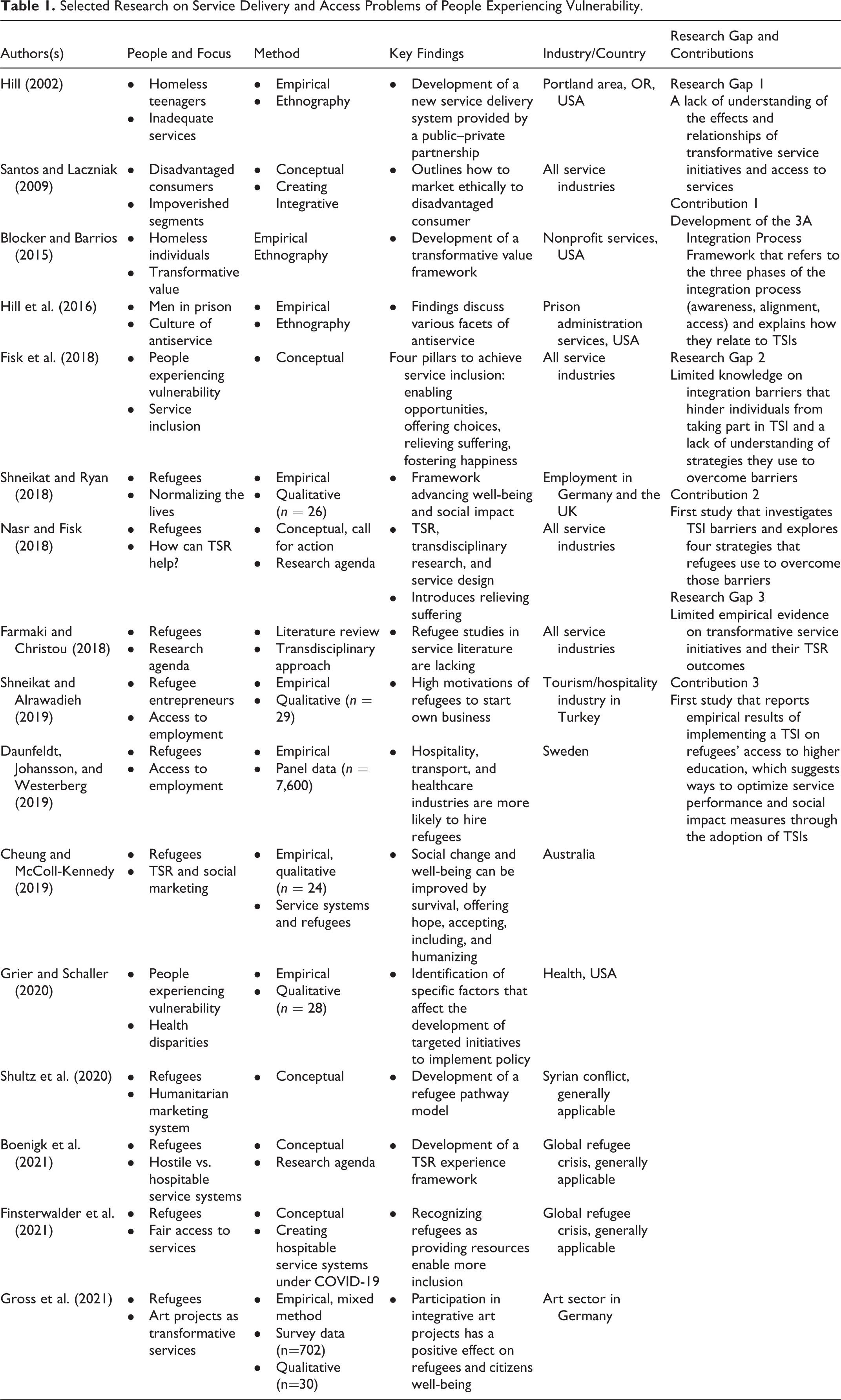
First, studies of TSIs are new to the service discipline. Boenigk et al. (2021) mention TSIs in their research agenda and recommend empirical tests of the positive effects they predict. Thus, Research Gap 1 refers to the lack of understanding of the effects of TSIs on people’s access to critical services. To address this gap, we build on the fundamentals of TSR and integration theory to develop a process-oriented model that reflects different integration process stages, explains how the process relates to TSIs, and empirically tests the effects of TSIs on access to services.
Second, people experiencing vulnerability confront barriers that hinder their integration process and their participation in TSIs. With regard to health care systems, Anderson et al. (2016) identify three structural barriers: “accessing expertise,” missing “appropriate knowledge,” and facing “complex service systems.” Scheer et al. (2003) assert that for persons with disabilities, health care access also is limited by the interaction of environmental, structural, and process-related barriers. Considerable research examines barriers to refugees’ integration (Berg 2018; Dryden-Peterson 2016; Stevenson and Willot 2007), though no service studies exist that explicitly link those barriers to TSIs. Therefore, Research Gap 2 pertains to limited knowledge about which integration barriers hinder people from taking part in TSIs and the strategies they might use to overcome them.
Third, we lack clear measures of the effectiveness of TSIs (Gross et al. 2021). Streitwieser et al. (2019, p. 487) analyze diverse TSIs, targeting a specific population with vulnerabilities (i.e., refugees during the 2015–2016 crisis), but also caution, “we found little publicly available data and information about the actual outcomes of most interventions…. This makes it difficult to truly know what is and what is not working.” Thus, Research Gap 3 focuses on the lack of empirical evidence about TSIs and their outcomes.
This article makes three key contributions to the service discipline. First, we develop the 3A Integration Process Framework, to reflect three phases of integration (Awareness, Alignment, and Access) and clarify the interactions between service providers and people experiencing vulnerability. Second, we offer the first TSR study to investigate TSI barriers and strategies that refugees use to overcome those barriers. Third, this study provides the first empirical evidence of how implementing a TSI affects refugees’ access to higher education, which contributes to both TSR and practice by suggesting ways to optimize service performance and social impact measures (Ostrom et al. 2015), through the adoption of TSIs.
In the next section, we develop our conceptual process framework based on TSR and integration theory. Then, we explain the methodological approach and our data structure. In Study 1, we empirically test the framework using propensity score matching (PSM) and logistic regressions. In Study 2, we conduct focus groups to analyze barriers and strategies to overcome them. Then, we follow Bolton’s (2020, p. 283) recommendation to explore “multiple sources of data to obtain a more complete understanding of societal outcomes.” Finally, we offer insights on designing and improving TSIs, with implications for service providers, public policymakers, and nonprofit organizations involved in service provision for people experiencing vulnerability.
Conceptual Framework
Transformative Service Research and Integration Theory
TSR seeks to “create uplifting changes and improvements” in the well-being of individuals, collectives, and ecosystems through interactions between service providers and consumers (Anderson et al. 2013). Most TSR studies identify two well-being outcomes: eudaimonic, such as access to services or financial security (e.g., Brüggen et al. 2017), and hedonic, such as life satisfaction or happiness (e.g., Nasr et al. 2014; Nasr and Fisk 2018). In focusing on (1) the interaction between service providers and people experiencing vulnerability within a TSI and (2) access to critical services as a key outcome of their integration process, we adopt Anderson et al.’s (2013, p. 1205) definition of access as “the ability or right to make use of a service.”
Focusing on access to service makes theories of integration relevant. With a sociological perspective, Esser (2004, 2010) proposes a model of intergenerational integration, though no comprehensive, consensus theory of integration exists. Ager and Strang’s (2008) conceptual model indicates four core domains related to integration and critical service access: (1) employment, (2) housing, (3) education, and (4) health care. Beyond these core needs, social connections, language, and cultural knowledge constitute important facilitators of integration. However, their model of integration domains does not include integration processes. We know of no empirical studies or integration theory models that conceive of integration as a process, though from a service research perspective, such a model is necessary. In reviewing TSR and integration theory, we also identify crossovers in perspectives and intended outcomes, such as improving the lives of people experiencing vulnerability and enabling access to critical services.
The 3A Integration Process Framework
In general, integration into society is a complex, nonlinear, individualized journey for people experiencing vulnerability. To create a theoretical framework of this journey, we build on real-world examples and literature pertaining to refugees. Most authors agree that the start of refugee integration processes is the point of arrival in the final host country (Boenigk et al. 2021; Chuah et al. 2018). Refugees share the experience of suffering from service exclusion, which TSIs can help overcome. The 3A Integration Process Framework comprises Awareness, Alignment, and Access phases, as detailed in Figure 1 in relation to TSIs over time. According to TSR and integration theory, individual refugee experiences might range from suffering at the point of arrival (Service Exclusion), over participating in TSIs, to uplifted well-being (Service Inclusion) by the end of the integration process (Alkire et al. 2020; Fisk et al. 2018, Nasr and Fisk 2018; Wilkinson and Kleinman 2016). In the following sections, we explain the three phases of the framework.
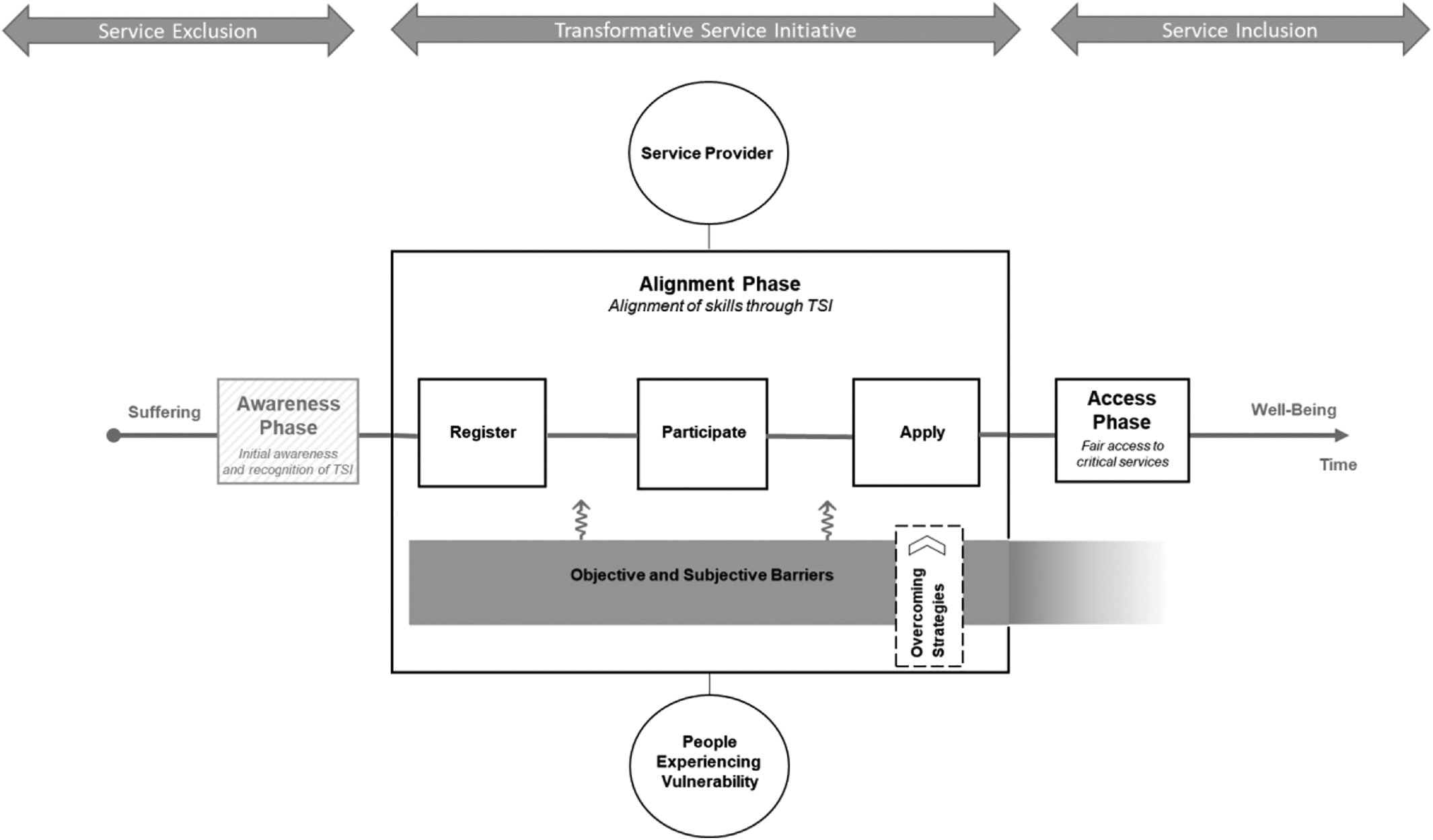
The 3A integration process framework.
Awareness Phase
Refugees’ awareness phase begins after their initial arrival, as they start settling in the host country. Shneikat and Ryan (2018) highlight refugees’ typically “forward orientation,” as reflected in a desire to resume their careers, start their own businesses, or continue their education. A characteristic of this phase is information-seeking behavior, such that refugees seek insight into projects, organizations, or other individuals that may help them realize their future goals. In this phase, they identify local TSIs, often through word-of-mouth communication with other refugees (Grüttner et al. 2018; Streitwieser et al. 2019). The awareness phase is preliminary, prior to any observable refugee behavior, so it is not the primary focus of our empirical investigation, and we shade it in gray in Figure 1.
Alignment Phase
In the alignment phase, refugees engage in TSIs (Gross et al. 2021; Grüttner et al. 2018; Hannah 1999; Streitwieser et al. 2019). Alignment refers to their improved skills and understanding of how to access critical services through such participation. In higher education settings, alignment consists of substantial improvements in language skills, through participation in language classes, gained knowledge of the educational system based on information provided by TSI employees, or a better understanding of the university application processes by participating in counseling TSIs (Streitwieser et al. 2019). These interactions depend on the refugee’s individual skillset, the kind of TSI, and the sector in which they are being implemented, but we also propose an overall, three-step process for any interaction designed to facilitate access to critical services (see Figure 1): register, participate, and apply. We also consider barriers to those steps.
Register
In this step, refugees express their free will and register with a TSI, usually according to an established registration process (online or off-line). Two outcomes may result: (1) Refugees register, physically show up, and engage in TSI or (2) they register but by the start of the program do not participate (no-shows) for various reasons (McBrien 2005), potentially related to barriers they encounter.
Participate
Similar to any form of customer participation (Blut, Heirati, and Schoefer 2020; Dong and Sivakumar 2017; Hau and Thuy 2016), refugee participation refers to the extent refugees accept the services offered, contribute their preferences and knowledge, and share information or other interactions with employees, volunteers, and other refugees. We use the term “participation” rather than “co-creation” (Vargo and Lusch 2004) or “co-production” (Mende et al. 2017; Mende and van Doorn 2015), which is in line with Johns and Davey’s (2019) argument that unlike other categories of consumers, at their point of arrival, newly arrived refugees often lack the resources or ability to act as full co-creating partners (Plé and Chumpitaz Cáceres 2010). Co-creation would imply that refugees interact as full partners, at parity, and configure their own services, which is rarely possible due to language issues and other barriers (Johns and Davey 2019). Although co-creating behavior is evident in a few real-world cases, it is not common or appropriate to expect it from most TSI participants. As consumers of specific integration services, refugees tend to be relatively passive and grateful (Hannah 1999; Plasterer 2010). Therefore, the more passive term “participation” fits the refugee context better than “co-creation.”
Such participation includes sporadic personal interactions and attendance at intensive service offerings, such as language courses (Hau and Thuy 2016). The degree of participation varies among refugees (Streitwieser et al. 2019), such that some participants use all available services, whereas others select one or a few. According to integration theory, social connections with host community members represent important facilitators of integration (Ager and Strang 2008), so participation in knowledge-based and sociocultural services may positively affect access. Furthermore, Ager and Strang (2008) highlight links between knowledge about the host country and social connections. We adopt this logic and anticipate interaction effects between knowledge-based and sociocultural services. The degree of participation in TSIs should affect refugees’ future integration success.
Apply
Finally, refugees might apply to receive a “standard” service. In a higher education context, it would mean applying to a university to enter a degree program (Grüttner et al. 2018). At this step, refugees realize they have the “ability or right to use the service” (Anderson et al. 2013, p. 1205). Refugees’ ability to apply thus offers a strong positive indicator of the success of the TSI. This argument is based on a key rationale: An application implies that the refugee has fulfilled all necessary formal qualifications and reached a position equivalent to other applicants, such as the pool of all international students in our study context. The application represents a means for refugees to overcome stereotypes associated with being labeled a “refugee” instead of an “international student.” Even if they suffer rejection from a popular degree program (e.g., medicine) at a prestigious university, it may be due to reasons other than their refugee status, and they can apply to other programs. Consequently, sending out an application marks the end of the interaction phase and the first TSR outcome variable we study (i.e., apply).
Barriers
Barriers can hinder refugees from engaging in TSI and impede their access. Some studies examine overall barriers that refugees encounter in their daily lives, but the insights remain general in nature, without addressing unique barriers to specific services, such as education and health care (McBrien 2005). In studies focused on refugees’ educational barriers, three main categories arise (Aydin and Kaya 2017; Dryden-Peterson 2016): legal barriers like refugees’ legal status and required documentation, language problems, and social problems like discriminatory or biased behavior by locals. Such studies provide more specific insights but also suffer two relevant limitations. First, they mostly study barriers to students enrolling in primary or secondary school rather than those that confront students who want access to higher education. Second, they identify barriers created by government policies, legal status, social factors, and individual factors, not those created by service organizations. Berg’s (2018) extensive list of barriers to refugees’ access to higher education in Germany is especially informative for our study context. It includes language problems, financial issues, gaps in the educational biography, missing entrance qualifications, missing documents, study culture, feelings of social isolation, missing information, unclear residential status, residence infrastructure, and trauma and psychological stress (see also Crea 2016; Streitwieser et al. 2018).
This refugee barrier list includes both relatively objective and relatively subjective barriers, similar to lists of barriers in health care contexts (Polonsky et al. 2018). Leveraging this conceptual insight, we differentiate objective and subjective barriers in Figure 1 (Prilleltensky 2012), all of which can hinder refugees’ participation in TSI and slow their integration processes. Furthermore, some barriers may arise in any higher education situation, whereas others might be specific to the TSI in which refugees participate individually. Finally, in previous studies of access barriers, we find no discussion of strategies to overcome them. Thus, the strategies in Figure 1 reflect our qualitative analysis (with more details in the Results sections).
Access Phase
In the access phase, refugees exit the TSI and transition to regular services. We argue that the quality and depth of their skills, knowledge, and relationships with host community members have increased, so refugees have achieved fair access to standard living services. According to Fisk et al.’s (2018) service inclusion logic, we propose that refugees have gained fair access to critical services (Finsterwalder et al. 2021). Consequently, access is our second TSR outcome variable we study. However, we acknowledge that access to one critical service does not mean the refugee integration process is complete. Over time, integration likely continues in other areas, such as employment, to produce other well-being outcomes.
Research Method and Context
We adopt an action research approach (Lewin 1946; Ozanne and Anderson 2010; Ozanne and Saatcioglu 2008) and apply a multimethod design. It includes a quantitative, longitudinal study of refugees seeking access to higher education over 2.5 years (Study 1) and qualitative focus group interviews centered on barriers to refugees’ integration (Study 2).
The study context is a specific TSI called the Refugee Study Orientation Program (RSOP). It was developed and implemented by a large German university at the peak of the European refugee crisis in August 2015. The RSOP is free of cost and open to refugees who want to start or continue their disrupted academic careers. Each semester, refugees can register online for the RSOP. It starts twice a year, in April and October. As of the winter term 2016–2017 (the starting point of our longitudinal study), the initiative had been organized sufficiently to feature an established curriculum with a preparatory class structure. The RSOP offers two knowledge-based services. First, preparatory classes feature information and counseling by tutors (master’s students) and personal consulting with administrative staff. Information about Germany’s higher educational landscape, an overview of faculties, advice on programs to study, and details about the application process and its formal requirements were included. Classes of about 25 participants take place twice per week over one semester (16 weeks). Second, professional language teachers offer German language courses. Refugees are placed into courses that reflect their language skill levels. Each course meets four times per week.
Moreover, the RSOP offers two sociocultural services that strengthen social connections and bonds on campus. First, buddy-matching brings refugees and university students together in an informal setting. It encourages informal contacts that refugees can use to help them resolve everyday problems related to university life. Second, with free access to about 200 sports courses, refugees can play sports with other students. For these two services, refugees register once at the start of the semester and participate when and how they prefer.
Study 1: Refugee Access to Higher Education
Quantitative Data Collection and Sample
The data collection spanned five semesters, across 2016–2017 and 2018–2019. We created a factual database of behavioral, application, and access data over time, as well as sociodemographic and educational background information for the five student cohorts (Jenkins and Siedler 2007). The data sources included information submitted during the online registration process, objective documentation of participation in the offered services, and statistics obtained from official university records (student service center). These longitudinal, factual data offer two main advantages. First, they minimize the risk of reporting errors, which is especially important for refugee research due to the prevalent risk of translation issues or misinterpretations. Second, these data suffer less from systematic biases and potential influences of non-relevant information (Jahedi and Méndez 2014).
The flowchart in Figure 2 presents the overall data structure and analysis procedure. In total, 2,068 refugees registered for the RSOP. The full sample includes 887 participants and 1,181 nonparticipants (no-shows). The sample characteristics of the full and subsamples are available in Online Appendix A. Overall, our refugee sample mirrors the refugee population in Germany (DAAD 2017). In terms of gender, 76% are men, and 24% are women. With regard to age, 37.4% are younger than 25 years, 34.1% are between 25 and 29 years, 18.2% are between 30 and 34 years, and 10.3% are older than 30 years. It is not surprising that the refugee sample is older on average (M = 27.27 years; SD = 5.79) than other international students starting higher education. The top five countries of origin are Syria (62.8%), Iran (11%), Afghanistan (10.7%), Iraq (3.5%), and Eritrea (1.6%). The refugees’ German language skills when starting the RSOP vary, such that 2.3% meet language requirements and have advanced German language skills, the majority (50.2%) score on an intermediate level, and 15.9% have elementary language skills. Finally, 65.5% of the sample indicate that they studied in their home country, for an average of 3.96 semesters (SD = 3.93).
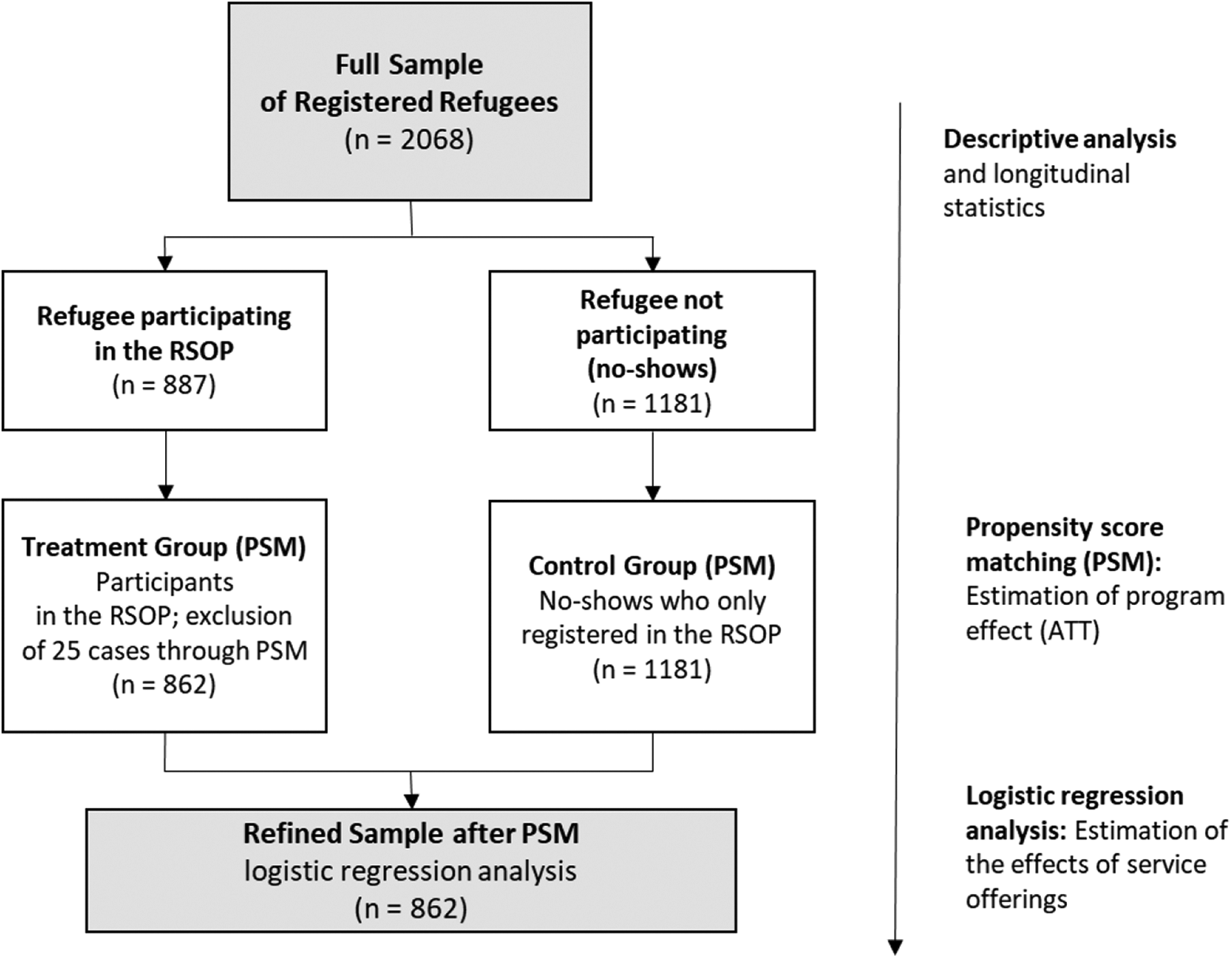
Data structure for Study 1.
Descriptive Cohort Statistics and Longitudinal Analysis
The data analysis involved three steps: descriptive cohort statistics and longitudinal analysis, PSM analysis, and logistic regression analysis. Online Appendix B lists constructs, measures, and descriptive data for the 2.5 years of observation and analysis.
Register
In the online registration process, 2,068 (100%) people registered to join the RSOP. They provided sociodemographic and background information, stated their free will and intention to show up on campus in the upcoming semester, and agreed to the terms of participation. To account for cohort effects and longitudinal processes, we include the time since the first registration in the RSOP. As Online Appendix B shows, in winter 2016–2017 (t1), 701 refugees registered for the first time, followed by 375 in summer 2017 (t2), 343 in winter 2017–2018 (t3), 440 in summer 2018 (t4), and 209 in winter 2018–2019 (t5). Refugees could register and participate multiple times.
Participate
Objective documentation of attendance, provided by tutors and staff of the RSOP, provides the data source for our participation measures. Of the 2,068 refugees, 887 (42.9%) became participants of the RSOP. Throughout the observation period, the number of participants decreased overall, from 296 refugees at the peak of the refugee crisis in t1, followed by 156 in t2, 164 in t3, 166 in t4, and 105 in t5. As in previous refugee studies (McBrien 2005), no-shows represent a challenge. We define them as refugees who registered but did not participate in any service during that semester. In total, 1,181 (57.1%) registered refugees were no-shows. Online Appendix B further shows that refugees participated to a higher degree in knowledge-based services, such as the German language course, and sociocultural services were used to a lesser extent.
Apply
The applications and access data come from official university statistics. In total, 303 of 2,068 registered refugees finally applied to university (14.7%) (Web Appendix B). Of these, 245 (80.9%) came from RSOP participants, and only 58 (19.1%) applications came from no-shows. Among participants of the RSOP, 27.7% (245/887) applied, compared with 4.9% (58/1,181) in the group of no-shows. The χ2 test produces a significant value of 208.9 (p = .00).
Access
In total, 166 refugees (8% of all 2,068 registered refugees) received an acceptance notification, implying access to higher education. A majority of them, 137, participated in the RSOP (82.5%; 137/166), and the smaller group of 29 accepted students were no-shows (17.5%; 29/166). With this information, we can calculate success ratios. Regarding applications, we find no great difference in the success ratio between participants and no-shows. That is, among participants, 245 applied and 137 attained access, for a success ratio of .56 (137/245; 56%), whereas the success ratio for the group of no-shows is .5 (29/58; 50%). The χ2 test indicates a nonsignificant relationship between RSOP participation and access (χ2 = .663, p = .416). In interpreting this preliminary finding, we posit that among no-shows, perhaps only serious refugee students, who may already be qualified, submit their application. The RSOP instead motivates and enables some refugee students who would not have submitted applications without participating in the initiative. Nevertheless, the descriptive results should be interpreted with caution, because they indicate no significant group differences. We thus perform a more in-depth data analysis with PSM.
PSM
Longitudinal data that rely on past observations commonly suffer from endogeneity issues (Papies, Ebbes, and Van Herde 2017; Rutz and Watson 2019). Our study may be prone to such concerns because several factors could determine whether refugees apply and can participate in the RSOP. Thus, we adopt a data analysis approach that seeks to reduce the risk of endogeneity and omitted variable problems. When we applied PSM at the beginning of our analysis to minimize selection bias (Jenkins and Siedler 2007), we found that participants and no-show refugees were similar in their sociodemographic characteristics and educational background. Considering that they all registered for the RSOP, they probably were influenced by comparable situational and motivational factors, even if some did not participate. To minimize measurement errors, we also relied on objective student records. Then to isolate the effect of the RSOP (Figure 2), we applied PSM to compare participants (treatment group) with no-shows (control group) and identify any systematic differences. Both groups represent pools of registered refugees, so in this sense, our application enjoys an advantage over most PSM studies that use broad panel data. The two groups already share many relevant traits, as target users of the RSOP. Finally, by applying PSM, we minimize the bias that might arise from selecting confounding variables (Jenkins and Siedler 2007).
This matching procedure consists of two steps. First, we estimated each refugee’s propensity to participate in the RSOP according to age, gender, country of origin, semesters studied in the home country, and initial language skills, using a probit regression. For refugees who did not complete language skill tests, we assumed a beginner’s level. Second, we applied the Epanechnikov kernel-matching algorithm, using the Stata psmatch2 application (Leuven and Sianesi 2003), to match participants (n = 887) with no-shows (n = 1,181). Many previous service studies that use PSM adopt nearest-neighbor pair matching (Eggert, Steinhoff, and Witte 2019; Garnefeld et al. 2013). However, as Frölich (2004) shows, kernel-matching performs better for larger groups than nearest-neighbor pair matching when used with an adequate bandwidth parameter that determines a distance around participants to exclude overly different values (Handouyahia, Haddad, and Eaton 2013). Kernel-matching pairs one participant of the RSOP (treatment group) with one or more refugees from the group of nonparticipants (control group), based on their estimated propensity of taking part in the RSOP. Furthermore, the algorithm applies greater weighting to non-participants, whose estimated probabilities are closer to those of their paired active participants. The weighting process increases comparability between groups. In contrast, nearest neighbor-matching only uses the most similar case available. Thus, Kernel-matching allows us to generate a larger control group, increase validation and power, and further increase comparability between the two groups, due to the weighting. As suggested by Frölich (2004), the sufficient bandwidth parameter (.003) uses cross-validation.
Results of PSM
Table 2 displays the PSM results, which verify our assertion that the group of participants and the group of no-shows were already comparable. Only 25 participants had to be excluded from the former group due to a lack of sufficient available matches (after matching, n = 862). From the group of no-shows, 19 refugees were excluded during the matching process due to missing values (after matching, n = 1,162, Table 2). Through elimination and weighting, based on the propensity scores, we improved the balance between participants and no-shows. Specifically, good language skills and semesters studied at home significantly increase the likelihood of becoming participants in the RSOP. We find no significant mean differences in the confounding variables between groups in the matched sample, nor do any factors predict RSOP participation (Pseudo r2 = .002; likelihood ratio χ2 = 5.55, p = .784). The mean bias in the model also decreased, from 14.1 to 3.2 (Leuven and Sianasi 2003).
Propensity Score Matching and Average Treatment Effect on the Treated Results.
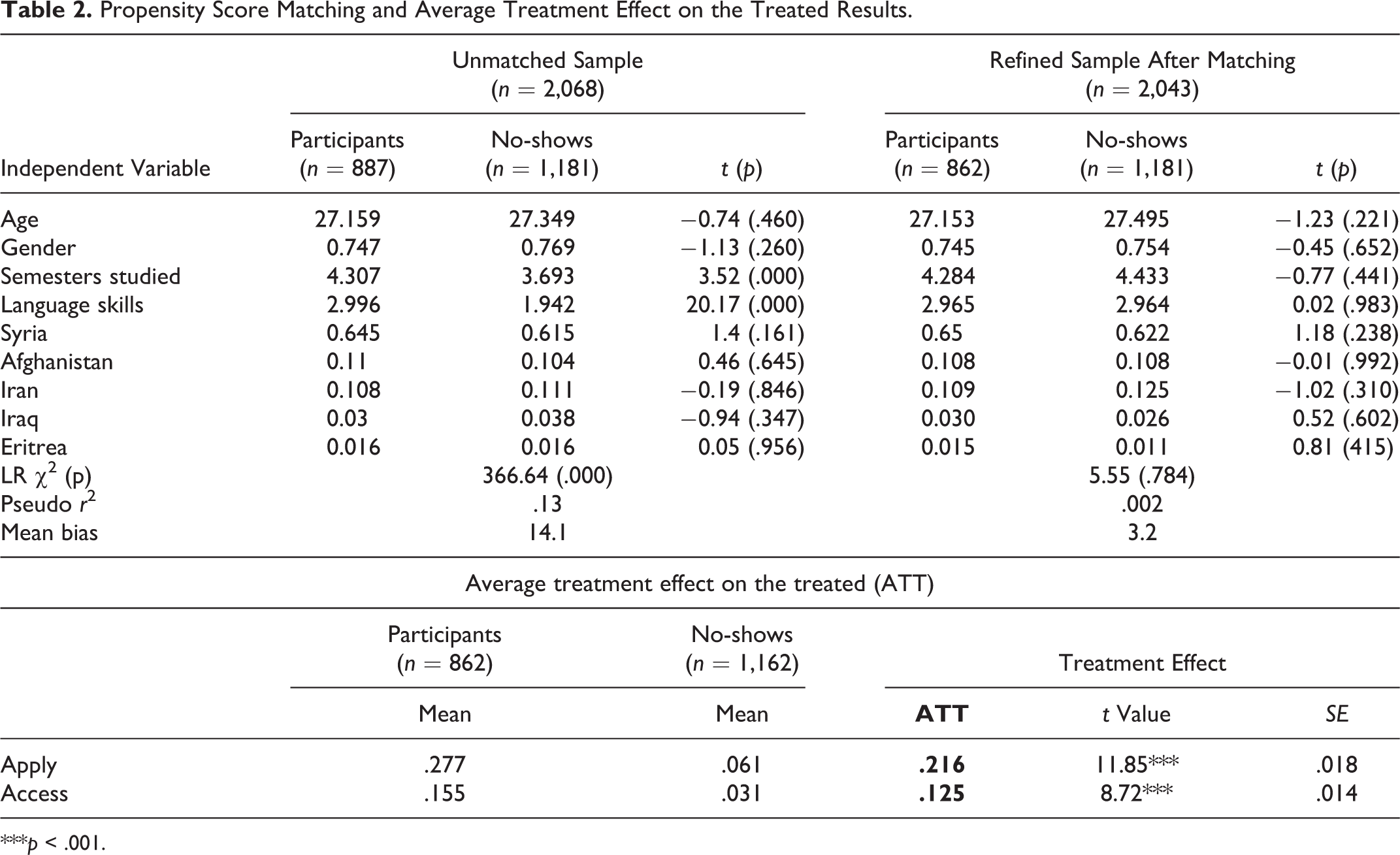
***p < .001.
Table 2 also contains the results of an average treatment effect on the treated (ATT) analysis, which in our case refers to the average effect of actively participating in the RSOP on applying and gaining access to higher education (Caliendo and Kopeining 2008; Cepeda et al. 2003). We find that the probability of applying and being accepted to a course of study is significantly higher among participants of the RSOP compared with refugees who did not participate (no-shows). The ATT for application is .216 (t = 11.85; p < .001), and that for access is .125 (t = 8.72; p < .001). These combined analyses offer empirical evidence that the TSI for refugees that we study has positive effects on refugees’ application and access to higher education.
Logistic Regression Analysis
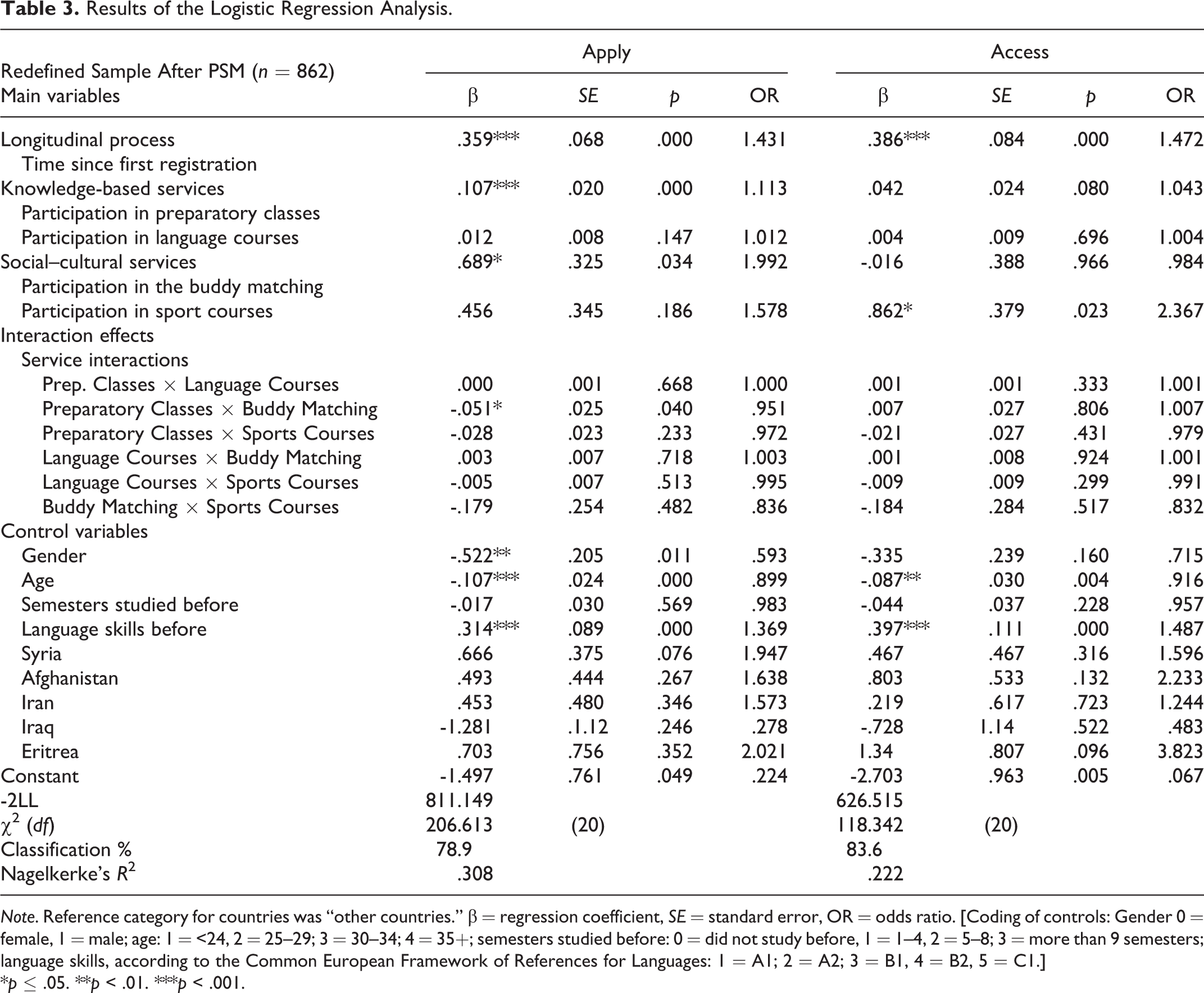
We seek to analyze how the TSI for refugees enhances refugee integration processes with a binary logistic regression. Specifically, we estimate the direct effects of the two types of service offerings (knowledge-based and sociocultural) on application and access as dependent variables (Table 3). To account for our data set’s longitudinal nature, we include the time passed since the person’s first registration in the RSOP. We also control for interaction effects among different services and for sociodemographic information. For this analysis, we use the refined sample of participants after PSM, which reduces selection bias (n = 862). As a robustness check, we apply the logistic regression analysis to each cohort separately. Still, the results do not reveal any new insights, so we present the full sample results according to each outcome variable.
Results of the Logistic Regression Analysis.
Note. Reference category for countries was “other countries.” β = regression coefficient, SE = standard error, OR = odds ratio. [Coding of controls: Gender 0 = female, 1 = male; age: 1 = <24, 2 = 25–29; 3 = 30–34; 4 = 35+; semesters studied before: 0 = did not study before, 1 = 1–4, 2 = 5–8; 3 = more than 9 semesters; language skills, according to the Common European Framework of References for Languages: 1 = A1; 2 = A2; 3 = B1, 4 = B2, 5 = C1.]
*p ≤ .05. **p < .01. ***p < .001.
Results for apply
The time since registering for the RSOP is a significant factor determining application (β = .359, OR = 1.431, p < .001). An application is more likely when refugees participate in the RSOP for a longer time. Regarding knowledge-based services, we find a significant effect of participation in preparatory classes on application likelihood (β = .107, OR = 1.113, p < .001). The classes are intended to help refugees navigate the German higher education landscape and to gather necessary documents to apply. Our results indicate they are an effective element of the RSOP, in that they work well to motivate refugees to apply for a course of study of their choosing, providing them the knowledge required to do so. Regarding sociocultural services, the coefficient of .689 indicates a significant effect of the buddy-matching feature on applications (OR = 1.992, p < .05). The finding makes intuitive sense; “buddies” (student volunteers) help motivate and stabilize refugees while also sharing their experiences with informal and formal campus life aspects. We find a small but significant interaction effect of the preparation classes with buddy matching (β = −.051, OR = .951, p = .04), which might signal that relevant information is already provided by the buddies, leading refugees to decide not to attend the preparatory classes.
Results for access
For most indicators, the results for access are similar to those for application. These similarities might be explained by the previous results, in that applying to a course of study is a necessary prior step to acceptance. We accordingly find the expected, significant effect of the time passed since first registering (β = .386, OR = 1.472, p < .001). In terms of the effects of specific services, as part of the RSOP, the results for the knowledge-based services show only a marginally significant effect for the preparatory classes (β = .042, OR = 1.043, p = .08) and no significant effect for language courses (β = .004, OR = 1.004, p = .696). This finding is logical. A university’s decision to accept a student reflects its evaluation of formal requirements (e.g., grades, sufficient language skills). The marginally significant effect of the preparation classes may indicate that participants in those classes are more likely to apply for courses of study to which they have better chances to be accepted. For the sociocultural services, we find that participation in sports has a significant effect on acceptance to a course of studies (β = .862, OR = 2.367, p = .023). Theoretically, this service should have no direct link to universities’ decision to accept an applicant, so we cautiously interpret this finding as an effect of motivation, social bonding, or well-being achieved through individual leisure activities.
Control variable results
Among the control variables, we find three significant effects on application and two significant effects on access. First, with a coefficient of −.522, we note a significant effect of gender. Women are less likely to apply. Second, age has a significant effect, such that older refugees are less likely to apply (β = −.107, OR = .899, p < .05) or get access (β = −.087, OR = .916, p < .05). Third, good prior language skills have a significant effect on application (β = .314, OR = 1.369, p < .001) and access (β = .397, OR = 1.487, p < .001). This effect of prior language skills understandably overlies the effect of the language courses: Advanced German language skills are required to apply to a university, and learning a new language takes longer than one semester, so we should find significant effects. It also highlights the importance of language skills, which can be supported by language classes.
Summary
Study 1 provides empirical evidence about the role of TSI in the refugee integration process. First, the descriptive statistics indicate that completing the three steps of the interaction phase—register, participate, and apply—increases success ratios in subsequent phases. Second, our PSM analysis supports the overall proposition that participating in a TSI leads to positive and significant effects on both TSR outcomes under study (apply and access). Moreover, the logistic regression results suggest different effects of various types of programs within the TSI on refugees’ application and access. Although these empirical results detail different steps and phases in the refugee integration process, the nature of the data make it hard to gain insights into the barriers that refugees face during the integration process. We conducted Study 2 to reveal such barriers and to help refugees overcome them.
Study 2: Integration Barriers and Strategies to Overcome Them
Qualitative Data Collection and Sample
With Study 2, we sought to understand how integration barriers slow or hinder refugee integration processes, as well as which strategies refugees use to overcome them. Leveraging some theoretical insights on such barriers, we used an approach grounded in the abductive logic for this qualitative research (Dubois and Gadde 2002; van Maanen, Sorensen, and Mitchell 2007). With an abductive logic, researchers develop and adjust a preliminary conceptual framework, such that it features an interplay between conceptual and empirical efforts. Therefore, to enhance the rigorous description of the 3A Integration Process Framework, we adjust the developed framework, which contains objective and subjective barriers (Figure 1), to add a new “overcoming strategies” element, which we derived from the qualitative findings (Nenonen et al. 2017). These findings emerged from a series of focus group workshops, conducted with refugees who participated in the RSOP, by a researcher whose refugee project management background enabled her to navigate between research and practice. With the abductive logic, we can expand understanding of both the theory and relevant empirical phenomena, so it is particularly suitable for developing new theories or concepts, as we seek to do (Dubois and Gadde 2002).
Accordingly, the qualitative data collection took place in two rounds, involving six focus groups with 44 refugees who had participated in the RSOP. In February 2018, the first round of data collection involved five focus groups. We randomly selected 400 refugees registered for the RSOP and sent them email invitations, which explained the study’s goals and setting. The sample included 31 former RSOP participants, three of whom had gained access to an academic program at a university. Due to their vulnerability and unstable living conditions, refugees are difficult to reach (Hepi et al. 2017), which likely explains the low 8% response rate, as well as the size of these five focus groups, ranging from 3 to 11 participants. We separated the groups by gender, with four focus groups with men (n = 24) and one with women (n = 7), out of respect for the refugees’ religious and cultural backgrounds (Stewart and Shamdasani 2014). In July 2019, we conducted one additional focus group to generate more insights into how refugees overcome barriers. From the RSOP participant pool, we invited refugees who had participated in the initiative and successfully gained access to higher education. Noting the low participation rates in the first round of data collection, we modified our recruiting method and invited 38 refugees by telephone, which led to a more satisfactory response rate of 34%. This sample consisted of 13 refugees who achieved access to an academic program by successfully overcoming initial barriers. We collected data until we reached saturation, such that no new insights emerged (Guest, Bruce, and Johnson 2006).
Focus Group Procedure
All focus groups lasted between 1.5 and 2.5 hr and were audio-recorded and transcribed verbatim. The setting featured two moderators (observers), one of whom led the discussion according to the focus group interview protocol (see Online Appendix C) and another who ensured completeness and noted emerging themes (Carson et al. 2009; Krueger and Casey 2015). The second moderator was known to the refugees and did not claim to be an independent, external researcher. This important feature established an atmosphere of trust within the focus groups, and both moderators offered assurances of respondents’ confidentiality. Maintaining confidentiality while investigating sensitive questions is a unique challenge for qualitative research (Gibson, Benson, and Brand 2013), which Kaiser (2009) suggests resolving through careful consideration of the focus group audience and strong, informed consent processes. Accordingly, we chose only persons who had been prior or current RSOP participants. In addition, we obtained informed verbal consent. The moderator issued the informed consent statement at the beginning of each interview, indicating that the reports resulting from this study would not contain any information that could be used to identify the respondents. Because of cultural differences, we preferred verbal over written consent. The practice of signing documents is rather unusual for our study sample and might contradict the effort to create a trusting environment. As another means to ensure confidentiality, we removed any personal identifiers during transcription.
Qualitative Data Analysis
The data analysis moved from consideration of the data to a comparison with conceptualizations in the theoretical framework, such that it involved first-, second-, and third-order analyses. We used the MAXQDA 2018 software (Gibbs 2018) to assess the qualitative data, because it effectively identifies overlaps among codes and controls for the complexity of the data. Accordingly, we used open coding and identified all statements about integration barriers or strategies to overcome them (see Online Appendix D). This step revealed 16 first-order concepts about barriers and 11 first-order concepts related to strategies. In a second step, we defined the criteria for coding and categorization, using the results from our prior conceptualization and literature analysis (Corbin and Strauss 2015). The coding scheme indicates three levels and objective versus subjective perspectives on relevant barriers to refugee integration. Finally, in the iteration step, we cycled among data and theory again to gain a deeper understanding of the context and formed the respective categories of barriers and strategies. Two researchers coded the findings separately and achieved a good intercoder reliability of 90%. They discussed differences until they reached a full agreement (Miles and Huberman 1994).
Results: Integration Barriers in Higher Education
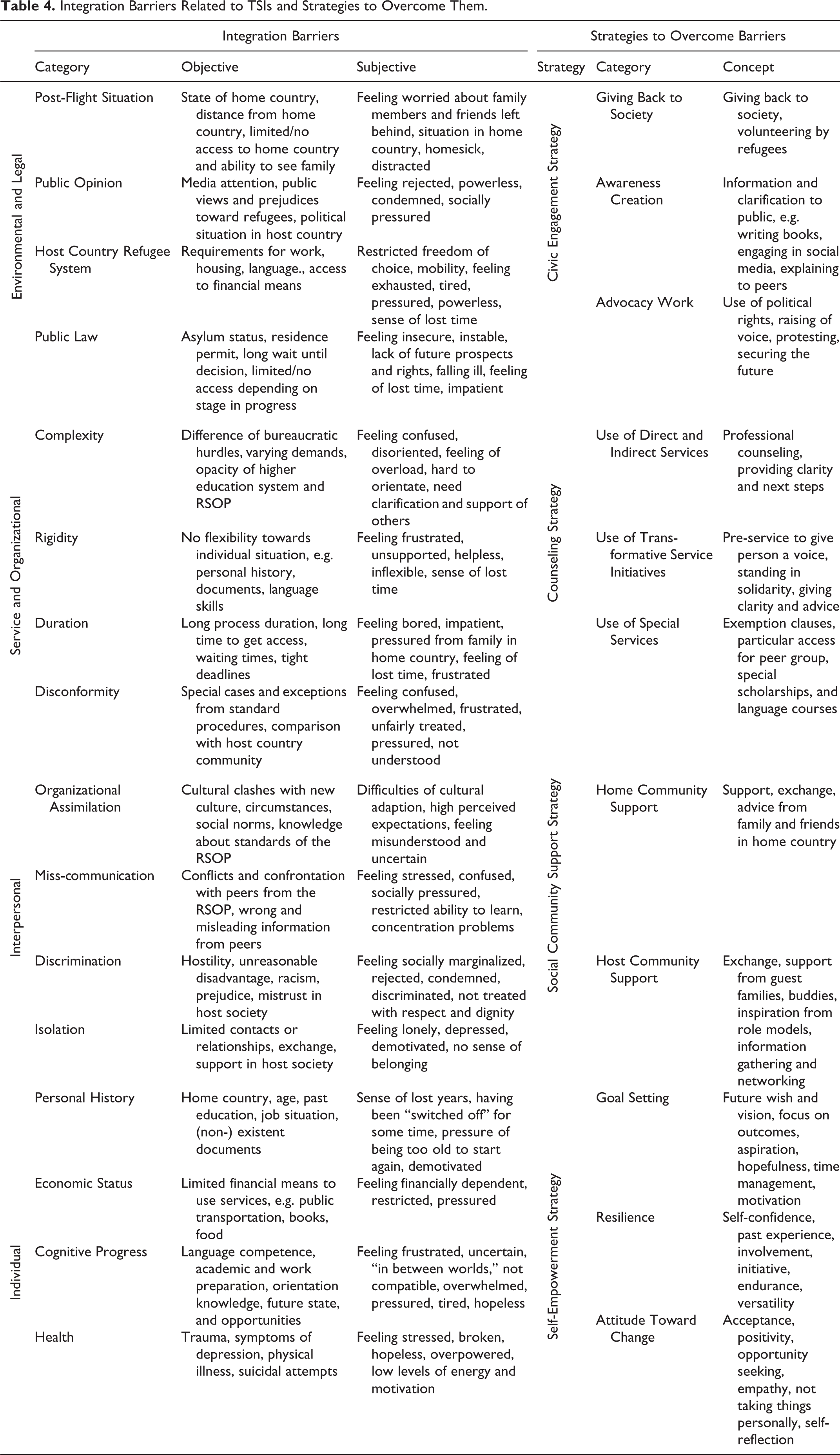
As Table 4 indicates, we find that refugees face various integration barriers, some of which directly influence their ability to participate in the RSOP, whereas others apply more generally to the wider context of refugee integration and higher education. Thus, our findings can inform studies of higher education–related barriers (Berg 2018; Streitwieser et al. 2018). We provide a more comprehensive analysis of objective and subjective barriers and TSR efforts, in that we reveal specific barriers related to TSI.
Integration Barriers Related to TSIs and Strategies to Overcome Them.
Environmental and legal barriers
In many host countries, refugees have limited access to continuing education due to their legal status and the documentation required to register (DAAD 2017). Our Study 2 findings add more specific legal factors that emerge as barriers too. The postflight situation affects any person who had to flee their home country and cope with that flight’s consequences, such as limited or no access to the home country, family members, or friends. This form of statelessness creates legal barriers for many refugees when participating in educational initiatives and gaining eventual access to higher education services. A second barrier pertains to public opinion in the host country, including media attention, public views, and prejudices against refugees in general, as well as the political situation, which might increase refugees’ suffering and affect their ability to use services. The third barrier at this level refers to the requirements in the host country refugee system for work, housing, language, and access to financial means. Legal documentation requirements and the related bureaucracy are key barriers to refugees’ access to labor markets too (Bucken-Knapp, Zainab, and Stephar 2018). Our findings affirm their important role in hindering refugees’ access to higher education. For many refugees, such barriers represent the primary restriction on their ability to improve their housing and financial situation and their access to service provision and freedom of choice. For example, they might prefer to take part in the RSOP rather than enter the job market but cannot because they need financial income. Finally, the public law barrier pertains to (legal) asylum status, refugees’ residence permits, and limited access to certain service offers, depending on their stage in the process. This barrier largely restricts refugees’ security and stability, leading to a lack of future prospects and rights.
Service and organizational barriers
The complexity of services in the German higher education system is reflected by the variety of bureaucratic hurdles, high and differing demands, and system opacity, which lead to confusion, disorientation, and cognitive overload. The RSOP encourages the preparation of applications, which inherently involves bureaucratic challenges. To apply successfully, refugees must understand this complex, nationally distinctive system. Another organizational barrier relates to the rigidity of the university system. Typical German universities do not offer much flexibility or consider refugees’ individual situations, personal (study) history, or access to documents in deciding whether to accept applicants to an academic program. These barriers parallel the complexity of the university entrance and administrative processes for refugees (Berg 2018). Even if they can overcome other hurdles, like language, students still need qualifications earned through various institutional and subject-level testing before being admitted to a higher education program (DAAD 2017). Another major barrier is the duration of the processes, including the waiting time to gain access, combined with tight deadlines, which leaves many refugees impatient and frustrated. Disconformity arises as another barrier, in that each refugee’s specific situation and documents might constitute special cases or variations from the standard procedures while attending the RSOP. In particular, refugees may need to have their academic credentials from their homeland obtained and assessed and then undergo additional screening and approval (Streitwieser et al. 2018). The longer duration of the process needed to handle such special cases creates barriers to refugees who want to participate in different initiatives to help them continue their higher education. Relative to the “normal” student community, many refugees feel overwhelmed, unfairly treated, pressured, and possibly deterred from pursuing higher education.
Interpersonal barriers
The interpersonal barriers involve exchanges with other individuals or groups, as might be manifest in a lack of organizational assimilation to the RSOP. This terminology refers to the process by which individuals become integrated into a culture of an organization (Davis and Meyers 2018). In our study context, participants express some misalignment with the social norms and standards of the RSOP’s culture and environment (as well as academic programs in general). Refugees report difficulties with (student) cultural adaptation, high perceived expectations of their linguistic skills, feelings of misunderstanding, and uncertainty about how to act. This barrier emerged from our findings and confirmed the importance of refugees’ acculturation through relationships between students and teachers, in and outside the classroom, for their effective participation in higher education initiatives (Aydin and Kaya 2017). In a similar way, miscommunication, or conflicts and confrontations with peers from the RSOP, as well as wrong and misleading information, represents a second barrier (Crea 2016). In the early stages of the integration process, some respondents report difficult housing situations in refugee camps, with many roommates or little privacy, which restricts their ability to learn and participate. A third barrier refers to discrimination, hostility, unreasonable disadvantages, racism, prejudices, and mistrust. Many refugees feel socially marginalized, rejected, condemned, or not treated with respect and dignity in the host community, a finding that aligns with evidence of employee sabotage behaviors in education and health care service settings (Kabadayi 2019). A few refugees reported discriminatory behavior among different refugee groups within the RSOP, which prevented them from actively engaging. These barriers confirmed exclusionary practices in a service system as pertinent barriers to refugee integration into host societies (Fisk et al. 2018). Finally, isolation stems from limited relationships, exchanges, and support in the host society. Most respondents noted this barrier in their first months in the new country, along with feelings of loneliness, depression, and a missing sense of belonging, which can reduce motivation to continue in the RSOP.
Individual barriers
The first barrier in this category is the refugee’s personal history, reflecting his or her home country, age, past education, job situation, and the lack of availability of documents. This finding aligns with the previously identified importance of refugees’ experiences, including their educational performance (Aydin and Kaya 2017). These personal factors, which may involve substantial suffering, lead some refugees to argue they are too old to start an academic program again or have been “off” for so long that participating in the RSOP represents a major challenge. Moreover, many participants suffer from insufficient economic states, such that they rely on government support for sufficient resources for living. The economic hardships refugees face are major barriers because they affect refugees’ ability to pay their education costs (Berg 2018).
Furthermore, asylum status and time-consuming efforts to participate in academic programs reduce their capacity to work and earn money, limiting RSOP participation. Applying for an academic program requires costly expenditures for document verification and approval for traveling costs too. A third barrier relates to cognitive progress, including language competence, academic and work preparation, and knowledge about the person’s future state. The language barrier is a particular challenge for many refugees, leaving them frustrated and uncertain (Streitwieser et al. 2018). Finally, health barriers can hinder refugees’ participation in and access to services. Many refugees are traumatized, showing symptoms of depression, physical illness, or even suicidal tendencies (Gottvall et al. 2020). Similarly, our findings suggest that stress is prevalent, and some respondents experience feelings of hopelessness and diminished levels of energy and motivation: The worst problem, I would say, is the situation as a refugee. I talked to many. I have heard stories that you cannot imagine. One of our course participants has tried to kill himself. The other’s father was arrested…in Syria. Another from Eritrea was simply thrown from one refugee camp to another by the immigration authority. He was totally broken. (Focus Group 5, Person D)
Results: Strategies to Overcome Integration Barriers
Table 4 also lists four strategies that the refugees in our focus groups have used to overcome these barriers. These results mainly reflect our qualitative data analysis; few conceptual or empirical evidence has been available in previous studies.
Civic engagement strategy
Refugees choose this strategy to address environmental and legal barriers and give back to their communities by volunteering, to enhance social and human capital, contributing to their integration into the host country (Handy and Greenspan 2009). Furthermore, they express a willingness and motivation to give back to (the host) society. By seeking volunteer projects, they can stabilize their situation while avoiding a sense of rejection or social pressure. Another option is to participate in awareness creation by providing information to the wider public. For example, social media posts might report on their home country’s situation or their experiences in the host community. Finally, other respondents engage in advocacy work and actively leverage their political rights. This strategy is similar to the reasons for heightened civic engagement identified in previous studies (Weng and Lee 2016).
Counseling strategy
To overcome service and organizational barriers, refugees who successfully access academic services often turn to available, face-to-face service provision offers, such as the RSOP service encounter or individual appointments with RSOP staff and tutors. Furthermore, the RSOP itself cooperates with “standard” university service providers, such as the international office, central student services, and students’ psychological services. The refugees who adopt a counseling strategy make extensive use of these special services beyond the RSOP. The following quote illustrates this usage: Those were the people [the RSOP] who always had an open door for us…. You can describe your problems, and you can be sure to get a good consultation and help. This is very important, and I am sure that without the RSOP, it would have been a very difficult challenge for me. Maybe I could not have done it at all, or it would have taken me two years [to get access to an academic program]. (Focus Group 4, Person G)
Social community support strategy
Refugees take substantial advantage of home and host community support. Home community support includes exchanges of advice with family or friends to select the next (academic) steps and pursue greater life satisfaction. Host community support pertains to information exchanges through networking, peers, guest families, and new friends. This strategy is closely linked to giving back to social behavior, but the focus shifts to interpersonal connections. As one refugee stated: For example, if I go to a preparation class and have contact with the other participants, I can build a study group one day. I’m a person who can study well in a group, and when I’m alone, I find it difficult. If we are five people, we have five times the knowledge.…Electronic media is particularly helpful for me, and we use it to support each other. (Focus Group 4, Person H)
Self-empowerment strategy
Within this strategy, we identify three behaviors that refugees adopt to overcome individual barriers. With a mental strategy of goal setting, refugees formulate and envision their future, focus on outcomes, and exhibit aspiration, hopefulness, strong time management, and motivation. In motivational psychology research, this strategy is referred to as mental contrasting (Krott and Oettingen 2018). In our focus groups, a respondent explained: It is very important to set goals right from the start and to evaluate them correctly. I do not want to study because studying is cool, but because I’m really into it. I know all the barriers in between. Also, I do not study because a relative studied. In such situations, you lose the motivation very quickly. (Focus Group 6, Person I)
Discussion and Implications
Conceptualization of Integration Processes and TSI
By combining TSR and integration theory insights, we have developed the 3A Integration Process Framework (Awareness, Alignment, and Access; Figure 1) to offer deeper understanding of the integration process that people experiencing vulnerability undergo. Furthermore, the framework clarifies when and how people typically come in contact with TSIs. The conceptual framework and empirical results from two studies detail the interactions between service providers and a population of refugees, how refugees overcome existing barriers, and how TSIs enable access. Although refugees are the primary focus for the current study, the 3A Integration Process Framework can apply to many groups of people experiencing vulnerability (e.g., homeless, ex-convicts, asylum seekers, undocumented immigrants, victims of sexual abuse or human trafficking, environmental migrants). We propose that TSIs can help them undergo the processes of registering, participating, and applying for critical services, so that they can enjoy fair access. For example, a TSI designed for homeless people thus might help them join a job training program, participate in the program, and apply for jobs. Such a TSI could provide a step-by-step approach toward becoming financially independent, tailored to each person’s needs.
Empirical Evidence for If a TSI Enables Access
This study provides the first empirical evidence of a TSI that targets people experiencing vulnerability (in our case, refugees) in relation to higher education services. In Study 1, the ATT results (Table 2) support the proposition that participating in a TSI has positive effects on higher education access. Specifically, when refugees participate in the RSOP, greater participation has more positive effects on their probability of applying and getting accepted to a course of study, compared with the chances for those who do not participate fully. Future research should replicate our study to confirm and broaden these empirical findings, beyond refugee populations and for other groups as well. Moreover, replication studies might address access to not just higher education but also housing, the job market, or other service contexts. More empirical evidence on TSIs would be particularly useful because our descriptive statistics reveal no differences between the access success ratio for participants and no-shows, though we interpret these results with caution. As mentioned, the RSOP we study has the unintended effect of motivating people who might not have thought about achieving access to higher education, had they not participated in the TSI. Further research might focus explicitly on such unintended effects within TSIs.
Deeper Insights on How TSI Helps Integrate People Experiencing Vulnerability
The logistic regression results in Study 1 also support the positive effects of TSIs on people’s access to higher education. Notably, the time between registering for the RSOP and applying for higher education access has a significant impact on refugees’ application behaviors and access. However, our study period was “only” 2.5 years. Longitudinal studies should assess TSIs over 5–10 years. Moreover, our regression findings suggest that preparatory classes have marginally significant effects on program participants’ access to a course of study, but language programs surprisingly have no such effect. In our view, this latter finding does not indicate language courses are a bad investment. Educational background and refugees’ prior language expertise strongly determine access to critical services. Service research might analyze the impact of individual language and other qualifications on access to other TSR outcomes. For example, how can a TSI help develop individual entrepreneurial ideas into a new business that helps people integrate into society? (Alkire et al. 2020). Finally, TSR and integration theory emphasize the positive effects of social contacts on integration (Ager and Strang 2008). In our regression, participation in buddy-matching programs increased the likelihood that refugees apply to higher education, though participation in sports programs did not exert such an effect. Thus, beyond any single TSI, it would be interesting to map the whole network of services and social contacts that surrounds an individual and determines the dynamic alignment of their skill sets, the stability of barriers, or other factors.
Uncovering Objective and Subjective Barriers
Study 2 provides insights into the objective and subjective barriers to refugees’ TSI participation. Barriers take four forms: legal and environmental, service and organizational, interpersonal, and personal. These findings align with prior research that identifies barriers in refugees’ daily lives (McBrien 2005) or educational services experiences (Aydin and Kaya 2017). We add to extant literature by specifying barriers to refugees’ participation in higher education through a TSI. These barriers are not limited to legal/political or personal factors. We add various service organization barriers. Further research might develop strategies for service providers to help reduce barriers to TSIs in other service contexts and for other populations.
New Insights on Strategies to Overcome Barriers
Although service providers can reduce barriers directly related to the TSI they offer, several other barriers in Table 4 cannot be addressed without refugees’ efforts. We provide evidence that refugees develop their own strategies to overcome barriers: civic engagement, counseling, social community support, and self-empowerment strategy. This comprehensive view of the barriers that refugees encounter and their strategies to overcome them establishes a clearer understanding of how to ensure refugees have access to higher education. Following this first service study of such barriers, we hope future projects work on this issue, such as by focusing on each of the identified strategies in greater depth.
Implications for Universities and Other Education Service Providers
Implement more TSIs in (higher) education
The PSM results and ATT show that a well-planned and implemented TSI for refugees enables both applications and access. Thus, we recommend that the boards of universities and relevant departments (e.g., diversity departments, international offices) should implement more TSIs for refugees and possibly for other people such as ex-convicts facing vulnerabilities. The descriptive statistics and results of the regression analysis over time suggest that refugee integration processes need time to reach the intended outcomes, such as access. Therefore, educational service providers should take a long-term view of their implementation. If they decide to implement TSI for refugees, they should devote sufficient financial and personal resources to ensure their continued existence and improvement over time. Many universities currently participating in such initiatives receive only short-term financial support from national agencies like the German Academic Exchange Service (DAAD 2017) or local government funding. Our findings suggest the need for longer-term investments. Supporting such TSIs may also require collaborations among schools, universities, governments, business partners, public institutions, and private donors to ensure their continuance.
Redesign the offered services
The findings offer another implication related to the design and curriculum of TSIs. For example, participation in preparatory classes encourages refugees’ applications, but we also recommend implementing more self-learning strategies. An effective program design should acknowledge and facilitate the strategies already used by refugees to overcome the barriers they face. For example, more counseling and service centers for refugees would likely be helpful. In particular, psychological counseling services may be necessary to help refugees address their lingering health issues and trauma. Housing support services could help with their efforts to find appropriate housing. Finally, the design of programs and initiatives should consider the qualifications and skills that the people experiencing vulnerability bring to the table as part of their personal resources. For example, some refugees may already have sufficient language proficiency, making language-related courses or services irrelevant for them; ex-convicts may have a prior education or skills that need updating. Therefore, when designing such programs, a one-size-fits-all approach should be replaced with customized curriculum designs for the different needs of people experiencing vulnerability, based on their individual qualifications and resources.
Implications for Public Policy, Civil Society Organizations, and For-Profit Companies
Public policymakers often only support refugee integration initiatives for a limited time, which may prove inefficient in terms of resource allocations and cannot support long-term capacity building (Mangan and Winter 2017). Based on our finding of positive, measurable effects of TSI for refugees, we recommend that public policymakers ensure the targeting and the mid- to long-term funding of such initiatives (Grier and Schaller 2020). Moreover, considering the wide variety of TSIs needed, we recommend a network approach (Boenigk et al. 2021). Civil society organizations and for-profit companies might join or initiate new TSIs designed for refugees and other human groups experiencing vulnerabilities. The massive arrival of refugees to Europe and other parts of the world prompted many citizens to volunteer their assistance, though engagement and volunteering activities peaked in 2016 and have declined since. Sustainable integration of people experiencing vulnerability instead requires continued, effective responses to support access to multiple areas of society and their associated service systems.
Research Limitations and Future Research
The concept of TSIs and the 3A Integration Process Framework was developed for people experiencing vulnerability and tested in a specific refugee, higher education context. Future research should address how TSIs for other critical services (e.g., employment, housing, health care) might help overcome barriers and enable access for other people experiencing vulnerabilities (e.g., minorities, children, pregnant women, elderly, prisoners, undocumented immigrants, malnourished people, immunocompromised). Moreover, this study focused on individual refugees without addressing interconnections among individual, collective, and ecosystem levels. Future research might consider the communal effects of TSIs. For example, refugees often connect with local families and other service networks that might contribute to their successful integration. Additional studies might specify the role of peoples’ social connections in a service system relative to other service aspects, such as finding information on housing or financial issues. Not all integration barriers can be overcome, future research might explore the coping strategies refugees use. Empirical multi-country studies would allow comparisons with other countries. Finally, our qualitative analysis is limited to six focus groups. More in-depth qualitative and quantitative analyses of barriers to access could help specify additional needs and behaviors.
Conclusion
Robust methods and practices for reducing human suffering and uplifting well-being are needed to fulfill the higher purpose of TSR and advance the service discipline. With this research, we demonstrate that people experiencing vulnerability, and the global refugee crisis in particular, deserve more TSI studies. Scholars also might take inspiration from the comprehensive research agenda developed by Boenigk et al. (2021), which contains several other important TSR research questions related to different refugee journey phases, such as “how are refugees co-creating value?” or “how can refugee well-being in camps be monitored and improved?” (Boenigk et al. 2021, Table 1, Web Appendix, p. 9). Moreover, interested service researchers can participate in ServCollab (Fisk et al. 2020), a service research organization for diagnosing and treating humanity’s service system problems. Its first service inclusion project was Boenigk et al.’s (2021) refugee study. Finally, the 3A Integration Process Framework can be applied to all “transformative service initiatives,” not just initiatives for refugees or for higher education access. We invite researchers to test the framework and TSIs in other settings and contexts. We hope this study inspires future TSI research on behalf of people experiencing vulnerability.
Supplemental Material
Supplemental Material, sj-pdf-1-jsr-10.1177_10946705211013386 - Transformative Service Initiatives: Enabling Access and Overcoming Barriers for People Experiencing Vulnerability
Supplemental Material, sj-pdf-1-jsr-10.1177_10946705211013386 for Transformative Service Initiatives: Enabling Access and Overcoming Barriers for People Experiencing Vulnerability by Silke Boenigk, Aaron A. Kreimer, Annika Becker, Linda Alkire, Raymond P. Fisk and Sertan Kabadayi in Journal of Service Research
Supplemental Material
Supplemental Material, sj-pdf-2-jsr-10.1177_10946705211013386 - Transformative Service Initiatives: Enabling Access and Overcoming Barriers for People Experiencing Vulnerability
Supplemental Material, sj-pdf-2-jsr-10.1177_10946705211013386 for Transformative Service Initiatives: Enabling Access and Overcoming Barriers for People Experiencing Vulnerability by Silke Boenigk, Aaron A. Kreimer, Annika Becker, Linda Alkire, Raymond P. Fisk and Sertan Kabadayi in Journal of Service Research
Footnotes
Acknowledgments
The authors would like to thank the editor and the three reviewers for their extensive and constructive feedback throughout the review process, in particular for their inspiration on the title of the “3A (Awareness, Alignment, Access) Integration Process Framework”. Furthermore, we thank all the participants in this study, as well as all colleagues for their comments on earlier versions of this article.
Declaration of Conflicting Interests
The author(s) declared no potential conflicts of interest with respect to the research, authorship, and/or publication of this article.
Funding
The author(s) received no financial support for the research, authorship, and/or publication of this article.

Supplemental Material
The supplemental material for this article is available online.
Author Biographies
References
Supplementary Material
Please find the following supplemental material available below.
For Open Access articles published under a Creative Commons License, all supplemental material carries the same license as the article it is associated with.
For non-Open Access articles published, all supplemental material carries a non-exclusive license, and permission requests for re-use of supplemental material or any part of supplemental material shall be sent directly to the copyright owner as specified in the copyright notice associated with the article.
