




Abstract
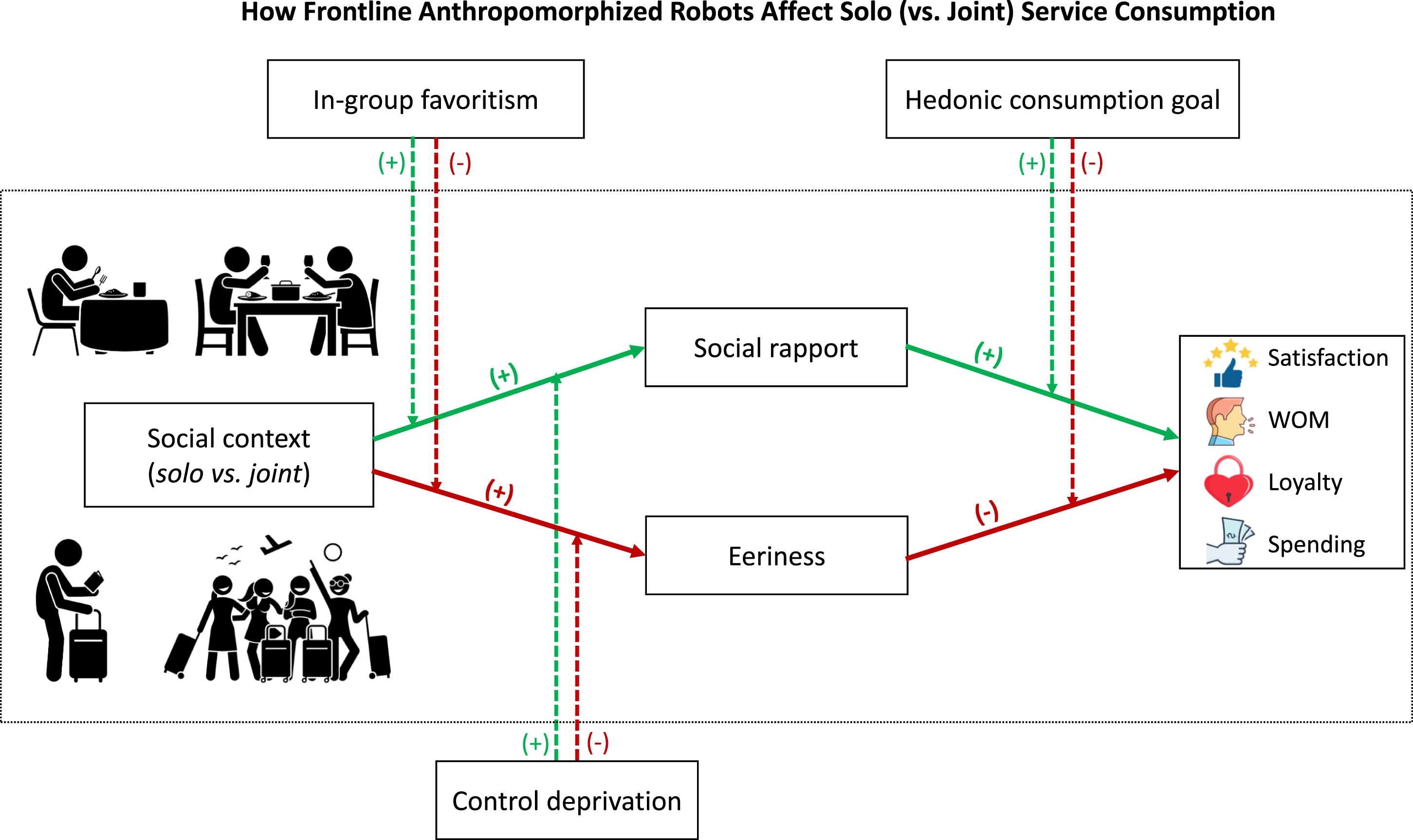
Solo consumption has become an emerging trend in recent years. However, the service experiences of solo customers with the growing adoption of frontline humanlike robots remain unclear, particularly in direct comparison with joint customers. Building on the literature of anthropomorphism and information processing theory, this study examines whether and how frontline anthropomorphized robots (FAR) might improve the service experiences of solo customers relative to their joint counterparts. Data from four studies, including field and online experiments, reveal that solo customers are more likely than joint customers to perceive FAR as offering rapport but also as being eerie, leading to different service evaluations (both attitudinal and behavioral outcomes). Nevertheless, as parallel mechanisms, these levels of social rapport and eeriness are contingent on features of the FAR, the service delivery process, and customers’ consumption goals. The rapport (eeriness) mechanism is strengthened (weakened) when the robot is of in-group favoritism, the service process deprives customers of control, and customers have a hedonic consumption goal. With the boom in adopting frontline humanlike robots in hospitality services, this study offers managerially relevant implications for serving solo customers as an emerging segment along with the traditional segment of joint customers.
Keywords
Get full access to this article
View all access options for this article.
References
Supplementary Material
Please find the following supplemental material available below.
For Open Access articles published under a Creative Commons License, all supplemental material carries the same license as the article it is associated with.
For non-Open Access articles published, all supplemental material carries a non-exclusive license, and permission requests for re-use of supplemental material or any part of supplemental material shall be sent directly to the copyright owner as specified in the copyright notice associated with the article.
