




Abstract
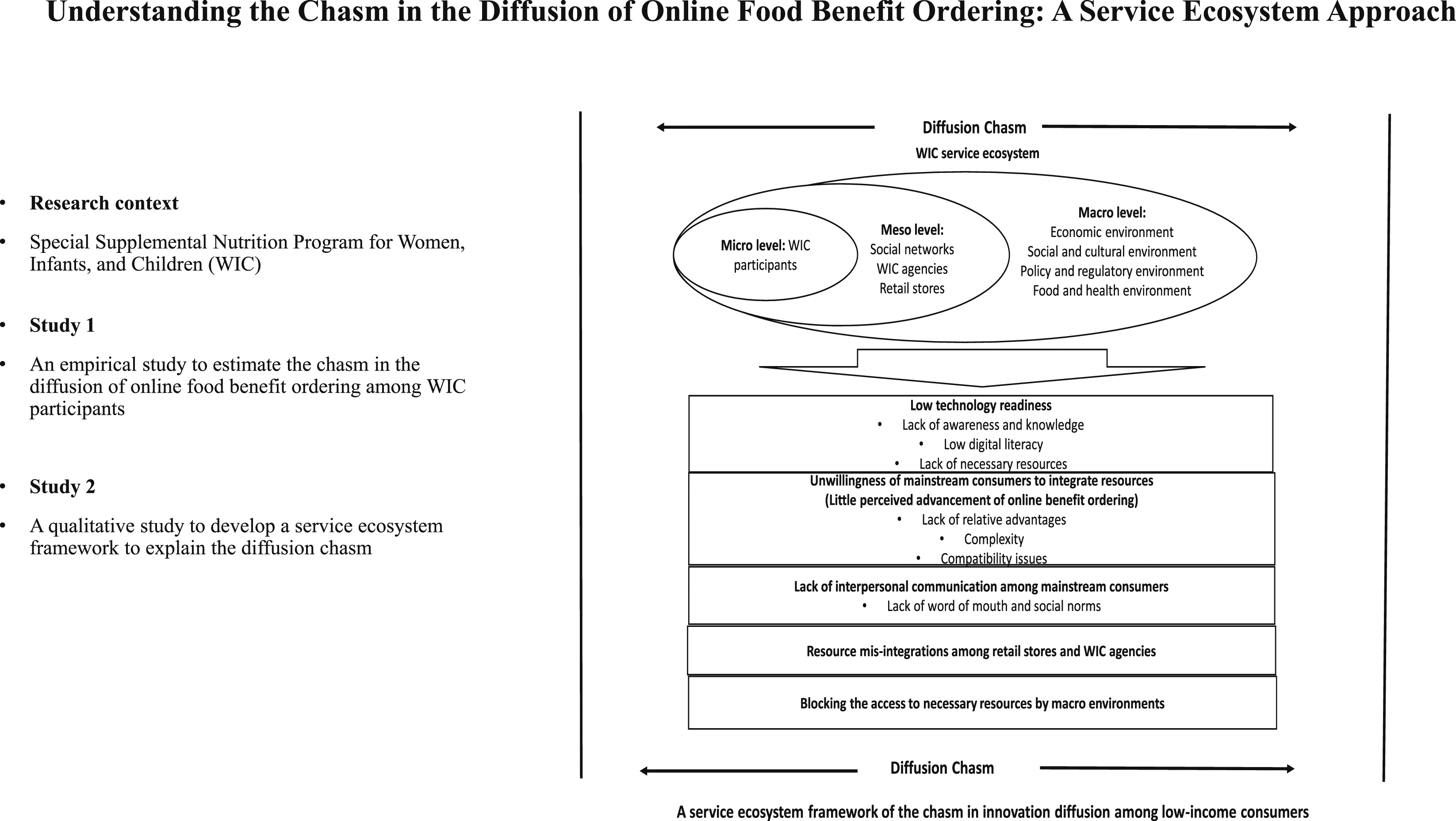
Although consumers used online grocery shopping more frequently to limit exposure to the COVID-19 virus during the pandemic, the participants of some federal nutrition assistance programs lacked the option to redeem their food benefits online. Some retailers were pilot-testing online food benefit ordering for the participants of the Special Supplemental Nutrition Program for Women, Infants, and Children (WIC), one of the largest federal nutrition assistance programs in the United States. Linking the administrative data from a state WIC agency with the online ordering data from a grocery store chain, Study 1 empirically estimates the diffusion of online food benefit ordering among WIC participants, examines the influence of the COVID-19 pandemic-related factors, store strategies, and individual characteristics on the diffusion process, and unveils the existence of a diffusion chasm. Study 2 is a qualitative study in which WIC participants and store employees were interviewed. A service ecosystem framework is developed to explain how the chasm was formed and non-adoptions occurred. The retrospective examination of the diffusion chasm during the pandemic provides important recommendations regarding how to cross the chasm and improve WIC participants’ food well-being.
Keywords
Get full access to this article
View all access options for this article.
References
Supplementary Material
Please find the following supplemental material available below.
For Open Access articles published under a Creative Commons License, all supplemental material carries the same license as the article it is associated with.
For non-Open Access articles published, all supplemental material carries a non-exclusive license, and permission requests for re-use of supplemental material or any part of supplemental material shall be sent directly to the copyright owner as specified in the copyright notice associated with the article.
