




Abstract
Multiple research efforts are currently unfolding to advance the wide-scale sustainability transformation of services and service ecosystems to address the United Nations Sustainable Development Goals (SDGs). While “how” to create service ecosystems and “whom” and “what” these service ecosystems serve have been receiving increasing scholarly attention, current research leaves the “where” question relatively underexplored. Thus, precise theoretical conceptualizations of the role of spaces and places in sustainable service ecosystem design (SED) are lacking. By longitudinally investigating two in-depth case studies, we illuminate the spatial aspects of sustainable SED. Our findings suggest five spatial mechanisms that enlighten how sustainable SED unfolds in relation to spaces and places. We also identify three tensions that affect the implementation of sustainable SED, each tension having both enabling and constraining manifestations. The study contributes to the service research on sustainability by illuminating the previously under-researched spatial aspects of sustainable SED. Results have implications for a broad set of actors involved in sustainable SED, providing advice on how to design new and utilize existing spaces and places to maximize their potential in addressing sustainability challenges.
Keywords
A wide-scale sustainability transformation of services and service ecosystems is paramount if the contemporary, service-oriented economies are to make meaningful progress toward United Nations sustainable development goals (SDGs). Multiple important research efforts are currently unfolding toward this overall aim. For example, transformative service research (TSR) has made considerable advances in increasing our understanding about the well-being consequences and inclusivity of services (Anderson and Ostrom 2015; Anderson et al. 2013). Others have outlined how service research can be used to embed sustainability in the education of future managers (Saviano et al. 2017). There is also vibrant research stream on how to make product-service systems more sustainable (Li et al. 2022; Vezzoli, Ceschin, and Diehl 2015). However, sustainability-oriented service research remains scattered (Calabrese et al. 2018) and the different streams oftentimes emphasize the sustainability dimensions unevenly; for example, the TSR has accentuated social aspects while product-service systems scholars tend to highlight the environmental dimension.
Service scholars are increasingly positing service ecosystem design (SED) as a fruitful line of inquiry for sustainable service research, as highlighted in the recent service research priorities (Field et al. 2021). The main vantage points of SED for sustainable service research are three-fold. First, adopting a deliberately systemic perspective, going beyond service encounters and offerings to entire service ecosystems, enables pursuing ambitious and wide-ranging research questions (Field et al. 2021; Vink et al. 2021). Second, all design approaches—SED included—follow the betterment principle, the deliberate striving for the better (Anderson et al. 2013; Karpen, Gemser, and Calabretta 2017). This is compatible with sustainable service research, which deliberately aims to improve the sustainability outcomes. Third, SED allows for a paradigmatic radicalness: deliberately questioning fundamental assumptions and beliefs as well as exploring radically new futures (Koskela-Huotari et al. 2021). Such fundamental paradigmatic change is likely to be needed if service ecosystems are to transition from an economic growth paradigm to a genuine sustainability paradigm (Dwyer 2018).
Some studies have already applied the SED approach to sustainability-related research questions. For example, Nie et al. (2019) have investigated the deliberate design of sustainable macro-level service in the context of university career counseling. Fehrer and Bove (2022), on the other hand, have studied how service ecosystems can be shaped for increased resilience. However, many of the current sustainable SED studies emphasize the social aspects of sustainability, leaving the environmental aspects to lesser attention. Hence, more research covering both social and environmental ramifications of sustainable SED is needed.
Even more fundamentally, the current SED research leaves the “where” question relatively underexplored—and we posit that such spatial understanding is required for sustainable SED research to realize its full potential. The existing research postulates that SED unfolds through collective processes, enabling various actors to shape institutional arrangements and their physical enactments (Koskela-Huotari et al. 2021; Vink et al. 2021). Thus, SED is doubly a spatial affair: it unfolds in a physical and social space, and the spatial elements themselves are also subject to design efforts. However, we still do not know how different physical and social spaces influence SED processes. Thus, we cannot say much about where sustainable SED is—or should be—unfolding. In a similar vein, there is limited understanding of how the physical enactments of institutional arrangements should be designed in service ecosystems for improved sustainability outcomes. This is a crucial gap in understanding as “whom” and “what” a service ecosystem serves are questions firmly embedded in “where”: spaces and places (Holmes, Fernandes, and Palo 2021).
Against this backdrop, the purpose of this paper is to examine the spatial aspects of sustainable SED. In particular, we seek to answer the following two research questions: 1. How does sustainable SED unfold in relation to spaces and places? 2. How do spaces and places enable and/or constrain sustainable SED?
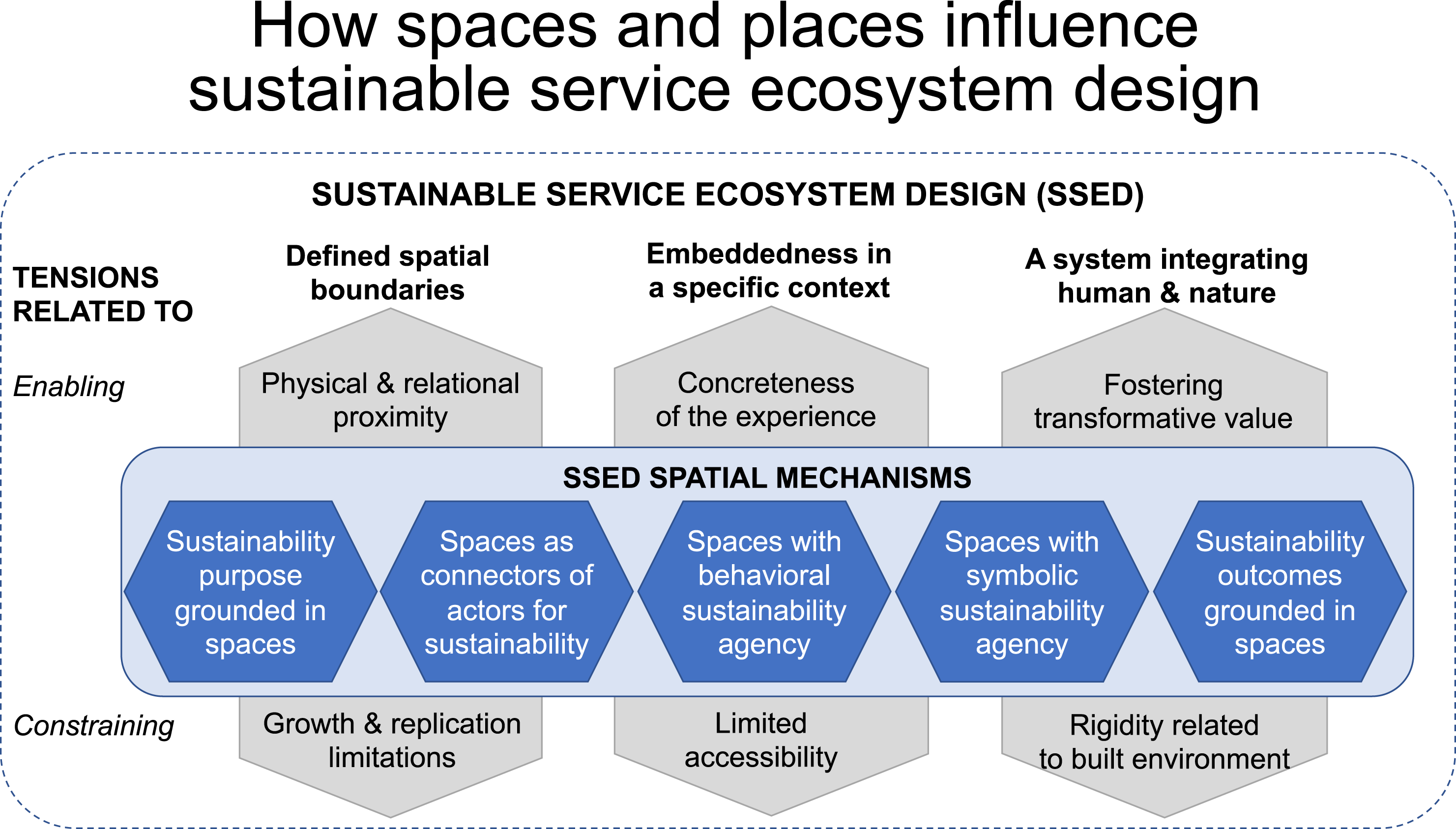
To address these research questions, we employ two longitudinal, in-depth case studies on Cultural Urban Sea (CUS) and Milan Food Waste Hub (MFWH). Our findings put forward five spatial mechanisms that illuminate how sustainable SED unfolds in relation to spaces and places: sustainability purpose grounded in spaces, spaces as connectors of actors for sustainability, spaces with behavioral sustainability agency, spaces with symbolic sustainability agency, and sustainability outcomes grounded in spaces. We also identify three tensions that affect the implementation of sustainable SED, each having both enabling and constraining manifestations.
Theoretically, the paper contributes to the service research on sustainability in general and the growing research on SED for sustainable service in particular (Field et al. 2021; Koskela-Huotari et al. 2021; Vink et al. 2021) by illuminating the previously under-researched spatial aspects of sustainable SED. In particular, we provide additional insights regarding the agency of spaces and places in sustainable SED processes, how to manage spaces and places for improved sustainability outcomes, and how the duality of spaces and places as simultaneous enablers and constraints manifests in sustainable SED. Results have implications for a broad set of actors involved in sustainable SED, providing advice on how to design new and utilize existing spaces and places to maximize their potential in addressing sustainability challenges.
Conceptual Background
Spaces and Places in SED: Context of Design and Design Elements
Vink et al. (2021, p. 169) define SED as “the intentional shaping of institutional arrangements and their physical enactments by actor collectives through reflexivity and reformation to facilitate the emergence of desired value creation forms.” This definition highlights two facets of SED that differentiates it from other related concepts: (1) the intentional agentic efforts to (2) shape the service ecosystem. The emphasis on the intentional agentic change efforts distinguishes SED from other systemic service research concepts such as service ecosystem well-being (Frow et al. 2019) or service ecosystem transformation (Koskela-Huotari et al. 2021). The focus on shaping the meso- or macro-level service ecosystems, on the other hand, separates SED from agentic efforts to develop new, more micro-level, service offerings, discussed under terms such as service design, service innovation, or new service development (Edvardsson and Olsson 1996; Patrício, Gustafsson, and Fisk 2018).
The concept of service ecosystem, “a relatively self-contained, self-adjusting system of resource-integrating actors connected by shared institutional arrangements and mutual value creation through service exchange” (Vargo and Lusch 2016, p. 10-11), stems from the service-dominant logic (SDL). Thus, many SED studies implicitly or explicitly draw on SDL. Our review of SDL reveals three perspectives to spaces and places. First, spaces and places can be viewed as facets of the value cocreation context. Service-dominant logic adopts a phenomenological view on value (Vargo and Lusch 2016) and the concept of value-in-context is used to explicitly denote that value is always contingent on the context (Akaka and Vargo 2015; Vargo, Maglio, and Akaka 2008). According to Akaka and Vargo (2015), service contexts—including their spatial aspects—comprise multiple nested levels: micro (dyad), meso (triad), and macro (network), each manifesting different configurations of value dimensions (Akaka and Parry 2019). For example, exchange and social value are more prevalent on the micro level, while socio-technical value is highlighted on the meso level, and cultural and historic value on the macro level (ibid). Service ecosystems, on the other hand, can be seen as “meta layers” that cut across the different levels of aggregation, flattening it.
Second, spaces and places can be considered as resources. Especially the early concept of “operant resources” (Madhavaram and Hunt 2008; Vargo and Lusch 2008), which require other resources to act on them for value creation, is applicable to spaces and places. However, the more recent SDL research no longer emphasizes the operant versus operand resource dichotomy, and highlights more “the ability of a (potential) resource to facilitate the accomplishment of something desirable” (Akaka, Koskela-Huotari, and Vargo 2021, p. 381). The ability of various spaces and places to facilitate attaining desirable outcomes varies on at least two continuums: the characteristics of the space and the value being sought. Therefore, the ability of the same spaces to act as valuable resources in a SED process aimed for improved sustainability outcomes may differ from their ability to support a SED process seeking solely economical and functional improvements.
Third, spaces and places can be seen as manifestations of institutions and institutional arrangements. The SDL theorizing has increasingly emphasized the importance of institutions, defined as “humanly devised coordinating mechanisms, such as rules, norms, symbols, etc., that enable and constrain value-cocreating actions,” and institutional arrangements, defined as “assemblages of interrelated institutions, which can contain technological, sociological, cultural, and economic structures” (Akaka, Koskela-Huotari, and Vargo 2021, p. 381). However, many institutional theorists (Scott 2013) and SDL scholars (Koskela-Huotari et al. 2016; Siltaloppi, Koskela-Huotari, and Vargo 2016) reason that the largely immaterial institutions and institutional arrangements are made manifest in practice—and thus physical enactments such as buildings, infrastructures, and accessories are reflections of institutions and institutional arrangements. Drawing on the concept of institutional work (Battilana and D’aunno 2009; Lawrence and Suddaby 2006), SED views institutional arrangements and their physical enactments as primary design materials (Koskela-Huotari et al. 2021; Vink et al. 2021). Viewing physical surroundings, physical materials, and the bodily perceptions of actors is both a continuation and deviation from service design focusing on the development of new service offerings. From early on, service design has considered physical elements as important components to be designed (Bitner 1992, Secomandi and Snelders 2011).
Places and Spaces in the Study of Transformative Service Research: Physical and Virtual Spaces Designed for Human Well-Being
Focusing on social sustainability, TSR literature has extensively researched the role played by the physical spaces of commercial and nonprofit services as so-called third places 1 in improving individual and collective well-being outcomes (Rosenbaum 2006, 2009; Rosenbaum et al. 2007; Rosenbaum and Smallwood 2013; Rosenbaum, Sweeney, and Windhorst 2009). Such third places that may range, according to the TSR scholars, from coffeehouses to cancer resource centers, allow especially vulnerable people to “maintain commercially based friendships that promote human well-being via the exchange of socially supportive resources” (Rosenbaum et al. 2020, p. 435). The person-place relationship is central to this debate but, at the same time, deserves to be further explored (Rosenbaum et al. 2020; Russell-Bennett et al. 2019).
Over time, the notion of third places has been extended to capture discontinuities and tensions in social structures. For example, Finsterwalder and Kuppelwieser (2020) highlight how during the COVID-19 pandemic, third places have been reconsidered as safe value cocreation contexts for socializing and interacting with the aim to enhance individuals’ well-being while maintaining social distancing. By moving third places from physical settings to online, Parkinson, Schuster, and Mulcahy (2021) develop an integrated framework and a set of propositions that consider how characteristics of (online) third places may also have unintended consequences that enhance or diminish consumers’ well-being. Further contributions have highlighted the role of third places to address the social impact of the aging population (cf., Meshram and O'Cass 2018; Fong et al. 2021). Wexler and Oberlander (2017) contribute to this debate by distinguishing three types of third places: communitarian, designed to improve social conditions by adopting a social problem orientation; commercial, profit-driven with the aim to humanize experiences through socialization; and digital, mainly focused on sharing and connectivity via social media.
Places and Spaces in the Study of Market Dynamics: Space as a Designer
The broader spatial turn in social sciences suggests that spaces are not merely simple and passive reflections of human behavior, but also active participants in social practices (Giovanardi and Lucarelli 2018; Merriman et al. 2012; Warf and Arias 2009). Beyes and Holt (2020, p. 5) summarize this spatial turn “denoting a renaissance of ‘space’ as a conceptual and analytical category and marking a renewed interest in the spatial nature of human experience.”
Consumer research has been one of the early adopters of the spatial turn (Arnould and Thompson 2005). For our purposes, however, the recent developments in the study of market dynamics are particularly relevant: similar to SED, market dynamics research focuses on system level phenomena and acknowledges the agency of actors to influence the development of the system in question. The majority of the spatial investigations in market dynamics research take a practice perspective, and they highlight the agency of spaces and places in these practices (Castilhos and Dolbec 2018; Castilhos, Dolbec, Veresiu 2017). Spatial aspects also influence the agency of actors: small-scale spaces and places augment the potential agency of the actors embedded in them (Castilhos, Dolbec, Veresiu 2017).
In addition to underscoring the agency of spaces and places, market dynamics research considers the roles actors and practices play in (re)producing spaces and places. Castilhos and Dolbec’s (2018) typology of public, market, segregating, and emancipating spaces helps in understanding the roles of actors in (re)producing—or designing—spaces. Especially interesting as the “emancipating spaces” that are “created by communities as spaces of subversion that allow for the challenging of hegemonies” and they “serve as spaces of safe expression for communities defending marginalized positions” (ibid., 160). Such emancipating spaces are often temporary, but they can also be more permanent (Chatzidakis, Maclaran, and Bradshaw 2012). Maciel and Wallendorf (2021), on the other hand, study the use of space by consumers to assert greater cultural value for their identities. They identify three interdependent practices: spatial affirmation (occurring on private scale), spatial repurposing (occurring on semi-public scale), and spatial incursion (occurring on public scale), temporarily countering stereotypes of what is seen as an acceptable use of public space. Interestingly, also Maciel and Wallendorf (2021) draw our attention to the temporal aspect of spatial practices: the public and semi-public practices appear to be temporary rather than permanent. Finally, Holmes, Fernandes, and Palo (2021) investigate the spatial dimensions of market-making practices and make an implicit link to sustainable SED: where and how to create service ecosystems, and whom and what these service ecosystems serve are firmly anchored in spaces and places. Thus, according to Holmes et al. (2021), it would be futile to attempt sustainable SED without explicitly acknowledging the “where” questions.
Summary
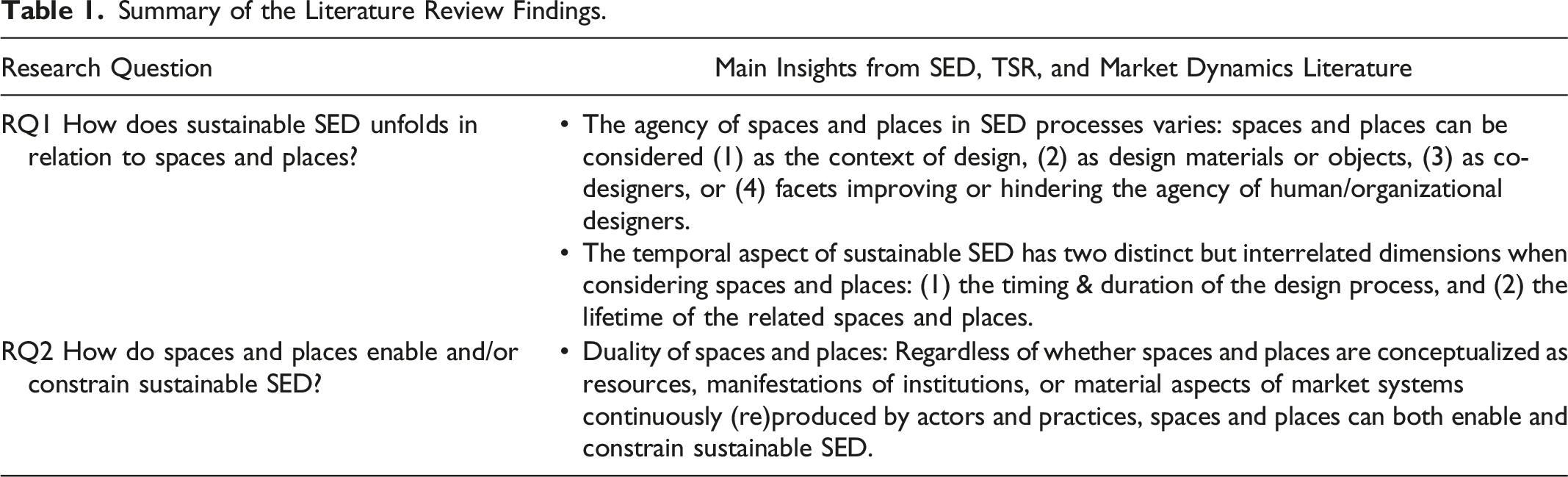
Summary of the Literature Review Findings.
Methodology
Sampling
The present study uses a qualitative case study methodology (Stake 1995; Yin 2012). The empirical material comprises two longitudinal, in-depth case studies. As the study is exploratory, the aim of the sampling was to illuminate the phenomenon under study as comprehensively as possible. Hence, the aim was not to seek a representative sample—but instead we sought to sample “polar type” cases that represent the extreme ends of the phenomenon (Eisenhardt and Graebner 2007). For the present research, we considered two dimensions particularly important in identifying the polar types. First, we sought cases that, while considering concurrently in their development the three dimensions of sustainability, started from addressing, in one case, environmental issues, and in the other social issues. Second, we sought variation in the focal actors behind the initiatives, seeking to sample one firm-led initiative and another one led by a public actor. The screening of the potential case studies was done based on secondary information sources such as newspaper and magazine articles as well as informal discussion with researchers and NGOs interested in sustainability.
The final decision about which cases to include in the study was based on five criteria: (1) covering the above-discussed polar types, that is, conception of sustainability and focal actor, (2) widely recognized (e.g., in the media) and documented (e.g., objective measurements) success in triggering a significant service ecosystem change toward both environmental and social sustainability, (3) longitudinal data that allows observing the case over time, (4) level of access so that the informants are willing to discuss also challenging aspects of the case, and (5) authors having a sufficient level of understanding of the cultural nuances of the cases. At last, we selected two cases to be included in the study: CUS and MFWH.
Description of the Two Cases
CUS is a social enterprise that initiated a process of urban and social redevelopment in the Milan suburbs through the recovery of a farmstead. This building dates back to the 16th century and was acquired by a public organization in the early 1900s. In 2014, the process of recovering the building and the historical courtyard began, backed by a private initiative collaborating with various cross-sector actors (nonprofit organizations, foundations, and public actors).
The founding idea behind CUS was to create a focal point for the neighborhood where sustainability-related projects could be carried out. The space contains a coworking area, two rehearsal rooms, a multipurpose hall, a stage for concerts, a craft brewery, and a restaurant. The project has been integrated into the existing environment and also promotes environmental sustainability by raising visitors’ awareness of environmental sustainability issues, for example, by hosting a weekly farmers’ market. To reduce barriers to participation, CUS guarantees free entrance to the facility so that people can attend cultural events without having to purchase tickets. Where commercial activity is concerned (e.g., the restaurant), they try to keep prices low and accessible for everyone.
Over time, CUS has become a laboratory for novel forms of dialogue between artists, performers, architects, designers, actors, graphic designers, directors, researchers, associations, local cultural operators, and citizens, who have gained a profound sense of community through working together. Furthermore, it has stimulated its area economically by directly creating jobs and indirectly opening pathways to employment (e.g., offering on-the-job training and matching employers and marginalized jobseekers).
The second case examined in the study is a public initiative called the MFWH, within the broader project Milan Food Policy, the origins of which can be traced to the 2015 Expo on “Feed the Planet, Energy for Life.” The Food Policy sets out a comprehensive vision for rethinking city’s food system, targeting multiple stakeholders, risks, and outcomes. Reducing food waste is one of the priorities of the Food Policy, with the goal of cutting food waste by 50% by 2030. In order to do so, the municipality established the first Local Food Waste Hub, a pilot project that recovers food surpluses from local supermarkets and canteens and redistributes it to people in need through local neighborhood networks. The project was designed in 2017 through a partnership between the municipality, local foundations, universities, and nonprofit organizations. The municipality donated a public space, dedicated to stocking and redistribution of recovered food, to local charities involved in the project. Today, the city has three food waste hubs, and the fourth and fifth hubs are in the planning phase, each recovering about 130 tons of food per year, translating to about 260,000 meals. Some consider that the Food Policy and its food waste hubs have created a blueprint that can be scaled throughout the world. In 2021, the project won the first edition of the Earthshot Prize, a prestigious international recognition for the best solutions to protect the environment.
Data Collection
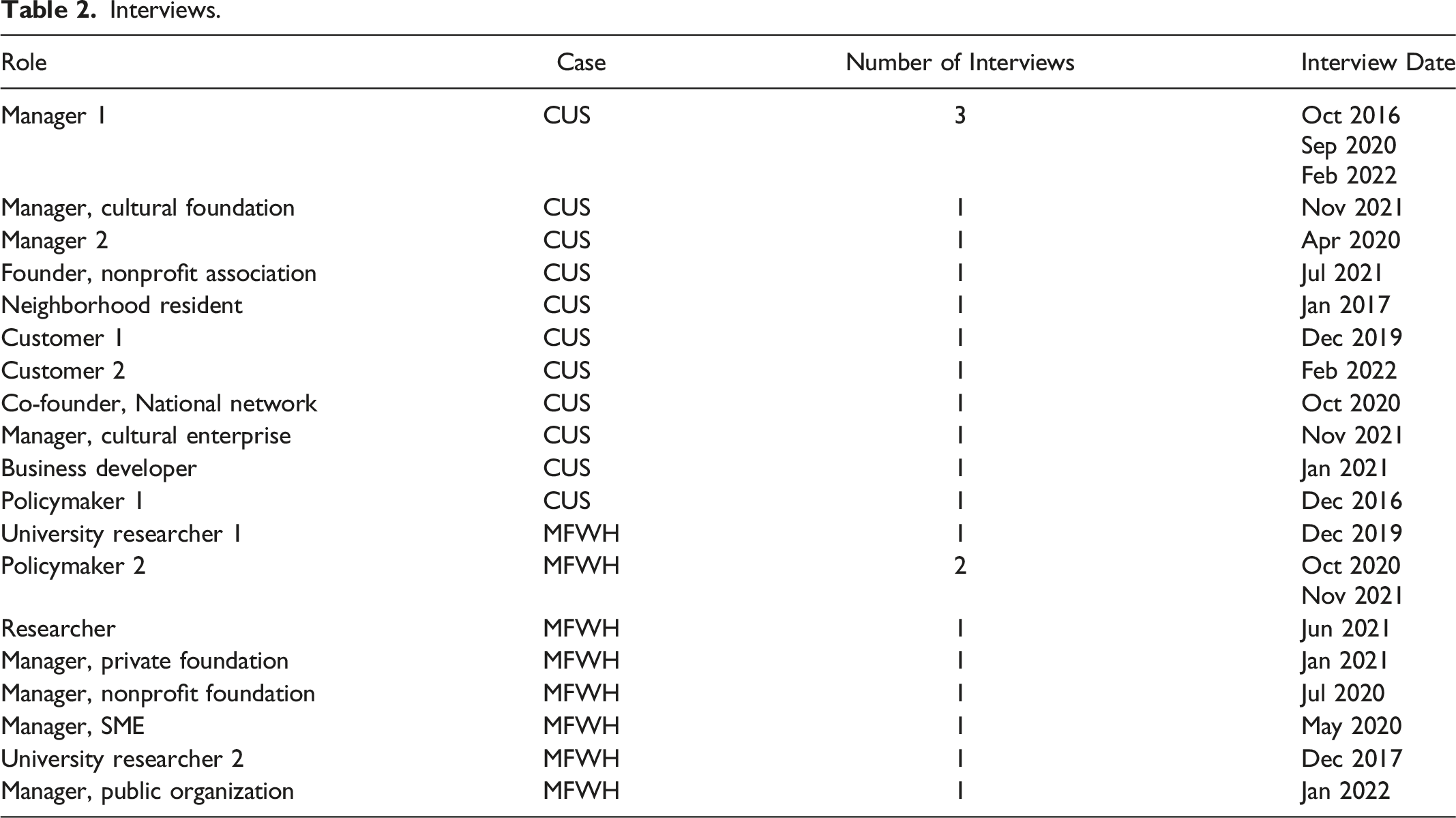
The data collection has unfolded longitudinally since 2015. The data collection started initially with one case: CUS. During the first months, we collected secondary data and engaged in participant observations. The secondary data comprised of various organizational documents, reports and financial records, articles in newspapers and magazines, as well as customer testimonials in open online platforms such as TripAdvisor and Google. In most of the participant observations, we remained passive, but one of the members of the research team had a more active role in meetings. After we have accumulated sufficient understanding of the CUS case, we started conducting semi-structured interviews. The initial interviewees were identified through document analysis and participant observations, and we sought to interview individuals who could provide us with as comprehensive account of the case as possible. After the initial interviews, the subsequent interviewees were identified via snowball sampling. The use of snowball sampling is recommended especially when it is necessary to identify hard-to-locate informants (Feldman, Bell, and Berger 2004), which is often the case when researching wide and largely informal networks. The data collection on CUS was stopped after data, theoretical and inductive thematic saturation was reached in the first months of 2022.
The data collection for MFWH started in 2019, and it unfolded in a similar manner to CUS with two minor exceptions. First, due to the nature of the case, there are no public customer testimonials available about MFWH. Instead, we probed the customer and stakeholder value creation through semi-structured interviews and participant observations. Second, we did not assume an active role in any of the participant observations related to MFWH. The data collection on MFWH was stopped after data, theoretical and inductive thematic saturation was reached in early 2022.
Interviews.
Data Analysis
First, the data was organized temporally. In practice, this meant that the two members of the author team rearranged the critical activities over a timeline, creating an “event history database” (Garud and Rappa 1994). These event histories of both cases enabled the authors in cross-checking the activities throughout the analysis. Furthermore, the event histories provided the basis for narration: creating detailed storylines of the two case studies (Gersick 1988; Langley 1999; Van Maanen 1995). These narratives are also summarized in the Findings section.
Second, the data was coded in an abductive manner, allowing an interplay between conceptual and empirical domains while giving primacy to the empirical world (Dubois and Gadde 2002; Sætre and Van de Ven 2021; van Maanen, Sørensen, and Mitchell 2007). In practice, we started with inductively coding the empirical data, identifying the initial open codes line-by-line. After this, we conducted axial coding during which data was given more conceptual codes informed also by the literature. Finally, selective coding was used to relate to emerging categories to each other. Two of the authors conducted the above-mentioned three stages of the empirical analysis independently, constantly comparing their results as well as debating and reconciliating the differences. The third author audited the analysis process and the work-in-progress findings regularly. The final data structure is depicted in Figure 1. Data structure.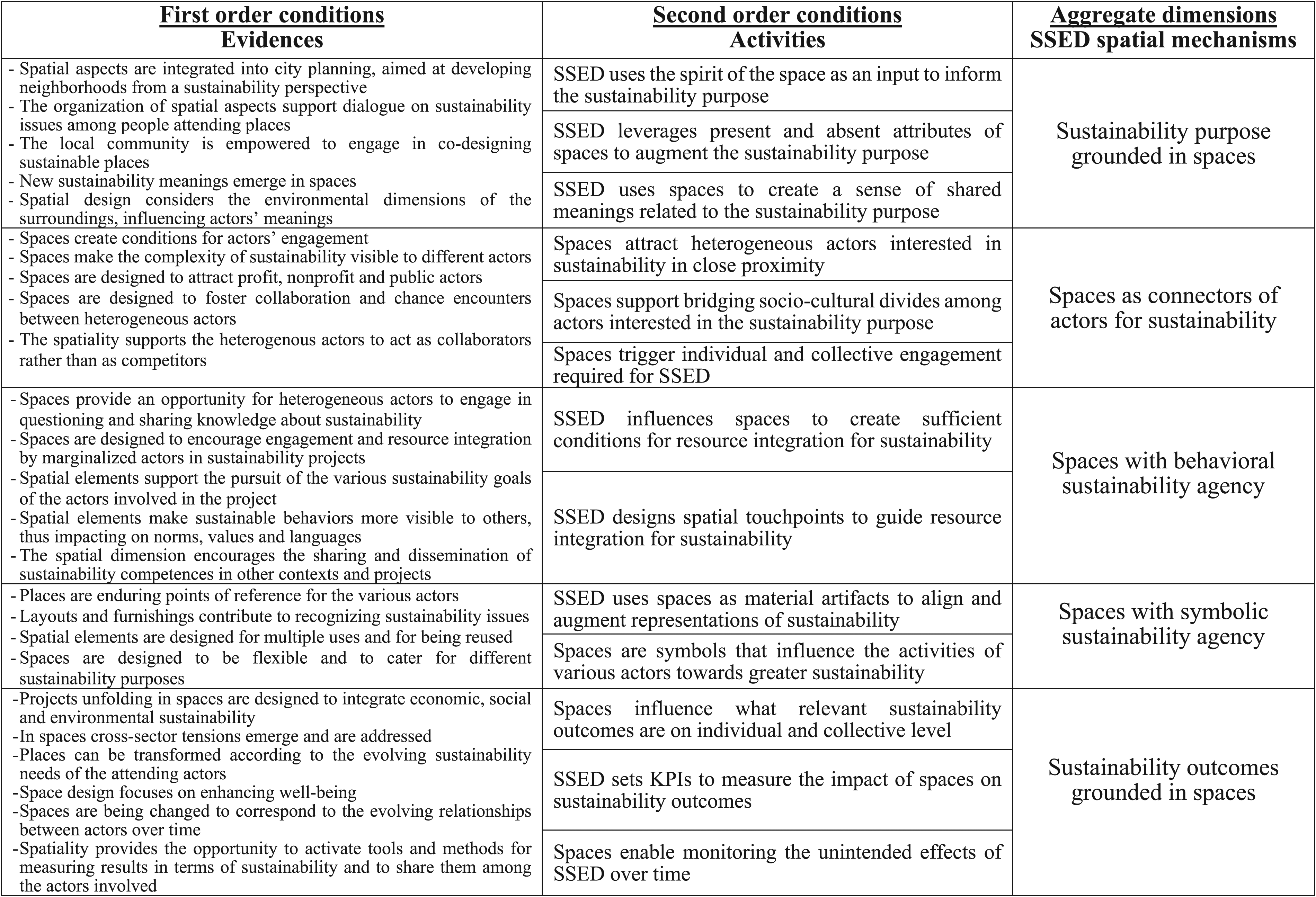
To ensure reliability and trustworthiness of our analysis, we applied five additional measures: excluding those informants that were likely to feel intimidated by the presence of academic researchers (e.g., individuals in vulnerable positions), providing interview questions to interviewees beforehand, maintaining also non-directive conversations during interviews and participant observations, giving interview transcripts to interviewees for member checking, and discussing emerging findings with key members of the case organizations on several occasions (Lincoln and Guba 1985; Spiggle 1994; Strauss and Corbin 1990).
Findings
Unfolding of Sustainable SED in Relation to Spaces and Places
In our analysis, we identified five sustainable SED spatial mechanisms that explain how sustainable SED unfolds in relation to spaces and places: sustainability purpose grounded in spaces, spaces as connectors of actors for sustainability, spaces as behavioral sustainability agents, spaces as symbolic sustainability agents, and sustainability outcomes grounded in spaces. These five mechanisms were identified from 13 different activities (second-order conditions), as shown in Figure 1.
Sustainability Purpose Grounded in Spaces
Our empirical analysis supports the argument that sustainable SED develops processes that consider the various attributes of spatiality to reinforce the overall sustainability purpose: the places we analyzed are firmly embedded in their territory. Giovanardi and Lucarelli (2018) pose that all places possess a “spirit” that captures and communicates the location-specific characters of the place. Our findings suggest that sustainable SED takes into account this location-specific character when designing various activities and projects that will unfold in the space in question. Furthermore, sustainable SED leverages the “spirit” of the place to create a common social and environmental purpose, thus managing the different and sometimes divergent desired forms of sustainability by the heterogeneous actors.
In the case of MFWH, one of the hubs is located within the main fruit and vegetable market in the city of Milan. This location enables MFWH to distribute recovered food, mainly originating from supermarkets and companies’ canteens, to the neediest citizens via NGOs with dignity: recovered food is nothing to be ashamed of, but it deserves a place in a prime fruit and vegetable market.
Furthermore, both cases emerged in specific suburbs of the city with a clear aim of enhancing this specific area and involving not only the actors who directly use the spaces, but also the broader local community. Moreover, since their conception, the development of these places has been integrated in the urban planning of the city, in order to develop their neighborhoods in a sustainable perspective. CUS was intentionally set up in a neighborhood virgin from the point of view of cultural proposals. We are in the western suburbs of the city, where there is really nothing, and this is one of the main vocations of the project. We want to go where there is no light and try to light a candle and turn it into a lighthouse together. (Manager 1)
In both cases, we have analyzed the purpose of the sustainable SED initiative, something that has been highlighted as the “heart of design” (Vink et al. 2021, p. 173). This purpose is developed and experienced through individual and collective engagement: for example, the local community was actively involved also in the co-designing of the various sustainable projects housed within the spaces. Furthermore, people living in these neighborhoods participate in theater performances and stage shows as actors and as volunteers at the food waste hubs.
In these spaces, various actors characterized by intrinsic differences—such as profit, nonprofit, and public actors—interact, jointly start, and collaborate in sustainable projects. These places are considered, by the different players, to be physical platforms, in which different perspectives and approaches to environmental and social sustainability were shared. Thus, the places and spaces helped diverse actors to create a sense of shared meanings related to the sustainability purpose. This could be contextualized through an example from CUS in which the goal was to reinforce the role of this “locus of sustainability” and to improve the well-being of the local residents: The “Diffused Premiere” has been one of the first major projects of cultural participation and social inclusion in the last ten years and has paved the way for other highly successful initiatives that continue to light up the city on a variety of themes. The collaboration with a theatre, the partnership with a big company, and the participation of other actors made it possible to transform the premiere into an event for everyone, and not just for those in the theatre. And ten years on, I am still thrilled by the idea of sharing such an important and heartfelt event, which turns the spotlight of the world on Milan, with an entire city that experiences it as a single, large audience…CUS is one of the thirty-four venues chosen for this year’s event. (Manager Cultural Foundation)
To summarize our findings related to the first spatial mechanism related to sustainable SED, we propose: Research Proposition 1: The spirit of the place and spatial attributes influence the purpose of sustainable SED initiatives.
Spaces as Connectors of Actors for Sustainability
The findings suggest these spaces facilitate connections between actors with different objectives and ways of working—such as profit, nonprofit, and public actors—favoring the creation of cross-sector partnerships. Analysis shows that due to this coexistence, some nonprofit organizations collaborated, for the first time, with for-profit companies and public organizations. MFWH brought together private sector companies with nonprofit organizations, public actors, and universities, who collaborate to co-develop projects focusing on new solutions for food waste recovery, recycling methods, redistributing processes and supplier relationships. (Policymaker 2)
The collaborative design process in these places aims at engaging actors as “experts of their experiences” (Sanders and Stappers 2008, p. 12) so they can contribute to sustainable SED by outlining in detail the benefits that could accrue to them and others as well as providing novel perspectives on how environmental and social sustainability could be practiced and experienced. Data show also that these places provide actors transparency to each other’s experiences of sustainability, something that is crucial for new sustainability purposes to be socially evaluated and hence to gain legitimacy (Nilsson 2015). Our research also indicates that these spaces are deliberately designed to engage marginalized actors in sustainability projects and to provide them with both access to space and agency to act upon it: CUS becomes a fundamental point in the daily geography of the people who live in this area. This is facilitated by the range of services provided and by being able to offer a place where teenagers are protected, where families with young children find a place where they can stay and feel well, where the elderly are welcomed and listened to, where it is easy to meet and take advantage of the many possibilities that CUS offers, from beer to pizza, concerts, performances, farmer markets…CUS, on the other hand, manages to bring together people who are very different from each other, both in terms of age and cultural and social background. This is something that can be felt immediately and makes you feel that you are in a different place from others. (Customer 1)
Our findings from the two cases suggests sustainable SED hinges aligning the different visions of sustainability held by different actors—and that a key mechanism to achieving this alignment is fostering individual and collective engagement. However, the engagement of interdependent, but heterogeneous, actors does not occur spontaneously in these places. Instead, it requires deliberate orchestration. In both cases, the spaces provided an enduring platform that allowed different actors to work together toward sustainability goals over prolonged periods of time. For example, the actors involved with MFWH have underlined that dedicated spaces were essential in allowing them to continue promoting everyone’s right to healthy food during the COVID-19 pandemic.
To summarize our findings related to the second spatial mechanism related to sustainable SED, we propose: Research Proposition 2: Spaces and places facilitate sustainable SED initiatives by attracting heterogeneous actors and triggering engagement across socio-cultural divides.
Spaces with Behavioral Sustainability Agency
In these places, cross-sector actors integrate their competences and resources to carry out socially and environmentally sustainable projects: all the actors are involved, even if they are not always in perfect agreement on the exact objectives or courses of action. Furthermore, interviewees described these spaces as places of connection where different players have the opportunity to share their perspectives and knowledge about sustainability. Interestingly, we found that the heterogeneous actors interacting within these places did not lose their identities—even if the socio-cultural divides were considerable. Instead, when participating in collaborative sustainability projects, actors continuously redefined their roles and methods of collaboration while maintaining their identities.
Sometimes the on-going resource integration, unfolding in stable physical places, resulted into surprising—but positive—sustainability outcomes. In this new normal era, during the summer of 2021 we collaborated with CUS and, thanks also to the City of Milan, we have branched out the programming in the town halls and we have also arrived in quite decentralized spaces which are the current and future locations of CUS... through this collaboration we have started a new decentralization process. (Manager Cultural Enterprise)
The stability of the spaces and places also helped developing trusting relationships among the heterogeneous actors, which in turn appears to facilitate more enduring sustainability transitions. The underlying motivations to collaborate in such on-going resource integration process differed; however, sometimes the actors were motivated by ideological reasons, other times by purely economic rationale: To avoid perfectly edible food going to waste, Milan introduced a 20% waste tax break in 2018 for any food businesses donating their surplus food to charities and food banks. The municipality created a cross-departmental working group covering environmental, fiscal, and food policy staff to implement the regulation. (Policymaker 2)
Our findings also indicate that the new sustainable competencies achieved in these collaborative places are transferable to other contexts. Thus, these new competencies can be used in other spaces, or they can be used to develop new sustainability projects with different partners pursuing new and different aims in the same space.
The findings also reveal that touchpoints were used and designed to trigger more sustainable behavior. For example, in both places, recycled and recyclable materials were used, and the use of plastics was avoided. This influenced the behavior of the individuals using the spaces, also in other contexts. In some instances, the activities carried out in these places generated new sustainable initiatives; for example, CUS hosted the weekly farmers’ market, and over time, the presence of the farmers had shaped the idea of giving producers a voice to their production methods. Consequently, it was decided to involve associations that promoted the use of traditional production methods and brush up on old skills.
To summarize our findings related to the third spatial mechanism related to sustainable SED, we propose: Research Proposition 3: Spaces and places manifest their agency in sustainable SED initiatives by allowing and guiding resource integration for sustainability.
Spaces with Symbolic Sustainability Agency
Sustainable SED places considerable emphasis on symbols and narratives through which individuals make sense of sustainability. Symbols and narratives related to spaces were found to activate a common ground—and sometimes also a common language—among the heterogeneous actors, useful for carrying out sustainable projects. In the case of CUS, the setting created in the courtyard with sand (evoking the concept of the sea), deck chairs and parasols, and a screen on which films and other cultural content are projected, enabled actors to more easily understand the intention of the project through concrete symbols. Spaces were characterized by unique layouts and immediately recognizable sustainable furnishings. “Building the unexpected” is our motto, and the fact that it was written on recycled pieces of wood and placed above the shared library makes is a characteristic element of our place that customers easily recognize. (Manager 2)
These places contained durable elements that had been left as they were; for example, the walls of the farmhouse had been restored but were the typical and recognizable brick structure of the ancient local farms. In addition to static or steady structural elements, we also identified aspects that were dynamic, transformed by adapting extant elements or introducing new ones to deliver temporary sustainability projects. These spaces are static and even iconic; thus, actors can recognize them and adjust their behavior accordingly, but they are also malleable and enable using the space in multiple ways, allowing transitions between different processes and practices. In terms of sustainable SED, providing a constant and sustainability-oriented physical backdrop has helped aligning the heterogeneous actors’ representations of social and environmental sustainability. Furthermore, material artifacts—such as spaces and place—situate the concept of sustainability (Pezzulo 2011), making it more concrete.
The spaces in the two cases are distinctive, both in terms of the buildings and their location. Our findings indicate that investing in these spaces—located in the peripheral areas of the city—created new centers where more services are being offered. This, in turn, made these places symbols of their neighborhoods. The building is a property belonging to the City of Milan, which the Department of Urban Planning has assigned to a company on a leasehold basis with the obligation of conservative restoration work and the commitment to devote the spaces to socio-cultural activities, a redevelopment model that the city administration intends to implement in other farmhouses in the city. By presenting a project dedicated to culture, art, and the community, CUS has obtained the management of the building with a subsidized commercial lease. (Manager Private Foundation)
Such spatial symbols and related narratives can support sustainable SED by encouraging shifts in thinking and perception, which in turn can lead to changes in practices and institutions. These symbols and narratives function as meaning-laden tools and can be seen as so-called boundary objects (Mele, Sebastiani, and Corsaro 2019) that act as bridge-builders, connecting actors and fostering collaboration. In the cases we analyzed, symbols used in spaces helped, for example, heterogeneous actors better understand why the top priority in our society should not be profit and growth, but people and the planet. Thus, we propose: Research Proposition 4: Spaces and places manifest their agency in sustainable SED initiatives by providing a constant symbolic reference for resource integration for sustainability.
Sustainability Outcomes Grounded in Spaces
In both cases, the different sustainable projects carried out in these spaces were aimed at improving the quality of life on both individual and collective levels. This individual and collective well-being can be seen to represent the social dimension of sustainable value creation (Blocker and Barrios 2015) while the manifestations of the environmental value creation varied depending on the context. As an example of social value creation, CUS employed local disadvantaged people as waiters and provided them with training and job placement. For what concern environmental value, CUS promotes food sustainability and limits its environmental impact by, for example, favoring raw, seasonal, and local ingredients in its restaurant. MFWH, on the other hand, creates environmental, social, and economic value by redistributing food to disadvantaged people, helping the city to implement its waste policy, and allowing companies to claim tax reductions.
Our empirical data also showed the importance of setting and sharing KPIs to measure the impact of the different projects: both cases provided indicators and measures to inform the actors involved of the achievement of the sustainability goals. Communicating KPIs related to social and environmental sustainability was also important in attracting potential new actors to these places and get involved in sustainable projects.
Our data suggests that it is important to monitor sustainability projects as this helps understanding the value of these activities, and to communicate this value to various stakeholders and the broader community. However, the findings also reveal that sometimes it can be difficult to align visions of heterogeneous actors over prolonged periods of time. The main argument interviewees voiced in association with this issue was the lack of mutual understanding. Actors were many and diverse, and even if they all cared about the project they shared, sometimes it was difficult to collaborate because they had different reaction times, different skills, and different involvement in the space and in the projects. It also emerged that sometimes the problem was related to intrinsic differences between the actors (such as for-profit orientation versus nonprofit orientation), and sometimes it was related to the absence of a common language. Thus, it is important to monitor the unintended and sometimes unexpected outcomes from resource integration process in sustainable SED. We have tried to collaborate with an association in the area for many years, but unfortunately, we have not been able to create a real partnership because, it may sound strange to say, we have had problems of understanding and a different vision of the environmental sustainability. (Manager, Nonprofit Foundation)
In addressing these tensions, sometimes new sustainable solutions emerged that could then also be used in other sustainability projects unfolding in the same space. The choice to elect a “senior representative” to accompany a younger mediator made the situation clearer for many of the interlocutors from ethnic restaurants and companies (Manager Public Organization).
To summarize our findings related to the fifth spatial mechanism related to sustainable SED, we propose: Research Proposition 5: Spaces and places influence which outcomes of sustainable SED initiatives are considered relevant and how these outcomes are followed up.
Spatial Tensions Related to Sustainable SED
In addition to the aforementioned five spatial mechanisms of sustainable SED, our analysis also uncovered three paradoxical spatial tensions. These spatial tensions can have both positive and negative ramifications for the sustainable SED. Paradoxical tensions related to sustainability are common, and they cannot be eliminated by making trade-offs during the design process (Hahn et al. 2015). However, these paradoxical tensions can provide the necessary pressure for institutional reconciliation (Chandler et al., 2019), allowing actors to find mutually acceptable arrangements between conflicting dimensions in a sustainable SED.
Defined Spatial Boundaries
Defined spatial boundaries, the first identified paradoxical spatial tension, enable sustainable SED by providing the needed physical and relational proximity while constraining SED by posing rigid growth and replication limitations. When considering the influence of space and places to sustainable SED, it is necessary to consider boundaries. The notion of boundaries poses limits. These limits distinguish the inside of the place from its outside; boundaries represent the physical dividing line that separates one space from another. In the cases analyzed, the places where the sustainable SED unfolds have clearly defined boundaries that characterize them and convey to the outside world that something interesting related to sustainability is happening within these boundaries. The absence of boundaries undermines the sense of spatiality: without boundaries, it is not possible to recognize a distinct place.
Relationships between heterogeneous actors and their respective resource integration processes are central to sustainable SED. As the spaces and places have clear—and oftentimes relatively restrictive—boundaries, the encounters unfolding in them are characterized by physical proximity. This physical proximity also enables chance encounters and unplanned discussions about meanings, practices, and activities related to sustainability. This, in turn, supports the alignment of the different perspectives toward shared values and meanings related to sustainability—or at least increased empathy toward different values and meanings. In addition to physical proximity, spaces and places contextualize relationships temporally. Even if the actors are inherently different and have different meanings, goals, and practices related to social and environmental sustainability, they are together in this place at this moment. Thus, it is no coincidence that in both cases analyzed, even the most marginalized actors felt that they had found a context in which their role is recognized and that are able to actively contribute to the improvement in individual and collective well-being.
At the same time, the presence of spatial boundaries limits the scope of action of sustainable SED, in terms of volume and variability. In the case of MFWH, the size and structure of the warehouses where the products are recycled, stored, and redistributed represent a strict physical limit to the scaling up of the project. In CUS, the walls of a historical, protected farmstead could not be extended. Hence, our analysis hints at a particular growth logic: instead of extending places, they are replicated to ensure the delivery of similar sustainable services in another area of the city. We created the various CUS Hubs in other suburbs of the city. Our intention is to focus the work of the CUS headquarters more and more on being an art factory, a place of residence, experimentation, and a place where artists can work who have in their DNA the intention of involving the community of reference, creating a place of experimentation in participatory public art, ensuring that the evolutionary function of art is always possible. The aim is to create artistic processes that are not only available to an elite of people who have had the good fortune to be educated to read certain codes, who can appreciate a concert or an exhibition, or know what it means to go to the theatre, which in the areas where we work is not so obvious. (Manager 2)
From the perspective of sustainable SED, spaces and places are inseparable from the contexts in which they are embedded. This is not only a purely physical or geographical matter but refers also to the interconnectedness with the specific socio-cultural context. In terms of socio-cultural embeddedness, spatial aspects do not only provide a backdrop for social structures, relationships, and processes, but spaces and places also have agency with recognizable and interdependent effects on social life (Gieryn 2000). For example, the geographic “center-periphery” and “metropolitan-provincial” distinctions are often invoked when making sense of places from a social and environmental sustainability perspective. These properties of places, in turn, limit their replication in time and space. Thus, sustainable SED initiatives are constrained by the imprints (Marquis and Tilcsik 2013) of the initial spatial conditions. In our empirical data, the decision to locate the first site of the CUS project in a particular underdeveloped peripheral area of a large urban center influenced not only its design but also its development over time. When the time came to replicate the model, many aspects of the project had to be rethought and adapted to the new location.
How spaces and places multiply or are reproduced is given less attention in the literature, but our empirical findings suggest that the growth patterns of these places are more akin to cell multiplication than economic growth. After the physical boundaries of the place are reached, it is more likely that a new place will be created rather than the existing place undergoing an expansion. From a design perspective, this means that these places cannot be set up in whatever space is available. Instead, the physical, symbolic, and social boundaries of the places must be recognizable, and these boundaries should not exclude those actors whose participation is sought. A feasibility study was conducted, and the 12-month operation of the hub was monitored. This created an extensible and expandable logistics model for other neighborhoods where the hubs could be located. (University Researcher 2)
Embeddedness in a Specific Context
Spaces and places embed seemingly abstract concepts such as sustainability to a specific context, helping their translation into concrete actions and experiences. The physical and concrete nature of the context in which the activities take place and in which the projects unfold supports actors in becoming more aware of both the assumptions and the practical implications of sustainability. Spaces and places contribute to the creation of sustainability experiences by fostering bodily sensations, evoking feelings, and guiding behaviors—all of which are influenced by the spatial design. Furthermore, the sensory dimension is essential in contextualizing the social and environmental sustainability experience of individuals and collectives, making it rooted in a specific place. For example, the experiences that actors have through the facilities, equipment, objects, and events of CUS and MFWH help to deepen the concept of sustainability and infuse it with meaning. This aspect is particularly relevant for sustainable SED as it helps closing the gap between intentions and behaviors, something that is also recognized in the extant literature (Carrington, Neville, and Whitwell 2010; Carrington, Zwick, and Neville 2016). Furthermore, the concreteness of experiences gathered in spaces and places enables actors to better understand the meaning and implications of the metrics used to measure the impact of the social, economic, and environmental sustainability initiatives. In this sense, sustainable SED can use spatial aspects to create powerful sustainability-focused experiential learning environments.
On the other hand, being embedded in a specific spatial context determines how accessible sustainable SED initiatives are to different actors. Unsurprisingly, the size of the space has an impact on the number and characteristics of the activities that can take place in them, as well as the number of actors that can participate in them. In a similar vein, spaces and places located far away from residential centers limit the ability of potential actors to participate in sustainable SED. However, we would like to draw attention to the issue of inequitable accessibility of sustainability outcomes: how disproportionate access to the benefits accrued from sustainable spaces can foster social and environmental increased inequalities between individuals and collectives. The limited amount of food passing through the spaces of the MFWH fails to meet the growing need for food of the poorest population. CUS, on the other hand, requires online bookings for many of its activities, which penalizes some more marginalized sections of the population. Finally, both places were frequently visited by actors who were particularly attentive to the issues of social and environmental sustainability and who identified themselves with the local projects being carried out.
A System Integrating Human and Nature
Sustainability transformations are rarely outcomes for a simple, standalone change. Instead, they require more systemic change in perceptions, paradigms, institutions, practices, and various resource integration processes. In sustainable SED, spaces are seen as collaborative environments which foster transformation of socio-ecological systems toward greater sustainability. Rethinking alternative ways of dealing with food waste, as in the case of MFWH, is an example of how the environmental problem of waste management found a creative solution that simultaneously addressed the urgent social needs of the poorest sections of society by bringing together public, private, and nonprofit actors in purposefully designed and institutionally recognized places. In this sense, spaces and places become contexts open to integration between subjects and objects, between humans and the environment. CUS, besides its social purpose, promotes the development of underdeveloped neighborhoods through its harmonious integration with pre-existing green areas and the emphasis on the role of biodiversity. CUS has also promoted various festivals and events dedicated to reuse, self-production, and zero waste in its space. An example of such an event is the “Message in a Bottle,” aimed at addressing climate change by promoting more sustainable practices. Spatial installations claiming “vintage is old and dirty,” “craftsmanship is expensive,” and “self-production is for those who have time to waste” have been very effective in challenging the misconceptions and prejudices associated with sustainable alternatives.
The systemic nature of spaces and places also has its constraining powers. In our empirical data, such constraints relate especially to the rigidity related to the built environment. Such rigidity is oftentimes connected to the formal norms and rules related to spaces and places, affecting sustainable SED indirectly. For example, one cannot ignore the limits set by legislation and building codes when considering the built environment. Such rules tend to limit the nature and extent of changes allowed to the spaces and buildings as well as the materials and techniques used (especially when talking about historical buildings). Additionally, there tend to be guidelines that must be met for a space to be considered accessible and safe. Such rigidity related to the built environment limits sustainable SED by constraining the degree to which spaces and places can be adapted to changing social and environmental sustainability needs. This rigidity also affects the temporal dynamics in which the sustainable SED unfolds. The time frames of various approvals can be very long, and the permits may be difficult to obtain. Thus, the processes of creating spaces and places for sustainable SED may be unexpectedly long and inefficient, potentially undermining the entire initiative as happened in the initial phase of the development of the CUS project.
The five mechanisms that illustrate how sustainable SED unfolds in relation to spaces and places, as well as the identified spatial tensions, are summarized in the conceptual framework shown in Figure 2. Conceptual framework.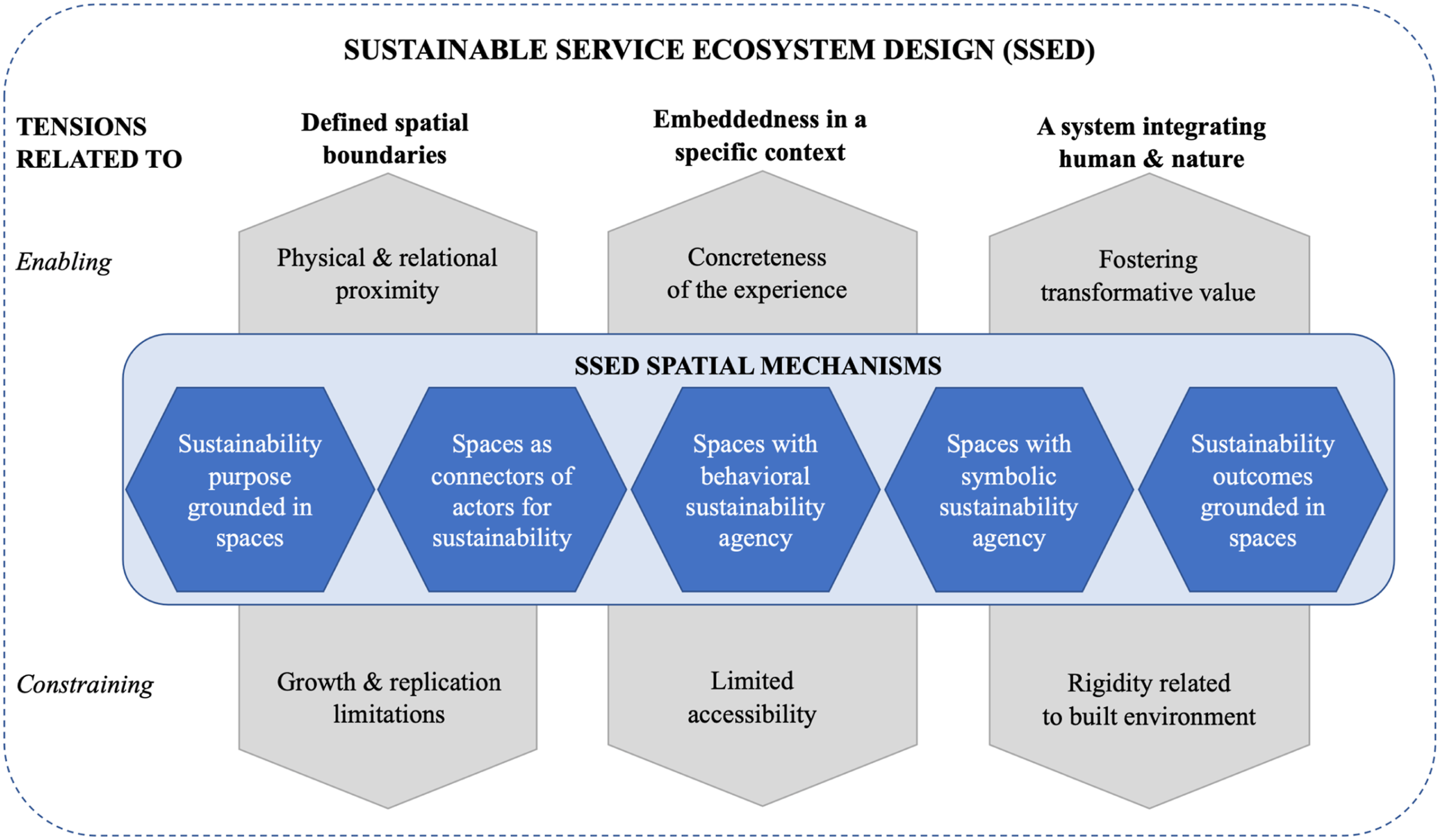
Discussion
Theoretical Contributions and Limitations
The purpose of the present paper is to examine the spatial aspects of sustainable SED. Theoretically, we present three main contributions to the existing literature on sustainable SED. First, we provide additional insights regarding the agency of spaces and places in sustainable SED processes. Prior research has given limited explicit attention to the agency of spaces and places, but implicitly, the spaces and places have been considered to assume predominantly passive roles such as the context of design or design materials (Koskela-Huotari et al. 2021; Rosenbaum 2006, 2009; Rosenbaum and Smallwood 2013; Rosenbaum et al. 2007; Rosenbaum, Sweeney, and Windhorst 2009) and to indirectly influence the agency of human and organizational designers (Castilhos, Dolbec, Veresiu 2017). Some studies investigating the spatial dynamics of systems have acknowledged the agency of spaces and places over the various practices unfolding in these systems (Castilhos and Dolbec 2018; Castilhos, Dolbec, Veresiu 2017). We build on this line of theorizing and suggest that spaces and places enable sustainable SED by connecting diverse actors and triggering engagement among them. Furthermore, we suggest that spaces and places have particular agency in physically and symbolically guiding resource integration for sustainability. Thus, this paper also provides a spatial answer to the call to investigate under which circumstances cross-sector partnerships could improve sustainable processes and outcomes (Field et al. 2021).
Second, this paper provides a contribution by illuminating a previously under-researched aspect of the agency of human and organizational designers in sustainable SED processes: how to manage spaces and places for improved sustainability outcomes. Some of these insights repeat what is already known in service management such as the need to establish performance indicators and to monitor also for possible unintended consequences over time. In addition to these, our results bring forth two somewhat more novel perspectives to managing space and places: the need to measure sustainability outcomes both on individual and collective levels, and the spatial limitations related to scaling up sustainable SED initiatives. The fact that spaces and places put physical constraints to the volume of activities and the number of beneficiaries is relatively self-evident, but the spatial limitations to the replication of sustainable SED initiatives is more novel. Our findings indicate that sustainable SED initiatives are imprinted (Marquis and Tilcsik 2013; Stinchcombe 1965) by the places and spaces where they unfold. Thus, replicating a similar sustainable SED initiative in other places and spaces should take these often invisible imprints to account. The imprinting by material aspects has been alluded in previous service research studies (Kurtmollaiev et al. 2018), but to our knowledge, it has not been explicitly discussed in sustainable SED research.
Third, the conceptual framework proposed in this paper contributes to the nascent understanding of the paradoxical tensions related to spaces and places in sustainable SED, acting simultaneously both as enablers and constraints. Our conceptual framework presents three paradoxical tensions, each providing more precise details about the enabling and constraining nature of spaces and places in sustainable SED. For example, clearly defined boundaries give the space a sense of place and foster close collaboration—while simultaneously limiting the volume and variability of sustainability initiatives. The presence of such tensions or trade-offs is oftentimes mentioned in sustainable SED (Banerjee and Punaker 2020) and sustainable TSR research (Blocker et al. 2022). We contribute to this discussion by introducing a novel categorization of spatial tensions related to sustainable SED.
This paper has some limitations. We focused on an exploratory qualitative investigation of two case studies, and hence, further empirical research is necessary to corroborate our findings and conceptualizations. In particular, additional research would be helpful in illuminating the possible nuances between sustainable SED aimed for improved social versus environmental outcomes. Since our empirical data comes from a single, developed country, future research should involve observations from other countries—especially developing ones. Furthermore, the two case studies examined in the present research were both designed to support sustainability transition from the beginning. Existing places that have evolved into fourth places over time were hence not studied for this paper, thus representing a fertile field for future investigation. Finally, our findings revelated relatively scant insights related to the temporal aspects of spaces and places in relation to sustainable SED. As prior research has identified this as an important area, future research could focus more clearly on the temporal dynamics related to spaces and places in sustainable SED.
Practical Implications
Our research has implications for a broad set of actors involved in sustainable SED. Below, we outline the four main practical implications on a general level, even though we recognize that the exact manifestations of these recommendations will be different for different types of actors such as consumer collectives, governmental actors, social enterprises, or traditional for-profit firms.
First, the spatial aspects play an important role in sustainable SED. The exact location of the spaces and places will render the sustainable SED concreteness. For example, sustainable SED initiatives aimed at reducing food waste will look different in an inner-city food court than in a sub-urban community center. The spirit of the space and other spatial characteristics should be taken into account already when starting to outline a new sustainable SED initiative. Furthermore, smaller spaces and places are likely to augment the agency of the players as smaller-scale locations are perceived as more manageable. However, physically more constrained spaces and places cannot foster as many players as larger ones, thus reducing the scalability of the SED initiative. Thus, the size of the spaces and places is an important tradeoff to consider when designing sustainable SED processes.
Second, the spatial boundaries limit the replicability of sustainable SED initiatives. This is explained by the imprints that sustainable SED initiatives take from their surroundings. This is not to say that similar initiatives—for example, to reduce food waste in inner-city food courts—could not be created, but they are going to unfold somewhat differently in each location. Thus, the possible blueprints to replicate sustainable SED initiatives in new locations should provide sufficient flexibility to take into account the specific features of each individual space and place. Turning sustainable SED initiatives into fully virtual ones would eliminate such restrictions related to scalability and replicability, but our findings indicate that this carries a cost of reduced concreteness of the experience, potentially hampering the on-going engagement of the relevant actors.
Third, the agency of material aspects can and should be used deliberately in sustainable SED. For example, cross-sector partnerships are likely to benefit if the spaces and places are designed in an egalitarian way, highlighting the agency of all parties and sometimes even downplaying the possible power differences. Furthermore, spaces and places can be used as constant reminders of the purpose of the sustainable SED initiative. Continuing our food waste reduction example, the food court can use artwork and other artifacts to communicate its “no food waste” vision and use displays to visualize the development of the actual food waste over time.
Four, as spaces and places are constant carriers of the purpose of sustainable SED initiatives, any changes to the spaces and places themselves should be done in accordance with that purpose. In general, renovation projects related to sustainable SED initiatives are likely to favor creating reusable and inclusive spaces, using sustainable building materials, and employing local professionals and companies. The exact purpose of the sustainable SED initiative can guide the spatial changes, too. For example, given the purpose of our imaginary food court to reduce food waste, it is likely that the renovation project of this food court would seek to minimize the building waste and maximize the reuse of the existing materials.
Supplemental Material
Supplemental Material - Uncovering the Hidden “Where” of Sustainable Service Ecosystems: The Role of Spaces and Places
Supplemental Material for Uncovering the Hidden “Where” of Sustainable Service Ecosystems: The Role of Spaces and Places by Alessia Anzivino, Suvi Nenonen, and Roberta Sebastiani in Journal of Service Research
Footnotes
Declaration of Conflicting Interests
The author(s) declared no potential conflicts of interest with respect to the research, authorship, and/or publication of this article.
Funding
The author(s) received no financial support for the research, authorship, and/or publication of this article.

Supplemental Material
Supplemental material for this article is available online.
Note
Author Biographies
References
Supplementary Material
Please find the following supplemental material available below.
For Open Access articles published under a Creative Commons License, all supplemental material carries the same license as the article it is associated with.
For non-Open Access articles published, all supplemental material carries a non-exclusive license, and permission requests for re-use of supplemental material or any part of supplemental material shall be sent directly to the copyright owner as specified in the copyright notice associated with the article.
