




Abstract
The circular economy (CE) presents an alternative perspective to the linear take-make-use-dispose model prevalent in industrial value chains. CE envisions economies operating like natural ecosystems—restorative and waste-free, underpinned by principles such as reuse, repair, share, and pay-for-use. Surprisingly, although these principles align with the fundamentals of service management, there is limited scholarly exploration of CE within service research. Leveraging service-dominant logic, this study introduces the concept of circular service ecosystems as ideal types of service ecosystems, regenerative, and embedded within nature, where (material, intellectual, digital and financial) resources flow seamlessly within and between nested systems without creating any waste or leakage. By analyzing 3,178 blogs penned by CE experts over 7 years and conducting in-depth interviews with industry specialists, this study offers two significant contributions. Firstly, it presents a process framework elucidating the transition towards circular service ecosystems. This framework explains the emergence of novel circular solutions and service ecosystem properties through processes of de- and re-institutionalization. Secondly, the study identifies six shaping strategies that actors can apply to drive circular service ecosystem transitions. The study concludes by emphasizing the importance of circular service ecosystems and CE as promising areas for future service research, providing a comprehensive research agenda to explore these areas in depth.
Keywords
Introduction
The global population is predicted to reach 9.7 billion people by 2050 and, more than ever, resources are being used at a greater rate than the planet can provide (United Nations 2019). Over the course of a few generations, the expansion of industrial systems and rapid growth have significantly impacted the environment (Rockström et al. 2009; Stahel 2016)—a wicked issue fueling ongoing debates about the relationship between business and planetary boundaries (Whiteman, Walker, and Perego 2013). A transition to a circular economy (CE) is proposed as one path that fosters sustainability (Geissdoerfer et al. 2017) and aligns with the Sustainable Development Goals (SDGs) (European Commission 2020). However, it is important to note that CE represents a distinct concept from the broader idea of sustainable development, which seeks to meet present needs without compromising the ability of future generations to meet their own needs (World Commission on Environment and Development 1987). CE specifically emphasizes achieving economic viability while simultaneously decoupling economic growth from environmental degradation (Stal and Corvellec 2018). By challenging the prevailing linear take-make-use-dispose value chains anchored in the industrial paradigm, CE provides an alternative narrative for resource utilization and value creation (Merli, Preziosi, and Acampora 2018).
The CE concept proposes economies can function like natural ecosystems by being restorative without generating waste (Ellen MacArthur Foundation 2013; Geissdoerfer et al. 2017), through creating circular closed-loop systems that prolong product use, materials and resources. Core principles include the use of renewable energies, elimination of toxic chemicals, waste eradication through maximizing reuse, repair, remake, recycle (Bocken et al. 2016; Geissdoerfer et al. 2017; Kirchherr, Reike, and Hekkert 2017), and the dematerialization of industrial processes (Hobson et al. 2018; Stahel 1982; Tukker 2015). In short—servitization.
The popularity of the CE concept has grown significantly in recent years, in disciplines as diverse as engineering (Reh 2013), environmental science (Korhonen et al. 2018), innovation and business model research (Bocken et al. 2016; Kirchherr, Reike, and Hekkert 2017), coupled with growing interest from organizations and governments (European Commission 2020). However, although CE is viewed as a universally appealing disruptive concept, only 8.6% of the world economy can be considered circular (World Business Council for Sustainable Development 2021). One reason for this low rate may be that CE initiatives frequently adopt a narrow business model perspective (Fehrer and Wieland 2021; Vargo 2021) that omits a more (eco-)systemic perspective. Vargo (2021) argues much of the CE literature implicitly, and frequently explicitly, perpetuates the dominant industrial paradigm of linear value chain thinking, where value creation is typically controlled, delivered, and captured by one focal economic actor—the firm.
An emerging stream of CE literature aims to overcome this linear logic by adopting an ecosystem perspective (e.g., Aarikka-Stenroos, Ritala, and Thomas 2021; Konietzko, Bocken, and Hultink 2020). For example, Konietzko et al. (2020) posit circularity needs to be understood as a systemic property (e.g., a city’s transportation system) rather than as an individual product, service, or business model (e.g., an electric vehicle or a ridesharing provider). However, CE research that draws on ecosystem perspectives is nascent, and often narrowly focused on collaboration and coordination practices between firms in innovation or business ecosystems (Aarikka-Stenroos, Ritala, and Thomas 2021; Boldrini and Antheaume 2021; Konietzko, Bocken, and Hultink 2020). Despite the valuable contributions made by these scholars, these approaches do not explore socio-cultural complexities, nor institutional change as the foundation of CE transitions (Lawrence and Suddaby 2006, Oliver 1992; Polese et al. 2021).
The purpose of this paper is to gain insights into the complex dynamics of CE transitions. We draw on service-dominant (S-D) logic (Vargo and Lusch 2004; Vargo and Lusch 2016), which views service ecosystems as complex adaptive systems of resource integrating actors connected by shared institutional arrangements (i.e., shared beliefs, values, norms, rules, and discourses.) (Vargo and Lusch 2016, pp. 10–11). Through an abductive reasoning approach (Dubios and Gadde 2002), we combine the systematic reading of 3,178 blogs written by CE industry practitioners (published from 2014 to 2021) and expert interviews, with S-D logic-informed thought on emergence (Polese et al. 2021; Vargo et al. 2023) and service ecosystem shaping (Mele et al. 2018; Vink et al. 2021; Vink and Koskela-Huotari 2022). This results in a novel process framework of circular service ecosystem transitions.
This paper makes important contributions to service research. First, we define and delineate circular service ecosystems as ideal types of service ecosystems, regenerative and embedded within nature, where (material, intellectual, digital, and financial) resources flow seamlessly within and between nested systems without creating any waste or leakage. This study demonstrates the potential of the service ecosystem framework in informing discussions on CE and highlights its effectiveness in capturing the complex nature of CE transitions. Our second contribution involves the extraction of six shaping strategies to influence circular service ecosystem transitions. Specifically, these strategies are: (1) Collaborating with others for the greater good; (2) Creating living labs and regional minimum viable systems for circularity; (3) Thinking in fractal structures; (4) Creating digital platforms to enable circularity; (5) Framing circular service ecosystems as real; and (6) Learning from alternative (world)views. These strategies can influence the emergence of novel circular solutions, novel patterns of circular resource integration, and ultimately, novel properties of circularity within and between nested service ecosystems. Lastly, this paper contributes methodologically by refining discourse analysis of blogs and concludes by presenting a summary of questions to guide future service research.
Conceptual Framework
Circular Economy Concept
Boulding (1966) was the first to highlight the Earth’s role as a circular and closed-loop system, vital for sustaining human life in the long-term. Expanding on this notion, Pearce and Turner (1989) are recognized as the originators of the term “circular economy” as they applied the laws of thermodynamics to explain economic systems. CE has its theoretical roots in industrial ecology (Erkman 1997; Graedel 1996) and ecological economics (Costanza et al. 2014; Ghisellini, Cialani, and Ulgiati 2016; Greyson 2007; Murray, Skene, and Haynes 2017). Industrial ecology takes its inspiration from natural ecosystems and seeks to transform linear industrial processes into cyclical processes. Following this perspective, the industrial system is viewed as a subsystem that depends on resources and services provided by the biosphere. The goal is to close material and energy loops, improve energy efficiency, and reduce the overall use of materials (dematerialization). Similarly, ecological economics focuses on the interconnectedness of economic, social, and environmental systems, aiming to ensure that social and economic activities operate within the limits set by the planet (Bruel et al., 2019).
Accordingly, the origins of CE recognize the natural environment, society, and the economy as nested ecosystems, in contrast to perceiving the natural environment as external to human-made systems (Giddings, Hopwood, and O'Brien 2002). However, over time, the definitions of CE have converged towards portraying CE as the business case for sustainability. For example, Bocken et al. (2016) define the CE as the “design and business model strategies slowing, closing, and narrowing resource loops.” Similarly, after conducting an extensive literature review on sustainability and CE conceptualizations, Geissdoerfer et al. (2017) conclude that CE represents an economic approach to achieving sustainability, involving economic actors seeking financial benefits while also striving to preserve the natural environment.
Within the last decade, the CE concept has become a central pillar of many governments’ and corporates’ sustainability agendas (Fehrer and Wieland 2021). However, the political turning point for CE being seen as the new way of doing business came in 2013 when the Ellen MacArthur Foundation established a global network of 100 companies committed to changing their operations in line with the CE principles: Designing out waste and pollution, keeping products and materials in use, and regenerating natural systems. Since then, academic publications in the fields of business and economics have increased significantly. These publications have generated new viewpoints on management research, including business models (e.g., Bocken et al. 2016; Geissdoerfer, Vladimirova, and Evans 2018), innovation (Carrillo-Hermosilla, Del Río, and Könnölä 2010; Konietzko, Bocken, and Hultink 2020), supply chain management (Angelis, Howard, and Miemczyk 2018), and business ethics (Merli, Preziosi, and Acampora 2018). One of the most encompassing understandings of CE, which we use as a working definition in this paper, is provided by Kirchherr, Reike, and Hekkert (2017). Based on an analysis and synthesis of 114 definitions, the authors propose (p. 244): “A circular economy describes an economic system that is based on business models which replace the ‘end-of-life’ concept with reducing, alternatively reusing, recycling and recovering materials in production/distribution and consumption processes, thus operating at the micro level (products, companies, consumers), meso level (eco-industrial parks) and macro level (city, region, nation and beyond), to accomplish sustainable development, which implies creating environmental quality, economic prosperity and social equality, to the benefit of current and future generations.”
While the origins of CE initially embraced an ecosystemic perspective, academic discussions have shifted towards viewing CE primarily as a business case (Bocken et al. 2016; Esposito, Tse, and Soufani 2018; Geissdoerfer et al. 2017). However, this avenue perpetuates a weak sustainability approach (Neumayer 1999), which treats environmental sustainability as a mere by-product of economic growth that benefits a focal economic actor (Fehrer and Wieland 2021). In response, Vargo (2021) suggests that the theoretical foundations of CE should instead be based on a systemic view, encompassing broad sets of actors (customers, competitors, suppliers, governments, activists, and others) who mutually contribute to, and benefit from, circular value cocreation processes. This aligns with recent CE studies that increasingly recognize the need for an ecosystem perspective.
Ecosystem Perspectives in the Circular Economy Literature
Review of Ecosystem Perspectives Discussed in the CE Literature.
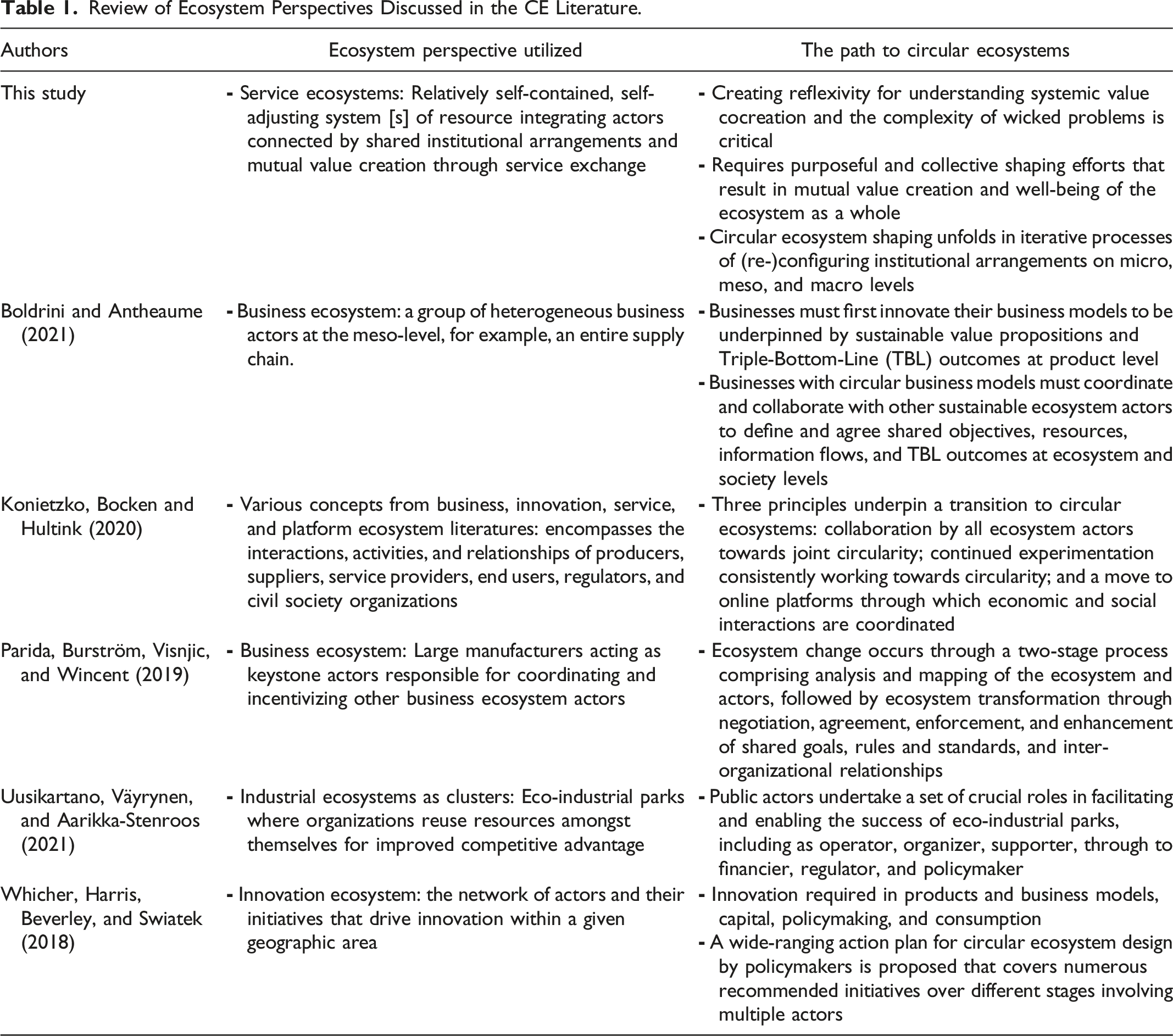
The narrowest of these perspectives focuses on tightly-bounded networks of business actors (Moore 1993) or collectives that jointly work together to deliver given value propositions (Adner 2017). Drawing on the former perspective, Parida et al. (2019) propose a two-stage process through which keystone actors (in the form of large manufacturing firms) orchestrate business-to-business partners towards circularity. First, the ecosystem is mapped and assessed, including investigations of the external environment, partner capabilities, and business models. Second, shared objectives and goals are negotiated, formal rules and standards developed and enforced, and inter-organizational relationships enhanced and rewarded. Similarly, Boldrini and Antheaume (2021) argue circular ecosystems can be achieved by incentivizing the collaboration of previously disconnected actors to work together. The authors provide tools for business model innovation that incorporate principles of CE while also encouraging development of multi-actor, multi-level collaboration. While each individual organization must underpin value propositions, inputs and outputs with triple-bottom-line principles, Boldrini and Antheaume (2021) argue complementary actors must negotiate and align shared objectives, resources, cash flows, and triple-bottom-line outcomes at ecosystem (meso-) and society (macro-)levels.
Beyond the role of firms in orchestrating ecosystem transitions, public actors, and regulators have also been highlighted as key. Drawing on an ecosystem-as-cluster perspective, Uusikartano, Väyrynen, and Aarikka-Stenroos (2021) explore the role of public actors in eco-industrial parks, where organizations reuse and recycle resources amongst themselves. Where prior research into public actors had predominantly focused on taxation, funding, and regulation, Uusikartano et al. (2021) highlight the influential and enabling role of public actors as operator, organizer, supporter, financier, regulator, and policymaker. Similarly, Whicher et al. (2018) adopt an innovation ecosystem perspective to develop an action plan for regulators. The authors utilized a design methodology involving numerous actors throughout Scotland identified as main drivers or initiators of innovation. Their plan proposes a broad collection of processes aimed at initiating, instigating, then cementing systemic change, involving numerous activities like targeted business support and funding, education, promotion, skill-building, policymaking, and regulation.
Broadening out further, Konietzko et al. (2020) draw on a wide collection of concepts derived from various ecosystem literatures including business, innovation, and service ecosystems, to develop three principles for circular ecosystem innovation. Similar to Boldrini and Antheaume (2021) and Parida et al. (2019), the first principle is a requirement for strong collaboration by all ecosystem actors working towards circularity, including multiple actors from disparate industries negotiating and agreeing shared objectives and strategies. Second is ongoing experimentation by defining and redefining the circular ecosystem’s value proposition and resources, and mapping and prototyping the minimum viable circular ecosystem. Third is the need for an open online platform upon which all social and economic interactions are coordinated, reflecting the role of the sharing economy in transitioning to circularity.
Despite the valuable contributions made by these scholars, CE research that adopts an ecosystem perspective has predominantly concentrated on actor interactions, collaboration, and coordination, whether within business-to-business relationships or involving public actors within innovation, cluster, or business ecosystems. However, these approaches have been criticized for their narrow scope, neglecting the socio-cultural and systemic complexities of CE transitions (Merli, Preziosi, and Acampora 2018; Corvellec et al. 2022).
Service Ecosystems
An S-D logic-informed perspective of service ecosystems can effectively capture the complex nature of CE (Fehrer and Wieland 2021; Vargo 2021) by highlighting the grounding of all economic and societal transitions in institutional change processes (Lawrence and Suddaby 2006). In fact, Vargo and Lusch (2016) suggest that it is this institutional nature that gives service ecosystems their self-organizing, co-evolutionary, and emergent characteristics (see also, Taillard et al. 2016; Vargo et al. 2023). Specifically, Vargo and Lusch (2016) define service ecosystems as “relatively self-contained, self-adjusting system [s] of resource integrating actors connected by shared institutional arrangements and mutual value creation through service exchange” (pp.10–11).
The viability of a service ecosystem, as explained by S-D logic, is the result of actors engaging in cocreative processes of resource integration. Thus, the usefulness of any actor’s resources depends on both the availability of resources from others and the willingness and capability of others to engage (Vargo and Lusch 2011). Furthermore, Vargo and Lusch (2016) argue that value cocreation and resource integration within service ecosystems are enabled and constrained by institutions and institutional arrangements. These institutions encompass social structures such as formal contracts, standards, and societal norms that influence actors' behaviors. Importantly, institutions are not given; they emerge and can be shaped through intentional efforts of actors (Vargo and Lusch 2016; Vargo et al. 2023).
The concept of emergence suggests that novel outcomes, such as innovative solutions and new social structures, arise “from the relationships among existing system’s elements” (Vargo et al. 2023). These novel outcomes are neither fully “reducible to nor determined by the attributes of their base resources” since the emergent “whole is more than the sum of its parts” (Peters 2016, p. 3003). Stated alternatively, ecosystem elements (i.e., actors, resources, and institutional arrangements) constantly react with one another and across higher and lower order systems—this allows service ecosystems to adapt and transition (Laszlo and Krippner 1998).
For instance, climate change disrupts numerous service ecosystems, spanning from agriculture to aviation. To adapt to these disruptions, service ecosystems undergo phase transitions, progressing from temporal stability to de-institutionalization, then to re-institutionalization, and ultimately to new configurations of stability over time (Lawrence and Suddaby 2006; Polese et al. 2021). Positive feedback loops drive change, such as the implementation of policies that incentivize the use of synthetic fuels, while negative feedback loops promote stability, such as dynamic pricing to encourage customers to offset CO2 emissions (Fehrer and Bove 2022; Holbrook 2003). This interplay between positive and negative feedback loops facilitates de- and re-institutionalization, guiding service ecosystems towards new orders and structures (Fehrer and Bove 2022). Importantly, these outcomes cannot be fully predicted based on past experiences or the behavior of individual actors (Holbrook 2003; Vargo et al. 2023). Logically, if new orders and structures create mutual value for actors in a service ecosystem, those orders and structures will stabilize. That is to say, the new system dynamics become the system dynamics, and the circle of emergence is (at least temporarily) complete (Vargo et al. 2023).
While a service ecosystem perspective informed by S-D logic acknowledges that actors play a role in transition processes and that some actors have more significant influence than others (Mele et al. 2018), it does not reduce ecosystem transitions to the sole leadership of a focal actor. Instead, it highlights processes in which ecosystem transitions are shaped by the collective actions of various relevant actors (Fehrer and Wieland 2021). Service ecosystems comprise actors who “have some reflective capacity, which enables them to observe the emergence they produce” (Haan 2006). Reflexivity implies awareness of structural constraints and opportunities, and the mutability of society (Suddaby, Viale, and Gendron 2016; Vink and Koskela-Huotari 2022). Consequently, actors' reflexivity and shared intentionality can be leveraged to actively shape service ecosystems, fostering enhanced sustainable outcomes (Taillard et al. 2016; Polese et al. 2021; Mele et al. 2018; Fehrer and Bove 2022).
The interplay between intentional shaping efforts by actors and emergence, although arguably crucial for circular service ecosystem transitions, has received limited attention in the academic discourse on CE. Even studies that explicitly utilize service ecosystems as a conceptual foundation, such as Konietzko et al. (2020), tend to narrow their focus to activities within industry networks and provide limited insights regarding transition processes. However, within industry practice, there exists an advanced discourse on CE that appears to reflect a significantly more holistic and systemic understanding of circular ecosystems and the processes that enforce and hinder their transitions. In the subsequent section, we will outline the process through which we extracted and comprehended this discourse by integrating it with the latest research on S-D logic, employing an abductive reasoning approach. Following this, we will proceed to present our findings.
Methodology
The adoption of abductive reasoning in this study was driven by the mismatch between existing literature and our understanding of the complex and ambiguous challenges associated with CE transitions. Much of the current CE literature, to some extent, maintains a traditional linear view of value creation (Fehrer and Wieland 2021). Studies that adopt an ecosystem perspective often focus solely on collaboration and coordination within innovation or business ecosystems (e.g., Boldrini and Antheaume 2021; Konietzko, Bocken and Hultink 2020), overlooking the critical aspect of institutional change (Merli, Preziosi and Acampora 2018).
We employed a non-linear, iterative process that involved a constant movement between the literature and empirical data (Tavory and Timmermans 2014). This approach allowed us to reconceptualize and expand upon literature-based results based on the insights gained from empirical findings (Tavory and Timmermans 2014). Abduction was a suitable method to lay the groundwork for further inquiry as it starts with “unmet” expectations and then infers plausible explanations (Nenonen et al. 2017; van Maanen, Sørensen, and Mitchell 2007). By continuously navigating between the CE literature, service ecosystem research informed by S-D logic, and the empirical insights derived from CE blogs and expert interviews, our goal was to illuminate patterns of circular service ecosystem transitions and extract shaping strategies that drive them.
Data Selection
Blogs
As pointed out by Kirchherr, Reike, and Hekkert (2017), the CE concept has almost exclusively been developed and led by practitioners, including policymakers and business development agencies such as consultants, business associations, and foundations, including the Ellen MacArthur Foundation and the World Economic Forum. These practitioners have developed a fast-growing body of expert knowledge available publicly as blogs on CE platforms. These blogs feature a vast variety of CE definitions and viewpoints regarding the usefulness and feasibility of CE. The discourse spans from narrow understandings of CE as a business case for sustainability to reflections on the complexity of CE transitions as a systemic issue that requires a paradigm shift in incumbent economic models. Recent publications on the Ellen MacArthur Foundation and World Economic Forum websites suggested to us that practitioner understanding of the complexity, wickedness and emergent nature of CE transitions is much more nuanced than it is in academic literature. Accordingly, we systematically read 3,178 blogs, posted on a variety of blog websites. The overall target was to identify blogs featuring content that reflected the complex nature of circular ecosystem transitions, the institutional change required to facilitate such transitions, and the role actors can play in driving institutional change.
In line with accepted selection procedures for online content (Kozinets 2002), to determine the empirical data for this research we followed a sophisticated search process, similar to that developed by Fehrer and Nenonen (2020). First, keywords were selected to find relevant blogs on the Google News search engine (see web appendix, Table A1). We were particularly interested in CE blogs discussing CE transition and innovation processes, value creation in the CE, complex challenges that hinder transitions, and ways to overcome these challenges. We systematically selected the first 100 blogs for each of the search terms. Since Google News prioritizes recent blogs, we next searched year-by-year to ensure the data represented discourse through time. The earliest blogs appeared in 2014; hence, a timespan from 2014 to 2021 was explored. Initial screening of the blog material allowed identification of the most relevant platforms that publish CE-related blogs. These platforms are the World Economic Forum, the Ellen McArthur Foundation, the World Resources Institute, Circular, Green Alliance, and Rethink. In addition to the Google News search, these platforms were searched for relevant articles. After exclusion of duplicate blogs, an initial corpus of 3, CE 178 blogs, all written in English, was systematically read.
Following Kozinets (2002), content quality criteria were applied, centered on the professionalism of the writing (accuracy and adequacy of language). A record was kept of the number of blogs written by any given author and, if accessible, the author’s profile was reviewed. Since, we were interested in ecosystemic relationships and institutional change related to CE, we excluded blogs that were too narrowly focused on plastic recycling, technicalities related to engineering, or specific product features. The final corpus featured 421 CE blogs with high relevance, representing 13% of the initial blog selection. Web appendix, Table A1 provides further details regarding the blog selection.
Expert Interviews
To triangulate our findings from the blogs and provide further richness regarding the reasoning and sense-making processes of CE experts, 10 experts were interviewed. As we were interested in “insider” perceptions from experts with high standing in the CE practitioner community, recruitment for the interviews followed a targeted, purposive sampling approach (Etikan, Musa, and Alkassim 2016; Palinkas et al. 2015). Purposeful sampling “compare[s] and contrast[s], to identify similarities and differences in the phenomenon of interest” (Palinkas et al. 2015, p. 534), allowing interviews to be conducted with individuals who are knowledgeable. In our case, these experts were internationally recognized CE pioneers, consultants and advisors to governments.
We recruited experts through our international CE industry networks. Interviews were conducted face-to-face and via Zoom with the average interview length being 51 min. All participants consented to their interview being audio recorded and transcribed. In total, interviews yielded 507 min (134 single-spaced pages) of primary data. Web appendix Table A2 provides a summary of the expert sampling. Expert interviews focused on the knowledge and experiences of the expert (Döringer 2021) related to CE transitions. Building on insights from the blog data, we used the expert interviews and blog data as a foundation for new theory development (Bogner, Littig, and Menz 2009) through a process of abductive reasoning (Dubois and Gadde 2002).
Research Process and Data Analysis
The blogs and interviews were qualitatively coded using NVivo 20 software, and a procedure of open, selective, then theoretical coding was employed until stability in interpretation was reached (Altheide and Schneider 1996). Consistent with abductive reasoning, data analysis was broken into four rounds of thematic coding (Fehrer and Nenonen, 2020). We draw on Gioia et al.’s (2012) data structure, as illustrated in Figure 1. Importantly, however, after the initial coding stage, the data structure was informed by existing theory—S-D logic informed service ecosystems and their emergence (Dubios and Gadde, 2002). Data structure.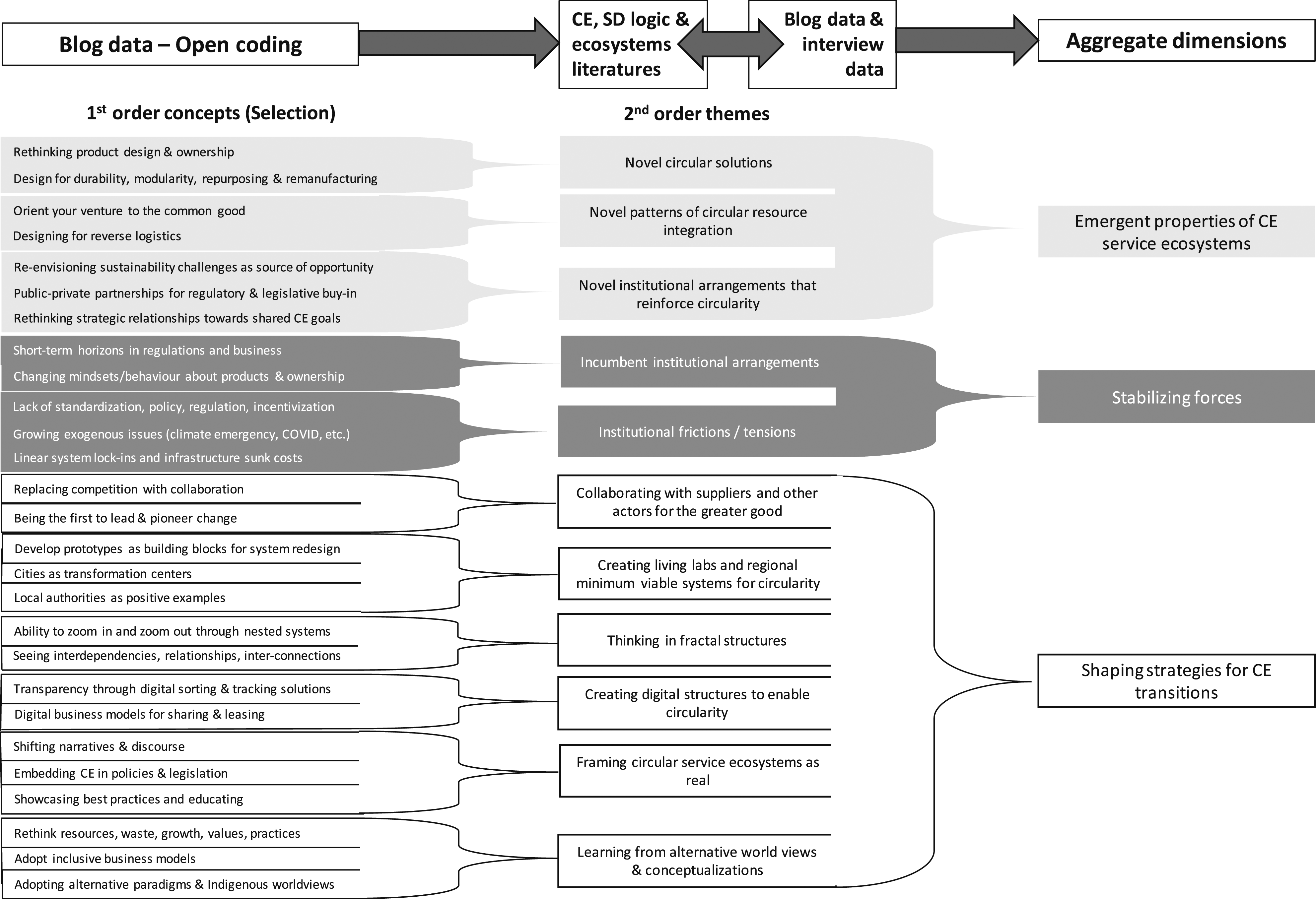
Specifically, during the inductive round of analysis, themes were identified within the blog dataset that would provide 1) an overview of the discourse in the CE blogosphere, and 2) an initial sense of the conditions, complex challenges, and processes of CE transitions. This open coding led to the identification of fifty-three wide-ranging first-order themes (27 of the most significant codes appear in Figure 1). Included in the first-order codes were elements such as rethinking product design and ownership, designing for reverse logistics, rethinking strategic partnerships, developing CE prototypes, developing the ability to zoom in and out through nested systems, digital business models for sharing and leasing, and so on.
In the second-order analysis, we searched for the most plausible explanation for the insights that appeared interesting and surprising to us in the data (e.g., the need for a paradigm shift to drive CE transitions) by going back to the literature (Dubois and Gadde, 2014). After two rounds of iterations, going back and forth between data and theory, we established S-D logic’s service ecosystem framework, recent work on ecosystem emergence (Polese et al. 2021; Vargo et al. 2023) and service ecosystem shaping (Mele et al. 2018; Vink et al. 2021; Vink and Koskela-Huotari 2022) as the guiding principles for the deductive analysis. This step identified eleven second-order concepts as depicted in Figure 1. These second-order concepts were then further distilled into three aggregated dimensions: emergent properties of circular service ecosystems, stabilizing forces, and shaping strategies.
We used insights from the blog data and the expert interviews in tandem with service ecosystem research informed by S-D logic to define and delineate the second-order concepts (Dubios and Gadde, 2002, 2014). Web Appendix 3 provides an overview of the anchor quotes from the blogs and the expert interviews that support the development of our new process framework of circular service ecosystem transitions, which we will present next.
Findings
Conceptualization of Circular Service Ecosystems
CE experts widely agree that a paradigm shift is necessary to facilitate CE transitions. This shift entails a reevaluation and reconceptualization of prevailing economic models. For instance, one blogger argues, that the “‘economic rationalist’ [perspective] takes a very limited view of the world” (B0070_2016) by excluding everything that, arguably, should be prized (like natural resources, public and social good): We almost live for free—we can pollute, we can destroy, we can deplete whatever we want, because we do not take externalities into the economic equation (P7).
Following the CE experts’ discourse revealed a shared understanding that endogeneity and interdependencies, rather than externalities, are key in driving circularity within and across nested natural and human-made ecosystems, underpinned by the realization that “you’re part of nature, and you have to develop a system that allows nature to live and recover its resources” (B0543_2019). Furthermore, CE experts recognize the importance of transformative change—a “just transition” (P3) ensuring that social as well as environmental goals are met. This embeddedness of nature as the supra-system within which all other (social and economic) service ecosystems are nested is central to the conceptualization of circular service ecosystems. Just like natural ecosystems, circular service ecosystems depend on resource flows within and between supra- and sub-systems. One CE expert explains, many stakeholders intuitively connect to the CE narrative, because: It got a future to it, you know, it's not linear anymore. Humans love this idea of the closed-loop. Well, it's an archetypal thing. I use the alchemical image of there's a whole cycle of degradation, putrification, evaporation and re-condensation. We find this in Yin-Yang, the two dragons, Ouroboros—the snake that eats itself. It points to the continual life and rebirth (P6).
Dependencies in natural ecosystems facilitate efficient and effective resource flows and enhance their overall functionality. When organic components die, they decompose and move in reverse closed cycles within and between the biosphere, atmosphere, hydrosphere and lithosphere. In this way, resources pass into different biotic communities, diffuse and stay in use across ecosystem boundaries through infinite multi- and inter-dependent value creating cycles. The discourse signals a profound integration of the narrative surrounding natural ecosystems within the CE concept. Consequently, we propose: Circular service ecosystems are ideal types of service ecosystems, regenerative and embedded within nature, where (material, intellectual, digital, and financial) resources flow seamlessly within and between nested systems without creating any waste or leakage.
S-D Logic Informed Conceptualization of Circular Service Ecosystems.
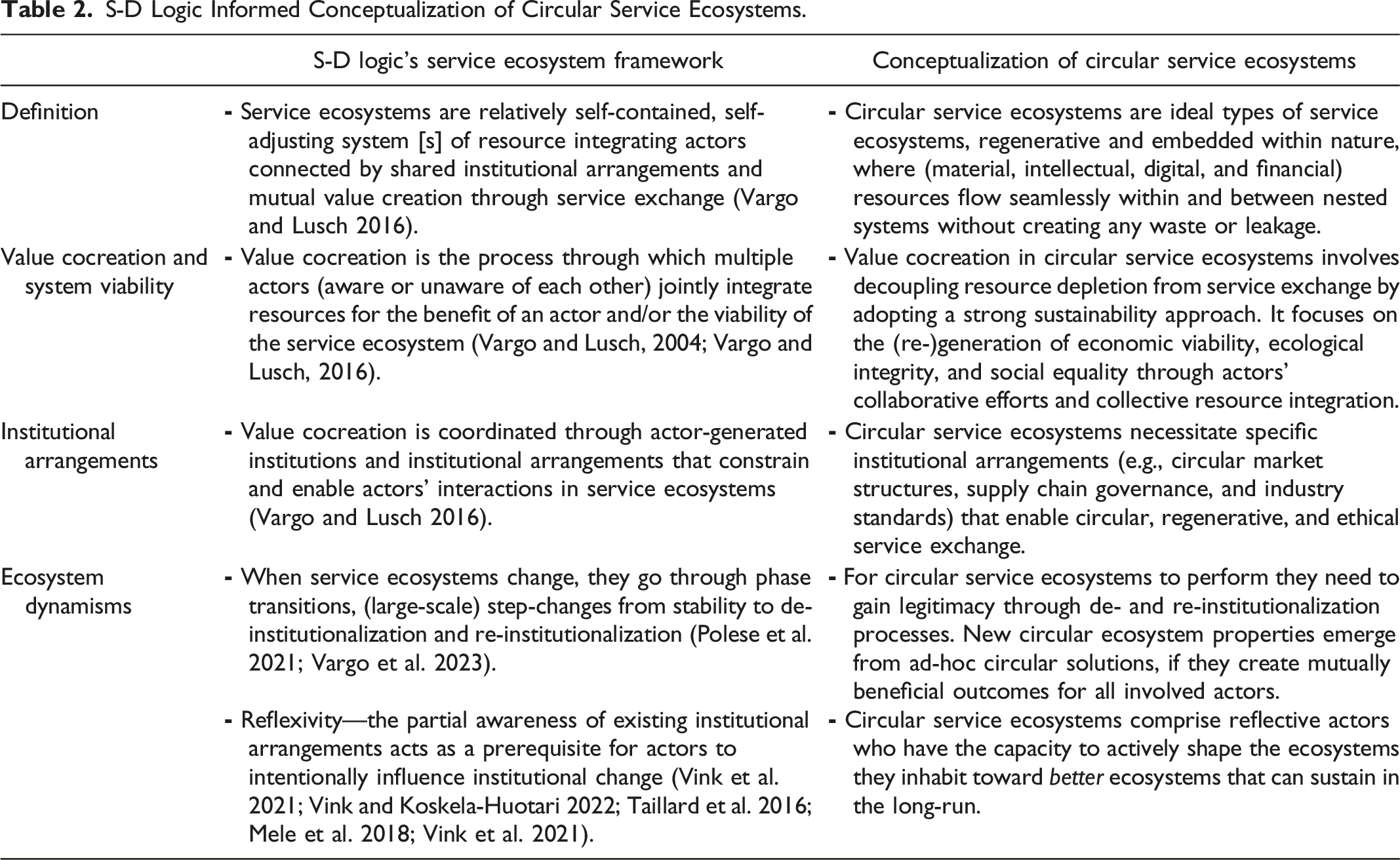
While the CE literature advocates for a non-reductionist view of value (Zacho Overgaard et al., 2018) that encompasses financial, environmental, and ethical concerns, CE practitioners further underscore the notion that “value cocreation is what we’re doing through everything that we do” (P1). Value cocreation entails “value preservation” (P6) emphasizing the retention of resources within the economy for as long as they remain valuable (da Costa Fernandes et al. 2020). Additionally, it involves achieving the “decoupling of resource use from economic growth” (P6) while simultaneously striving for a “resource efficient and socially-inclusive economy” (P3). This requires a balance between “efficiency and resilience” (P6) supporting what Neumayer (1999) refers to as a strong sustainability approach, which means a de-emphasis of efficiency as the dominant goal, because: A strategy focused on reducing the negative impacts of our activities—or making them more efficient—can only go so far. We need to ensure systems are effective, not just efficient. Remember—it’s not about doing less bad but rather more good (B2830_2021).
Circular service ecosystems further require specific sets of institutional arrangements—for instance, market structures that enable circular, regenerative, and ethical market practices (Glover et al. 2014), supply chain governance that ensures circularity among upstream and downstream supply chain partners (Batista et al. 2018), and standards that incentivize circular business practices (Schultz 2021). One blogger notes: Understanding the economic, environmental and social advantages involves implementing appropriate demand and supply chain models, ultimately supporting an important change in mindsets and methods throughout industry and beyond. (B0599_2019).
Stated alternatively, for circular service ecosystems to perform in a regenerative, sustainable and ethical way they need to gain legitimacy. Another industry expert adds: The antidote to the path dependencies originating [from existing] institutions is “ecological reflexivity”: the capacity to rethink values and practices in light of ecological information. (B0067_2016).
This points to one fundamental difference between natural and circular service ecosystems. CE practitioners recognize that actors, including firms, industry networks, governments, and customers possess the ability to observe the emergence they create (Suddaby, Viale, and Gendron 2016; Vink and Koskela-Huotari 2022). As a result, these actors have agency to actively shape: …better [ecosystems] than the broken systems of the past which have accelerated inequality and waste (B1245_2020).
Notably, CE industry experts offer a detailed understanding of the complex dynamics involved in circular service ecosystem transitions, which we will present in the next section.
Dynamisms of Circular Service Ecosystem Transitions
Novel Circular Solutions
Vargo et al. (2023) note that service ecosystem transitions initially manifest as novel outcomes from ad-hoc resource integration and service exchange. Frequently, ad-hoc resource integration occurs as actors attempt to resolve institutional frictions or misaligned institutional arrangements (Fehrer and Wieland, 2021). We see many of these ad-hoc circular solutions mentioned in the practitioners’ discourse. For example: Desso [in the 90s] was one of the first companies committed to become what we call now circular … They started by redesigning carpets and carpet tiles through the Cradle-to-Cradle certification, but quickly they ended up in a situation where they needed to change contracts, they needed to change supply chains, the sourcing, the R&D… Desso [is] a company that embraced circularity when the circular economy wasn't even there (P5).
This example aligns with the notion that novel outcomes (e.g., new circular solutions, designs, products, and business models) often emerge in the niches or in the periphery of service ecosystems, triggered by ecosystem pressures like, in this case, the waste of valuable resources. Through interactions among firms, supply chain partners, customers, and other stakeholders, new bilateral understandings of conducting business in a circular manner gradually took shape. CE experts highlight two shaping strategies that foster the cultivation of innovative circular solutions.
Shaping Strategy 1: Collaborating with Others for the Greater Good
There is broad consensus that “forging a path to a truly circular economy requires collaboration across the ecosystem” (B2478_2021). As “cooperation replaces competition” (B0139_2017), collaborating and collectively initiating new ideas and innovation leads to “benefits in the wider ecosystem, not just the companies involved” (B0139_2017). Such collaborative efforts might involve supply chain members, design, human-interaction and technology specialists, management consultants, NGOs, communities, competitors, governments, civil society, and other stakeholders from public and private sectors. Reflections in the CE practitioners’ discourse exceed those discussed in previous academic research on supply chains (Sudusinghe and Seuring 2021) and cross-sector collaborations (Köhler, Sönnichsen, and Beske-Jansen 2022). For example, one blogger explains how Tesla shared their manufacturing IP as open source to encourage other car producers to transition to low emission cars. Further, there is much encouragement for the development of platforms and forums, like the World Economic Forum’s “Accelerating Digital Traceability for Sustainable Production” initiative, which: …brings together manufacturers, suppliers, consumers and regulators to jointly establish solutions and provide a supporting ecosystem to increase supply chain visibility and accelerate sustainability and circularity across manufacturing and production (B2378_2021).
Shaping Strategy 2: Creating Living Labs and Regional Minimum Viable Systems for Circularity
Another shaping strategy on the regional level involves the creation of “autarch or autonomous systems” (P7). This includes strengthening of regional communities and businesses to increase resilience. Indeed, the Covid-19 pandemic exposed the fragility of supply chains and business models, “which has led to more conversations about creating more regional supply networks and reviving urban manufacturing” (B1177_2020). Regional (rather than individual) circular solutions enable efficient resource flows across service ecosystems. One CE expert explicates: “I'll give you one example. We now try to make individual homes independent of gas, and we see them as a unit in which energy can be provided for self-sufficiency. That is never going to work. It's a theoretical concept. The only way this is going to work is when we start building neighbourhoods based on the scope of, say, 250-300 units” (P7).
Other concepts include transition towns, ecovillages and sharing cities, seen as transformative social innovations “involving new ways of doing, organizing, knowing and framing [business]” (B0865_2019) with a strong focus on local and regional initiatives.
CE experts also advocate for installing living labs where researchers, businesses, government entities, and the general public collaborate to cocreate, experiment, and test innovative solutions in a real-life setting: So, there were successful trials. And then we were just going back to doing what we always did. And what we recognized is a degree of a risk appetite for a pilot project is higher… So that's why we were proposing the establishment of a living lab where you bring all of that into an environment […] the regulators […] the supply chain […] everyone needs to leave the starting gate at the same time (P8).
These shaping strategies foster de-institutionalization within certain niches and regional areas (i.e., positive feedback loops), which eventually expand and lead to greater regularity of performing circular business practices. However, we also found evidence for stabilizing forces (i.e., negative feedback loops), which maintain incumbent ecosystem properties. For instance, a group of experts showed a strong aversion to engaging in pilot projects, as such actions implicitly maintain incumbent institutional arrangements: As long as we call a pilot a pilot we have—as a real witchcraft—taken care that it will not enter the real world. It's protected. Many politicians love pilots because it doesn't touch the real system […] we need to develop systems in which we cannot turn back (P7).
Novel Circular Resource Integration Patterns
Legitimization of doing business in a new and circular way begins with the emergence of new durable patterns of resource integration (Vargo et al. 2023). Such patterns result from dynamic processes of de-institutionalization through positive feedback loops enforcing change and re-institutionalization through negative feedback loops creating stability (Vargo and Lusch 2016). Interactions between actors and emerging circular solutions generate and reinforce circular patterns that, in turn, result in novel circular solutions (Vargo et al. 2023). CE experts confirm, if such patterns do not form, circular solutions remain pilots and “will not enter the real world” (P7). The CE practitioners’ discourse revealed two critical shaping strategies to enforce the development of circular resource integration patterns:
Shaping Strategy 3: Thinking in Fractal Structures
Fractal structures build on the idea of regional solutions discussed earlier, but require a zooming out from regional to global, and vice versa. One CE expert explains: There are fractal structures in almost everything that's a dynamic system, whether it's a cloud in the atmosphere, water systems, living systems—it has a fractal structure—if it persists…like the capillary system. You need the big flows. … But how do you encourage the small flows? Well, paying the real price helps, because it stops big distant firms having a price advantage because they are subsidized in effect [through tax benefits]. … But the key seems to be, you need infrastructure. You need to add value with what you've got and circulate it locally. Now, when it comes to the capillary system in the human body, you get that thing that flows can be redirected. It can take damage, it's very resilient, the number of pathways are almost endless and it can reroute. So, you damage a few [resource flows], it doesn't matter, it will reroute and keep going (P6).
This reference to natural ecosystems clarifies how circular service ecosystems can become resilient, while preforming efficiently—through fractal structures. Another CE expert argues, “we have to move away from a centralized subsystem economy, meaning we have mobility, we have energy, we have whatever, we have centralized functional systems” (P7). Instead, they suggest a decentralized structure—a system of regions—to allow for more resilience. This implies “making the circular economy a place-based concept” to allow for inclusivity on the regional level, while also shaping “institutional infrastructure to make closed loops effective” on the broader ecosystem level (P5).
Shaping Strategy 4: Creating Digital Platforms to Enable Circularity
Digital technology is seen as vital to enable collaboration, knowledge-sharing, transparency, and accountability among actors in circular service ecosystems. For instance, one blogger explained how virtual reality fueled circular resource integration and value cocreation processes between customers and firms through “custom production […] avoiding a surplus of unsold products and utilizing the minimal amount of material” (B0979_2019). CE experts broadly agreed upon that “without digital enablers we wouldn’t be talking about circular economy today” (P5) and “no single company or industry can take on the infrastructure challenge by themselves” (B0176_2017).
We found an advanced discussion regarding the usefulness of different digital technologies to increase circularity, such as the Internet of Things and Big Data for predictive maintenance and end of life management. Blockchain is viewed as a means to reduce resource depletion “by providing transparency and traceability, which efficiently facilitates the provenance of items” (B1267_2020), while 3D printing enables on-demand service. In sum, “digital intervention is needed to create a transparent ecosystem” (B0867_2019). Thus, increased transparency across service processes and supply chains powered by AI and blockchain solutions fosters confidence, credibility and trust and consequently supports the establishment of new circular resource integration patterns.
Although CE experts generally agreed that connecting resources, people, and processes through digital technologies reinforces circular service ecosystem transitions, more critical reflections alert to their risks: We all hope technology is gonna sort it out. And I think technology offers a lot in terms of operations so that you can get that kind of recycling and waste management and all the rest of it. [However] one of the vulnerabilities we are facing at the moment globally is that we overly rely on these global connections. So, if they actually don’t work or some financial systems, somewhere else that you rely on for your local investment in your local operations, then it's gonna be a disaster… technology is not everything (P2).
Other experts highlight ethical concerns regarding technologies: “AI development efforts [accelerating] the transition to a circular economy should be fair and inclusive, and safeguard individuals’ privacy and data security” (B0784_2019). And: …if we were wanting to make all products and services transparent and have full provenance of them to be able to track and trace them, for example, in digitized systems, that's not an easy problem to solve... [it’s] quite difficult getting the software and capability to do it [and] do we even have the legitimacy and support the authorizing environment? (P3).
This controversy highlights the challenges involved in establishing the necessary enabling infrastructures for the effective functioning of circular service ecosystems. Despite the promises, it is unlikely that new digital infrastructure can be implemented seamlessly across interconnected service ecosystems in the near term. Even in the digital age, the processes of re-institutionalization required for adopting new patterns of circular resource integration take time to gain widespread acceptance and legitimacy (Hinings et al. 2018).
Novel Circular Service Ecosystem Properties
Achieving successful transitions towards circular service ecosystems necessitates the ability to replicate emergent patterns of circular resource integration and service exchange (Vargo et al. 2023). This replication process drives the re-institutionalization of new orders and structures that coordinate circular value cocreation (Fehrer and Wieland 2021; Mishra, Chiwenga, and Ali 2019). Put simply, circular service ecosystems need to become real: I absolutely disagree with some of my colleagues that recently have been trying to question, if a circular economy exists. It does exist… Many of those stakeholders consider it, perform it, sometimes as a side strategy or a plan B, or in terms of scenario setting (P5).
This quote highlights a divergence within the discourse among CE experts. There is consensus among experts that the transition towards circular service ecosystems is underway. However, there is also an acknowledgment that this transition is not yet fully reflected in well-established institutions and institutional arrangements that consistently reproduce circular value cocreation and resource integration processes. Indeed: We are locked into the present system. It's very evident, we cannot step out of the system. We now get into the real fundamentals of this debate, we are locked in this system we started to create in the 50s (P7).
CE experts highlight two shaping strategies that possess the potential to unlock path dependencies and redirect circular service ecosystem transitions away from returning to the status quo:
Shaping Strategy 5: Framing Circular Service Ecosystems as Real
One CE expert suggests: I think some of the indicators [of circular economy becoming mainstream] is actually having government strategies around these things […] And I think maybe then having some metrics on balance sheets. I guess that's where we're going in business sense, ESG reporting, so that we actually have certification that businesses are circular and moving towards circular and that they're the ones that organizations invest in (P1).
Metrics, measurement tools, certifications, data standards, reporting frameworks, and successful case studies assume a crucial role in establishing the functionality of circular service ecosystems. One blogger emphasizes: We need metrics that keep us focused on the impacts we seek, together with targets that ensure we stay within the safe operating space and don’t venture beyond the ability of the planet to support society” (B0665_2019).
In addition to the reporting instruments and tools offered by prominent organizations like the World Economic Forum, World Resources Institute, Ellen MacArthur Foundation, United Nations, and others, CE experts advocate for the incorporation of circularity into legislation. They emphasize the importance of circularity being integrated into strategy documents, operational plans, and business planning to ensure its presence in everyday business decisions. Government organizations play a crucial role as role models by transforming their procurement practices to align with circularity and stimulate circular innovation.
In summary, there are indications of changing ecosystem representations; however, concerns arise regarding the resemblance of seemingly new circular ecosystem properties, which upon closer examination suggest a limited departure from the status quo. One CE expert explains that CE “is now framed as the business case for sustainability” (P5). They continue: I think circular economy is becoming part of that narrative - a business case. It's very attractive to change your strategies, rethink your business models. It's an innovation trajectory with a spin towards sustainability, which is great. However, there is also another debate in parallel which says, no look, we have an opportunity here to really go into socio-ecological discussions and use the circular economy as a socio-ecological transformation which goes deeper into what we can aim to change (P5).
Another CE expert reflects: Somebody way back in the Ellen MacArthur Foundation said to me: “So we're going to fix the resources question, stop it being extractive… We're going to leave the money system to be extractive and reinforce a Rentier Capitalism,” you know, to use the jargon. And I said, “Well, that won’t really work, will it? I mean you want to fix the material system and leave everything else in play when we're seeing increasing inequality?” … [Designing financial systems], so that [they] too become circulatory not extractive, that's it. This is essentially Post-Keynesian Economics…and it’s a good flavor of modern monetary theory in that (P6).
Indeed, there is broad agreement in the CE expert discourse that if capitalism continues to guide economic behavior, nothing will substantially change, “in terms of power relation, distributive opportunities, participatory mechanisms [and] democratic mechanisms” (P5). CE could even make things worse: Because who controls the cycles? If this becomes another opportunity to make products, components, material to asset classes, a way to charge economic rents to get access [it’s a problem], because, of course, you just think about it in economic terms (P6).
Further, the complex nature of circularity means potentially solving one sustainability issue while creating another. The CE discourse features a sophisticated discussion, as CE is: not straightforward. If we look closely, we can see circular approaches with unforeseen consequences. […] There are a number of “false solutions”—ways of “going circular” that don’t improve sustainability and may even cause negative impacts (B2310_2021). [And] moving to a circular economy can shift investment and employment away from production and manufacturing (which tends to happen in lower-income countries) towards later stages of the value chain, such as repair, resale, sorting, and recycling (which are often concentrated in wealthier countries) (B3100_2021).
In response to this discussion, the second shaping strategy engages critically with the foundations of mainstream economics underpinned by Western worldviews.
Shaping Strategy 6: Learning from Alternative (World) Views
CE experts suggest a questioning, unshackling, and (re)thinking of the existing “rules of the game.” Inclusive business models represent just one of their suggestions: Business structures themselves should be inclusive—for example, cooperatives, employee ownership, social enterprises and community interest companies. Inclusive business models benefit employees and their communities. They support and build value for all stakeholders—employees, customers, suppliers and shareholders (B2500_2021).
Aligned with recent studies, other CE experts propose sustainable degrowth (Hobson and Lynch 2016; Kallis et al. 2018; Schröder et al. 2019)—a downscaling of production and consumption through equitable socio-economic settings balanced with reasonable levels of economic throughput that jointly improve quality of life and respect planetary boundaries: It highlights what is often ignored: our economy includes local sharing, repairing and self-provision, unpaid family care, and many other non-commodified activities. This comprehension of economic activities beyond merely monetary and reciprocal transactions is essential in order to imagine, creatively experiment with, and implement new solutions to pressing sustainability challenges (B2549_2021).
This holistic approach introduces societies to new social values and policies, capable of generating social progress while “building with – not over – nature” (B2576_2021).
Finally, the CE discourse highlights the significance of Indigenous cultures that have historically lived in harmony with nature. In line with emerging research in the field of the circular economy (Pereira et al. 2022; Siragusa and Dmitry Arzyutov 2020), CE experts engage in discussions about how Indigenous knowledge can provide valuable insights for circular ecosystem transitions: [First Nation peoples] understand the impacts that humans have on the earth, like natural resources and vice versa. They don't delineate between the two, country is as important as human existence, if not more so (P1). [And] many cultures and traditions have been upcycling materials forever [and] have got a very different idea of our relationship with nature and relationship with others (P5).
We found further reference to New Zealand Maori in a few blogs, emphasizing that: Transformational changes required are more likely to succeed if there is a strong role for Māori that is consistent with Te Tiriti [New Zealand's founding document] the wellbeing of the environment and people are embedded in the Māori cultural mindset” (B2002_2021).
This discourse highlights the potential of alternative worldviews to restore and (re)shape service ecosystems that are “inclusive, diverse and distributed equitably across our cities, regions and society” (B2245_2020).
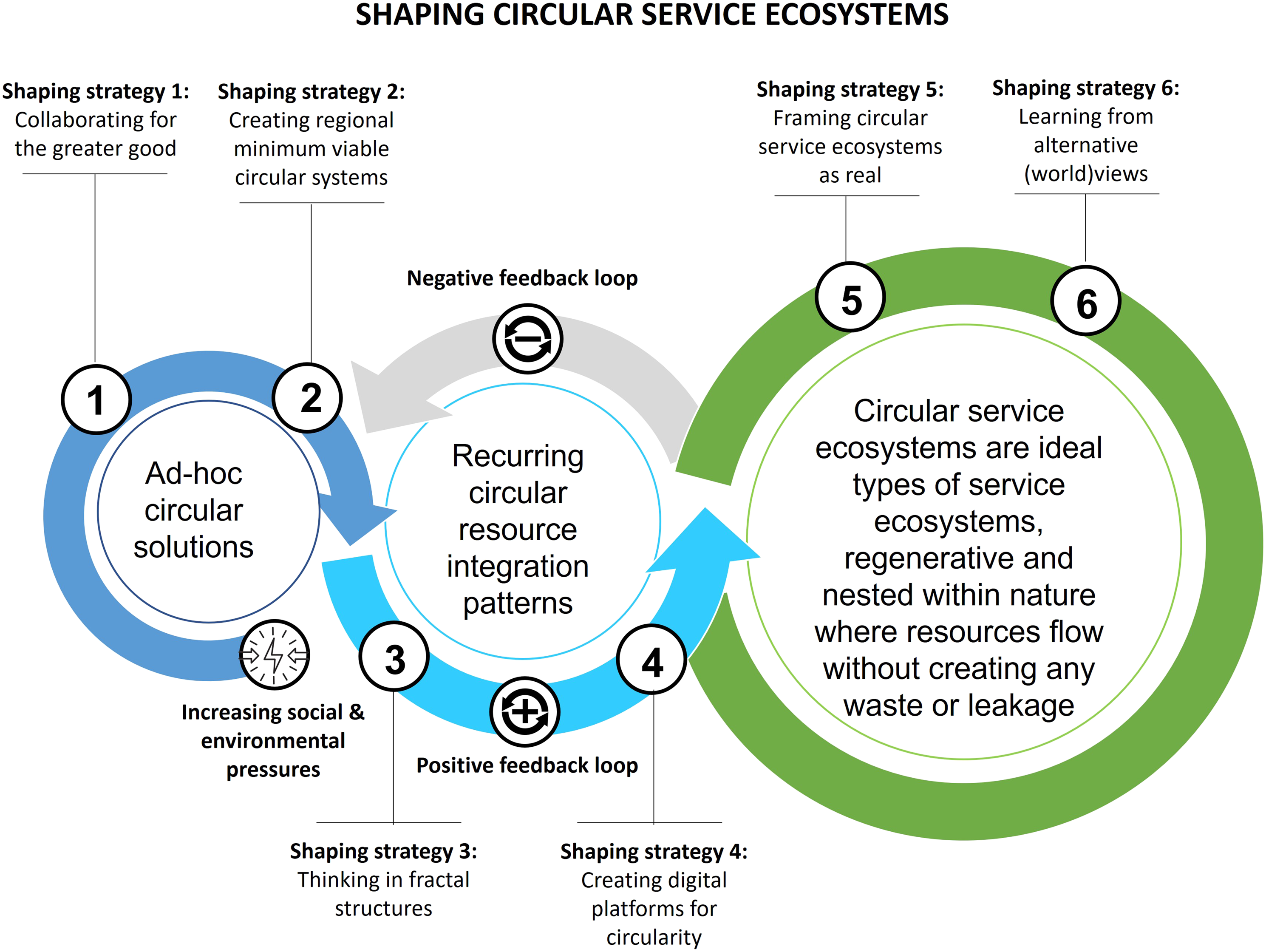
Figure 2 presents a comprehensive process framework that illustrates circular service ecosystems transitions. This framework offers insights into the emergence of novel circular solutions, recurring patterns of circular resource integration, and the distinct properties that characterize circular service ecosystems. Additionally, it effectively portrays the potential hindrances posed by stabilizing forces, emphasizing their capability to impede transitions. Furthermore, the framework underscores the influential role of actors who can positively impact circular ecosystem transitions through their reflexivity and intentional shaping efforts. Circular service ecosystem transitions.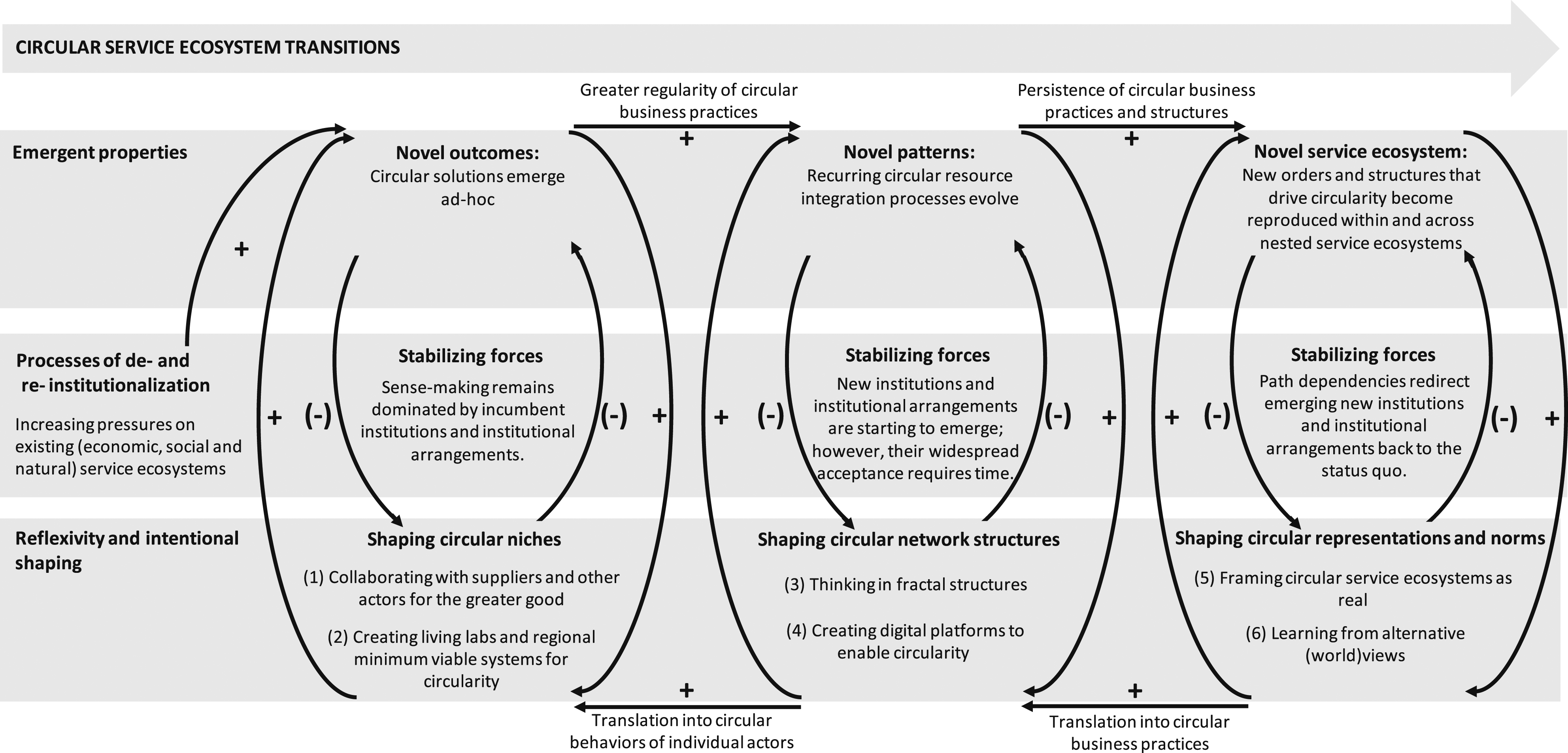
Discussion and FUTURE Research Agenda
Theoretical and Managerial Implications
The CE expert discourse and a handful of very recent studies show that CE transitions are best understood from an ecosystem perspective (e.g., Boldrini and Antheaume 2021; Konietzko, Bocken, and Hultink 2020)—one that embraces complexity instead of avoiding it. However, the particular ecosystem concept chosen by any researcher necessarily frames the scope and breadth of their study. While valuable in revealing interactions between actors beyond single firms, most CE ecosystem concepts remain predominantly firm-centric, albeit focused on groups of firms (Boldrini and Antheaume 2021) or large firms as orchestrators of ecosystem partners (Parida et al. 2019). Our study is the first to explain how the service ecosystem concept can inform the CE discussion and why this concept is so powerful at capturing the complexity of CE transitions.
As we have shown, the service ecosystem concept enables zooming out to discuss value cocreation and resource integration processes within nested service ecosystems, rather than narrowly focusing on value creation by a focal firm or network of firms. The “natural environment” is the supra service ecosystem within which all other (social and economic) service ecosystems are nested (Fehrer and Bove 2022). Hence, in contrast to more narrow business and innovation ecosystem perspectives, the natural environment is explicitly part of the circular service ecosystem definition rather than being seen as an external dimension. As all other (human-made) service ecosystems reside within the boundaries of the natural environment, a circular service ecosystem perspective is implicitly undergirded by a strong sustainability ethic, which takes a long-term approach to sustainability, recognizing the intrinsic value of nature and the need for ecosystemic change. It prioritizes the preservation of ecological integrity and intergenerational equity, aiming for economic viability guided by sustainability and justness (Neumayer, 1999).
Our first contribution comes from defining and delineating circular service ecosystems as ideal types of service ecosystems. Circular service ecosystems are in many ways similar to natural ecosystems, where material, financial, digital, and intellectual resources flow in a circular manner within and between nested systems, with no waste or leakage. Transitions to this ideal type are underpinned by processes (i.e., feedback loops) that unfold within and between nested service ecosystems and their components (i.e., actors, resources, and institutional arrangements). These feedback loops inspire episodes of de- and re-institutionalization, resulting in emergent, novel outcomes, and ecosystem properties (Polese et al. 2021; Vargo et al. 2023) that eventually feature circularity. Institutional arrangements guide embedded actors while additionally being structured through those same actors’ practices and behaviors. Whether those actors are policymakers investigating new regulations, managers exploring new circular business processes, or activist groups driving new practices, circular transitions can “bubble up,” challenge incumbent institutions, and become accepted.
Building on our new understanding of circular service ecosystems, our second contribution involves extracting shaping strategies to intentionally influence circular service ecosystem transitions. This directly addresses Vargo et al.'s (2023) call to explore proactive shaping efforts by actors and their impact on ecosystem emergence. Drawing on extensive qualitative data collected from CE thought-leaders and incorporating latest service ecosystem theory (Mele et al. 2018; Polese et al 2021; Vargo et al. 2023; Vink and Koskela-Huotari 2022), we provide a comprehensive explanation of how the reflective and intentional shaping endeavors of diverse actors drive the emergence of new ecosystem properties that foster circularity.
The six shaping strategies we develop are directly useful to managers and policymakers. (1) Collaborating with others for the greater good requires managers to seek allies with whom to develop innovative solutions that benefit not only them, but a wider network within their industry and potentially beyond (see also, Ruggieri et al. 2016). This might include working, at least temporarily, with competitors (e.g., letting competitors benefit from service innovations). This strategy demands a shift in mindset from a focus on competitive advantage to co-opetitively increasing ecosystem viability. (2) Creating living labs and regional minimum viable systems for circularity means expanding beyond incubator environments, pilots, or experiments, to instead developing functioning systems on city or regional levels that involve all relevant actors (Cuomo et al. 2020). Because these minimum viable systems are not protected lab environments but are part of the “real world,” they have the potential to expand their boundaries and grow. As increasing numbers of citizens, businesses, municipalities, and others get involved, circular resource integration processes become more widespread, regular, and institutionalized. Nevertheless, as the management of material flows implicitly requires geographic co-location, logically, effective CE transitions must be accomplished—at least initially—on local or regional levels.
However, (3) thinking in fractal structures enables managers and policymakers to zoom in to understand the requirements for circularity and resilience at a regional level, and also zoom out to consider the infrastructure required to make circular service ecosystems feasible at industry, market, or societal levels. For circular service ecosystems to become and remain viable, managers and policymakers must navigate and balance the interplay between both perspectives—resilience within regions coupled with infrastructure requirements for effectiveness. Nevertheless, thinking in fractals additionally enables actors to engage in imagining futures, and inspiring others by communicating the potential impacts of local activities as they scale. (4) More specifically again, advancements in digital infrastructure have the potential to drive circular business practice. Digital infrastructure and platforms enable collaboration, knowledge-sharing, transparency and accountability among actors in circular service ecosystems. But managers and policymakers must realize that the building and management of infrastructure to enable circularity requires a collective effort. The impact of infrastructure can only fully unfold if all actors (including those in emerging economies and embedded in global value chains) have access and know how. Additionally, to reflect the regional nature of effective CE solutions, digital infrastructures should be focused at that level. Hence, platformization on a global level is unlikely to provide suitable solutions.
(5) Framing circular service ecosystems as real requires businesses, policymakers, activists, and customers to generate narratives (Leipold, Weldner, and Hohl 2021) through media, consultancy reports, best practice examples, industry benchmarks, measurement frameworks (Corona et al. 2019) and other means to ensure circular business practices are disseminated widely. Moreover, in the same way that the CE must be framed as real, the kinds of institutional disturbances that drive actors to engage and experiment with sustainable solutions (e.g., climate change, social inequalities) must remain central to these discourses. These challenges are the inspiration for action. Finally, navigating circular service ecosystem transitions means questioning, unshackling, and (re)thinking existing “rules of the game”; hence, (6) learning from alternative (world)views. CE experts broadly encourage a rethinking of the economic assumptions that undergird capitalism, and instead, the adoption of alternative perspectives. Degrowth is mentioned as one potential path forward (Kallis et al. 2018). Additionally, in contrast to modern Western perspectives, Indigenous worldviews recognize co-dependencies between humans and nature. For managers, citizens, and policymakers, the adoption of alternative perspectives requires reflexivity of the assumptions upon which Western economic and social models are built. Instead of taking these models for granted, they could be viewed as malleable, and the basis for innovative service ecosystem design adventures. Moreover, engagement with Indigenous and First Nations peoples potentially provide an avenue to confront historical grievances and inequities by recognizing and elevating traditional knowledge systems.
Our final contribution is methodological. Kirchherr, Reike, and Hekkert (2017) highlight the CE concept has, to a large degree, been developed and led by practitioners. With this study, we capture practitioner discourse in an innovative way—through blogs. Building on recent work by Fehrer and Nenonen (2020), we refine the blog selection procedure to ensure the blogs were representative of the CE discourse by avoiding algorithm biases of blog search engines, which commonly prioritize recently published entries. Additionally, to enhance the robustness of our findings, we complemented the blog analysis with in-depth expert interviews. By employing a combination of both methods, we effectively address inherent biases in each approach and enhance the depth and quality of our findings.
Limitations and Future Research
This study provides a comprehensive perspective on CE transitions by explaining the critical interplay between actors’ intentional efforts in shaping circular service ecosystems and ecosystem emergence. Our revised understanding of circular service ecosystems highlights the idea that social and economic service systems exist within the limits of natural service ecosystems. It also emphasizes the importance of endogeneity and interdependencies in driving circularity. This revised conceptualization, informed by S-D logic challenges conventional economic theories, questioning notions of value creation and the firm’s role, while emphasizing the significance of collaborative endeavors over competitive advantages.
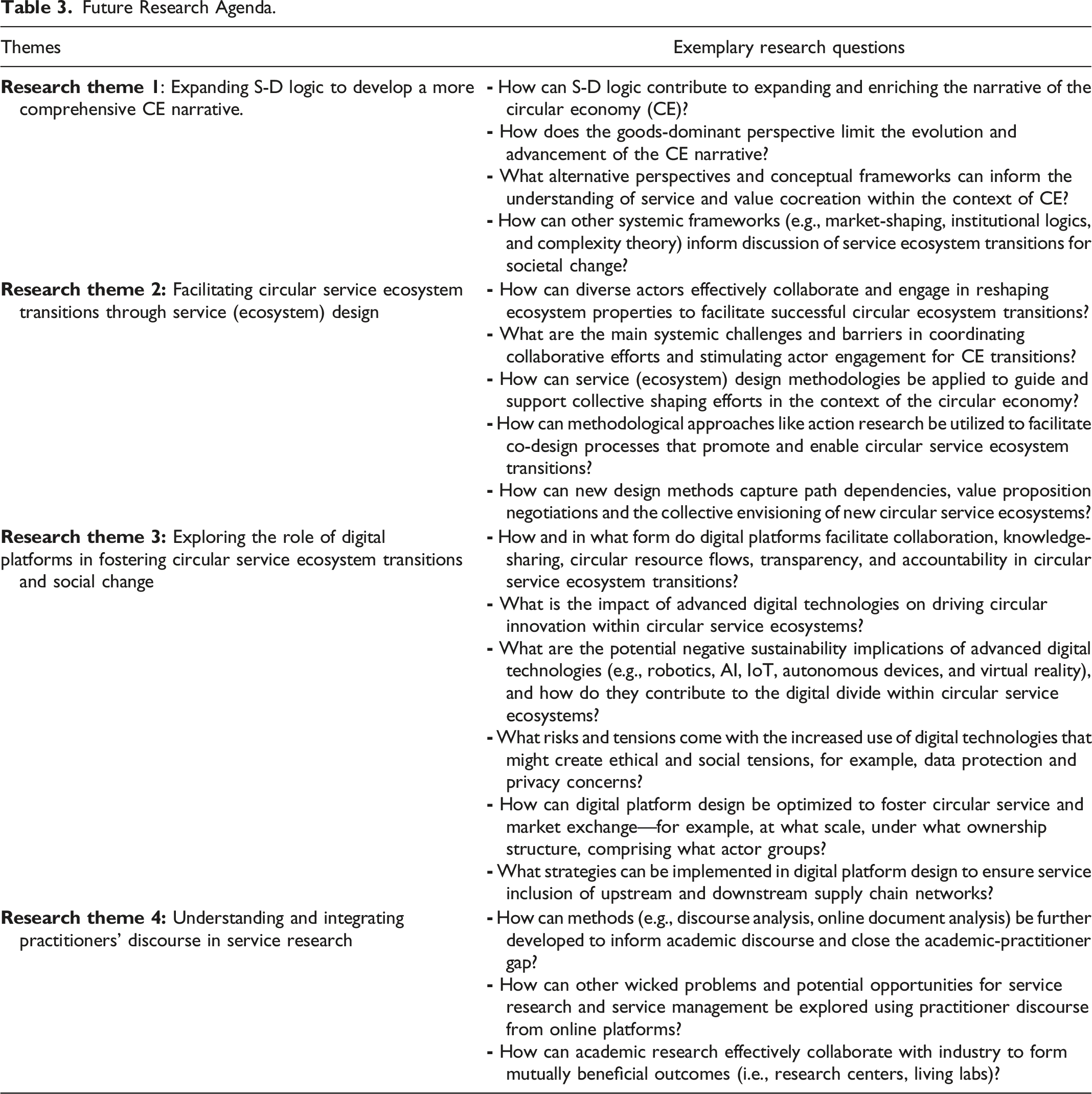
Future research can delve into how S-D logic can contribute further to enriching the CE narrative. Despite the growing attention to service and servitization within the CE discourse, a significant portion of the current discussion remains rooted in a goods-dominant perspective. This limited viewpoint impedes the evolution of the CE narrative, as it continues to uphold an economic exchange model designed for an industrial economy. Hence, it becomes crucial to explore new perspectives that reimagine service and value cocreation, offering promising avenues for service scholars to extend and advance the ongoing CE debate.
Our study highlights that taking an ecosystemic perspective on CE transitions necessitates the collaborative efforts and engagement of diverse actors (Brodie et al. 2011; Brodie et al. 2019) to actively reshape ecosystem properties for the benefit of society and the environment. However, coordinating such collaborative efforts can be challenging. Service research, particularly recent work on service (ecosystem) design, provides an advanced methodological toolkit that can guide collective shaping efforts (Patrício et al. 2018; Vink et al. 2021). To illustrate, collaborative action towards circularity entails acknowledging path dependencies, engaging in value proposition negotiations, and striving for mutually beneficial outcomes for all involved actors. This process requires guiding actors through co-designing envisioned shared futures. Promising future research opportunities lie in exploring methodological approaches like action design research (Sein et al. 2011), which can facilitate co-design processes that foster circular service ecosystem transitions.
Our research has demonstrated the pivotal role of digital platforms in facilitating circular service ecosystem transitions. These platforms are seen as a promising avenue for promoting collaboration, knowledge-sharing, circular resource flows, transparency, and accountability. Their implementation can lead to a reduction in information asymmetry and uncertainty among all participants in circular service ecosystems. However, the existing discourse among practitioners and scholars has paid less attention to two important aspects. Firstly, the impact of advanced digital technologies on driving circular innovation needs further exploration. Secondly, it is crucial to examine how these technologies may contribute to sustainability issues by exacerbating the digital divide. These areas present ample opportunities for service scholars to explore, such as investigating the tensions between sustainability and digitalization, service inclusion of upstream and downstream supply chain networks, and digital platform design that fosters circular service and market exchange.
Future Research Agenda.
Supplemental Material
Supplemental Material - Shaping Circular Service Ecosystems
Supplemental Material for Shaping Circular Service Ecosystems by Julia A. Fehrer, Joya A. Kemper, and Jonathan J. Baker in Journal of Service Research
Supplemental Material
Supplemental Material - Shaping Circular Service Ecosystems
Supplemental Material for Shaping Circular Service Ecosystems by Julia A. Fehrer, Joya A. Kemper, and Jonathan J. Baker in Journal of Service Research
Footnotes
Acknowledgments
The authors would like to express their appreciation to Katie Henderson and Sebastian Seitzer for their dedicated efforts in searching, categorizing, and coding the Circular Economy blogs. Julia Fehrer and Joya Kemper would like to extend their gratitude to the New Zealand Ministry of Business, Innovation, and Employment for their support in conducting this research. Furthermore, the author team sincerely acknowledges the valuable and insightful comments received from the three reviewers, the Associate Editor, and the Guest Editors, namely Professors Lerzan Aksoy, Timothy Keiningham, and Edward Malthouse. Lastly, the authors acknowledge the use of ChatGPT, an AI language model developed by OpenAI, to support language editing during the preparation of this article. ChatGPT (Version 3.5) provided assistance in refining the language of the manuscript. While ChatGPT aided in the editing process, it should be noted that the intellectual content and findings presented in this article are solely attributed to the authors and their research.
Declaration of Conflicting Interests
The author(s) declared no potential conflicts of interest with respect to the research, authorship, and/or publication of this article.
Funding
The author(s) disclosed receipt of the following financial support for the research, authorship, and/or publication of this article: This work was supported by New Zealand Ministry of Business, Innovation, and Employment grant no: UOAX2212.

Supplemental Material
Supplemental material for this article is available online.
Author Biographies
References
Supplementary Material
Please find the following supplemental material available below.
For Open Access articles published under a Creative Commons License, all supplemental material carries the same license as the article it is associated with.
For non-Open Access articles published, all supplemental material carries a non-exclusive license, and permission requests for re-use of supplemental material or any part of supplemental material shall be sent directly to the copyright owner as specified in the copyright notice associated with the article.
