



Abstract
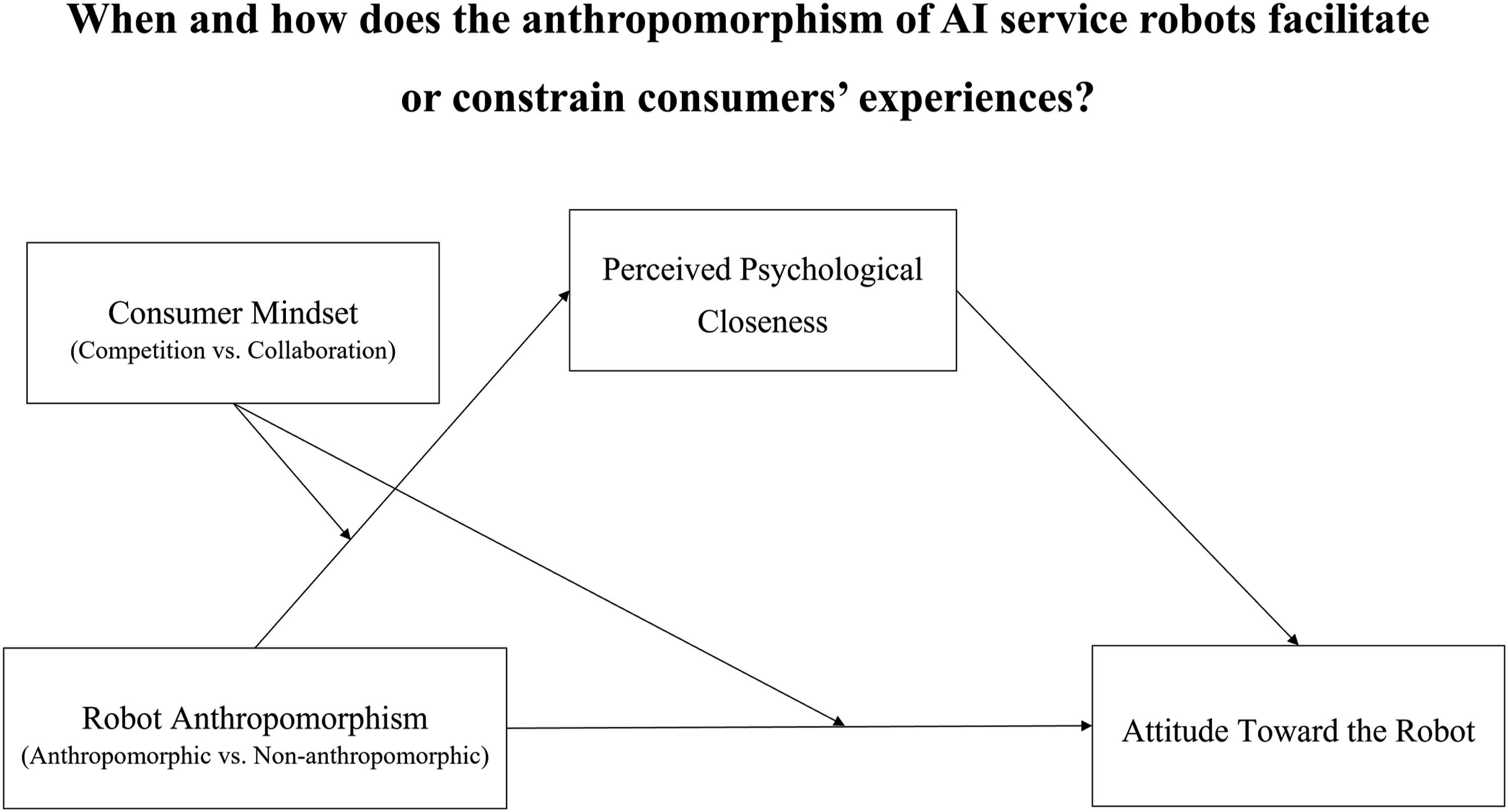
The use of artificial intelligence (AI) service robots is on the rise. With service frontlines gradually shifting to human–robot interactions, the question of whether the anthropomorphism of robots facilitates or constrains consumers’ experiences has emerged. This article focuses on the individual factor “consumer mindset” (competition vs collaboration) and investigates how it impacts consumers’ attitudes toward anthropomorphic AI robots during service delivery. Across three studies, we confirm our main prediction that competitive mindset consumers respond less favorably to anthropomorphic (vs. non-anthropomorphic) AI robots, whereas collaborative mindset consumers respond more favorably to anthropomorphic (vs. non-anthropomorphic) AI robots. We test the mediating role of perceived psychological closeness and the moderating role of interaction distance to explain the underlying mechanism. Our findings provide theoretical insights into the mixed results of previous studies of service robot anthropomorphism and have practical implications for service agencies using frontline robots.
Keywords
Get full access to this article
View all access options for this article.
References
Supplementary Material
Please find the following supplemental material available below.
For Open Access articles published under a Creative Commons License, all supplemental material carries the same license as the article it is associated with.
For non-Open Access articles published, all supplemental material carries a non-exclusive license, and permission requests for re-use of supplemental material or any part of supplemental material shall be sent directly to the copyright owner as specified in the copyright notice associated with the article.
