




Abstract
Fueled by technological advances, service delivery today is increasingly realized among multiple actors beyond dyadic service encounters. Customers, for example, often collaborate with peers, service employees, platform providers, or other actors in a service ecosystem to realize desired outcomes. Yet such multi-actor settings pose greater demands for both customers and employees given added connectivity, changing roles, and responsibilities. Advancing prior dyadic readiness conceptualizations, this article lays the theoretical ground for an ecosystem-oriented understanding of readiness, which we refer to as actor ecosystem readiness (AER). Grounded in a six-stage systematic synthesis of literature from different disciplines, our AER concept unpacks the cognitive, emotional, interactional, and motivational conditions that enable a customer or an employee to navigate a service ecosystem effectively. Building on human capital resource literature, we propose a multilevel framework around five sets of propositions that theorize AER’s nomological interdependencies across ecosystem levels. In articulating the process of how AER results in higher-level ecosystem outcomes, we demonstrate how AER serves as a microfoundation of service ecosystem effectiveness. By bridging this micro–macro divide, our AER concept and framework advance multilevel theory on human readiness and critically refine the service ecosystem concept itself while providing managerial guidance and an extensive future research agenda.
Keywords
Service delivery today is increasingly realized through multiple actors, transcending the boundaries of traditional dyadic service encounters—a development fueled by technological advances, the rise of the collaborative economy, and the increasing fragmentation of service delivery (Ostrom et al. 2015; Tax, McCutcheon, and Wilkinson 2013). Financial advisers, health care practitioners, event managers, travel agents, and employees of platform providers such as Uber, Airbnb, or Hello Alfred regularly need to be ready to work with a wide range of third-party providers to fulfill customer requests. Similarly, customers often need to be ready to coordinate multiple freelancers to complete simple tasks (e.g., Fiverr); contribute to problem-solving, brand, and online communities; integrate multiple applications in customized workflows (e.g., IFTTT and Zapier); or participate in designing complex care plans for chronic diseases that require the coordination of an extensive support network of health care practitioners (e.g., doctors, nurses, psychologists, and dieticians), peers, family, and friends.
Such multi-actor service provision can lead to better profit margins, satisfaction rates, and health outcomes (Libert et al. 2014; McColl-Kennedy et al. 2012). Yet its success often hinges on the readiness of customers and employees to leverage resources and collaborate effectively, both with each other and with others in the service process. Without sufficient readiness, interconnected service processes may otherwise break down (Patrício et al. 2011), leading to customer and employee stress (Moschis 2007), burnout (Auh et al. 2016), disengagement (Keeling et al. 2021), or deviant behaviors (Fombelle et al. 2020).
In short, customers and employees involved in multi-actor service settings—described as interdependent networks of actors and resources constituting a service ecosystem (Vargo and Lusch 2016)—face fundamentally altered capability and motivational demands. Compared with dyadic encounters, they need to have a broader state of readiness to act as effective resource integrators (Hibbert et al. 2012) and deal with added connectivity, changing roles, and responsibilities (Larivière et al. 2017). Even if a service is judged as simple and is deliberately outsourced (e.g., concierge services), customers and employees still need a threshold readiness to participate at all or to select suitable others (e.g., peers or colleagues) who are willing and able (i.e., ready) to manage the service process instead.
While extant readiness concepts provide rich insights into what it takes for customers and employees to “function” in dyadic encounters (Bowen 1986; Dong et al. 2015; Meuter et al. 2005), little is known about the readiness customers and employees need to navigate a service ecosystem, let alone how their readiness impacts ecosystem outcomes. Although prior research stresses the importance of human assets for the very functioning of an ecosystem (Vargo and Lusch 2008, 2016), there is little understanding of what constitutes those assets, what influences them, and how they drive behavior and outcomes across ecosystem levels. These gaps exist because prior readiness research essentially takes a microlevel view while extant ecosystem literature primarily focuses on macrolevel theorizing (Wilden et al. 2017). The urgency in bridging this micro–macro divide is reflected in recent calls for deeper insights into “the specific skills and competencies” (Larivière et al. 2017, p. 244) customers and employees require to manage multi-actor encounters (Bolton et al. 2018; Keeling et al. 2021; Ng, Sweeney, and Plewa 2019). Likewise, ecosystem scholars continuously call for more microfoundational (Felin et al. 2012) research to overcome the concept’s rather abstract nature and positive bias (Mustak and Plé 2020; Storbacka et al. 2016; Wilden et al. 2017).
This article addresses this theoretical void and proposes a multilevel framework of human readiness to answer the following research question: What are the nature and role of the readiness of human actors such as customers and employees in a service ecosystem? To this end, we draw on a six-stage problematization approach (Alvesson and Sandberg 2011) to adapt and build multilevel theory (Jaakkola 2020; Kozlowski and Klein 2000) for our proposed concept of actor ecosystem readiness (AER), defined as the abilities and motivation embedded in a human actor that form his or her intrinsic potential to collaborate with multiple actors and use accessible resources in a service ecosystem. In line with human capital resource (HCR) literature (Nyberg and Ployhart 2013; Ployhart and Moliterno 2011) and microfoundational theorizing (Felin et al. 2012; Salvato and Rerup 2011), we ground our AER concept and framework in the recognition that collective, unit-level outcomes emerge “through the combination and transformation of individual human assets and their unique psychological endowments” (Nyberg et al. 2014, p. 317–318). Thus, fully understanding service provision in a service ecosystem requires in-depth insights into (1) those cognitive, emotional, interactional, and motivational human assets (i.e., AER) and (2) the process by which those assets transform into higher-level phenomena. Accordingly, our framework centers on the AER of individual human actors (a customer, an employee) as the unit of analysis but theorizes AER’s nomological interdependencies (antecedents, consequences, and boundary conditions), including contextual influences, across the micro-, meso-, and macrolevels of an ecosystem. In articulating this central multilevel process of emergence, our framework shows how AER serves as a microfoundation of service ecosystem effectiveness.
Our article offers two key contributions. First, our AER concept advances prior customer and employee readiness concepts to equip the service domain with an ecosystem-oriented conceptualization of readiness that accommodates the complexities of multi-actor service provision (Black and Gallan 2015; Ostrom et al. 2015; Tax, McCutcheon, and Wilkinson 2013). Specifically, we outline why a revised readiness concept is required and systematically delineate AER’s elements. Second, we provide a multilevel framework with five sets of propositions that theorize the process of how human AER results in ecosystem outcomes. By bridging this micro–macro divide, our framework advances multilevel theory on readiness and critically refines the ecosystem concept itself (Vargo and Lusch 2016) by providing a more nuanced picture of its microfoundations (Wilden et al. 2017), thus building the necessary theoretical scaffolding for future empirical service research across a variety of areas, including networked service delivery, customer misbehavior, or service design. In line with MacInnis (2011), the theoretical contributions of our AER concept and framework are threefold and can be classified as revising, delineating, and integrating. Managerially, our AER concept provides firms with an actionable set of human assets they can leverage to monitor, segment, or match their customers and employees based on their AER profiles.
This article proceeds in two stages. We first outline the necessity for an ecosystem-oriented readiness concept and establish the unit of analysis by unpacking AER’s elements. Then, we examine AER’s nomological interdependencies across ecosystem levels, before demonstrating the real-life applicability of our framework. Our discussion highlights AER’s theoretical and managerial implications and offers an extensive future research agenda.
Conceptual Background
Prior Customer and Employee Readiness Research
Rooted in philosophy, readiness generally refers to one’s potential to participate in a given future behavior (Atkinson 1964). In the marketing and management domains, we identify two relevant literature streams (see Supplementary Appendix 1). One stream stresses employees’ readiness to perform job-related tasks (Churchill et al. 1985; Weitz, Sujan, and Sujan 1986) or to participate in (or resist) organizational change efforts (Armenakis, Harris, and Mossholder 1993; Holt et al. 2007). The other stream focuses on customers’ readiness to fulfill the role of “partial firm employees” within the firm’s service provision process (Bowen 1986; Dong et al. 2015), to use self-service technologies (Meuter et al. 2005; Van Beuningen et al. 2009), or to adhere to firm instructions (Dellande, Gilly, and Graham 2004; Gallan et al. 2013).
While prior readiness research offers valuable insights, it is critically limited in three respects. First, prior readiness concepts assume a firm-centric perspective. A customer or employee is (implicitly) viewed either as a source of labor, information, and other input in the firm’s processes or as someone who needs to comply with firm-prescribed roles, instructions, or technologies. However, this understanding contrasts with contemporary service settings in which both customers and employees may take on more active roles—from idea generation to joint consumption—to realize a range of outcomes, such as mental or physical well-being, innovation, or societal change (Larivière et al. 2017; Oertzen et al. 2018; Ostrom et al. 2015).
Second, prior readiness concepts are too narrowly conceptualized. They either focus on the readiness employees require to perform activities in their organizations or on the readiness of customers to undertake activities with a specific provider. Although such an intraorganizational or dyadic view is essential for an in-depth understanding of readiness, it needs to be expanded to critically account for the abilities and motivations customers and employees need to bring together and work with multiple actors beyond one focal customer–provider dyad. The increasing fragmentation of service delivery (Tax, McCutcheon, and Wilkinson 2013), the rise of the collaborative economy (Benoit et al. 2017), and the prevalence of platform businesses (Libert et al. 2014) highlight today’s ubiquity of multi-actor interactions and accentuate the need for a broader readiness concept.
Third, given their dyadic and firm-centric nature, prior readiness concepts focus on limited cognitive or motivational elements related to specific knowledge or skills, role expectations, and incentives that customers or employees need, or seek to gratify, to provide the input firms require to produce the service. However, today’s service settings are often characterized by increased sociality in which emotions are integral (Gallan et al. 2013). Emotional and interactional abilities—two readiness categories “currently under-serviced in training and education” (Lu et al. 2020, p. 378)—are thus crucial in multi-actor settings.
Expanding the scope of readiness to multi-actor settings also aligns with the notion of resource integrators. Grounded in service-dominant logic, customers and employees are understood as active resource integrators who cocreate value by combining resources from a wide range of actors in a service ecosystem (Vargo and Lusch 2004, 2016). Although prior value cocreation research acknowledges human abilities and motivation to be critical in this process (Hibbert, Winklhofer, and Temerak 2012) and to lead to various outcomes (McColl-Kennedy et al. 2012; Sweeney, Danaher, and McColl-Kennedy 2015), their nature and role in driving behavior and outcomes in multi-actor settings are largely left untheorized. Together, these gaps accentuate the need for an ecosystem-oriented conceptualization of readiness.
Toward an Ecosystem Perspective of Actor Readiness
Customers and service employees are not situated in a vacuum; instead, they are embedded in interaction structures that constitute a service ecosystem. Defined as a “self-adjusting system of resource-integrating actors connected by [partially] shared institutional arrangements and mutual value creation through service exchange” (Vargo and Lusch 2016, p. 10–11), a service ecosystem can be analyzed at different levels of aggregation such as micro, meso, and macro. Studies at the meso- and macrolevels take a bird’s-eye view and investigate the entire ecosystem or focus on a particular subsystem (e.g., teams and brand communities). By contrast, studies at the microlevel often zoom in to the surroundings of a focal actor (e.g., a customer, a service employee), and analyze the service ecosystem from the perspective of that actor (e.g., McColl-Kennedy, Cheung, and Ferrier 2015; Nenonen, Gummerus, and Sklyar 2018).
Aiming to uncover the human assets that constitute the readiness of customers and employees to navigate a service ecosystem, we take a microlevel view that nevertheless accounts for meso- and macrolevel interdependencies. Specifically, we develop a readiness concept that is centered on customers and service employees, two key ecosystem actors whose encounters often represent the “moments of truth” when the core service is provided (Normann 1991). Depending on the nature of the service, customers, and employees may collaborate with a wide range of market-facing (e.g., other customers and employees), private (e.g., friends and family), or public-facing (e.g., nonprofit organizations) ecosystem actors. However, needs are not static; they may change over time, as may actor constellations. As a malleable structure (Chandler et al. 2019), a service ecosystem is thus fugacious (Löbler 2013): it dynamically changes over time to meet evolving customer or employee needs.
This service ecosystem approach resonates with research on service (delivery) networks (Black and Gallan 2015). Yet, compared with networks that emphasize connections between actors, an ecosystem approach takes a more dynamic perspective and pays attention to the influence of wider social structures that shape behavior (Vargo and Lusch 2016). Moreover, compared with service-delivery networks (Tax, McCutcheon, and Wilkinson 2013), an ecosystem approach considers a wider range of actors beyond employees of multiple providers, thus making it more suitable to delineate a broader readiness concept.
AER as a Microfoundation of Service Ecosystem Effectiveness
Extant ecosystem literature largely assumes that actors possess both sufficient ability and motivation (Mustak and Plé 2020), yet customers and employees are often unwilling or unable to effectively collaborate with others, likely resulting in negative outcomes (Skålén, Aal, and Edvardsson 2015). This assumption of actor effectiveness also fails to explain why some customers or employees outsource responsibilities (Ng, Plewa, and Sweeney 2016) or choose not to participate at all (Oertzen, Odekerken-Schröder, and Mager 2020).
A better grasp of these abilities and motivation (i.e., readiness) would thus not only provide detailed explanations of the role of human characteristics in promoting (or hindering) positive outcomes in multi-actor settings (Ostrom et al. 2015). It would also help the service ecosystem literature overcome its positive bias (Mustak and Plé 2020) and break down the concept’s rather abstract nature by offering a microfoundation of ecosystem effectiveness by zooming in to arguably its most important element: the human ecosystem actors themselves.
Microfoundations are explanations that locate “the proximate causes of a phenomenon (or explanations of an outcome) at a level of analysis lower than that of the phenomenon itself” (Felin, Foss, and Ployhart 2015, p. 586). In the case of service ecosystem effectiveness, this means providing explanations of the constituent elements of a service ecosystem at the microlevel (e.g., human actors) and how these elements are influenced (macro–micro links) and, in turn, influence the effectiveness of team, organizational, and, ultimately, ecosystem processes, and outcomes (micro–macro links) (Coleman 1990).
Researchers in the microfoundation stream often highlight the important but under-researched roles of individual-level cognitions, emotions, and interactions as influencing mechanisms for system-level outcomes (Felin et al. 2012; Salvato and Rerup 2011). Similarly, HCR literature highlights the role of human assets such as knowledge, skills, abilities, and psychological endowments as a foundation for unit-level assets and outcomes (Nyberg et al. 2014; Ployhart and Moliterno 2011). Essentially, unit-level phenomena are understood to emerge through the “amplification” of cognitive and noncognitive human assets (Ployhart and Moliterno 2011). Yet, despite the merits of multilevel research (Kozlowski and Klein 2000), current ecosystem literature is largely confined to macrolevel theorizing (Wilden et al. 2017) while prior readiness research primarily takes a microlevel perspective (e.g., Dong et al. 2015; Meuter et al. 2005). Thus, we argue that much theoretical depth can be gained in bridging this micro–macro divide by articulating (1) the human assets relevant for multi-actor service provision in an ecosystem and (2) the process by which those assets transform into higher-level ecosystem outcomes. Accordingly, we next begin by conceptualizing AER, before outlining its nomological interdependencies across ecosystem levels.
Methodological Approach
To ground the conceptual domain of our AER concept, we used Alvesson and Sandberg’s (2011) “problematization methodology.” Problematization is the point of departure for theory adaption (Jaakkola 2020) and comprises six stages. We next provide a summative overview of each problematization stage (for more in-depth illustrations, see Supplementary Appendix 2).
In the first stage, we identified relevant literature of our domain theory (Jaakkola 2020)—namely, readiness research. The two main literature bodies pertain to employee and customer readiness, as described earlier. In the second and third stages, we identified, articulated, and evaluated implicit assumptions underlying prior readiness concepts, primarily related to their firm-centeredness, intraorganizational or dyadic perspective, and narrow focus, and justified why a shift to an ecosystem perspective is necessary.
AER: Dimensions, components, and definitions.
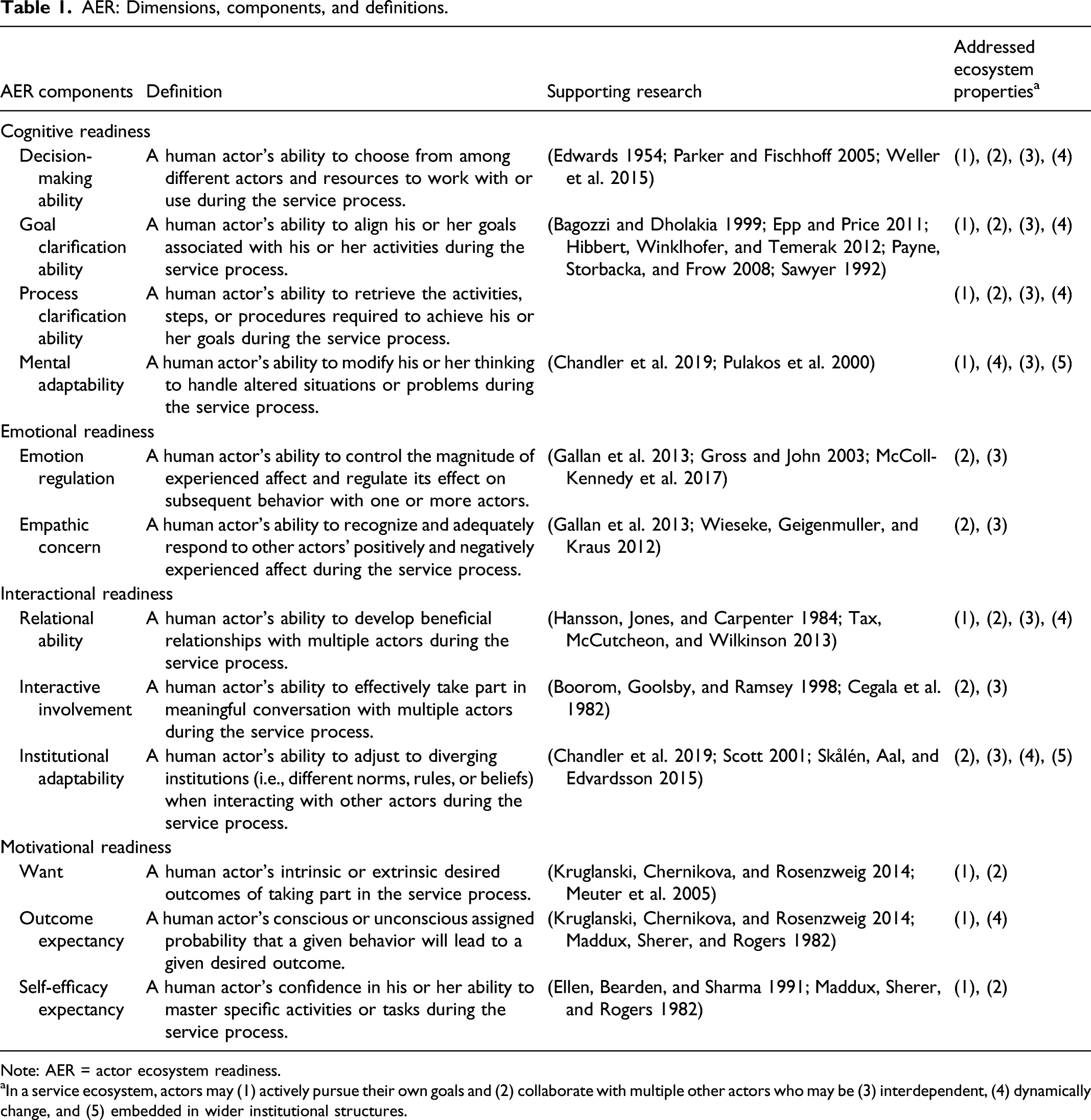
Note: AER = actor ecosystem readiness.
aIn a service ecosystem, actors may (1) actively pursue their own goals and (2) collaborate with multiple other actors who may be (3) interdependent, (4) dynamically change, and (5) embedded in wider institutional structures.
In the fifth and sixth stages, we evaluated our readiness concept in relation to its relevant audience (Alvesson and Sandberg 2011). Specifically, during multiple stages of this problematization process, 14 service research experts evaluated the adequacy of the emergent AER concept. We approached these experts given their publication record (i.e., number of Google Scholar citations or level 4/4* publications based on Chartered ABS ranking) and/or considerable expertise in service ecosystems. Further responses from service scholars at academic conferences also helped us refine our AER concept and framework.
Conceptualizing AER in a Service Ecosystem
We conceptualize AER as comprising four readiness dimensions: cognitive, emotional, interactional, and motivational. Together, these dimensions form an individual’s potential to collaborate with multiple actors, as defined previously. Similar to other human characteristics (e.g., age and personality traits), AER is a human property. Although its formation, level, and impact are subject to contextual influences and may differ, for example, by one’s role in the service process, AER’s constituent elements remain foundational and can be possessed (or not) by any human actor, whether customer or employee. Table 1 defines all AER elements.
Cognitive Actor Readiness
Research has long demonstrated the importance of cognitive abilities for individual-level performance in dyadic settings (Brown et al. 2002; Hunter 1986; Meuter et al. 2005) and unit-level, organizational outcomes (Nyberg et al. 2014). Accordingly, we argue that service research would also benefit from a better understanding of the cognitive underpinnings of multi-actor service provision. Our problematization approach yields four fundamental cognitive abilities that constitute human actors’ cognitive readiness in a service ecosystem.
Decision-making ability: Compared with dyadic encounters, multi-actor service provision requires customers and employees to frequently choose among a wide range of actors and resources that can be more or less instrumental to reaching desired outcomes. Psychology research refers to the capacity to understand, judge, and select between various sets of available choices as decision-making ability (Edwards 1954; Weller et al. 2015). Representing a state of rational thought, decision-making ability predicts social and risky behaviors (Parker and Fischhoff 2005) and is often understood as an important cognitive microfoundation that can inform higher-level processes and outcomes, such as team or organizational decisions and actions (Felin et al. 2012; Salvato and Rerup 2011).
Goal and process clarification ability: Customers and employees possess different, sometimes conflicting goals (Locke and Latham 2006) given distinct knowledge, needs, and wants—a condition known as dual-sided information asymmetry (Black and Gallan 2015). In a service ecosystem, this asymmetry is exacerbated as customers and employees often pursue multiple individual or collective, self-set or provider-prescribed goals (Hibbert, Winklhofer, and Temerak 2012). To resolve this asymmetry, customers and employees must be able to reconcile their goals and the processes for attaining them. Goal and process clarification abilities are thus essential for resolving dual-sided information asymmetry among ecosystem actors to promote a state of mutualism with more balanced interactions.
Mental adaptability: Customers and employees are frequently challenged to respond to altered situations, owing to potential shifts in actor goals (Skålén, Aal, and Edvardsson 2015) or changes in the ecosystem’s context (Chandler et al. 2019). As such, they must be able to learn new tasks, technologies, and processes to effectively navigate altered settings. They must also be able to invent solutions to complex, ill-defined, and atypical problems they have not encountered before. Psychology research refers to this ability as mental adaptability (Pulakos et al. 2000). Being able to mentally adapt to changing situations is crucial in multi-actor settings and thus is an important cognitive microfoundation of human ecosystem actors.
Emotional Actor Readiness
Multi-actor settings are typified by increased sociality among peers, employees, or other actors. This multitude of interpersonal bonds may trigger various affective experiences or come with greater demands on emotional labor. A single event of major affective significance during one encounter may trigger an unfolding, dynamic series of subevents that also elicit—sometimes contrasting—affective experiences in subsequent encounters with the same or other actors (McColl-Kennedy et al. 2017). Coupled with a heightened risk of emotional contagion and the potential ripple effect of emotions from customers to service employees and vice versa (Pugh 2001), both customers and employees may remain in an increased state of emotional arousal (Frijda 1993). Their ability to manage their feelings and handle those of others is thus critical in multi-actor settings. We identify emotion regulation and empathic concern as two fundamental abilities that form a human actor’s emotional readiness.
Emotion regulation: Extreme, unregulated responses to experienced affect can constrain collaboration between ecosystem actors. A major form of affect regulation is emotion regulation, or the “processes by which individuals influence which emotions they have, when they have them, and how they experience and express these emotions” (Gross 1998, p. 287). This ability can be triggered at any stage of emotional responding, significantly influencing a person’s interpersonal functioning (McColl-Kennedy et al. 2017). Customers and employees with greater emotion regulation ability will not only be able to better control their overall level of experienced affect but also be better at regulating their behaviors in response to varying levels of experienced affect elicited by any emotional event across encounters. Possessing this ability will thus reduce their risk of “catching” others’ negative affective states, while enabling the display of positive emotions, reinforcing positive emotional contagion that can foster customer–employee rapport (Hennig-Thurau et al. 2006).
Empathic concern: While emotion regulation is directed to one’s own affective experiences, collaboration partners are also confronted with affective stimuli that can trigger (un)favorable partner responses. Customers and employees who are unable to respond adequately to other actors’ affective experiences therefore risk service failures. This risk is magnified in multi-actor settings in which recognizing the affective distress of others is often critical in handling conflicts. Being able to respond to “another person’s emotions … without experiencing these emotions” (Wieseke, Geigenmuller, and Kraus 2012, p. 317)—an ability referred to as empathic concern—is thus essential for fostering collaboration in an ecosystem.
Interactional Actor Readiness
Interactions lie at the core of multi-actor service provision, which span across physical, social, and digital realms of a service ecosystem (Bolton et al. 2018). These realms become more connected as interactions increase among multiple actors through myriad touchpoints and channels, making service experiences more social in nature (Lemon and Verhoef 2016). Understanding the abilities that allow customers and employees to effectively navigate their social context is therefore crucial in the success (or failure) of multi-actor service provision. We identify relational ability, interactive involvement, and institutional adaptability as three fundamental abilities that form a human actor’s interactional readiness.
Relational ability: In a service ecosystem, actor relationships dynamically develop or cease to exist (Löbler 2013) in response to environmental changes or changed actor needs (Black and Gallan 2015; Chandler et al. 2019). Customers and employees must thus be able to continuously initiate or sustain relationships. Social psychology refers to this ability as relational competence, entailing individual characteristics that “facilitate the acquisition, development, and maintenance of mutually satisfying relationships” (Hansson, Jones, and Carpenter 1984, p. 273). As deficits in relational ability may result in distorted, deviant, and risky behavior, we expect customers and employees with greater relational ability to more easily develop and sustain collaborative relationships with other ecosystem actors over time.
Interactive involvement: As interaction implies some form of communication, communication abilities are often essential for positive outcomes. Dialogical communication research frequently focuses on the concept of interactive involvement, or “the extent to which an individual participates with another in conversation” (Cegala et al. 1982, p. 229). The concept consists of two aspects: (1) attentiveness and/or perceptiveness, or one’s ability to receive (non)verbal cues during interactions and to assign meaning to communication stimuli, and (2) responsiveness, or one’s ability to formulate timely and effective messages (Boorom, Goolsby, and Ramsey 1998). In multi-actor settings, interactive involvement is particularly important because customers and employees may often communicate with fast-changing actor constellations through myriad online or offline channels to accomplish their goals.
Institutional adaptability: Interactions among ecosystem actors are guided by multiple, sometimes competing institutions—the (in)formal rules, norms, and beliefs (Scott 2001) that shape behavior. Competing institutions are more likely in multi-actor settings because customers and employees may bring together a wide range of actors from different backgrounds who might be guided by diverging rules, norms, or beliefs. Such competing institutions may catalyze ambiguity and conflict about acceptable behaviors, but they may also prompt actors to question the prevalent institutional order (Chandler et al. 2019). We expect individuals to possess diverging degrees of institutional adaptability—that is, the ability to adjust to competing institutions within an ecosystem. Customers and employees with greater institutional adaptability may not only adapt more readily to various institutional settings but also be better at questioning prevalent values, rules, or norms, and initiating respective change efforts, thus driving institutionalization processes in a service ecosystem.
Motivational Actor Readiness
Motivation represents the energizing force that drives the meaningful application of one’s abilities. Even when individuals have the abilities to participate in multi-actor settings, they may not be motivated to do so. We refer to this condition as motivational actor readiness, which is determined by momentary desire (want) and outcome and self-efficacy expectancy.
Want: Psychology research defines a want as the “outcome that a person … desires at a given moment,” including “all types of desires … whether based on internal physiological deficits or broad psychogenic needs, and regardless of their modes of origination” (Kruglanski, Chernikova, and Rosenzweig 2014, p. 369). As such, the want concept establishes the basis for the formation of and commitment to pursue particular service goals (Bagozzi and Dholakia 1999). It accounts for intrinsic motives (fun and pleasure) and external sources of desire (convenience and time/money savings), as put forth by Deci, Connell, and Ryan’s (1989) self-determination theory, that catalyze participation in dyadic encounters (Meuter et al. 2005). While extrinsic desires may fuel activities in multi-actor settings, we expect them to be particularly driven by intrinsic socioemotional desires, such as one’s desire to develop friendships or one’s attachment to specific peer groups (Amichai-Hamburger et al. 2016).
Outcome and self-efficacy expectancy: Individuals may have multiple wants, but not all wants can be gratified equally. Psychology research refers to anticipated gratification as expectancy, or the “subjective probability an individual assigns (consciously or unconsciously) to gratification of the [w]ant” (Kruglanski, Chernikova, and Rosenzweig 2014, p. 369). Expectancy takes two forms. Outcome expectancy is “the belief that a given behavior will or will not lead to a given outcome” (Maddux, Sherer, and Rogers 1982, p. 208), while self-efficacy expectancy refers to a person’s “evaluation of [his or her own] competence or ability to perform the required task(s) or behavior” (Ellen, Bearden, and Sharma 1991, p. 299). Both expectancy forms are particularly important in an ecosystem context, given the possibility of customers and employees to collaborate with many actors for the gratification of a particular want—collaborations (and associated tasks) that they are more or less confident that they will handle well or that they judge as having differing probabilities of accomplishment or as requiring different degrees of effort, or “amount of energy [they need to] put into a behavior” (Mohr and Bitner 1995, p. 240). Indeed, prior service research shows that customers anticipate varying degrees of effort (and, thus, outcome expectancy) in their interactions with different ecosystem actors (Sweeney, Danaher, and McColl-Kennedy 2015).
Overall, our AER concept integrates interdisciplinary research on human abilities and motivation to introduce a broader, ecosystem-oriented readiness concept. We newly develop some AER components (e.g., goal and process clarification ability and mental and institutional adaptability), and we adapt others from prior multidisciplinary research on individual differences (e.g., decision-making ability, emotion regulation, and want). Together, they represent a novel, unique, and parsimonious configuration of readiness components that jointly allow a human actor to effectively navigate a service ecosystem. It is precisely this integration, alongside the rigorous problematization of traditional readiness concepts and the systematic delineation of each AER component, that constitutes the threefold theoretical contribution of our AER conceptualization of revising, delineating, and integrating (MacInnis 2011).
Theorizing AER: A Multilevel Framework
Although our previous discussion delineates constituent elements of AER, it does not explain the means by which those AER dimensions interact with each other to ultimately transform into higher-level ecosystem outcomes. Following HCR theorizing (Ployhart and Moliterno 2011), Figure 1 presents a rich multilevel framework addressing this emergence process: it structures AER’s nomological interdependencies in five sets of propositions across two building blocks. The first block theorizes AER’s microlevel interdependencies by delineating how AER dimensions shape one another (P1) and how AER translates into customer and employee behavior and outcomes at the microlevel (P2). In line with multilevel theorizing (Kozlowski and Klein 2000), the second building block theorizes AER’s systemic interdependencies across ecosystem levels, including contextual influences, and AER’s influence on higher-level outcomes as we discuss AER’s boundary conditions (P3), antecedents (P4), and micro–meso–macro links (P5). Thus, unlike prior microlevel readiness and prior macrolevel ecosystem research, our model articulates the nature of these cross-level relationships to explicate why and how AER serves as a microfoundation of service ecosystem effectiveness. Conceptual framework.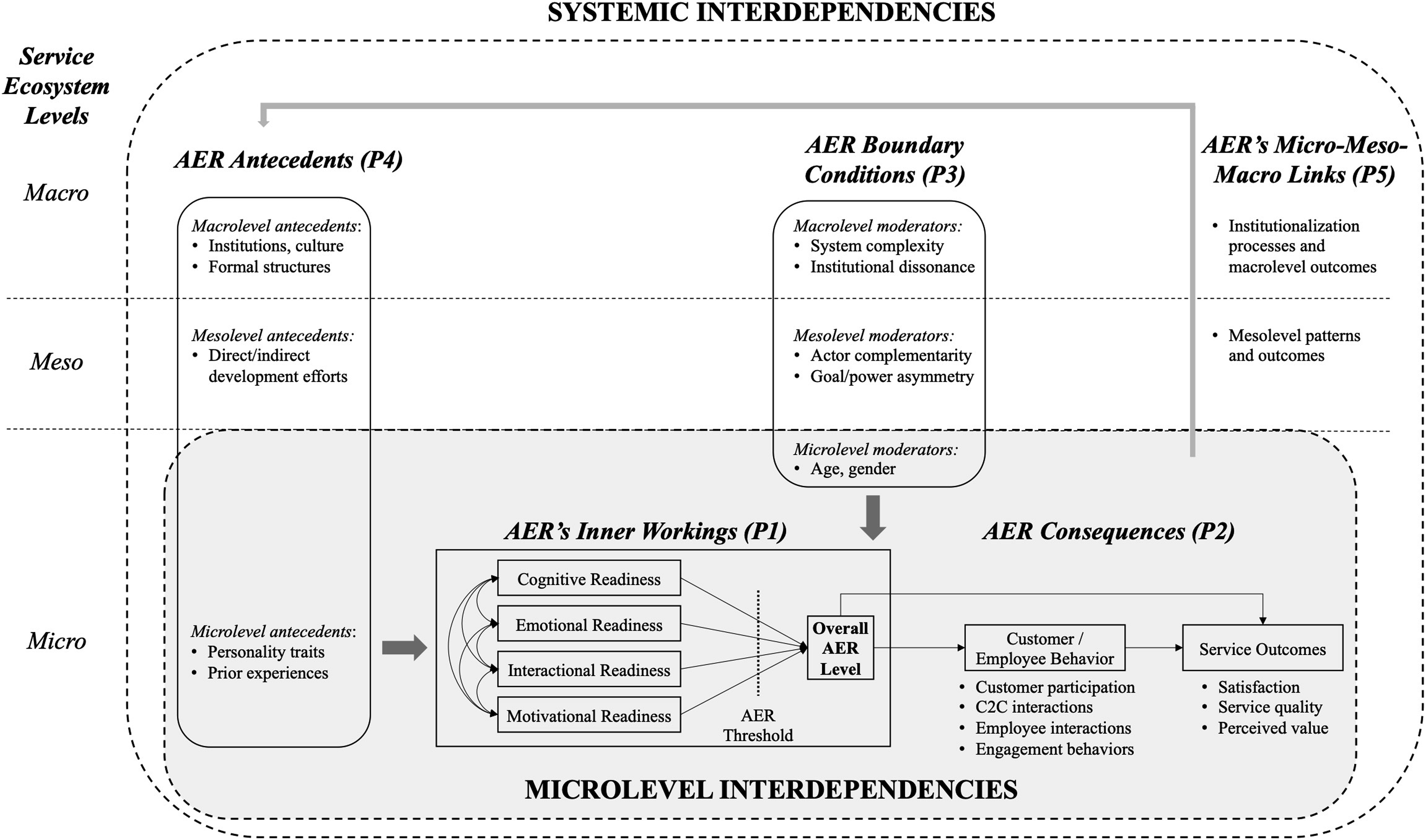
Given AER’s fundamental ecosystem focus, which accommodates the versatile roles and responsibilities of customers and employees in collaborative service settings (e.g., Brodie et al. 2019; Vargo and Lusch 2016; see also Benoit et al. 2017; Bowen 2016; Larivière et al. 2017; Ostrom et al. 2015), we next delineate AER’s nomological relationships relevant to both actor types. We recognize, however, that differences may exist between customers and employees, either due to different roles and behavioral boundaries or because of varying access to resources or embeddedness in (organizational) structures that can influence AER’s formation, level, or impact. Supplementary Appendix 4 provides in-depth illustrations of customer and employee differences for all five propositions, together with empirical examples.
Microlevel Interdependencies of AER
Inner workings of AER: All AER components represent conceptually distinct AER facets. Yet we expect that some of those facets are interdependent and may affect one’s overall AER both positively and negatively. For example, psychology research suggests that greater cognitive abilities positively affect interpersonal adaptability (Pulakos et al. 2000; Weller et al. 2015) while motivational readiness components positively determine one another (Kruglanski, Chernikova, and Rosenzweig 2014). However, in highly emotional situations, empathic sharing may inhibit mental performance (Kanske et al. 2016), while artificial suppression of emotions may reduce interactional abilities (Butler and Egloff 2003).
In line with cognitive psychology research (Kruglanski, Chernikova, and Rosenzweig 2014), we further propose that neither abilities nor motivation alone will instill readiness and that all readiness dimensions must surpass a minimum threshold to establish a potential that may translate into action. Psychology research further suggests that only when motivational readiness surpasses a given threshold level of want and expectancy will individuals commit to attaining a specific goal (Kruglanski, Chernikova, and Rosenzweig 2014). Below this commitment point, one’s wants are not powerful enough to generate goal commitment and so will not translate into AER. Insufficient abilities will likewise prevent overall AER formation. Even individuals scoring high on motivational readiness, and thus highly committed to attaining specific goals, may lack the necessary cognitive, emotional, or interactional means to collaborate with others or use resources effectively for the purpose of fulfilling those goals. Thus, in the complete absence of any one AER dimension (or when all dimensions remain under a minimum threshold), we expect one’s overall AER to be zero.
By contrast, when ability-related AER dimensions exceed a minimum threshold given sufficient motivational readiness, the dimensions’ respective effects on overall AER will be additive. That is, when individuals score high on cognitive, emotional, and interactional readiness, they will also score high on overall AER, when motivational readiness is held constant. In turn, when motivational readiness exceeds a minimum threshold given sufficient abilities, its effect on overall AER will be synergistic. That is, higher motivational readiness may not only enhance AER directly but also amplify the impact of abilities on one’s overall AER. This is because individuals who score higher on motivational readiness possess greater goal commitment, which propels the meaningful application of their abilities (Kruglanski, Chernikova, and Rosenzweig 2014). Therefore, we expect motivational readiness to have a stronger total impact on overall AER than any other AER dimension. Thus:
From AER to action and service outcomes: Our proposed AER concept attains its distinctiveness from actual behavior, representing a customer’s or employee’s intrinsic potential. Yet, for readiness to translate into action, AER dimensions need to surpass a certain threshold. After surpassing this threshold, customers, and employees with higher AER levels will be more likely to leverage resources and engage in meaningful interactions with multiple ecosystem actors. These interactions might be directed to firms or other customers or colleagues, resulting in higher customer participation, customer-to-customer interactions, or employee interactions (McColl-Kennedy et al. 2012). They might also encompass engagement behaviors, referring to extra-role behaviors such as referral, word of mouth, or helping others that go beyond what is essential to transactions (Van Doorn et al. 2010).
However, while changes in ability-related AER dimensions are of a rather long-term nature, motivational readiness may fluctuate more frequently, given changes in the goals that one desires (want) and the perceived likelihood of their attainment (outcome expectancy). That is, while customers and employees may possess sufficient motivational readiness and, thus, goal commitment before the service encounter, the magnitude of one’s commitment to a particular goal may change quickly (Kruglanski, Chernikova, and Rosenzweig 2014). Service processes unfold dynamically, and events during the service encounter (e.g., a sudden opportunity or adversity, a service failure) or in the wider environment (e.g., transportation issues, an emergency) may cause a sudden shift in priorities and lead to the pursuit of new goals that are more desirable or attainable (Ajzen and Kruglanski 2019). Thus, want and expectancy are updated dynamically, as are one’s motivational readiness and overall AER.
An individual’s actions are also not situated in a vacuum, nor is AER. While AER represents an individual-level human property, it essentially influences and is influenced by the wider institutional and social context of the service ecosystem. AER thus does not deny the role of context—quite the opposite. In line with Phillips, Lawrence, and Hardy’s (2000) notion on how organizational fields affect actors, we argue that the wider institutional context of a service ecosystem provides the structural scaffolding in which AER develops and influences behavior. Simultaneously, AER allows individual actors to reflect on and shape the very institutions and structures in which they are embedded, thus driving the process of structuration (Giddens 1984) that ensures stability and change in a service ecosystem.
This dual perspective emphasizes how AER enables actors not only to undertake highly conscious, means–end activities but also rather unconscious, habitual activities in ordinary life and, with that, practices, both of which are guided by the institutional context of the service ecosystem. Indeed, our AER concept may also be understood as a condition for enacting practices, such as “routinized ways in which bodies are moved, objects are handled, subjects are treated, things are described and the world is understood” (Reckwitz 2002, p. 250). Importantly, practices still require the creative mobilization of abilities and motivation to handle unfolding situations by making some practices more self-evident than others so that the person is unconsciously drawn to them (Cardinale 2018). AER therefore not only instills highly conscious, deliberate activities in high-interest encounters but also affects routinized, often unconscious behaviors in low-risk, everyday encounters.
For example, in health care, a certain level of AER will not only help a patient consciously evaluate, choose, or rule out one treatment option over another in view of anticipated benefits (e.g., whether to pursue a physiotherapeutic treatment or a risky surgical intervention) but also actively orient him or her to a specific treatment option from among all viable treatment possibilities. That is, depending on his or her AER, some treatments will not occur as options at all (e.g., the possibility to ask other patients for support is not likely to occur to patients scoring low on interactional readiness), while other options will appear self-evident, such that the patient is unconsciously drawn to them. This mechanism likewise applies to routinized behavior, though the impact of AER is more subtle. For example, patients trying to renew a prescription they have been using for several years and who score low on emotional readiness will unconsciously be more inclined to renew their prescription online rather than risk direct encounters with a pharmacist who might provoke feelings of guilt, shame, or embarrassment—situations that often occur for psychological, skin, or sexual diseases. Likewise, health care professionals scoring low on interactional readiness will be more inclined to adopt a provider style that entails fewer patient interactions and act as delegates or mentors instead of as partners or coaches (Ng, Plewa, and Sweeney 2016).
According to person–job fit theory (Edwards 2001), customers and employees with higher AER levels may further experience better service outcomes given their enhanced demands–ability fit. A demands–ability fit refers to “a situation in which one’s knowledge, skills, and abilities are commensurate with what the job [or the encounter] requires” (Kristof-Brown, Zimmerman, and Johnson 2005, p. 284). Extant evidence shows that both employees and customers who experience such a fit will have increased satisfaction, loyalty, and performance (Dong et al. 2015; Lauver and Kristof-Brown 2001). Thus:
AER’s Systemic Interdependencies
Multilevel boundary conditions of AER: Several boundary conditions across ecosystem levels can moderate the strength of AER’s microlevel links. At the microlevel, age, for example, negatively influences participation in collaborative settings (Oertzen, Odekerken-Schröder, and Mager 2020). With increasing age, people become more reluctant to use novel technologies (Parasuraman and Colby 2015), thus inhibiting technology-mediated interactions despite high AER levels. Moreover, women are more likely to exhibit citizenship behaviors (Oertzen, Odekerken-Schröder, and Mager 2020)—differences that we expect to also strengthen AER’s link to behavior and outcomes in multi-actor settings.
At the mesolevel, high goal or power asymmetry will likely inhibit AER by curtailing its influence on mutually beneficial outcomes. Specifically, high goal asymmetry will likely spark tension and conflict among actors (Skålén, Aal, and Edvardsson 2015), thus requiring higher degrees of AER. This negative effect will be amplified when customers or employees, depending on their role, possess different degrees of power—whether by being more trusted (Black and Gallan 2015), more connected, or able to access or disseminate information faster; by bridging otherwise disconnected groups (Scott and Carrington 2011); or by possessing greater autonomy in selecting potential collaborators (Tax, McCutcheon, and Wilkinson 2013). For example, in general, customers possess greater autonomy to select potential partners, while employees tend to be more connected with other stakeholders and to have greater access to information and resources. By contrast, we expect a high degree of complementarity among actors’ AER to strengthen AER’s link to outcomes. This is because ecosystem outcomes often depend on the readiness of others, as necessary tasks are often executed by different individuals (e.g., employees from different providers) or outsourced to others (Ng, Sweeney, and Plewa 2019). Therefore, we argue that an individual’s lack (or excess) of AER dimensions is likely to affect others’ required AER, while ideally AER shortcomings may be balanced out by other actors’ AER to achieve desired outcomes.
At the macrolevel, various structural ecosystem features may inhibit or strengthen AER’s influence. For example, some ecosystems are characterized by high stability and largely shared institutions, while others are more fluid, given the presence of competing institutions and, thus, institutional dissonance (Chandler et al. 2019). As employees in an organization or customers in an online community generally share prevalent norms, rules, and values, institutional dissonance is more likely to be an issue between customers and employees or among employees of different service providers. Research suggests that individuals experiencing high institutional dissonance will more likely encounter tension and conflict (Skålén, Aal, and Edvardsson 2015). Consequently, interactions will be more demanding, requiring higher levels of effort to realize desired outcomes. As an individual has limited capacity to effectively deal with effortful situations (Cowan 2005), we expect higher levels of institutional dissonance to curtail AER’s impact. Various other ecosystem features can further moderate AER’s impact. For example, ecosystems may differ in the number of actors involved, the degree of connectivity among actors, or the predictability of actors’ behavior (Black and Gallan 2015). Together, these features (and the rate at which they change) may amplify customers’ or employees’ perceptions of overall system complexity or the “subjectively perceived difficulty in making sense of [multi-actor] service [processes]” (Mikolon et al. 2015, p. 514), thus restraining their AER. However, compared with customers, employees follow more formalized roles and have greater access to resources, such as information, networks, and expertise. Their readiness may thus be less affected by system complexity, as they will require less effort to comprehend complex service processes.
Notably, the positive or negative impacts of AER’s boundary conditions can reinforce or offset one another. For example, Ng, Plewa, and Sweeney (2016, p. 388) observe that customers “may avoid participating in a service process if they perceive it as overwhelming.” Instead, overwhelmed customers often choose to outsource tasks and responsibilities to service employees. Yet the benefits of outsourcing will only materialize if employees possess complementary AER. Therefore, perceived system complexity can attenuate AER’s impact, whereas high levels of AER complementarity offset this negative moderating effect. Thus:
Antecedents of AER: macro–meso–micro links: AER is shaped by multiple factors across ecosystem levels. At the microlevel, actor-related factors may influence AER development. Some of these are unlikely to change over a person’s lifetime. For example, high openness—one of the Big Five personality traits (Gosling, Rentfrow, and Swann 2003)—may increase one’s ability to mentally adapt to atypical problems or creatively invent new solutions, leading to increased cognitive readiness. Other factors, such as past positive or negative experiences with particular (constellations of) ecosystem actors, may allow for observation, leading to changes in cognition and ability enhancement (Kolb 2014; Wood and Bandura 1989). Indeed, research suggests that high-valence experiences, especially negative ones, can provoke self-awareness and trigger reflective learning and ability development (Bosangit and Demangeot 2016), while also having mixed effects on motivational readiness. Specifically, we expect a person’s desires (i.e., wants) to be either intensified or diminished, depending on whether these experiences are judged to have resulted from his or her own or another actor’s (repeated) success or failure (Verleye, Gemmel, and Rangarajan 2014). For example, if a customer judges a negative experience to have resulted from his or her own personal failure, motivational readiness is likely to be diminished. If, instead, a customer ascribes a negative experience to company failure, this may intensify his or her desire to be compensated. By contrast, past positive experiences, for example, in a similar service context, will likely increase one’s desire and expectancy and, thus, motivational readiness.
At the mesolevel, various (in)direct development efforts initiated by any ecosystem actor (e.g., service or platform providers, nonprofit organizations, peers, and service robots) can affect AER. Direct efforts encompass instructional activities, such as coaching or mentoring (Ng, Plewa, and Sweeney 2016), and include incentives, such as money, fun, time savings, encouragement, or appraisal (Bell, Auh, and Eisingerich 2017). Indirect efforts focus on providing favorable conditions for self-directed learning (Hibbert, Winklhofer, and Temerak 2012). These conditions include supplying learning resources, offering feedback, putting formalized incentive mechanisms in place, and establishing virtual or offline learning environments. Depending on the type of knowledge that is acquired (Plangger et al. 2020), some efforts can be more effective, while others can be counterproductive to the development of AER dimensions (e.g., monetary incentives foster motivational readiness but incentivize antisocial behaviors, thus negatively affecting interactional readiness). Generally, employees tend to have greater access to direct development efforts, while customers’ AER development is rather self-directed and driven by indirect development efforts, often provided by peers.
At the macrolevel, AER can be influenced by more or less formalized structures. These structures form the ecosystem’s social, cultural, and institutional context and specify the conditions that shape behavior. For example, institutionalized norms, cultural beliefs, and established routines can affect the degree of information diffusion, knowledge sharing, and coordination among actors, thus influencing ability development at the microlevel (Felin et al. 2012). AER can also be affected by formalized structures, ranging from the design of peer-to-peer (P2P) platforms or incentive systems that “nudge” specific behaviors to formal relationships governed by contracts. Formalized (organizational) structures, which likely affect employees’ AER to a greater extent, also include the design of leadership or other coordination mechanisms that can either drive or curtail AER formation. Formal and informal structures can affect AER directly and indirectly, by impacting the provision of development efforts at the mesolevel and individuals’ learning experiences at the microlevel. Thus:
From AER to ecosystem outcomes: micro–meso–macro links: Not only is AER influenced by multilevel factors, but it can also influence behaviors and outcomes at the meso- and macrolevels of the service ecosystem. This micro–meso–macro link is critical in understanding why AER qualifies as a microfoundation of ecosystem effectiveness because it unpacks how human assets explain more distant, macrolevel phenomena (Coleman 1990). According to HCR literature (Ployhart and Moliterno 2011) and microfoundational theorizing (Felin, Foss, and Ployhart 2015), aggregation in an ecosystem is not additive but rather complex due to actor interdependencies that may lead to emergent, unforeseen outcomes.
More specifically, AER may lead to the development of particular collaboration patterns at the mesolevel (Storbacka et al. 2016) which we argue will be more effective if customers and employees possess higher AER levels. In turn, more effective collaboration patterns might lead to more beneficial collective outcomes, such as higher satisfaction scores among employees of coproviders or better peer evaluations. By contrast, lower AER levels may lead to problematic behaviors that may challenge institutionalized expectations. Indeed, these mesolevel patterns and outcomes are likely to affect the legitimization of existing or the development of new belief, rule, and norm systems that underlie institutionalization processes in a service ecosystem. Importantly, these new or reinforced macrolevel structures will not only affect system-level outcomes, such as ongoing stability and functioning of the service ecosystem, but also act as AER antecedents that may influence AER in subsequent service processes. Different AER levels may thus emerge in iterative collaboration cycles over time, thus accounting for the ecosystem’s inherent within-interaction dynamics. Thus:
Empirical Illustrations
Next, we showcase the real-life applicability of our AER framework in the context of disease management programs (DMPs) and platform-enabled concierge services. These multi-actor services differ along various dimensions (complex treatments of chronic diseases vs. simple concierge services, offline vs. app-based services, high- vs. low-involvement encounters).
Illustrative Example: Disease Management Programs
Disease management programs are increasing in popularity for treating chronic conditions (Pearl and Madvig 2020). In Germany, more than 4.3 million statutorily insured patients are currently enrolled in DMPs for type 2 diabetes (Kassenärtzliche Bundesvereinigung 2020). With more than 340,000 patients (Krankenkasse 2020), TK-Plus is the leading DMP for diabetes, offered by the largest German statutory health insurer Techniker Krankenkasse (TK). Key to TK-Plus is that patients are actively involved in the design of complex care plans with an extensive network of health care practitioners (e.g., doctors and dieticians), peers, family, and friends.
Both patients and participating general practitioners (GPs) need to surpass a readiness threshold to initiate the TK-Plus program. For patients, this involves showing up to appointments, providing documentation of their medical history, and contributing to setting treatment goals. In turn, GPs need to be ready to suggest an initial set of professionals (e.g., dieticians, podiatrists, and ophthalmologists), decide on the intervals of check-ups with each, and obtain feedback reports. Patients with higher AER will be better at managing a diverse support team and engaging new or replacing current caregivers, as will caregivers, in offering support, and making necessary program changes. AER dimensions are also interdependent; for example, an empathetic dietician may also possess better social skills, while a patient who is confident about his or her abilities may be better at setting dietary goals (P1).
Ultimately, patients with higher AER will more likely use available TK-Plus resources and collaborate more effectively with peers or health care professionals. Not only will their AER allow them to consciously evaluate whether they should choose one treatment over another, but it will also unconsciously lead them to seek specific forms of support. Given an enhanced demands–ability fit, they will likely obtain better treatment outcomes. Participating GPs and other caregivers with higher AER will also be more effective at adopting suitable styles and acting as mentors, partners, or coaches (P2). Yet, despite high AER levels, older patients may be more reluctant to use self-management tools integral to TK-Plus (e.g., logbooks). Likewise, goal and power asymmetries between patients and caregivers, the overall complexity of the TK-Plus program, or clashing perceptions of acceptable behaviors may overwhelm patients and hamper participation despite high AER levels. Yet negative effects on treatment outcomes (and patient AER shortcomings) may be balanced out by complementary AER levels of involved caregivers, peers, or family members (P3).
Patients’ and caregivers’ AER are influenced by their personality traits (e.g., more extroverted patients will possess greater interactional readiness) or past experiences with specific treatments. Patients may also develop AER through structured education programs or other incentives offered by TK-Plus (e.g., participation in the TK bonus rewards program). Participating GPs, in turn, may develop their AER through diabetes-specific trainings or networking events. Since their introduction in 2004, DMPs such as TK-Plus have become increasingly structured with established coordination mechanisms, while unwritten rules, norms, and beliefs (institutions) may influence information exchange, coordination among patients and caregivers, the design of education programs, and, ultimately, a patient’s or caregiver’s AER development (P4). Conversely, their AER may affect the development of more (or less) effective collaboration patterns and either legitimize existing or give rise to new rules and norms or to the design of new formal structures over time that may affect patients’ and caregivers’ AER as they continue to participate in the TK-Plus program (P5).
Illustrative Example: Platform Businesses
The role of AER is also apparent in platform-enabled services that provide solutions for rather simple, everyday needs. Hello Alfred, for example, is a US-based platform that connects consumers, real estate developers, property managers, residents, and local service providers with a personal home manager, called “Alfred.” Dedicated Alfreds coordinate and complete a customer’s weekly errands and customized on-request services, such as apartment cleaning, grocery shopping, event planning, and gift shopping. To complete more elaborate tasks, Alfreds partner with multiple third-party providers, other specialists, and local vendors.
To effectively fulfill requests, Alfreds need to surpass a minimum readiness threshold; higher AER levels will enable Alfreds to carefully put together local vendors, stores, and service providers that they can visit while they are in the customer’s neighborhood that best fulfills the customer’s needs but also aligns with their own goals (e.g., minimal effort and enjoyable encounters) and those of the platform provider (e.g., quality standards) (P1).
Alfreds with higher AER will collaborate with customers, platform employees, and coproviders more effectively, choose—consciously or unconsciously—specific delivery options or partners over others, and make the most of accessible resources (e.g., platform support, estate facilities), likely resulting in better service outcomes (P2). Despite high AER levels, goal and power asymmetries and differing perceptions of acceptable behavior among Alfreds, customers, or local service providers might hamper effective interaction. Some Alfreds may further judge some tasks or interactions as more complex than others, which may require more effort and lead to less ideal outcomes. Highly empathetic Alfreds may likewise balance out potential emotional readiness shortcomings of customers, vendors, third-party providers, or platform staff (and vice versa) to ensure effective service delivery (P3).
Hello Alfred follows established industry practices—that is, “rules of the game” (institutions) of multisided platforms regarding, for example, review mechanisms or quality control practices that guide the behavior of customers and Alfreds. By putting specific payment policies in place, Hello Alfred creates incentive structures that can reduce an Alfred’s or partner’s shortsighted thinking, ultimately affecting their AER development (P4). Higher AER across Alfreds, coproviders, and customers may, in turn, lead to the emergence of effective collaboration patterns and outcomes (e.g., evaluation scores) that can reinforce existing or fuel the development of new more or less formalized macrolevel structures (P5).
Discussion
Theoretical Contributions
Theoretically, this article provides two significant contributions. First, it advances prior readiness concepts by introducing a novel configuration of abilities and motivational conditions that are fundamental to customers and employees navigating multi-actor settings. Importantly, our AER concept is grounded in a synthesis of interdisciplinary literature streams. This integration, alongside the systematic problematization of prior readiness concepts and the rigorous development of an ecosystem-oriented readiness conceptualization, constitutes AER’s threefold theoretical contribution of revising, delineating, and integrating (MacInnis 2011). Thus, in contrast to prior readiness concepts (e.g., Dellande, Gilly, and Graham 2004; Dong et al. 2015; Meuter et al. 2005), AER is not concerned with the “proper” functioning of customers or employees in accordance with firm objectives, nor is it confined to the customer–provider dyad. Instead, our AER concept foregrounds the customer and employee and specifically accounts for dynamic, multi-actor interactions and nomological interdependencies of the wider ecosystem context. Accommodating these complexities of multi-actor service provision is precisely where the real value lies in adopting an ecosystem perspective and where prior readiness concepts fail to provide relevant answers. The urgency in providing a broader, ecosystem-oriented understanding of readiness is reflected in various recent calls in service research for deeper insights into actor characteristics (Keeling et al. 2021), person-dependent factors (Oertzen, Odekerken-Schröder, and Mager 2020), ecosystem-specific actor endowments (Ng, Sweeney, and Plewa 2019), and the skills and competences (Larivière et al. 2017; Lu et al. 2020) needed by customers and employees to navigate today’s interconnected service environments. Our AER concept answers these calls.
Second, building on HCR literature (Nyberg et al. 2014; Ployhart and Moliterno 2011), this article offers a multilevel framework with five sets of testable propositions that theorize AER’s nomological interdependencies across ecosystem levels. In this way, our framework not only details how AER dimensions shape one another and how AER translates into behavior and outcomes at the microlevel. It also articulates the contextual influences and the process of how these human assets transform into higher-level outcomes at the meso- and macrolevels of a service ecosystem. In explicating these micro–meso–macro links (and vice versa), our framework articulates why and how AER qualifies as a microfoundation of service ecosystem effectiveness (Felin, Foss, and Ployhart 2015). Specifically, our framework serves two central functions. First, it explicates the crucial role of human assets in promoting (or hindering) positive outcomes in multi-actor settings. In doing so, it directly responds to the two service research priorities of “[f]ostering service network collaboration to enhance customer experiences” and “[u]nderstanding value creation in multi-actor, network, and collaborative contexts” proposed by Ostrom et al. (2015, p. 153), thus extending knowledge of service-delivery networks (Tax, McCutcheon, and Wilkinson 2013) and other views on networked value cocreation (Black and Gallan 2015). Second, our AER framework critically refines the service ecosystem concept itself (Vargo and Lusch 2016) by providing a more theoretically complete and nuanced picture of its microfoundations (Wilden et al. 2017), thus helping to overcome the concept’s rather abstract nature and the positive bias in current ecosystem literature (Mustak and Plé 2020). The overarching theoretical contribution of our framework can thus be classified as delineating, as it “detail[s], chart[s], describe[s], or depict[s] an entity [i.e., AER] and its [cross-level] relationship to other entities” (MacInnis 2011, p. 138).
Contributions and future research agenda.
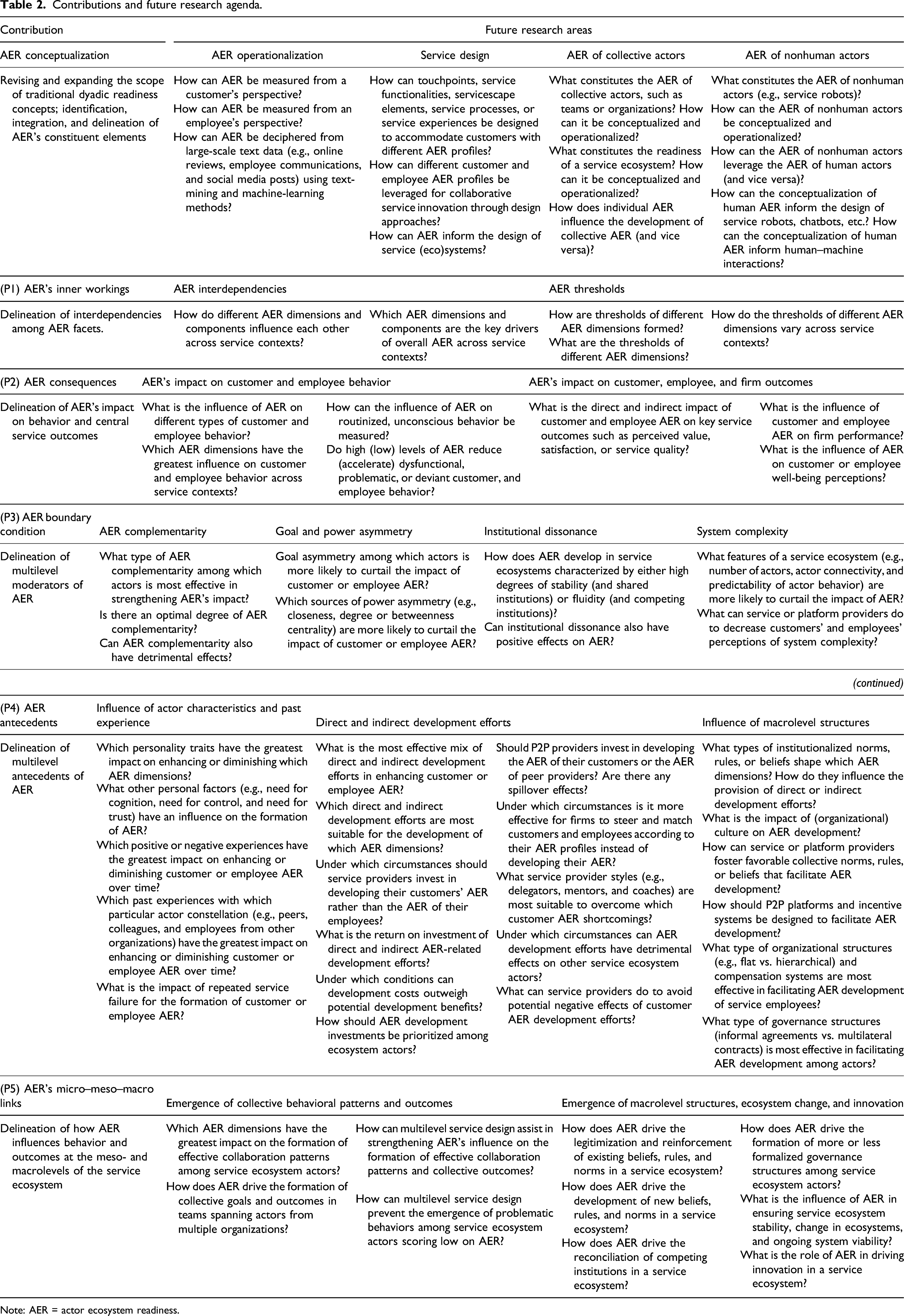
Note: AER = actor ecosystem readiness.
Managerial Implications
From a managerial perspective, our AER concept can help practitioners better discern why some customers or employees fail while others succeed in leveraging accessible resources; why some are better than others in managing a network of service providers or peers; or why some are active in online communities, patient support groups, or citizen platforms while others do not participate at all. This understanding is important as firms often struggle to adequately manage their customers’ and employees’ individual differences (Frei 2006), a challenge that is exacerbated in multi-actor health care (Keeling et al. 2021), P2P (Fombelle et al. 2020), commercial (Larivière et al. 2017), and public (Baruch, May, and Yu 2016) service settings.
Moreover, our AER concept equips firms with an actionable set of 12 components that they can use strategically to develop both their employees and customers. Yet, when financial resources are scarce, a useful approach might be to prioritize investment decisions according to specific AER components. Managers can use our AER concept to monitor and segment employees or customers to detect groups that deserve specific attention. For example, customers scoring low across AER dimensions will require more hand-holding. In turn, providing opportunities to learn from peers or colleagues might be more suited for customers or employees scoring high on emotional and interactional readiness, while active encouragement might be more effective for those scoring low on motivational readiness. For example, employees could be instructed to compliment customer progress, especially in complex settings, to alleviate perceptions of personal failure that might otherwise reduce their motivation to participate in future encounters. Likewise, staff could encourage customers by demonstrating participation returns (e.g., customized solutions and unique travel experiences), or providers could use platform functionalities or user interfaces to establish incentive systems that “nudge” desired behaviors. Thus, our AER concept could serve as a basis for the design of new or the adjustment of existing service processes or functionalities (Patrício et al. 2011).
Finally, our AER concept can guide firms to better match customers and employees according to their AER profiles. For example, customers could be directed to employees, peers, or third-party providers that are specifically trained to accommodate their needs (Wieseke, Geigenmuller, and Kraus 2012). Different service provider styles (e.g., delegators, mentors, and coaches; Ng, Sweeney, and Plewa 2019) could then be employed to overcome particular customer AER deficiencies. Likewise, customers and employees could be steered to specific subprocesses or touchpoints that are particularly designed to suit different “AER personas” (Lemon and Verhoef 2016). Alternatively, the deliberate steering into groups of customers or employees with differing AER profiles (i.e., matching) may lead to experiential learning cycles (Kolb 2014) and more effective collective behavioral patterns and outcomes.
Limitations and Future Research Agenda
In developing our AER concept and framework, we deliberately synthesized diverse literature streams that somewhat overlap or are partly grounded in diverse (paradigmatic) assumptions. In line with our problematization approach, however, the juxtaposition of “such assumptions is often a central ingredient for generating interesting research questions” (Alvesson and Sandberg 2011, p. 255) that can outweigh potential drawbacks in mixing insights from various schools of thought. Although our AER concept is specifically geared toward multi-actor settings, it may also apply to dyadic encounters, particularly those characterized by rather collaborative roles. However, we do not contend that all AER elements will always be equally important or that high AER will always be required to realize desired outcomes, as other involved actors might balance out potential AER shortcomings. We also do not propose that AER influences deliberate behavior in high-risk encounters in the same way as in routinized encounters. These are very different situations that our framework discusses.
However, empirical research is necessary to corroborate our AER concept and model. Several research areas emerge in relation to our two key theoretical contributions—our AER conceptualization and framework and its five propositions. In addition to summarizing the most important future research areas here, we offer an extensive research agenda in Table 2.
In relation to our AER conceptualization, four key research areas emerge. First, to empirically corroborate our proposed AER conceptualization, future research should develop a measurement instrument for AER. Although limited measures exist for some AER components (e.g., Wieseke, Geigenmuller, and Kraus 2012), they do not cover their precise content domain, thus presenting an opportunity for novel (higher-order) measurement approaches. Text-mining and machine-learning methods could also help decipher one’s AER degree from secondary text data, such as online reviews or employee communications.
Second, future research could explore the interplay between AER and service design (Patrício et al. 2011). For example, how can touchpoints, functionalities, or servicescape elements be designed to accommodate different AER profiles? Third, while we delineate the AER of individual actors, how the readiness of actors on aggregated levels, such as teams, firms, or even ecosystems, can be conceptualized and measured remains unclear. Finally, the readiness of nonhuman actors such as service robots (Huang and Rust 2018) is likely to differ substantially from human AER. Yet our AER concept may provide guidance on specific abilities that machines should be trained for to enable effective human–machine interactions. Future research examining how machines can leverage human AER appears highly relevant.
In relation to AER’s inner workings (P1), future empirical research could examine the exact manner of interdependence among the concept’s elements. It appears particularly useful to investigate differences in the relative importance of each AER dimension in driving overall AER across service contexts. Qualitative research could also try to uncover potential context-specific complexities/nuances. Whereas we theorize that all AER dimensions need to surpass a threshold to instill AER, future research could investigate how high those thresholds are, how they are formed, and whether they differ across different service contexts.
Regarding AER’s consequences, P2 predicts that AER drives various forms of customer and employee behavior and outcomes. Yet the extent of this impact and the relative importance of particular AER dimensions in driving various types of behaviors and outcomes remain unknown, including AER’s effects on firm performance. Future studies could further explore whether high (low) levels of AER reduce (intensify) misbehavior (Fombelle et al. 2020), particularly in collaborative consumption contexts (Benoit et al. 2017).
Regarding AER’s boundary conditions (P3), survey research using dyadic (e.g., customer–employee) or polyadic (e.g., customer–customer–employee) data may offer a way to judge the AER complementarity of multiple actors. Experimental methods could further assess the moderating effect of demographic factors and system complexity on AER’s link to outcomes. In turn, social network analysis could help determine power asymmetries among actors and investigate whether particular power-asymmetry sources are more likely to curtail AER’s impact than others. Finally, a comparative case study approach seems appropriate for exploring the impact of institutional dissonance on AER (Chandler et al. 2019).
Regarding AER’s antecedents (P4), future studies could explore which personality traits and what kind of positive and negative experiences have the greatest impact on the formation of AER over time. Researchers could likewise investigate the most effective mix of direct and indirect development efforts and the conditions under which firms, platform providers, and other actors should reasonably pursue customer and employee development efforts, or when they should focus instead on refining their steering or matching capabilities.
Finally, regarding AER’s micro–meso–macro links (P5), future research could explore the process through which effective collaboration patterns emerge over time, whether specific AER constellations propel this development, and how multilevel design can assist in driving their emergence. Qualitative research could also explore how actors’ AER drives the legitimization of existing institutions or the development of new ones. Prior ecosystem research on institutional work (Chandler et al. 2019) can serve as a starting point for further exploration.
Supplemental Material
sj-pdf-1-jsr-10.1177_10946705211032275 – Supplemental Material for Actor Ecosystem Readiness: Understanding the Nature and Role of Human Abilities and Motivation in a Service Ecosystem
Supplemental Material, sj-pdf-1-jsr-10.1177_10946705211032275 for Actor Ecosystem Readiness: Understanding the Nature and Role of Human Abilities and Motivation in a Service Ecosystem by Ilias Danatzis, Ingo O. Karpen and Michael Kleinaltenkamp in Journal of Service Research
Supplemental Material
sj-pdf-2-jsr-10.1177_10946705211032275 – Supplemental Material for Actor Ecosystem Readiness: Understanding the Nature and Role of Human Abilities and Motivation in a Service Ecosystem
Supplemental Material, sj-pdf-2-jsr-10.1177_10946705211032275 for Actor Ecosystem Readiness: Understanding the Nature and Role of Human Abilities and Motivation in a Service Ecosystem by Ilias Danatzis, Ingo O. Karpen and Michael Kleinaltenkamp in Journal of Service Research
Footnotes
Acknowledgments
The authors thank the anonymous reviewers, the associate editor, and the editor Professor Michael Brady for their helpful comments and guidance throughout the review process. We would also like to thank Professor Ko de Ruyter, Professor Stephen L. Vargo, Associate Professor Jennifer D. Chandler, and Associate Professor Melissa Archpru Akaka for their helpful comments on earlier versions of this article.
Declaration of Conflicting Interests
The author(s) declared no potential conflicts of interest with respect to the research, authorship, and/or publication of this article.
Funding
The author(s) received no financial support for the research, authorship, and/or publication of this article.

Supplemental Material
Supplemental material for this article is available online.
Author Biographies
References
Supplementary Material
Please find the following supplemental material available below.
For Open Access articles published under a Creative Commons License, all supplemental material carries the same license as the article it is associated with.
For non-Open Access articles published, all supplemental material carries a non-exclusive license, and permission requests for re-use of supplemental material or any part of supplemental material shall be sent directly to the copyright owner as specified in the copyright notice associated with the article.
