




Abstract
Technology is rapidly changing the nature of service, customers’ service frontline experiences, and customers’ relationships with service providers. Based on the prediction that in the marketplace of 2025, technology (e.g., service-providing humanoid robots) will be melded into numerous service experiences, this article spotlights technology’s ability to engage customers on a social level as a critical advancement of technology infusions. Specifically, it introduces the novel concept of automated social presence (ASP; i.e., the extent to which technology makes customers feel the presence of another social entity) to the services literature. The authors develop a typology that highlights different combinations of automated and human social presence in organizational frontlines and indicates literature gaps, thereby emphasizing avenues for future research. Moreover, the article presents a conceptual framework that focuses on (a) how the relationship between ASP and several key service and customer outcomes is mediated by social cognition and perceptions of psychological ownership as well as (b) three customer-related factors that moderate the relationship between ASP and social cognition and psychological ownership (i.e., a customer’s relationship orientation, tendency to anthropomorphize, and technology readiness). Finally, propositions are presented that can be a catalyst for future work to enhance the understanding of how technology infusion, particularly service robots, influences customers’ frontline experiences in the future.
Any sufficiently advanced technology is indistinguishable from magic.
In this new environment, the nature of the interplay between customers and organizations might change considerably. Specifically, enhancing customers’ service experiences will increasingly entail technology infusion, which we define as the incorporation by service organizations of technological elements into the customer’s frontline experience. Based on the notion that in the marketplace of 2025, technology such as service-providing humanoid robots will be melded into numerous service experiences, 2 this article aims to highlight some major technology-related developments in service markets and to stimulate research into some of the key issues arising from these developments.
Our central proposition is that technology infusions will more systematically and effectively engage customers on a social level and aim to foster the development of relationships between, for example, service robots and humans. Drawing on research in robotics (e.g., Kim, Park, and Sundar 2013), we therefore propose the idea of increasing levels of “automated social presence” (ASP) in services. We refer to ASP as the extent to which machines (e.g., robots) make consumers feel that they are in the company of another social entity (Heerink et al. 2010). ASP can either work in conjunction with or possibly fully substitute for human frontline employees (FLEs). For example, a human nurse might be supported by a care-providing humanoid robot that transports patients; alternatively, ASP might function without human FLEs, such as robot waiters in restaurants or virtual avatars that guide customers through a company’s website. To account for such distinct configurations, we develop a 2 × 2 typology of service frontline experiences that are characterized by high versus low automated and human social presence, highlighting both existing and emerging technology.
The ability of technology to engage in social encounters and develop relationships with humans will have substantial implications for both customers’ service experiences and how such experiences should be managed. To explicate how ASP might influence customers during the service process and their resulting service outcomes, we focus on two key consumer-centric mediators: social cognition (Fiske, Cuddy, and Glick 2007) and psychological ownership (Pierce, Kostova, and Dirks 2001).
We propose that social cognition, and its universal dimensions of warmth and competence, not only helps better explain customers’ responses to human FLEs (e.g., Scott, Mende, and Bolton 2013) but is also fruitful in capturing how consumers perceive ASP.
The psychological ownership perspective allows us to consider the extent to which technology infusion provides customers with a sense of control in service experiences, an ability to understand and express their self-identity, and a sense of belongingness, resulting in a desire to revisit the service experience in the future.
Taken together, our work makes three main contributions to service research. First, we introduce the notion of ASP to the service literature. Our corresponding typology spotlights different and novel combinations of automated and human social presence, thereby indicating literature gaps and avenues for future research.
Second, we develop a conceptual framework that highlights two mechanisms through which ASP influences customers’ frontline experiences: social cognition and psychological ownership. Moreover, our framework considers three customer-related moderators that vary the relationship between ASP and those mediators: the customers’ relational orientation, the extent to which they anthropomorphize the technology, and their technology readiness.
Third, we present propositions to highlight important research needs that can initiate future work to enhance the scholarly and managerial understanding of how technology-infused ASP affects customers’ frontline experiences.
A Typology of Automated and Human Social Presence in the Service Frontline
ASP in the Service Frontline
Technology infusions will continue to transform customers’ frontline experiences. Among the potential lenses that might be used to discuss these transformations (e.g., employee lens, organizational lens), we adopt a customer perspective. We expect that customer service experiences of the future will be particularly shaped by the extent to which technology engages customers on a social level. This conceptual lens emphasizes one important distinction between our work and prior research on self-service technologies (SSTs; e.g., Meuter et al. 2005): The vast majority of existing SSTs (e.g., self-service terminals in banks) lack the capacity to engage consumers socially. Therefore, technologies that can truly engage in meaningful social encounters and develop lasting relationships with humans have substantial implications for customers’ experiences.
Extant services and marketing research implicitly assumes that social agents that service consumers encounter are other humans (i.e., employees and/or other consumers) and has studied, for example, the effects of consumers’ awareness of (real or imagined) social agents in retail settings (cf. Dahl, Manchanda, and Argo 2001). We enrich this perspective by the notion that social agents do not have to be human but can be technology generated. For instance, research on social intelligence in computer science has a history of applying “machine intelligence techniques to social phenomena” (Bainbridge et al. 1994, p. 408), striving to enable robots “to establish and to participate competently in dynamic affective exchanges with human partners” (Damiano, Dumouchel, and Lehmann 2015, p. 1). Consistent with these strivings, we draw on the concept of social presence, which broadly refers to the “sense of being with another” (Biocca, Harms, and Burgoon 2003; Heeter 1992).
Early research on social presence has focused on face-to-face interactions between humans and has compared them to mediated interactions (e.g., teleconferencing; Biocca and Harms 2002). However, in light of technological evolution, the focus has shifted to the idea that humans increasingly engage in “quasi-social relationships with new forms of artificially intelligent beings,” such as computers (Biocca and Harms 2002, p. 10). Notably, such technologies are often deliberately designed to create feelings of social presence, conceptualized as the awareness of the copresence of another being or intelligence (Biocca and Nowak 2001).
We draw on the above understanding of social presence, but we deliberately refer to ASP in services, because automation is defined “as the execution by a machine agent (usually a computer) of a function that was previously carried out by a human” (Parasuraman and Riley 1997, p. 231). Thus, the adjective automated emphasizes that technology replaces human providers as social agents. Of course, service organizations can still decide whether to use ASP alone or in conjunction with human providers to serve their customers.
The Interplay Between Automated and Human Social Presence
To organize our discussion of current knowledge and to identify additional research opportunities, we refer to the typology in Figure 1. This matrix highlights the interplay between automated and human social presence and illustrates technologies that already exist versus emerging technologies that might soon become part of service frontlines.
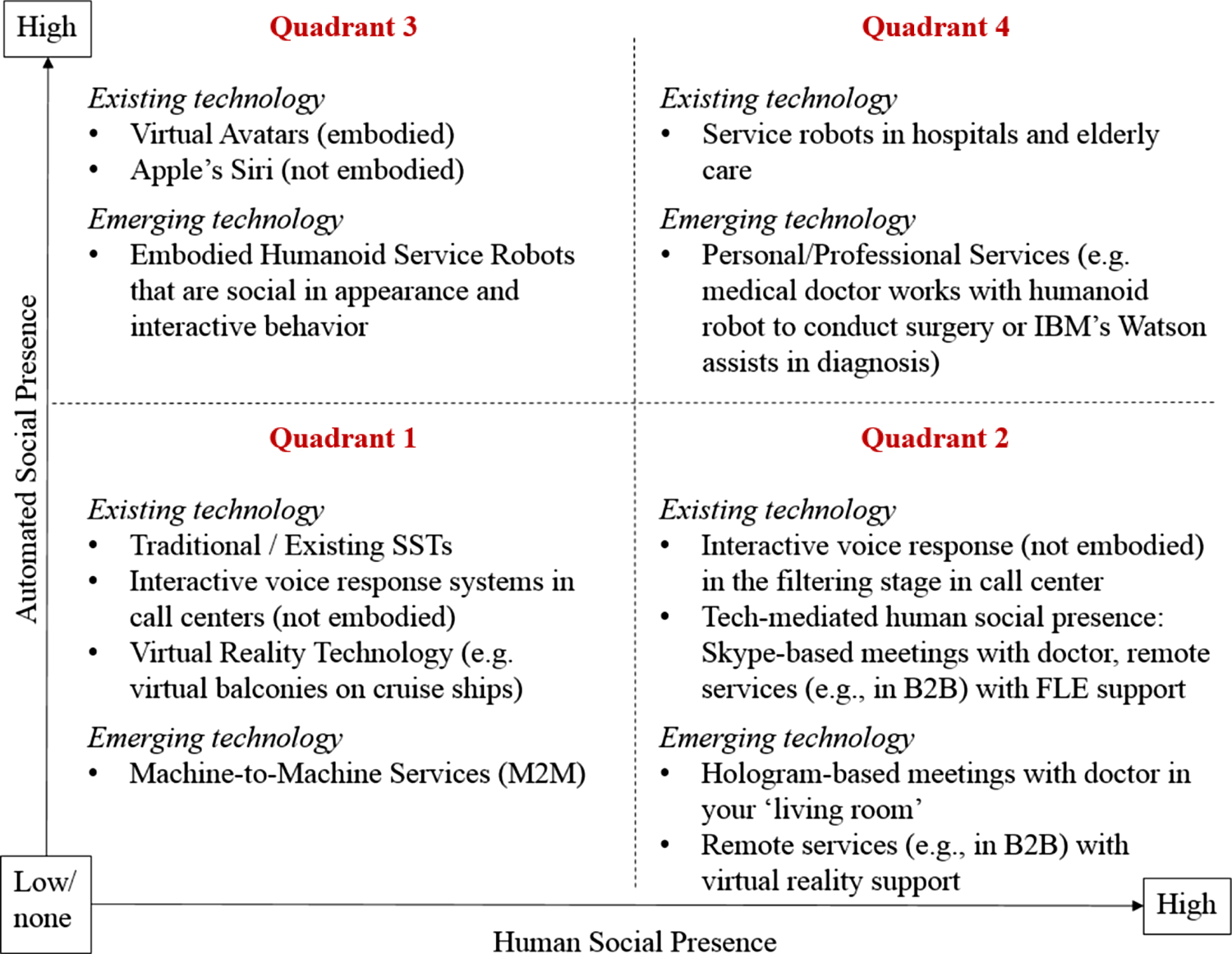
A typology of technology infusions into customers’ service frontline experiences.
Quadrant 1 represents service frontline experiences that are low on both automated and human social presence. Corresponding examples include traditional SSTs, such as automated teller machine (ATMs) or self-check-in/-out terminals (Meuter et al. 2000, 2005). We expect that machine-to-machine (M2M) transactions (e.g., related to the Internet of things), which enable fully automated services with minimal human intervention, represent the next frontier for service interactions within Quadrant 1. For example, a Tesla car that needs to be repaired can, on its own, call for a needed software download and, when other repairs are needed, send an invitation to the customer to have a valet come pick it up and drive it to Tesla’s repair facility (Porter and Heppelmann 2014; also Marinova et al. 2017 in this “Special Section”).
Quadrant 2 encompasses service frontline experiences with high human social presence but no or low ASP. In addition to traditional customer–FLE interactions without any technology infusion, Quadrant 2 also includes technology-mediated social interactions (Froehle and Roth 2004); for instance, service transactions (e.g., patient-doctor encounters) that are facilitated via Skype or, in the near future, virtual reality.
Service frontline experiences that are high in ASP but low in human social presence are conceptualized in Quadrant 3. These experiences distinguish themselves from those in Quadrant 1 by incorporating technology that deliberately and effectively engages customers on a social level. Existing examples include virtual avatars (Kohler et al. 2011) and Apple’s language user interface Siri. In the future, we expect humanoid service robots that are truly social in their appearance and interactive in their behavior to be part of service frontlines high in ASP (Feil-Seifer and Mataric 2015). Notably, striving to enable more effective human-robot interactions, the field of social robotics seeks to develop robots that can assist humans and adopt norms and behaviors related to their social role (Wykowska et al. 2014). Developments in this field suggest that humans and social robots will soon interact in truly collaborative and socially enriching ways, such that both parties benefit from learning about and from each other as they collaborate (Jacucci et al. 2014; Lessiter et al. 2014). During these interactions, the robot can potentially develop a representation of the user’s abilities, intentions, and beliefs (Lesh et al. 2004). Thus, the service collaboration shifts away from scenarios in which robots serve as emotionless machines and instead become entities “that can create social and emotional connections with their human partners” (Cabibihan, Williams, and Simmons 2014, p. 311).
Finally, Quadrant 4 represents the combination of high human and high ASP. Such configurations would include a customer coproducing a service with two social entities, the human employee and the automated service agent. Notably, in elderly care, service robots are already used to supplement the care provided by human medical staff (Pigini et al. 2012). In the future, we expect more services to be collaboratively provided by human and social robot FLEs, such as in health-care and hospitality services.
Our proposed 2 × 2 typology (Figure 1) raises the question which of its quadrants have received insufficient attention from service scholars? In order to provide corresponding initial insights, Table 1 presents an illustrative overview of key literature covering these four quadrants. Table 1 illustrates that the vast majority of service research dealing with technology infusion and social presence issues falls into Quadrants 1 and 2, while very little research examines service frontlines that are high on ASP. 3 Because ASP in services is a novel and quickly emerging area, with important implications for service scholars and managers, our discussion will focus on how high levels of ASP might affect customers’ service experiences. Specifically, the focus of our framework and discussion will be Quadrant 3, while we will highlight some differences that may emerge in Quadrant 4 in our concluding sections.
Sample Articles Pertaining to Each Quadrant of Proposed 2 × 2 Typology.
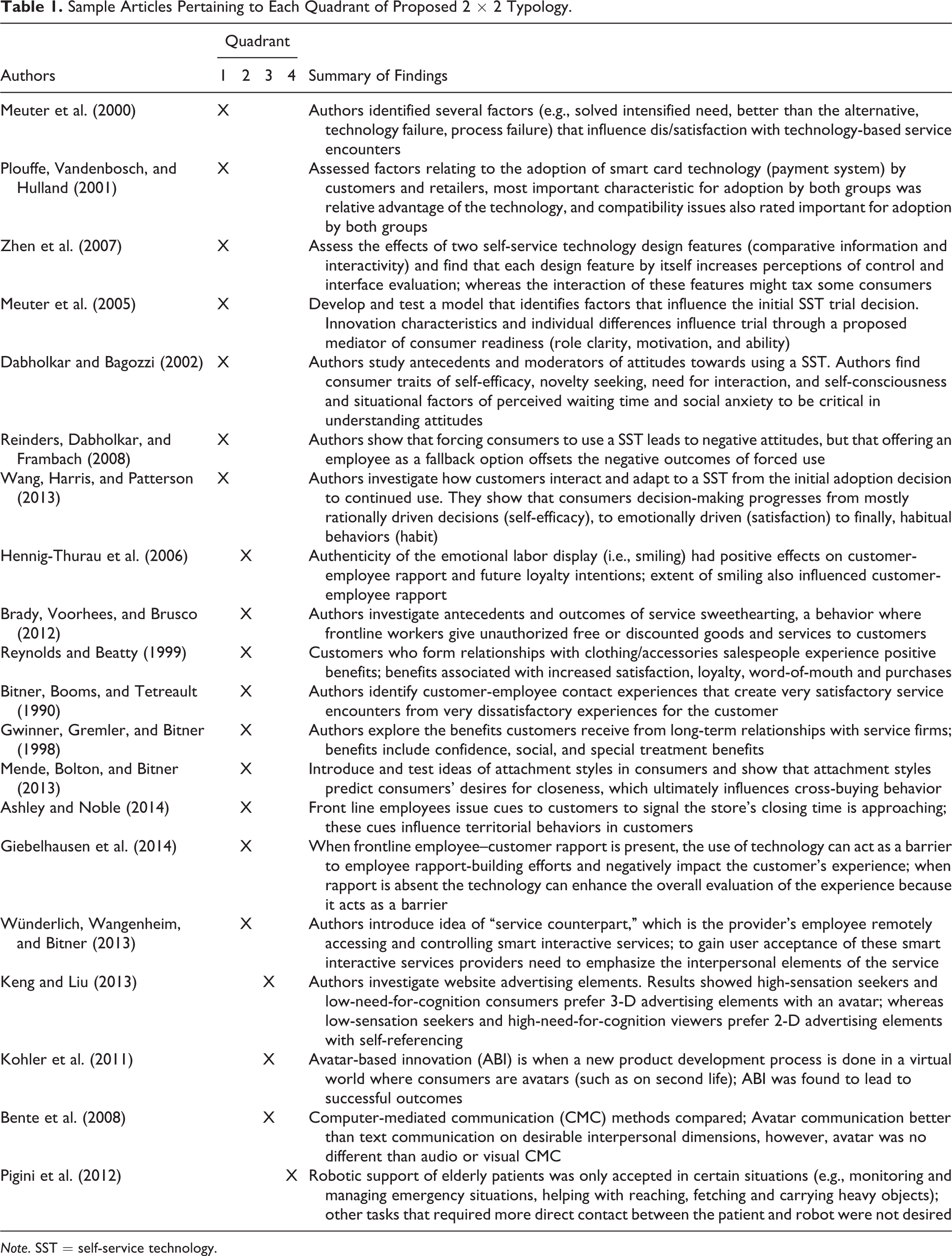
Note. SST = self-service technology.
The Impact of Automated and Human Social Presence on Service Outcomes: An Organizing Framework
To organize our discussion, we derive the conceptual framework in Figure 2. This framework theorizes that the four types of frontline configurations combining different levels of automated and human social presence (cf. Figure 1) affect key service and customer outcomes such as satisfaction, loyalty, repatronage, engagement, and well-being (Anderson et al. 2013; Palmatier et al. 2006; van Doorn et al. 2010).
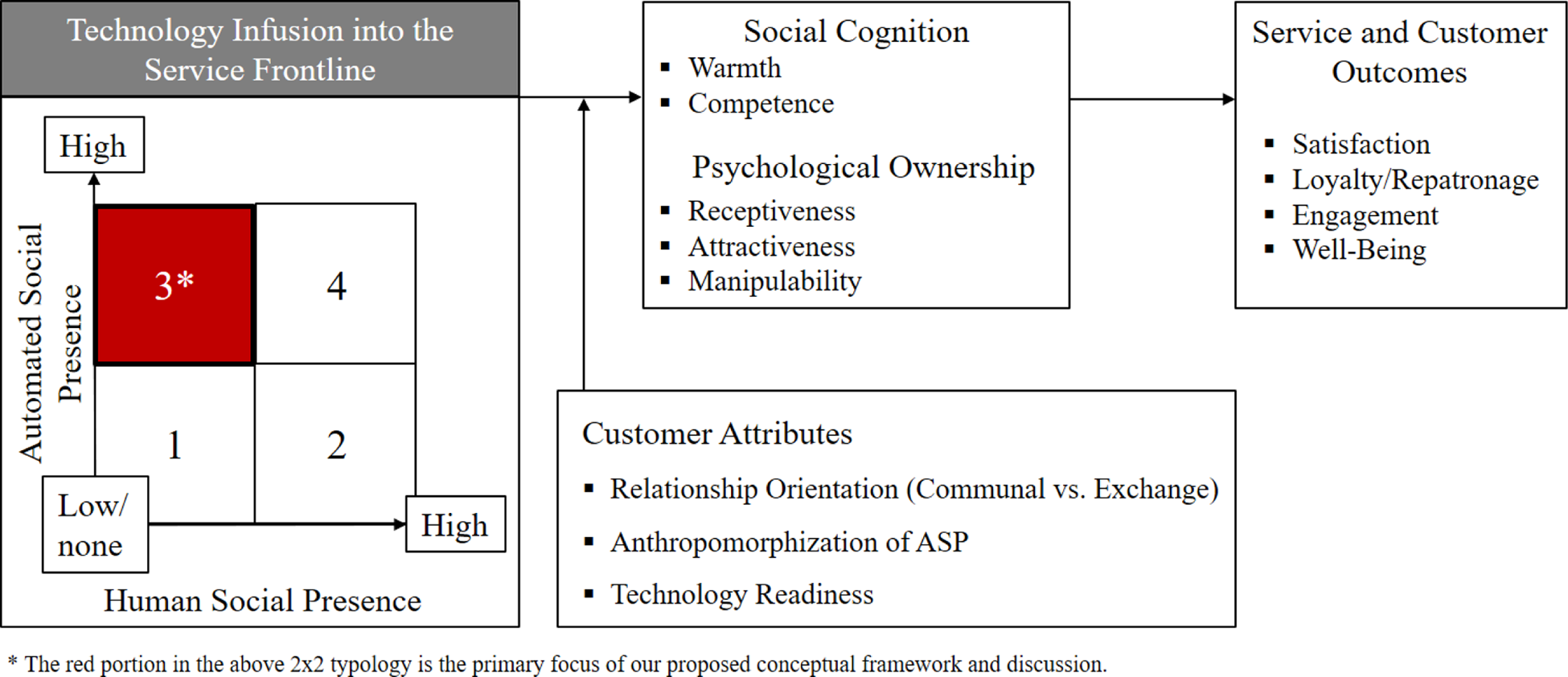
Conceptual framework.
As mentioned above, we focus on the effects of technologies that evoke high levels of ASP. Our premise is that infusing ASP will affect the customer’s service experience and service outcomes. In order to explore the influence of ASP on service-related outcomes in greater detail, we consider two mediating and three moderating mechanisms (Figure 2): In terms of mediators, we argue that social cognition (and its fundamental dimensions of warmth and competence) is a powerful theoretical perspective to explain customers’ responses not only to human FLEs (Scott, Mende, and Bolton 2013) but also to ASP. Second, through the theoretical lens of psychological ownership (Hulland, Thompson, and Smith 2015; Pierce, Kostova, and Dirks 2001), we highlight how technology-infused service environments that invoke ASP can address customers’ needs for a sense of control, self-identity, and sense of belongingness. In doing so, we illustrate how ASP relates to the customer’s psychological ownership, with important implications for both organizations and customers. Consistent with prior research (Cuddy, Fiske and Glick 2008; Scott, Mende and Bolton 2013), we expect inferred warmth and competence to drive customer and service outcomes such as satisfaction and behavioral intentions. Similarly, psychological ownership should positively affect service and customer outcomes (Hulland, Thompson, and Smith 2015; Jussila et al. 2015).
Furthermore, we theorize that the effects of ASP on both social cognition and psychological ownership are moderated by a consumer’s relationship orientation (the tendency to seek a communal vs. exchange relationship; Mills and Clark 1994), the extent to which customers anthropomorphize the focal technology (Epley, Waytz, and Cacioppo 2007), and consumers’ technology readiness (Parasuraman and Colby 2015). While we note that these moderators may also influence the relationship between the two mediating constructs (social cognition, psychological ownership) and service outcomes, we will focus on how the three focal factors moderate the effect of ASP on social cognition and psychological ownership.
The subsequent sections follow a three-step approach: First, we introduce social cognition and psychological ownership theory as mediators. Second, we highlight how the effect of different levels of ASP on social cognition and psychological ownership varies with a customer’s relationship orientation, propensity to anthropomorphize, and technology readiness. Throughout, we provide foundational propositions and specific research questions. We conclude with suggestions on how to make progress in this area and to address the proposed research issues in light of some existing challenges.
Linking ASP and Customer Responses: The Mediating Role of Social Cognition
Social cognition is concerned with how humans encode, store, retrieve, and process information about conspecifics (members of the same species; Fiske and Macrae 2012). Although a technology or a machine is not a conspecific, service organizations increasingly aim to infuse high-ASP technology that can successfully imitate human employees (e.g., robots) into their frontline settings. Therefore, we draw on social cognition to theorize how customers may respond to ASP in service encounters.
Research has identified warmth and competence as the two universal dimensions of social cognition (Fiske, Cuddy, and Glick 2007). This bifurcation rests on the evolutionary rationale that perceivers want to know others’ positive or negative intent and their ability to effectively pursue this intent; these aspects correspond to the warmth and competence dimensions, respectively. Perceived warmth captures traits such as being helpful or caring; perceived competence captures traits such as being skillful or efficacious (Fiske, Cuddy, and Glick 2007). A considerable body of research in psychology has demonstrated a mediating role of warmth and competence, that is, inferences about warmth and competence drive peoples’ responses to a target person across numerous settings (cf. Cuddy, Fiske, and Glick 2008).
Previous services research shows that the fundamental mechanisms of social perception, in particular warmth and competence, generalize to commercial service contexts and that warmth and competence can ultimately drive service outcomes. For example, Scott, Mende, and Bolton (2013) show that customers use appearance-related cues of FLEs to make inferences about their warmth and competence; in turn, these inferences drive customers’ behavioral intentions toward those employees.
Extending this prior research, we predict that warmth and competence inferences mediate the impact of ASP on service outcomes. More specifically, we propose that consumers’ inferential processes relating to warmth and competence vary as a function of the level of ASP (high vs. low) present in the service context, with downstream consequences for consumers’ responses toward the service experience (e.g., satisfaction, engagement, loyalty).
The idea of infusing ASP into service encounters is to evoke the perception of a conspecific presence. While a review of the literature on social robotics is beyond the scope of our discussion (e.g., see Kanda and Ishiguro 2013), we note that robots with more humanlike features are more likely to inspire trust, are perceived to be more sociable, and encourage their human users to bond with them (Broadbent et al. 2008; Li, Rau, and Li 2010). Accordingly, customer-perceived warmth of technological service agents should increase with higher (vs. lower) levels of ASP.
To understand the effect of ASP on competence, we draw on research that has examined how a robot’s animacy (i.e., perceived as having life or being lively) influences its user-perceived intelligence. Initial findings suggest a positive association between a robot’s animacy and its inferred intelligence (Bartneck et al. 2010). Therefore, customer-perceived competence of technological service agents should increase with higher (vs. lower) levels of ASP.
4
Thus, we propose:
The Mediating Role of Psychological Ownership
Although it may initially seem odd to consider “ownership” in the context of the relationship between technology-infused services and customers, Belk (2013, p. 477) suggests that “digital technologies [are] fundamentally changing consumer behavior in ways that have significant implications for the formulation of the extended self.” Psychological ownership—the “state in which individuals feel as though the target of ownership or a piece of that target is ‘theirs’” (Pierce, Kostova, and Dirks 2001, p. 86)—stems from three main psychological consumer needs: (1) a need to control the environment and possess the ability to make changes, (2) a need for self-understanding and self-identity, and (3) a need to form affiliative attachments with the target service. Such motives likely facilitate rather than cause a sense of psychological ownership in technology-infused service environments (Pierce, Kostova, and Dirks 2003).
It is the attributes of the target (i.e., the service setting) that can create a sense of psychological ownership on the part of an individual consumer (Pierce and Jussila 2011). A variety of attributes have been proposed (e.g., Jussila et al. 2015), and a subset of these have been suggested as drivers of the success of online services (e.g., social media platforms; Hulland, Thompson, and Smith 2015). These attributes relate to the underlying motivations described above. Jussila et al. (2015) suggest that, at a minimum, potential targets need to be visible and attractive since they must arouse the consumer’s interest and attention and that they must also be distinctive from other potential ownership targets. Introducing high levels of ASP into the service can help address these needs for visibility, attractiveness, distinctiveness and desires for manipulability and receptiveness (as defined below). The presence of some or all of these attributes will in turn satisfy the individual consumer’s psychological ownership needs. 5
Jussila et al. (2015) argue that the need for affiliation is closely associated with receptiveness, the need for self-identity is associated with attractiveness, and the need for control is associated with manipulability. In service contexts, receptiveness is manifested in the responsiveness and helpfulness of frontline service providers (e.g., Dabholkar, Thorpe, and Rentz 1996; Parasuraman, Zeithaml, and Berry 1988). Thus, when ASP is high, many customers are likely to perceive a greater degree of receptiveness (addressing their need for affiliation), resulting in a heightened sense of psychological ownership.
Service attractiveness can be influenced by service personnel-related variables (Keh et al. 2013), the design of the servicescape (Baker et al. 2002; Bitner 1992), and similar factors. In the absence of attractiveness, customers are unlikely to be motivated to associate with a service. Notably, advancements in engineering make it increasingly possible to design both aesthetically appealing (e.g., facial and body features) and socially attractive robots (e.g., robots that are designed to be agreeable, funny, and empathetic; Damiano et al. 2015; Mazzei et al. 2012). Thus, high ASP could lead to superior perceptions of attractiveness, perhaps through perceived novelty, imaginativeness, or delight (addressing the need for self-identity).
Finally, service manipulability represents the degree to which service experiences can be customized by consumers, allowing them to adjust services to their personal preferences. The importance of customization for service encounter satisfaction (Bitner, Brown, and Meuter 2000) indicates that the levels of adaptability and customization available through frontline technologies are key to success. One way to adapt technology-infused service provision to the needs of customers is to let them participate in the service provision. Fuchs, Prandelli, and Schreier (2010) find that cocreation enhances psychological ownership of and demand for a product. 6 It is entirely possible that customers will soon be able to cocreate the ASP in a very comprehensive manner (e.g., even today users can choose whether their smartphone has a male or female voice and which accent it has). To the extent that high ASP emphasizes a give-and-take relationship between consumer and technology, then, the greater will be the perceived manipulability (addressing the need for control).
Through its impact on perceived receptiveness, attractiveness, and manipulability, the degree of ASP infused into service settings should foster a greater sense of psychological ownership. As Belk (2013, p. 494) asserts, new technologies create opportunities “through which we present and extend our self” via social interactions, adding that “robots may become part of our extended self.” Summarizing the above:
Customer-Related Moderators Influencing the Effect of ASP
Moderating Role of Communal Versus Exchange Relationship Orientation
Consumers have distinct relational orientations and display identifiable and relatively stable patterns of preferences regarding their relationships with service firms and employees (e.g., Beatty et al. 1996; De Wulf, Odekerken-Schroeder, and Iacobucci 2001; Mende and Bolton 2011). One influential perspective of consumers’ relational orientations draws on the concept of communal and exchange relationships (Clark and Mills 1993). In communal relationships, people expect partners to have a genuine concern for their welfare and to be kind and responsive but not to be motivated primarily by reciprocation or profit maximization. In contrast, exchange relationships imply a quid pro quo and a request for prompt repayment for received benefits (Clark and Mills 1979).
Marketing scholars have leveraged this idea of communal and exchange relationships based on two perspectives: First, communal and exchange relationship norms can be closely associated with specific service contexts. For example, health-care services are typically associated with the communal norm, whereas financial services (e.g., banks) are frequently associated with the exchange norm (Scott, Mende, and Bolton 2013). Second, individual consumers can have chronic, dispositional tendencies to desire and adopt either the communal or the exchange norm as they approach service relationships (Clark and Mills 1993, 2012). Drawing on the second perspective of individual differences, we propose that the effects of ASP on both social cognition and psychological ownership depend on the customer’s (communal or exchange) relationship orientation.
Social cognition
Social perception is contextually malleable, and the extent to which people consider warmth and competence in their social assessments can vary (Abele and Wojciszke 2007). A customer with a communal relationship orientation should put more emphasis on cues eliciting perceptions of warmth than competence (Scott, Mende, and Bolton 2013). High (vs. low) ASP with, for instance, more humanlike features should be perceived by consumers as more sociable, facilitating the building of an emotional connection that should increase feelings of warmth, particularly when a customer has a communal orientation (e.g., Broadbent et al. 2008).
Consumers with an exchange relationship orientation put more emphasis on cues showing a service agent’s competence (Scott, Mende, and Bolton 2013). Drawing on research showing that higher intelligence and competence is ascribed in general to robots that are more animate and humanlike (Bartneck et al. 2009; Canning, Donahue, and Scheutz 2014), we expect that high (vs. low) ASP should influence perceptions of competence, particularly when consumers have an exchange orientation. Thus, we propose:
When considering Proposition 3, note that research in psychology (which is typically conducted in noncommercial contexts) argues for a relatively greater importance of warmth over competence, that is, warmth is believed to be assessed before competence, and judgments of a target’s warmth typically are believed to matter more to observers than competence in their responses to a target (Wojciszke 2005). While we argue that, at least to some extent, human-robot encounters follow the principles of human-to-human interactions, we revise the idea of a primacy of warmth in service settings. Specifically, we theorize that neither of the two dimensions is consistently dominant in shaping the downstream effect of ASP on service and customer outcomes; rather, as proposed above, we expect that the effects may vary with the customer’s relationship orientation (and possibly the corresponding nature and context of the service relationship).
Psychological ownership
We propose that the positive effect of high (vs. low) ASP on psychological ownership should be more pronounced for consumers with a communal (vs. exchange) orientation. Again building on literature showing that robots with more humanlike features are perceived as more sociable and easier to connect with emotionally (Broadbent et al. 2008), we expect that it should be easier for consumers to foster a personal connection and develop a greater sense of receptiveness when ASP is high (vs. low). To consumers with a communal orientation, receptiveness (e.g., the responsiveness and helpfulness of an ASP) is of particular importance.
Both the novelty and sociability of high ASP contexts are likely to facilitate a sense of attractiveness, leading to heightened interaction especially for consumers with a communal orientation, to whom such interactions are particularly important. Given that the desire to manage self-identity should be more pronounced in typically more meaningful communal relations than in superficial exchange relations, the opportunities that new technologies create to present the self (Belk 2013) should be particularly welcomed by consumers with a communal (vs. exchange) orientation.
Earlier, we argued that the levels of adaptability and customization available through frontline technologies will be important drivers of success, since they increase perceived manipulability. Individuals with a communal relationship orientation expect partners to have a genuine concern for their welfare and to be responsive (Clark and Mills 1979). More intelligent and competent technology facilitates the provision of a customized service experience that is uniquely adapted to the customer’s needs. Further, the increased sociability of high-ASP technology is likely to engender more mutually responsive and engaging relationships between customers and service agents. Both of these effects should lead consumers with a communal orientation to perceive greater manipulability.
In contrast, consumers with an exchange relationship orientation focus more on cues demonstrating a service agent’s competence (Scott, Mende, and Bolton 2013). Because higher intelligence and competence are ascribed to robots that are more animate and humanlike (Bartneck et al. 2009; Canning, Donahue, and Scheutz 2014), high (vs. low) ASP should result in stronger perceptions of competence. For exchange-oriented consumers, this is likely to result in fewer perceived opportunities to exert personal control over the situation, resulting in a more limited sense of service manipulability.
To summarize, we expect high (vs. low) ASP to have a stronger impact on all three aspects of psychological ownership for consumers with a communal (vs. exchange) relationship orientation.
Moderating Role of Anthropomorphism
Humans have a tendency to anthropomorphize objects; that is, they “imbue the real or imagined behavior of nonhuman agents with humanlike characteristics, motivations, intentions, or emotions,” which then influences how they interact with those agents (Aggarwal and McGill 2007; Epley, Waytz, and Cacioppo 2007, p. 864). Anthropomorphization has received increasing attention in marketing, because it can influence how consumers respond to brands, products, and services (Aggarwal and McGill 2007; Kim, Chen and Zhang 2016; Puzakova, Kwak, and Rocereto 2013). Therefore, frontline research needs to understand when and why customers anthropomorphize focal technologies, and how anthropomorphism influences the service experience with ASP. We begin with considering the interplay between ASP, anthropomorphism, and social cognition.
Social Cognition
Anthropomorphism is applicable to human interactions and relationships with technology (e.g., computers; Epley, Waytz, and Cacioppo 2007), effectively merging the realms of consumer research with computer engineering and artificial intelligence. To understand the moderating role of anthropomorphism with regard to the effect of ASP on warmth, note that anthropomorphizing products and brands elicits more positive emotional responses in consumers (e.g., they perceive a product as more endearing and desirable), which ultimately results in consumer preference for the offering (Wan and Aggarwal 2015). Therefore, we expect that anthropomorphization will further enhance the positive effect of ASP on warmth.
Regarding the effect on competence, recall that research in social robotics discovered a positive effect of a robot’s animacy (i.e., being perceived as having life) on its inferred intelligence (Bartneck et al. 2009). On a more nuanced level, we believe it is relevant to distinguish between being perceived as lifelike (e.g., dog-shaped robots) from being perceived as humanlike (e.g., human-shaped robots). For instance, Canning, Donahue, and Scheutz (2014) found that more humanlike robots are perceived as more intelligent and are rated higher on utility and competence than mechanical ones. Therefore, anthropomorphizing a technology-infused service agent should further boost the positive effect of ASP on inferred competence. 7
In short, anthropomorphism should emphasize the social cognition mechanism in response to technology-based service agents (proposed in Propositions 2 and 3).
Psychological ownership
Anthropomorphism can influence the interplay between ASP and psychological ownership (i.e., receptiveness, attractiveness, and manipulability). First, recall that receptiveness is associated with the need for affiliation (Jussila et al. 2015), and fulfilling this need should be facilitated more strongly when ASP is high in the service context (vs. low; cf. Proposition 2). This effect should be even stronger when consumers anthropomorphize a technology, because it should further address consumers’ needs for belonging, one of the underlying motivational drivers of psychological ownership. Thus, higher levels of ASP should—especially in the presence of higher (vs. lower) levels of anthropomorphism—provide consumers with a greater sense of service receptiveness.
Second, higher levels of anthropomorphism should also boost the effect of ASP on attractiveness. When people anthropomorphize a nonhuman target, it appears more similar to them (Epley et al. 2007). Perceived similarity (homophily) is related to attractiveness (e.g., McCroskey, McCroskey, and Richmond 2006), greater attentiveness (Gotlieb and Sarel 1992), and shared meaning (Rogers, Ratzan, and Payne 2001). Furthermore, “when the receiver perceives him- or herself as similar…communication between the two is more effective” (Dellande, Gilly, and Graham 2004, p. 81). Thus, the effect of ASP on attractiveness of the service environment should be strengthened particularly when consumers are more likely to anthropomorphize the technology.
Finally, manipulability refers to consumers’ need and desire for control in service settings (Jussila et al. 2015; Pierce, Kostova, and Dirks 2001, 2003). While ASP should positively influence consumers’ perceived control, this effect should be enhanced in the presence of high (vs. low) anthropomorphism, because imbuing humanlike characteristics to a nonhuman (service) agent has been shown to increase feelings of predictability and controllability (Epley et al. 2007).
Moderating Role of Technology Readiness
Service organizations that aim to leverage ASP should be aware of customer dispositions that can influence their experiences with technology. Accordingly, understanding consumers’ technology readiness is important. Technology readiness is defined as one’s propensity to embrace, adopt, and use new technologies in any aspect of one’s life (e.g., home, work, leisure; Parasuraman 2000; Parasuraman and Colby 2015). Increases in ASP in frontline experiences are likely to elicit negative reactions by some consumers (Dabholkar 1996; Mick and Fournier 1998). However, those most ready to embrace new technology-infused experiences should enjoy its benefits. As such, we propose consumer technology readiness as a moderator between the technology-infused ASP in frontline experiences and its impact on social cognition and psychological ownership.
Social cognition
Consumers with relatively high levels of technology readiness are likely to accept changes and advancements in technology-infused frontlines. Higher levels of acceptance of such technology should allow the warmth of an ASP to be felt, without fear or apprehension. Similarly, higher degrees of technological readiness imply that there is an enhanced trust in the technology’s capabilities since one is ready to embrace it and use it (Parasuraman and Colby 2015). This enhanced trust should allow the competence aspects of the ASP to be felt more strongly. Thus, we propose:
Psychological ownership
The moderating effect of higher levels of technology readiness on all three aspects of psychological ownership (receptiveness, attractiveness, and manipulability) is straightforward. The proposed positive effect of ASP on psychological ownership should be greater for consumers higher in technology readiness because those most likely to embrace high ASP should experience heightened feelings of affiliation and receptiveness. With regard to the desire to manage one’s self-identity, those most likely to use and embrace high ASP are also the most likely to view it as attractive and as highly relevant to their self-identity. Furthermore, in enthusiastically accepting the new technology, these consumers signal to others the unique self-defining elements of their personality. Finally, as they embrace and use the technology, they should be more likely to try and use the ASP to their advantage. These are consumers who would be most likely to recognize the manipulability enhancing aspects of ASP, providing them with greater control over the service experience (Jussila et al. 2015; Pierce, Kostova, and Dirks 2001, 2003). Thus, we propose that technology readiness heightens the positive impact of ASP on all three dimensions of psychological ownership:
Conclusion, Limitations, and Future Directions
This article aims to envision technology-infused frontline experiences of the future through the discussion of current and emerging examples of such technology and to present a conceptual framework and testable propositions centered on the concept we call ASP. We predict that in the marketplace of 2025, technology will be melded into numerous service experiences, with the major advancement being that future technology infusion engages customers on a social level and enables true relationships between service robots and humans.
We have proposed that social cognition and psychological ownership mediate the relationship between ASP and service outcomes and that key factors (relationship orientation, anthropomorphism, and technology readiness) moderate the effects of ASP. With the rise of service robots, gaining a better understanding of the implications of ASP and its impact is important. While our article aims to spark interest in this novel research avenue, there—naturally—are numerous issues beyond those discussed here that are related to our framework and the broader issue of robots in frontline service settings. We briefly highlight some of those.
First, to explicate how ASP influences customers in the service process and outcomes, we consider the underlying role of social cognition and psychological ownership. In our theorizing, however, we refrain from addressing potential nonlinear effects. Building on social cognition, we assumed that higher ASP elicits higher levels of customer-inferred warmth, yet the “uncanny valley” concept (Mori, MacDorman, and Kageki 2012) suggests that an artificial service agent that too closely resembles a human could be perceived as creepy and therefore less warm. A similar effect is conceivable for the competence dimension of social cognition. The more ASP resembles a human, the more customers may infer human capabilities and limitations and ascribe lower competence to the ASP. Interestingly and on a more positive note, this idea might also suggest that customers—in turn—might be more forgiving when such more humanlike automated service agents cause service failures, because their inferences about the ASP’s competences were lower to begin with. Such an effect would be even more likely when customers are more likely to anthropomorphize the ASP.
Second, our conceptual development focused on Quadrant 3 of our typology (frontline experiences high on automated but low on human social presence). Moving to Quadrant 4, where automated and human social presence appear in conjunction, raises an entirely new set of questions and issues. For instance, when humanoid service robots collaborate with medical doctors in health-care settings, should the ASP assist the human medical staff or vice versa? And how does the presence of a human alter the effects of ASP on social cognition, psychological ownership, and ultimately service outcomes? Given that customers can turn to the human employee for an emotional connection, the impact of ASP on warmth might be less pronounced in such “combined” human-ASP frontlines. In combined human-ASP frontlines, the level of ASP may also play a less central role for psychological ownership because customers are likely to experience a high degree of receptiveness through the human service employee. Furthermore, the effects of combined frontlines may be less dependent on the extent to which customers anthropomorphize technology and their level of technology readiness. Put differently, combined human-ASP frontlines might be a good way to introduce ASP to customers who are less likely to anthropomorphize ASP and/or who are more reluctant to use new technology. Understanding how service robots and FLEs can optimally collaborate in cocreating value with consumers is therefore another fruitful area of frontline research.
Third, our framework is limited to discussing high versus low levels of ASP in general; therefore, one extension is to focus on the appearance of ASP, because consumers make spontaneous inferences about FLEs’ appearance, often before any verbal exchange occurs (Ambady, Krabbenhoft, and Hogan 2006). For example, in investigating how a robot’s facial gender cues influence human inferences about it, Eyssel and Hegel (2012) find that a short-haired, male robot is perceived as more agentic than a long-haired, female robot, whereas the female robot is perceived as more communal. Therefore, the effect of ASP on warmth, competence, and psychological ownership, in particular in communal versus exchange relations, may also depend on the appearance of the ASP. Such insights also raise questions for the design of service robots. Should service robots be able to change their gender, depending on their human partner or their task? Should they have a unisex appearance? Similar questions arise in light of stereotypes related to the robot’s presumed age, nationality, or race, all of which may help or hinder the service experiences.
Fourth, the idea of close customer-robot relationships highlights the need to reflect on and revise existing theories. Customer relationships with ASP represent a distinct phenomenon, because they differ from attachments to mere material, nonhumanoid possessions (e.g., cars, phones, toys; Belk 1988), from parasocial bonds (e.g., with pets; Mosteller 2008), and from traditional customer-provider relationships (e.g., commercial friendships; Price and Arnould 1999). Although popular media increasingly feature ideas of customer-robot relationships (e.g., movies such as Robot and Frank and Her), service scholars have yet to broaden their theoretical lens as needed to investigate these relationships. Core questions include, what similarities and differences arise between these bonds and relationships established in the service literature? Can traditional theories (e.g., social exchange, investment model, relationship norms; Eimler et al. 2010) explain customer-robot relationships, or are novel theories needed (e.g., our discussion of psychological ownership)?
Fifth, we focus on settings in which customers interact with an organization (e.g., store, restaurant, hospital) that might feature FLEs, SST, and/or social robots as well as online interactions; but we also note that future technology will increasingly influence customer experiences beyond the organizational boundaries and beyond interactions with an organization’s websites and applications (e.g., in consumers’ cars and their smart homes). This triggers questions such as, what are the implications of ASP in these other contexts? What new factors become relevant when these technologies are embedded within our more personal/private versus public spaces?
Sixth, regardless of the setting and whether service experiences involve customers engaging with a robot or with an FLE working in collaboration with a robot, there remains the issue of what limits exist in regard to what can be automated. While technology is increasingly capable of taking on routine tasks that people do now (in the next 20 years, 47% of jobs in the United States face the risk of automation; Pofeldt 2016) as well as analyzing vast amounts of data and identifying patterns in ways that people cannot (e.g., IBM’s Watson computer), it is likely there will be some human characteristics that technology will have difficulty replicating or replacing. Situations characterized by strong needs for empathy (e.g., those faced by teachers, psychologists, social workers), where developing original and creative solutions is required (e.g., designers, engineers) or that necessitate high levels of social intelligence (e.g., managerial positions) are less at risk for automation. The nature of the research questions important to pursue related to ASP will need to be assessed in relation to technology’s expanding capabilities and identified limitations within service-related contexts (Stylianou et al. 2015).
Finally, although we focus on the positive experiences from technology infusion, some dark side effects exist. Issues such as consumer privacy concerns, risks involved with a robot that serves as the agent of service-providing entities (e.g., insurance companies), or robots serving as substitutes for human caregivers (robots that diagnose patients) need to be addressed. For example, there are issues related to social robots that collect consumers’ facial expressions and try to make inferences about their emotional states, while also collecting biophysical data (e.g., blood pressure, heart rate, hormonal levels, fertility, and menstrual cycles). Analyses of these data offer clear benefits, such as preventive medical applications, but these data collection also has an evident dark side, related to consumer privacy. In this case, how accurate and reliable are robots’ data collection efforts, who owns these data, what may they be used for (and by whom), in which circumstances, and what are the risks of data abuse?
As another example, social robots likely will be programmed to communicate protests and discourage human partners from courses of action that might appear suboptimal or undesirable (Cabibihan, Williams, and Simmons 2014). This ability raises questions about who defines undesirable or suboptimal behaviors as well as whether it is acceptable for a machine algorithm to control (or at least influence) human behavior. Does a social robot represent consumers’ best interests, in light of the basic norm in favor of people’s free will? Equally relevant is to examine whether strong customer-robot bonds are always beneficial or whether there are some unintended consequences?
Addressing these important questions related to technology-infused service, especially service robots, will require effective interdisciplinary collaboration (Gustafsson et al. 2016) between service science, engineering, computer science, and others as well as partnerships with firms experimenting with service robots (e.g., Lowe’s OSHBot; Cooper 2015). Although exciting and potentially impactful, this type of research will also run into practical issues (e.g., different research approaches and obtaining approval from institutional review boards).
We hope that our framework and related propositions that emerge from consideration of the advances in technology taking place that enable an infusion of ASP into the service frontline will serve as a catalyst for important service research to better understand and be prepared for the technology infused frontline experience in the marketplace of 2025.
Footnotes
Authors’ Note
The authors are grateful to three anonymous reviewers, the guest editors, Scott Thompson, and the organizers and participants of the “Organizational Frontlines Research Symposium” 2015 in Stillwater, OK, the “Organizational Frontlines Research Symposium” 2016 in Tallahassee, FL, and the 2016 Winter Marketing Educators’ Conference in Las Vegas, NV, for their valuable feedback on previous versions of this article. The first two authors are listed alphabetically—they contributed equally and share first authorship.
Declaration of Conflicting Interests
The author(s) declared no potential conflicts of interest with respect to the research, authorship, and/or publication of this article.
Funding
The author(s) received no financial support for the research, authorship, and/or publication of this article.