




Abstract
While literature reviews play an increasingly important role in theory development, understanding how they contribute to the process of theorizing is lacking. This article develops the metaphor of a miner-prospector continuum, which allows review scholars to identify approaches taken in literature reviews to develop theory. We identify eight strategies located on a continuum ranging from miners—who position their contributions within a bounded and established domain of study alongside other researchers—to prospectors, who are more likely to step outside disciplinary boundaries, introducing novel perspectives and venture beyond knowledge silos. We explore the pathways between miner and prospector in terms of strategies followed, choices made, risks borne, and benefits gained. We identify the roles to be played by different stakeholders in balancing the mix between miners and prospectors. While respecting the need for both miner and prospector approaches, we suggest that collective efforts toward encouraging prospector reviews could assist management research in tackling, through reviews, the complex challenges facing organizations and society today.
Prospectors hope to strike it rich but probably won’t; miners’ returns are moderate but much more predictable. In the actual mining West, miners greatly outnumbered prospectors. So it is with historians. The prospector is fairly rare; the profession more safely rewards the miner.
Literature reviews play a significant and growing role in management and organization studies, providing strategic platforms from which future research may be launched (Cropanzano, 2009). Reviews are regarded increasingly as important vehicles for theorizing, where theorizing is seen as a continuum from initial speculations and imaginative insights at one end, to explanations, models, and “full-blown theories” at the other (Cunliffe, 2018b; Weick, 1995). Within this range, evidence-based theoretical contributions within reviews may involve, variously, making sense of past research; developing, extending, or refining existing theory; identifying emergent themes; or novel theorizing, which makes scholars think differently about a given research field, triggering new ideas and pathways (Hoon, 2013; Hoon & Baluch, 2019; see also Runkel & Runkel, 1984; Shepherd & Suddaby, 2017; Weick, 1995). Yet despite the growth of interest in literature reviews, methodological guidance and reflections regarding the review process have failed to keep pace. In particular, clarity about (and explorations of) the role played by literature reviews in theory building is limited (Hoon & Baluch, 2019; Kunisch et al., 2018; Post et al., 2020).
This article extends the body of knowledge on review articles through proposing a new scheme of classification, which we term the “miner-prospector continuum.” Our miner-prospector continuum contributes to the understanding of theorizing through reviews by addressing questions regarding how best to articulate the nature of each contribution, given the complexity of the differing approaches undertaken in review papers (Kunisch et al., 2018, p. 519). Within the miner-prospector continuum, the theoretical contributions of differently styled literature reviews are positioned between, on the one hand, a “miner” approach (outlining and synthesizing a given field) and, on the other hand, a “prospector” approach, drawing on evidence across domains with a view to changing conceptual understandings and perhaps shifting research paradigms (see Cozzo, 1999; Nugent, 2011). Through this new scheme of classification, the article identifies, and explicates, eight strategies that may be used by authors to assist in the building of theory (Shepherd & Suddaby, 2017). The continuum enables authors, editors, and reviewers to locate reviews in relation to theory development, at the same time as enabling authors to articulate the nature, risks, and benefits of their choices.
Specifically, the miner-prospector continuum categorizes, at one end, traditional miner reviews as spotting (though not necessarily addressing or filling) conceptual gaps, moving through the continuum of organizing and categorizing literatures, problematizing existing literatures, and identifying and exposing contradictions (Pickering et al., 2015). It is argued that reviews based on a miner’s approach might extend knowledge within a given domain but, like the inhabitants of Plato’s cave (Morgan, 1980), might not search for materials beyond the shadows of the walls within extant scholarly mines. Miner reviews have capacity to make conceptual contributions, but these may be developed within resources that are already known, if not fully explored.
While miners seek to position their contributions alongside other researchers through reviewing a circumscribed and established domain of study (Pickering et al., 2015), we argue that reviews that adopt a “prospector” orientation are more likely to search for knowledge beyond the boundaries of the “mine.” Prospectors may step outside the conventions of their field, discovering and proposing innovative and creative ideas (Cozzo, 1999; Nugent, 2011) through transferring theories across disciplinary boundaries, developing analogies and metaphors across knowledge domains, blending and merging literatures across disciplines, and setting out “new” narratives and conceptualizations (Cunliffe, 2018b). Potentially reshaping scholarly thought (Kunisch et al., 2018), a prospector may take more risks than a miner, discovering untapped resources suitable for review. Prospectors must also manage the difficult balance between making new contributions to theory, yet nevertheless ensuring that they “set the stage” for such theory development through reviewing thoroughly and systemically the evidence supporting new departures—or risk being rejected due to lack of a sufficient evidence base (Elsbach & van Knippenberg, 2018). Further, having unearthed new and unfamiliar opportunities, prospector reviewers may struggle to persuade editors and reviewers that they have indeed struck gold; in stepping outside “normal science,” prospector reviewers might invite greater risk of rejection (Aguinis et al., 2020; Kuhn, 1996).
Using this eight-category miner-prospector continuum, we explore the implications for theory development within review papers adding new insights regarding how theoretical contributions may be developed, and articulating the risks and benefits of each. In so doing we support authors to engage in what Hoon and Baluch (2019) describe as “powerful theorizing” through review, while enabling them to envision where their work “sits” on the continuum between convention and novelty. The article is structured as follows. First, the miner-prospector metaphor is explored in detail. The different paths taken by authors of reviews who adopt respectively a miner or prospector approach are outlined, with consideration given to choices made. Such articulation facilitates authors, when theorizing through literature reviews, in deciding about the positioning of a review contribution based on the relative opportunities of each approach along the miner prospector continuum. Having explored the continuum between miner and prospector approaches, we provide examples of review papers under each of the miner-prospector categories. We acknowledge that some papers may contain elements of more than one categorization, however we classify the examples in relation to what we understand to be the main contribution within each paper. We then draw on these literatures to exemplify specific strategies used by either miners or prospectors when developing theory through literature reviews. In the final section of the article, we identify roles to be played by different stakeholders in nurturing and developing researchers to follow these paths. We further outline three core features of a review—transparency, inclusivity, and criticality—which apply to all approaches across the miner-prospector continuum.
We suggest that journal editors might disrupt publication norms through encouraging more innovative papers, as opposed to incremental, consensus-based research (Alvesson & Sandberg, 2013; Hoon & Baluch, 2019). While explicating the benefits of both mining and prospecting reviews, and reserving a place for miners to review rich seams of knowledge, we argue that more prospector reviews are needed within organization and management studies. Without prospector reviews, “mines” of knowledge may become depleted, with new perspectives needed to address the challenges facing organizations today (G. Wood et al., 2018).
The Miner-Prospector Metaphor
The miner-prospector metaphor has been drawn upon in other research traditions to illuminate differences between approaches that are more conventional versus those that are more original. For example, Nugent (2011), quoted at the start of this article, utilizes it to describe the different trajectories pursued by history scholars as regards their research careers. Similarly, Cozzo (1999) uses the metaphor to describe the contribution of pure philosophers, who introduce new (what he describes as “pre-theoretical”) ideas to a field, and logicians, who add rigor and theory to consolidate (or critique) existing ideas. We were introduced to the metaphor through a conversation with Howard Aldrich, University of North Carolina. Similar to Nugent (2011), our definition of the term envisions miners as working to plumb an existing seam of resource as deeply as possible, while prospectors pursue new avenues “sinking or swimming on their own hunches” (Nugent, 2011, p. 209).
In using metaphors to illuminate our arguments within this article, we pursue a path well established within management studies. Metaphors act as a powerful device for sensemaking, enabling better comprehension of complex scholarly and organizational phenomena (Hekkala et al., 2018; Weick, 1989). Making accessible concepts that may be hard to imagine or define because these are abstract or covert, metaphors facilitate evaluation through creating meaning (Kendall & Kendall, 1993; Morgan, 1980; Tsoukas, 1991). Metaphors may be illuminative, offering new ways of seeing and understanding hidden practices (Cornelissen, 2004; Cornelissen & Clarke, 2010). For example, the use of the metaphor “glass ceiling” has shed light on the invisible yet impenetrable barriers that impede women’s career advancement and might otherwise have been obscured from view (Jackson & O’Callaghan, 2009; see also Powell & Butterfield, 1994).
We acknowledge here that the miner and prospector reviewer approaches might not be mutually exclusive. Furthermore, while the two approaches could at first glance be viewed as a dualism of opposites, we observe in practice an important interrelationship between them (Putnam et al., 2016; Seo et al., 2004). We suggest that a more productive way of viewing miner and prospector approaches would be to treat these perspectives as a mutually constitutive duality in the sense described by Putnam et al. (2016): That is, rather than being necessarily at odds with one another, miner and prospector approaches could also be defined as “interdependent” (Putnam et al., 2016, p. 74; see also Farjoun, 2011; Seo et al., 2004). Our interpretation of interdependence implies that creative and apparently pretheoretical terrains uncovered through a process of prospecting might, in practice, emerge from landscapes mapped by the hard work of mining. Drawing upon adventurous discoveries found through prospecting, mining in turn may develop theory through contributing rigor and conceptual clarification to the new excavation. The dynamic interplay between mining and prospecting thus creates a tension and energy (Putnam et al., 2016), as each category exists through and influences the other—together offering potential for theorizing through literature reviews within organization and management studies.
The Miner’s Path
As Morris (2008) and Gilles (2014) have observed, both in relation to the actual practice of mining (Morris) and in metaphorical terms (Gilles), the goal of the miner is to extract from an existing mine (or scholarly field) sufficient material to make a living (or write a paper). Metaphorically, “miner” reviews seek to extract a distinct contribution relative to others working within the field and to position a literature review within a domain of study. At the beginning of the miner-reviewer’s journey, a potential target is identified that fits both the miners’ interests and capabilities. Within this target mine, there will be many scholars competing for resource within the crowded space, from well-seasoned and battle-hardened old-timers to novices finding their way (Rollag, 2004). The former will tell hero and war stories (which fill novices with both inspiration and trepidation; Nugent, 2011) of exploiting hard-won mining leases, muscling against each other (and the novices) for prize positions (Pickering et al., 2015; Rollag, 2004). Those who have invested most in the mine are more likely to aggressively defend their patch. As Francis Crick once noted, “The dangerous man is one with only one theory, because he’ll fight to the death over it” (Burkhard, 2011).
The Miner’s Choices
The goal of the miner is to mine an unexploited section of the mineral seam or, in research terms, to fill an identified gap within an existing knowledge domain (Pickering & Byrne, 2014). In achieving this goal, miners have a number of important choices to make over time. First, they must choose the right mine and seam (or topic) to work on. Two questions need to be addressed here. Does the mine seam look profitable enough to work? Does the miner have the resources needed to extract mineral from this (Torraco, 2005)? Regarding the former question, one must gauge the potential value of a particular approach, theory, or paradigm to deliver contributions now and into the future (Pickering et al., 2015). There are clearly unknowns here. However, the miner might examine then extend the exposed seam and thus extrapolate projections into the future. With regard to the second question, the miner needs to consider whether they have the experience and capabilities to first gain access to the seam and then carve out valued contributions (Pickering & Byrne, 2014).
Second, the miner must locate themselves (and their review) relative to the other workers within the metaphorical mine and position their work and future contributions (Webster & Watson, 2002). This involves the miner first in gaining understanding of the field, and of the contributions being made by others within the same working group. They then need to become part of the group of miners working that seam. This involves learning the language of the group and positioning themselves within the hierarchy of coworkers (Torraco, 2005). Some coworkers are more senior and demand the respect of more junior colleagues (Ylijoki & Henriksson, 2017). In this manner, the miner learns to fit into the working patterns of those within the group, where each contributes to the collective effort of mining that particular seam (Nugent, 2011; Ylijoki & Henriksson, 2017).
Third, the miner needs to exploit their stake and carve out their contribution. As noted above, they must carefully work at this, with the views of other coworkers in mind (Pickering & Byrne, 2014). Too hasty an advance might encroach upon the work of another, with the threat of isolation or retaliation. If the work is too clumsy, it might undermine the foundations of neighbors, or potentially the integrity of the entire seam. Carving out the contribution involves seeing how one’s contribution fits with that of other coworkers. It is thus a codependent process, as the individual miner works alongside others to carefully advance the seam together. Ultimately, the miner seeks to make incremental steps (Pickering et al., 2015), working alongside others as they collectively extract value from the seam.
The Miner’s Approach to Managing Risks
The miner seeks to manage risks by following the insights of others in an uncertain world. However, the process is not without risks. First, by choosing a particular mine and seam within it, miners put all their eggs in a single metaphorical basket, adopting a textbook silo approach. On the one hand, this allows miners to put boundaries on the knowledge domain within which they work. If the mine seam is extensive, then they can secure a steady stream of future earnings (or publications) by theorizing and adding rigor to such a domain (Cozzo, 1999). On the other hand, putting boundaries on knowledge constrains their ability to move outside the seam, as they invest within extant disciplines. As they become increasingly invested in working the seam, miners view the world, speak the same language, and use the same tools as their coworkers. Among purist miners, this worldview however runs the risk of becoming obsolete if the seam runs dry, and they search for new sources of value in the world beyond. Moreover, if the market changes and the minerals they mine no longer have value in a changing environment, all their efforts could come to nothing in an unknown future world.
The Prospector’s Path
The prospector has a different calling to the miner. The prospector does not follow a predetermined path to knowledge acquisition but seeks one that is less trodden (Cozzo, 1999). As they move through the research landscape, prospectors pay attention and are open to what may unfold. This “wayfaring” scholar prepares for this journey with “a backpack of tentative interests and ideas, and a commitment to the craft or art of inquiry” (Cunliffe, 2018b). Prospectors use imagination to make less obvious connections, leading to new insights, and bringing together ideas that may seem at first unconnected (Cunliffe, 2018b).
By following this path, the prospector hopes to “strike it rich” and discover the next big thing (Nugent, 2011, p. 209). In some cases, prospectors (both in scholarly terms and in practice) might discover marginal mines, with limited seams of mineral (Gilles, 2014). They live in hope that they will find a larger, productive mine, which has many future seams of mineral of varying quality extending beyond the core source (Nugent, 2011). As the source of new ideas, prospectors can lay claim to future work in their area, divvying out licenses to future miners, all of whom will pay dividends (in the form of citations) back to the finder (Cozzo, 1999). The prospector thus seeks to shape the direction of research or search for new knowledge domains. The prospector avoids established hierarchies in existing mines, and follows their sense of adventure into unknown worlds beyond (Cozzo, 1999; Nugent, 2011). As Simsek et al. (2015) note, “While some opportunities are of the ‘low-hanging fruit’ variety, others call for creative and courageous efforts to explore topics of unknown variety with a substantial risk of dead ends and empty hands but with potential to rejuvenate and enlighten the entire landscape.”
The Prospector’s Choices
The prospector seeks not to work solely within an established mine but to search for “new and unexpected” mines (Anderson & Thomas, 2014). The prospector’s explorations are not completely random, but calculated. Anderson and Thomas (2014, p. 10), who use the metaphor “olden-day gold prospector” as a lens for exploring new ideas regarding metacognition, report how, in relation to the practice of gold mining, “The rock ‘spoke’ to the prospector and could provide telling indications as to whether they were near a potentially productive vein.” The first choice faced by prospectors is thus the decision regarding where to search for future mines. Prospectors might be guided in their search by looking towards other mines. The location of these mines might hint at some wider pattern of seam within an unexplored area. This approach therefore involves stepping back and examining the location of mines within the wider environment and possible connections between these mines. On the other hand, prospectors might be guided by signs within the untouched hills themselves. Learning from prior prospectors, they search for signals of untold riches in the landscape itself (see Anderson & Thomas, 2014; Cozzo, 1999).
While the prospecting author of a literature review does not seek to work within an established mine, they nonetheless need to identify which existing mines and/or prior prospectors (or scholars) to study in order to search for targets, as noted above. In this respect, they still need to position themselves relative to other domains. If they prospect too close to an existing mine, they may be accused of infringing an existing claim. If they prospect in disputed areas between more than one mine, they may equally be caught up in an ongoing conflict (Pfeffer, 1995; Van Maanen, 1995). If they prospect at too far a distance from existing mines, they may lack the resources and infrastructure needed to later exploit the mine (Toulmin, 1972). Once they locate the mine, they then need to move fast to lay claim to future returns and carve out their contribution. If they delay in their actions, or lack the resources or skills to capitalize on the find, they may be overtaken by other opportunistic prospectors, or even miners whose luck has run dry in an existing claim.
The Prospector’s Approach to Managing Risks
Ultimately the prospector’s path is more high risk than that of the miner, though there are possibilities that the return on investment may be greater (Nugent, 2011; see also Anderson & Thomas, 2014). In order to locate new sources, prospectors must take a broader perspective, and not be constrained by disciplinary boundaries. On the one hand, this allows the prospector to wander between mines, following a nomadic path (Alvesson et al., 2017). Unconstrained by domain-specific boundaries, prospectors can cross established boundaries, which in turn encourages the cross fertilization of ideas, opening up new paths and insights (Cozzo, 1999). On the other hand, the higher risks faced by the prospector need to be managed. They need to have both the nerve, and the resilience, to continue on this path. As they strike out into the unknown, prospectors may lack the social support of both the novice miners and more established supporters who might be reviewing their papers, especially if prospectors seek to review a field which is new, relative to other areas of concern (for example, information technologies: Webster & Watson, 2002). Given the unknown nature of their journey, prospectors cannot follow the paths and approaches taken by others (such as, for example, following the guidance proffered on producing a quantitative review as advised by Pickering et al., 2015). With low chances of striking gold, they may wish to hedge their bets and prospect in a number of places at the same time. Ultimately, prospectors may be driven more by the risks and search process itself than the safety of the collective; “once the gold is found and miners start working,” prospectors may move on to “explore new terrain” (Cozzo, 1999, p. 56).
From Mining to Prospecting
While our view of the miner prospector relationship might appear initially to present both approaches as a dichotomy, the paths chosen by academics might be more helpfully viewed as falling within a miner-prospector continuum (see Figure 1). Drawing on prior research, we have identified eight strategies consistent with miner or prospector paths, through which scholars seek to develop theory in review papers. These strategies are classified below as spotting (though not necessarily addressing) conceptual gaps, organizing and categorizing literatures, problematizing the literature, identifying and exposing contradictions, transferring theories across domains, developing analogies and metaphors across domains, blending and merging literatures across domains, and setting out “new” narratives and conceptualizations. Within each category both miner and prospector approaches are possible (see Figure 1). However, as one moves down the continuum, the approach taken tends toward a prospector orientation and vice versa.
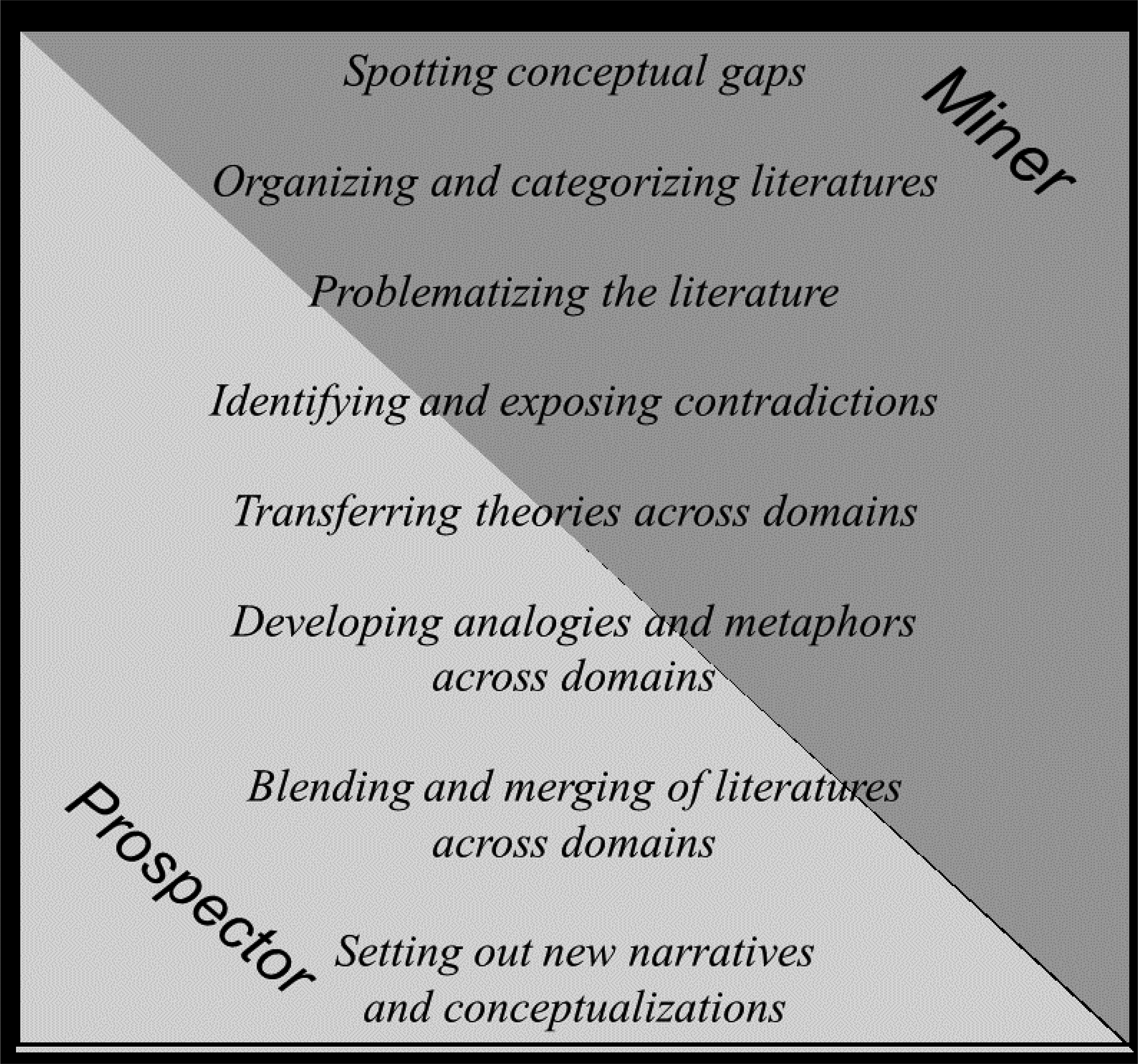
Miner-prospector continuum. This figure shows how different approaches taken to develop theory in literature reviews, might by driven by either a miner and prospector orientation. Within each category (e.g., problematizing the literature) both miner and prospector approaches are possible. However, as one moves down the continuum, the approach taken tends towards a prospector orientation and vice versa. The approaches are mutually constitutive, i.e., each has potentially an influencing effect on the other. Miners dig deeply into new or “pretheoretical” ideas proposed by prospectors. Prospector reviews must base on the ground work of miners their creative leaps forward, and prospecting reviews benefit subsequently from “mining” reviews which build additional rigor and add theoretical clarification.
Figure 1 shows how different approaches taken to develop theory in literature reviews might be driven by either a miner or prospector orientation. Within each category (e.g., problematizing the literature), both miner and prospector approaches are possible. However, as one moves down the continuum, the approach taken tends toward a prospector orientation and vice versa. The approaches are mutually constitutive, that is, each has potentially an influencing effect on the other. Miners dig deeply into new or “pretheoretical” ideas proposed by prospectors. Prospector reviews must base on the ground work of miners their creative leaps forward, and prospecting reviews benefit subsequently from “mining” reviews, which build additional rigor and add theoretical clarification.
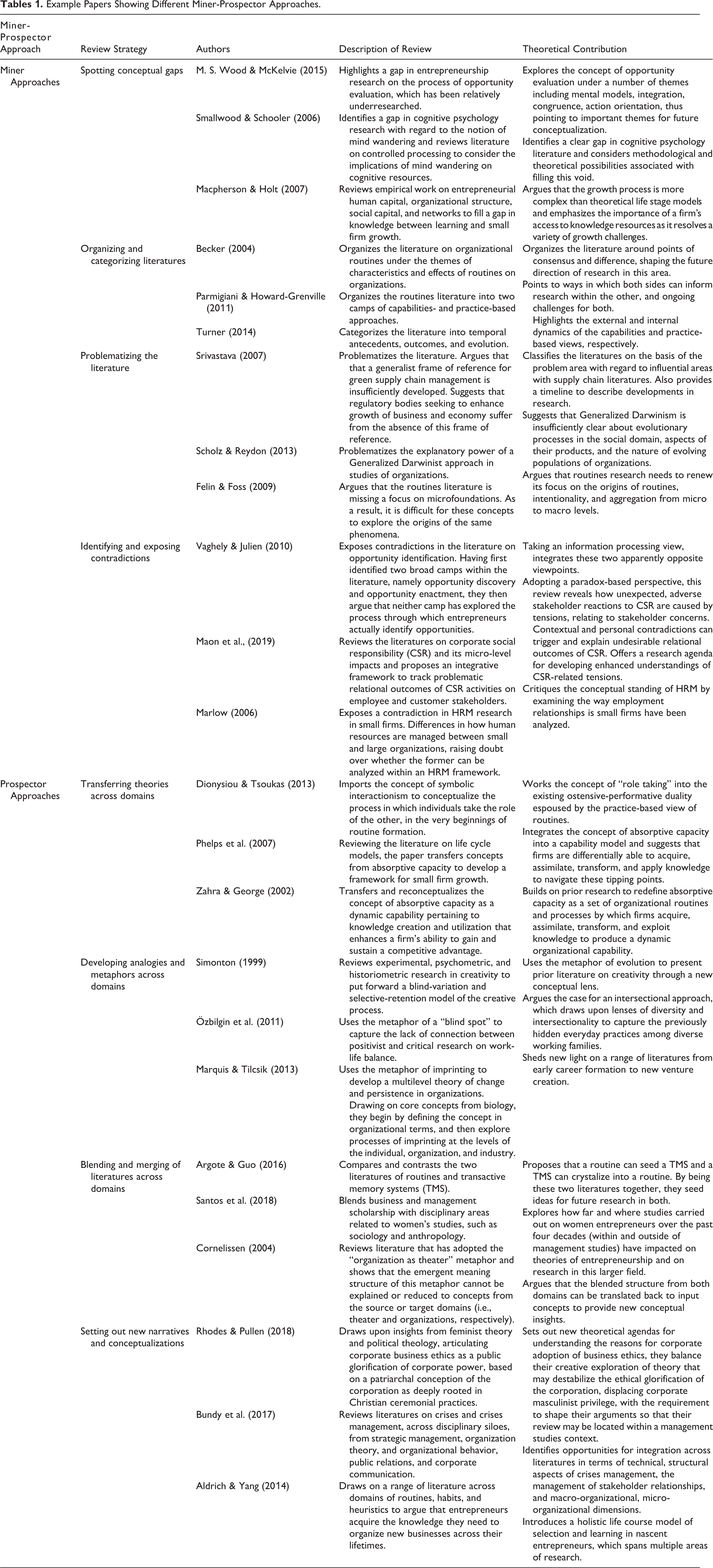
In order to illustrate the eight strategies on the miner prospector continuum, each author worked, at first individually, to identify reviews that would best explicate each category. Each of us subsequently proposed between two and three reviews, which we shared and discussed between us. Following these discussions, we eventually converged on and selected a sample of 24 review papers (3 papers in each category) that we felt best illustrated the central thrust of each approach (see Figure 1). We recognize that each of these papers may touch on a number of approaches across and from both sides of the continuum. However, we have categorized papers according to their key contribution, the central aim, and scope. For instance, while Felin and Foss’s (2009) paper highlights a gap in the “routines” literature with regard to microfoundations, its central focus is on problematizing the collective view taken by existing scholars; it thus fits into the “Problematizing the Literature” category (see Table 1). As with the miner and prospector paths described above, each of these strategies involves different degrees of risk for authors. However, the general thrust of our argument is that while miners immerse themselves in the mine, prospectors may open up the field, having discovered new and rich seams of scholarly gold.
Example Papers Showing Different Miner-Prospector Approaches.
Miners
By harvesting knowledge from within a defined domain, miners seek to identify unexploited gaps within seams of the mine, reorganize approaches taken to extract valuable knowledge within that mine, or increase the effectiveness of the mining operation. The purist miner focuses on one domain, where the boundaries of that domain are defined in a systematic fashion as noted above. Given this focus, papers tend to be more comprehensive in their literature search inclusion criteria when compared to prospector reviews, reviewing different streams, and subthemes within a given literature (Denyer & Tranfield, 2009; Rowe, 2014). Miner papers also tend to present an in-depth and critical analysis of these streams (Webster & Watson, 2002), as they spot conceptual gaps, organize and categorize literatures, problematize the literature, and expose contradictions. At the point of “transferring theories across domains” we see authors stepping from the miner domain into prospector territory. As noted above, these approaches are not mutually exclusive.
Spotting Conceptual Gaps
In this strategy, “miner” authors seek to make conceptual contributions by completing literature reviews in which gaps are identified, future research agendas are articulated within a well-defined literature and some observations regarding extant literatures are made (Alvesson & Sandberg, 2013). Junior scholars are advised to adopt the gap spotting approach as an achievable means to getting published, partly on the basis that richer reviews with a narrative or discursive approach (see Baumeister & Leary, 1997; Green et al., 2006) are more accessible to experienced scholars with established knowledge in the field (Pickering & Byrne, 2014; Pickering et al., 2015). Some gap-spotting papers might lean toward gap-filling, extending beyond mere identification. For example, M. S. Wood and McKelvie (2015) make the case for research on opportunity discovery to also consider the underresearched phenomenon of opportunity evaluation. They argue that without this extension, the literature suffers from an “incompleteness problem” (Locke & Golden-Biddle, 1997). Their review explores evaluation under a number of themes including mental models, integration, congruence, action orientation, thus pointing to important directions for future conceptualization, which complements the discovery literature (M. S. Wood & McKelvie, 2015). As gap spotting approaches generally do not question the assumptions in a given literature in a substantive manner, it can be challenging to develop “interesting” and significant conceptual contributions (Sandberg & Alvesson, 2011).
Through gap spotting, authors do not attempt to challenge existing views but instead seek to build directly on previous thinking and theorizations. In this respect the gap is recognized by researchers within the domain. Smallwood and Schooler (2006), for instance, position their review within the literature on controlled processing, making the case for a better understanding of the related phenomenon of mind wandering. They put forward a definition of mind wandering as “a situation in which executive control shifts away from a primary task to the processing of personal goals” (Smallwood & Schooler, 2006). They then consider the implications of mind wandering in relation to existing literature, focusing on methodological and theoretical possibilities associated with filling this void. Authors might develop theory by presenting synthesized coherence in their reviews and by arguing that researchers working in different areas are not aware of common points of similarity and intersection, and so identifying underdeveloped research areas (Locke & Golden-Biddle, 1997). Macpherson and Holt (2007) extend theory on small firm growth in this way, tackling the underexplored area of knowledge and learning. They emphasize the importance of a firm’s access to knowledge resources as it resolves a variety of growth challenges (Macpherson & Holt, 2007). These examples illustrate the consensus-building approach taken by authors, as they extend and build upon existing literatures to fill underresearched gaps. Of course, authors need to present their case for taking such an approach (Haveman et al., 2019), and not all readers will agree that all gaps need to be filled. By joining well-established research conversations scholars enter crowded spaces, thus constraining the scope of any potential contribution (Patriotta, 2017).
Organizing and Categorizing Literatures
Here the miner-researchers seek to develop theory within a defined domain by organizing and categorizing a reviewed body of literature according to some dimension or framework, such as antecedents-process-outcomes. Generally speaking, as with the spotting conceptual gaps approach, such an organization of the literature confirms existing interpretations of researchers within the field (Oswick et al., 2011). As a result, this strategy again exemplifies the miner’s approach. The takeaway for readers is a conceptual reorganization or framework, as opposed to a new set of explanatory concepts. This framework however may be the starting point for the subsequent development of theory (Strauss & Corbin, 1998). In Becker’s (2004) review of the literature on organizational routines, he highlights a number of characteristics and effects of routines, helping to identify shared themes within the literature, areas of consensus and growth. For example, he discerns consensus within the literature around the view that routines enable coordination, provide stability, economize on cognitive resources, and bind knowledge. By drilling down into the different conceptualizations of the routine, Becker (2004) organizes the literature around these points of consensus and difference, shaping the future direction of research in this area.
In a later review of routines, Parmigiani and Howard-Grenville (2011) make a further contribution by organizing and categorizing the routines literature into two broad camps of capabilities- and practice-based approaches. While not directly challenging the different approaches taken, their review helps demarcate the two camps, and highlights important differences in terms of foundations, levels of analysis, theoretical assumptions, and also areas of common interest. They thus point to ways in which both sides can inform research within the other, and ongoing challenges for both (Parmigiani & Howard-Grenville, 2011). By focusing on the growth of knowledge and consensus of views within a domain, such review papers can develop and focus lines of inquiry (Locke & Golden-Biddle, 1997). Furthermore, by positioning their contribution within a defined field (Oswick et al., 2011), reviewers who organize the literature seek to carefully fit into an established group of authors mining that seam of knowledge. For instance, Turner (2014) builds directly from Parmigiani and Howard-Grenville’s earlier review, by focusing on the temporal dimension of routines, within both capabilities and practice perspectives. Using this earlier organizational scheme, Turner further categorizes the literature into temporal antecedents, outcomes, and evolution. Within each perspective, he discusses time as a signal for action, time, and outcomes and the evolution of routines over time. Turner then feeds these findings back into the capabilities-practice dichotomy, highlighting the external and internal dynamics of the capabilities and practice-based views respectively. In this manner, reviews that organize and categorize the literature can contribute to the growth and development of theory within a domain, helping to shape emergent themes and research streams. However, at times, such organizational activities can fail to highlight important limitations and contradictions within the domain as a whole.
Problematizing the Literature
In this category, authors seek to stimulate theory development by problematizing the literature within a given domain (Shepherd & Suddaby, 2017). Researchers thus review the current body of literature, to identify a tension or opposition, which represents the starting point for novel theorizing (Suddaby et al., 2011). In this way, authors can show the literature is incomplete, inadequate, or incommensurable (Locke & Golden-Biddle, 1997; Rowe, 2014), and challenge taken-for-granted assumptions in an established literature (Nadkarni et al., 2018). For example, Srivastava (2007) problematizes the literatures on green supply chain management. This highly cited paper argues the lack of a generalist frame of reference for green supply chain management. The author suggests that regulatory bodies, seeking to enhance growth of business and economy, require such a frame of reference in order to achieve results (Srivastava, 2007). Scholz and Reydon (2013) equally problematize the explanatory power of a Generalized Darwinist approach in studies of organizations. The authors argue that the approach is insufficiently clear about evolutionary processes in the social domain, aspects of their products, and the nature of evolving populations of organizations. They therefore caution against transferring such metaphors between domains as distal as biology and social science (Scholz & Reydon, 2013).
While a problematizing strategy might be seen to fall within the miner approach, the researcher is seeking to upset the status quo within an existing mine. This process can lead to opportunities to create new or capture existing knowledge seams and/or mine these using different approaches or techniques, thus generating new ways of understanding within a given area of concern (Alvesson & Sandberg, 2020). For example, Felin and Foss (2009) problematize the literature on routines, by arguing that it has overly focused attention on the collective level, ignoring important microfoundations. As a result, they argue it is difficult for the routine concept to explore the origins of the same phenomena. This creates the opportunity for new strands of research, as Felin and Foss (2009) make the case for routines research to renew its focus on the origins of routines, intentionality, and aggregation from micro to macro levels. Problematizing literatures can therefore redefine research directions or open up new seams of knowledge within a given domain. At the same time, in many cases the researcher does not question the validity of the overall mine (i.e., the bounded domain of knowledge), and by highlighting noncoherence, authors merely highlight different approaches as belonging to a common research program or goal but linked by disagreement (Locke & Golden-Biddle, 1997).
Identifying and Exposing Contradictions
Finally, here authors extend the problematizing approach and develop theory, by challenging the theoretical foundations or implicit assumptions within a domain of interest (Alvesson & Sandberg, 2013; Suddaby et al., 2011). They might achieve this by setting up two competing views against the other and, in so doing, identifying similarities and differences between the two. For example, Vaghely and Julien (2010) expose contradictions in the literature on opportunity identification. Having first identified two broad camps within the literature, namely opportunity discovery and opportunity enactment, they then argue that neither camp has explored the process through which entrepreneurs actually identify opportunities. Taking an information processing view, they then integrate these two apparently opposite viewpoints (Vaghely & Julien, 2010). By identifying contradictions, scholars present a much greater challenge to the way things work within the mine, and who holds the balance of power. Maon et al. (2019) review the literatures on corporate social responsibility (CSR) and its micro-level impacts. They propose an integrative framework to track problematic outcomes of CSR activities on internal and external stakeholders. Using a paradox-based perspective, this review reveals how contextual and personal contradictions can set off undesirable relational outcomes of CSR. The paper offers a research agenda for developing a better understanding of CSR-related tensions.
By exposing contradictions, authors can construct a mystery, focusing on breakdowns and discrepancies between empirical material and prevailing theories (Alvesson & Kärreman, 2007). Equally, by setting up one approach against another through contrastive explanation, authors compare the explanatory power of current key constructs with alternative explanations (Suddaby et al., 2011). Marlow (2006) exposes a contradiction in HRM research in small firms, exploring differences in how human resources are managed between small and large organizations. This exercise raises doubt over whether the former can be analyzed within an HRM framework (Marlow, 2006). Marlow critiques the conceptual standing of HRM by examining the way employment relationships in small firms have been analyzed. Marlow concludes that given limitations in how HRM has been conceptualized, due to its focus on large firms, its application to small firms is not productive. Authors who highlight contradictions in this way present a threat to the status quo within existing mines, potentially shaping the foundations of theory within. By exposing fundamental contradictions, authors hope to rally support for their cause, and so increase their chances of grabbing extra seam space. However, such direct attacks can provoke defensive reactions from both readers and reviewers.
Prospectors
While miners seek to explore and exploit underresearched areas within a domain of knowledge, prospectors set their sights beyond existing mines. The prospector aims to identify new lines of inquiry across and between domains and disciplines—as Cozzo (1999) describes (with reference to philosophers), proposing new ideas for understanding organizational phenomena (see also Nugent, 2011, with respect to historians). In this manner, prospecting authors use literature reviews to bridge across isolated silos of knowledge (Hoon & Baluch, 2019). As one moves along the miner-prospector continuum, contributions become increasingly less bound to prior assumptions and logic within a given literature (Barney, 2018), as “institutionalized lines of reasoning” are disrupted (Sandberg & Alvesson, 2011). Given the wider range of literatures included in prospector reviews (when compared to “pure” miner reviews), literature search inclusion criteria tend to be more selective within each of the domains from which articles are drawn (Denyer & Tranfield, 2009; Rowe, 2014). Furthermore, the critique of these literatures occurs often with respect to theories and approaches drawn from other disciplines (Webster & Watson, 2002), as authors transfer theories, develop analogies and metaphors, blend and merge literatures across domains, and set out “new” narratives and conceptualizations. As observed earlier, it should be noted these approaches are not mutually exclusive, and indeed scholars may pursue more than one simultaneously. The provision here of the miner-prospector continuum offers strategies that will enable authors to take informed decisions regarding where to place their review within the framework and to manage the risks and benefits accordingly.
Transferring Theories Across Domains
In this strategy authors seek to make a conceptual contribution by transferring theories between domains, or applying a theory from one to another domain (Nadkarni et al., 2018). The transfer here occurs at largely a substantive level or area of application (Glaser & Strauss, 1967), and as a result the approach does not challenge the underlying theory that is transferred. For example, Dionysiou and Tsoukas (2013) import the concept of symbolic interactionism (Mead, 1934) to conceptualize the process of routine formation. They thus use Mead’s concept of “role taking” to develop an account of routine emergence, extending the ostensive-performative conceptualization put forward by practice scholars Feldman and Pentland (2003). The process of transferring concepts and theories is motivated by the desire to apply established theories to a new empirical setting (Suddaby et al., 2011). This strategy can be viewed as the beginnings of a prospector approach, in that the scholar is moving away from one established mine and transferring techniques to another. Phelps et al. (2007), for instance, transfer concepts from absorptive capacity (Cohen & Levinthal, 1990) to develop a framework for small firm growth. By integrating absorptive capacity into a capability model, they suggest that firms are differentially able to acquire, assimilate, transform, and apply knowledge to navigate key growth tipping points (Phelps et al., 2007). They thus seek to shift the study of small firm growth away from life cycle models by proposing an alternative conceptual framework for the growing firm.
The transfer of theories can therefore result in more significant conceptual insights and innovation and, with this, potential rewards over time. Zahra and George (2002) also apply the concept of absorptive capacity to reconceptualize dynamic capabilities, which pertain to knowledge creation and utilization that enhances a firm’s ability to gain and sustain a competitive advantage. In this process, Zahra and George introduce new insights into this literature by redefining absorptive capacity as a set of organizational routines and processes by which firms acquire, assimilate, transform, and exploit knowledge to produce a dynamic organizational capability. While the transfer approach can lead to such insights through the cross-fertilization of ideas, transferors tend to stick to and build upon theoretical foundations developed by scholars in the source mine. For instance, Dionysiou and Tsoukas (2013) transfer the concept of role taking from symbolic interactionism (Mead, 1934), to rework the practice view interpretation of the routines as noted above. In addition, such boundary spanning research can be challenged by the disciplinary thinking in both source and target domains, limiting the potential for such cross-fertilization (Nadkarni et al., 2018).
Developing Analogies and Metaphors Across Domains
This transfer between domains occurs at a higher level of abstraction, through formal theory or grand narratives (Cornelissen, 2004). For example, Simonton (1999) draws on the metaphor of evolution, to conceptualize a blind-variation and selective-retention model of creativity. Focusing on the mechanism of blind-variation, he draws on experimental, psychometric, and historiometric literatures across the field to support his view that ideas mostly emerge from a blind-variation process (Simonton, 1999). Using the metaphor of evolution, Simonton thus presents prior literature through a new conceptual lens. In this manner, metaphors also involve the transfer of information from a source domain to a target domain (Tsoukas, 1991). While the author seeks to reveal a deep structure that exists between the two domains (Cornelissen, 2004), the similarity between them is less clear cut. As a result, this approach challenges established views within the target domain. Özbilgin et al. (2011) use the metaphor of a “blind spot” in this way, to capture the lack of connection between positivist and critical research on work-life balance. The authors argue the case for an intersectional approach, which draws upon lenses of diversity and intersectionality to show previously hidden practices among diverse working families.
Scholars who adopt metaphors could be regarded as now firmly within the prospector path, as they set out beyond existing mines to identify opportunities and patterns of discovery in others. Marquis and Tilcsik (2013) also use a biology metaphor (imprinting) to develop a multilevel theory of change and persistence in organizations. Drawing on core concepts from biology, they begin by defining the concept of imprinting in organizational terms, and then explore processes of imprinting at the level of the individual, organization, and industry. In so doing, Marquis and Tilcsik shed new light on range of literatures from early career formation to new venture creation. Cornelissen (2004) assesses metaphors through their aptness or meaningfulness (or whether they offer new insights into an unfamiliar field) and the “distance” between the domains. The greater the contextual distance between the two domains (e.g., biology and management), then the better the prospects of the metaphor being insightful (Cornelissen, 2004; Morgan, 1980). However, as the strategy is largely one-directional, theoretical assumptions from the source domain are again not questioned. As a result, if these source foundations become discredited or redundant, then the basis of the prospectors’ strategy likewise collapses, as argued by Scholz and Reydon (2013) above.
Blending and Merging of Literatures Across Domains
This strategy extends the borrowing of theories at a higher level of abstraction, by developing theory in both the source and target domains. An example of this is provided by Santos et al. (2018), who explore how far studies carried out on women entrepreneurs over the last four decades (within and outside of management studies) have impacted on theories of entrepreneurship. They bring into the business and management literatures from disciplinary areas related to women’s studies, such as sociology and anthropology, and in so doing they reflect on how theories relating to women entrepreneurs have impacted on theories of entrepreneurship within a broader context. Blending in this way involves the projection of mental frames from two domains into a separate “blended” mental space (Cornelissen & Durand, 2012). Blending is thus a two-way correspondence involving meaningful engagement in both domains producing new insights in both (Oswick et al., 2011; Schoeneborn et al., 2013). For example, Argote and Guo (2016) contribute to the literatures in routines and transactive memory systems (TMS) by comparing and contrasting literatures in both. They examine the dynamics of change within each literature, and then consider the potential reciprocal relationship between the two concepts. This results in new insights in both literatures, as they propose that on the one hand, a routine can seed a TMS, and on the other, a TMS can crystalize into a routine (Argote & Guo, 2016). By bringing these two literatures together, they thus seed ideas for future research in both.
These blending prospectors thus straddle multiple mines to identify opportunities to make conceptual contributions in both and beyond. Cornelissen (2004) for example reviews literature which has adopted the “organization as theater” metaphor. He shows that the emergent meaning structure of this metaphor cannot be explained or reduced to concepts from the source or target domains (i.e., theater and organizations, respectively). He further argues that the blended structure from both domains, can be translated back to input concepts to provide new conceptual insights (Cornelissen, 2004). The combination of theories across domains is complicated by the conceptual distance between the phenomena under examination and the underlying assumptions of each theoretical lenses (Okhuysen & Bonardi, 2011). An additional challenge relates to the compatibility of lenses, or the degree to which the different theories “rely on similar or dissimilar individual decision-making processes, organizational mechanisms, or other properties in the development of their explanations” (Okhuysen & Bonardi, 2011, p. 7). If theories are too close together in terms of sharing compatible assumptions and addressing similar phenomena, they can struggle to show sufficient novelty to warrant publication (Suddaby et al., 2011). On the other hand, the further the distance between and the more incompatible the underlying assumptions appear incompatible, then the more difficult papers are to craft (Okhuysen & Bonardi, 2011; Suddaby et al., 2011).
Setting Out “New” Narratives and Conceptualizations
This final prospector strategy leaves the door open so to speak, to possible new conceptualizations, not necessarily emanating from other disciplines, and with no precedent in any other field of study—what Cozzo (1999) might describe as “pretheoretical” ideas, opening up new pathways (or seams of gold) for scholarly investigation. These new narratives can side-step building on or challenging an existing literature (Sandberg & Alvesson, 2011). Rhodes and Pullen (2018), for instance, step into uncharted waters as they draw upon insights from feminist theory and political theology, articulating corporate business ethics as a public glorification of corporate power, based on a patriarchal conception of the corporation as deeply rooted in Christian ceremonial practices. Setting out new theoretical agendas for understanding the reasons for corporate adoption of business ethics, they balance their creative exploration of theory which may destabilize the ethical glorification of the corporation, displacing corporate masculinist privilege, with the requirement to shape their arguments so that their review may be located within a management studies context. In metaphorical terms, these prospectors are not guided by the experiences of former miners, but use their intuition and creative leaps to identify sources of new mines. In their review of crises and crises management, Bundy et al. (2017) bridge across disciplinary siloes, integrating literatures from strategic management, organization theory, and organizational behavior, public relations and corporate communication. In so doing, they create a framework with incorporates two perspectives: one internally focused on technical and structural aspects of a crisis and the other externally oriented toward managing stakeholder relationships (Bundy et al., 2017). Bundy et al. thus open up the possibility for new theoretical development within and across literatures, with their framework serving as a foundation for future multilevel research on crises and crisis management.
Setting out new paths (or pure prospecting) is considered high risk, with many more misses than hits over time (Nugent, 2011). Authors might set out new directions based on practical rationality, by setting current theory against the actual practices of management (Suddaby et al., 2011). Alternatively, researchers might use complex real-world problems as the starting point for theorizing beyond established domains of theoretical disciplines. Taking the complex life journeys of entrepreneurs as a starting point, Aldrich and Yang (2014) draw on a range of literature across domains of routines, habits and heuristics to argue that entrepreneurs acquire the knowledge they need to organize new businesses across their lifetimes. This multidisciplinary approach reflects the complexity of such career paths, as entrepreneurs acquire knowledge from family, schools, and work careers prior to the start-up stage, in addition to learning through the start-up process. Aldrich and Yang thus introduce a holistic life course model of selection and learning in nascent entrepreneurs, which spans multiple areas of research. Prospectors such as those mentioned here, seek to break free of prevailing norms by writing differently, being more imaginative, experimental, dialogic and reflexive (Gilmore et al., 2019). After all, writing in the social sciences is not just a matter of representation but of “imagination, originality, particularity, emotionality and expressiveness” (Rhodes, 2019, p. 27). However, given the novelty of their contributions, these prospectors might face, in practice, editor/reviewer criticisms that their reviews lack legitimacy within any camp. Thus, pure prospectors might experience compromised capacity to find the resources needed to support their ventures—it is not possible for a review paper to develop theory if it is never published. This strategy of prospecting for “new” scholarly gold therefore represents a high level of risk for authors as they pursue, what may become, lifelong projects.
From Literature Reviews to Theory Development
Reflecting on the range of review strategies taken by authors outlined above, it is important to define, regardless of where an approach might be located on the miner-prospector continuum, at what point does a literature review become a theory paper and vice versa. Prospectors after all increasingly move into the unknown and away from established domains of knowledge. In relation to literature reviews, the need for contributions to surprise is particularly challenging (M. S. Davis, 1971). On the one hand, a review, by definition, involves researching, gathering, and combing through prior works to present the field in a new light, and/or spot previously unseen trends or gaps. On the other, the review needs to develop theory, diverging from, while at the same time aligning itself to, a field of study. Reviewing reconstructs an account of the field by re-presenting the literature and intervening in the literature (Gond et al., 2020). Thus, the International Journal of Management Reviews seeks papers which “make significant conceptual contributions, offering a strategic platform for new directions in research, and making a difference to how scholars might conceptualise research in their respective fields” (Gatrell & Breslin, 2017, p. 1). At what point then do literature reviews become theory papers, and what differentiates the two? We propose that (regardless of whether it mines a rich vein of scholarly knowledge or prospects within new terrain) a review paper can be differentiated from a theory paper in terms of its “systematicity” (Rowe, 2014; Tranfield et al., 2002). Such systematicity is likely to include a number of elements and which at its core requires theory development to be situated and contextualized within the evidence base provided by previous research:
First, the review should be transparent (Denyer & Tranfield, 2009), in setting out how the authors identified, analyzed, and interpreted the literature (Denyer & Tranfield, 2009; Fink, 2010; Tranfield et al., 2003). While methods may differ, transparency allows the reader to understand the boundaries of the domain reviewed, and the process that has shaped the author’s thinking. By being transparent, review authors are thus clear about the background to their work, and assumptions made in the paper. It is acknowledged here that integrative reviews by experienced authors (published, for example, in Academy of Management Annals) might adopt a more narrative approach and would not necessarily include a methods section, but would nevertheless usually be expected to identify the specific fields they are reviewing, offering a clear sense of where these are located and how they relate to one another (see, e.g., Jaskiewicz et al., 2017)
Second, the inclusivity of the review should fit the goals of the paper (Denyer & Tranfield, 2009; Rowe, 2014). Inclusion allows reviewers to avoid a myopic selection of supportive scholars and works, which can strengthen the development of the paper’s contribution. In this sense, one must look back in order to look forward. Literature reviews base their theorizing on the evidence of extant knowledge (Elsbach & van Knippenberg, 2018; Hoon & Baluch, 2019), and regardless of how it is presented, the review paper must be organized around a full review of evidence within a given field as described by Elsbach and van Knippenberg (2018, p. 1; see also Elsbach & van Knippenberg, 2020). These editors (of Annals) describe how the journal preference is for papers that develop new theory, but caution that papers that privilege theory at the expense of the review will not be accepted. Inclusivity furthermore helps to position the paper within the existing body of research, both in terms of motivating the work and in terms of reconciling contributions back into that literature. However, the more comprehensive this inclusion criterion, then the more challenging it becomes to integrate the literature into a unifying framework or model (Rowe, 2014). Furthermore, the more the paper seeks to develop theory, then the more the breadth of the supporting review becomes compromised (Jones & Gatrell, 2014; Kilduff, 2006).
Third, reviews constitute a critical aspect as they interpret and analyze the literature (Blumberg et al., 2005; Jones & Gatrell, 2014; Webster & Watson, 2002) in order to identify biases and gaps and set out new research directions (Rowe, 2014). For example, the International Journal of Management Reviews argues that papers published should be “analytical” rather than “descriptive” (Jones & Gatrell, 2014). Success here rests in presenting an in-depth critical understanding of the extant knowledge base (Elsbach & van Knippenberg, 2018) allowing scholars to track irregularities and anomalies (Nadkarni et al., 2018). In this manner, the review should not present an “unsurprising overview” of the literature (Rowe, 2014) but provide the foundation for advancing knowledge by facilitating theory development (Webster & Watson, 2002). A critical assessment of prior work can motivate the contribution and, in addition, create the building blocks for the development of theory, as the authors identify gaps, connections, or insights that are molded into a new contribution. The critical review thus sets out the departure point, for future theorizing.
We stop short at setting out “methods” for literature reviews in prescriptive terms (see Post et al., 2020, for ideas about how to write a review), but instead recognize that these three features characterize review papers from across the miner-prospector continuum. For example, Rhodes and Pullen (2018) are transparent both with regard to their prior knowledge of the literature and in relation to the inclusion of literature from key articles the authors were already familiar with, and a focused search for papers that question ethics in business. Rhodes and Pullen (2018, p. 489) then critically assess this literature to suggest that previous research did “not go far enough in interrogating the corporate enthusiasm for ethics,” and build on this to argue that businesses have a hidden gendered substructure that seeks to glorify itself through ethics. Similarly, Dionysiou and Tsoukas (2013) set out the background to their review of the routines literature (i.e., transparency), highlighting the paucity of research on microfoundations and relational aspects of routines. Their review thus focuses on including studies of the performative perspective on routines. Their critique of this literature highlights gaps in understanding the internal dynamics of routines, arguing that past research had focused largely on established, and not emergent, routines (Dionysiou & Tsoukas, 2013). They build on this critique of the practice view (Feldman & Pentland, 2003) to make the case for a new conceptualization of routine emergence. Finally, Özbilgin et al. (2011) are transparent in describing the method used, and motivation for, their literature review. They set out to review work-life literature with a view to addressing a narrow focus on traditional family structures, including both positivist and critical approaches to the areas of life, diversity, and power. Critically assessing this literature, they argue that previous theorizations are incomplete. Presenting an intersectional approach, they invoke a rethink of “the treatment of life, diversity and power in order to reconceptualize the work-life interface” (Özbilgin et al., 2011, p. 186).
At times, and particularly as one moves toward the prospector end of the continuum, it can be difficult to differentiate between a review and theory paper because the latter are frequently also developed from a review of the literature (Kilduff, 2006). However, while review papers arrive at new conceptual insights through an integration of the evidence, in theory papers, the emphasis is on the former as opposed to the latter (Elsbach & van Knippenberg, 2018). Furthermore, unlike literature reviews, a transparent, inclusive, and critical presentation of the field is not a necessary goal of theory papers. Instead, systematicity (with a small s), as outlined above, shapes the main purpose and body of a review and acts as the principal foundation for any theoretical contribution that is developed.
Finally, while the above review has focused on the central strategy used within a paper, it is possible that elements of both miner and prospector approaches can exist within each review paper. Thus, a “miner” paper may contain elements of a prospector approach. For example, Parmigiani and Howard-Grenville (2011) use the metaphor of the “black box” to differentiate between capabilities and practice approaches to studying routines. While the former approach assumes routines are enacted as designed, the latter seeks to open up processes within this “black box.” Similarly, Turner’s (2014) review has been classified above as a miner approach (i.e., organizing and categorizing literature). However, when discussing the temporal antecedents of routines, Turner transfers the notion of clock and event time (Ancona et al., 2001) to explore the implications of these different conceptualizations on capabilities and practice camps. Equally, prospector reviews may contain elements of a miner approach within, identifying gaps and problematizing the literature before setting out new theoretical directions. For example, Bundy et al. (2017) first spot a conceptual gap in crises and crisis management, highlighting a lack of theoretical rigor, and thereby justify the need for developing a multidisciplinary approach. These examples highlight the opportunity of a mutually constitutive relationship or duality (Putnam et al., 2016) between miner and prospector approaches in the crafting of review papers.
Implications for Organization and Management Studies Research
In this article we have developed the miner-prospector continuum to examine the choices, risks, and implications for theory development through literature reviews associated with various approaches located along its length. In so doing we enable authors to carefully position different choices and approaches within a context. We build on the work of others who show how theory development can occur in review papers (Hoon & Baluch, 2019; Kunisch et al., 2018; Post et al., 2020). Authors can choose a miner approach, adopting the norms of the discipline and carving out their contribution, while prospectors might choose to view existing literatures as a launch pad for future endeavors, challenging, disrupting, or circumventing established disciplinary norms and assumptions. In so doing we facilitate editors and reviewers in identifying and articulating where a paper is positioned, explicating clearly where and how a paper might require to set the boundaries between familiarity and adventure.
We have noted above the need to nurture novelty within organization and management studies research, increasing support for scholars to choose not only the “safer” miner approach to reviewing (Pickering et al., 2015), but also the perhaps riskier and challenging prospector paths (Cozzo, 1999). However, we also acknowledge that while prospector reviews might, in the abstract, offer potential for making conceptual contributions through opening up new horizons (Cunliffe, 2018b), individual scholars might take a cautious view regarding the wisdom of pursuing a revisionist (or prospector) pathway. Such caution may relate to justified fears that reviewers and editors will be conservative in their views, resisting new ideas that undermine current beliefs or taken-for-granted assumptions (Bartunek et al., 2006; Cunliffe, 2018a; Patriotta, 2017; Starbuck, 2003). Due to concerns about achieving sufficient publications to secure career advancement (Aguinis et al., 2020; Gabriel, 2010; Knights & Clarke, 2014), plus the received wisdom that incremental “miner” reviews will get published where more adventurous prospecting reviews might fail (see Pickering et al., 2015), scholars may repress prospector approaches in favor of tried and tested miner formulae. Authors may resist the lure of innovation and heterogeneity, delivering theoretical contributions as incremental revisions to established debate, rather than proposing radical change in order to get reviews accepted for publication (Aguinis et al., 2020; Pickering & Byrne, 2014).
Given the above-noted pressures for academics to follow incremental, low-risk research paths, how can our profession produce a more balanced mix of miners and prospectors? After all, the wider research process depends on a healthy supply of both. As discussed, organization and management research requires theories that reflect the complexity and multidisciplinary nature of our field, setting out new narratives and conceptualizations. Literature reviews have a key role to play in this process. Scholars require space to develop new ideas—a pretheoretical state where new pathways may be explored (Toulmin, 1972): a “scholarship of foresight, imagination and reflexivity” (Cunliffe, 2018b, p. 1431). At the same time, institutional forces act to uphold publication norms, resulting in a proliferation of miner strategies at the expense of prospectors. Below, we explore two key issues that can be seen to change this trend.
Nurturing Novelty
Reviews facilitate the identification and classification of extant research, yet also offer possibilities for challenging existing paradigms through proposing new theoretical paths and developing new conceptualizations (see Cunliffe, 2018b; Nadkarni et al., 2018; Suddaby et al., 2011). Different stakeholders have a role to play in changing the institutional environment to encourage such groundbreaking research paths. First, journal editors can seek to disrupt publication norms and to encourage more imaginative and innovative papers, in addition to incremental, consensus-based research. Editors might thus alter their publication criteria and editorial boards (Corbett et al., 2014; G. F. Davis, 2010): They have the remit to reposition their journals to develop prospector reviews, providing space where “ideas from different places [can] meet” (Burrell et al., 1994). These decisions likewise involve risk for editorial teams, with journal impact factors hinging on papers being both read and cited. It may thus take a brave prospector editor to take a proactive role in the peer review process, ensuring that “the demands of a broad agreement between referees, Associate Editors and Editors in Chief does not squeeze out work which is provocative, irritating or stylistically demanding” (Parker & Thomas, 2011, p. 426). In this manner, prospector editors can shape the peer review process by calling on reviewers who are supportive of prospector goals (Gilmore et al., 2019).
Universities could create a climate that encourages scholars to be more reflective, through workshops focusing on questioning assumptions, as opposed to cultivating academics as paper authors (Alvesson & Sandberg, 2013). Wider academic communities, such as the Academy of Management, also have a role to play in nurturing novelty, by both “incubating” blue skies ideas for further development and encouraging prospector mind-sets (Renwick et al., 2019). Learned societies can nurture new concepts through discussion teams, special interest groups, and specialized journal fora. Efforts may include developing prospector talent through PhD mentoring programs. By providing incubation space, new ideas may “demonstrate their merits before being swamped in the larger population” (Toulmin, 1972, p. 294). Incentive policies might also be changed to reward innovative research, regardless of the stage of its development. Equally workloads could be managed to support such approaches. Approaches that radicalize and challenge should be promoted, increasing the chances of research being disruptive and novel (Hoon & Baluch, 2019; Suddaby et al., 2011) triggering new paths and revolutions. Such unconventional research often requires greater investments in time and risk (Corbett et al., 2014), and setting a one-size-fits-all incentive scheme might favor miners over prospectors. Such shifts in institutional strategies involve many risks and gambles, but without these moves, the future of their research pipelines, and that of the wider organization and management field, becomes increasingly constrained.
Setting the Researcher’s Path
Academics themselves also have a role to play in increasing the mix between prospectors and miners through the choices and priorities that they make (Alvesson & Sandberg, 2013). In this sense, it is not just the “winners” in the publication game who are reluctant to change, but the “losers” as well (Alvesson et al., 2017). The latter play the miner’s game in the hope that one day they will get space within the crowded mine (Nadkarni et al., 2018). However, many risk going away empty-handed (Alvesson et al., 2017). Therefore, while making a contribution to knowledge via the miner’s path is often, in relation to literature reviews, presented to early career researchers as being of lower risk (see Pickering et al., 2015), the increasing demands of journals for contributions that are both novel and “interesting” heighten the risks that such strategies will result in rejections and publication dead-ends.
While some academics are pressured to play a hard miner’s game in the pursuit of tenure or the next promotion (see Knights & Clarke, 2014; Pickering et al., 2015), others (perhaps especially those fortunate enough to be tenured: Ylijoki & Henriksson, 2017) still enjoy relative academic freedom to follow research paths for which they have a passion. Given the long-term nature of the research process, it is important to choose and prioritize questions about which the researchers “truly care about the most” (Corbett et al., 2014). As Rynes (2007, p. 1382) notes, researchers should ideally be given chance to “commit to…ideas we care about rather than focusing on what our publications will do for our image, our compensation, or our careers.” When writing literature reviews, authors might step back and reflect on the assumptions and norms prevalent within their domain of interest. They could actively seek to embrace conflict and disagreement within the literature, thereby revealing limitations and anomalies, problematizing the literature and sowing the seeds of new theory (Nadkarni et al., 2018). Review authors may immerse themselves in domains not only adjacent to their fields of interest but distal to them (Byron & Thatcher, 2016; Nadkarni et al., 2018) and consider transferring theories or applying analogies and metaphors in new ways. Scholars might prospect into the unknown, discard disciplinary blinkers, follow their intuition, and engage with problems in the world of practice (Kilduff, 2006; see also Hambrick, 2005).
As a result, researchers themselves need to take on many of the risks associated with following both a miner and prospector’s path. While the former may be perceived as lower in risk, trends in publication noted above make it increasingly difficult to get such incremental research into the top-tiered journals. Prospectors on the other hand face an uphill battle as they seek to make bridges between disciplines, potentially meeting in this process competing demands from defensive miner reviewers. Given the challenges of both approaches, it is perhaps advisable for researchers to develop (and universities to facilitate) a portfolio of projects spanning the miner-prospector continuum. Nadkarni et al. (2018) suggest scholars develop a portfolio, including core, adjacent, and transformational projects. In this way, the scholar keeps in play a range of projects spanning the miner-prospector continuum, with potential for each to influence the other and to coevolve over time, in a mutually constitutive manner. While individual academics may have a tendency to lean across their portfolio of work toward a miner or a prospector approach (Nugent, 2011), there is potential for a prospector in every miner and vice versa. Ultimately, researchers need to retain a focus on the goal and direction of longer-term projects, despite the threat of potentially slower career paths. The passion associated with following whatever path is what drives and ultimately fulfills the researcher’s calling. Indeed, prior research has shown that the stronger the perceived competence or self-efficacy of the researcher, the more likely they will pursue a consensus-challenging research path and the more likely they will be willing to bear associated risks (McMullen & Shepherd, 2006).
Conclusion
Going forward, research in organization and management studies needs a balance between miner and prospector approaches, and literature reviews have a key role to play in this journey. It is recognized how institutional forces push the research community further down the path of the miner. As a result, making a theoretical contribution via either miner or prospector paths could now be seen as laden with risk. We argue that all stakeholders from institutions and editors to reviewers and researchers have a role to play in redressing the balance. Yet while we recognize the risks and benefits of both the miner and the prospector approaches, we remain concerned that, on balance, the prospector path might seem riskier, meaning that both editors and authors might eschew the rockier path of the prospector journey.
Institutions have a key role to play in nurturing novelty, “incubating” blue-skies ideas for further development through incentive and performance assessment policies (see also Aguinis et al., 2020). In the absence of these collective efforts toward prospecting, we argue that organization and management studies research will continue to meander down the path of normal science and fail to tackle the complex challenges facing organizations and society today (Renwick et al., 2019; Stern, 2016).
Our miner-prospector continuum takes a step in the direction of supporting such efforts. In classifying different stages within the continuum, it facilitates a range of potential contributions within review papers including valuable and relevant mining reviews through to more adventurous prospecting approaches. Through clarifying where reviews might be positioned on the length of the eight-category miner-prospector continuum, we facilitate authors (and editors and reviewers) in understanding the risks and benefits of each approach, enabling the proactive and strategic management of choice regarding tradition versus new challenge.
Footnotes
Acknowledgements
The authors would like to thank the editor Paul Bliese, the special issue guest editors, Sven, Kunisch, Markus Menz, Jean Bartunek, Laura Cardinal, David Denyer, and three anonymous reviewers for their invaluable help and guidance in the development of this article. They would also like to thank Penny Dick and Ossie Jones who provided feedback on earlier drafts of the paper.
Declaration of Conflicting Interests
The author(s) declared no potential conflicts of interest with respect to the research, authorship, and/or publication of this article.
Funding
The author(s) received no financial support for the research, authorship, and/or publication of this article.
