



Abstract
The Expert Panel for Cosmetic Ingredient Safety reviewed newly available studies since their original assessment in 2002, along with updated information regarding product types and concentrations of use, and confirmed that Acetyl Triethyl Citrate, Acetyl Tributyl Citrate, Acetyl Triethylhexyl Citrate, and Acetyl Trihexyl Citrate are safe as cosmetic ingredients in the practices of use and concentration as described in this report.
Current and Historical Frequency and Concentration of Use of Acetyl Trialkyl Citrates According to Duration and Exposure.
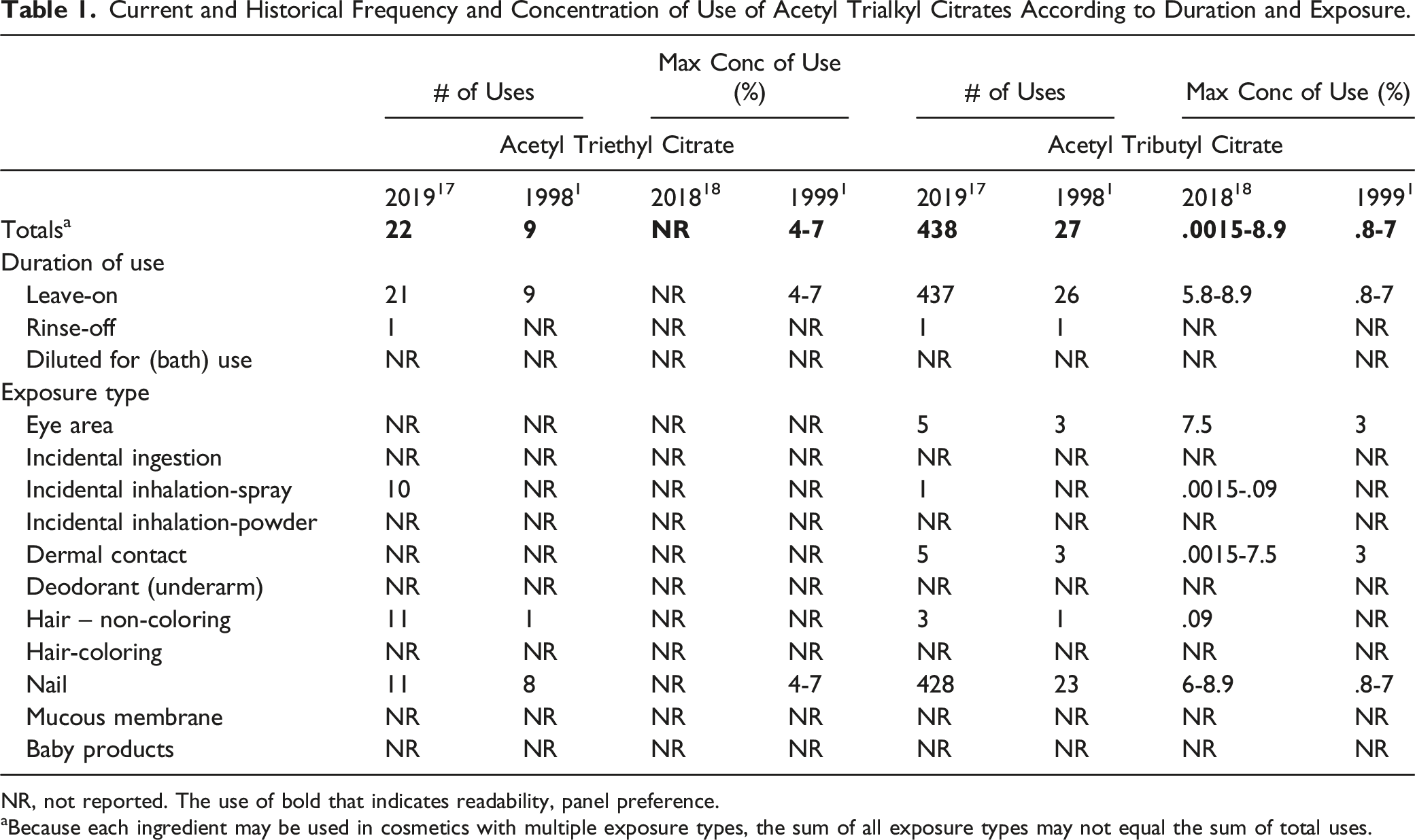
NR, not reported. The use of bold that indicates readability, panel preference.
aBecause each ingredient may be used in cosmetics with multiple exposure types, the sum of all exposure types may not equal the sum of total uses.
The data indicate that only Acetyl Triethyl Citrate and Acetyl Tributyl Citrate are currently reported to be used in cosmetic products.17,18 The frequency of use has increased for both of these ingredients since the initial assessment. According to VCRP data, Acetyl Triethyl Citrate and Acetyl Tributyl Citrate were reported to be used in 9 and 27 formulations, respectively, in 1998. 1 In 2019, VCRP data indicate that Acetyl Triethyl Citrate is used in 22 formulations, and Acetyl Tributyl Citrate is used in 438 formulations. 17 There were no reported uses of Acetyl Trihexyl Citrate or Acetyl Triethylhexyl Citrate (formerly Acetyl Trioctyl Citrate) in 1998 or in 2019. For Acetyl Triethyl Citrate, the maximum concentration of use was 7% in nail products in 1999 1 ; however, according to a recent survey provided by the Council, current use concentration data on this ingredient were not submitted. 18 For Acetyl Tributyl Citrate, the maximum concentrations of use have increased slightly since the original report was issued. In 1999, Acetyl Tributyl Citrate was used at up to 7% in nail products and up to 3% in products that resulted in dermal contact (i.e., eyeliners) 1 ; data collected in 2018 indicate that the maximum concentrations of use are 8.9% in nail products and 7% in products that result in dermal contact. 18 Though increases in use concentrations are noted when the two years are compared, the higher use concentrations were not considered to be dissimilar to the values that were reported initially and do not warrant any safety concerns.
Footnotes
Author's Note
Unpublished sources cited in this report are available from the Director, Cosmetic Ingredient Review, 1620 L Street, NW, Suite 1200, Washington, DC 20036, USA.
Author Contributions
The articles in this supplement were sponsored by the Cosmetic Ingredient Review.
Declaration of Conflicting Interest
The author(s) declared the following potential conflicts of interest with respect to the research, authorship, and/or publication of this article: The articles in this supplement were sponsored by the Cosmetic Ingredient Review.
Funding
The author(s) disclosed receipt of the following financial support for the research, authorship, and/or publication of this article: The articles in this supplement were sponsored by the Cosmetic Ingredient Review. The Cosmetic Ingredient Review is financially supported by the Personal Care Products Council.