The Expert Panel for Cosmetic Ingredient Safety reviewed newly available studies since their original assessment in 1998, along with updated information regarding product types and concentrations of use and confirmed that EDTA and certain salts are safe as cosmetic ingredients in the practices of use and concentration as described in this report.
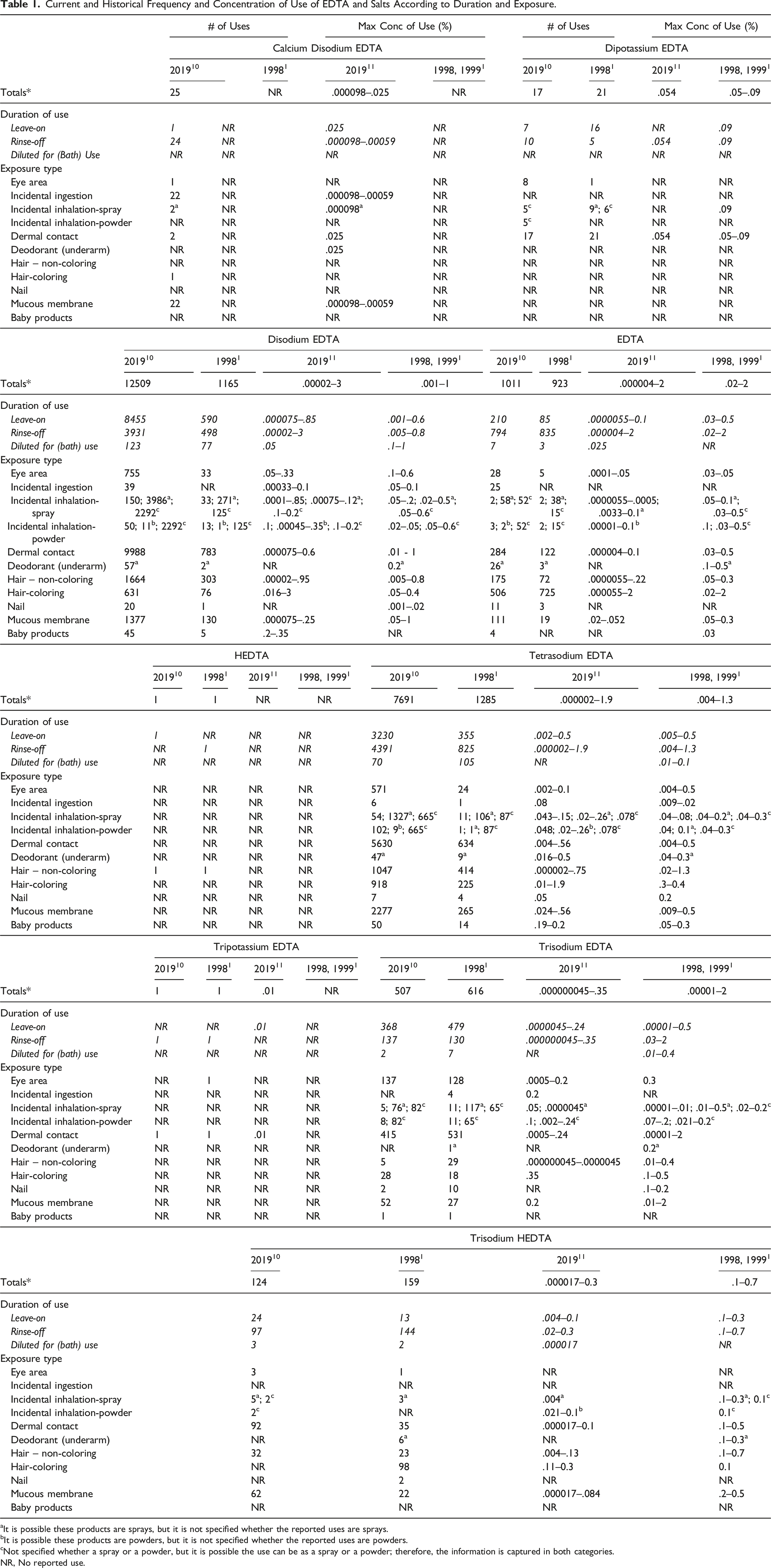
The Expert Panel for Cosmetic Ingredient Safety first published a final report on the Safety Assessment of EDTA and Salts in 1998.1 The Expert Panel concluded that EDTA, Calcium Disodium EDTA, Diammonium EDTA, Dipotassium EDTA, triethanolamine (TEA)-EDTA, Tetrasodium EDTA, Tripotassium EDTA, Trisodium EDTA, hydroxyethyl ethylenediamine triacetic acid (HEDTA), and Trisodium HEDTA are safe as used in cosmetic formulations as described in that report. Because it has been at least 15 years since the report was published, in accord with Cosmetic Ingredient Review Procedures, an updated search was performed, and the Expert Panel considered whether the safety assessment of EDTA and the related salts should be reopened. Data identified in the published literature2-9 that have become available since the original report was issued support the original conclusion. The Expert Panel also considered updated information regarding product types and ingredient use frequencies as reported in the US Food and Drug Administration (FDA) Voluntary Cosmetic Registration Program (VCRP) database,10 and the maximum use concentrations provided by the Personal Care Products Council.11 The Expert Panel determined to not reopen this safety assessment and reaffirmed the original conclusion that EDTA and salts of EDTA are safe as cosmetic ingredients in the present practices of use and concentration, as given in Table 1.
Current and Historical Frequency and Concentration of Use of EDTA and Salts According to Duration and Exposure.
aIt is possible these products are sprays, but it is not specified whether the reported uses are sprays.
bIt is possible these products are powders, but it is not specified whether the reported uses are powders.
cNot specified whether a spray or a powder, but it is possible the use can be as a spray or a powder; therefore, the information is captured in both categories.
NR, No reported use.
According to VCRP data from 2019, Disodium and Tetrasodium EDTA are reported to be used in 12,509 and 7691 formulations, respectively, while in 1998 they were reported to be used in 1165 and 1285 formulations.1,10 In addition, in 1998, Calcium Disodium EDTA and Tripotassium EDTA were not reported to be in use. According to 2019 VCRP data, these ingredients are reported to be used in 25 and 1 formulation, respectively. In 1998, the maximum concentrations of use were reported for EDTA (2% in hair products; rinse-off) and Trisodium EDTA (2% in bath soaps and detergents; rinse-off).1 According to 2019 concentration of use data, the ingredient with the highest maximum concentration of use is Disodium EDTA, which is used at 3% in “other hair coloring preparations.”11 This ingredient was previously reported to be used at a maximum of 1% in bath products. Disodium EDTA is also reported to have the highest concentration of use in leave-on products (.85%; hair color sprays) and in products which would come in contact with the skin (.6%; skin cleansing). All other in-use ingredients are reported to be used at 2% or less.
Although a substantial increase in frequency of use was reported, the lack of evidence of genotoxic and clinical effects continues to support the safety of this ingredient group. According to the Expert Panel, EDTA and its salts did not pose a toxicological risk as used in cosmetics; and therefore, the original conclusion was reaffirmed.
Footnotes
Author's Note
Unpublished sources cited in this report are available from the Director, Cosmetic Ingredient Review, 1620 L Street, NW, Suite 1200, Washington, DC 20036, USA.
Author Contributions
The articles in this supplement were sponsored by the Cosmetic Ingredient Review.
Declaration of Conflicting Interest
The author(s) declared the following potential conflicts of interest with respect to the research, authorship, and/or publication of this article: The articles in this supplement were sponsored by the Cosmetic Ingredient Review.
Funding
The author(s) disclosed receipt of the following financial support for the research, authorship, and/or publication of this article: The articles in this supplement were sponsored by the Cosmetic Ingredient Review. The Cosmetic Ingredient Review is financially supported by the Personal Care Products Council.
References
1.
AndersonF.A. (ed). Final report on the safety assessment of EDTA, calcium disodium EDTA, diammonium EDTA, dipotassium EDTA, disodium EDTA, TEA-EDTA, tetrasodium EDTA, tripotassium EDTA, trisodium EDTA, HEDTA, and trisodium HEDTA. Int J Toxicol2002;21:95-142.
2.
BallalNRaoBMalaKRaoB. Assessment of genotoxic effect of maleic acid and EDTA: A comparative in vitro experimental study. Clin Oral Invest. 2013;17:1319-1327.
3.
WhittakerPSeifriedHSanRClarkeJDunkelV. Genotoxicity of iron chelators in L5178Y mouse lymphoma cells. Environ Mol Mutagen. 2001;38:347-356.
4.
NIH U.S. National Library of Medicine. CCRIS: Ethylenediaminetetraacetic acid. 2000.
5.
MarinsJSassoneLFidelSRibeiroD. In Vitro genotoxicity and cytotoxicity in murine fibroblasts exposed to EDTA, NaOCl, MTAD, and citric acid. Braz Dent J. 2012;23(5):527-533.
6.
JuzenieneAJuzenasPIaniVMoanJ. Topical applications of iron chelators in photosensitization. Photochem Photobiol Sci. 2007;6:1268-1274.
7.
Laborde-CastérotHVillaARosenbergNDupontPLeeHGarnierR. Occupational rhinitis and asthma due to EDTA-Containing detergents or disinfectants. Am J Ind Med. 2012;55:677-682.
8.
Sánchez-PedreñoPGarcía-BravoBFrías-IniestaJ. Contact allergy to tetrasodium EDTA in a sunscreen. Cont Derm. 2009;61:125-126.
9.
KimuraMKawadaA. Contact dermatitis due to trisodium ethylenediaminetetra-acetic acid (EDTA) in a cosmetic lotion. Cont Der. 1999;40:341.
10.
US Food and Drug Administration (FDA) Center for Food Safety & Applied Nutrition (CFSAN). Voluntary cosmetic registration Program (VCRP) - frequency of use of cosmetic ingredients. (Obtained under the Freedom of Information Act from CFSAN; requested as “Frequency of Use Data”; received January 31, 2019). College Park, MD; 2019
11.
Personal Care Products Council. Council concentration of use by FDA product category: EDTA ingredients. (Unpublished data submitted by the Personal Care Products Council on January 31, 2019). 2019