The Expert Panel for Cosmetic Ingredient Safety reviewed newly available studies since their original assessment in 2002, along with updated information regarding product types and concentrations of use, and confirmed that these 17 glyceryl diesters are safe as cosmetic ingredients in the practices of use and concentration as described in this report.
The Expert Panel for Cosmetic Ingredient Safety first issued a final report on the safety of glyceryl diesters in 2002, with an insufficient data conclusion.1 Subsequently, the necessary data were received, and in 2007, the Expert Panel published an amended final report on the safety of the glyceryl diester ingredients (listed below).2 The Expert Panel concluded that these ingredients are safe as cosmetic ingredients in the present practices of use and concentrations described in the safety assessment provided that the content of 1,2-diesters is not high enough to induce epidermal hyperplasia. Glyceryl Dimyristate was originally a part of this group, but has since been reviewed with Myristic Acid ingredients, and is therefore not included in this rereview.
Glyceryl Dilaurate
Glyceryl Diarachidate
Glyceryl Dibehenate
Glyceryl Dierucate
Glyceryl Dihydroxystearate
Glyceryl Diisopalmitate
Glyceryl Diisostearate
Glyceryl Dilinoleate
Glyceryl Dioleate
Glyceryl Diricinoleate
Glyceryl Dipalmitate
Glyceryl Dipalmitoleate
Glyceryl Distearate
Glyceryl Palmitate Lactate
Glyceryl Stearate Citrate
Glyceryl Stearate Lactate
Glyceryl Stearate Succinate
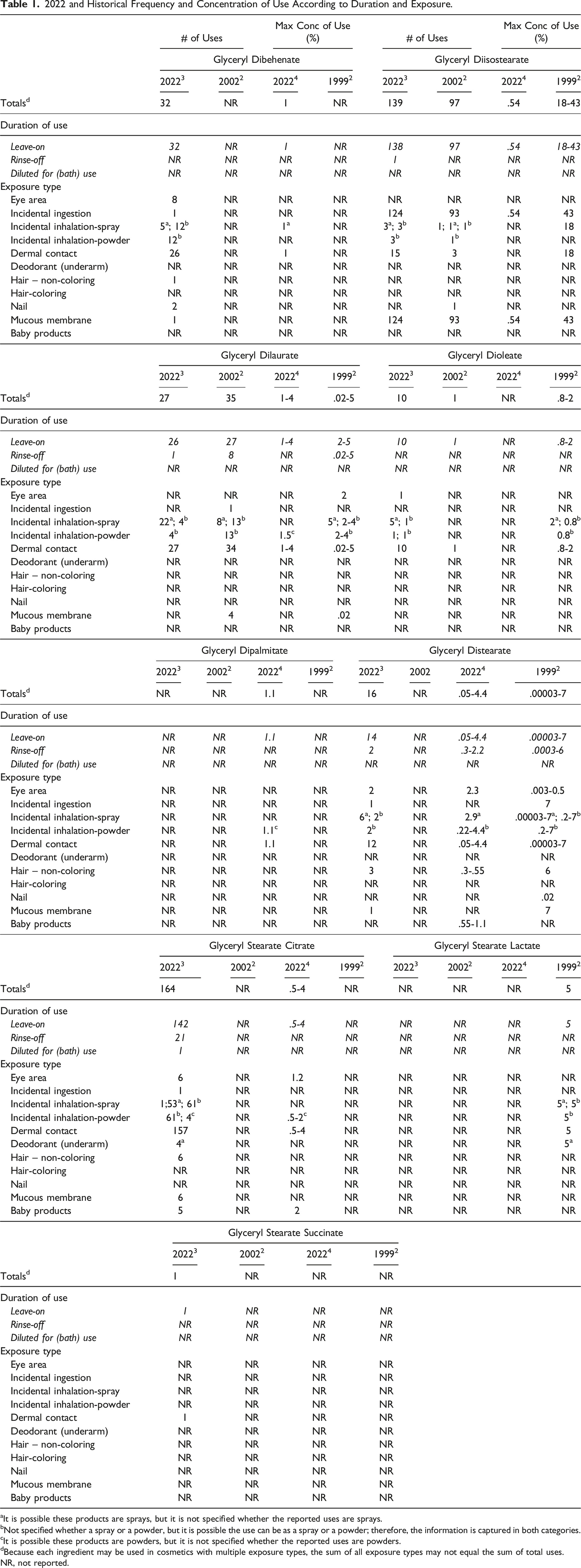
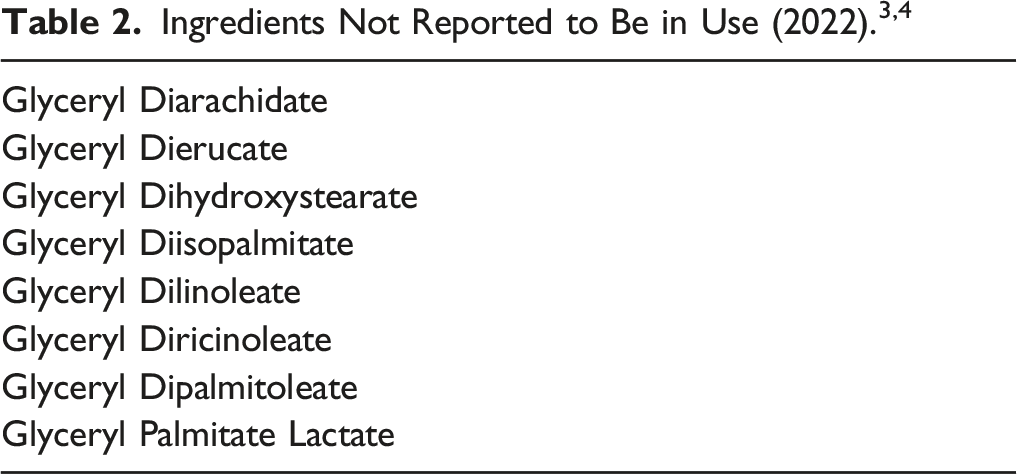
Because it has been at least 15 years since the amended final report was published, in accordance with Cosmetic Ingredient Review Procedures, the Expert Panel determined whether the safety assessment should be reopened. At the September 2022 meeting, the Expert Panel considered updated (2022) information regarding product types and ingredient use frequencies as reported by the US Food and Drug Administration (FDA) Voluntary Cosmetic Registration Program (VCRP) database3 and the maximum use concentrations provided in response to the survey conducted by the Personal Care Products Council.4 Generally, there has been an increase in frequency of use since the last review in 2007. As of 2022, Glyceryl Distearate and Glyceryl Stearate Citrate were reported to be used in baby products, when there were no reported uses for glyceryl diesters in this product category previously. Glyceryl Stearate Citrate, which had no reported uses in the original report, is reported to have 164 uses, at a maximum concentration of use of 4% in non-spray moisturizing products, in 2022. Additionally, although the number of reported uses of Glyceryl Diisostearate in lipstick increased, the maximum reported concentrations of use for this product category significantly decreased, from 43% in 1999 to .54% in 2022. The cumulative frequency and concentration of use data are presented in Table 1. Ingredients with no reported use are listed in Table 2.
2022 and Historical Frequency and Concentration of Use According to Duration and Exposure.
aIt is possible these products are sprays, but it is not specified whether the reported uses are sprays.
bNot specified whether a spray or a powder, but it is possible the use can be as a spray or a powder; therefore, the information is captured in both categories.
cIt is possible these products are powders, but it is not specified whether the reported uses are powders.
dBecause each ingredient may be used in cosmetics with multiple exposure types, the sum of all exposure types may not equal the sum of total uses.
An extensive search of the world’s literature was performed for studies dated 2002 forward, and new data were found.5-27 The Expert Panel considered new chronic toxicity,14,18 developmental and reproductive toxicity,19-21 and carcinogenicity/tumor promotion studies.22-25 In addition to these studies having negative results, the FDA-approved use of Glyceryl Dibehenate and Glyceryl Distearate as inactive ingredients in oral capsule formulations,26 as well as the approved use of diacylglycerol oil and diglycerides as food additives, reassured the Expert Panel of safety.27
The Expert Panel reviewed 2022 frequency and concentration of use data, in addition to any new, available, relevant safety data, and reaffirmed the 2007 conclusion regarding the safety of glyceryl diesters in cosmetics.
Footnotes
Author's Note
Unpublished sources cited in this report are available from the Director, Cosmetic Ingredient Review, 1620 L Street, NW, Suite 1200, Washington, DC 20036, USA.
Author Contributions
The articles in this supplement were sponsored by the Cosmetic Ingredient Review.
Declaration of Conflicting Interest
The author(s) declared the following potential conflicts of interest with respect to the research, authorship, and/or publication of this article: The articles in this supplement were sponsored by the Cosmetic Ingredient Review.
Funding
The author(s) disclosed receipt of the following financial support for the research, authorship, and/or publication of this article: The articles in this supplement were sponsored by the Cosmetic Ingredient Review. The Cosmetic Ingredient Review is financially supported by the Personal Care Products Council.
References
1.
BergfeldWFBelsitoDVKlaasseenCD, et al.Final report of the cosemtic ingredient review expert panel. Safety assessment of glyceryl dilaurate, glyceryl diarachidate, glyceryl dibehenate, glyceryl dierucate, glyceryl dihydroxystearate, glyceryl diisopalmitate, glyceryl diisostearate, glyceryl dilinoleate, glyceryl dimyristate, glyceryl dioleate, glyceryl dipalmitate, glyceryl dipalmitoleate, glyceryl distearate, glyceryl palmitate lactate, glyceryl stearate citrate, glyceryl stearate lactate, and glyceryl stearate succinate. 2002, Available from CIR. https://www.cir-safety.org/ingredients
2.
AndersenFA. ed. Amended final report on the safety assessment of glyceryl dilaurate, glyceryl diarachidate, glyceryl dibehenate, glyceryl dierucate, glyceryl dihydroxystearate, glyceryl diisopalmitate, glyceryl diisostearate, glyceryl dilinoleate, glyceryl dimyristate, glyceryl dioleate, glyceryl diricinoleate, glyceryl dipalmitate, glyceryl dipalmitoleate, glyceryl distearate, glyceryl palmitate lactate, glyceryl stearate citrate, glyceryl stearate lactate, and glyceryl stearate succinate. Int J Toxicol. 2007;26 (Suppl 3):1-30.
3.
U.S. Food and Drug Administration Center for Food Safety & Applied Nutrition (CFSAN). Voluntary cosmetic registration Program - Frequency of use of cosmetic ingredients (VCRP). Obtained under the freedom of information act from CFSAN; requested as “Frequency of use data” January 4, 2022; Received January 11, 2022. 2022.
4.
Personal Care Products Council. Concentration of use by FDA product category: Glyceryl diesters. Unpublished data submitted by the Personal Care Products Council on July 7, 2022. 2022.
5.
FrankJAYushchenkoDAHodsonDJ, et al.Photoswitchable diacylglycerols enable optical control of protein kinase C. Nat Chem Biol. 2016;12(9):755-762.
6.
YamaguchiYShiraiYMatsubaraT, et al.Phosphorylation and up-regulation of diacylglycerol kinase gamma via its interaction with protein kinase C gamma. J Biol Chem. 2006;281(42):31627-31637.
7.
LoS-KTanC-PLongKYusoffMSALaiO-M. Diacylglycerol oil—properties, processes and products: a review. Food Bioproc Tech. 2008;1(3):223-233.
8.
TakaseH. Metabolism of diacylglycerol in humans. Asia Pac J Clin Nutr. 2007;16(Suppl 1):398-403.
LeeWJZhangZLaiOMTanCPWangY. Diacylglycerol in food industry: Synthesis methods, functionalities, health benefits, potential risks and drawbacks. Trends Food Sci Technol. 2020;97:114-125.
13.
ZengNGaoXHuQ, et al.Lipid-based liquid crystalline nanoparticles as oral drug delivery vehicles for poorly water-soluble drugs: cellular interaction and in vivo absorption. Int J Nanomedicine. 2012;7:3703-3718.
14.
MoritaOTamakiYKirkpatrickJBChengelisCP. Safety assessment of heated diacylglycerol oil: Subchronic toxicity study in rats. Food Chem Toxicol. 2008;46(8):2748-2757.
15.
HondaHKawamotoTDoiY, et al.Alpha-linolenic acid-enriched diacylglycerol oil does not promote tumor development in tongue and gastrointestinal tract tissues in a medium-term multi-organ carcinogenesis bioassay using male F344 rat. Food Chem Toxicol. 2017;106(Pt A):185-192.
16.
KasamatsuTOguraRIkedaN, et al.Genotoxicity studies on dietary diacylglycerol (DAG) oil. Food Chem Toxicol. 2005;43(2):253-260.
BushitaHItoYSaitoT, et al.A 90-day repeated-dose toxicity study of dietary alpha linolenic acid-enriched diacylglycerol oil in rats. Regul Toxicol Pharmacol. 2018;97:33-47.
19.
MoritaOKnappJFTamakiYNemecMDVarshoBJStumpDG. Safety assessment of dietary diacylglycerol oil: a two-generation reproductive toxicity study in rats. Food Chem Toxicol. 2008;46(9):3059-3068.
20.
BushitaHLiuSOhtaT, et al.Effects of dietary alpha-linolenic acid-enriched diacylglycerol oil on embryo/fetal development in rats. Regul Toxicol Pharmacol. 2018;98:108-114.
21.
ChengelisCPKirkpatrickJBMaritGBMoritaOTamakiYSuzukiH. A chronic dietary toxicity study of DAG (diacylglycerol) in Beagle dogs. Food Chem Toxicol. 2006;44(1):81-97.
22.
ChengelisCPKirkpatrickJBBrunerRH, et al.A 24-month dietary carcinogenicity study of DAG in mice. Food Chem Toxicol. 2006;44(1):122-137.
23.
ChengelisCPKirkpatrickJBBrunerRH, et al.A 24-month dietary carcinogenicity study of DAG (diacylglycerol) in rats. Food Chem Toxicol. 2006;44(1):98-121.
24.
IchiharaTYoshinoHDoiY, et al.No enhancing effects of diacylglycerol oil on tumor development in a medium-term multi-organ carcinogenesis bioassay using male F344 rats. Food Chem Toxicol. 2008;46(1):157-167.
25.
HondaHFujitaYHayashiAIkedaNItoYMoritaO. Genotoxicity evaluation of alpha-linolenic acid-diacylglycerol oil. Toxicol Rep. 2016;3:716-722.
European Food Safety Authority (EFSA). Opinion on the re-evaluation of mono- and diglycerides of fatty acids (E 471) as food additive in foods for infants below 16 weeks of age and follow-up of their re-evaluation as food additives for uses in foods for all population groups. EFSA J. 2021;19(11):6885.