




Abstract
The Expert Panel for Cosmetic Ingredient Safety reviewed updated information that has become available since their original assessment from 2001, along with updated information regarding product types, and frequency and concentrations of use, and reaffirmed their original conclusion that Biotin is safe as a cosmetic ingredient in the practices of use and concentration as described in this report.
Current and Historical Frequency and Concentration of Use of Biotin According to Duration and Exposure.
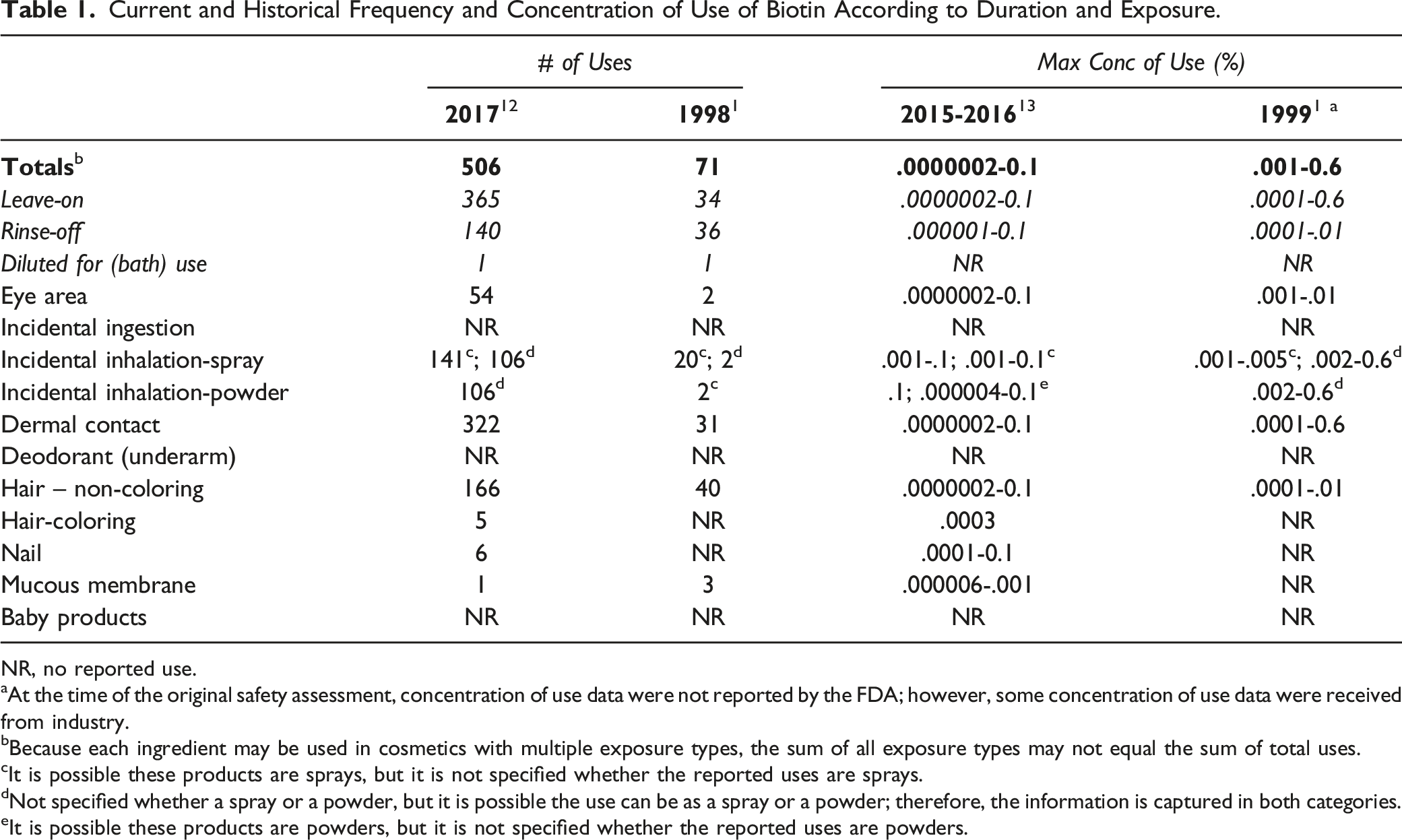
NR, no reported use.
aAt the time of the original safety assessment, concentration of use data were not reported by the FDA; however, some concentration of use data were received from industry.
bBecause each ingredient may be used in cosmetics with multiple exposure types, the sum of all exposure types may not equal the sum of total uses.
cIt is possible these products are sprays, but it is not specified whether the reported uses are sprays.
dNot specified whether a spray or a powder, but it is possible the use can be as a spray or a powder; therefore, the information is captured in both categories.
eIt is possible these products are powders, but it is not specified whether the reported uses are powders.
The reported frequency of use of Biotin in cosmetics has increased since safety was originally reviewed; 71 uses were reported 1998, 1 and 506 uses are reported in 2017. 12 The reported maximum leave-on concentration of use has decreased from .6% to .1%.1,13 The number of uses in formulations with intentional application near the eye area increased from 2 to 54, and the maximum concentration of use reported for this type of exposure increased from .01% to .1%. However, this use concentration is still quite low and did not raise any new concerns.
As in the original assessment, the Expert Panel recognized that data on the irritation and sensitization potential of Biotin were absent. However, the Expert Panel was of the opinion that if Biotin had a strong potential for irritation or sensitization, case reports would be available in the published literature.
The Expert Panel also noted that there are reproductive studies of Biotin that show strong inhibition to spermatogenesis. 11 However, these are oral studies at high levels which are irrelevant to uses in cosmetics. Therefore, it is the opinion of the Expert Panel that the results of those studies are not pertinent to the safety of Biotin as a cosmetic ingredient.
Finally, the Expert Panel stated that manufacturers should be aware that naturally occurring Biotin comprises only the
Footnotes
Author's Note
Unpublished sources cited in this report are available from the Director, Cosmetic Ingredient Review, 1620 L Street, NW, Suite 1200, Washington, DC 20036, USA.
Author Contributions
The articles in this supplement were sponsored by the Cosmetic Ingredient Review.
Declaration of Conflicting Interests
The author(s) declared no potential conflicts of interest with respect to the research, authorship, and/or publication of this article.
Funding
The author(s) disclosed receipt of the following financial support for the research, authorship, and/or publication of this article: The articles in this supplement were sponsored by the Cosmetic Ingredient Review. The Cosmetic Ingredient Review is financially supported by the Personal Care Products Council.