The Expert Panel for Cosmetic Ingredient Safety (Panel) assessed the safety of 46 butyl polyoxyalkylene ethers that share a common structural motif, namely a butyl chain (4 carbon alkyl chain) bound to a polyoxyalkylene (PPG, PEG, or both); 23 of these ethers were previously reviewed by the Panel, and 23 are reviewed herein for the first time. Most of the butyl polyoxyalkylene ethers have several functions in cosmetics, but the most common reported functions include hair conditioning agent and skin conditioning agent, and many reportedly function as solvents. Upon review of new data, including frequency and concentration of use, and data from previous Panel reports and on read-across analogs, the Panel concluded that these ingredients are safe in the present practices of use and concentration in cosmetics when formulated to be non-irritating.
The Expert Panel for Cosmetic Ingredient Safety (Panel) published the Amended Final Report on the Safety Assessment of PPG-40 Butyl Ether with an Addendum to Include PPG-2, -4, -5, -9, -12, -14, -15, -16, -17, -18, -20, -22, -24, -26, -30, -33, -52, and -53 Butyl Ethers in 2001.1 Based on the available data, the Panel concluded that these butyl PPG ethers were safe for use in cosmetics when formulated to avoid irritation. This was a revised conclusion for PPG-40 Butyl Ether; in 1993, the Panel concluded that the safety of PPG-40 Butyl Ether was not documented or substantiated.2
In 2000, the Panel published the Final Report on the Safety Assessment of PPG-12-Buteth-16, PPG-9-Buteth-12, PPG-26-Buteth-26, and PPG-28-Buteth-35.3 Based on the information included in that published report, the Panel concluded that PPG-26-Buteth-26 and PPG-28-Buteth-35 are safe as used in cosmetic products, and that the data were insufficient to support the safety of PPG-12-Buteth-16 and PPG-9-Buteth-12 as used in cosmetics. However, that same year, the Panel issued an Amended Final Report on these butyl PPG/PEG ethers, and concluded that all four ingredients are safe as used in cosmetic products.4
The Panel usually evaluates the conclusions of previously-issued reports every 15 years, and it has been at least 15 years since the last assessments have been issued on the ingredients named above. Because the ingredients included in the reports on the butyl PPG ethers and the butyl PPG/PEG ethers share a common structural motif, namely a butyl chain (4 carbon alkyl chain) bound to a polyoxyalkylene (PPG, PEG, or both), the Panel determined that the butyl PPG ethers and butyl PPG/PEG ethers could be re-reviewed together in one report; this family is referred to as the butyl polyoxyalkylene ethers.
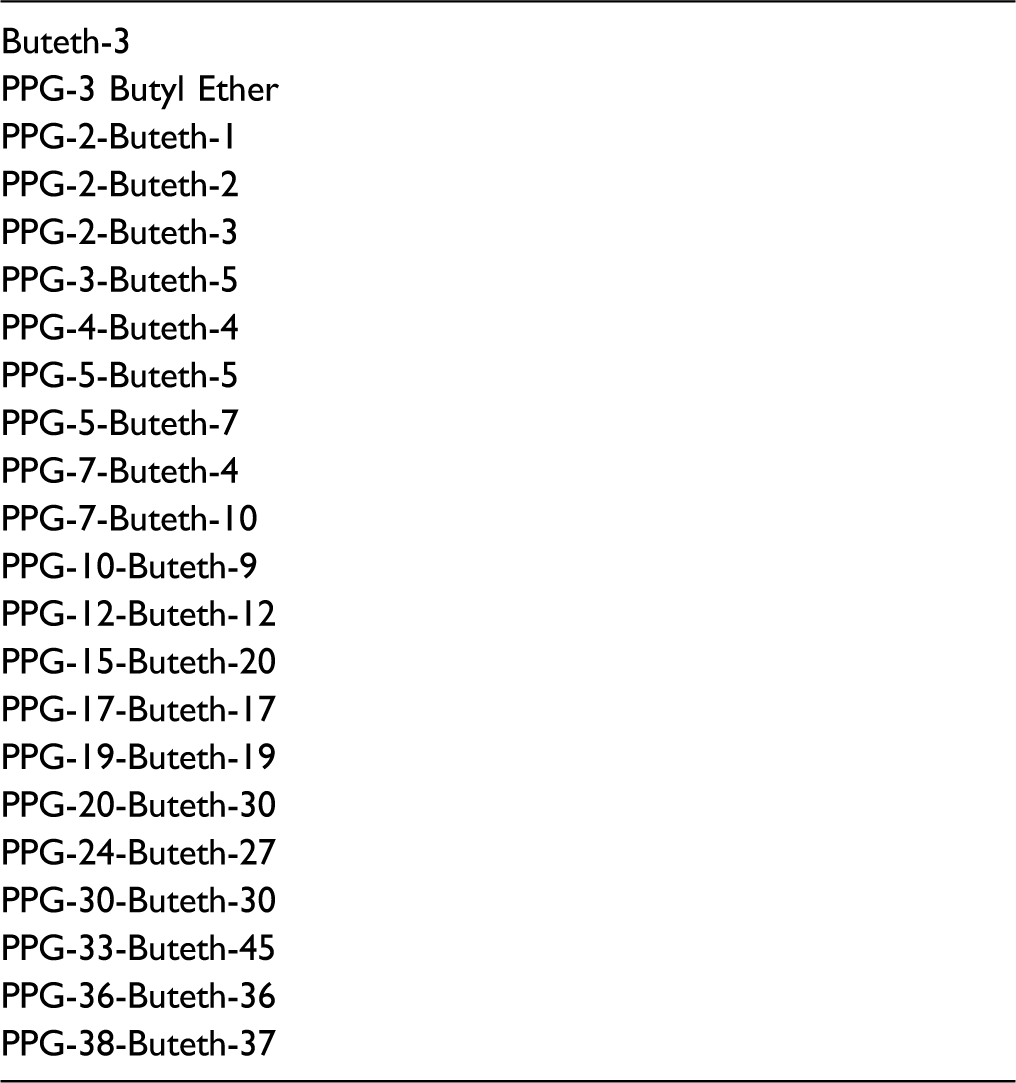
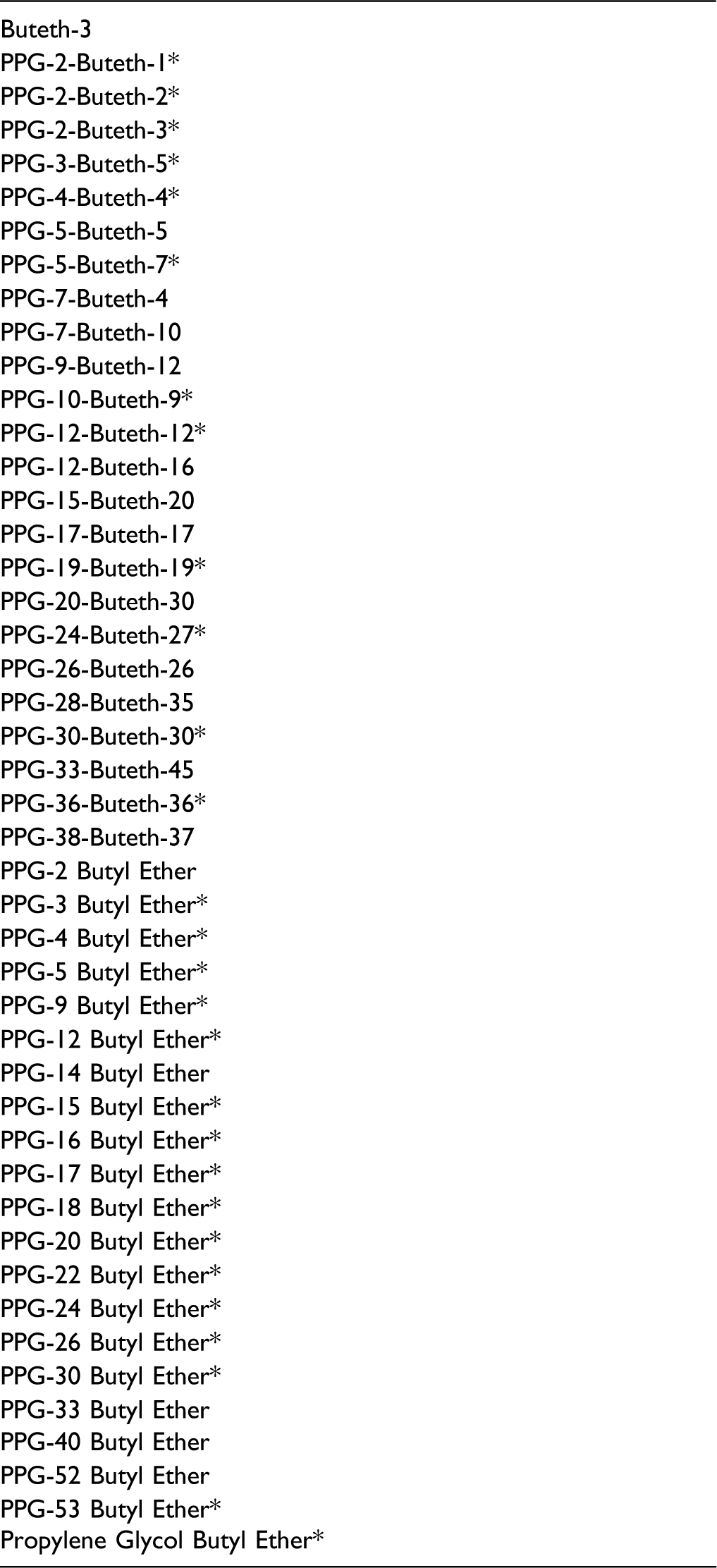
Included in this assessment are butyl polyoxyalkylene ethers named in the International Cosmetic Ingredient Dictionary and Handbook (Dictionary) that have not yet been reviewed:
Buteth-3
PPG-3 Butyl Ether
PPG-2-Buteth-1
PPG-2-Buteth-2
PPG-2-Buteth-3
PPG-3-Buteth-5
PPG-4-Buteth-4
PPG-5-Buteth-5
PPG-5-Buteth-7
PPG-7-Buteth-4
PPG-7-Buteth-10
PPG-10-Buteth-9
PPG-12-Buteth-12
PPG-15-Buteth-20
PPG-17-Buteth-17
PPG-19-Buteth-19
PPG-20-Buteth-30
PPG-24-Buteth-27
PPG-30-Buteth-30
PPG-33-Buteth-45
PPG-36-Buteth-36
PPG-38-Buteth-37
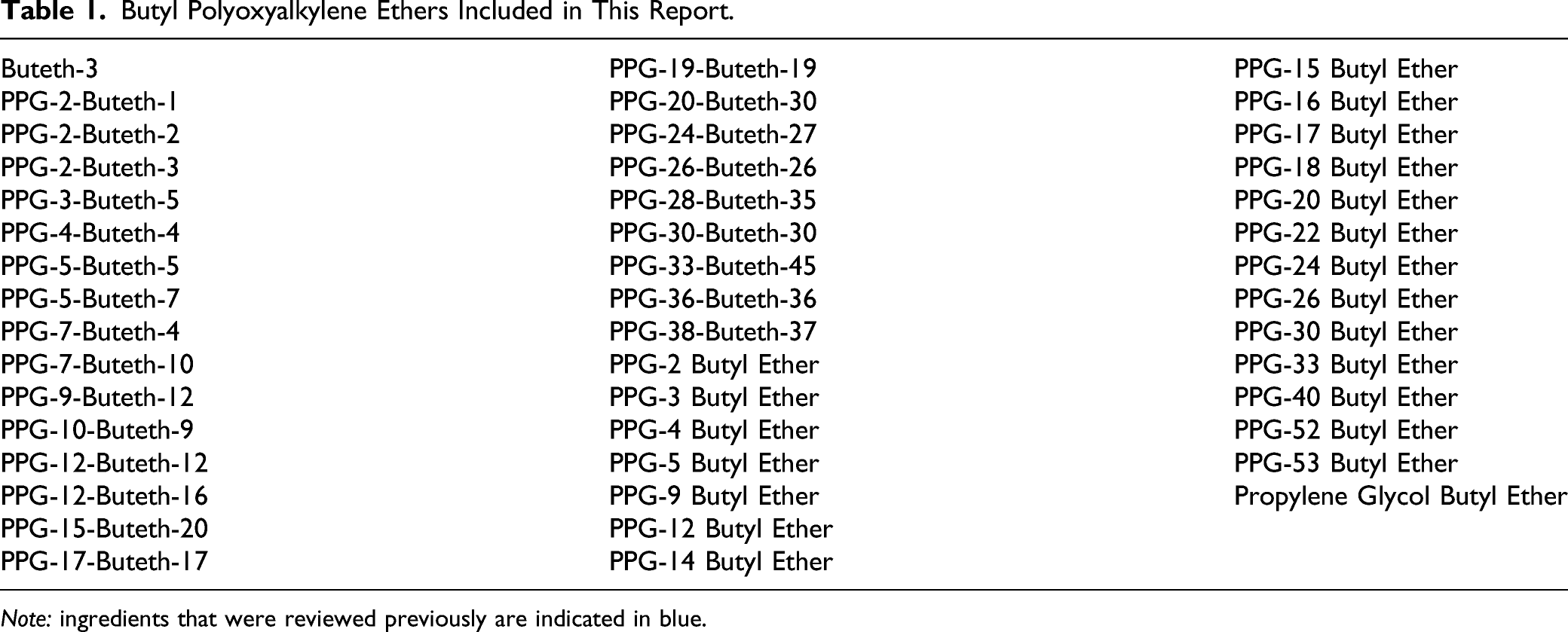
Therefore, this safety assessment includes 23 butyl polyoxyalkylene ethers that were evaluated in two previous reports and 23 butyl polyoxyalkylene ethers that were not yet reviewed by the Panel. A list of all 46 ingredients included in this review is provided in Table 1.
Butyl Polyoxyalkylene Ethers Included in This Report.
Note: ingredients that were reviewed previously are indicated in blue.
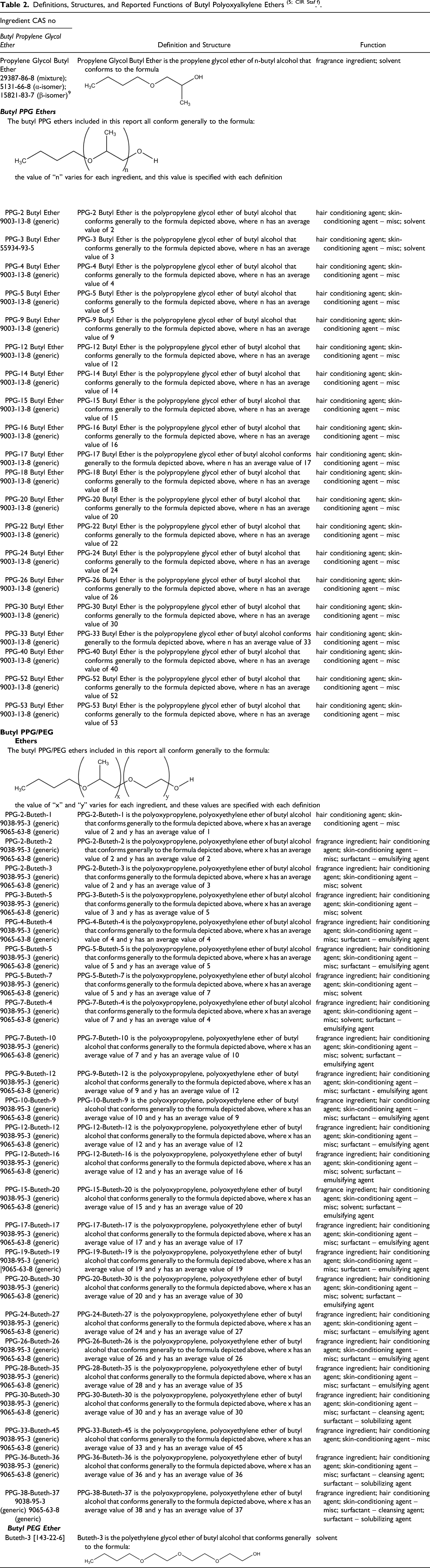
The two groups of ingredients that are being combined in this report have similar functions in cosmetics. According to the Dictionary, both the butyl PPG/PEG ethers and the butyl PPG ethers are reported to function as hair conditioning agents and skin conditioning agents (Table 2).5 Other functions for some butyl PPG/PEG ethers include fragrance ingredients, surfactants, or solvents. Buteth-3 is reported to function as a solvent.
Definitions, Structures, and Reported Functions of Butyl Polyoxyalkylene Ethers (5; CIR Staf.f).
Propylene Glycol Butyl Ether is the propylene glycol ether of n-butyl alcohol that conforms to the formula
fragrance ingredient; solvent
Butyl PPG Ethers
The butyl PPG ethers included in this report all conform generally to the formula:the value of “n” varies for each ingredient, and this value is specified with each definition
PPG-2 Butyl Ether9003-13-8 (generic)
PPG-2 Butyl Ether is the polypropylene glycol ether of butyl alcohol that conforms generally to the formula depicted above, where n has an average value of 2
PPG-3 Butyl Ether is the polypropylene glycol ether of butyl alcohol that conforms generally to the formula depicted above, where n has an average value of 3
PPG-4 Butyl Ether is the polypropylene glycol ether of butyl alcohol that conforms generally to the formula depicted above, where n has an average value of 4
PPG-5 Butyl Ether is the polypropylene glycol ether of butyl alcohol that conforms generally to the formula depicted above, where n has an average value of 5
PPG-9 Butyl Ether is the polypropylene glycol ether of butyl alcohol that conforms generally to the formula depicted above, where n has an average value of 9
PPG-12 Butyl Ether is the polypropylene glycol ether of butyl alcohol that conforms generally to the formula depicted above, where n has an average value of 12
PPG-14 Butyl Ether is the polypropylene glycol ether of butyl alcohol that conforms generally to the formula depicted above, where n has an average value of 14
PPG-15 Butyl Ether is the polypropylene glycol ether of butyl alcohol that conforms generally to the formula depicted above, where n has an average value of 15
PPG-16 Butyl Ether is the polypropylene glycol ether of butyl alcohol that conforms generally to the formula depicted above, where n has an average value of 16
PPG-17 Butyl Ether is the polypropylene glycol ether of butyl alcohol conforms generally to the formula depicted above, where n has an average value of 17
PPG-18 Butyl Ether is the polypropylene glycol ether of butyl alcohol that conforms generally to the formula depicted above, where n has an average value of 18
PPG-20 Butyl Ether is the polypropylene glycol ether of butyl alcohol that conforms generally to the formula depicted above, where n has an average value of 20
PPG-22 Butyl Ether is the polypropylene glycol ether of butyl alcohol that conforms generally to the formula depicted above, where n has an average value of 22
PPG-24 Butyl Ether is the polypropylene glycol ether of butyl alcohol that conforms generally to the formula depicted above, where n has an average value of 24
PPG-26 Butyl Ether is the polypropylene glycol ether of butyl alcohol that conforms generally to the formula depicted above, where n has an average value of 26
PPG-30 Butyl Ether is the polypropylene glycol ether of butyl alcohol that conforms generally to the formula depicted above, where n has an average value of 30
PPG-33 Butyl Ether is the polypropylene glycol ether of butyl alcohol conforms generally to the formula depicted above, where n has an average value of 33
PPG-40 Butyl Ether is the polypropylene glycol ether of butyl alcohol that conforms generally to the formula depicted above, where n has an average value of 40
PPG-52 Butyl Ether is the polypropylene glycol ether of butyl alcohol that conforms generally to the formula depicted above, where n has an average value of 52
PPG-53 Butyl Ether is the polypropylene glycol ether of butyl alcohol that conforms generally to the formula depicted above, where n has an average value of 53
The butyl PPG/PEG ethers included in this report all conform generally to the formula: the value of “x” and “y” varies for each ingredient, and these values are specified with each definition
PPG-2-Buteth-1 is the polyoxypropylene, polyoxyethylene ether of butyl alcohol that conforms generally to the formula depicted above, where x has an average value of 2 and y has an average value of 1
PPG-2-Buteth-2 is the polyoxypropylene, polyoxyethylene ether of butyl alcohol that conforms generally to the formula depicted above, where x has an average value of 2 and y has an average value of 2
PPG-2-Buteth-3 is the polyoxypropylene, polyoxyethylene ether of butyl alcohol that conforms generally to the formula depicted above, where x has an average value of 2 and y has an average value of 3
PPG-3-Buteth-5 is the polyoxypropylene, polyoxyethylene ether of butyl alcohol that conforms generally to the formula depicted above, where x has an average value of 3 and y has as average value of 5
PPG-4-Buteth-4 is the polyoxypropylene, polyoxyethylene ether of butyl alcohol that conforms generally to the formula depicted above, where x has an average value of 4 and y has an average value of 4
PPG-5-Buteth-5 is the polyoxypropylene, polyoxyethylene ether of butyl alcohol that conforms generally to the formula depicted above, where x has an average value of 5 and y has an average value of 5
PPG-5-Buteth-7 is the polyoxypropylene, polyoxyethylene ether of butyl alcohol that conforms generally to the formula depicted above, where x has an average value of 5 and y has an average value of 7
PPG-7-Buteth-4 is the polyoxypropylene, polyoxyethylene ether of butyl alcohol that conforms generally to the formula depicted above, where x has an average value of 7 and y has an average value of 4
PPG-7-Buteth-10 is the polyoxypropylene, polyoxyethylene ether of butyl alcohol that conforms generally to the formula depicted above, where x has an average value of 7 and y has an average value of 10
PPG-9-Buteth-12 is the polyoxypropylene, polyoxyethylene ether of butyl alcohol that conforms generally to the formula depicted above, where x has an average value of 9 and y has an average value of 12
PPG-10-Buteth-9 is the polyoxypropylene, polyoxyethylene ether of butyl alcohol that conforms generally to the formula depicted above, where x has an average value of 10 and y has an average value of 9
PPG-12-Buteth-12 is the polyoxypropylene, polyoxyethylene ether of butyl alcohol that conforms generally to the formula depicted above, where x has an average value of 12 and y has an average value of 12
PPG-12-Buteth-16 is the polyoxypropylene, polyoxyethylene ether of butyl alcohol that conforms generally to the formula depicted above, where x has an average value of 12 and y has an average value of 16
PPG-15-Buteth-20 is the polyoxypropylene, polyoxyethylene ether of butyl alcohol that conforms generally to the formula depicted above, where x has an average value of 15 and y has an average value of 20
PPG-17-Buteth-17 is the polyoxypropylene, polyoxyethylene ether of butyl alcohol that conforms generally to the formula depicted above, where x has an average value of 17 and y has an average value of 17
PPG-19-Buteth-19 is the polyoxypropylene, polyoxyethylene ether of butyl alcohol that conforms generally to the formula depicted above, where x has an average value of 19 and y has an average value of 19
PPG-20-Buteth-30 is the polyoxypropylene, polyoxyethylene ether of butyl alcohol that conforms generally to the formula depicted above, where x has an average value of 20 and y has an average value of 30
PPG-24-Buteth-27 is the polyoxypropylene, polyoxyethylene ether of butyl alcohol that conforms generally to the formula depicted above, where x has an average value of 24 and y has an average value of 27
PPG-26-Buteth-26 is the polyoxypropylene, polyoxyethylene ether of butyl alcohol that conforms generally to the formula depicted above, where x has an average value of 26 and y has an average value of 26
PPG-28-Buteth-35 is the polyoxypropylene, polyoxyethylene ether of butyl alcohol that conforms generally to the formula depicted above, where x has an average value of 28 and y has an average value of 35
PPG-30-Buteth-30 is the polyoxypropylene, polyoxyethylene ether of butyl alcohol that conforms generally to the formula depicted above, where x has an average value of 30 and y has an average value of 30
PPG-33-Buteth-45 is the polyoxypropylene, polyoxyethylene ether of butyl alcohol that conforms generally to the formula depicted above, where x has an average value of 33 and y has an average value of 45
PPG-36-Buteth-36 is the polyoxypropylene, polyoxyethylene ether of butyl alcohol that conforms generally to the formula depicted above, where x has an average value of 36 and y has an average value of 36
PPG-38-Buteth-37 is the polyoxypropylene, polyoxyethylene ether of butyl alcohol that conforms generally to the formula depicted above, where x has an average value of 38 and y has an average value of 37
Buteth-3 is the polyethylene glycol ether of butyl alcohol that conforms generally to the formula:
solvent
The Panel has reviewed similar groups of ingredients. Previously, the Panel concluded alkyl PEG ethers (reaction products of an alkyl alcohol and one or more equivalents of ethylene oxide) are safe in the present practices of use and concentration (as described in the safety assessment) when formulated to be non-irritating.6 The Panel also found the alkyl PEG/PPG ethers (reaction products of an alkyl alcohol and one or more equivalents each of ethylene oxide and propylene oxide) safe in the present practices of use and concentration (as described in the safety assessment) when formulated to be non-irritating.7 These reports are available on the Cosmetic Ingredient Review (CIR) website (https://www.cir-safety.org/ingredients).
Much of the new data included in this safety assessment was found on the European Chemicals Agency (ECHA) website8 and in an Organisation for Economic Co-operation and Development (OECD) Screening Information Data Set (SIDS).9
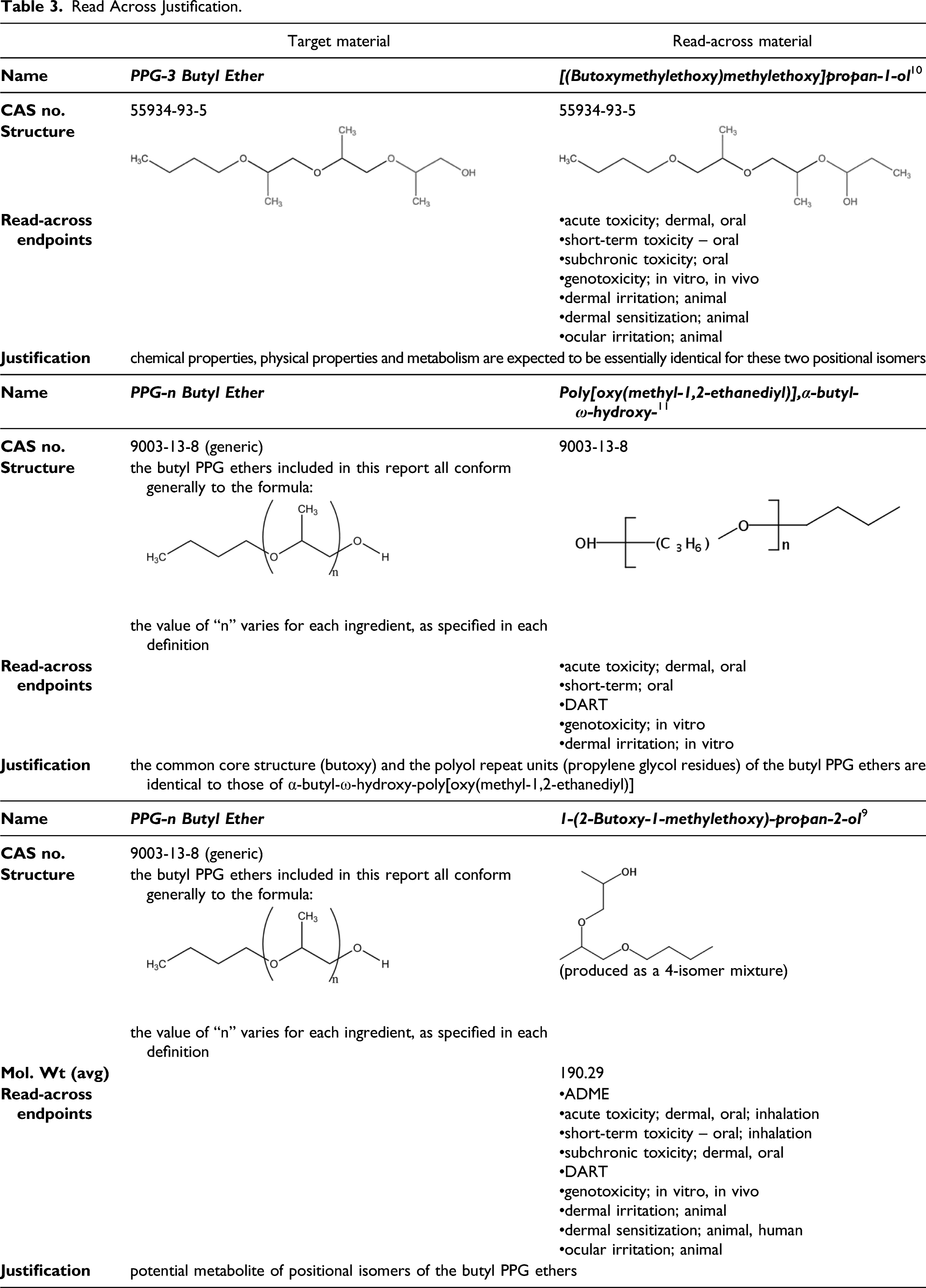
ECHA dossiers10,11 and the SIDS document9 also provided information that is useful for read-across. The justifications for the use of information on (butoxymethylethoxy)methylethoxy]propan-1-ol, poly[oxy(methyl-1,2-ethanediyl)],α-butyl-ω-hydroxy-, and 1-(2-butoxy-1-methylethoxy)-propan-2-ol for read across are provided in Table 3; test data on these compounds are included in the body of the report. Additionally, excerpts from the summaries of previous reports (issued in 2000 and 2001) on butyl PPG/PEG ethers and the butyl PPG ethers are disseminated throughout the text of this re-review document, as appropriate.
the butyl PPG ethers included in this report all conform generally to the formula: the value of “n” varies for each ingredient, as specified in each definition
Read-across endpoints
•acute toxicity; dermal, oral•short-term; oral•DART•genotoxicity; in vitro•dermal irritation; in vitro
Justification
the common core structure (butoxy) and the polyol repeat units (propylene glycol residues) of the butyl PPG ethers are identical to those of α-butyl-ω-hydroxy-poly[oxy(methyl-1,2-ethanediyl)]
the butyl PPG ethers included in this report all conform generally to the formula: the value of “n” varies for each ingredient, as specified in each definition
potential metabolite of positional isomers of the butyl PPG ethers
Chemistry
Definition and Structure
The definitions and structures of the butyl polyoxyalkylene ethers are provided in Table 2.
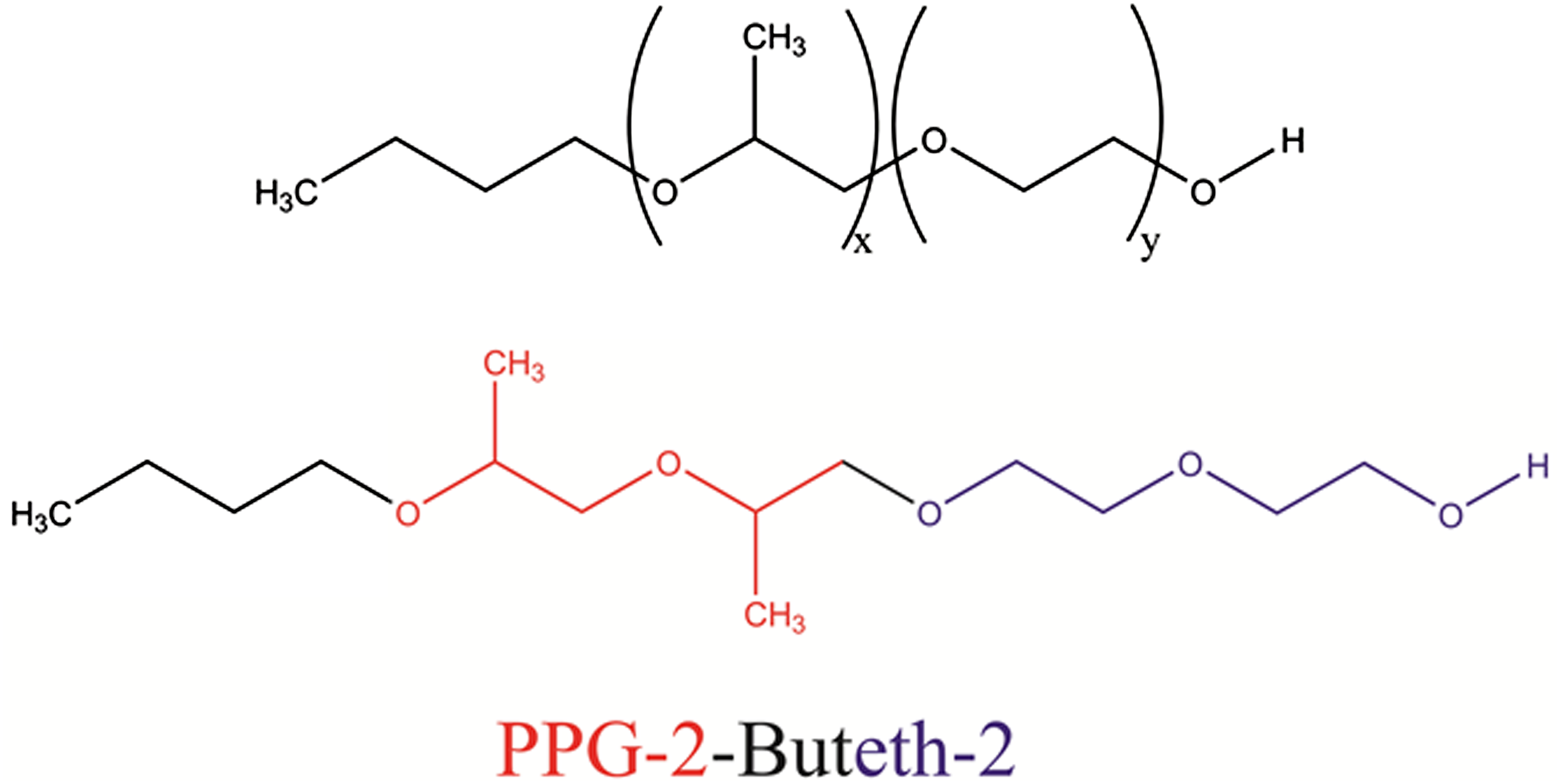
The butyl polyoxyalkylene ethers in this report share a common core structure comprising a linear, four carbon alkyl chain (butyl) connected, through an ether linkage, to a polyether chain comprising a polyethylene glycol (PEG, or an “eth” suffix), polypropylene glycol (PPG), or both. These polyether chains vary in length from just 1 repeat unit (i.e., Propylene Glycol Butyl Ether, MW = 132.20 g/mol) to 75 repeat units (i.e., PPG-38-Buteth-37, mean MW = 3911.12 g/mol). Accordingly, the butyl polyoxyalkylene ethers may be represented generically as a butyl terminated polyether, as shown in Figure 1.
Generic and specific butyl polyoxyalkylene ether structures.
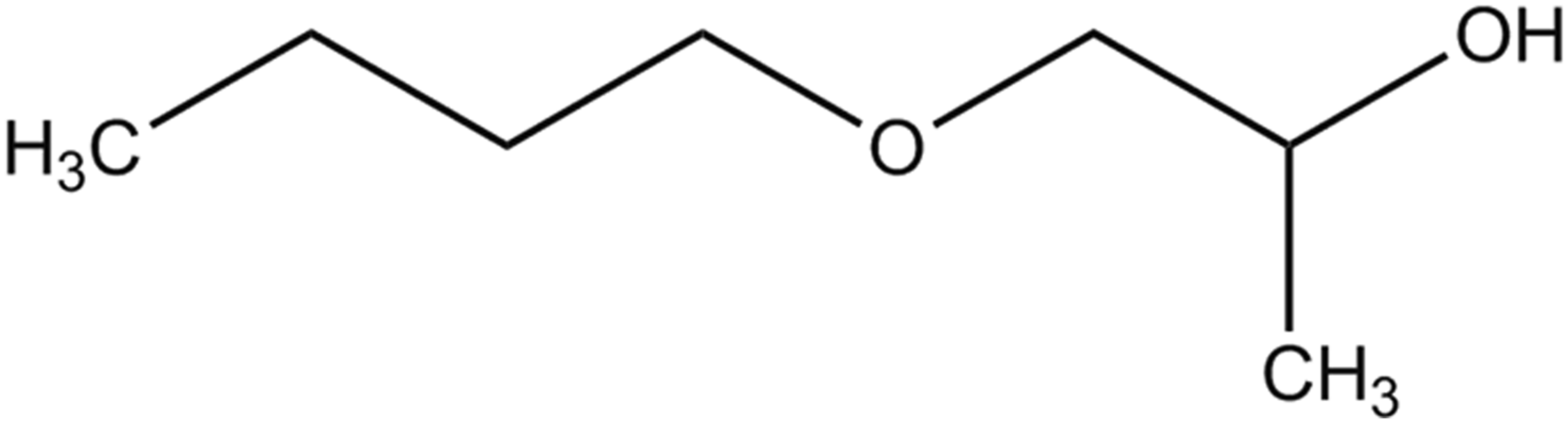
Propylene Glycol Butyl Ether represents the smallest ingredient in this report, and is simply the ether of butanol and one propylene glycol residue.12 While the Dictionary recites the structures of all of the other propylene glycol containing ingredients in this report as the β-isomers (terminal alcohol is primary (1o)), as shown in Figure 1, Propylene Glycol Butyl Ether is recited as the α-isomer (terminal alcohol is secondary (2o)) (Figure 2).
Propylene glycol butyl ether.
Physical and Chemical Properties
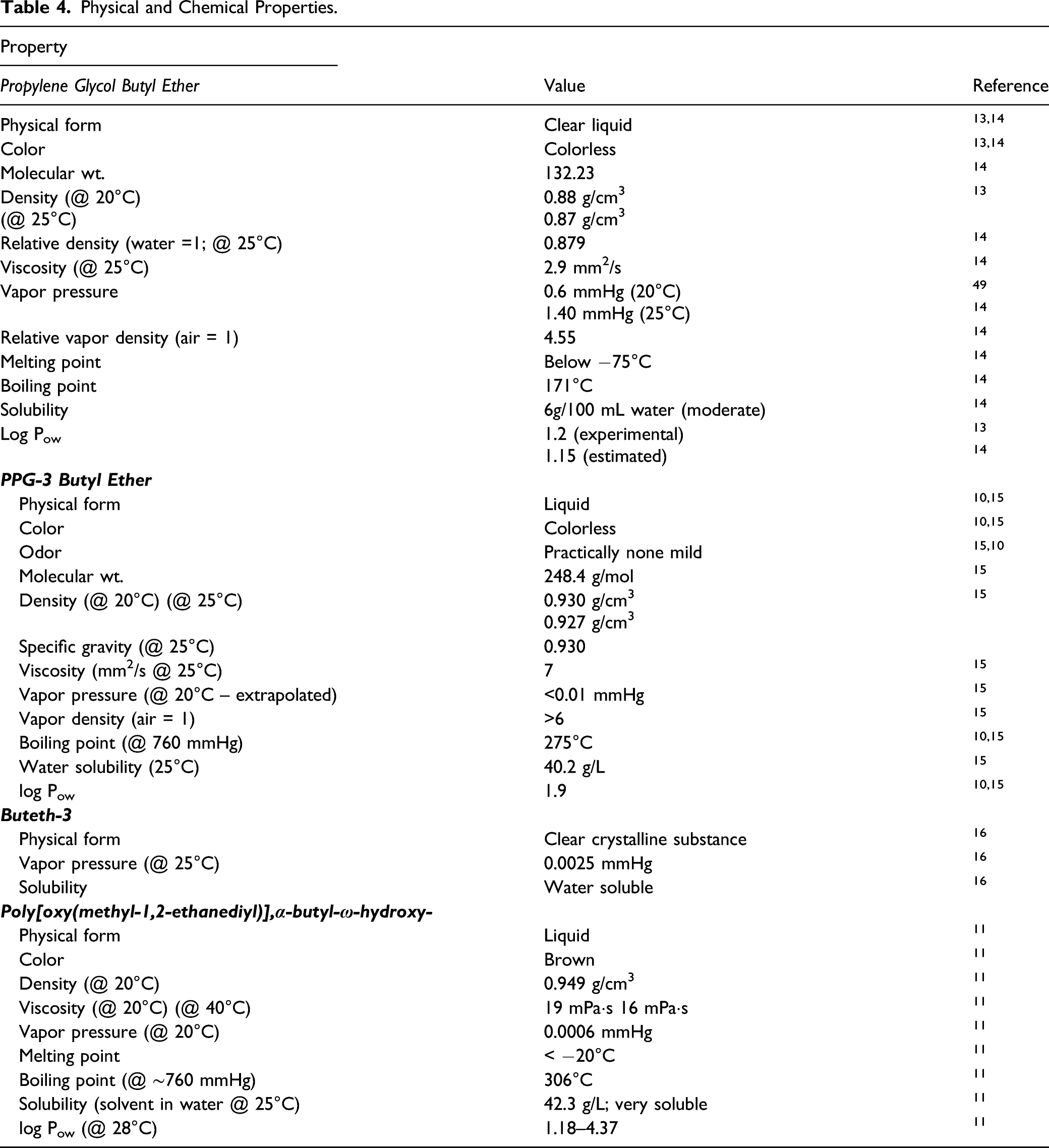
Propylene Glycol Butyl Ether13,14 and PPG-3 Butyl Ether,10 a hydrophobic glycol ether,15 are colorless liquids (Table 4). Also described in Table 4 are physical and chemical properties of Buteth-3, a water-soluble crystalline compound with low volatility,16 and those of an undefined polypropylene glycol butyl ether.
PPG-12-Buteth-16 and other ethylene oxide/propylene oxide polymers of this series, are butanol-initiated, random linear copolymers that are produced from equal amounts (by weight) of ethylene and propylene oxide.4
The PPG Butyl Ethers are produced by the reaction of excess propylene glycol with n-butyl alcohol.1
Generally, propylene glycol ethers are prepared commercially by reacting propylene oxide with an alcohol in the presence of a catalyst17 in a closed continuous system.9 This reaction can produce glycol ethers of varying chain lengths that depend on the stoichiometric ratio of reactants and the temperatures and pressures used in the reaction. Milder conditions and lower stoichiometric ratios of propylene oxide to alcohol yields the monopropylene glycol ethers, while using more propylene oxide and higher temperatures and pressures produces the di-, tri-, and poly-propylene glycol, mono-alkyl ethers. The products are purified by distillation.
The α-isomer and a β-isomer are usually formed during the synthesis of Propylene Glycol Butyl Ether. A technical product generally comprises 95–99% of the α-isomer and only traces of the β-isomer (the α-isomer is a secondary alcohol, and the β-isomer is a primary alcohol).17
Impurities
The concentration of residual ethylene oxide and propylene oxide in PPG-33-Buteth-45 is less than 1 ppm.4 The PPG Butyl Ethers can contain propylene oxide.1 It was reported (by two suppliers in 2010) that a maximum of 10 ppm propylene oxide was present in PPGs used to make finished products.18 A tradename mixture containing PPG-26-Buteth-26 contained <5 ppm dioxane and <1 ppm ethylene oxide.3
Some of the butyl polyoxyalkylene ethers are ethoxylated and therefore may contain trace amounts of 1,4-dioxane, which is a by-product of ethoxylation and a known animal carcinogen.19
Use
Cosmetic
The safety of the cosmetic ingredients addressed in this assessment is evaluated based on data received from the US Food and Drug Administration (FDA) and the cosmetics industry on the expected use of these ingredients in cosmetics. Use frequencies of individual ingredients in cosmetics are collected from manufacturers and reported by cosmetic product category in FDA’s Voluntary Cosmetic Registration Program (VCRP) database. Use concentration data are submitted by the cosmetic industry in response to a survey, conducted by the Personal Care Products Council (Council), of maximum reported use concentrations by product category.
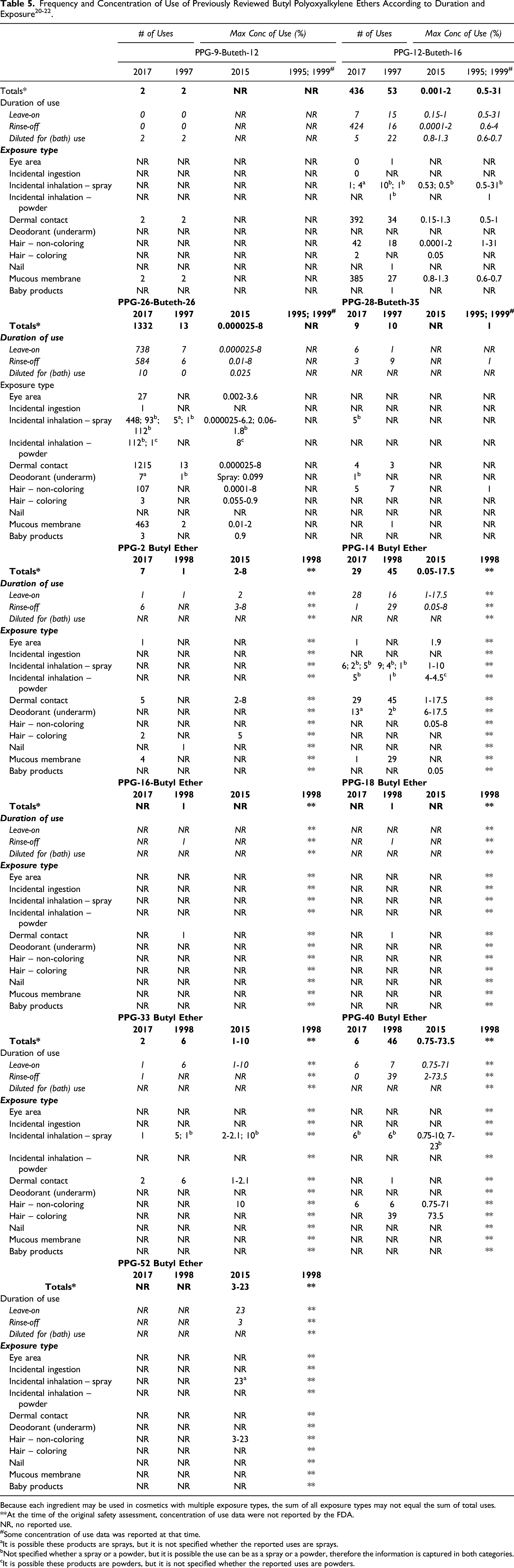
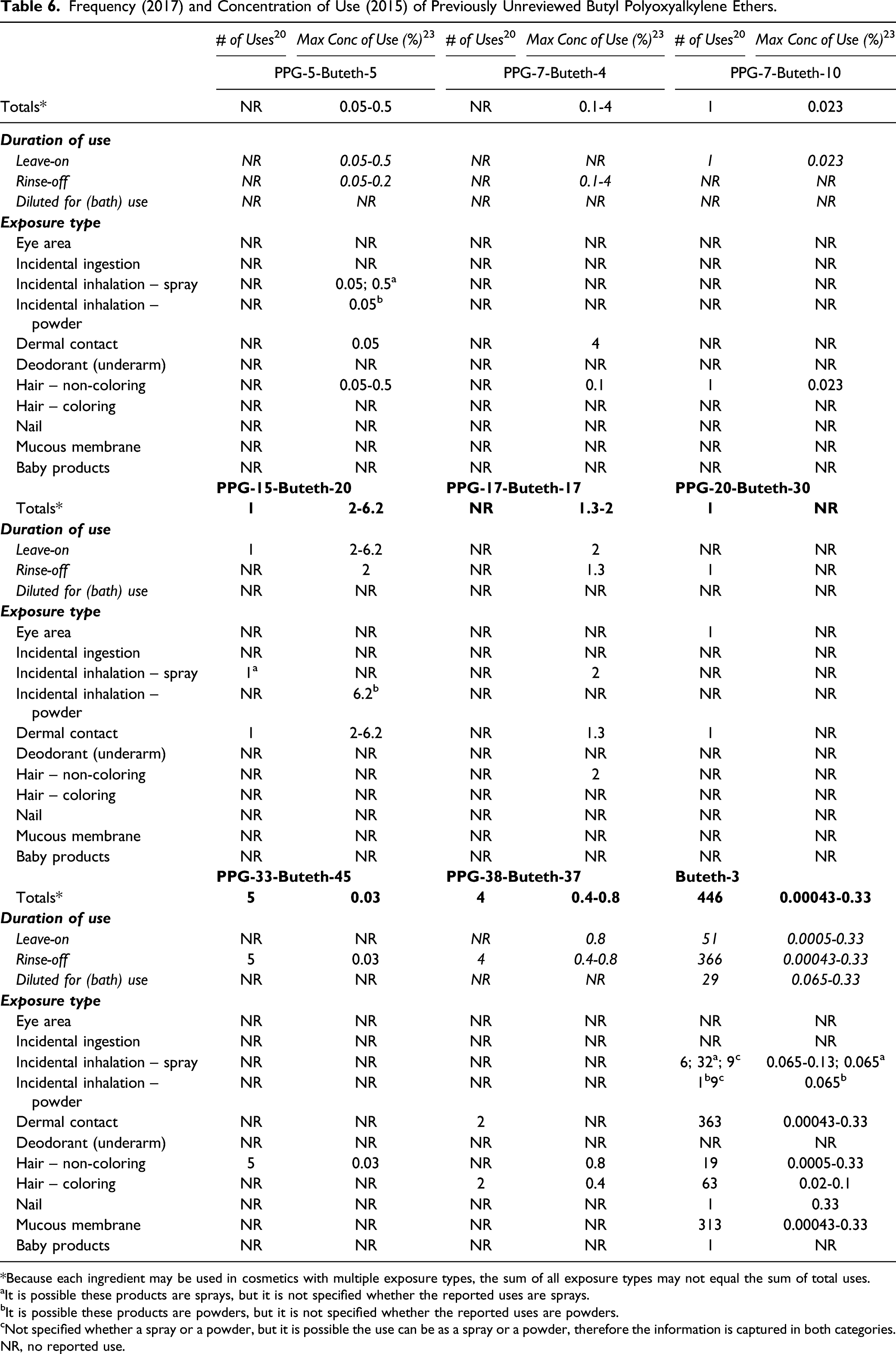
According to information from the VCRP and the Council, 18 of the 46 ingredients assessed in this report are in use.20-22 PPG-26-Buteth-26 has the highest frequency of use; according to the 2017 VCRP data, it is used in 1332 cosmetic formulations.20 Buteth-3 and PPG-12-Buteth-16 have the next highest frequency of use, with 446 and 436 reported uses, respectively (Tables 5 and 6).
Frequency and Concentration of Use of Previously Reviewed Butyl Polyoxyalkylene Ethers According to Duration and Exposure20-22.
Because each ingredient may be used in cosmetics with multiple exposure types, the sum of all exposure types may not equal the sum of total uses.
**At the time of the original safety assessment, concentration of use data were not reported by the FDA.
NR, no reported use.
#Some concentration of use data was reported at that time.
aIt is possible these products are sprays, but it is not specified whether the reported uses are sprays.
bNot specified whether a spray or a powder, but it is possible the use can be as a spray or a powder, therefore the information is captured in both categories.
cIt is possible these products are powders, but it is not specified whether the reported uses are powders.
Frequency (2017) and Concentration of Use (2015) of Previously Unreviewed Butyl Polyoxyalkylene Ethers.
*Because each ingredient may be used in cosmetics with multiple exposure types, the sum of all exposure types may not equal the sum of total uses.
aIt is possible these products are sprays, but it is not specified whether the reported uses are sprays.
bIt is possible these products are powders, but it is not specified whether the reported uses are powders.
cNot specified whether a spray or a powder, but it is possible the use can be as a spray or a powder, therefore the information is captured in both categories.
NR, no reported use.
The results of the concentration of use survey conducted by the Council in 2015 indicate that PPG-40 Butyl Ether has the highest maximum use concentration in both leave-on (71% in a hair wax listed under tonics, dressings, and other hair grooming aids) and rinse-off formulations (73.5% in hair tints)23 PPG-14 Butyl Ether has the greatest maximum leave-on concentration of use that results in dermal exposure; it is used at up to 17.5% in deodorants (Tables 5 and 6).
Approximately half of the in-use ingredients have been reviewed previously by the Panel.3,4 The current frequency of use for the majority of these ingredients is similar to that reported at the time of the original review. However, there has been a large increase in the frequency of use of PPG-26-Buteth-26; in 1997, this ingredient was reported to be used in 13 formulations, and it is now used in 1332 formulations. Concentrations of use were not reported by the FDA at the time of the previous safety assessments, so it is not known if the concentrations of use have changed.
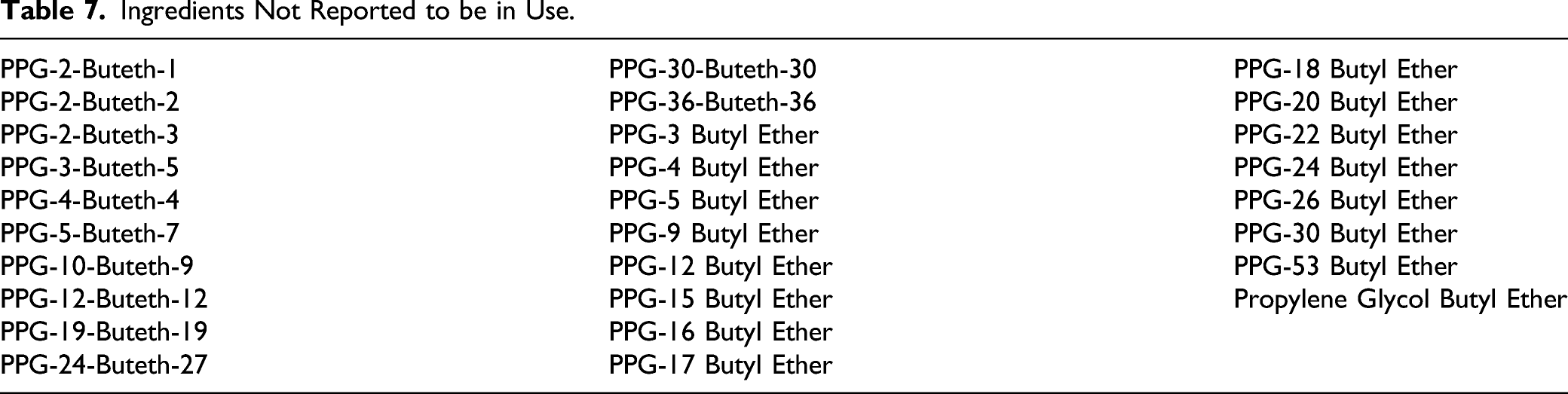
The 28 butyl polyoxyalkylene ethers not currently reported to be in use according to VCRP data and industry survey are listed in Table 7.
In some cases, reports of uses were received from the VCRP, but no concentration of use data was provided. For example, PPG-28-Buteth-35 is reported to be used in 9 formulations, but no use concentration data were submitted. In other cases, no uses were reported to the VCRP, but a maximum use concentration was provided in the industry survey. For example, PPG-52 Butyl Ether was not reported to be in use in the VCRP database, but the industry survey indicated that it is used in at least 2 hair product categories; it should be presumed that PPG-52 Butyl Ether is used in at least one cosmetic formulation in each category.
A few of the butyl polyoxyalkylene ethers are used in products that can be used near the eye (e.g., 3.6% PPG-26-Buteth-26 in eyeliner and eye shadow) or come in contact with mucous membranes (e.g., 2% PPG-26-Buteth-26 in bath soaps and detergents). Additionally, some of these ingredients are used in cosmetic sprays and could possibly be inhaled; for example, PPG-40 Butyl Ether is reported to be used at a maximum concentration of 10% in hair sprays. In practice, 95% to 99% of the droplets/particles released from cosmetic sprays have aerodynamic equivalent diameters >10 μm, with propellant sprays yielding a greater fraction of droplets/particles <10 μm compared with pump sprays.24,25 Therefore, most droplets/particles incidentally inhaled from cosmetic sprays would be deposited in the nasopharyngeal and thoracic regions of the respiratory tract and would not be respirable (i.e., they would not enter the lungs) to any appreciable amount.26,27 PPG-26-Buteth-26 has reported use in spray deodorant at a concentration of 0.099%. There is some evidence indicating that deodorant spray products can release substantially larger fractions of particulates having aerodynamic equivalent diameters in the range considered to be respirable.27 However, the information is not sufficient to determine whether significantly greater lung exposures result from the use of deodorant sprays, compared to other cosmetic sprays.
The butyl polyoxyalkylene ethers described in this safety assessment are not restricted from use in any way under the rules governing cosmetic products in the European Union (EU).28
Non-Cosmetic
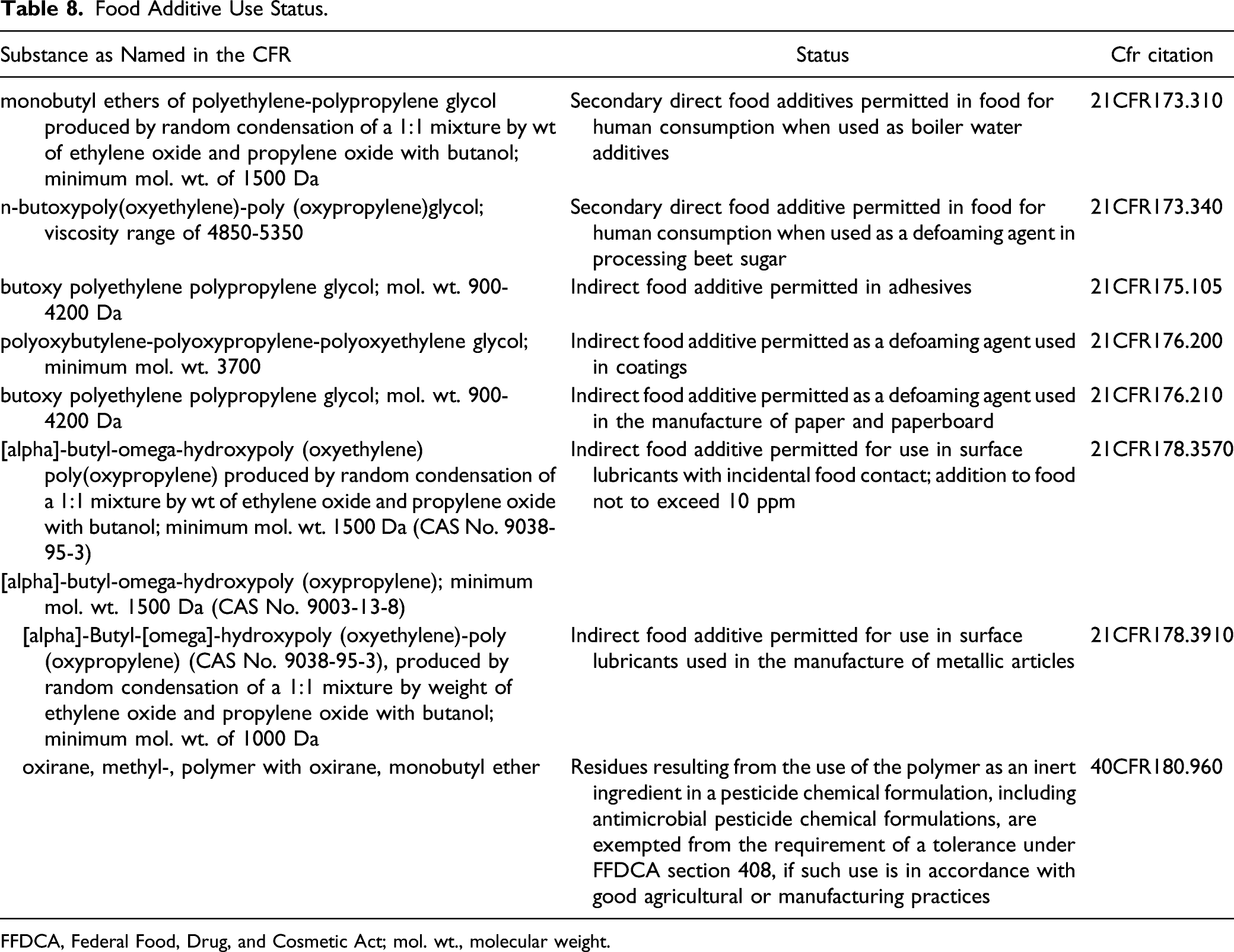
Most of the butyl polyoxyalkylene ethers are approved for use as secondary direct food additives or as indirect food additives (Table 8).
Food Additive Use Status.
Substance as Named in the CFR
Status
Cfr citation
monobutyl ethers of polyethylene-polypropylene glycol produced by random condensation of a 1:1 mixture by wt of ethylene oxide and propylene oxide with butanol; minimum mol. wt. of 1500 Da
Secondary direct food additives permitted in food for human consumption when used as boiler water additives
21CFR173.310
n-butoxypoly(oxyethylene)-poly (oxypropylene)glycol; viscosity range of 4850-5350
Secondary direct food additive permitted in food for human consumption when used as a defoaming agent in processing beet sugar
21CFR173.340
butoxy polyethylene polypropylene glycol; mol. wt. 900-4200 Da
Indirect food additive permitted as a defoaming agent used in coatings
21CFR176.200
butoxy polyethylene polypropylene glycol; mol. wt. 900-4200 Da
Indirect food additive permitted as a defoaming agent used in the manufacture of paper and paperboard
21CFR176.210
[alpha]-butyl-omega-hydroxypoly (oxyethylene) poly(oxypropylene) produced by random condensation of a 1:1 mixture by wt of ethylene oxide and propylene oxide with butanol; minimum mol. wt. 1500 Da (CAS No. 9038-95-3)
Indirect food additive permitted for use in surface lubricants with incidental food contact; addition to food not to exceed 10 ppm
21CFR178.3570
[alpha]-butyl-omega-hydroxypoly (oxypropylene); minimum mol. wt. 1500 Da (CAS No. 9003-13-8)
[alpha]-Butyl-[omega]-hydroxypoly (oxyethylene)-poly (oxypropylene) (CAS No. 9038-95-3), produced by random condensation of a 1:1 mixture by weight of ethylene oxide and propylene oxide with butanol; minimum mol. wt. of 1000 Da
Indirect food additive permitted for use in surface lubricants used in the manufacture of metallic articles
21CFR178.3910
oxirane, methyl-, polymer with oxirane, monobutyl ether
Residues resulting from the use of the polymer as an inert ingredient in a pesticide chemical formulation, including antimicrobial pesticide chemical formulations, are exempted from the requirement of a tolerance under FFDCA section 408, if such use is in accordance with good agricultural or manufacturing practices
40CFR180.960
FFDCA, Federal Food, Drug, and Cosmetic Act; mol. wt., molecular weight.
Propylene glycol ethers are coalescing, coupling and dispersing agents.17 These ethers are used in solvents and have a wide range of applications. For example, they are used in paints, lacquers, resins, surface coatings, dyes, and other related products.
Propylene Glycol Butyl Ether
Propylene Glycol Butyl Ether is used as a coupling agent and solvent due to its high solvency, oil solubility, high formulating flexibility, and low viscosity.29 It has been used in household and commercial degreasers and hard surface cleaners.
PPG-3 Butyl Ether
PPG-3 Butyl Ether is a solvent and coalescing agent used in architectural and industrial coatings, and in indoor decorative paints.30 It is also used as a solvent in heavy-duty cleaning formulations, oven cleaners, inks for ball-point and felt-tip pens and stamp pads, and in textile printing pastes.
Buteth-3
Buteth-3 is used as a component of hydraulic brake fluid, as a solvent in paint stripping formulations, and as a dye carrier for textile dye processes.16
Toxicokinetics Studies
Dermal Penetration
Buteth-3
The dermal penetration of Buteth-3 through human skin was measured in vitro.31 Epidermal samples were mounted in a glass diffusion apparatus; the exposure area was 2.54 cm2. (The composition of the receptor fluid was not described.) Undiluted Buteth-3 (99.9% pure) was placed in contact with the epidermis for 12 h; 5 runs were performed. Tritiated water was used as a control. The diffusion rate was 22 μg/cm2/h. Additionally, the epidermal damage caused by exposure to Buteth-3 was examined by measuring the increase in tritiated water diffusion following exposure. Buteth-3 had no significant effect on skin barrier function; the damage ratio (i.e., the ratio of permeability constants determined from tritiated water diffusion after chemical exposure compared to before exposure) was 1.26.
Absorption, Distribution, Metabolism, and Excretion (ADME)
In rats dosed orally with [14C]PPG-7-Buteth-10, most of the administered radioactivity was excreted (urine, feces, and expired CO2) within seven days post-dosing. Similar observations were reported for rats dosed orally with [14C]PPG-33-Buteth-45; however, radioactivity was not detected in expired carbon dioxide.4
Absorption of the PPGs Butyl Ether was inversely proportional to the molecular weight; typical gastric absorption values ranged from 2% to 100%, depending upon the chain length. PPG BE800 (PPG BE refers to the molecular weight of the substance; PPG BE800 is ∼PPG-13 Butyl Ether) penetrated rabbit skin slowly, if at all, and passed poorly through internal tissue barriers. Once absorbed, the butyl group was removed and oxidized, then was partly or completely excreted as carbon dioxide by the lungs. The chains were apparently split into random length fragments and eliminated in urine as weak acids after oxidation of the terminal hydroxyls to carboxyl groups.1
Propylene glycol butyl ether
As a class, the propylene glycol ethers are rapidly absorbed and distributed throughout the body following oral and inhalation exposure.9 The primary routes of excretion are via the urine and expired air; a small amount is excreted in the feces.
Absorption via the dermal route is slower, but subsequent distribution is rapid.9 Additionally, Propylene Glycol Butyl Ether (a monoglycol ether) is expected to be absorbed more rapidly than diglycol and triglycol ethers.12 However, diglycol and triglycol ethers may be present on the skin much longer than monoglycol ethers because of lower vapor pressures.
Animal
Oral
1-(2-Butoxy-1-methylethoxy)-propan-2-ol (read-across for PPG-n Butyl Ethers)
New ADME data were not available for the PPG Butyl Ethers. But an appropriate read across material was identified; an ADME study was conducted in accord with OECD Guideline 417 with 1-(2-butoxy-1-methylethoxy)-propan-2-ol.9 Groups of four male Fischer 344 rats were given a single dose by gavage of 0.4 or 4.4 mmol/kg bw [14C]1-(2-butoxy-1-methylethoxy)-propan-2-ol in 1% methylcellulose. Urine, feces, expired air, blood, and tissues were collected for 48 h and analyzed for total [14C]-activity. In the low dose group, 42% of the dose was excreted in urine, 4% in the feces, and 42% as 14CO2; the tissues, carcass, and skin retained 11% of the radioactivity. In the high-dose group, 51% of the dose was excreted in urine, 11% in the feces, and 35% as 14CO2; the tissues, carcass, and skin retained 7% of the dose. Peak blood levels of [14C]-activity occurred 0.5 h after dosing in the low dose group and 4 h after dosing in the high dose group. The distribution of [14C]-activity in tissues was similar between dose groups, with liver, bone marrow, and kidneys retaining the greatest percentage of [14C]. Urinary metabolites included propylene glycol n-butyl ether, dipropylene glycol, propylene glycol, and the sulfate conjugate of 1-(2-butoxy-1-methylethoxy)-propan-2-ol. The parent material was present in the urine.
Human
Inhalation
Propylene glycol butyl ether
A cleaning solution containing 3.5% Propylene Glycol Butyl Ether was applied in a simulated cleaning procedure in 7 offices where 8 individuals were employed.12 The office floor spaces ranged from 41 to 55 m2 and the room volumes ranged from 33 to 50 m3. Each office contained wooden furnishings and linoleum flooring and was naturally ventilated. The furniture was wetted with 40 mL of undiluted cleaning solution in the morning; application of the cleaner resulted in a Propylene Glycol Butyl Ether concentration of 0.55 ppm (average; standard deviation 0.17 ppm) in the office air. Seven of the subjects were exposed for approximately 8 h, and one was exposed for approximately 5 h.
Subjects collected daily urine the day before, the day of, and the day after exposure. Urine samples were collected by unexposed individuals and analyzed to determine background levels of glycol ether metabolites. 2-Butoxypropionic acid, a metabolite of Propylene Glycol Butyl Ether, could not be quantified in control urine samples. In all test subjects, the concentration of 2-butoxypropionic acid in the urine was below the limit of quantification (LOQ; 0.01 ppm) the day before exposure; it was present at an average concentration of 0.06 ppm (standard deviation 0.9 ppm) in samples collected on the day of exposure. In three subjects, 2-butoxypropionic acid was detected in the urine samples collected on the day after exposure at concentrations slightly above the LOQ (0.012–0.014 ppm).
Toxicological Studies
Acute Toxicity Studies
Mortality rates for rabbits dosed with PPG Buteths (dose = 21 g/kg) in acute dermal toxicity studies are summarized as follows: 1 of 4 rabbits (PPG-12-Buteth-16); 1 of 4 rabbits (PPG-20-Buteth-30); and 1 of 4 rabbits (PPG-33-Buteth-45). In another acute dermal toxicity study, no deaths occurred in groups of rabbits dosed with PPG-24-Buteth-27 (2, 4, 8, and 16 mL/kg). Erythema, edema, ecchymosis, and desquamation were noted in this study. Pulmonary lesions were noted at necropsy. In New Zealand Albino rabbits dosed with PPG-26-Buteth-26, the acute cutaneous LD50 was not achieved at a dose of 2.0 g/kg (1.89 mL/kg).4
An LD50 of 18.3 g/kg for PPG-12-Buteth-16 was reported in an acute oral toxicity study involving rats. Acute oral LD50s ranging from 4.49 to 8.57 mL/kg have been reported for PPG-7-Buteth-10 in studies involving rats. Oral LD50s of 7.46 mL/kg (mice) and 1.77 mL/kg (rabbits) for PPG-7-Buteth-10 also have been reported.
The oral LD50 for PPG-20-Buteth-30 in rats was 20.6 g/kg, and, > 16 mL/kg, in rats dosed with PPG-24-Buteth-27. An oral LD50 of >5.01 g/kg (4.72 mL/kg) was reported for PPG-26-Buteth-26 in Long Evans rats. Similar results were reported for Sprague-Dawley rats dosed with a solubilizing system containing PPG-26-Buteth-26 (concentration not stated); the LD50 was greater than 5.0 g/kg (4.81 mL/kg).
In acute oral toxicity studies on PPG-33-Buteth-45 using rats and mice, LD50s of 45.2 mL/kg and 49.4 mL/kg, respectively, were reported. In studies using rabbits, an LD50 of 15.8 mL/kg was reported for PPG-33-Buteth-45.
Acute inhalation LC50 values for PPG Buteths that have been reported for rats are as follows: 4670 mg/m3 and >5230 mg/m3 for males and females, respectively (PPG-12-Buteth-16); 4.77 mg/m3 (males and females) for PPG-7-Buteth-10; 330 mg/m3 (males and females) for PPG-20-Buteth-30; and 14 7 mg/m3 for PPG-33-Buteth-45. LC50 values of 174 mg/m3 (mice); 511 mg/m3 (hamsters); and 293 mg/m3 (guinea pigs) have also been reported for PPG-33-Buteth-45 in other acute inhalation toxicity studies.
In general, the lethality of the PPG Butyl Ethers decreased as the molecular weight increased. In rats, the acute oral LD50 values of the PPG butyl ethers ranged from 1.6 to 2.9 mL/kg (PPG-2 Butyl Ether) to 48.7 mL/kg (PPG-40 Butyl Ether). For rabbits, the cutaneous LD50 values were 5.9–7.1 mL/kg (PPG-2 Butyl Ether) to >20 mL/kg (PPG-40 Butyl Ether).1
PPG-2 Butyl Ether vapors were non-toxic by the inhalation route. A room-temperature mist of PPG-33 Butyl Ether was nontoxic when inhaled by rats, but when the mist was evolved at 170°C, the ether was moderately toxic. Rats that were exposed to mist and oxidation products from cooling PPG-9, -18, and -24 Butyl Ether vapors for 1 hour died, but none were killed during a 15-min exposure period.
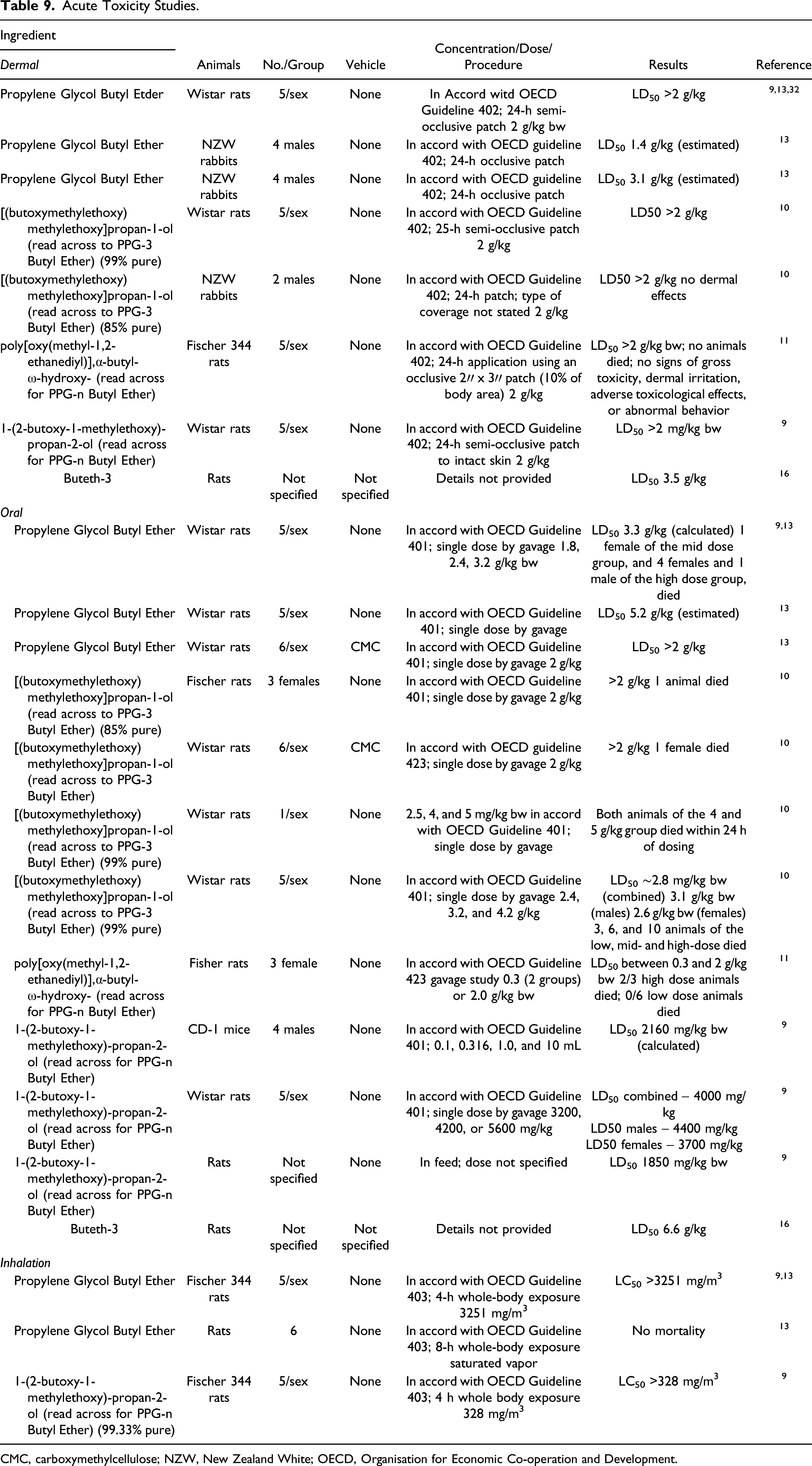
The acute dermal, oral, and inhalation toxicity studies summarized below are described in Table 9. No new acute toxicity data were available for PPG-3 Butyl Ether. But appropriate read across materials were identified for dermal, oral, and inhalation acute toxicity testing, and those data are included in this table.
CMC, carboxymethylcellulose; NZW, New Zealand White; OECD, Organisation for Economic Co-operation and Development.
In rats, the dermal LD50 was 3.5 g/kg for Buteth-316 and >2 g/kg for Propylene Glycol Butyl Ether,9,13,32 [(butoxymethylethoxy)methylethoxy]-propan-1-ol,10 poly[oxy(methyl-1,2-ethanediyl)],α-butyl-ω-hydroxy-,11 and 1-(2-butoxy-1-methylethoxy)-propan-2-ol.9 In rabbits, the dermal LD50 was ≥1.4 g/kg for Propylene Glycol Butyl Ether13 and >2 g/kg for [(butoxymethylethoxy)methylethoxy]-propan-1-ol.10
In rats, the oral LD50 was 6.6 g/kg for Buteth-3,16 > 2 g/kg for Propylene Glycol Butyl Ether,13 [(butoxymethylethoxy)methylethoxy]-propan-1-ol,10 and 1-(2-butoxy-1-methylethoxy)-propan-2-ol, and between 0.3 and 2 g/kg poly[oxy(methyl-1,2-ethanediyl)],α-butyl-ω-hydroxy-.11 In rats, inhalation LC50s were >3251 mg/m3 Propylene Glycol Butyl Ether10,11,16 and >328 mg/m3 1-(2-butoxy-1-methylethoxy)-propan-2-ol.9
Short-Term, Subchronic and Chronic Toxicity Studies
The subchronic (3 mo) oral toxicity of PPG-24-Buteth-27 in rats was evaluated at concentrations of 0.01 to 1.25% in the diet. Acute pneumonia was the primary cause of death in one of the two rats (highest exposure group) that died. Lesions were observed in the livers and kidneys of rats from the 0.05, 0.25, or 1.25% treatment groups. The changes observed in the 0.05% treatment group were regarded as transitory, and tissues from rats in the 0.01% group differed little from those of the control group.4
Hepatic and renal lesions were also observed in another subchronic study (90 d) in which groups of rats were fed PPG-33-Buteth-45 at dietary doses of 0.7 and 4.0 g/kg/d for 90 d. These lesions were not observed in rats fed lower doses (0.03 or 0.15 g/kg/d).
In a 2-yr feeding study involving rats, no statistically significant differences were found in the incidence of neoplasms and other lesions (20 tissues) between rats fed PPG-7-Buteth-10 (0.004, 0.02, 0.1, and 0.5 g/kg/d) and control groups. Similar results were reported for PPG-33-Buteth-45, following administration to groups of rats at dietary concentrations of 0.02, 0.1, and 0.5 g/kg/d, respectively.
In a chronic 2-yr feeding study involving dogs, no statistically significant differences in the incidence of gross or microscopic lesions (18 tissues) between groups of animals fed PPG-7-Buteth-10 (0.004, 0.02, 0.1, and 0.5 g/kg/d) and control groups were observed. Similar results were reported for PPG-33-Buteth-45, following administration to groups of dogs at dietary doses of 0.023, 0.11, and 0.61 g/kg/day.
PPG-2 Butyl Ether at a dose of 0.40 g/kg/day was nontoxic to rats during a 14-d feeding study. In 90-d feeding studies, the no-observed effect levels (NOELs) of PPG BE400, 800, 910, and 1020 were 0.047 g/kg/d, 0.16 to 0.67 g/kg/d, 0.25% of the diet, and 0.0625% of the diet, respectively. When rats were treated topically with PPG-2 Butyl Ether 5 d/wk for 13 wk, the dermal NOEL was 0.1 mL/kg/d, which was equivalent to a dose of 91 mg/kg/d. Doses of 0.25 g/kg/d 80% PPG-40 Butyl Ether, 2.0 g/kg/d 80% PPG-33 Butyl Ether, and 1.0 mL/kg/d PPG BE800 had no effect on mortality, weight change, or microscopic findings when applied to the skin of rabbits 5 d/wk for 6 wk, but the 30-d dermal NOEL for PPG BE400 was <0.1 mL/kg/d. When dogs and rats were fed PPG BE800 and 910 for up to 2 yr, the NOELs were up to 0.5 g/kg/d.1
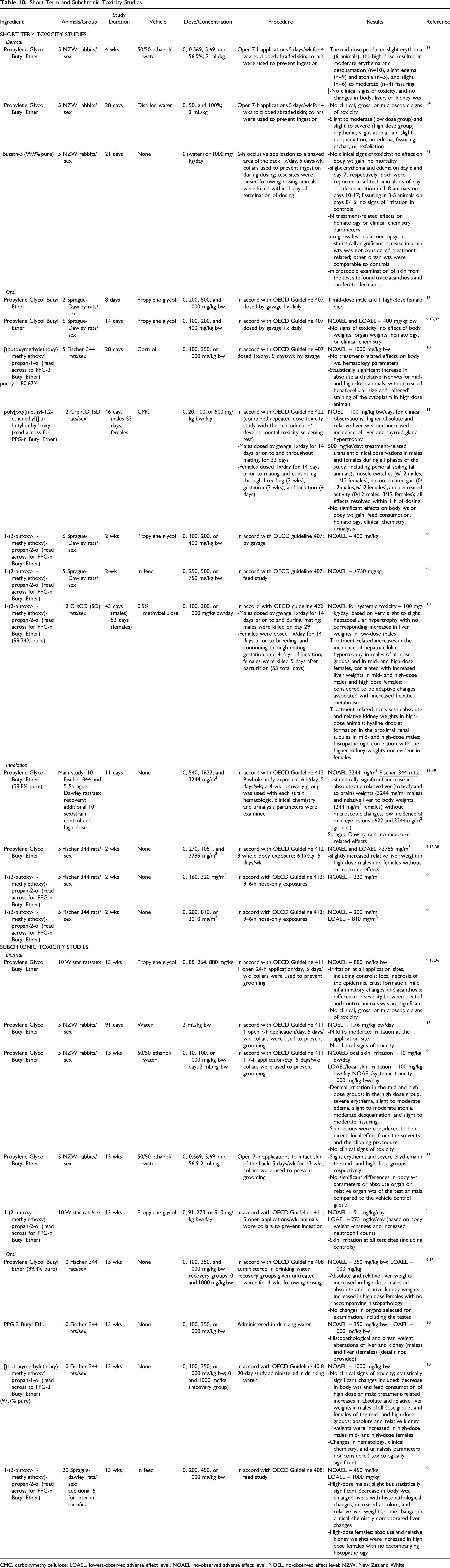
The short-term and subchronic toxicity studies summarized below are described in Table 10. No new repeated-dose dermal, oral, or inhalation toxicity data were available for PPG-3 Butyl Ether. Appropriate read-across materials were identified for dermal subchronic toxicity, oral short-term and subchronic toxicity, and short-term inhalation toxicity testing, and those data are included in this table.
Short-Term and Subchronic Toxicity Studies.
Ingredient
Animals/Group
Study Duration
Vehicle
Dose/Concentration
Procedure
Results
Reference
SHORT-TERM TOXICITY STUDIES
Dermal
Propylene Glycol Butyl Ether
5 NZW rabbits/sex
4 wks
50/50 ethanol/water
0, 0.569, 5.69, and 56.9%; 2 mL/kg
Open 7-h applications 5 days/wk for 4 wks to clipped abraded skin; collars were used to prevent ingestion
-The mid-dose produced slight erythema (6 animals), the high-dose resulted in moderate erythema and desquamation (n=10), slight edema (n=9) and atonia (n=5), and slight (n=6) to moderate (n=4) fissuring|-No clinical signs of toxicity, and no changes in body, liver, or kidney wts
Open 7-h applications 5 days/wk for 4 wks to clipped abraded skin; collars were used to prevent ingestion
-No clinical, gross, or microscopic signs of toxicity-Slight to moderate (low dose group) and slight to severe (high dose group) erythema, slight atonia, and slight desquamation; no edema, fissuring, eschar, or exfoliation
6-h occlusive application to a shaved area of the back 1x/day, 5 days/wk; collars used to prevent ingestion during dosing; test sites were rinsed following dosing animals were killed within 1 day of termination of dosing
-No clinical signs of toxicity; no effect on body wt gain; no mortality-slight erythema and edema on day 6 and day 7, respectively; both were reported in all test animals as of day 11; desquamation in 1-8 animals on days 10-17; fissuring in 3-5 animals on days 8-16; no signs of irritation in controls-N treatment-related effects on hematology or clinical chemistry parameters-no gross lesions at necropsy; a statistically significant increase in brain wts was not considered treatment-related; other organ wts were comparable to controls-microscopic examination of skin from the test site found trace acanthosis and moderate dermatitis
[(butoxymethylethoxy)methylethoxy]propan-1-ol (read across to PPG-3 Butyl Ether)purity – 80.67%
5 Fischer 344 rats/sex
28 days
Corn oil
0, 100, 350, or 1000 mg/kg bw
In accord with OECD Guideline 407dosed 1x/day, 5 days/wk by gavage
NOAEL – 1000 mg/kg bw-No treatment-related effects on body wt, hematology parameters-Statistically significant increase in absolute and relative liver wts for mid-and high-dose animals, with increased hepatocellular size and “altered” staining of the cytoplasm in high dose animals
poly[oxy(methyl-1,2-ethanediyl)],α-butyl-ω-hydroxy- (read across for PPG-n Butyl Ether)
12 Crj: CD (SD rats/sex
46 day, males 53 days, females
CMC
0, 20, 100, or 500 mg/kg bw/day
In accord with OECD Guideline 422 (combined repeated dose toxicity study with the reproduction/develop-mental toxicity screening test)-Males dosed by gavage 1x/day for 14 days prior to and throughout mating, for 32 days-Females dosed 1x/day for 14 days prior to mating and continuing through breeding (2 wks), gestation (3 wks), and lactation (4 days)
NOEL – 100 mg/kg bw/day, for clinical observations, higher absolute and relative liver wts, and increased incidence of liver and thyroid gland hypertrophy500 mg/kg/day: treatment-related transient clinical observations in males and females during all phases of the study, including perioral soiling (all animals), muscle twitches (6/12 males, 11/12 females), uncoordinated gait (0/12 males, 6/12 females), and decreased activity (0/12 males, 3/12 females); all effects resolved within 1 h of dosing-No significant effects on body wt or body wt gain, feed consumption, hematology, clinical chemistry, urinalysis
1-(2-butoxy-1-methylethoxy)-propan-2-ol (read across for PPG-n Butyl Ether) (99.34% pure)
12 Crl:CD (SD) rats/sex
43 days (males) 53 days (females)
0.5% methylcellulose
0, 100, 300, or 1000 mg/kg bw/day
In accord with OECD guideline 422-Males dosed by gavage 1x/day for 14 days prior to and during, mating; males were killed on day 29-Females were dosed 1x/day for 14 days prior to breeding, and continuing through mating, gestation, and 4 days of lactation; females were killed 5 days after parturition (53 total days)
NOAEL for systemic toxicity – 100 mg/kg/day, based on very slight to slight hepatocellular hypertrophy with no corresponding increases in liver weights in low-dose males-Treatment-related increases in the incidence of hepatocellular hypertrophy in males of all dose groups and in mid- and high-dose females, correlated with increased liver weights in mid- and high-dose males and high dose females; considered to be adaptive changes associated with increased hepatic metabolism-Treatment-related increases in absolute and relative kidney weights in high-dose animals; hyaline droplet formation in the proximal renal tubules in mid- and high-dose males; histopathologic correlation with the higher kidney weights not evident in females
Main study: 10 Fischer 344 and 5 Sprague-Dawley rats/sex recovery: additional 10 sex/strain control and high dose
11 days
None
0, 540, 1622, and 3244 mg/m3
In accord with OECD Guideline 412 9 whole body exposure; 6 h/day, 5 days/wk; a 4-wk recovery group was used with each strain hematologic, clinical chemistry, and urinalysis parameters were examined
NOAEL 3244 mg/m3Fischer 344 rats: statistically significant increase in absolute and relative liver (to body and to brain) weights (3244 mg/m3 males) and relative liver to body weights (244 mg/m3 females) without microscopic changes; low incidence of mild eye lesions 1622 and 3244 mg/m3 groups)Sprague Dawley rats: no exposure-related effects
In accord with OECD Guideline 4111 open 24-h application/day, 5 days/wk; collars were used to prevent grooming
NOAEL – 880 mg/kg bw-Irritation at all application sites, including controls; focal necrosis of the epidermis, crust formation, mild inflammatory changes, and acanthosis; difference in severity between treated and control animals was not significant-No clinical, gross, or microscopic signs of toxicity
In accord with OECD Guideline 411 1 7-h application/day, 5 days/wk; collars were used to prevent grooming
NOAEL/local skin irritation – 10 mg/kg bw/dayLOAEL/local skin irritation – 100 mg/kg bw/day NOAEL/systemic toxicity – 1000 mg/kg bw/day-Dermal irritation in the mid and high dose groups; in the high dose group, severe erythema, slight to moderate edema, slight to moderate atonia, moderate desquamation, and slight to moderate fissuring.-Skin lesions were considered to be a direct, local effect from the solvents and the clipping procedure.-No clinical signs of toxicity
Open 7-h applications to intact skin of the back, 5 days/wk for 13 wks; collars were used to prevent grooming
-Slight erythema and severe erythema in the mid- and high-dose groups, respectively-No significant differences in body wt parameters or absolute organ or relative organ wts of the test animals compared to the vehicle control group
1-(2-butoxy-1-methylethoxy)-propan-2-ol (read across for PPG-n Butyl Ether)
10 Wistar rats/sex
13 wks
Propylene glycol
0, 91, 273, or 910 mg/kg bw/day
In accord with OECD Guideline 411; 5 open applications/wk; animals wore collars to prevent ingestion
NOAEL – 91 mg/kg/dayLOAEL – 273 mg/kg/day (based on body weight -changes and increased neutrophil count)-Skin irritation at all test sites (including controls)
0, 100, 350, and 1000 mg/kg bw recovery groups: 0 and 1000 mg/kg bw
In accord with OECD Guideline 408administered in drinking waterrecovery groups given untreated water for 4 wks following dosing
NOAEL – 350 mg/kg bw; LOAEL – 1000 mg/kg-Absolute and relative liver weights increased in high dose males ad absolute and relative kidney weights increased in high dose females with no accompanying histopathology-No changes in organs selected for examination, including the testes
NOAEL – 350 mg/kg bw; LOAEL – 1000 mg/kg bw-Histopathological and organ weight alterations of liver and kidney (males) and liver (females) (details not provided)
[(butoxymethylethoxy)methylethoxy]propan-1-ol (read across to PPG-3 Butyl Ether) (97.7% pure)
10 Fischer 344 rats/sex
13 wks
None
0, 100, 350, or 1000 mg/kg bw; 0 and 1000 mg/kg (recovery group)
In accord with OECD Guideline 40 890-day study administered in drinking water
NOAEL – 1000 mg/kg bw-No clinical signs of toxicity; statistically significant changes included: decrease in body wts and feed consumption of high dose animals; treatment-related increases in absolute and relative liver weights in males of all dose groups and females of the mid- and high-dose groups; absolute and relative kidney weights were increased in high-dose males mid- and high-dose females-Changes in hematology, clinical chemistry, and urinalysis parameters not considered toxicologically significant
1-(2-butoxy-1-methylethoxy)-propan-2-ol (read across for PPG-n Butyl Ether)
20 Sprague-dawley rats/sex; additional 5 for interim sacrifice
13 wks
In feed
0, 200, 450, or 1000 mg/kg bw
In accord with OECD Guideline 408; feed study
NOAEL – 450 mg/kgLOAEL – 1000 mg/kg-High-dose males: slight but statistically significant decrease in body wts, enlarged livers with histopathological changes, increased absolute, and relative liver weights; some changes in clinical chemistry corroborated liver changes-High-dose females: absolute and relative kidney weights were increased in high dose females with no accompanying histopathology
In dermal studies, effects on rabbit skin were reported in a 21-d toxicity study of Buteth-3 (1000 mg/kg, occlusive application),31 in 28-d (at concentrations of ≥5.69%, open applications)33,34 and 91 d (NOEL of 1.76 mg/kg bw/d) studies of Propylene Glycol Butyl Ether,9,35 and in a 13-wk study of 1-(2-butoxy-1-methylethoxy)-propan-2-ol (≥91 mg/kg bw/d). Clinical signs of toxicity generally were not observed. Irritation was also observed in a 13-wk study of Propylene Glycol Butyl Ether in rats (≥88 mg/kg).9,13,36
In short-term oral toxicity studies in rats, a no-observed adverse effect level (NOAEL) of 400 mg/kg was reported in 14-d gavage studies of Propylene Glycol Butyl Ether9,13,37 and 1-(2-butoxy-1-methylethoxy)-propan-2-ol,9 and of 1000 mg/kg in a 28-d gavage study with [(butoxymethylethoxy)methylethoxy]-propan-1-ol.10 In oral combined repeated dose toxicity studies with the reproduction/developmental toxicity screening test in rats, the NOEL was 100 mg/kg bw/d in rats exposed to either poly[oxy(methyl-1,2-ethanediyl)],α-butyl-ω-hydroxy-11 or 1-(2-butoxy-1-methylethoxy)-propan-2-ol.10 In subchronic (13-wk) drinking water studies in rats, both Propylene Glycol Butyl Ether9,13 and PPG-3 Butyl Ether30 had a NOAEL of 350 mg/kg, and [(butoxymethylethoxy)methylethoxy]-propan-1-ol had a NOAEL of 1000 mg/kg.10 A NOAEL of 450 mg/kg was reported in rats fed a diet containing 1-(2-butoxy-1-methylethoxy)-propan-2-ol for 13 wk.9
In short-term inhalation studies (nine 6-h exposures) in rats, the NOAEL for Propylene Glycol Butyl Ether was 3785 mg/m39,13,38 and for 1-(2-butoxy-1-methylethoxy)-propan-2-ol was ≥200 mg/m3.9
Developmental and Reproductive Toxicity Studies
PPG-2 Butyl Ether when dermally applied was nontoxic to pregnant rats and was non-teratogenic at doses up to 1.0 mL/kg/d.1
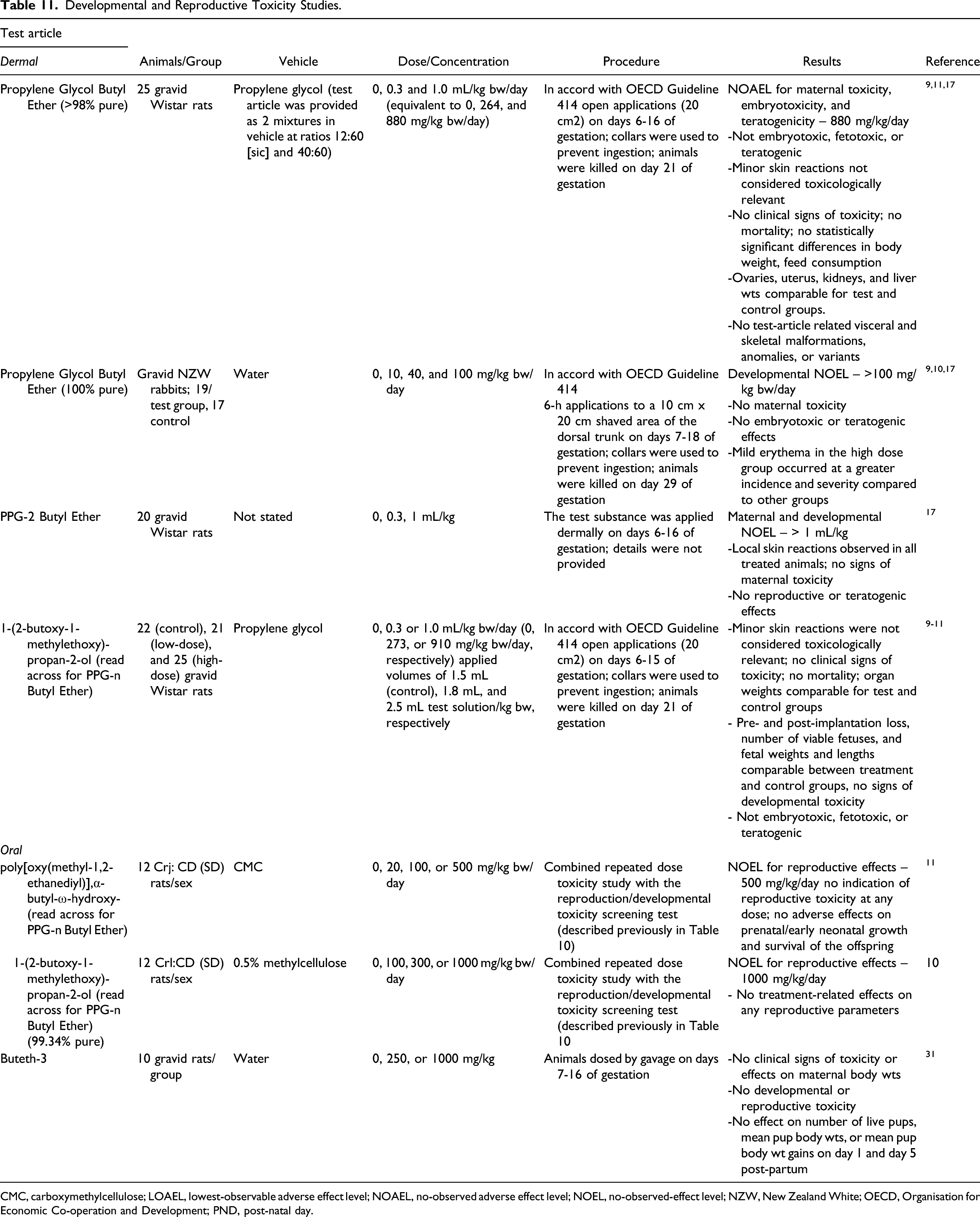
The developmental and reproductive toxicity (DART) studies summarized below are described in Table 11. Appropriate read-across materials were identified for dermal and oral DART testing, and those data are included in this table.
Developmental and Reproductive Toxicity Studies.
Test article
Animals/Group
Vehicle
Dose/Concentration
Procedure
Results
Reference
Dermal
Propylene Glycol Butyl Ether (>98% pure)
25 gravid Wistar rats
Propylene glycol (test article was provided as 2 mixtures in vehicle at ratios 12:60 [sic] and 40:60)
0, 0.3 and 1.0 mL/kg bw/day (equivalent to 0, 264, and 880 mg/kg bw/day)
In accord with OECD Guideline 414 open applications (20 cm2) on days 6-16 of gestation; collars were used to prevent ingestion; animals were killed on day 21 of gestation
NOAEL for maternal toxicity, embryotoxicity, and teratogenicity – 880 mg/kg/day-Not embryotoxic, fetotoxic, or teratogenic-Minor skin reactions not considered toxicologically relevant-No clinical signs of toxicity; no mortality; no statistically significant differences in body weight, feed consumption-Ovaries, uterus, kidneys, and liver wts comparable for test and control groups.-No test-article related visceral and skeletal malformations, anomalies, or variants
In accord with OECD Guideline 4146-h applications to a 10 cm x 20 cm shaved area of the dorsal trunk on days 7-18 of gestation; collars were used to prevent ingestion; animals were killed on day 29 of gestation
Developmental NOEL – >100 mg/kg bw/day-No maternal toxicity-No embryotoxic or teratogenic effects-Mild erythema in the high dose group occurred at a greater incidence and severity compared to other groups
The test substance was applied dermally on days 6-16 of gestation; details were not provided
Maternal and developmental NOEL – > 1 mL/kg-Local skin reactions observed in all treated animals; no signs of maternal toxicity-No reproductive or teratogenic effects
1-(2-butoxy-1-methylethoxy)-propan-2-ol (read across for PPG-n Butyl Ether)
22 (control), 21 (low-dose), and 25 (high-dose) gravid Wistar rats
Propylene glycol
0, 0.3 or 1.0 mL/kg bw/day (0, 273, or 910 mg/kg bw/day, respectively) applied volumes of 1.5 mL (control), 1.8 mL, and 2.5 mL test solution/kg bw, respectively
In accord with OECD Guideline 414 open applications (20 cm2) on days 6-15 of gestation; collars were used to prevent ingestion; animals were killed on day 21 of gestation
-Minor skin reactions were not considered toxicologically relevant; no clinical signs of toxicity; no mortality; organ weights comparable for test and control groups- Pre- and post-implantation loss, number of viable fetuses, and fetal weights and lengths comparable between treatment and control groups, no signs of developmental toxicity- Not embryotoxic, fetotoxic, or teratogenic
poly[oxy(methyl-1,2-ethanediyl)],α-butyl-ω-hydroxy- (read across for PPG-n Butyl Ether)
12 Crj: CD (SD) rats/sex
CMC
0, 20, 100, or 500 mg/kg bw/day
Combined repeated dose toxicity study with the reproduction/developmental toxicity screening test (described previously in Table 10)
NOEL for reproductive effects – 500 mg/kg/day no indication of reproductive toxicity at any dose; no adverse effects on prenatal/early neonatal growth and survival of the offspring
1-(2-butoxy-1-methylethoxy)-propan-2-ol (read across for PPG-n Butyl Ether) (99.34% pure)
12 Crl:CD (SD) rats/sex
0.5% methylcellulose
0, 100, 300, or 1000 mg/kg bw/day
Combined repeated dose toxicity study with the reproduction/developmental toxicity screening test (described previously in Table 10
NOEL for reproductive effects – 1000 mg/kg/day- No treatment-related effects on any reproductive parameters
10
Buteth-3
10 gravid rats/group
Water
0, 250, or 1000 mg/kg
Animals dosed by gavage on days 7-16 of gestation
-No clinical signs of toxicity or effects on maternal body wts-No developmental or reproductive toxicity-No effect on number of live pups, mean pup body wts, or mean pup body wt gains on day 1 and day 5 post-partum
CMC, carboxymethylcellulose; LOAEL, lowest-observable adverse effect level; NOAEL, no-observed adverse effect level; NOEL, no-observed-effect level; NZW, New Zealand White; OECD, Organisation for Economic Co-operation and Development; PND, post-natal day.
Dermal application of PPG-2 Butyl Ether to rats during days 6–16 of gestation produced local skin reactions, but not reproductive or teratogenic effects (NOEL >1 mL/kg).17 Dermally applied Propylene Glycol Butyl Ether was not embryotoxic or teratogenic to rats (≤1.0 mL/kg bw/d applied on days 6–16 of gestation)9,11,17 or rabbits (≤100 mg/kg bw/d applied on days 7–18 of gestation).9,10,17 Dermal application of up to 910 mg/kg bw/d 1-(2-butoxy-1-methylethoxy)-propan-2-ol was not embryotoxic, fetotoxic, or teratogenic in rats.9-11
No test-article related adverse developmental or reproductive effects were observed in rats dosed by gavage (days 7–16 of gestation) with up to 1000 mg/kg Buteth-3.31 No effects on reproduction were observed in rats dosed orally prior to and during mating with up to 500 mg/kg bw/d poly[oxy(methyl-1,2-ethanediyl)],α-butyl-ω-hydroxy-11 or up to 1000 mg/kg bw/d 1-(2-butoxy-1-methylethoxy)-propan-2-ol.10
Genotoxicity Studies
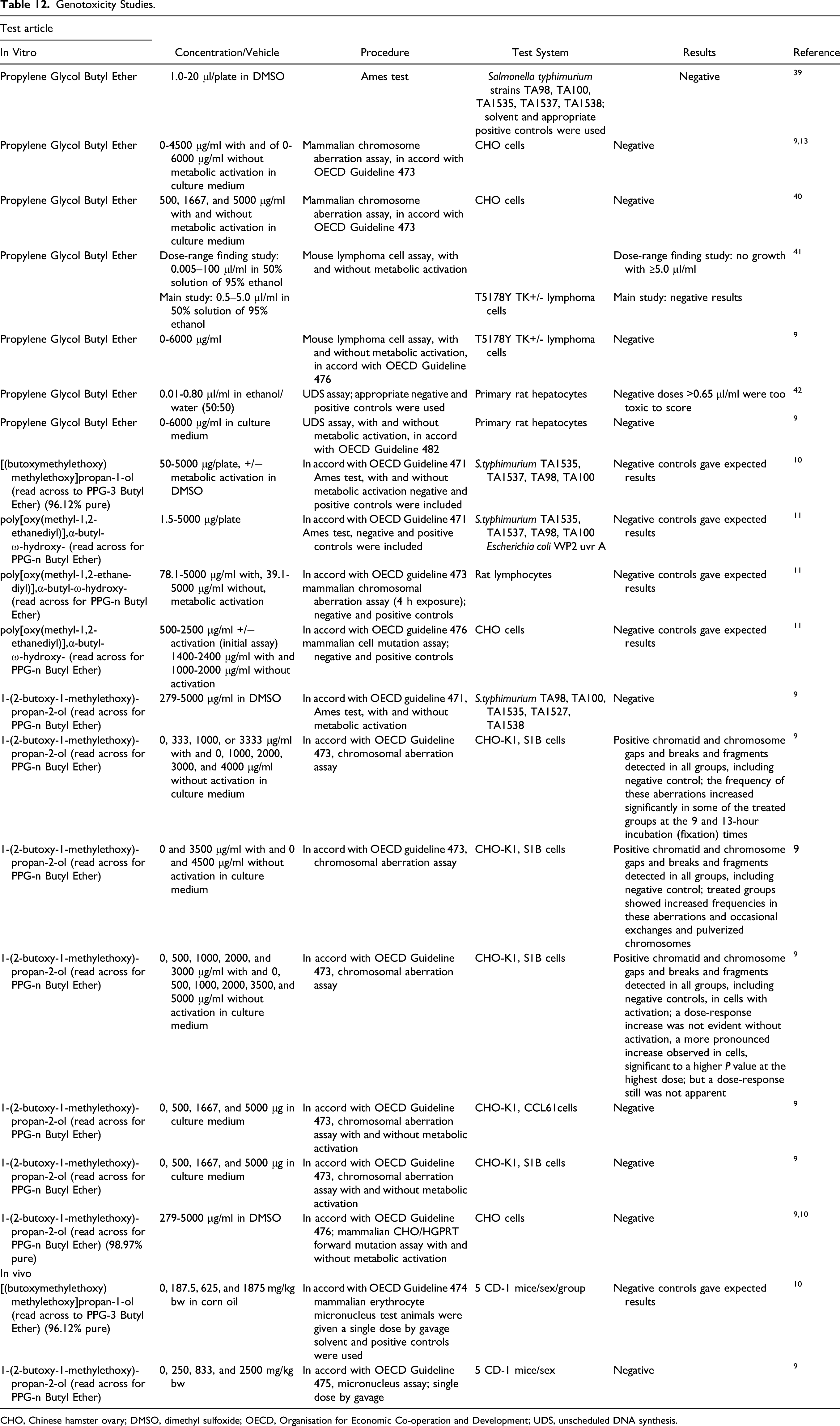
The genotoxicity studies summarized below are described in Table 12. No genotoxicity data were available for PPG-3 Butyl Ether. Appropriate read-across materials were identified for which Ames tests, mammalian chromosomal aberration assays, and a mammalian cell mutation assay were conducted in vitro and micronucleus tests were conducted in vivo. Those data are included in this table.
Genotoxicity Studies.
Test article
Concentration/Vehicle
Procedure
Test System
Results
Reference
In Vitro
Propylene Glycol Butyl Ether
1.0-20 μl/plate in DMSO
Ames test
Salmonella typhimurium strains TA98, TA100, TA1535, TA1537, TA1538; solvent and appropriate positive controls were used
1-(2-butoxy-1-methylethoxy)-propan-2-ol (read across for PPG-n Butyl Ether)
0, 333, 1000, or 3333 μg/ml with and 0, 1000, 2000, 3000, and 4000 μg/ml without activation in culture medium
In accord with OECD Guideline 473, chromosomal aberration assay
CHO-K1, S1B cells
Positive chromatid and chromosome gaps and breaks and fragments detected in all groups, including negative control; the frequency of these aberrations increased significantly in some of the treated groups at the 9 and 13-hour incubation (fixation) times
1-(2-butoxy-1-methylethoxy)-propan-2-ol (read across for PPG-n Butyl Ether)
0 and 3500 μg/ml with and 0 and 4500 μg/ml without activation in culture medium
In accord with OECD guideline 473, chromosomal aberration assay
CHO-K1, S1B cells
Positive chromatid and chromosome gaps and breaks and fragments detected in all groups, including negative control; treated groups showed increased frequencies in these aberrations and occasional exchanges and pulverized chromosomes
1-(2-butoxy-1-methylethoxy)-propan-2-ol (read across for PPG-n Butyl Ether)
0, 500, 1000, 2000, and 3000 μg/ml with and 0, 500, 1000, 2000, 3500, and 5000 μg/ml without activation in culture medium
In accord with OECD Guideline 473, chromosomal aberration assay
CHO-K1, S1B cells
Positive chromatid and chromosome gaps and breaks and fragments detected in all groups, including negative controls, in cells with activation; a dose-response increase was not evident without activation, a more pronounced increase observed in cells, significant to a higher P value at the highest dose; but a dose-response still was not apparent
[(butoxymethylethoxy)methylethoxy]propan-1-ol (read across to PPG-3 Butyl Ether) (96.12% pure)
0, 187.5, 625, and 1875 mg/kg bw in corn oil
In accord with OECD Guideline 474 mammalian erythrocyte micronucleus test animals were given a single dose by gavage solvent and positive controls were used
CHO, Chinese hamster ovary; DMSO, dimethyl sulfoxide; OECD, Organisation for Economic Co-operation and Development; UDS, unscheduled DNA synthesis.
Propylene Glycol Butyl Ether,39 [(butoxymethylethoxy)methylethoxy]-propan-1-ol,10 poly[oxy(methyl-1,2-ethanediyl)], α-butyl-ω-hydroxy-,11 and 1-(2-butoxy-1-methylethoxy)-propan-2-ol9 were not mutagenic in Ames tests. Propylene Glycol Butyl Ether was not mutagenic in numerous other genotoxicity studies, including mammalian chromosomal aberration assays in Chinese hamster ovary (CHO) cells (≤6000 μg/ml),9,13,40 mouse lymphoma cell assays in T5178Y TK+/- lymphoma cells (≤6000 μg/ml),9,41 and unscheduled DNA synthesis (UDS) assays in primary rat hepatocytes (≤6000 μg/ml).42 Poly[oxy(methyl-1,2-ethanediyl)],α-butyl-ω-hydroxy-was not genotoxic in a mammalian chromosomal assay in rat lymphocytes (≤5000 μg/ml), or a mammalian cell mutation assay in CHO cells (≤2500 μg/ml).11 1-(2-Butoxy-1-methylethoxy)-propan-2-ol was positive, with chromatid and chromosome gaps and breaks, in chromosomal aberration assays in CHO-K1, S1B cells but not in CHO-K1, CCL61 cells, or CHO cells.9 Gaps and breaks were also reported in negative controls in the tests using CHO-K1, S1B cells.
Both [(butoxymethylethoxy)methylethoxy]-propan-1-ol and 1-(2-butoxy-1-methylethoxy)-propan-2-ol were negative in vivo in the mouse micronucleus assay following a single oral dose of 1875 mg/kg bw10 and 2500 mg/kg bw,9 respectively.
Carcinogenicity Studies
In two lifetime skin painting studies, PPG-7-Buteth-10 and PPG-33-Buteth-45, respectively, did not induce papillomas or carcinomas in mice. When administered following either one or two initiator doses of dimethylbenzanthracene (DMBA), 70% PPG-24-Buteth-27 acted as a tumor promoter; however, 5% PPG-24-Buteth-27 did not act as a tumor promoter.4
PPG BE800 at concentrations of 0.001% to 0.26% in feed was non-carcinogenic to rats after 2 yr of treatment.1
Dermal Irritation and Sensitization Studies
In a skin irritation test of PPG-12-Buteth-16, PPG-20-Buteth-30, and PPG-33-Buteth-45, capillary injection was observed in rabbits only after the application of PPG-12-Buteth-16. The results of another study indicated that PPG-24-Buteth-27 induced minor erythema and moderate edema in rabbits. Reactions were not observed after day 2 post-application. PPG-26-Buteth-26 induced very slight to slight skin irritation in New Zealand albino rabbits. A solubilizing system containing PPG-26-Buteth-26 (concentration not stated) was classified as a mild skin irritant in New Zealand White rabbits.4
A human repeated insult patch tests (HRIPT) study in 109 subjects found no irritation or sensitization associated with the application of 0.75% PPG-12-Buteth-16 under semi-occlusive patches. Aftershave formulations containing 2.5% PPG-26-Buteth-26 were not skin irritants or sensitizers when evaluated in two 21-d home use tests. The skin irritation and/or sensitization use test and the skin irritation use test involved 52 and 54 subjects, respectively.
In a 4-h occlusive patch test using rabbits, PPG-2 Butyl Ether caused minor, transient erythema and desquamation, but not edema. PPG-33 Butyl Ether was nonirritating in a vesicant, 4-h irritation, and 3-d repeated application tests. Undiluted PPG-40 Butyl Ether was minimally irritating to the skin of rabbits. Rabbits treated with PPG BE800 had minimal capillary injection during a 3-d repeated application test, and PPG-40 Butyl Ether was slightly less irritating than PPG BE400 (caused erythema) in a 4-h belly irritation test. PPG-9 and -18 Butyl Ethers caused capillary injection, whereas PPG-15, -33, and ∼9-15 Butyl Ethers caused no response during a rabbit belly vesicant test.1
In clinical studies, PPG BE800 was nonirritating and non-sensitizing to the skin when tested using 200 subjects. PPG-40 Butyl Ether was neither an irritant nor a sensitizer in a repeat insult patch test using 112 subjects.
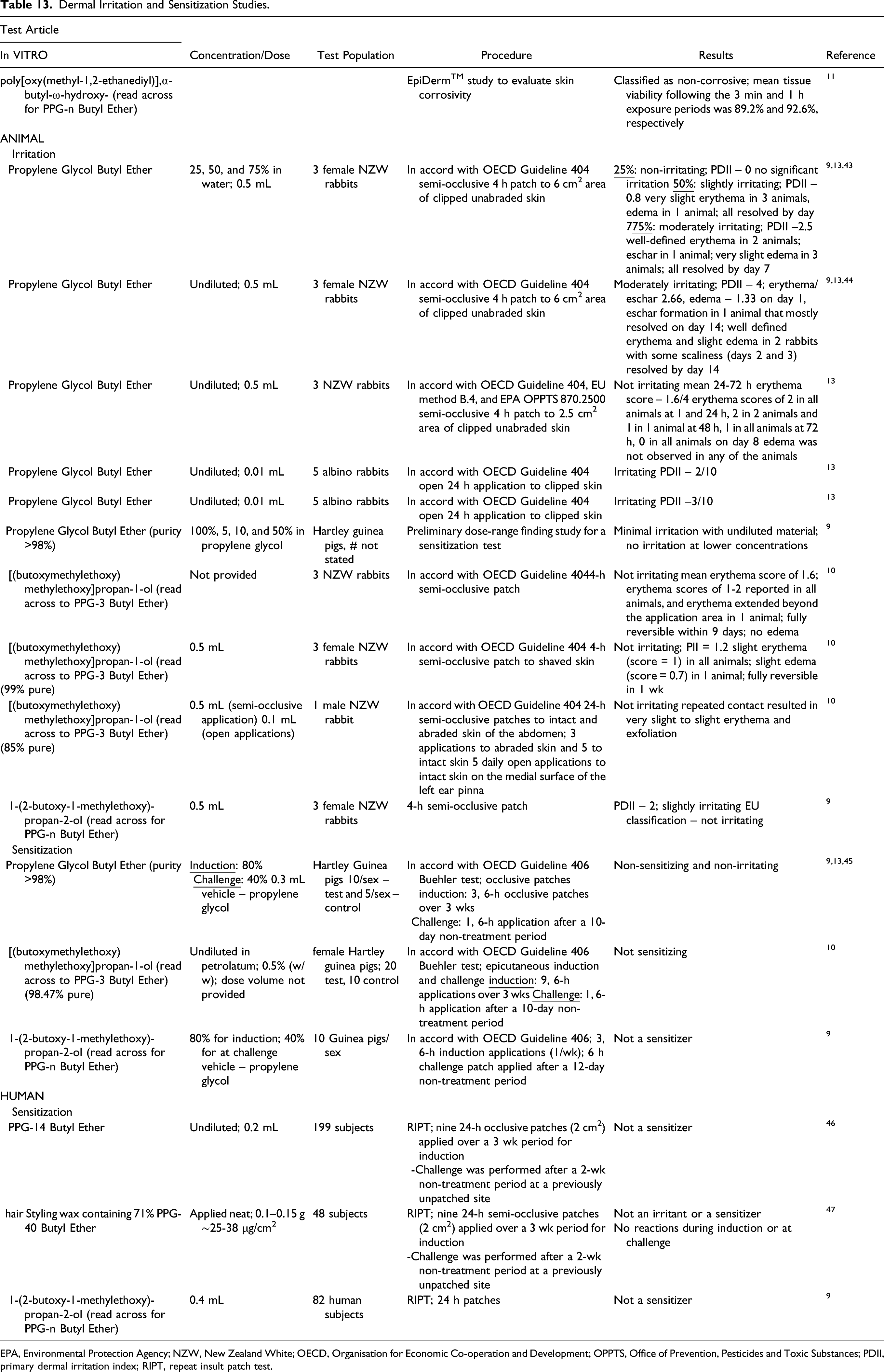
The dermal irritation and sensitization studies summarized below are described in Table 13. No new dermal irritation or sensitization data were available for PPG-3 Butyl Ether. Studies on appropriate read-across materials were identified for in vitro irritation testing, irritation and sensitization testing in animals, and sensitization testing in humans. Those data are included in this table.
Dermal Irritation and Sensitization Studies.
Test Article
Concentration/Dose
Test Population
Procedure
Results
Reference
In VITRO
poly[oxy(methyl-1,2-ethanediyl)],α-butyl-ω-hydroxy- (read across for PPG-n Butyl Ether)
EpiDermTM study to evaluate skin corrosivity
Classified as non-corrosive; mean tissue viability following the 3 min and 1 h exposure periods was 89.2% and 92.6%, respectively
In accord with OECD Guideline 404 semi-occlusive 4 h patch to 6 cm2 area of clipped unabraded skin
25%: non-irritating; PDII – 0 no significant irritation 50%: slightly irritating; PDII – 0.8 very slight erythema in 3 animals, edema in 1 animal; all resolved by day 775%: moderately irritating; PDII –2.5 well-defined erythema in 2 animals; eschar in 1 animal; very slight edema in 3 animals; all resolved by day 7
In accord with OECD Guideline 404 semi-occlusive 4 h patch to 6 cm2 area of clipped unabraded skin
Moderately irritating; PDII – 4; erythema/eschar 2.66, edema – 1.33 on day 1, eschar formation in 1 animal that mostly resolved on day 14; well defined erythema and slight edema in 2 rabbits with some scaliness (days 2 and 3) resolved by day 14
In accord with OECD Guideline 404, EU method B.4, and EPA OPPTS 870.2500 semi-occlusive 4 h patch to 2.5 cm2 area of clipped unabraded skin
Not irritating mean 24-72 h erythema score – 1.6/4 erythema scores of 2 in all animals at 1 and 24 h, 2 in 2 animals and 1 in 1 animal at 48 h, 1 in all animals at 72 h, 0 in all animals on day 8 edema was not observed in any of the animals
[(butoxymethylethoxy)methylethoxy]propan-1-ol (read across to PPG-3 Butyl Ether)
Not provided
3 NZW rabbits
In accord with OECD Guideline 4044-h semi-occlusive patch
Not irritating mean erythema score of 1.6; erythema scores of 1-2 reported in all animals, and erythema extended beyond the application area in 1 animal; fully reversible within 9 days; no edema
[(butoxymethylethoxy)methylethoxy]propan-1-ol (read across to PPG-3 Butyl Ether) (85% pure)
0.5 mL (semi-occlusive application) 0.1 mL (open applications)
1 male NZW rabbit
In accord with OECD Guideline 404 24-h semi-occlusive patches to intact and abraded skin of the abdomen; 3 applications to abraded skin and 5 to intact skin 5 daily open applications to intact skin on the medial surface of the left ear pinna
Not irritating repeated contact resulted in very slight to slight erythema and exfoliation
Induction: 80%Challenge: 40% 0.3 mL vehicle – propylene glycol
Hartley Guinea pigs 10/sex – test and 5/sex – control
In accord with OECD Guideline 406 Buehler test; occlusive patches induction: 3, 6-h occlusive patches over 3 wks Challenge: 1, 6-h application after a 10-day non-treatment period
[(butoxymethylethoxy)methylethoxy]propan-1-ol (read across to PPG-3 Butyl Ether) (98.47% pure)
Undiluted in petrolatum; 0.5% (w/w); dose volume not provided
female Hartley guinea pigs; 20 test, 10 control
In accord with OECD Guideline 406 Buehler test; epicutaneous induction and challenge induction: 9, 6-h applications over 3 wks Challenge: 1, 6-h application after a 10-day non-treatment period
RIPT; nine 24-h occlusive patches (2 cm2) applied over a 3 wk period for induction -Challenge was performed after a 2-wk non-treatment period at a previously unpatched site
RIPT; nine 24-h semi-occlusive patches (2 cm2) applied over a 3 wk period for induction-Challenge was performed after a 2-wk non-treatment period at a previously unpatched site
Not an irritant or a sensitizerNo reactions during induction or at challenge
EPA, Environmental Protection Agency; NZW, New Zealand White; OECD, Organisation for Economic Co-operation and Development; OPPTS, Office of Prevention, Pesticides and Toxic Substances; PDII, primary dermal irritation index; RIPT, repeat insult patch test.
Poly[oxy(methyl-1,2-ethanediyl)],α-butyl-ω-hydroxy- was classified as non-corrosive based on the results of an EpiDermTM test.11 In rabbits, Propylene Glycol Butyl Ether was slightly irritating at a concentration of 50%9,13,43 and was generally irritating when applied undiluted.9,13,44 In guinea pigs, undiluted Propylene Glycol Butyl Ether was a minimal irritant in one study9; however, it was not irritating or sensitizing in a Buehler test (three induction patches with 80% and a challenge with 40%).9,13,45 Undiluted [(butoxymethylethoxy)methylethoxy]-propan-1-ol was not irritating to rabbit skin and was not a sensitizer in guinea pigs in a Buehler test.10 1-(2-Butoxy-1-methylethoxy)-propan-2-ol produced some slight irritation in rabbit skin, but was not irritating according to EU classification criteria; also, it was not a sensitizer in guinea pigs (three induction patches with 80% and a challenge with 40%).9
In HRIPT, undiluted PPG-14 Butyl Ether,46 hair styling wax containing 71% PPG-40 Butyl Ether (applied neat),47 and 1-(2-butoxy-1-methylethoxy)-propan-2-ol9 were not sensitizers.
Ocular Irritation Studies
Buteth-27 induced iritis and minor to moderate conjunctival irritation. All reactions had cleared by day 2 post-instillation. PPG-26-Buteth-26 did not induce ocular irritation in New Zealand albino rabbits. Mild ocular irritation was induced in New Zealand White rabbits tested with a solubilizing system containing PPG-26-Buteth-26 (concentration not stated).4
Rabbits treated with 0.1 mL PPG-2 Butyl Ether had minor corneal injury (opacity), iritis, and moderate conjunctival irritation; rabbits treated with 0.01 mL of the ether had iritis and minor to moderate conjunctival irritation. In an ocular toxicity study, PPG-15 Butyl Ether produced traces of diffuse corneal necrosis in four of five rabbits and PPG-33 Butyl Ether was not irritating. PPG-9, ∼9-15, −15, -18, -22, and -33 Butyl Ethers caused minor injury to the eyes of rabbits.1
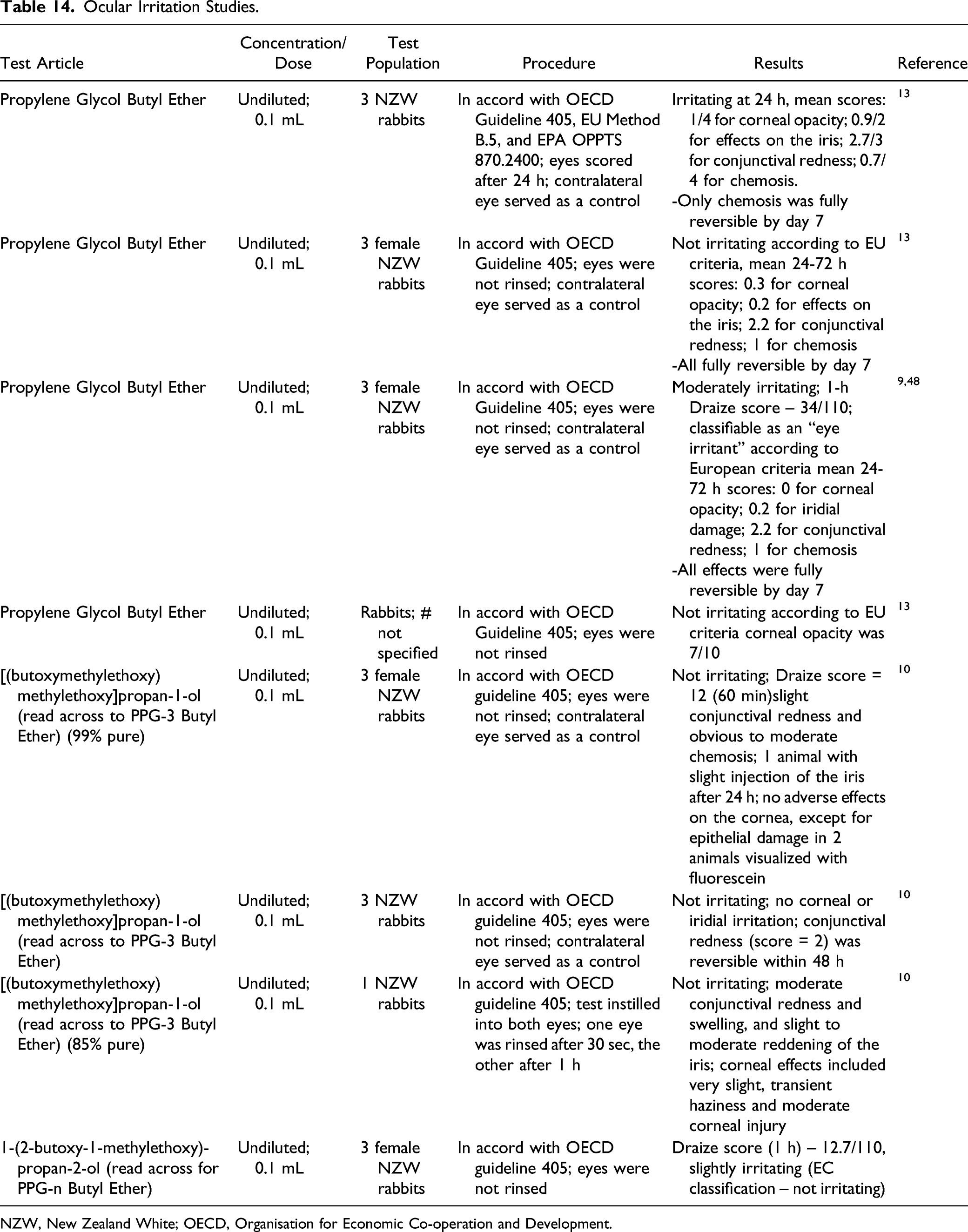
The ocular irritation studies summarized below are described in Table 14. No new ocular irritation data were available for PPG-3 Butyl Ether. Ocular irritation studies in rabbits for appropriate read-across materials were identified, and those data are included in this table.
Ocular Irritation Studies.
Test Article
Concentration/Dose
Test Population
Procedure
Results
Reference
Propylene Glycol Butyl Ether
Undiluted; 0.1 mL
3 NZW rabbits
In accord with OECD Guideline 405, EU Method B.5, and EPA OPPTS 870.2400; eyes scored after 24 h; contralateral eye served as a control
Irritating at 24 h, mean scores: 1/4 for corneal opacity; 0.9/2 for effects on the iris; 2.7/3 for conjunctival redness; 0.7/4 for chemosis.-Only chemosis was fully reversible by day 7
In accord with OECD Guideline 405; eyes were not rinsed; contralateral eye served as a control
Not irritating according to EU criteria, mean 24-72 h scores: 0.3 for corneal opacity; 0.2 for effects on the iris; 2.2 for conjunctival redness; 1 for chemosis -All fully reversible by day 7
In accord with OECD Guideline 405; eyes were not rinsed; contralateral eye served as a control
Moderately irritating; 1-h Draize score – 34/110; classifiable as an “eye irritant” according to European criteria mean 24-72 h scores: 0 for corneal opacity; 0.2 for iridial damage; 2.2 for conjunctival redness; 1 for chemosis -All effects were fully reversible by day 7
[(butoxymethylethoxy)methylethoxy]propan-1-ol (read across to PPG-3 Butyl Ether) (99% pure)
Undiluted; 0.1 mL
3 female NZW rabbits
In accord with OECD guideline 405; eyes were not rinsed; contralateral eye served as a control
Not irritating; Draize score = 12 (60 min)slight conjunctival redness and obvious to moderate chemosis; 1 animal with slight injection of the iris after 24 h; no adverse effects on the cornea, except for epithelial damage in 2 animals visualized with fluorescein
[(butoxymethylethoxy)methylethoxy]propan-1-ol (read across to PPG-3 Butyl Ether) (85% pure)
Undiluted; 0.1 mL
1 NZW rabbits
In accord with OECD guideline 405; test instilled into both eyes; one eye was rinsed after 30 sec, the other after 1 h
Not irritating; moderate conjunctival redness and swelling, and slight to moderate reddening of the iris; corneal effects included very slight, transient haziness and moderate corneal injury
NZW, New Zealand White; OECD, Organisation for Economic Co-operation and Development.
The classification of undiluted Propylene Glycol Butyl Ether in rabbit eyes ranged from not irritating (according to criteria established by the EU) to moderately irritating (according the Draize scores).9,13,48 Undiluted [(butoxymethylethoxy)methylethoxy]-propan-1-ol10 and 1-(2-butoxy-1-methylethoxy)-propan-2-ol9 were not irritating and slightly irritating to rabbit eyes, respectively.
Summary
The Panel previously issued final reports on the safety of 19 butyl PPG ethers (2001; safe for use in cosmetics when formulated to avoid irritation) and four butyl PPG/PEG ethers (2000; safe as used in cosmetic products). The ingredients reviewed in those two reports share a common structural motif, namely a butyl chain (4 carbon alkyl chain) bound to a polyoxyalkylene (PPG, PEG, or both). This safety assessment combines the 23 butyl polyoxyalkylene ethers named in those two reports with 23 butyl polyoxyalkylene ethers that were not previously reviewed by the Panel. Most of the ingredients included in this safety assessment are reported to function as hair conditioning agents and skin conditioning agents and several are also reported to function as fragrance ingredients, surfactants, or solvents.
Eighteen of the 46 ingredients assessed in this report are currently reported as used in cosmetic formulations. According to 2017 VCRP data, PPG-26-Buteth-26 has the highest frequency of use, with 1332 reported uses. Buteth-3 and PPG-12-Buteth-16 have the next highest frequency of use, with 446 and 436 reported uses, respectively. PPG-40 Butyl Ether has the highest maximum use concentration in both leave-on (71% in tonics, dressings, and other hair grooming aids) and rinse-off formulations (73.5% in hair tints). Approximately half of the ingredients that are in use have been reviewed previously by the Panel, and for the majority of these ingredients, the frequency of use has not changed. However, there has been a large increase in the frequency of use of PPG-26-Buteth-26, from 13 reported uses in 1997 to 1332 uses reported in 2017.
Most of the butyl polyoxyalkylene ethers are approved for use as secondary direct food additives or as indirect food additives.
The in vitro diffusion rate of Buteth-3 through human skin samples following a 12-h exposure was 22 μg/cm2/h. Buteth-3 did not have a significant effect on skin barrier function.
Small propylene glycol ethers are rapidly absorbed and distributed throughout the body following oral and inhalation exposures. Excretion is primarily via the urine and expired air; a small amount is excreted in the feces. Absorption via the dermal route is slower, but subsequent distribution is rapid. Additionally, Propylene Glycol Butyl Ether (a monoglycol ether) is absorbed through the skin better than diglycol and triglycol ethers. However, diglycol and triglycol ethers may be present on the skin much longer than monoglycol ethers because of their lower vapor pressures.
Following a single oral dose of [14C]1-(2-butoxy-1-methylethoxy)-propan-2-ol in 1% methylcellulose in rats, 42–51% of the dose was excreted in the urine and 42–35% in carbon dioxide (0.4 or 4.4 mmol/kg bw, respectively) within 48 h. Metabolites and the parent compound were present in the urine.
2-Butoxypropionic acid, a metabolite of Propylene Glycol Butyl Ether, appeared in the urine (at a concentration of 0.06 ppm) of 6 subjects who were exposed to vapors from a cleaning solution containing 3.5% Propylene Glycol Butyl Ether. The day after the exposure, 2-butoxypropionic acid was detected in the urine samples of 3 subjects at slightly over the LOQ (0.012–0.014 ppm).
In rats, the dermal LD50 was 3.5 g/kg for Buteth-3 and >2 g/kg for Propylene Glycol Butyl Ether, [(butoxymethylethoxy)methylethoxy]-propan-1-ol, poly[oxy(methyl-1,2-ethanediyl)],α-butyl-ω-hydroxy-, and 1-(2-butoxy-1-methylethoxy)-propan-2-ol. In rabbits, the dermal LD50 was ≥1.4 g/kg for Propylene Glycol Butyl Ether and >2 g/kg for [(butoxymethylethoxy) methylethoxy]-propan-1-ol.
In rats, the oral LD50 was 6.6 g/kg Buteth-3, >2 g/kg for Propylene Glycol Butyl Ether, [(butoxymethylethoxy)methylethoxy]-propan-1-ol, and 1-(2-butoxy-1-methylethoxy)-propan-2-ol, and between 0.3 and 2 g/kg poly[oxy(methyl-1,2-ethanediyl)],α-butyl-ω-hydroxy-. In rats, inhalation LC50s were >3251 mg/m3 Propylene Glycol Butyl Ether and >328 mg/m3 1-(2-butoxy-1-methylethoxy)-propan-2-ol.
In dermal studies, effects on rabbit skin were reported in a 21-d toxicity study of Buteth-3 (1000 mg/kg, occlusive application), in 28-d (at concentrations of ≥5.69%, open applications) and 13-wk (NOEL of 1.76 mg/kg bw/d) studies of Propylene Glycol Butyl Ether, and in a 13-wk study of 1-(2-butoxy-1-methylethoxy)-propan-2-ol (≥91 mg/kg bw/d). Clinical signs of toxicity generally were not observed. Irritation was also observed in a 13-wk study of Propylene Glycol Butyl Ether in rats (≥88 mg/kg).
In short-term oral toxicity studies in rats, a NOAEL of 400 mg/kg was reported in 14-d gavage studies of Propylene Glycol Butyl Ether and 1-(2-butoxy-1-methylethoxy)-propan-2-ol, and of 1000 mg/kg in a 28-d gavage study with [(butoxymethylethoxy)methylethoxy]-propan-1-ol. In oral combined repeated dose toxicity studies with the reproduction/developmental toxicity screening test, the NOEL was 100 mg/kg bw/d in rats exposed to either poly[oxy(methyl-1,2-ethanediyl)],α-butyl-ω-hydroxy- or 1-(2-butoxy-1-methylethoxy)-propan-2-ol. In subchronic (13-wk) drinking water studies in rats, both Propylene Glycol Butyl Ether and PPG-3 Butyl Ether30 had a NOAEL of 350 mg/kg, and [(butoxymethylethoxy) methylethoxy]-propan-1-ol had a NOAEL of 1000 mg/kg. A NOAEL of 450 mg/kg was reported in rats fed a diet containing 1-(2-butoxy-1-methylethoxy)-propan-2-ol.
In short-term inhalation studies (nine 6-h exposures) in rats, the NOAEL for Propylene Glycol Butyl Ether was 3785 mg/m3 and for 1-(2-butoxy-1-methylethoxy)-propan-2-ol was ≥200 mg/m3. Dermal application of PPG-2 Butyl Ether to rats during days 6–16 of gestation produced local skin reactions, but it did not produce reproductive or teratogenic effects (NOEL >1 mL/kg). Dermally applied Propylene Glycol Butyl Ether was not embryotoxic or teratogenic to rats (≤1.0 mL/kg bw/d applied on days 6–16 of gestation) or rabbits (≤100 mg/kg bw/d applied on days 7–18 of gestation). Dermal application of up to 910 mg/kg bw/d 1-(2-butoxy-1-methylethoxy)-propan-2-ol was not embryotoxic, fetotoxic, or teratogenic in rats.
No test-article related adverse developmental or reproductive effects were observed in rats dosed by gavage (days 7–16 of gestation) with up to 1000 mg/kg Buteth-3. No effects on reproduction were observed in rats dosed orally prior to and during mating with up to 500 mg/kg bw/d poly[oxy(methyl-1,2-ethanediyl)],α-butyl-ω-hydroxy- or up to 1000 mg/kg bw/d 1-(2-butoxy-1-methylethoxy)-propan-2-ol.
Propylene Glycol Butyl Ether, [(butoxymethylethoxy)methylethoxy]-propan-1-ol, poly[oxy(methyl-1,2-ethanediyl)],α-butyl-ω-hydroxy-, and 1-(2-butoxy-1-methylethoxy)-propan-2-ol were not mutagenic in Ames tests. Propylene Glycol Butyl Ether was not mutagenic in numerous other genotoxicity studies, including mammalian chromosomal aberration assays in CHO cells (≤6000 μg/ml), mouse lymphoma cell assays in T5178Y TK+/- lymphoma cells (≤6000 μg/ml), and UDS assays in primary rat hepatocytes (≤6000 μg/ml). Poly[oxy(methyl-1,2-ethanediyl)],α-butyl-ω-hydroxy-was not genotoxic in a mammalian chromosomal assay in rat lymphocytes (≤5000 μg/ml), or a mammalian cell mutation assay in CHO cells (≤2500 μg/ml). 1-(2-Butoxy-1-methylethoxy)-propan-2-ol was positive, with chromatid and chromosome gaps and breaks, in chromosomal aberration assays in CHO-K1, S1B cells but not in CHO-K1, CCL61 cells, or CHO cells. Gaps and breaks were also reported in negative controls in the tests using CHO-K1, S1B cells. Both [(butoxymethylethoxy)methylethoxy]-propan-1-ol and 1-(2-butoxy-1-methylethoxy)-propan-2-ol were negative in the mouse micronucleus assay following a single oral dose of 1875 mg/kg bw and 2500 mg/kg bw, respectively.
Poly[oxy(methyl-1,2-ethanediyl)],α-butyl-ω-hydroxy- was classified as non-corrosive in an EpiDermTM study. In rabbits, Propylene Glycol Butyl Ether was slightly irritating at a concentration of 50% and was generally irritating when applied undiluted. In guinea pigs, undiluted Propylene Glycol Butyl Ether was a minimal irritant in one study; it was not irritating or sensitizing in a Buehler test (three induction patches with 80% and a challenge with 40%). Undiluted [(butoxymethylethoxy)methylethoxy]-propan-1-ol was not irritating to rabbit skin, and was not a sensitizer in guinea pigs in a Buehler test. 1-(2-Butoxy-1-methylethoxy)-propan-2-ol produced some slight irritation in rabbit skin, but was not irritating according to the EU classification, and it was not a sensitizer in guinea pigs (three induction patches with 80% and a challenge with 40%). In HRIPTs, undiluted PPG-14 Butyl Ether, hair styling wax containing 71% PPG-40 Butyl Ether (applied neat), and 1-(2-butoxy-1-methylethoxy)-propan-2-ol were not sensitizers.
The classification of undiluted Propylene Glycol Butyl Ether in rabbit eyes ranged from not irritating (according to criteria established by the EU) to moderately irritating (according the Draize scores). Undiluted [(butoxymethylethoxy)methylethoxy]-propan-1-ol and 1-(2-butoxy-1-methylethoxy)-propan-2-ol were not irritating and slightly irritating to rabbit eyes, respectively.
Discussion
The Panel previously issued final reports on the safety of 19 butyl PPG ethers (2001; safe for use in cosmetics when formulated to avoid irritation) and four butyl PPG/PEG ethers (2000; safe as used in cosmetic products). In accordance with its Procedures, the Panel evaluates the conclusions of previously-issued reports every 15 yr to determine whether the conclusion should be reaffirmed. Because the ingredients included in the reports on the butyl PPG ethers and the butyl PPG/PEG ethers share a common structural motif, the Panel determined that the butyl PPG ethers and butyl PPG/PEG ethers should be combined in one report for the re-review. Additionally, the Panel determined that it was appropriate to include 23 butyl polyoxyalkylene ethers that have not yet been reviewed, because these ingredients also share the same structural motif.
The Panel addressed the use of chemicals for read-across, and determined that information reported for [(butoxymethylethoxy)methylethoxy]propan-1-ol, poly[oxy(methyl-1,2-ethanediyl)], α-butyl-ω-hydroxy-, and 1-(2-butoxy-1-methylethoxy)-propan-2-ol (see Table 3) is appropriate for read-across. [(Butoxymethylethoxy)methylethoxy]propan-1-ol and PPG-3 Butyl Ether are positional isomers. The Panel stated that, because the chemical and physical properties and metabolism of these two compounds should be similar, the information on [(butoxymethylethoxy)methylethoxy]propan-1-ol is useful for evaluating the safety of ingredients included in this assessment. Poly[oxy(methyl-1,2-ethanediyl)],α-butyl-ω-hydroxy- contains the common core structure of the butyl polyoxyalkylene ethers; therefore, the information on this chemical supports the safety of the butyl PPG ethers named in this report. 1-(2-Butoxy-1-methylethoxy)-propan-2-ol is a potential metabolite of the butyl PPG ethers; accordingly, data on this ingredient are included to strengthen the toxicity profile.
For many of the ingredients included in this report, the frequency of use has increased some since the Panel’s original review; however, the frequency of use of PPG-26-Buteth-26 has increased notably, from 13 reported uses in 1997 to the 1332 uses reported in 2017. Additionally, at the time of the original review, concentrations of use were not reported. It is now known that PPG-14 Butyl Ether has the greatest maximum concentration of use that results in dermal exposure (up to 17.5% in deodorants), and that the overall maximum use concentrations are for PPG-40-Butyl Ether, that is, up to 71% for leave-on formulations (in a hair wax) and 73.5% in rinse-off formulations (hair tint).
The Panel noted that the smaller compounds are more rapidly absorbed than the larger compounds in the group. However, because there is a strong weight of evidence for low systemic toxicity across the group, the Panel was generally not concerned about the use of these ingredients in cosmetics.
Because some of these ingredients are ethoxylated, the Panel was concerned about the possible presence of 1,4-dioxane and ethylene oxide impurities. The Panel stressed that the cosmetics industry should continue to use the necessary procedures to limit these impurities from the butyl polyoxyalkylene ethers before blending them into cosmetic formulations.
The Panel was also concerned that the potential exists for dermal irritation with the use of products formulated with butyl polyoxyalkylene ethers. Therefore, the Panel specified that products containing these ingredients must be formulated to be non-irritating.
Finally, the Panel discussed the issue of incidental inhalation exposure, as some of the butyl polyoxyalkylene ethers are used in cosmetic sprays and could possibly be inhaled. For example, PPG-40 Butyl Ether is reported to be used at a maximum concentration of 10% in hair sprays. The inhalation study data included in the safety assessment did not concern the Panel. Additionally, the Panel noted that droplets/particles from spray cosmetic products would not be respirable to any appreciable amount. Furthermore, droplets/particles deposited in the nasopharyngeal or bronchial regions of the respiratory tract present no toxicological concerns based on the chemical and biological properties of these ingredients. Coupled with the small actual exposure in the breathing zone and the concentrations at which the ingredients are used, the available information indicates that incidental inhalation would not be a significant route of exposure that might lead to local respiratory or systemic effects. A detailed discussion and summary of the Panel’s approach to evaluating incidental inhalation exposures to ingredients in cosmetic products is available at https://www.cir-safety.org/cir-findings
Conclusion
The Expert Panel for Cosmetic Ingredient Safety concluded that the following butyl polyoxyalkylene ethers safe in the present practices of use and concentration in cosmetics when formulated to be non-irritating:
Buteth-3
PPG-2-Buteth-1*
PPG-2-Buteth-2*
PPG-2-Buteth-3*
PPG-3-Buteth-5*
PPG-4-Buteth-4*
PPG-5-Buteth-5
PPG-5-Buteth-7*
PPG-7-Buteth-4
PPG-7-Buteth-10
PPG-9-Buteth-12
PPG-10-Buteth-9*
PPG-12-Buteth-12*
PPG-12-Buteth-16
PPG-15-Buteth-20
PPG-17-Buteth-17
PPG-19-Buteth-19*
PPG-20-Buteth-30
PPG-24-Buteth-27*
PPG-26-Buteth-26
PPG-28-Buteth-35
PPG-30-Buteth-30*
PPG-33-Buteth-45
PPG-36-Buteth-36*
PPG-38-Buteth-37
PPG-2 Butyl Ether
PPG-3 Butyl Ether*
PPG-4 Butyl Ether*
PPG-5 Butyl Ether*
PPG-9 Butyl Ether*
PPG-12 Butyl Ether*
PPG-14 Butyl Ether
PPG-15 Butyl Ether*
PPG-16 Butyl Ether*
PPG-17 Butyl Ether*
PPG-18 Butyl Ether*
PPG-20 Butyl Ether*
PPG-22 Butyl Ether*
PPG-24 Butyl Ether*
PPG-26 Butyl Ether*
PPG-30 Butyl Ether*
PPG-33 Butyl Ether
PPG-40 Butyl Ether
PPG-52 Butyl Ether
PPG-53 Butyl Ether*Propylene Glycol Butyl Ether*
*Not reported to be in current use. Were ingredients in this group not in current use to be used in the future, the expectation is that they would be used in product categories and at concentrations comparable to others in this group
Footnotes
Author’s Note
Unpublished sources cited in this report are available from the Director, Cosmetic Ingredient Review, 1620L Street, NW, Suite 1200, Washington, DC 20036, USA.
Author Contribution
Fiume, M. contributed to conception and design, contributed to acquisition, analysis, and interpretation, drafted manuscript, and critically revised manuscript; Heldreth, B. contributed to conception and design, contributed to acquisition, analysis, and interpretation, drafted manuscript, and critically revised manuscript; Gill, LJ, Bergfeld, W., Belsito, D., Hill, R., Klaassen, C., Liebler, D., Marks, J., Shank, R., Slaga, T., and Snyder, P. contributed to conception and design, contributed to analysis and interpretation, and critically revised manuscript. All authors gave final approval and agree to be accountable for all aspects of work ensuring integrity and accuracy.
Declaration of Conflicting Interest
The author(s) declared no potential conflicts of interest with respect to the research, authorship, and/or publication of this article.
Funding
The author(s) disclosed receipt of the following financial support for the research, authorship, and/or publication of this article: The articles in this supplement were sponsored by the Cosmetic Ingredient Review. The Cosmetic Ingredient Review is financially supported by the Personal Care Products Council.
References
1.
AndersenFA. Amended final report on the safety assessment of PPG-40 Butyl Ether with an Addendum to Include PPG-2, -4, -5, -9, -12, -14, -15, -16, -17, -18, -20, -22, -24, -26, -30, -33, -52, and -53 Butyl Ethers. Int J Toxicol. 2001;20(suppl 4):39-52. http://www.cir-safety.org/ingredients
2.
AndersenFA. Final report on the safety assessment of PPG-40 Butyl Ether. J Am Coll Toxicol. 1993;12(3):257-259. http://www.cir-safety.org/ingredients
3.
AndersenFA. Final report on the safety assessment of PPG-12-Buteth-16, PPG-9-Buteth-12, PPG-26-Buteth-26, and PPG-28-Buteth-35. Int J Toxicol. 2000;19(suppl 1):47-67. http://www.cir-safety.org/ingredients.
4.
JohnsonWJJr. Amended Final Report on the Safety Asssessment of PPG-9-Buteth-12, PPG-12-Buteth-16, PPG-26-Buteth-26, and PPG-28-Buteth-35. 2000. Available at: http://www.cir-safety.org/ingredients
5.
NikitakisJLangeB. International Cosmetic Ingredient Dictionary and Handbook. 16 ed. : Personal Care Products Council; 2016.
6.
FiumeMMHeldrethBBergfeldWF, et al.Safety assessment of Alkyl PEG ethers as used in cosmetics. Int J Toxicol. 2012;31(suppl 2):169-244.
7.
FiumeMMHeldrethBBergfeldWF, et al.Safety Assessment of Alkyl PEG/PPG Ethers as Used in Cosmetics; 2013. Avaiable at: http://www.cir-safety.org/ingredients
8.
European Chemicals Agency (ECHA). Information on Chemicals [pamphlet]; 2016.
9.
Organisation for Economic Co-operation and Development (OECD). Propylene Glycol Ethers; Screening Information Data Set (SIDS) Initial Assessment Report for SAIM 17; 2003. http://www.inchem.org/documents/sids/sids/pges.pdfAccessed 20 June, 2016.
FrommeHNitschkeLBoehmerSKiranogluMGöenT. Exposure of German residents to ethylene and propylene glycol ethers in general and after cleaning scenarios. Chemosphere. 2013;90(11):2714-2721.
National Institute for Occupational Health and Safety (NIOSH). International Chemical Safety Card (ICSC) 1614: Propylene Glycol N-Butyl Ether; 2014. http://www.cdc.gov/niosh/ipcsneng/neng1614.htmlAccessed 22 June, 2016.
SpencerPJ. New toxicity data for the propylene glycol ethers - a commitment to public health and safety. Toxicol Lett. 2005;156(1):181-188.
18.
FiumeMMBergfeldWFBelsitoDV, et al.Safety assessment of propylene glycol, tripropylene glycol, and PPGs as used in cosmetics. Int J Toxicol. 2012;31(suppl 2):245S-60S.
19.
KocibaRJMcCollisterSBParkCTorkelsonTRGehringPJ. 1,4-Dioxane. I. Results of a 2-year ingestion study in rats. Toxicol Appl Pharmacol. 1974;30:275-286.
20.
Food and Drug Administration (FDA). Frequency of Use of Cosmetic Ingredients. FDA Database; 2017.
21.
Personal Care Products Council. Concentration of Use: Propylene Glycol Butyl Ether. Unpublished data submitted by Personal Care. Products Council; 2016.
22.
Personal Care Products Council. Updated Concentration of Use by FDA Product Category: Butyl Polyoxyalkylene Ethers. Unpublished data submitted by Personal Care Products Council; 2016.
23.
Personal Care Products Council. Updated Concentration of Use by FDA Product Category: Butyl Polyoxyalkylene Ethers. butyl polyoxyalkylene ethers; 2016.
24.
JohnsenMA. The influence of particle size. Spray Technol Mark. 2004;14(11):24-27.
25.
RotheH. Special Aspects of Cosmetic Spray Evalulation. 2011. Unpublished data presented at the 26 September CIR Expert Panel meeting. Washington, D.C.
26.
RotheHFautzRGerberE, et al.Special aspects of cosmetic spray safety evaluations: Principles on inhalation risk assessment. Toxicol Lett. 2011;205(2):97-104.
27.
BremmerHJPrud'homme de LodderLCHEngelenJGM. Cosmetics Fact Sheet: To Assess the Risks for the Consumer. Report No. RIVM 320104001/2006. Updated version for ConsExpo 4. 1-77; 2006.
LeberAPScottRCHodgeMCEJohnsonDKrasavageWJ. Triethylene glycol ethers: evaluations of in vitro absorption through human epidermis, 21-day dermal toxicity in rabbits, and a developmental toxicity screen in rats. J Am Coll Toxicol. 1990;9(5):507-515.
32.
NOTOX. Evaluation of the Acute Dermal Toxicity of Dowanol-PnB (Propylene Glycol n-BUtyl Ether) in the Rat; 1987. https://ntrl.ntis.gov/NTRL/Accessed 22 June, 2016. NTIS OTS0520760.
33.
Hazleton Laboratories America, Inc. 28-Day Subchronic Percutaneous Toxicity Test of Substance B0964-01 (CAS No. 5131-66-8); 1987. https://ntrl.ntis.gov/NTRL/Accessed 22 June, 2016. NTIS OTS0520508.
34.
Hazleton Laboratories America, Inc. Final Report: 28-day Subchronic Percutanous Toxicity Study in Rabbits with 81034-02 (CAS No. 5131-66-8). NTIS document OTS0520506; 1987. https://ntrl.ntis.gov/NTRL/Accessed 22 June, 2016. Report No. HLA Study No, 297-505.
35.
Hazleton Laboratories America, Inc. 91-Day Subchronic Percutaneous Toxicity Study. CAS No. 5131-66-8); 1987. https://ntrl.ntis.gov/NTRL/Accessed 22 June, 2016. NTIS OTS0520507
36.
Civo Institutes TNO. Subchronic (13 wk) Dermal Toxicity Study with Propylene Glycol n-Butyl Ether in Rats; 1988. https://ntrl.ntis.gov/NTRL/Accessed 22 June, 2016. Report No. Study No. 1002NTIS OTS0520767.
37.
NOTOX. Assessment of the Oral Toxicity, Including the Haemolytic Activity, of Dowanol-PnB (Propylene Glycol n-Butyl Ether) in the Rat 14-day Study; 1987. https://ntrl.ntis.gov/NTRL/. NTIS OTS0520763.
38.
Dow Chemical Company. Propylene Glycol n-Butyl Ether: Two-Week Vapor Inhalation Study with Fischer 344 Rats; 1989. https://ntrl.ntis.gov/NTRL/Accessed 22 June, 2016. NTIS OTS0520768.
39.
Microbiological Associates. Salmonella/mammalian Microsome Mutagenesis Assay of Test Substance B0964-01 (1-Butoxy-2-Propanol; 5131-66-8). NTIS OTS0520511; 1998. https://ntrl.ntis.gov/NTRL/Accessed 22 June, 2016. Report No. Study No. T5294.501
40.
Dow Chemical Company. Evaluation of Propylene Glycol-N-Butyl Ether in an In Vitro Chromosomal Assay Utilizing Chinese Hamster Ovary (CHO) Cells; 1988. https://ntrl.ntis.gov/NTRL/Accessed 22 June, 2016. NTIS OTS0520751
41.
Sitek Research Laboratories. Test for Chemical Induction of Mutation in Mammalian Cells in Culture; the L5178Y +/- Mouse Lymphoma Cells for Test Substance B0964-01 (Butoxypropanol, CAS No. 5131-66-8). NTIS OTS00520512; 1987. https://ntrl.ntis.gov/NTRL/Accessed 6 22 June, 2016. Report No. Study no. 0048-2400.
42.
Sitek Research Laboratories. Test for Chemical Induction of Unscheduled DNA Synthesis in Primary Cultures of Rat Hepatocytes (By Autoradiography) of Test Substance 80964-01 (1-Butoyx-2-Propanol; CAS No. 5131-66-8). NTIS OTS0520510; 1986. https://ntrl.ntis.gov/NTRL/Accessed 6 22 June, 2016. Report No. Study No. 0048-5100.
43.
NOTOX. Assessment of Primary Skin Irritation/corrosion by Dowanol PbN (Propylene Glycol n-Butyl Ether) Diluted to 75%, 50%, and 25%. (w/w) om the rabbit; 1987. https://ntrl.ntis.gov/NTRL/Accessed 22 June, 2016. Report No. 0482/748NTIS OTS0520761.
44.
NOTOX. Assessment of primary skin irritation/corrosion by Dowanol-PnB (Propylene Glycol n-Butyl Ether) in the rabbit. 1987. https://ntrl.ntis.gov/NTRL/Accessed 22 June, 2016. NTIS OTS0520762
Dow Chemical Company. Summary of a Repeated Insult Patch Test Study of PPG-14 Butyl Ether. Unpublished data submitted by. Personal Care Products Council; 1993.
47.
Essex Testing Clinic Inc. Clinical Safety Evaluation Repeated Insult Patch Test (Hair Styling Wax Containing 71% PPG-40 Butyl Ether). Unpublished data submitted by. Personal Care Products Council; 2011.
48.
NOTOX. Assessment of Acute Eye Irritation/corrosion of Dowanol-PnB (Propylene Glycol n-Butyl Ether) in the Rabbit; 1987. https://ntrl.ntis.gov/NTRL/Accessed 22 June, 2016. NTIS OTS0520758
49.
Bushy Run Research Center. Propasol® Solvent B: Nine-Day Vapor Inhalation Study on Rats. NTIS Document; 1989:1304-1789. https://ntrl.ntis.gov/NTRL/Accessed 22 June, 2016. Report No. BRRC Project No. 87-15-99101; Project Report 51-5 OTS0557477; pdf.