




Abstract
Arsenic is both a chemotherapeutic drug and an environmental toxicant that affects hundreds of millions of people each year. Arsenic exposure in drinking water has been called the worst poisoning in human history. How arsenic is handled in the body is frequently studied using rodent models to investigate how arsenic both causes and treats disease. These models, used in a variety of arsenic-related testing, from tumor formation to drug toxicity monitoring, have virtually always been developed from animals with telomeres that are unnaturally long, likely because of accidental artificial selective pressures. Mice that have been bred in captivity in laboratory conditions, often for over 100 years, are the standard in creating animal models for this research. Using these mice introduces challenges to any work that can be affected by the length of telomeres and the related capacities for tissue repair and cancer resistance. However, arsenic research is particularly susceptible to the misuse of such animal models due to the multiple and various interactions between arsenic and telomeres. Researchers in the field commonly find mouse models and humans behaving very differently upon exposure to acute and chronic arsenic, including drug therapies which seem safe in mice but are toxic in humans. Here, some complexities and apparent contradictions of the arsenic carcinogenicity and toxicity research are reconciled by an explanatory model that involves telomere length explained by the evolutionary pressures in laboratory mice. A low-risk hypothesis is proposed which has the power to determine whether researchers can easily develop more powerful and accurate mouse models by simply avoiding mouse lineages that are very old and have strangely long telomeres. Swapping in newer mouse lineages for the older, long-telomere mice may vastly improve our ability to research arsenic toxicity with virtually no increase in cost or difficulty of research.
Introduction
In researching human physiology and pathophysiology, we use animal models to understand how the human body works, what happens when it goes wrong, and how to fix it. We euthanize animals so that we may gain insight about how to advance research on human health more safely. All medical researchers know that there are serious limitations on animal models because the results do not always translate well to human biology and medicine. But they are a powerful tool nevertheless. Developing a good animal model that is as strongly analogous to humans as possible can accelerate research and eventually help reduce harms caused to patients in clinical settings.
Telomeres Matter
Rodents are easy to maintain and handle, reproduce quickly, and take up little space and few resources, making them a popular choice for animal models. However, some of the factors that make them useful also inject risk into the research that uses them. In 2002, Weinstein and Ciszek 1 started a discussion about how artificial selective pressures caused popular strains of laboratory mice to have elongated telomeres, the series of DNA repeats attached to the end of chromosomes that, among other things, govern how many times a cell can divide before it stops proliferating. The theory that Weinstein developed years earlier predicted that the well-known long and hypervariable telomeres 2 of mice were likely an artifact of the conditions under which strains of laboratory mice have been kept, usually for many decades.
Telomere length was proposed to be governed by an antagonistic pleiotropy, that is, a necessary trade-off between opposing phenotypes. Longer telomeres meant cells could undergo more divisions (had a greater “reserve capacity”), which allowed for more repair and maintenance of damaged tissues. 1 However, this telomere-induced increase in proliferation capacity also carried a higher risk of tumorigenesis, because cell lineages that had acquired a mutation to speed up proliferation would exist longer and be more likely to acquire a second mutation that activated telomerase, allowing telomeres to be lengthened and the lineage to become immortal, and thus, cancerous. Moving mice out of their natural conditions and into conditions of abundance, lack of predation, and rapid, early breeding created a powerful selective pressure that placed a high value on the ability to have healthy, robust tissues early in life and tremendous capacity for tissue repair. However, this came with the long-term cost of losing the limits of cell division that originally protected against tumors. The loss of this limit is not a problem when the tumors would not become relevant anyway until after breeders were retired, escaping the gaze of selection altogether. 1 However, in a natural, nonlaboratory environment, when breeding sometimes occurred later in life than 8 months, this trade-off may not have been so evolutionarily favorable. That is, trading early health (reserve capacity) for late cancer (long telomeres) is a good bargain in the laboratory, but not in the wild. Further, constraint on energy, which is absent in the laboratory, may also limit any strategy that allowed for more energetically costly proliferation of cells. 3
Regardless of the evolutionary mechanism and selective forces that caused the lengthening of these telomeres, the captive laboratory environment appears to have supplied the right conditions. This lengthening of telomeres could have major implications in the interpretation of any research that has looked at mechanisms and outcomes related to tissue damage or tumor formation.
Weinstein’s hypothesis that wild and newly captive mice would have shorter telomeres than old laboratory strains of mice was tested and confirmed in 2000. Long-established strains of mice that were kept and bred in artificial laboratory conditions for upward of 80 years consistently had around 10-fold longer telomeres than those found in mice that were trapped in the wild or established into laboratory strains much more recently. 4 Weinstein and Ciszek went on to predict a suite of complications that these artificially long telomeres were imposing and continue to impose on medical research. They posited that drug/toxicology studies on mouse models may drastically underreport toxicity and possibly overreport carcinogenicity. They expected virtually anything that caused tissue damage to have attenuated effects in mice, reasoning that the cells of mice had more tissue-repair capacity given their ability to perform many more divisions, enabled by their strangely long telomeres. 1
Arsenic and Rodent Models
Arsenic is a metalloid that is ubiquitously found around the world and often leaches into groundwater from its origin bound to the metals in rocks. Consumption of contaminated groundwater is chiefly how humans get exposed chronically.
5
Other exposure sources include mining, coal-burning, wood preservation, glass-manufacturing, and electronics-manufacturing industries.
6,7
The study of arsenic-containing compounds, hereafter called “arsenicals”, is performed chiefly in 2 contexts: 1. Arsenic is a known human carcinogen, to which over 200 million people are exposed every year at unsafe levels
8,9
; it has been called the worst poisoning in human history.
10
Chronic arsenic exposure also has a strong link to other diseases like diabetes, neuropathies, and cardiovascular disease.
11
2. Arsenicals are a promising treatment for some cancers, including acute promyelocytic leukemia, and arsenic trioxide is currently in clinical use as a chemotherapeutic agent.
12
Early in the study of arsenic biology, from 1967 to 2000, animal models were used to try to understand how a whole organism handles and disposes of arsenic. However, despite the fact that arsenic was a potent carcinogen in humans, it was virtually impossible to get rodents to develop arsenic-related tumors (reviewed by Gentry et al in 2004). 13 Later on, many groups were able to get mice to mimic the human response and develop tumors upon chronic exposure to arsenic in their drinking water. However, in order to induce these tumors, researchers had to use concentrations of arsenic several orders of magnitude higher than the concentrations at which humans get exposed (reviewed by Tokar et al in 2010). 14 This led Tokar et al to rightly declare “The accumulated evidence that arsenic is carcinogenic in rodents is compelling, and it acts as a complete carcinogen in numerous studies”(p923) and “The stance that arsenic is not carcinogenic in animals is no longer tenable or warranted.”(p923)
This new characterization of rodents as susceptible to arsenic-caused cancers appears to support the use of rodents as models of arsenic handling and carcinogenicity. However, this view is clouded by the fact that the concentrations of arsenic in the drinking water used to generate these tumors are at minimum 1000-fold higher than the safety limit for humans published by the World Health Organization (10 ppb) and usually vastly exceed the highest concentrations documented in human drinking water. 14,15
Despite the different responses to arsenic between humans and rodents, rodent models are currently in use to test new chemotherapeutics. Under the assumption that the pharmacokinetic differences likely explain the vast disparity in dose needed to cause cancer in mice and humans, the ways that proteins and tissues absorb, move, store, and eliminate arsenic is an active field of research. 8,16 -20 This promising endeavor gives us the ability to combine the knowledge gleaned from rodent models with explanations and interpretive aids drawn from what we learn about how rodent proteins and systems behave differently than their human analogues at a molecular level. Some have argued, however, after pharmacokinetic modeling of arsenic in mice, that the differences in pharmacokinetics are not sufficient to explain differences in carcinogenicity. 13
It is precisely because rodent models are such powerful research tools that we pay so much attention to species differences from the molecular to whole-organism levels. But all of the research done in rodent models have been done on rodents with unnaturally long telomeres. If the antagonistic pleiotropy of tissue repair and tumor resistance is indeed linked to telomere length, this field may have to reinterpret its current data from mouse models and start collecting new data on mice that do not have this artifact of accidental artificial selection before attempting to translate results to human medicine.
Arsenic and Telomeres
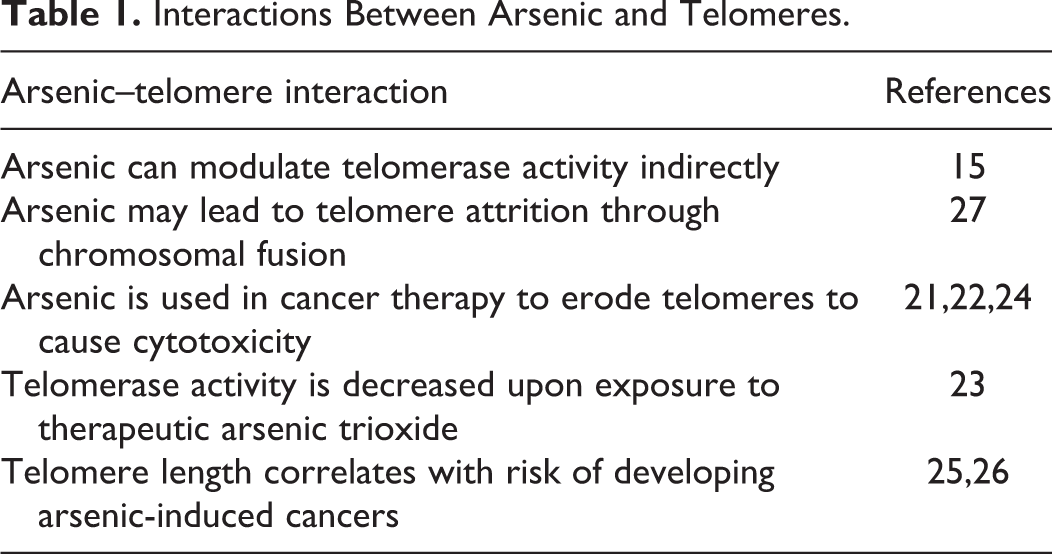
Although the above-discussed reserve capacity hypothesis 1 has potential relevance to any study that looks at tissue damage or carcinogenesis in long-telomere models, it is particularly relevant to arsenic. Several interactions between arsenic and telomeres are summarized in Table 1. First, arsenic has been observed to directly damage, erode, and destabilize telomeres via oxidative stress and direct binding 15,21,22,27 and to inhibit the activity of telomerase, the enzyme that elongates telomeres. 23 Indeed, there is research that specifically looks at tumors with short telomeres being particularly sensitive to arsenic-related therapies. 22,24 Second, there is some early evidence in humans pointing to the variation in telomere length between different individuals affecting risk of arsenic-induced cancers, with shorter telomeres sometimes being linked to higher risk. 25,26
Interactions Between Arsenic and Telomeres.
Arsenic is one of the few substances that is studied both as a cytotoxic therapeutic (in cancer treatment) and as an environmental carcinogen affecting enormous populations, meaning it has ample potential to be affected by the proposed factors related to telomere length: repairing damage from toxicity and causing or preventing the formation of tumors. The value of rodent models based on strains that are newer and closer to wild type, specifically with natural telomere length, remains to be investigated.
Hypothesis
If common arsenical-related testing is repeated on newer mouse strains that are closer to wild type and which have natural-length telomeres, tumor results which more closely model known effects on humans at physiological doses will be observed, and new data on drug toxicity in mice will be discovered, from which we can more accurately predict the toxicity of drugs in humans. Mouse models can be developed that are more analogous to humans.
Acute Toxicity of Arsenicals
In chemotherapy involving arsenicals, toxicity is a limitation to efficacy, as the therapeutic window can lie beyond the limit of toxicity for humans. 28 To combat this unacceptable toxicity, one strategy, which is not unique to arsenical therapies, is to combine 2 drugs hoped to act in synergy at lower doses to achieve the same benefit with less toxicity. 29 -32
One example of this adjuvant/combination strategy is the pairing of arsenic trioxide and carnosic acid. The combination of the 2 drugs, and each drug separately, has been tested on long-telomere mice, derived from BALB mice bred in captivity since at least 1913. These mice, genetically immunosuppressed to prevent immune rejection, were first inoculated with human leukemia cells, successfully creating mice with a 100% leukemia rate. They were then exposed to either drug or a combination of both drugs. The cocktail resulted in longer survival of mice and greater detected cellular apoptosis than observed with either drug alone. This led the authors to conclude that “the two drugs in combination have strong synergistic effects in anticancer activity”(p262) and that the combination may have potential “due to its anticipated safety and great potency.” 30 (p923)
On its face, this work in a mouse model seems to support the safe and efficacious use of the drug cocktail in humans. Combining the drugs allowed mice with leukemia to survive longer, which addresses both anticancer power and safety. However, this result is also consistent with the drugs simply being more toxic in combination. If the hypothesis that abnormally long telomeres give mice much greater capacity to repair tissues is correct, this alone could explain why mice given more drugs survive longer. General toxicity that kills cancer cells and normal cells without preference is expected to be beneficial in mice that have no shortage of tissue repair ability. Until the tissue repair capacity is exhausted, increasing toxicity could continue to be helpful in keeping mice alive, as it could completely cancel the negative effects of any cancer. From research conducted in telomerase knockout mice, we expect that a typical laboratory mouse should have roughly 5 lifetimes of reserve cellular proliferation available for enormous tissue repair capability. 33 This was found by tracking mice that could not lengthen their telomeres, even during reproduction, over multiple generations until they exhausted their reserve capacity.
Carcinogenicity and Toxicity
This telomere-centered interpretation is consistent with strange findings in other mouse models. In exploring the effect of arsenic on the development of tumors in mice, Cui et al 34 chronically exposed mice to arsenic at 4 concentrations: 0, 1, 10, and 100 ppm. The mice used had been bred in captivity for laboratory purposes for over 80 years. After 18 months of exposure, the mice that received the highest dose of arsenic had the highest survival (100%), which was better even than the nonexposed control (63%). This study was looking for cancerous and precancerous lung outcomes in these mice and found that by some measures (adenocarcinoma and adenoma, but not hyperplasia or lesions), arsenic did have a positive effect. However, only mice that survived to 18 months were investigated, and without knowing the cause of death of the mice that died before 18 months, it is not clear what role arsenic had on cancer. A similar study was conducted by Tokar et al which exposed mice (long-telomere, old strain) to different concentrations of arsenic (0-24 ppm) for 2 years. Although this experiment was set up such that it had a higher likelihood of missing the beneficial effect of toxicity due to the narrower and overall lower concentration range, again, the mice that received the highest dose had the longest average survival time, the highest survival rate at 1 year, and either the highest (female) or second highest (male) survival rate at 2 years. 35 Groups measured were as small as 9 mice, suggesting larger studies may be beneficial to be more sure that effects observed are not due to chance.
This too is consistent with an excess reserve capacity. Although all concentrations used in the study were too high to be relevant in humans who are exposed to arsenic, the fact that mice that received the highest doses of arsenic outlived all others including the control mice may be explained by the fact that 100 ppm arsenic is expected to be extremely toxic; the general destruction of all cells, including cells that have acquired the mutations necessary for cancer, could be beneficial for longevity at least until the reserve capacity is depleted through extensive cell proliferation during tissue repair. If 18 months was not long enough to deplete this capacity, we would expect sublethal general toxicity to be a potent protection against death from cancer. Barring other insults such as pathogens and injury, cancers represent perhaps the most significant threat to mice that does not come from an external source. Thus, an anticancer effect is a powerful extender of life.
The fact that rodents do not experience cancer at lower doses that are more relevant to humans still needs to be addressed. The complex roles that telomeres play in cancer formation might be a major factor. Telomeres have 3 broad impacts on cancer that are quite direct.
First, telomeres serve as the aforementioned proliferation limiter. All else equal, a shorter telomere should have an anticancer effect. That is, when a cell acquires a protocancerous mutation that speeds up proliferation, that cell lineage maintaining that mutation is rapidly exhausted, limiting the potential of the precancerous cells to gain a second mutation necessary for immortality and thus cancer.
Second, telomeres serve as chromosomal stabilizers, which have an anticancer influence when they are above a minimum length. Telomeres that are too short have been demonstrated to allow the procancerous fusion of chromosomes at the ends that the telomeres are supposed to protect. 36,37 This is a paradoxical influence: Too long telomeres allow higher probability of acquiring cancerous mutations and too short make chromosomal fusion more likely. Both consequences are procancer. Too long can be caused, among other things, by selective pressures and too short can be caused, among other things, by local or systemic damage that necessitates rapid tissue repair and replenishment.
Third, telomeres need to be (re-)lengthened for a cell lineage to become cancerous. For cancer, generally 2 conditions must be met: a mutation or condition that allows for rapid growth and proliferation and a mutation or condition that allows the cell lineage to escape its senescence at the Hayflick limit, the maximum number of replications that are supposed to be possible. Thus, for the vast majority of cancers, a mutation that activates telomerase, the enzyme that lengthens telomeres, is necessary. 38
The complex and variable roles of telomeres in cancer do not make interpreting the different carcinogenicity results in humans and mouse models a simple task. One potential explanation is that the cancer formation at lower doses relies on toxicity indirectly. If human tissues get damaged, necessitating repair and thereby the shortening of telomeres, but mouse tissues under the same circumstances still retain an abundance of telomere length, we might expect humans to be more susceptible to some carcinogens at lower doses, especially if chromosomal fusion is a potential mechanism of inducing the cancer.
Thus, any research that looks at the survival of laboratory mice and uses substances that are significantly toxic needs to pay close attention to the expected capacity to repair tissues and other telomere-related issues, which are strongly disanalogous to humans.
Arsenic trioxide is currently under investigation as a drug for treating a plethora of other cancers, including breast, liver, lung, bladder, colorectal, liver, and cervical cancers. 12 Combination therapies as discussed above are indeed a promising avenue of research, 39 but we must conduct this research in models that are analogous to humans. Controls must be in place to rule out the explanation for apparent efficacy and safety that arise merely from increased general toxicity in mice. Otherwise, we risk moving these apparently safe and efficacious drugs into the clinic and finding more instances of “damage to the [human] heart and liver…even when the dose is lower than the therapeutic dose.” 30 (p259)
Disproving the Hypothesis
We currently use rodent models to investigate the procancer (chronic) properties of arsenicals as well as the anticancer (acute) properties. Both of these studies need to be conducted in 1 or preferably multiple mouse lines that have natural-length telomeres. Some such mouse lines that are available are described by Hemann and Greider. 4 Since this work was done over 20 years ago, the mouse lines must be rechecked for telomere length before experiments begin.
A simple repeat of past studies on the carcinogenicity of arsenicals 14 in the mouse lines should be conducted, using a wide range of doses low enough to be relevant to humans (0-1,000 ppb) and high enough to replicate past work that was able to cause cancers in mice (0-1,000 ppm). The arsenic should be administered via drinking water over the time courses used in the past, up to approximately 18 to 24 months, and even longer, as mice with shorter telomeres tend to have longer life spans than popular strains of long-telomere laboratory mice. 4 If the mice continue to require superhuman doses of arsenic to acquire cancer, and if they remain immune to or even benefit from the high toxicity of megadoses, then this part of the hypothesis is disproved, and telomere length is not a sufficient explanation for what is seen in research that attempts to cause cancers in mice with arsenic.
Next, toxicity-related experiments should be conducted in the context of drug therapies. Simple repeats of past mouse studies need to be conducted in which different drugs, alone and in combinations, are tested in mice with short telomeres. It would be especially helpful to create a genetically immunosupressed mouse line to mimic mice currently used cancer models (that can accept inoculation of human cancer cells). If we continue to see that larger doses of arsenicals 34 and combinations of drugs without lowering dose 30 increase the survival of these mice, then this part of the hypothesis is disproved, and telomere length is not a sufficient explanation for the reports of mice surviving longer when given seemingly more toxic doses.
Very little research since Hemann and Greider’s discovery in 2000 has been published regarding new mouse lines with natural-length telomeres, so it may be necessary to establish new strains. It is further unclear how old a strain must be before laboratory conditions lead to changes in telomeres. Harper reviews the problem of old, inbred laboratory strains of mice from an experimental gerontology perspective and suggests doing research on lineages of newly captured “wild-derived” mice, similar to the research done on North-Central Idaho “Id” mice and South Pacific Island of Majuro “Ma” mice. Harper further expresses doubt that the problems of old laboratory lineages can be solved with so-called wild-derived strains that have been in captivity for many generations, exposed to laboratory conditions, and inbreeding (such as MOLF/Ei and CAST/Ei). 40 Even these newer lineages have generally been in captivity for well over a decade and some have been shown to already have longer than wild-type telomeres as early as 20 years ago, such as the CAST/Ei strain. 4
Implication in Medicine
This research is relatively low cost but with an extremely valuable potential benefit. The work could largely be conducted parallel to studies currently underway, necessitating only the acquisition of an additional mouse strain.
The utility that medical research would get from a good model for arsenic cancers and anticancer treatment is obvious and supported by the many attempts at using relatively poor rodent models in the past. We may specifically avoid deeming an anticancer drug or drug combination safe simply because it allowed cancerous mice to live longer, as the mice in our new models would not have unnatural protection from toxicity. Further, we could better study the mechanisms of how arsenic exposure leads to cancer in humans and develop strategies to help the over 200 million people a year who are chronically exposed to unsafe levels. These strategies could include genetic screening into risk categories and prophylactic drugs which may alter arsenic uptake, sequestration, and elimination.
Limitations
The explanatory model presented here does not complete the story. Even if all of the propositions and components of the hypothesis described presently are determined to be correct, there are many issues in arsenic research which are not particularly connected with toxicity or cancer. We should expect, generally speaking, that the further research moves away from toxicity and cancer, the less important telomere length should be and the less different the response should be between long-telomere mice and humans. Fitting with the model, this appears to often be the case. Long-telomere mice exposed to levels of arsenic which are relevant to common human exposures (10-50 ppb) develop expression differences in extracellular matrix genes and a variety of proteins. 41 The same mice also develop connective tissue pathologies in the lungs upon low dose arsenic exposure. 42 Further, a host of blood vessel and liver vessel pathologies and remodeling have been linked to arsenic exposure at low doses in these mice. 43 -46 Wherever telomere length is not important, we should not necessarily expect normal-telomere mouse models to be more helpful than the present models.
Additionally, while the telomere-damaging character of arsenic is described above, there are also associations between arsenic exposure and lengthened telomeres. 47,48 It is possible that finding long telomeres in areas where arsenic is abundant in the drinking water can be explained by the arsenic acting as a selective pressure toward evolutionary lengthening of telomeres in the long run. It is more likely that these studies point to the complexity of the connection between dosage, timing, and other exposure factors and the complexity of the relationship between telomere-influencing factors, like the regulation of telomerase and inducers of DNA damage in general. Several explanations have been forwarded for the disparity between rodent and human outcomes upon arsenic exposure, including the differences in metabolism of arsenicals 49 and the differences in sequestration abilities. 50 There is great merit in these explanations, and they undoubtedly form a part of the eventual complete picture that will resolve differences between species, toward which the field rightly strives.
Conclusion
It is clear that translating rodent research to human expectations is far too complicated to be solved by simply getting telomere length right. But it is possible that a great stride forward can be made, at least in arsenic-related research, by starting with rodent models that have telomere lengths that are in the realm of natural, on the order of 10 kb, and which are thus more analogous to humans.
Footnotes
Acknowledgments
The author thanks Dr Mayukh Banerjee for critical review of the manuscript.
Author Contributions
Whitlock contributed to conception, analysis, and interpretation, drafted the manuscript, critically revised the manuscript, gave final approval, and agrees to be accountable for all aspects of work ensuring integrity and accuracy.
Declaration of Conflicting Interests
The author(s) declared no potential conflicts of interest with respect to the research, authorship, and/or publication of this article.
Funding
The author(s) disclosed receipt of the following financial support for the research, authorship, and/or publication of this article: Overhead support was provided by the University of Alberta Health Accelerator.
