




Abstract
Toxicology is and will be heavily influenced by advances in many scientific disciplines. For toxicologic pathology, particularly relevant are the increasing array of molecular methods providing deeper insights into toxicity pathways, in vivo imaging techniques visualizing toxicodynamics and more powerful computers anticipated to allow (partly) automated morphological diagnoses. It appears unlikely that, in a foreseeable future, animal studies can be replaced by in silico and in vitro studies or longer term in vivo studies by investigations of biomarkers including toxicogenomics of shorter term studies, though the importance of such approaches will continue to increase. In addition to changes based on scientific progress, the work of toxicopathologists is and will be affected by social and financial factors, among them stagnating budgets, globalization, and outsourcing. The number of toxicopathologists in North America, Europe, and the Far East is not expected to grow. Many toxicopathologists will likely spend less time at the microscope but will be more heavily involved in early research activities, imaging, and as generalists with a broad biological understanding in evaluation and management of toxicity. Toxicologic pathology will remain important and is indispensable for validation of new methods, quality assurance of established methods, and for areas without good alternative methods.
Keywords
Introduction
In the three regional toxicopathology journals with over 4,000 scientific articles, the keyword “future” is used in more than 1,150 articles and the keyword “new trends” in close to 900 articles, while the term “21st century” is mentioned still relatively rarely in around 30 articles. In 2003, Bernhard A. Schwetz wrote an article entitled “Toxicologic pathology: looking ahead” (Schwetz 2003). He correctly foresaw that the pace of technologic change will accelerate and that new challenges will appear, including new pathogens.
Curiosity and wanting to be prepared are important reasons why people are interested in predictions, even though predictions often turn out to be wrong. The journal Scientific American (Pogue 2012) recently published a list of bad predictions, which included the following statement of Thomas Watson, Chairman of IBM in 1943: “I think there is a world market for maybe five computers.” Similarly wrong were predictions regarding xenotransplantation using organs of transgenic pigs in the 1990s (Bach et al. 1996; Ferran et al. 1997) or concerning the future need for toxicopathologists: in Switzerland, around 20 years ago, a special program was initiated by the Basel pharmaceutical and chemical industry in collaboration with a Swiss veterinary faculty to train veterinarians in toxicologic pathology. However, the anticipated demand for toxicopathologists did not materialize. In 2007, the American College of Veterinary Pathologists, the Society of Toxicologic Pathology (STP), and the American Society for Veterinary Clinical Pathology undertook a survey regarding employment and future needs of veterinary pathologists (Owens, Marzano, and Yang 2008): the prediction for the period 2010 to 2013 was approximately 160 open positions for anatomic pathologists. By looking at the current job market and talking to colleagues, no shortage of toxicopathologists is evident. Various reasons have contributed to this development: the global financial crisis has partly dramatically lowered the fractions of government budgets dedicated to scientific projects and slowed industrial growth. The continuing, if not accelerating, consolidation of the pharma and chemical industry is accompanied by closure of various research and development (R&D) sites with stagnating or decreasing R&D spending. Big pharma companies are hesitating to invest heavily in small biotechnology companies, which affects the business of preclinical contract research organizations (CROs). Furthermore, technical advances including better pathology software and tight management with performance measurements have increased the productivity of toxicopathologists.
Many more examples for unpredictability of the future development could be added. And what about the prediction that genomics/proteomics/metabolomics and the like (in the following called omics) will make at least longer term in vivo studies redundant or that alternative in silico and in vitro methods will replace animal testing altogether?
This article tries to examine how pathology in the framework of toxicology might develop over the next two to three decades by first briefly looking into the past development, then providing an overview over the current status before finally trying to anticipate major future developments of toxicology in general and toxicologic pathology in particular. Many aspects would deserve a more detailed discussion which, however, is not possible in this article.
Prediction Methods
The past was, the present is, and most likely also the future will be shaped by various factors, namely: Scientific knowledge including know-how (application of knowledge), technology, or available experimental methodologies Perceived threats including exposure to chemicals, pandemics, or climate and other environmental changes Social environment including acceptance of animal experimentation, credibility of experts or legislation, and regulations Economy including performance of global markets, pricing of products, and profitability of the chemical and pharmaceutical industry or government budgets for research activities Extrapolation of recent advances assuming an evolutionary development Assumption of revolutionary breakthroughs leading to a quantum leap or a change of development direction Looking at developments in other more advanced areas such as human medicine Analyzing existing gaps and trying to anticipate future needs
Various approaches can be used to predict the future:
Insight into the future of toxicology and toxicologic pathology can also be gained by
Examples illustrating the approaches mentioned will be provided in the chapters dealing specifically with future developments. Speculations without logical basis are avoided.
What can be learnt from the past and the present that facilitates prediction of the future?
The Past
Knowledge of toxicity has a long history. Toxins were used as medicine (e.g., arsenic to treat venereal diseases) or to kill, be it for hunting animals (especially curare), killing human individuals (e.g., connin to poison Socrates), or in warfare (poisonous gas during the 20th-century world wars). Postmortem examination was probably first used in religious acts, nota bene to predict the future, but later practiced out of scientific curiosity. The use of microscopes as of the 17th century marked a significant progress for understanding the structure of cells, tissues, and organs. Histopathology was probably first practiced by medical doctors, but as of the 18th and certainly the early 19th century it was also adopted by veterinarians, biologists, and other scientists. While initially histopathological knowledge was gained only by practicing, with time education in pathology became more professional and part of an academic curriculum.
In the 18th century, the pace of scientific progress accelerated in connection with the industrial revolution, in particular through advances in chemistry and analytical methods. As the world became wealthier, increasingly “artificial,” and more intensively exploited, concerns of relevance to toxicologists and toxicopathologists increased, especially with regard to exposure of humans and the environment to potentially noxious factors.
Probably, the two most famous postulates in toxicology have remained valid, namely “The dose alone makes a thing poisonous” by Paracelsus (1490–1541), a principle often forgotten and leading to adverse drug reactions (ADRs) in patients, as discussed later. Animal experiments are “entirely conclusive for the toxicology and hygiene of man” by Claude Bernard (1813–1878). This postulate is very much contested by some groups, but still valid with some restrictions addressed later in this article. Deaths caused in 1937 by a cough preparation containing sulfanilamide in diethylene glycol, which promoted the formation of the Food and Drug Administration of the United States of America (U.S. FDA) and the establishment of laws for safety testing of drugs on animals. Malformations in children born from mothers on the hypnotic thalidomide in the 1960s, leading to regulations about safety testing of new compounds in pregnant animals.
Unfortunately, a number of toxicological tragedies contributed to the rapid advancement of toxicology and associated sciences in the 20th century, such as the following ones:
Such events were the beginning of modern regulations in toxicology. To create discussion forum including regulators, toxicologists started to organize themselves in scientific societies in North America in 1961, in Europe in 1962, and in Japan in 1975. Pathology has been an essential element since the very beginning of modern experimental toxicology and relatively quickly emerged as a separate entity under the name of toxicologic pathology. Dedicated societies were founded in North America in 1971; in Japan in 1984; in Europe as of 1985; and in Korea, India, and South America after 2000. Global organizations were created, namely in 1989 as the International Federation of Societies of Toxicologic Pathologists and in 1999 as the International Academy of Toxicologic Pathology.
Initially, toxicopathologists came from various scientific disciplines. Particularly in Europe, a number of toxicopathologists originally majored in biology and others fields. Some gained worldwide reputation as toxicopathologists. This diversity decreased over the past 20 years, and younger toxicopathologists were recruited primarily from veterinary schools and some from medical schools.
The Present
The (North American) STP defines toxicologic pathology as follows:
Toxicologic pathology is a medical discipline that applies the professional practice of pathology—the study of diseases—to toxicology—the study of the effects of chemicals and other agents on humans, animals, and the environment. Toxicologic pathology professionals work in academic institutions, government, the pharmaceutical and chemical industry, contract research organizations or as consultants, and utilize traditional clinical or anatomic pathology endpoints, as well as contemporary advances in molecular and cellular biology. They are dedicated to the integration of toxicologic pathology into hazard identification, risk assessment, and risk communication regarding human, animal, and environmental exposure to potentially toxic substances. (STP n.d.)
The focus of human and veterinary pathology at large is on morphological alterations induced by diseases including infections, parasitic infestations, and age-related changes, where toxicity plays a minor role. Toxicopathologists investigate experimentally induced toxic alterations in various rodent and nonrodent animal species and need a broad knowledge in comparative physiology, anatomy, and pathology. They must be familiar with general pathology alterations, which may modify toxicity and which have to be distinguished from toxic effects. The role of toxicopathologists in industry has been well described recently (van Tongeren et al. 2011). Though the article’s focus is on the biopharmaceutical industry, many parts are applicable to the role of toxicopathologists in general.
This chapter will discuss four major aspects considered to best characterize the current status of toxicology and toxicologic pathology.
Scientific and Technological Environment
Toxicology and toxicologic pathology draw on many scientific disciplines and their future is therefore heavily influenced by the progress in these fields, especially by that of medical sciences at large. Overall, the understanding of the mechanisms of toxicodynamics has grown much at the molecular, cellular, tissue, and organ levels.
Changes of the paradigms governing the discovery process of chemicals and particularly of drugs over the past 50 years had and have significant consequences for toxicology and toxicologic pathology. Until the 1960s drugs used to be discovered in a serendipitous way, while modern drug discovery follows a rational approach. Resistance to anticancer agents, antipsychotics, and other drugs provided insight into the astonishing capability of biological systems to circumvent single pathway blocks (Burns 2001; Preskorn 2001). The high efficacy of today’s new xenobiotics may lead to effects not seen earlier in toxicology and toxicologic pathology. An example is the capability of experimental molecules to liberate large quantities of cytokines, as it happened in the TeGenero case (Attarwala 2010). Another consequence is the need to screen large numbers of compounds in particular for the presence of defined pharmacological effects and/or the absence/reduced occurrence of class-specific toxicities (Astashkina, Mann, and Grainger 2012). Such paradigm changes resulted in novel screening methods including in silico methods (Johnson and Rodgers 2006; Ryan, Stevens, and Thomas 2008; Merlot 2010; Gleeson et al. 2012) and in vitro and other methods (Gribaldo 2007; Xu, Dunn, and Smith 2009; Astashkina, Mann, and Grainger 2012). They need minimal amounts of compounds, are relatively inexpensive to perform, and allow a rapid read-out. The paradigm changes also require that toxicity investigations start early in the research phase (Kramer, Sagartz, and Morris 2007). The value added by toxicopathologists in discovery teams has been recognized (van Tongeren et al. 2011), as anatomic and clinical pathology methods and know-how are needed for the following: Evaluation of the therapeutic target by providing morphological data from in vivo studies validating data obtained from in vitro cell-based assays Differentiation between and evaluation of on-target and off-target effects including assessment of adverse animal findings in relation to exaggerated pharmacological effects Selection of the relevant species for preclinical studies, which should be sensitive to the intended pharmacological effect of the test substance, a key requirement for biopharmaceuticals. This may involve the use of genetically modified animals Identification and validation of biomarkers regarding safety and efficacy (see also below)
Scientific advances both require and facilitate the emergence of new and/or more sophisticated methods. The array of methods available to investigate toxicity has exploded over the past decades and includes now electrophysiological tools, telemetry, plethysmography, ultrasonography with special applications, for example, for measuring blood flow, transmission and scanning electron microscopy, X-ray investigation also allowing microanalyses, autoradiography, scintigraphy, morphometry, flow cytometry, microscopy including laser scanning and dissection microscopy, immunohistochemistry, in situ hybridization, tissue arrays, various immunology methods, large panel of clinical chemistry investigations, hormone measurements, and polymerase chain reaction methods, among others.
Imaging is one technology area where over the past 30 to 40 years spectacular progress can be observed (Ying and Monticello 2006). Imaging partly competes with classical human anatomic pathology, especially with autopsies (Roberts et al. 2012). Imaging is not destructive and can therefore be used in vivo. Repeated investigations allow dynamic pictures of diseases or toxic processes. Imaging is robust and reproducible and is based on a large array of methods, such as ultrasound including echocardiography, radiography, computer tomography (CT), and methods of nuclear medicine including scintigraphy with radiolabeled microdosed drugs and thermography. Specific atoms and molecules, but also organ structures, can be visualized by nuclear magnetic resonance techniques (Xie et al. 2012), positron emission tomography, and single-photon-emission CT, among other methods (Pysz, Gambhir, and Willmann 2010). Increasingly, images of the same subject obtained with different imaging techniques are correlated, for example, photo-acoustic imaging using optical and ultrasound imaging. Further methods such as electroencephalography, electrocardiography (ECG), and magneto-encephalography have an imaging component and provide insight into the function of various organs. Visualization of omics data is crucial for their interpretation. Pathologists can take a leading role for applying imaging for the investigation of toxicity.
The use of biomarkers, measured with different methods, is well established in toxicology and toxicologic pathology. Examples include
In life observations such as safety pharmacology parameters, clinical chemistry parameters, or increasingly used imaging methods (Ying and Monticello 2006; Xie et al. 2012) Macroscopic and organ weight data (Cohen 2010) Histopathological findings such as aberrant colon crypts, peroxisome proliferation, chronic irritation, or basophilic liver foci (Ettlin et al. 2010a, 2010b) Molecular investigations including immunohistochemistry, in situ hybridization, or flow cytometry (Ettlin et al. 1991; Gillett and Chan 1999)
In vivo and in vitro genotoxicity testing (Mahadevan et al. 2011)
Biomarkers have many advantages and may be used as surrogate markers for the ultimate effect of interest (Collings and Vaidya 2008). They need to be validated for their relevance and reliability for early detection of toxic effects. Histology is the most often applied validation reference standard and the U.S. FDA has drafted a guidance document for industry for the use of histology in biomarker qualification studies (U.S. FDA 2011). A recent example for biomarker development substantially supported by histopathological data is provided by The Predictive Safety Testing Consortium (The Predictive Safety Testing Consortium 2010), investigating biomarkers to monitor kidney injury in experimental animals. Urinary kidney injury molecule-1 (Kim-1; Vaidya et al. 2010) and serum cystatin C (Ozer et al. 2010) were found to be more sensitive and specific than conventionally used serum creatinine, blood urea nitrogen, and other parameters for monitoring renal toxicity of various types.
Biomarkers contribute to selecting drug candidates with lower toxicity, to speeding up development, and generally to establishing a no observed (adverse) effect level (Ettlin et al. 2010a, 2010b). They help to differentiate between competitor drugs, to stratify patient populations into responders and nonresponders to a particular therapy, and to render clinical trials safer. Biomarkers may also allow distinguishing between exaggerated pharmacological and toxic effects and between different types of toxicity.
Investigation of omics parameters is in the trend and certainly leads to a better understanding of toxicologic phenomena (Gomase, Tagore, and Kale 2008; Uehara et al. 2010; Afshari, Hamadeh, and Bushel 2011). Some words of caution may be allowed. Gene regulation and expression is complex, commonly multiparametric, often not linear in response, and time-dependent, which renders interpretation difficult. Omics data do not eliminate the problem of species-specificity. Primary, secondary, and tertiary effects superimpose. Interpretation of changes in gene expression without organ toxicity is difficult. In the foreseeable future, omics investigations are at large not superior concerning speed, costs, or information obtained and currently they are of little regulatory relevance. However, omics data can provide an integral picture of gene expression and their immediate downstream consequences and thus support a holistic view of a toxic reaction.
In response to growing scientific knowledge and increasingly demanding and complex methodologies, specialization has become mandatory regarding various aspects:
Toxicological specialties: for example, safety pharmacology, general/genetic/reproductive toxicology, and pyrogenicity testing. These specialties can be further subdivided according to their application: for example, pharmaceutical industry, chemical industry, forensic purposes, environmental toxicology, and occupational health and safety
Products: for example, conventional drugs, gene therapy, cell and organ therapy, small molecules, biotechnology products, and products involving nanotechnology
Methods: for example, in vivo including behavior, in vitro, in silico, molecular toxicology, analytics, clinical pathology, and anatomic pathology Toxicity in various organs: for example, central nervous system (CNS), liver, kidney, eyes, and skin including phototoxicity, or systems, for example, the respiratory, cardiovascular, or endocrine system and immunity/allergy
Support: for example, good laboratory practice (GLP) and specialized information technology (IT)
Probably in connection with this specialization trend, collaboration in R&D, regulatory, and partly academic teams has become a must and includes: project teams and working groups; collaboration in the area of (continuous) education on toxicologic and pathologic topics across institutions; collaboration between regulators, academia, and industry; exchange on good practices for chemical and drug development across companies. Today’s toxicologists and toxicopathologists have to be good team players, able to interact with many individuals and groups involved in chemical and drug R&D (van Tongeren et al. 2011). Essentially, global agreement was reached concerning harmonized nomenclatures for various toxicology areas (Mann et al. 2012; Vahle et al. 2009). Historical databases for animal data were set up across companies and continents (Deschl et al. 2002; Keenan 2002). This list could be continued.
Specialization means better understanding of and often more professional contribution to a relatively small scientific area. On the other hand, growing specialization may lead to neglecting the interplay of the various components of an organism and their regulation. Systems biology approaches are therefore becoming popular (see below). Growing specialization has increased the demand for generalists, who oversee larger scientific areas and are capable of integrating and interpreting results obtained in specialized fields. Toxicopathologists, based on their training in and experience with living organisms, are well positioned to play an important role as generalists in addition to their specialization in toxicologic pathology.
Scientific achievements in many areas and technologies as well as method-related advancement had a profound effect on toxicology and toxicologic pathology. New tools were needed to investigate large numbers of compounds early in the research phase or for screening of chemicals in the environment as addressed later. Large arrays of methods allow investigating many complex biological phenomena. Of particular value are biomarkers. Toxicopathologists increasingly contribute to the interpretation of omics data. Clinical imaging technologies are not yet used as much as in human medicine. The value of a holistic view is again appreciated in the scientific community.
The above developments will also influence the use of animal models, a topic discussed in the following subchapter.
Debate Regarding the Use of Animals in Toxicology
In 2008, 12 million animals were used in the European Union, among them approximately 7 million mice, 2 million rats, 31,000 carnivores, and 10,000 nonhuman primates (NHP, EC 2010). Of which, 38% were for fundamental biology studies, 23% for R&D activities without toxicology, 15% for production and quality control related to human and veterinary medicine, and only 9% for toxicological and other safety investigations. Overall, the number of experimental animals
1
has declined (Kulpa-Eddy, Snyder, and Stokes 2008), as refined or alternative methods are increasingly used (Gribaldo 2007; Kandarova and Letasiova 2011): Refinement of in vivo acute testing (e.g., limit dose testing) Replacement of certain reproductive and developmental tests by various in vitro or ex vivo tests Replacement of eye corrosion and irritation testing by ex vivo and in vitro testing Replacement of in vivo dermal absorption tests, endocrine screens, phototoxicity, pyrogenicity, and certain vaccine tests by in vitro testing
The Reduce-Refine-Replace (3R) movement, started in 1959 by Russell and Burch, is now well established and supported by various organizations, for example, by the European Center for the Validation of Alternative Methods ECVAM (ECVAM n.d.) and by the U.S. Interagency Coordinating Committee on the Validation of Alternative Methods ICCVAM together with the NTP Interagency Center for the Evaluation of Alternative Toxicological Methods NICEATM (NICEATM/ICCVAM n.d.). The 3R movement received support from legislators, for example, in the form of the European Union (EU) regulations on the safety of cosmetics including ingredients (EC 1976). These regulations forbid testing of cosmetics in animals and exclude cosmetics from the market if tested on animals despite the regulations. The transition period ends at the latest on March 11, 2013, irrespective of the availability of alternatives. More recently, the European Parliament passed the Directive 2010/63/EU underlining the necessity to apply the 3R approach in animal experimentation (European Parliament 2010; Hartung 2010).
Toxicologists and toxicopathologists can contribute significantly to 3R by their involvement in novel methods needing less or no animals and by critically reviewing research and development plans also regarding optimal and responsible use of test animals (van Tongeren et al. 2011).
Animal species currently used in regulatory toxicology are Rodents: rats, mice and transgenic mice Nonrodents: primarily dogs and rabbits (for reproductive and developmental testing), as alternative minipigs and nonhuman primates (NHP), occasionally guinea pigs (for immunotoxicity testing) Physiology of hormonal regulation, puberty, gastric emptying, or behavior (nocturnal activity, coprophagy, or cannibalism of rodents) Expression of receptors and other epitopes (especially relevant for biopharmaceuticals) Metabolism (cytochrome P450 isoenzyme pattern) Anatomy including unique organs (forestomach and various glands of rats) or absence of organs (gall bladder in rats) Pathology including type and extent of age-related alterations (very pronounced in rodents) or high spontaneous incidence of tumors with relatively benign behavior Sensitivity to certain pharmacological actions (dogs: high sensitivity to nonsteroidal anti-inflammatory drugs or positive inotropic drugs)
One should not forget that the phylogenetic developments of humans and test animals separated tens of millions of years ago—an important reason for asking if animal data can be predictive for humans. There are many similarities, but also a number of differences between test animals and humans (Derelanko and Hollinger 2002; Gad 2007). Examples are differences regarding:
For some more details see Ettlin et al. (2010a, 2010b).
One needs to see the similarities between test animals and human beings and simultaneously understand the differences to successfully assess the relevance of animal findings.
The use of rodents is relatively well accepted and criticism of carcinogenicity testing is directed primarily against the study design and less against the animal species used. However, the discussion regarding the best nonrodent species is ongoing and partly quite animated (Bailey and Taylor 2009). Depending on the data source, 5 to 10 times more NHP are used annually in the United States in comparison to Europe (Quigley 2007; SCHER 2009). The “mental” barrier as well as the hurdle for convincing approval bodies for toxicity studies appears to be somewhat higher in Europe.
NHP are often good predictors of adverse effects in humans due to close similarity of their enzyme system (Smith et al. 2001). They often have epitopes similar to those of man and are less prone for developing antibodies against biopharmaceuticals. Their small size reduces the requirement of test substance by a factor of 10 to 15, which can mean significant savings in cost and time during early stages of development. However, NHP are not always better models and can also fail to predict toxicity (for a review, see Bailey 2005).
Particularly in Europe, minipigs are considered a good alternative to dogs for well reflecting the human conditions with regard to the alimentary, urogenital, and immune system, sensory organs, skin, safety pharmacology parameters, drug metabolism, and stress-related diseases, among other aspects (Bode et al. 2010). They are relatively easy to handle, can be kept in dog facilities, and their larger size provides additional experimental freedom including larger blood samples.
This ongoing discussion regarding the best nonrodent species is an indication that a decision should be taken in a pragmatic way on a case-by-case basis, taking into account scientific arguments, practicability, and ethical aspects among other factors.
In 1999, the International Life Sciences Institute (ILSI) held a workshop with representatives from academia, multinational pharmaceutical companies, and regulatory agencies (Olson et al. 2000). The main aim of the workshop was to examine the strengths and weaknesses of animal studies for predicting human toxicity. For this purpose, a database was developed from a survey among 12 pharmaceutical companies, which covered 150 compounds with 221 events of human toxicity observed during clinical development. The results showed that human ADRs were correctly predicted in 71% of the cases based on rodent and/or nonrodent observations. Nonrodents alone were predictive for 63% of human toxicities and rodents alone for 43%. The highest incidence of overall concordance was seen for hematological, gastrointestinal, and cardiovascular human toxicities, and the least, not surprisingly, for cutaneous human toxicities including the frequent, though generally not severe, clinical skin rashes. The participants at the ILSI workshop concluded that these results support the value of in vivo toxicology studies. One needs to keep in mind that the actual concordance rate might be higher, as the drugs tested in humans were selected from a series of drug candidates, among others based on animal toxicity data.
Nevertheless, the question has to be asked whether the concordance rate mentioned in the ILSI study above is sufficient. Lazarou, Pomeranz, and Corey (1998) undertook a series of meta-analyses regarding ADRs in patients. The authors found that in 21 aggregated studies covering over 28,000 hospital admissions 4.7% of all patients were admitted due to serious ADRs. Among over 34,000 in-patients covered in 18 different studies, close to 11% experienced ADRs. Over 2% of 22,500 hospitalized patients (12 studies) had serious ADRs, and close to 0.2% of approximately 29,000 patients in 10 studies died in connection with ADRs. Though these findings might be perceived as alarming, one has to realize that particularly patients with fatal ARDs often suffered from severe or terminal illnesses. Many ADRs were foreseeable and would be preventable: 75 to 80% of ADRs are of type A and dose-related (Routledge et al. 2004; Flockhart et al. 2009). Polypharmacy is a significant risk factor for ADRs, the frequency of which increases exponentially with multiple medications (Flockhart et al. 2009), a fact actually known for decades (May, Stewart, and Cluff 1977). Especially at risk are elderly patients (Routledge et al. 2004).
However, sometimes the potential of drugs for causing ADRs goes undetected during preclinical and clinical development. Some types of ADRs are difficult to recognize in experimental animals such as the frequent, but commonly not severe, allergic skin reactions in humans. Of higher concern are the more serious ADRs, which may be detected only years after marketing of a new drug. This is partly related to the fact that many drugs are approved with data of an average of 1,500 patients (Flockhart et al. 2009). However, to detect rare toxicities, for example, bromfenac hepatotoxicity occurring in 1 of 20,000 treated patients, data of over 100,000 patients are needed to generate a signal (Friedman et al. 1999). This underlines the importance of well-functioning postmarketing surveillance systems.
It is now recognized in human medicine that “one size (drug type and dose) does not fit all.” This holds true in particular for oncology drugs: for example, anti-estrogenic treatment is only used if the breast tumors express estrogen receptors. Significant differences have been known for many years concerning the optimal therapeutic dose in relation to the risk of ADRs (Desoize and Robert 1994). Measurements of drug serum levels, PK modeling, and pharmacogenomics contribute to a more personalized medical treatment of patients and may thus help reduce the occurrence of clinical ARDs (McGinnity et al. 2007; Scott 2011; Horne et al. 2012). Preclinical safety assessment can add to these improvements based on insight obtained in animal models.
Overall, animal models have proven their value for protecting humans from toxicity and are currently not replaceable by the more artificial in vitro tests or even by in silico investigations. Human beings differ to a similar degree from each other as they differ from test animals with regard to tolerance of and reaction to drugs.
Regulatory Environment
Today, a plethora of national, regional, and global safety regulations cover the broad area of toxicology including Drugs such as small molecules, biologics, vaccines, or blood products Special therapies with organs, cells, genes, antisense molecules, or recombinant proteins Medical devices Radiation Nanoproducts for various applications Cosmetics Agrochemicals and pesticides Industrial chemicals, especially with regard to occupational health and safety and environmental safety Novel food and food additives Social “evils” such as tobacco
These guidelines and regulations were created to protect humans including children and women of childbearing potential, animals, flora, water, soil, or atmosphere. They regulate working procedures such as GLP, good manufacturing practice, and good clinical practice. The qualification of scientists involved in investigating and analyzing potential toxicological effects is currently regulated only to a small extent in most countries.
Every new development, such as the appearance of nanoproducts or gene-modified food or the occurrence of incidents, for example, the TeGenero case, leads to public discussion and political activism, resulting in additional regulatory requirements, improved methods, and often additional experimental work. Likewise, higher sensitivity of analytical methods may lead to additional toxicological evaluations or stop production of the chemical concerned. It is generally accepted that today’s regulation of potentially harmful substances, devices, or conditions has increased the safety of individuals and the environment.
Market failures such as the much publicized excesses in the banking business have strengthened the power of governments to regulate everyday life. Fortunately, in the toxicology area, science continues to date to play a major role, and regulators underline that guidelines are not laws and scientifically founded deviations are acceptable. Furthermore, international harmonization in various areas has progressed very well in the past two decades, which has facilitated global development of drugs and chemicals.
While scientific and technological progress occurs at an astonishing speed, changes in regulatory toxicology lag behind, in part related to the fact that full validation or at least wide acceptance of innovations is required. In addition, industry does not like to use new approaches that may generate results difficult to interpret but have to be reported to regulators nevertheless.
Globalized regulation of hazards is a positive fact and toxicologists and toxicopathologists are well advised to stay involved in the process of updating existing and creating new regulations, thus helping to assure that regulations are based on scientific grounds and reflect the state of the art.
Business Environment: The Pharmaceutical Industry as an Example
The profitability of chemical and pharmaceutical companies has changed considerably: in the 1960s, when money came in plentiful, especially pharmaceutical companies appeared not to have annual budgets or not to adhere to them. In recent years, cost-saving activities have become at least a biannual major exercise and regularly entail resizing of the workforce, including toxicologists and toxicopathologists. The cost for anatomopathological investigations of toxicity studies from planning to reporting and including troubleshooting activities is estimated to amount on average to around one-fourth to one-third of the total study costs. The cost is justified not only because of the regulatory requirements but also because the value added is generally crucial for the decision, if—based on preclinical safety data—a compound can be developed. Most biomarker findings including alterations of parameters of hematological and clinical chemistry investigations are only relevant if they correlate with anatomopathological findings. This also holds true for efficacy and non-GLP exploratory toxicity studies, for which no regulatory requirements for histopathology exist.
The academic education of a future toxicopathologist takes between 5 and 8 years and for gaining sufficient start-up practical experience another 4 to 6 years are necessary (Bolon et al. 2011). This means that the cost, both in time and in money, to educate a toxicopathologist constitutes a major barrier to offering cheaper toxicopathology services.
The easy therapeutic niches are filled, and finding as well as developing new drugs has become more expensive. Registration of me-too products is no longer attractive and good generics are available. Patent protection for a number of blockbuster products has expired or will soon expire. Governments and other major payers in the health sector increasingly exert pressure on pricing, though the public demand for better drugs is and will remain high. Among other observations, the following ones have somewhat adversely affected the public image of pharmaceutical and partly of chemical companies: luxurious R&D sites, high salaries especially of top management, marketing expenses exceeding R&D investments significantly, very high product prices particularly for oncology drugs, and unlawful practices resulting in large fines. In a recent case—an example for the changing perception of what is acceptable—a major pharmaceutical company was sentenced to a US$ 3 billion fine for off-label marketing, entertaining medical doctors, and failure to report safety data (Thomas and Schmidt 2012). On the other hand, the increasing age of the population, the increasing wealth of developing nations, scientific and technological progress, as well as the emergence of personalized medicine practices are promoting the business (Kumar 2011). The latter, though still not yet widely practiced (Fraenkel and Fried 2010; Laksman and Detsky 2011), is leading to a shift in the marketing paradigm, as blockbuster drugs are no longer the ultimate objective for business success.
Global companies with billions in sales generally have an expensive infrastructure and a complex organization with a multilayered and therefore slow decision process. Large expenses are not necessarily coupled with high productivity. Partly as consequence global companies tend to split up internally into business units with financial responsibility, but often keep central units such as for preclinical safety assessment. Large companies cannot compete cost–benefit-wise with smaller companies and their lower overhead costs and leaner structures, allowing faster decisions. Both large and small companies take advantage of global service providers often operating in low-cost countries. The extreme of this outsourcing trend is the emergence of virtual companies, which outsource all laboratory activities and the entire production.
Changes of the business environment affects and will continue to affect the profession of toxicologists and toxicopathologists and the way toxicology evolves.
Toxicology in the Coming Two to Three Decades
A fraction of some more comprehensive published prediction efforts are summarized below, followed by personal projections regarding the future advancement of toxicology in general with consequences for the practice of toxicologic pathology (this section) and predictions for toxicologic pathology in particular (following section).
Current major challenges are the early drug discovery phase, when thousands of compounds need to be screened for pharmco- and toxicodynamic effects (Astashkina, Mann, and Grainger 2012), as well as the screening of large numbers of chemicals in daily use and in the environment, which have never undergone proper toxicity testing at today’s standards. The projects summarized below focus on the latter challenges.
The Toxicology in the 21st Century (Tox21) project (Tox21 n.d.) is a major future-oriented effort sponsored by U.S. government agencies, namely the Chemical Genomics Center and the Center for Translational Therapeutics of the National Institute of Health (NIH), the National Toxicology Program (NTP) and the National Institute for Environmental Health Sciences, the National Center for Computational Toxicology, and the U.S. Environmental Protection Agency as well as the U.S. FDA. A similar approach is also described in a report of the U.S. National Academy of Sciences (NAS; U.S. NAS 2007). Traditional toxicity testing uses mainly laboratory animals, which means low-throughput, high-cost, and difficulties inherent to interspecies extrapolation, thus rendering traditional toxicity testing not well suited for evaluating large numbers of chemicals. The Tox21 collaborative program is aiming at a paradigm shift with moving toxicology from a predominantly observational science at the level of whole animal models to a predominantly predictive science based on target-specific, mechanism-based, biological observations. Tox21 takes advantage of the dramatic technological advances in cell biology, high-throughput screening, systems biology, and computer science, using in vitro biochemical- and cell-based assays and nonrodent animal models for toxicological testing.
The NTP listed the following points in connection with its vision for the 21st century (U.S. NTP 2004): Review existing study protocols and designs and change as needed Expand endpoints in in vivo studies to include functional genomics Develop a high-throughput capability for mechanistic targets Further evaluate and refine the use of nonhuman mammalian animal models Improve the use of toxicokinetic information Expand the use of imaging technologies Quantitative and automated high-throughput in vitro methods using human cells and cell lines to assess disturbances of pathways including omics measurements
In silico pharmacokinetic modeling for extrapolating in vitro results to the human situation based on human blood and tissue concentrations Impact and benefits of various types of regulatory activities Chemical screening and prioritization Risk assessment based on toxicity pathways Institutional transition associated with the new testing paradigm
These visions and programs lead to a number of follow-up publications (Andersen and Krewski 2009; Andersen et al. 2010; Krewski et al. 2010; Rhomberg 2010; Krewski et al. 2011) often focusing on combining in vitro assays with in silico extrapolations, especially:
The intra-agency Future of Toxicity Testing Workgroup looked into four main aspects of the future strategy to render toxicity testing of environmental chemicals more efficient and cost effective and to eliminate uncertainty factors (Firestone et al. 2010):
The European Commission (EC) is addressing similar challenges with the program of the European Chemicals Agency (ECHA) called REACH (Registration, Evaluation, Authorization and Restriction of Chemical substances; ECHA n.d.). The corresponding law entered into force on June 1, 2007. FRAME, the Fund for the Replacement of Animals in Medical Experiments, devoted to the REACH topic an article entitled “Toxicity testing: creating a revolution based on new technologies” (Bhogal et al. 2005). FRAME says that without a shift from checklist in vivo testing to inclusion of alternative methods using a case-by-case risk assessment strategy, the REACH program to assess tens of thousands of chemicals is unrealistic. Therefore, first the available information should be reviewed including the potential hazard of the chemical to humans and the environment (epidemiology, exposure, biomarkers). Then data from initial in silico screens (physicochemical properties, quantitative structure alerts, and further expert systems) and in vitro screens (cytotoxicity, high-throughput screens, omics, metabolism, possibly organ toxicity tests) should be analyzed, before considering additional tests, if necessary in a representative animal model.
Besides regulatory agencies and academia, the pharmaceutical and chemical industry takes interest in these alternative approaches avoiding animal experimentation, for example, with the formation of the In Vitro Testing Industrial Platform (Berg et al. 2011). At the 2009 meeting, this platform group concluded that physiologically relevant and metabolic competent models of both healthy and diseased people will be needed, that technologies and procedures have to be standardized, and that integrated testing strategies using various approaches will be necessary to implement the vision.
Alternative approaches applied successfully in environmental toxicology will undoubtedly also be used for testing of drugs and industrial chemicals in an effort to save animals, reduce costs, and gain time. Similar to their contribution to biomarker development, toxicopathologists are needed to explore and implement such changes. The increasing use of in vitro and in silico approaches will widen their traditional job spectrum, but simultaneously require that also established toxicopathologists gain the necessary knowhow.
As mentioned under “Prediction methods,” four approaches will be used in the following subchapters to predict the conceivable future of toxicology and toxicologic pathology, namely (1) extrapolation based on recent and current developments, (2) anticipation of breakthroughs, (3) advances in related fields, and (4) gap analysis and/or possible future needs. Some predictions could be discussed under more than one of the above headings. For example, the question of the necessity of animal studies is influenced by continuous improvement of existing methods and scientific insights, but could be heavily impacted by breakthroughs such as novel ways of pathway investigations, or advances in other related fields such as imaging. The issue of animal studies is also part of the gap analysis.
Extrapolation Assuming a Continuum
Predictions obtained by this approach are relatively easy and “safe,” as they result, among others, from the points mentioned under “The present” above.
Knowledge will continue to deepen regarding biology and perturbation of regulatory pathways of biological systems, thus increasing the understanding of toxicodynamics and the underlying mechanisms of toxicity. As said by the Tox21 program and others, this will move toxicology and toxicologic pathology from describing toxic effects to providing mechanistic explanations, which will be required increasingly by the regulatory agencies.
The pressure to share knowledge is likely to further increase. Unfortunately, sharing of preclinical data before approval of new drugs is still perceived as a competitive disadvantage, though finally all companies could benefit and redundant efforts would be prevented. Similar to practices for clinical trials (ClinicalTrials.gov; U.S. NIH n.d.), it is conceivable that companies will increasingly be asked by government agencies to publicly disclose results of toxicity studies at certain time points of development, such as start of phase II or phase III clinical studies. This could be implemented through toxicology data portals to which regulatory agencies and others have access.
Open access journals have become available, such as the (Japanese) Journal of Toxicologic Pathology, and scientific articles in journals with paid subscriptions are now often accessible free of charge after a certain time, for example, in this journal. E-publications not only avoid delays by printing and mailing but save costs for authors and users, an important aspect for smaller companies and individuals, and allow unlimited access around the world.
Investigative methods will continue to improve and new methods will appear with higher reliability, sensitivity, specificity, and predictivity. Better methods decrease the attrition rate of research substances during development, improve the understanding of mechanistic aspects of toxicity, and increase the safety of humans and the environment. In particular, in vitro systems (Blaauboer 2008; Astashkina, Mann, and Grainger 2012) and ex vivo molecular investigations including omics (Roy et al. 2011) will be perfected also related to target-specific and mechanistic aspects. More powerful bioinformatics systems will support the analysis of large data sets as stored in historical databases in an unprecedented way and thus increase the quality of expert systems for in silico risk assessments. Whether artificial intelligence of IT tools can ever match or even outpace the capabilities of human brains is not to be discussed in this article.
Improved study designs will generate more relevant data and save time, animals, and therefore costs. One option insufficiently explored so far is to combine pharmacokinetic and pharmacodynamic evaluations with safety pharmacology studies and classical toxicology testing in one study, especially during the research phase. Currently, these aspects are generally investigated in separate studies and frequently in different species by specialists with limited interest for collaboration, rendering correlation and integration of results difficult. Combined studies could have seamless (sequential) designs similar to seamless clinical studies (Bretz et al. 2006; Schmidli et al. 2006), which might allow further time and animal savings. However, for combining different study types, issues such as dose selection will have to be addressed, as was the case for combined chronic and carcinogenicity studies. For seamless study designs among others, the questions of interim evaluations and regulatory acceptability during later development phases need to be solved. A constant issue, also discussed in the gap analysis below, is the question, if in vivo testing for tumorigenicity can be better done in shorter term studies with inclusion of a set of biomarkers for proliferative activity (Cohen 2010 and others).
Specialization in small scientific areas will further increase to cope with growing knowledge and increasingly demanding and expensive methodologies. The trend to specialization is associated with a growing importance of a holistic view by multidisciplinary teams or generalists and supported by systems approaches. “Systems biology” has become a buzz word with dedicated journals (e.g., BMC Systems Biology n.d.) and specialized institutions and websites (e.g., ISB n.d.), though a holistic approach has been self-evident for medical professionals for a long time (Offit 2011).
Efforts to decrease ADRs in patients will continue at an accelerated pace supported by personalized medicine and the application of relevant biomarkers. The latter will provide a basis for a better understanding of individual differences including the so-called idiosyncratic ADRs (Kumar 2011). Preclinical data on the mechanisms of pharmaco- and toxicodynamics, the corresponding omics data, as well as other biomarkers will contribute significantly.
In addition to science-based trends mentioned above, further employment-relevant developments are expected to continue and partly gain importance as described below.
The power of public opinion will remain a fact of life also for scientists. Better education and increasing wealth render people around the world more critical and demanding. The failure of experts and governments to avoid catastrophic accidents in other areas such as nuclear plant accidents has compromised their prestige and credibility. Therefore, the public and opinion leaders are likely to intensify scrutinizing organizations, especially pharmaceutical companies which are excellent targets with their relatively high profitability. The public will remain alert to animal protection and environmental issues. In countries where this alertness is still at a relatively low level, the public will become more sensitive. For these reasons, the importance of continuous and open communication particularly with the public and nongovernmental organizations (NGOs) will further increase.
Government spending on research activities is expected to stagnate and academic research to depend increasingly on private funding also in Europe and the Far East, though private funding will no longer be plentiful.
Increasing pressure on prices will continue to affect the profitability of the chemical and pharmaceutical industry. The overall unsatisfactory productivity mainly of large companies will require actions beyond the Critical Path Initiative (U.S. FDA 2006). The imperative to save costs, to accelerate drug and chemical development, and to decrease the attrition rate during development, is favoring in silico and in vitro methods as well as higher automation and miniaturization of sample requirements. The unrest in companies will continue with frequent internal reorganizations involving changes of the management and so-called process optimizations. Mergers, acquisitions (often with disappearance of one company), and alliances will be frequent. Large companies might split into (small) research units and (large) development and marketing units. In the latter, the creation of independently funded divisions responsible for single therapeutic or other specified areas will continue. The number of small start-up and partly virtual companies will increase. Economically, it does not pay for smaller units and companies to employ a toxicopathologist, as relatively cheap outsourcing options will be available also in future. This drives toxicopathologists to seek employment in either the larger companies with central toxicology units, CROs, or consulting firms. In the midterm, the outsourcing trend in large companies might partly reverse, as communication across cultures can be complex, the quality provided may be partly not satisfactory and as increasing global involvement of emerging economies raises their local costs.
As a consequence of the above, the volatility of employment will stay high in North America and grow in the rest of the world, where the “hire and fire” practices are likely to take hold. The number of nolens volens “self-employed” professionals or professionals on temporary employment is expected to increase, but due to low birthrates this could be a transient phenomenon. As evident already at present, toxicologists and toxicopathologists must increasingly be willing to move to where their contribution is needed, including working in emerging economies on the southern hemisphere or in the Middle or Far East as teachers, coaches, peer reviewers, or department heads. This means ability to navigate effectively between cultures and requires an expansion of training from solely scientific areas to also culture awareness and foreign language skills. The globalization will increasingly influence the spirit and business habits in companies with local roots—to the better or to the worse, depending on many factors and on the viewpoint taken. Globalization and, where applicable, standardization will progress also regarding methods, experimental studies, work processes including GLP, as well as education and certification of scientists involved in generating safety data and in risk assessment. Regulatory agencies will be important partners and hopefully will remain flexible, thus allowing for case-by-case safety testing based on scientific considerations.
Anticipation of Breakthroughs or Other Radical Changes Resulting in a Discontinuous Development
New challenges arise from new types of therapy with cultured organs, tissues, and cells, as well as from therapies involving gene modifications, oligonucleotides, or antisense molecules, among others. Not only new chemicals but also new formulations are constantly developed to improve effectiveness of agents including drugs and agrochemicals, or to allow their application in new fields. One recent example is an intravenous foam suspension containing microparticles with a core of oxygen gas for intravenous delivery of oxygen in emergencies, when enough oxygen is not available through regular respiratory mechanisms (Kheir et al. 2012). Novel materials—nanomaterials are only one example—will be produced and require novel ways of toxicity testing (Hubbs et al. 2011). New forms of energy and the necessary resources will pose new safety challenges: the increasing exploitation of oil shale is an example and has created considerable environmental concern, at least in some countries. New challenges and threats may also arise also from gene-modified organisms or agents used by terrorists.
A core question is whether animal models will be replaced by in silico and in vitro systems mimicking biological networks. The human organism consists of some 40 organs and over 400 cell types (Liebsch et al. 2011). It does not appear very likely that such a complex system can be replaced entirely by a series of in vitro systems. Also the U.S. NAS states in its vision and strategy for the 21st century: “For the foreseeable future, some targeted testing in animals will need to continue, as it is not currently possible to sufficiently understand how chemicals are broken down in the body using tests in cells alone” (U.S. NAS 2007). The NTP vision for the 21st century specifically plans to evaluate and refine the use of nonhuman mammalian animal models (U.S. NTP 2004). However, the memorandum of understanding for the Tox21 strategy asks for increasing use of phylogenetically lower animal species such as worms and fish, if feasible. The relevance of such test systems needs to be validated.
No significant changes regarding the type of animal species used in toxicology are anticipated and rodents will remain important test animals, similar to dogs as nonrodent species. However, the importance of minipigs as alternative nonrodent species is expected to increase, particularly if smaller minipigs will become available. Minipigs can be a superior model for humans (Bode et al. 2010). There is currently no indication that ferrets, rabbits, or guinea pigs might become important alternative nonrodent species in general toxicology testing. NHP will not replace dogs or minipigs, but continue playing a role in early toxicity testing for rapid entry into man with small amounts of drugs. They remain important for verifying toxicities seen in dogs or minipigs and are occasionally the best nonrodent species, for example, for drugs acting on the female reproductive tract. The use of humanized animal models is not well explored so far, but may add value (see also subchapter 4 on identifying gaps below).
In vitro systems can be tailored on a case-by-case basis to serve as relevant models for precisely defined preclinical or human toxicities. However, the higher the throughput character of in vitro tests, generally the lower their human relevance. One also needs to keep in mind that alternative methods can take more than 20 years to be developed, validated, and implemented (Kandarova and Letasiova 2011).
Borrowing Insights from Related, but More Advanced Fields
Progress is particularly fast in human medicine, facilitated by wide attention and fueled by still considerable funding. Specialization in today’s medical practice is clearly more advanced than in toxicology or toxicologic pathology. An example: a specialist in internal medicine, formerly—besides surgery—the main discipline, acts today mainly as coordinator between various subspecialties such as cardiology, diabetology, or hepatology. Similarly, the general surgeon is being replaced by surgeons highly specialized on one organ. However, to some extent in contrast to toxicologic pathology, medical doctors are trained and required to evaluate clinical pathology data generally without support of a specialist trained in clinical pathology. The latter specialty exists but is restricted mainly to the management of larger clinical pathology laboratories and to the interpretation of complex and novel parameters of clinical pathology.
Most diagnoses in human medicine are based on modern imaging techniques, biomarkers, and on morphological investigations especially of biopsies. A large array of imaging technologies including endoscopic interventions both for diagnostic and for therapeutic reasons are used routinely in human medicine. Biomarkers for diseases are of paramount importance in human medicine and encompass—in comparison with those used in toxicology—more and frequently better validated parameters with prognostic value. A morphological diagnosis on biopsies may be the only means to diagnose (accurately) severe diseases. The involved anatomic pathologists tend to be highly specialized with in-depth knowledge of one particular organ or organ system. Excellent imaging methods have started to decrease the number of autopsies with exception of those in the medicolegal field (Roberts et al. 2012). Human pathologists profit from the fact that human beings are under medical control for often long time periods and undergo repeated investigations. They thus obtain better insights into the course of alterations, which allows them to continuously improve their anatomopathological diagnoses with regard to the prognosis of the alterations.
Clinical development of new drugs is changing considerably and involves very early proof-of-concept studies, microdosing, and seamless clinical study design (Stallard and Todd 2011; Friede et al. 2011). Preclinical toxicology has to be prepared to provide the necessary preclinical toxicity data earlier.
Identifying Gaps Which Need to Be Filled or Future Needs to Be Satisfied
The existence of gaps in the understanding of and the tools available for solving toxicologic issues is a strong driver for future advancements in toxicology.
An old discussion is the replacement of conventional long-term studies for non-genotoxic substances by subchronic studies supplemented with investigation of regulatory pathways such as endocrine regulation, immunologic status, cell kinetics, enzyme induction, or omics (Cohen 2010 and others). Progress regarding assessment and interpretation of the aforementioned supplementary parameters is encouraging. The recent concept paper “S1: Rodent Carcinogenicity Studies for Human Pharmaceuticals,” as endorsed by the Steering Committee of the International Committee on Harmonization (ICH) on April 24, 2012, paves the way. Specifically, the concept paper proposes to investigate whether alternative or additional testing strategies to the current approach could enhance the assessment of the carcinogenic risk of pharmaceuticals (ICH 2012). Based on historical data, it stipulates that approximately 40% of the rat 2-year lifetime studies were not necessary and their omission would not have compromised patient safety. These findings were supported by an analysis of 182 marketed and not marketed pharmaceuticals (Sistare et al. 2011): rat 2-year carcinogenicity studies do not add significant value, if the compound tested does not induce histopathological signs for proliferation in chronic toxicity studies and if there is no evidence for hormonal perturbation or genetic toxicity. The U.S. FDA agrees by saying that “With only a handful of exceptions, chronic studies appear capable of predicting effects at the end of two years with good accuracy” (Jacobson-Kram 2010). A transgenic mouse assay and 6-month rat study may soon be acceptable for most 2-year bioassays (Jacobson-Kram 2010; Storer et al. 2010).
A further deficiency of current test systems is the difficulty of predicting allergic ADRs in patients using animal models. This issue is particularly important for biopharmaceuticals (Bhogal 2010). Fortunately, most of these reactions in humans are relatively mild and limited to the skin, though causing unpleasant itching. In silico and in vitro methods especially for detecting potential phototoxicity are available, but unfortunately individual susceptibility of patients for rare severe phototoxic reactions is still difficult to predict.
The quest for higher relevance with respect to sensitivity and specificity as well as reproducibility of toxicity testing is another ongoing topic. Transgenic animals expressing human traits might be increasingly used not only in carcinogenicity studies but also in toxicity studies (Boverhof et al. 2011). Such human traits can be human receptors, human metabolism, or human diseases and susceptibility, thus rendering animal models more relevant for the human situation (Ito et al. 2012).
The large gaps for screening of large quantities of chemicals and drug candidates have already been mentioned above.
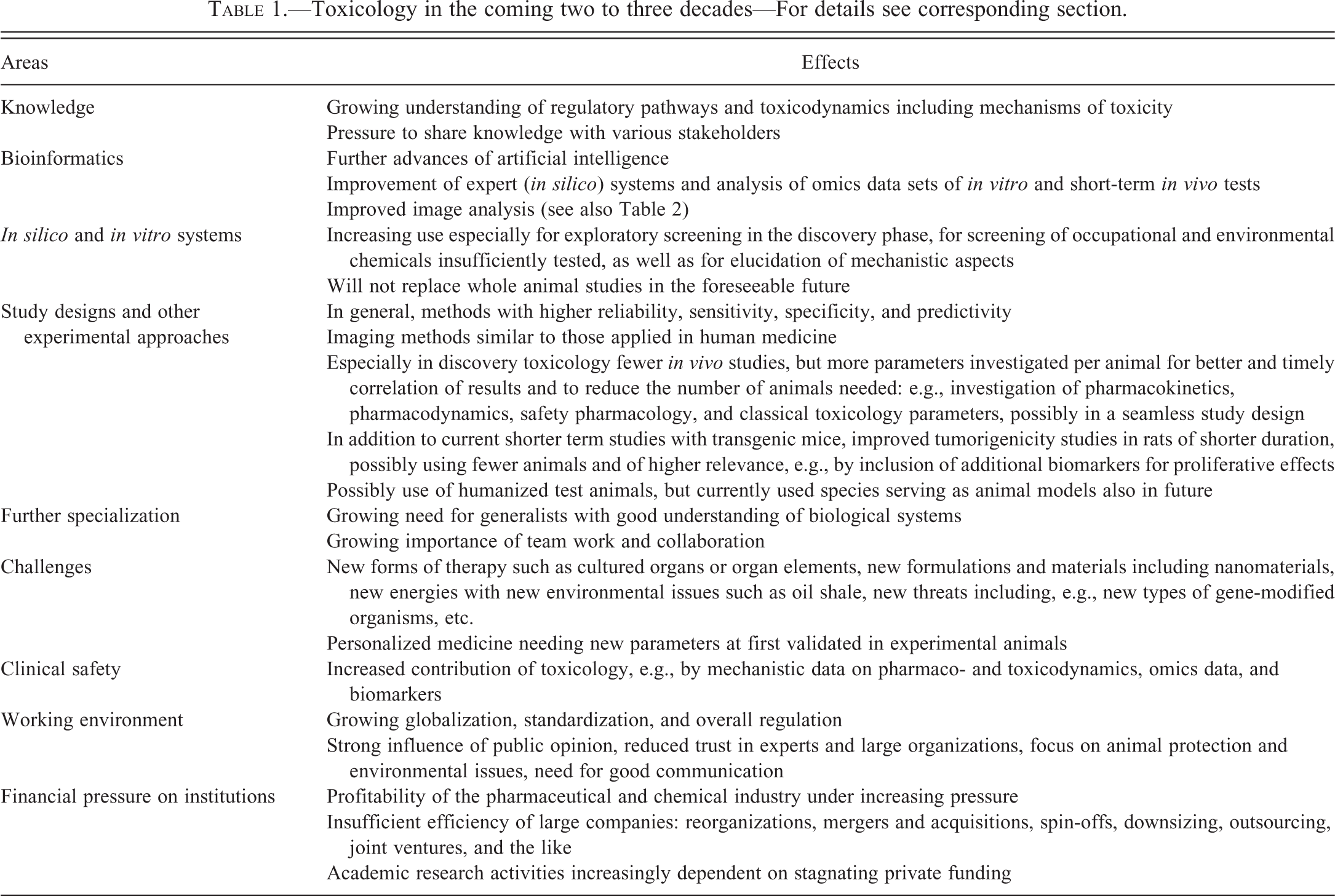
The main parameters mentioned in this section are summarized in Table 1.
Toxicology in the coming two to three decades—For details see corresponding section.
Toxicologic Pathology in the Coming Two to Three Decades
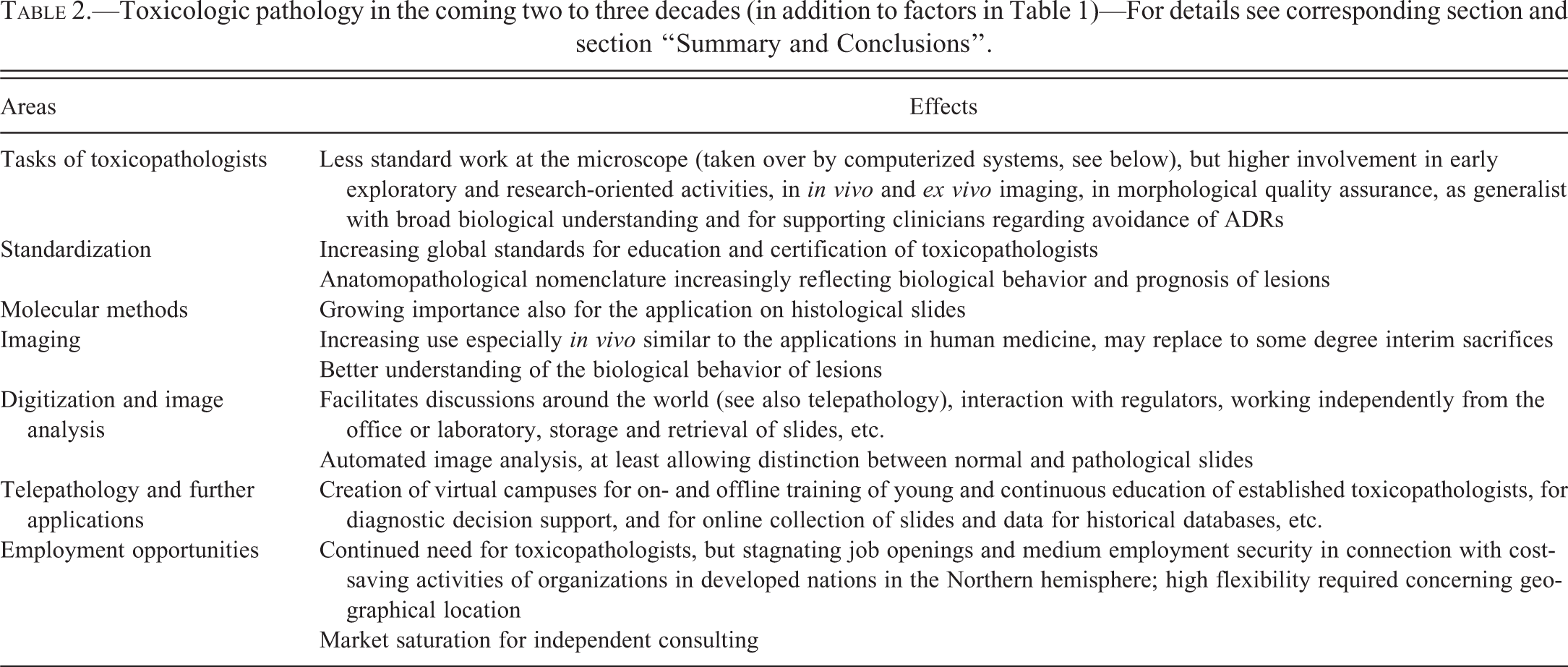
This section will first provide an overview over some changes anticipated specifically for toxicologic pathology without repeating prognoses addressed in the former chapter. Subsequently, three important areas are discussed in more detail, namely imaging, automated image analysis, and telepathology. For a summary please refer to Table 2, which also includes some important predictions of the final section “Summary and conclusions.”
Toxicologic pathology in the coming two to three decades (in addition to factors in Table 1)—For details see corresponding section and section “Summary and Conclusions”
Toxicologic pathology will remain a corner stone in preclinical safety assessment. Through their training and knowledge of biological regulation and pathways, toxicopathologists can understand disease processes and pathogenetic pathways. This is an excellent basis for recognizing potential modifying effects of human diseases and individual susceptibilities on toxicity, for assessing the consequences of animal findings for human beings and for developing better predictive animal models. The involvement of toxicopathologists in improving molecular diagnostic techniques and pharmacodynamic biomarkers as well as in elucidating mechanism of toxicity helps to define ideal patient populations likely to benefit from new therapies. This means that in the future veterinary pathologists will need a stronger understanding of pathways and the pathogenesis of diseases and toxicity including a broader basis in cell biology than provided by the current veterinary education.
Unfortunately, not all companies have recognized the importance of toxicopathologists for investigative studies and in translational teams, but continue considering toxicologic pathology more as a service component than an active key discipline for the analysis of issues, the design of follow-up studies, and final risk evaluation including extrapolation to humans. Therefore, toxicopathologists are encouraged to try being fully integrated into investigative groups and to serve also as principal investigators.
Currently, toxicologic pathology has two accepted subspecialties, namely anatomic pathology and clinical pathology. The increasing complexity of chemical and drug development has partly already led to further subspecialties, though not yet officially recognized, such as specialization in one particular organ/system, in one special pathology method including imaging, in discovery pathology, or as full-time project team members for preclinical safety. Further potential subspecialties particularly in large companies are quality assurance in pathology including peer review, expert for validation of biomarkers, and in vitro systems, or coordinator for outsourcing of pathology evaluations. The pros and the cons of this specialization trend are obvious. Since it is unlikely that this trend will be reversed, a further subspecialty will emerge, namely general toxicologic pathology as integrative discipline.
The contribution of toxicopathologists at early stages of research on new compounds (discovery toxicology and pathology, exploratory activities) will increase. In fact, exploratory discovery activities are becoming a major part of the tasks of toxicopathologists in some companies (van Tongeren et al. 2011). Standard regulatory toxicity and carcinogenicity studies are often contracted out to lower-cost CROs around the world. Therefore, many younger toxicopathologists working in industry are no longer as experienced in tumor diagnostics as the older generation involved in the evaluation of lifetime bioassays. However, these younger colleagues have a better understanding of novel methods including in silico methods for exploratory investigations of the pharmacology and (target-related) toxicology of new compounds (Astashkina, Mann, and Grainger 2012).
Various molecular pathology methods are applied already now in anatomic pathology, especially immunohistochemistry and in situ hybridization (Painter, Clayton, and Herbert 2010 and others). Many pathologists are involved in correlating omics data with pathological findings. Once enough historical data are available, omics data obtained from in vitro and short-term in vivo studies may well predict certain pathological alterations in longer-term in vivo studies. The contribution of molecular methods to pathology will undoubtedly continue to grow. If, with more powerful expert systems, omics data can replace longer-term toxicity studies with pathological investigations to a significant degree, remains speculative as discussed above.
Will a microscope become available with “light” of shorter wavelength for better resolution on quasi-routine slides by applying technologies and algorithms such as used in computer tomography to decrease superposition? This would fill the gap between conventional light microscopy and EM. However, to obtain better resolution, improved fixation is necessary. This might be less suited for routine applications, which is limiting the use of glycolmethacrylate sections. It is also important to remember that most diagnoses are made with low magnification, thus better resolution is generally not a key factor.
Standardization of education and certification of toxicopathologists is advancing (Ettlin et al. 2009; Bolon et al. 2011). A high degree of global agreement is available for working procedures in pathology and for the nomenclature of lesions (Vahle et al. 2009; Mann et al. 2012). However, toxicopathology diagnoses, in contrast to human anatomopathological diagnoses, still rely largely on morphology and often have not been validated sufficiently with regard to the biological behavior and prognosis of the lesions. For example, it has been known for a long time that certain lesions diagnosed on morphological criteria as tumors regress after termination of exposure to the offending agent (Lumb, Mitchell, and de la Iglesia 1985). Such cases were also described for drug candidates without hormonal activity (Schaffner et al. 2009; summarized by Ettlin et al. 2010b). Since by definition a tumor is characterized by an autonomous growth, it is not expected to regress and the tumor diagnosis is not appropriate in such cases.
Sophisticated e-environments are already at the disposition of most pathologists and include pathology software and laboratory information and management system (LIMS). It is difficult to envisage a breakthrough well beyond higher computational speed and better expert systems. However, computers are crucial for automated analyses of digitized images, as will be discussed below.
Imaging
Imaging both in vivo and ex vivo makes use of various technologies as described in the previous chapter with reference to their outstanding importance and performance in human medicine. The application of imaging methods in toxicology in general and toxicologic pathology in particular is still somewhat in its infancy in many institutions, as the required equipment is relatively expensive. Furthermore, the methodology is not so well established on small animals, but feasible (Johnson 2007; Xie et al. 2012). If imaging, biomarkers, and to a limited extent biopsies can partly replace autopsies and histopathological investigations, as it is the case in human medicine, and thus facilitate a seamless design of toxicity studies, remains to be seen. The big advantage of in vivo imaging is that sequential investigations are possible and functional and prognostic aspects can be addressed.
Automated Image Analysis
Digitization of pathological slides has become a standard procedure in many institutions for a number of years (McCullough et al. 2004), though the necessary powerful equipment is still quite expensive and the process somewhat slow. Attention must be paid to compliance with government regulations, especially with GLP regulations (Tuomari et al. 2007), which may require validation of digital pathology systems (Long et al. 2012). Digital slides can be examined on a computer monitor, where for comparison several slides can be displayed side by side. Digitized slides can be analyzed by IT algorithms and can be linked with other IT systems, such as a LIMS. IT algorithms can also be used to improve the quality of images including enhancement of the contrast of poorly stained slides or to highlight certain structures, but tampering with images has to be avoided (Graf et al. 2007). The topic was also discussed at the 2012 meeting of the (North American) STP (see also Maronpot 2011). Digitized slides are easy to archive and to retrieve whenever necessary. The pathologist can work from anywhere with a computer connected to the Internet and does not need to come to his professional office. Teleconferences on problematic or interesting slides are easy and may avoid unnecessary traveling (see also “Telepathology” below). However, the hope that the workload of toxicopathologists will lessen and working will become more relaxed, thus setting free time for more continuous education, is not well founded following the experiences with the introduction of so-called time-saving technologies such as fax, electronic data capturing, and Internet.
Advancements in automatic image analysis of digitized slides fuel the fear of professionals that in 10 to 20 years toxicopathologists will no longer be needed. Indeed, higher computational power and better algorithms coupled with automated learning capabilities deserving the term artificial intelligence will increasingly enable computers to automatically detect well-defined features and to distinguish between normal and pathological alterations. Numerous examples are already available, for example concerning detection of micronuclei (Decordier et al. 2011), evaluation of cytological preparations (Cortes-Mateos et al. 2009), diagnosis of skin lesions (Burbach and Zuberbier 2011), and analysis of X-rays and other medical images (Goldenberg and Peled 2011; Bagci et al. 2012). If and when computers will be capable of making a pathological diagnosis based on artificial intelligence is a different issue and appears more complex. However, the majority of anatomopathological diagnoses in a regulatory study are relatively simple and only a small fraction of diagnoses require significant toxicopathological experience. In the future, toxicopathologists might no longer have to spend much time on normal slides. Artificial intelligence might take over to some degree, but will not replace the pathologists, who will have to manage and supervise the system, a vision also endorsed by some human pathologists (Kayser et al. 2009). Toxicopathologists will remain essential for various important activities such as: Autopsies and macroscopic inspection of organs Quality assurance also of simple lesions possibly diagnosable by computers Examining and interpreting complex nonstandard pathological alterations as regularly encountered in routine regulatory studies Peer review, especially of studies contracted out Implementation and validation of new methods Research activities to further toxicologic pathology Exploratory activities
In vivo and ex vivo imaging Contributions to alternative methods Interpretation of toxicologic data and risk analysis Support for clinicians during clinical studies and scientific recommendations
In addition, as partly mentioned above, toxicopathologists will be more heavily involved in tasks such as
Thus, a shift is anticipated from predominantly routine activities to higher exploratory involvement and more research-oriented activities in addition to risk evaluation tasks.
Telepathology
Telepathology is a relatively novel method making use of digitized slides and Internet connection. In Switzerland, in 1992, the first telepathology connection became operational between the Institute of (human) Pathology at the University in Basel and the hospital in Samedan, some 250 km to the east (Demartines et al. 2000). The Samedan hospital did not have an in-house pathologist to examine snap-frozen sections of intraoperative specimens in order to support surgeons during interventions with regard to the malignancy of proliferations or the absence of tumor cells in the resection border. A technician was trained to prepare snap-frozen sections, which are mounted on a remote-controlled microscope and examined remotely by a pathologist at the University in Basel. Telepathology is now used globally and is invaluable, especially in underdeveloped countries or countries in development (Brauchli and Oberholzer 2005; Brauchli et al. 2005; Oberholzer et al. 2010). Telepathology systems are also used for other medical applications and therefore often are called telemedicine systems.
In comparison with e-mail, modern telepathology systems offer the following advantages: all data are stored on a server and accessible anytime and from anywhere by registered group members using a computer connected to the Internet. The necessary software is on the server, is therefore available without download, and can be maintained centrally. An example of telepathology software is Campus Medicus®, which is currently used for the MonTelNet project of the Swiss Surgical Team and the Swiss Agency for Development and Cooperation in Mongolia (Campus Medicus® n.d.). The three main functions of modern telepathology systems are diagnostic decision support with discussion options for difficult issues, teleteaching, and documentation. These applications are briefly explained in the following paragraphs.
If a member needs diagnostic decision support, he or she loads digitized slides, further documentation such as X-rays or clinical pathology data, and text including the questions onto the server. Automatically, all group members are informed about the new case. Without downloading, they access the documentation directly on the server and can contribute to the discussion anytime and from anywhere. All group members can follow the discussion simultaneously or at a time point of their choice. As alternative, the system allows tele- or videoconferencing via Internet without additional connection fees. This option is particularly useful, if studies are conducted at multiple sites (von Tongeren et al. 2011) or if a company has various toxicologic pathology departments and wants to consult with external experts.
Modern telepathology systems can be used for teleteaching and seminars. Webinar applications are comparable to teleteaching, but the latter systems may offer additional features. E-teaching allows independent locations of the speaker/teacher and seminar participants/students. The latter ones can see and hear the speaker/teacher and simultaneously see the actual slides. At the same time, they can open the script on the monitor or use a printout. The participants/students can type or orally ask questions anytime during the session, which the speaker/teacher sees or hears and can answer immediately or at an appropriate time. Slides, scripts, and videos can be stored on a virtual campus platform, where they are accessible for self-learning and repetition of a topic anytime from anywhere by members of a teaching/learning community.
Telepathology systems are useful for building databases by online collection of histological slides and further data. Furthermore, epidemiological studies data can be stored in individually designed forms. A group of investigators can participate in data collection from anywhere and anytime using a computer connected to the internet. Data can be exported from the remote server into tables of different formats (e.g., in .xls format) on the computer of a participating investigator and then can be processed locally with any software.
Summary and Conclusions
Humans, animals, and the environment at large are likely to be exposed to a growing number of potentially harmful agents, partly of new types. This fuels the demand of the public, NGOs, and governments for refined and better methods in toxicology and toxicologic pathology as well as for better understanding of toxic effects. Both toxicology and toxicologic pathology will continue to move to a more mechanism-based science with a good understanding of the underlying toxicodynamics.
An important conclusion discussed in this article is that animals will remain useful models for humans. The fact that animal experimentation does not predict all ADRs later observed in humans is less a problem of extrapolation from animals to humans than an issue of individual susceptibility of humans. Wrong drug use, especially overdosing and polypharmacy, contributes to the relatively high frequency of clinical ADRs.
The observation that in silico and in vitro testing is advancing is an enrichment in the toxicology toolbox and should not be perceived primarily as a threat. Animal testing provides a holistic assessment including ADME aspects and the interplay of numerous biochemical and functional pathways. The strengths of in silico and in vitro testing are their focus on well-defined single effects, rapid read-out, and low cost. Therefore, they are ideal tools to prove mechanistic hypotheses and for screening of large numbers of chemicals. Investigation of molecular phenomena related to gene regulation and expression as well as their downstream consequences for protein production, metabolism, and the like, will continue to support the 3R movement. Judged on the number of animals used in toxicology, the number of in vivo toxicity studies has stabilized in various parts of the world and might decrease in the future because of partial substitution by in silico and in vitro tests. However, despite considerable pressure by some NGOs, alternative methods cannot replace animal experimentation in a foreseeable future, though the necessity of certain study types and study designs has to be reviewed and further improved in a continuous manner.
Among the recent and anticipated future scientific and technical advancements, the following ones appear particularly relevant for toxicologic pathology:
In vivo and ex vivo imaging improving the understanding of the biological behavior and prognosis of lesions and possibly allowing better study designs Increasing array of molecular methods including those for use on histological sections, supporting the mechanistic understanding of toxicodynamics
Digitization of histological sections facilitating image analysis, teleworking, and telepathology applications Increasing computation power allowing automated image analysis, currently mainly limited to automated morphometry, but in future likely to support (partly) automated slide evaluation
In addition to the possible decrease of the number of in vivo toxicity studies by replacement with alternative methods, future study designs incorporating additional and better biomarkers are likely to ask for fewer animals. Therefore, in conjunction with (partly) automated slide evaluation, it is well possible that future toxicopathologists will spend less time with their traditional task on the microscope, though this task will remain important. Other scientific activities are expected to become more important, as explained earlier. Of unique value is the broad education and experience of toxicopathologists regarding in vivo biology, veterinary, or human medicine, which provides the basis for integrating data from different toxicology specialties and assessing their biological relevance. This requires willingness to face the difficulties for reaching conclusions, formulating recommendations, and accepting the associated responsibility. Toxicopathologists are also well positioned for communication with government agencies, NGOs, the public, and especially with the medical community to further improve clinical safety. Good communication skills should go hand-in-hand with high scientific standards and independent judgment.
While changes based on scientific progress are accepted by most colleagues involved in toxicology and toxicologic pathology, changes resulting from the social or financial environment affecting their institutions, their profession, and their jobs are often less welcome. One burning question regards the number of toxicopathologists needed and the working conditions available for the next 10 to 20 years. No crystal ball is needed to predict that the extremely good times of pharmaceutical and partly also chemical companies are over. Medical expenditures are soaring and the profitable pharmaceutical industry is in the focus of the large payers, namely governments and health insurances. Environmental chemicals are perceived as major problem and industry is considered to be the culprit. Large companies tend to be slow and find it difficult to match the efficiency and innovation of smaller and leaner companies. They are burdened by heavy overhead costs and have started to outsource routine and other non-key activities to CROs and other organizations, including companies in developing economies with lower salaries. Thus, in line with continuing globalization, job opportunities are shifting partly to low-cost countries, which can rely on large numbers of people eager to meet the demand. The economic situation requires a tightening of the belt within companies, and the quest for more efficiency with smaller workforces is ubiquitous.
Predictions of 10 and 20 years ago that additional toxicopathologists will be needed have not materialized and job security has decreased considerably. Probably related to involuntary termination of employment the number of self-employed toxicopathologists seems to grow. It is not assumed that these trends resulting from stagnating (decreasing?) in vivo testing as well as increasing cost pressure and shift of job opportunities to low cost countries will reverse.
In preclinical safety assessment, macroscopic and microscopic pathology findings are still the most important parameters, rendering the contribution of toxicopathologists indispensable. Very few functional changes are considered relevant for man. Toxicologic pathology will remain an essential tool of toxicology also for validation and quality assurance of in silico, in vitro, and biomarker approaches and for investigation of new areas, for which no validated alternative approaches exist.
To progress means to change
A saying is that one can choose to be part of change, thus being able to influence and advance change, or one can remain passive or resistant and as a result be changed. Change is associated with uncertainty and requires flexibility, which may not always be pleasant, but can be exciting and promotes innovation. The task ahead is to tackle emerging issues, to explore how and what to contribute to new areas, to grasp opportunities, and to remain open for continuous learning.
Footnotes
The author(s) declared no potential conflicts of interest with respect to the research, authorship, and/or publication of this article.
The author(s) received no financial support for the research, authorship, and/or publication of this article.
Abbreviations
absorption/distribution/metabolism/excretion of xenobiotics adverse drug reaction contract research organization computer tomography European Commission electrocardiography European Chemicals Agency European Center for the Validation of Alternative Methods European Union (U.S.) Food and Drug Administration Fund for the Replacement of Animals in Medical Experiments good laboratory practice Interagency Coordinating Committee on the Validation of Alternative Methods International Conference on Harmonization International Life Sciences Institute information technology urinary kidney injury molecule-1 laboratory information management system (U.S.) National Academy of Sciences nongovernmental organization nonhuman primates NTP Interagency Center for the Evaluation of Alternative Toxicological Methods (U.S.) National Institute of Health (U.S.) National Toxicology Program generic term for genomics, proteomics, metabolomics, interactomics, etc. reduce–refine–replace research and development Registration, Evaluation, Authorization and Restriction of Chemical Substances (North American) Society of Toxicologic Pathology
Acknowledgments
The author thanks the organizers of the 4th annual meeting of the Society of Toxicologic Pathology of Latin America (Associação Latino-americana de Patologia Toxicológica) in Sao Paulo on March 28, 2012. They asked for a presentation about toxicologic pathology in the 21st century and thus initiated the process of analyzing the key drivers for the future advancement of pathology in the area of toxicology in more detail. The author acknowledges the contribution of many colleagues, who shared their experiences and their ideas on the topic. Special thanks go to the participants at the aforementioned meeting for comments in face-to-face discussions after the meeting. The author is indebted to the journal of Toxicologic Pathology for the invitation to deepen the assessment of toxicology and toxicologic pathology in the 21st century and to summarize the conclusions in this publication. Comments and suggestions of the reviewers are gratefully acknowledged. Regula Ettlin contributed significantly to the paper by editorial review and by proofreading. As nonpathologist she provided an outside perspective, which enlivened the discussion.
Author’s Notes
With exception of accommodation and free access to the 4th ALAPTox Symposium 2012, no financial support was received for researching, writing, and publishing this article. The author is involved without remuneration in the Mongolian MonTelNet project of the Swiss Surgical Team and the Swiss Agency for Development and Cooperation, where the telemedicine software Campus Medicus® is used. Based on an invited presentation at the 4th ALAPTox Symposium 2012 (Annual meeting of the Associação Latino-americana de Patologia Toxicológica (Society of Toxicologic Pathology of Latin America), Sao Paulo, March 28, 2012.