



Abstract
An anonymous, online questionnaire was sent to active diplomates of the American Board of Veterinary Toxicology (DABVTs; n = 95) to determine the attitudes of veterinary toxicologists toward their ABVT certification and the adequacy of the training programs in this discipline. We gathered information related to demographics, educational and work history, and other specialty board membership. Ten questions sought the respondent’s opinion related to the economic value of the specialty, whether workforce shortages for DABVT exist, and whether DABVTs should complete a residency or graduate program. Fifty-one (54%) DABVTs responded. Their mean age was 58 and most (88%) held a graduate degree. When respondents were asked to rate their level of agreement (strongly disagree = 1; strongly agree = 5), most (73%) agreed or strongly agreed (median = 4) that there was a shortage of DABVTs. Fourteen (27%) participants strongly disagreed that the ABVT certification was required for their position, while 15 (29%) strongly agreed with this statement (median = 3). Most respondents agreed that the ABVT certification has been critical to their career (median = 4), in addition to a financial benefit to being a DABVT (median = 4). Most (67%) participants strongly or somewhat disagreed that current training programs are adequate to meet the shortage of DABVT (median = 2). Our findings indicate there is concern about the number of DABVTs and the adequacy of training programs to meet this perceived need. These findings improve our understanding of current attitudes of DABVTs toward their specialty.
Keywords
Introduction
The training of toxicologists is increasingly challenging since the science of toxicology is undergoing rapid advancements in knowledge and techniques, which increasingly requires toxicologists to have an understanding of nontraditional animal models, systems biology, toxicogenomics, and bioinformatics. 1 Given the breadth of expertise needed within this broad scientific discipline, it becomes paramount that core knowledge and competencies be identified to ensure that an individual can be acknowledged as a subject matter expert in toxicology. 2 For example, core competencies for general toxicologists include the ability to characterize and interpret toxic effects and using the results of toxicological studies to inform conclusions and identification of next steps in decision-making. 2,3 Mastery of core competencies and knowledge base by health professionals has often been evaluated through professional certification. 2,4 –6
Certification of individuals as toxicologists has been available for the past 50 years. The American Board of Toxicology (ABT) began certifying individuals in general toxicology in 1979. The certification process used by the ABT involves an initial evaluation of the candidate’s educational and work experience in order to confirm that they meet eligibility requirements, followed by successful completion of a certification examination that evaluates the candidate’s knowledge in general toxicology. 7 The ABT accepts applicants who hold bachelor’s, master’s, or doctorate degrees, and there are approximately 2,300 individuals with ABT certification. 3,8
Although the ABT is the largest organization to certify individuals in toxicology, it was not the first organization to do so. Since its inception in 1967, the American Board of Veterinary Toxicology (ABVT) has certified veterinarians as specialists in veterinary toxicology. 9,10 Like the ABT, the certification process implemented by the ABVT specifies education, experience, and examination requirements. Eligibility requirements include completion of a veterinary degree and additional postgraduate training or experience in toxicology or a closely related scientific discipline. The ABVT-certifying examination consists of 4 multiple-choice examinations given on a single day. The 4 examinations cover the following broad topics: toxic plants, biotoxins, drugs and feed additives, general toxicology, metabolism, safety testing, chemical toxicology, radiation biology, environmental residues, and clinical and diagnostic toxicology.
Despite being one of the oldest toxicology certifications, the ABVT remains a relatively small group. The ABVT currently has approximately 95 active members and the number of new diplomates largely replaces losses of active members due to retirement and other causes. The ABVT has undergone several changes in recent years in order to spur increased interest in this specialty, including expanding the mechanisms that an individual can use to become eligible to sit for the certifying examination. New pathways to eligibility consider a candidate’s experience, publication record, and whether they are currently certified by the ABT. Despite these efforts, the ABVT continues to have a relatively slow rate of growth (1-2 new members per year). The purpose of this study was to learn more about the perceptions of veterinarians who are currently certified by the ABVT in the hopes of gleaning additional insights into the slow growth of this toxicology specialty. The objectives are to (1) characterize the education and experiences of the ABVT membership and how they value this specialty training and (2) to seek input about the current status of training programs and possible future directions. The results of this survey will improve our understanding of the attitude of current ABVT diplomates toward veterinary toxicology and help identify areas that need to be addressed for the training of veterinarians in this discipline.
Materials and Methods
Study Protocol and Participant Recruitment
The institutional review board of the North Carolina State University (NCSU) reviewed and approved this study (NCSU IRB #9039). The study was designed as a cross-sectional anonymous survey of diplomates of the American Board of Veterinary Toxicology (DABVT). The survey instrument was created using a commercial software program (Qualtrics Survey Software, Provo, Utah). Whenever possible, checkboxes or drop boxes were used to facilitate the completion of the survey. A draft survey was sent to 2 veterinary toxicologists by 1 author (D.C.D.) as a pretest to refine the survey before distribution to other DABVTs. All DABVTs with access to the board’s list serve (N = 95) were eligible to participate in the survey. The following text was used to describe the survey in a recruitment e-mail: “The current and future status of the ABVT has been under considerable debate among the membership. I have developed an online survey to query the perception of fellow ABVT diplomates about the value of this credential. The survey will also ask for some demographic data (age, work history, and education). The survey will require 10 to 15 minutes to complete and is anonymous. The results of the survey will be shared with the ABVT membership.” The recruitment e-mail contained a link to the survey on the Qualtrics software site. The recruitment e-mail was sent on May 24, 2016, by one of the authors (D.C.D.) to the ABVT list serve membership. Reminder e-mails were sent via the ABVT list serve on May 27, 2016, and June 6, 2016. The survey closed on June 10, 2016.
Survey Description
The survey was broken down into several subparts that were completed online. The first field in the survey sought the individual’s informed consent to participate in the survey. Individuals were informed that completion of the survey should take approximately 10 minutes, their participation was completely voluntary, and there were minimal risks associated with completion of this survey. The first main section of the survey sought background information including demographics, educational status of the diplomate, and board certification. Specifically, the survey collected the following background information: respondent’s age, education (veterinary and graduate only), calendar year(s) a degree was granted, work history (whether an individual has ever worked in academia [veterinary school or other], veterinary diagnostic laboratory, government, industry, consulting, or other), and board certification (types and calendar year obtained). The second section of the survey centered on how the DABVT met the eligibility requirements of the board. At the time the survey was conducted, there were 3 methods available for meeting the ABVT’s eligibility requirements and the language used by the ABVT (see https://www.abvt.org/public/prerequisites.html) was included in the survey instrument. The third section of the survey included 10 questions concerning the individual’s perception of the ABVT and used a 5-point Likert-type scale (strongly disagree, somewhat disagree, neither agree nor disagree, somewhat agree, and strongly agree) for the respondent’s answers. The next section of the survey included an open-ended prompt: What recommendations do you have for addressing the shortage of veterinarians trained in toxicology? Selection of this question was based on prior list serve discussions among DABVTs. The final section of the survey provided the respondent with the opportunity to provide additional comments and contact information for one of the authors (D.C.D.). More details concerning the individual elements of the survey are found in the Results section of this article.
Statistical Analysis
Descriptive statistics appropriate for the analysis of Likert-type data were calculated for each survey response. 11 Pearson χ2 analyses were performed to determine whether responses were significantly associated with the work history of the diplomate (experience categories: ≤10, 11-20, 21-30, or ≥31 years of experience; work history categories considered employment sectors). Values of P < 0.05 were considered significant. All analyses were performed using a commercially available statistical program (JMP Pro 12.0.1; SAS, Cary, North Carolina). Unless otherwise indicated, data presented are mean (standard deviation).
Results
Although some surveys provided incomplete information for some questions, no surveys were fully excluded from analysis. The first objective was to collect demographic information about the age of current ABVT members and their educational background (Table 1). Fifty-one (54%) diplomates responded. Their mean age was 58 years and most (88%) held a graduate degree. Ten (20%) survey respondents had ≤10 years of experience since receiving the ABVT certification, 15 (30%) had 11 to 20 years of experience, 15 (30%) had 21 to 30 years of experience, 10 (20%) had ≥31 years of experience. One individual did not provide data about their years of experience. Twenty-four (47.1%) respondents were also a diplomate of the ABT (DABT), 1 (2%) was a diplomate of the American College of Veterinary Pathologists, and 1 (2%) was a diplomate of the American College of Animal Welfare. Some DABVTs indicated that they also belonged to the American Board of Forensic Toxicology (n = 1), American Board of Forensic Examiners (n = 1), and the American Board of Forensic Medicine (n = 1).
Summary of Demographic Information for the Survey Respondents.
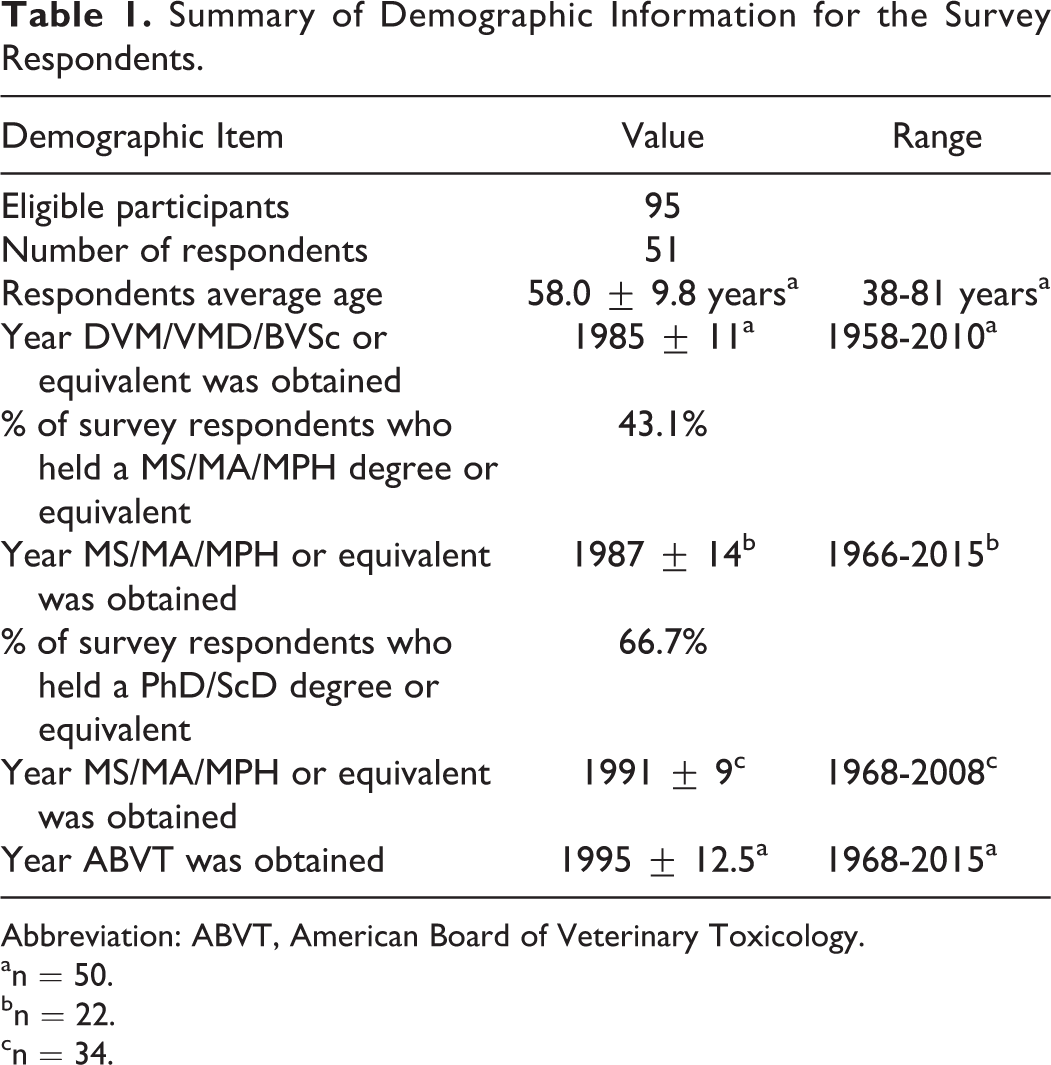
Abbreviation: ABVT, American Board of Veterinary Toxicology.
an = 50.
bn = 22.
cn = 34.
Of the 51 eligible respondents, the following number had at 1 time worked in a veterinary school (32 [62.7%]), elsewhere in academia (12 [23.5%], in a veterinary diagnostic laboratory (27 [52.9%]), in industry (23 [45.1%]), in government (13 [25.5%]), in consulting (24 [47.1%]), in uniformed services (3 [5.8%]), and in other sectors (13 [25.5%]). Other sources of employment included working in a non- or not-for-profit research institute (3 [5.9%]), private practice (4 [7.8%]), an animal shelter (1 [2.0%]), poison control centers (5 [9.8%]), or an organization that performed research with humans and over-the-counter products (1 [2.0%]). In order to maintain anonymity, information concerning the participant’s current employment sector was not collected.
Twenty-two (43.1%) respondents met the ABVT eligibility requirement by fully completing 4 calendar years of training in toxicology, including completion of an advanced degree, with a minimum of 2 of these 4 years spent under the direct supervision of a DABVT. Twenty-two (43.1%) respondents met the ABVT eligibility requirement by completing 2 calendar years in the clinical practice of veterinary medicine and at least 3 calendar years in a residency or other training program in toxicology, and/or in the teaching of toxicology, and/or toxicological research, and/or the practice of veterinary clinical and/or diagnostic toxicology, acceptable to the Board. Six (11.8%) individuals met the eligibility requirements through studies and experience obtained which requires a candidate to be the first author on 5 research papers or clinical reports acceptable to the Board. One (2.0%) individual did not respond to this question.
The respondent’s answers to the 10 questions that used a Likert-type scale are provided in Table 2. The diplomate’s years of experience was not associated with their response to the questions that used a Likert-type scale. Table 3 provides the result of the analysis of whether work history, with regard to employment sector, influenced a diplomate’s response to the 10 questions that used a Likert-type scale. We found that individuals who had worked as a consultant perceived that the ABVT certification was critical to their career when compared with their colleagues who did not have consulting experience. Diplomates of the ABVT who have worked in any aspect of academia were less likely than their peers to agree with the statement that existing veterinary toxicology residency programs are adequate for the training of veterinarians specializing in toxicology. Diplomates of the ABVT who have worked in a nonveterinary school academic setting were more likely to perceive that a shortage of DABVTs currently exists and were less likely to agree that DABVTs should have residency training when compared to peers who have not worked in this sector. They were less likely than their peers to agree that graduate training programs are adequate for the training of veterinarians specializing in toxicology or current training programs will meet existing shortages.
Frequency (%) of Survey Respondent’s Agreement or Disagreement With the Following Statements.
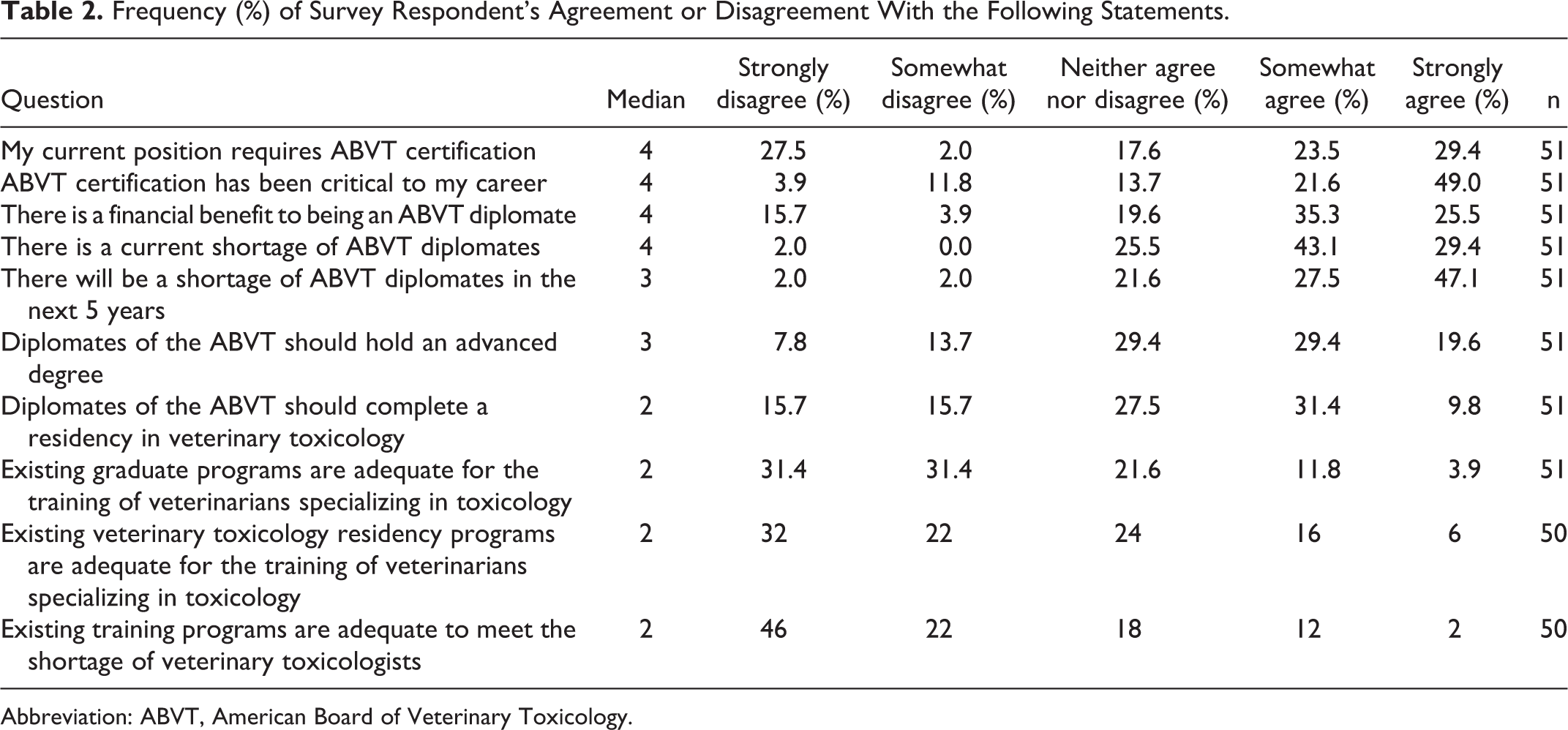
Abbreviation: ABVT, American Board of Veterinary Toxicology.
Analysis of the Frequency (%) of Survey Respondent’s (N = 51) Agreement or Disagreement With the Following Statements by Employment Sector (Pearson χ2).a
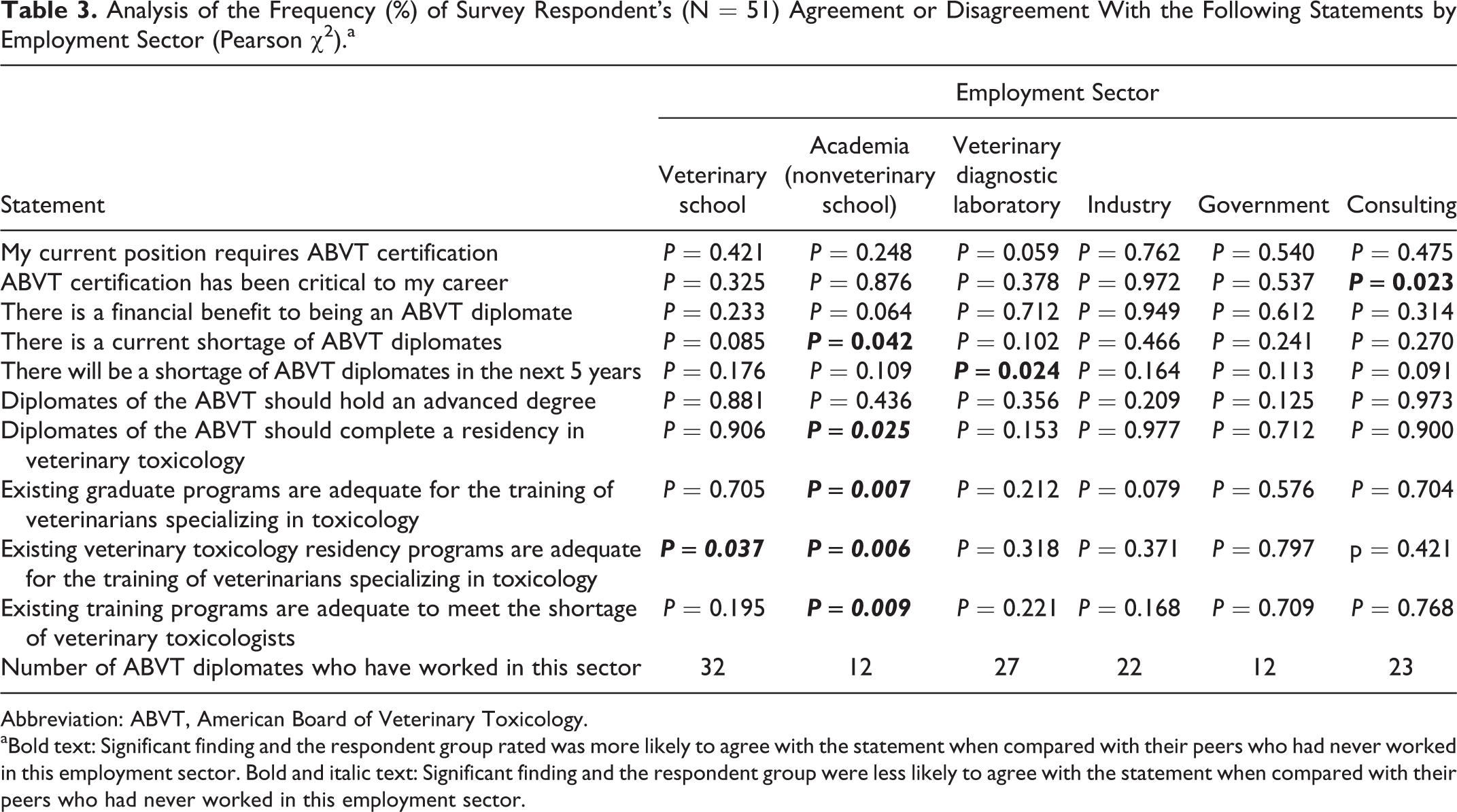
Abbreviation: ABVT, American Board of Veterinary Toxicology.
aBold text: Significant finding and the respondent group rated was more likely to agree with the statement when compared with their peers who had never worked in this employment sector. Bold and italic text: Significant finding and the respondent group were less likely to agree with the statement when compared with their peers who had never worked in this employment sector.
The second objective was to gather less structured input about the current status of training programs and possible future directions. Specifically, the survey provided fields for additional comments or suggestions regarding the diplomates’ opinion on whether a shortage of veterinary toxicologists exists (n = 43 comments) and a field for any additional comments (n = 12 comments). Comments related to a shortage of veterinary toxicologists centered on the need for increased awareness about veterinary toxicology and the state of the veterinary curriculum and postgraduate training. First, 15 comments pointed to the need for increased awareness, either among students (n = 8) or administrators (n = 7). Several comments reinforced the need for the ABVT to increase awareness among students about veterinary toxicology as a career. For example, 1 individual wrote “Need to inform veterinary students early on and through their training regarding the breadth of activities performed by toxicologists, the importance of clinical background as a foundation for toxicology practice, and the opportunities for both holistic/clinical medicine as well as research specialization within toxicology practice”. Other individuals commented on the need for increased awareness among administrators and hiring authorities about the value of ABVT certification. Comments generally echoed the following statement made by 1 respondent “Convince various academic institutions of the desirability of the credential, both at the service and especially teaching level”. Second, a number of comments were related to the veterinary curriculum and the state of veterinary and postgraduate training programs (n = 18). Suggestions from respondents included the need for expanded residency opportunities and increased financial support of training programs (“Would be nice if there were more residency programs within veterinary teaching hospitals” or “We need more training programs. Perhaps approach industry for funding”). Several individuals commented that there are an adequate number of graduate training programs in toxicology; however, veterinary residency programs are lacking (“Depends on what part of toxicology is considered. There are absolutely too few residency programs, but there are probably adequate PhD training opportunities—the latter would not prepare veterinarians for diagnostic/clinical positions”); however, these opinions were not uniformly held by the survey respondents (“Not sure there is a shortage; and if there is I think less supply would benefit salaries for those who are trained”). The final 10 comments broadly related to the way the ABVT certification was being marketed to veterinarians and veterinary students (eg, “We need to build name recognition of the veterinary toxicology specialty. Many do not realize the specialty exists and the opportunities for future employment within the specialty”) or how it was perceived by the scientific community (eg, “I think there needs to be some [public relations] work done on how the ABVT compares to the ABT, as it seems the ABT has replaced the ABVT in industry as the relevant board certification”).
Twelve participants included additional comments that ran the gamut from questioning the need for the survey (“What exactly is the purpose of this questionnaire”), further debating whether a shortage of veterinary toxicologists exists (“I’m struggling to decide if there is a shortage of veterinarians trained in toxicology. It doesn’t seem that the certification is valued much—as evidence by the fact that we’re posing it to ourselves as a board”), probing the survey design and questions (“I find the questions included in the survey to be reflective of the problem. The questions are oriented to view of veterinary toxicologists developing through an academic program”), and offering perspective on the current status of the certifying examination (“Recruit more and make the examination more reasonable to successfully complete” or “Rewrite the board examination, it seems very difficult to pass”).
Discussion
Our survey had an approximate 54% response rate, which is similar to the 44% response rate of DABTs in a recent survey of the members of that organization. 3 We found that the average DABVT was approximately 58 years old and had obtained their board certification 21 years earlier. The percentage of respondent DABVTs with ≤10, 11 to 20, 21 to 30, and ≥31 years of experience since obtaining the certificate were 20%, 30%, 30%, and 20%, respectively. A survey of DABT respondents had a mean of 21 years of experience as a toxicologist, with 16% having less than 10 years, 32% having 11 to 20 years, and 27% having 21 to 30 years of experience. 3 Nearly half (47.1%) of all surveyed DABVTs were also a DABT. We also found that veterinary toxicologists often received postgraduate training, with the majority of DABVTs (88%) holding an advanced graduate degree. Many survey participants (49%) valued the need for advanced graduate training of veterinary toxicologists as evidenced by their stated agreement with the statement that DABVTs should hold an advanced degree. Our analysis of these data by work history did not identify any employment sectors where the need for graduate training was perceived as necessary. Agreement with the need for residency training in veterinary toxicology was lower (41%). Somewhat surprisingly, DABVTs who had worked in a veterinary diagnostic laboratory at 1 time or another did not value this residency training more when compared with peers who had not shared this work experience.
Results indicate that career paths of DABVTs often diverge once they obtain their certification. Many veterinary toxicologists were employed at 1 time or another in academia or veterinary diagnostic laboratories. Of the 51 DABVTs surveyed, the majority (62.7%) had worked at 1 time or another in a veterinary school. This employment history is similar to that reported for board-certified veterinary pathologists where the majority were employed at universities either in academia or as diagnostic pathologists. 12 In contrast, employment in industry was the most common (45%) current employment sector for DABTs. 3 Our present survey, however, did not collect data about the current employment status of DABVTs in order to maintain anonymity of the participants.
The majority of survey respondents (>72%) somewhat agreed or strongly agreed that there is a current shortage of DABVTs that will persist into the next 5 years (2016-2021). This shortage was especially raised by DABVTs who had worked at 1 time or another in a veterinary diagnostic laboratory. Many survey respondents also expressed concern that existing training programs are inadequate to meet the perceived shortage of veterinary toxicologists. This sentiment was especially prevalent among DABVTs who had worked at 1 time or another in academia. Several free-text comments provided by the participants echo these survey results. Perceptions that there are shortages of toxicologists have existed for years. For example, concerns were raised in 1979 that the 7 US graduate veterinary toxicology programs in existence at that time were inadequate for meeting the need for veterinary toxicologists. 13 Our survey results suggest that the ensuing 4 decades have not altered this perception.
We also found that the majority of respondents reported that being a DABVT benefitted their career (71% somewhat agreed or strongly agreed that ABVT certification has been critical to my career). Diplomates of the ABVT who worked at 1 time or another as a consultant were more likely to agree that this certification was critical to their career. Likewise, most (61%) surveyed DABVTs somewhat agreed or strongly agreed that there is a financial benefit to being a DABVT; however, our secondary analysis that considered employment history did not identify an individual employment sector where this perception was statistically significant. A salary survey of toxicologists indicates that on average board-certified (eg, DABT or DABVT) toxicologists earned greater than US$10,000 per year more that their uncertified colleagues. 14
Several survey respondents commented on the difficulty of passing the ABVT-certifying examination. Within 10 years of its creation, the breadth, depth, and difficulty of the examination was raised among its membership. 15 This early concern likely reflected the relatively low pass rate of candidates on the ABVT-certifying examination. For example, the overall success rate on the first 14 certifying examinations was 45%. 16 The pass rate (approximately 54%) on the first ABT examination administered in 1980 was very similar to that seen with the ABVT examinations given during the preceding 15 years. 8 A major difference, however, was the size of that inaugural pool of candidates (approximately 400 individuals) that sat for the ABT.
In summary, this research characterized the education and experiences of members of the ABVT, their perceptions of its value, and opinions about the current status of training programs and possible future directions. Our results indicate some members are concerned about the number of DABVTs and the adequacy of training programs to meet the need for this toxicology specialty. In particular, DABVTs suggest the organization work toward increasing awareness about the value of ABVT certification. They also identified a need to seek ways to increase financial support for veterinary toxicology training programs. The respondents also encouraged the organization to improve its marketing efforts to veterinary students, veterinarians, and others by highlighting veterinary toxicology as a specialty with significant public health impact and wide-reaching career opportunities. Taken holistically, these findings improve our understanding of current attitudes of DABVTs toward their specialty.
Footnotes
Acknowledgments
The authors thank Drs Timothy Evans and Cynthia L Gaskill for their review of the draft survey and the DABVTs who participated in the survey. The authors also thank Sarah Hammond for her assistance with the conduct of the survey.
Author Contributions
A. A. Kedrowicz and D. C. Dorman contributed to conception and design, contributed to acquisition, analysis, and interpretation, drafted the manuscript, critically revised the manuscript, gave final approval, and agree to be accountable for all aspects of work ensuring integrity and accuracy.
Declaration of Conflicting Interests
The author(s) declared no potential conflicts of interest with respect to the research, authorship, and/or publication of this article.
Funding
The author(s) received no financial support for the research, authorship, and/or publication of this article.