




Abstract
The Cosmetic Ingredient Review (CIR) is a nonprofit program to assess the safety of ingredients in personal care products in an open, unbiased, and expert manner. Cosmetic Ingredient Review was established in 1976 by the Personal Care Products Council (PCPC), with the support of the US Food and Drug Administration (USFDA) and the Consumer Federation of America (CFA). Cosmetic Ingredient Review remains the only scientific program in the world committed to the systematic, independent review of cosmetic ingredient safety in a public forum. Cosmetic Ingredient Review operates in accordance with procedures modeled after the USFDA process for reviewing over-the-counter drugs. Nine voting panel members are distinguished, such as medical professionals, scientists, and professors. Three nonvoting liaisons are designated by the USFDA, CFA, and PCPC to represent government, consumer, and industry, respectively. The annual rate of completing safety assessments accelerated from about 100 to more than 400 ingredients by implementing grouping and read-across strategies and other approaches. As of March 2017, CIR had reviewed 4,740 individual cosmetic ingredients, including 4,611 determined to be safe as used or safe with qualifications, 12 determined to be unsafe, and 117 ingredients for which the information is insufficient to determine safety. Examples of especially challenging safety assessments and issues are presented here, including botanicals. Cosmetic Ingredient Review continues to strengthen its program with the ongoing cooperation of the USFDA, CFA, the cosmetics industry, and everyone else interested in contributing to the process.
Introduction
In the early 1970s, the US Congress considered legislation amending the Federal Food, Drug & Cosmetic Act to require premarket safety testing of cosmetics, much as is done for drugs. This legislation was not enacted, but Congress required cosmetics companies to ensure the safety of ingredients used in their products. Thus, the responsibility for premarket safety assessment of cosmetics rests with the manufacturers in the United States. 1
The CIR was established in 1976 as a nonprofit program to assess the safety of ingredients used in personal care products in an open, unbiased, and expert manner and to publish the results in the peer-reviewed scientific literature. 2,3 Cosmetic Ingredient Review was founded by the PCPC (formerly the Cosmetic, Toiletry, and Fragrance Association or CTFA) in cooperation with the USFDA and the CFA. More than 40 years later, CIR remains the only scientific program in the world dedicated to a systematic, thorough, and continuous review of cosmetic ingredient safety in a public forum.
Cosmetic Ingredient Review does not conduct or fund research, laboratory analyses, or toxicology tests nor does CIR have regulatory authority to force a company to withdraw an unsafe product from the market or the power to take regulatory actions. However, an insufficient data conclusion from the CIR Expert Panel can motivate industry and other stakeholders to submit additional data to support a safe or unsafe conclusion from the Panel. Furthermore, the CIR notifies USFDA and industry of specific safety concerns and recommends that appropriate investigation and action be taken to address the concerns. The USFDA can and does take action when a clear hazard is identified, including seeking voluntary recall from the companies involved. 4
For more than 40 years, USFDA, CFA, the cosmetics industry, and the public have worked cooperatively with the CIR contributing their views and recommendations as well as information that CIR considers in its safety assessments.
This article updates earlier reviews published in the medical and scientific literature detailing the CIR program, including its mission, methods, accomplishments, and plans for the future. 5 –11
The CIR Program
Cosmetic Ingredient Review operates in accordance with the Cosmetic Ingredient Review Procedures and Guidelines (Procedures), which are patterned after the USFDA process for the scientific review of over-the-counter (OTC) drugs. 2,12 The Procedures delineate requirements for a steering committee, the CIR Expert Panel, and staff and the process for prioritizing and reviewing ingredients used in personal care products.
The CIR Steering Committee
The CIR Steering Committee provides general policy and direction for the CIR. The Steering Committee selects Expert Panel members, after a public nomination process, and the Chair of the Expert Panel from among the panel members. In addition, the steering committee appoints the CIR director, who reports to the steering committee.
The steering committee includes 3 industry representatives and 4 public representatives. The industry representatives include the president and CEO of the PCPC, who serves as the chair of the Steering Committee, the chair of PCPC’s CIR Science and Support Committee (CIR SSC), and PCPC’s executive vice president for science. The public representatives include a dermatologist representing the American Academy of Dermatology (AAD), a toxicologist representing the Society of Toxicology (SOT), the chair of the CIR Expert Panel, and a consumer representative from the CFA.
The steering committee has no input into the scientific deliberations and safety conclusions of the Expert Panel. However, the committee can recommend changes to the CIR Procedures for the Panel to consider.
The CIR Expert Panel
The CIR Expert Panel is the decision-making body of the CIR program. The Experts of the Panel are appointed based on nominations primarily from the SOT, the AAD, and the ACS. However, any interested person or organization can nominate qualified persons.
Expert panelists must have expertise needed to assess the safety of cosmetic ingredients and no financial involvement with the personal care products industry; they are subject to the same conflict of interest rules as USFDA advisory committee members. Panel members and liaisons are listed in Table 1.
Cosmetic Ingredient Review (CIR) Expert Panel Members.
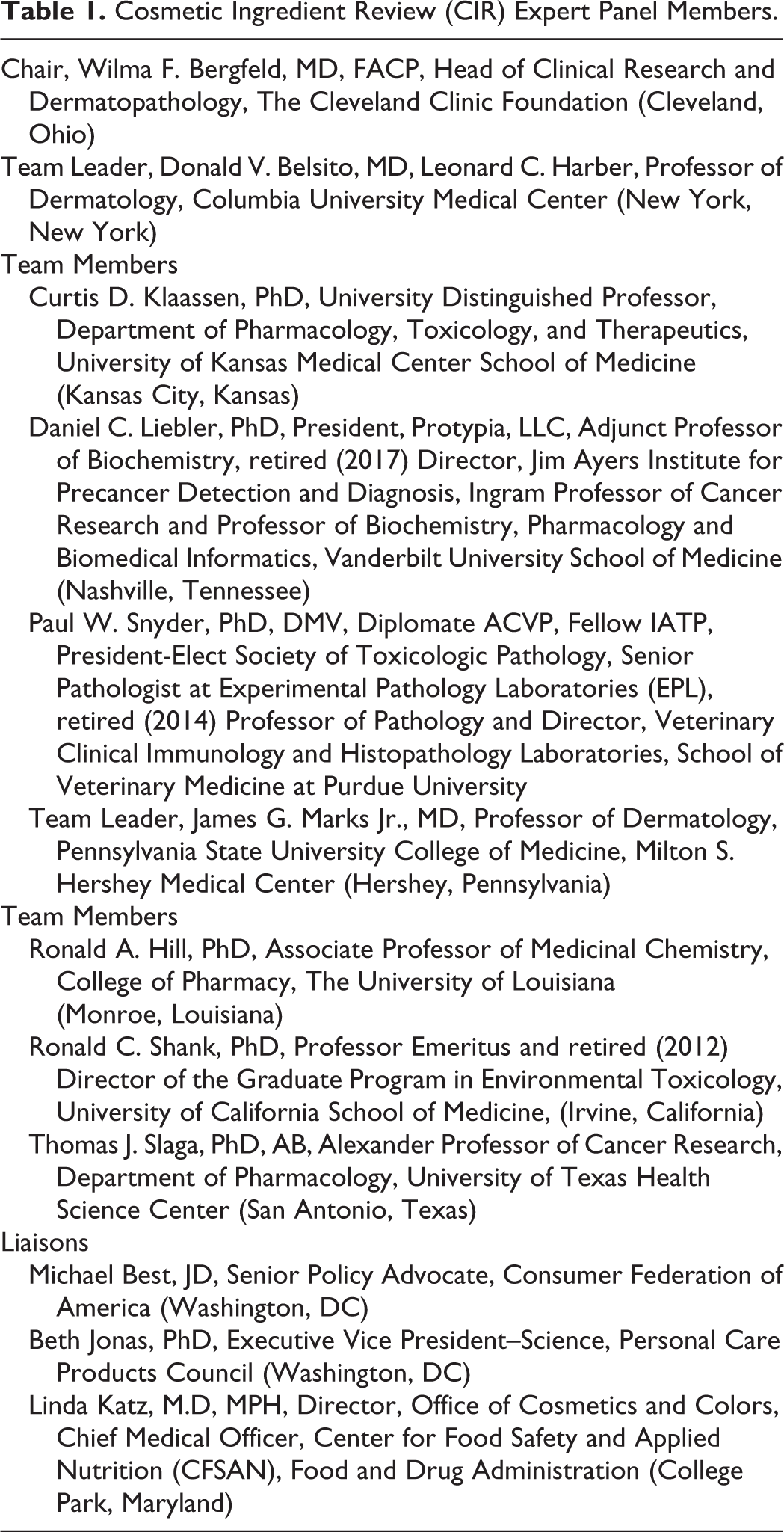
The 9 voting members of the Expert Panel include physicians, professors, department chairs, and presidents of professional associations. Dr Wilma Bergfeld, the panel chair, has been with CIR in several capacities since its inception, including team member, team leader, and now chair. Her vote serves as the tiebreaker when needed. She was the first female president of The AAD, and she is past president of the Women’s Dermatological Society. Dr Bergfeld was recognized by Galderma Pharma as one of the top 4 women dermatologist leaders in the world.
The Panel consists of 2 teams. Each team is led by a noted dermatologist and includes at least 1 toxicologist and a chemist.
Cosmetic Ingredient Review Panel members also include 3 nonvoting liaison members designated by the USFDA, CFA, and PCPC to represent the interests of the government, consumers, and the industry, respectively, in all deliberations of the Panel meetings. Each of these representatives serves as a conduit of information between the Expert Panel and the stakeholders.
The CIR Staff Members
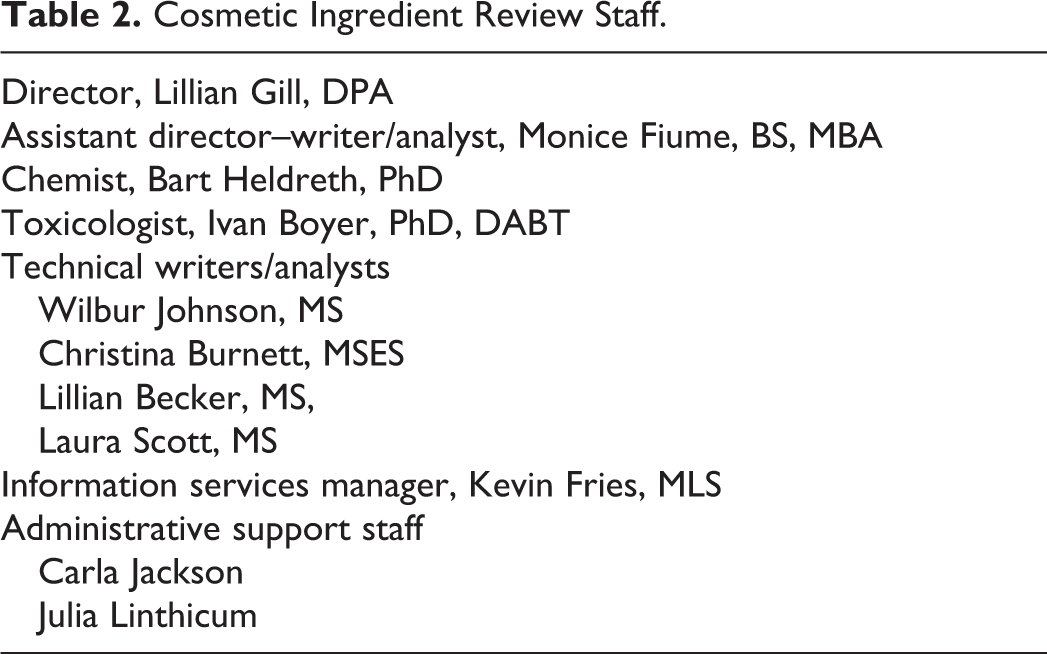
The CIR staff supports the Expert Panel in its assessment of the safety of cosmetic ingredients. The staff consists of 11 people, including the CIR director who has the authority and responsibility for daily administration of the CIR staff and Expert Panel. Staff members are listed in Table 2.
Cosmetic Ingredient Review Staff.
Personal Care Products Council’s CIR Science and Support Committee
Industry supports the CIR program in a tangible way by voluntarily providing CIR with unpublished data from the safety testing they have conducted. In addition, the PCPC provides a committee of industry scientists, namely the CIR SSC, which serves as a conduit of scientific information and advice for consideration by the CIR staff and Expert Panel during the development of a safety assessment. The CIR SCC is explicitly prohibited by CIR Procedures from providing general policy guidance or direction to the CIR staff or Expert Panel. However, the CIR Expert Panel can request tasks of the CIR SSC to provide data or analyses needed to address data gaps and other scientific issues in safety assessments.
Selecting Ingredients for Review
Ingredients to be reviewed (ie, “priority ingredients”) in a year are selected the previous year. The selection process includes consideration of the ingredients listed in the International Cosmetic Ingredient Dictionary and Handbook (dictionary). 13 The latest edition of the dictionary lists over 21,000 individual ingredients that were once used, are currently used, or are merely a supplier’s hope for future use.
About one-third of the ingredients listed in the dictionary may be excluded from CIR review by the CIR Procedures, depending on whether or not their safety is evaluated by another, specific organization developing relevant and appropriate safety assessments. 2 For example, fragrances reviewed or slated for review by the Research Institute for Fragrance Materials are generally excluded if they are reported to be used only as fragrances in cosmetics. A CIR review may be deferred if the ingredient is being reviewed by USFDA as a potential OTC drug active ingredient, food flavor, or generally recognized as safe food ingredient.
Cosmetic Ingredient Review focuses on the remaining ingredients for which industry has reported cosmetic uses to the USFDA Voluntary Cosmetic Registration Program (VCRP). 14 The VCRP captures data submitted by industry on ingredients and cosmetic product categories in which the ingredients are used. Currently, these number around 6,000 ingredients used in 81 product categories.
One criterion for inclusion on CIR’s annual priority list is the frequency of use of an ingredient (ie, the number of different products in which it is used), as determined from the current VCRP data. The frequency of use serves as a rough estimate of the overall exposure of consumers to an ingredient. The thinking is that the greater the frequency of use, the greater the likely consumer exposure and the more important it is to assess the safety of the ingredient.
Another important criterion is whether or not the ingredient is a concern for one reason or another. For example, the USFDA may identify an ingredient as a special concern or CIR may find emerging reports of adverse health effects associated with the use of an ingredient in personal care products. Such information can suggest the possibility of harm and signal a higher priority for conducting an evaluation or a reevaluation of an ingredient.
Any ingredient, whether or not it has been reviewed previously by the Panel, may be nominated for inclusion on the priority list by any stakeholder, including the general public. Some recent examples include Chlorphenesin, 15 retinyl palmitate, 16 and triclosan, 17 which were requested by USFDA; quaternium-15, 18 which was requested by a panel member; and parabens, 19 which were requested by the CIR staff, the industry, and several nongovernmental organizations.
In addition, ingredients reviewed 15 years earlier are automatically scheduled to be considered by the Panel for a rereview. This involves performing a literature search to determine whether the results of new studies might warrant revision of earlier safety assessments. Ingredients scheduled for rereview can also include ingredients for which there are new uses in personal care products.
In addition, CIR includes 1 hair dye ingredient on the priority list every year. This is to ensure that these ingredients, which typically have low frequencies of use, are covered in CIR safety assessments in an ongoing manner.
Draft priority lists are made available for public comment and are discussed in open Expert Panel meetings twice before the Expert Panel finalizes the list. Issuance of a final annual priority list is accompanied by a call for data.
The CIR Review Process
The CIR review process begins with the announcement of the priority ingredients. A CIR writer/analyst assigned to an ingredient or ingredient group conducts a comprehensive search of the published scientific literature and online open-source data and summarizes the relevant studies in a preliminary report referred to as the scientific literature review (SLR) for cosmetic safety. Cosmetic Ingredient Review staff members do not evaluate the data compiled in the SLR for cosmetic safety—the evaluation of this information is solely the purview of the CIR Expert Panel.
Cosmetic Ingredient Review posts the SLR online for 60 days for public review, with the request for relevant information not already included in the SLR. The writer/analyst revises the SLR to incorporate information received during the public comment period, and the resulting draft report (DR) is presented to the Panel. The Panel reviews the DR and decides how to proceed during the Panel meeting.
The Panel meets 4 times a year and each meeting is one and a half day long. If there are guest speakers, the speakers give their presentations to the entire Panel and other participants in the morning of the first day of a meeting. Among notable recent presentations to the Panel were briefings on the state of the art of in vitro skin sensitization test methods, plant cell cultures used as a source of cosmetic ingredients, the dermal diffusion barrier of neonates and infants, and an update of the ongoing research and regulatory issues concerning chemicals with endocrine activity. The briefing slides of all presentations to the Panel are posted on CIR’s website, as are summaries of the presentations in CIR post-meeting announcements (PMAs).
After the briefings, the 2 teams of panelists separate and meet in separate rooms to discuss all of the ingredients under review. Each team arrives at their own conclusions about each ingredient and ingredient group. On the second day, the teams reassemble as 1 group and resolve important differences in the conclusions or concerns that they may have about each ingredient or group. Then the voting Panel members vote to determine the overall conclusions of the meeting. The Expert Panel decides whether each ingredient and ingredient group is safe, safe with qualifications, or unsafe under each intended condition of use or that the data are not sufficient to support a safety determination.
The Panel issues an insufficient data announcement (IDA) if the information is not sufficient for arriving at a conclusion on the safety of an ingredient or ingredient group. The IDA specifies the additional data needed and is posted online to solicit the additional information. The writer/analyst incorporates relevant information that is received in response. The Expert Panel may then conclude that the available data either remain insufficient or are now sufficient to support a safety determination.
If the data are insufficient to support a safety determination, and there is no reported use of the ingredient in the VCRP database, the ingredient is placed in the “No Reported Use” category. If there are reported uses, and the data continue to be insufficient for 2 years, the ingredient is placed in the “Use Not Supported” category.
The Panel issues a tentative report (TR) whether the panel’s conclusion is that the data are sufficient or insufficient. The Discussion section of the TR provides the rationale for the Panel’s conclusion. The TR is posted for public comments during a 60-day period, revised if necessary based on all substantive comments received, reviewed by the Panel, and then, typically, a final report (FR) is issued and posted. The FR presents the conclusions and recommendations of the Expert Panel, including a complete explanation of the rationale. The FR also refers the reader to posted documents that detail background information and elaborate the Panel’s position on specific issues. Such documents address, for example, the potential incidental inhalation of ingredients used in spray or loose powder products, 20 the epidemiology of ingredients used as hair dyes, 21 and dermal penetration and other considerations in safety assessments addressing vulnerable populations such as babies. 22
The CIR director sends a copy of the FR and the PMA to the USFDA, which summarizes the discussions and decisions of the Panel after each meeting. Specifically, CIR sends these documents to the USFDA commissioner and the directors of the Center for Food Safety and Applied Nutrition and Office of Cosmetics and Colors. In addition, CIR submits each FR as a manuscript for publication in a triennial special issue of International Journal of Toxicology (IJT).
The CIR Rereview Process
As noted, previously reviewed ingredients are considered for rereview 15 years later or whenever new information emerges that there may be a concern that was not addressed in earlier reviews.
If newly available information indicates that the original conclusion may need to be amended, the Expert Panel reopens the safety assessment. This prompts a new review of the scientific literature and the subsequent steps of the review process. Often the consideration to rereview an ingredient offers opportunities to add closely related ingredients to form or expand a group or family of ingredients for the Panel’s review. When warranted, the Panel may reopen the report so that the original conclusion can be extended across the group that includes the newly added ingredients.
If the Panel decides not to reopen the safety assessment, they simply reaffirm the earlier conclusion. This decision is included in the PMA posted on the CIR website. In addition, a list of the new literature considered and information on the current uses and use concentrations are published in summaries of rereview findings in the IJT.
Independence and Transparency of the CIR Program
Funding for the CIR program is provided by the PCPC. The independence of the CIR program is maintained through the continued public openness and transparency of the safety assessment process, as well as the integrity of the Expert Panel members, the participation of the USFDA, CFA, and the general public, and the cooperation of the PCPC and the cosmetics industry.
The safety assessment process is subject to review and critique by interested parties, throughout, up to, and including peer review before publication of safety assessment reports in the IJT. The CIR process provides numerous opportunities for any interested party to provide comments, published or unpublished safety data, or information on ingredient use in cosmetics for consideration in any ingredient safety assessment.
Draft versions of the reports are posted online approximately 30 days prior to each Panel meeting. Every safety assessment is discussed and voted on in a public meeting before being released as a report for a 60-day public comment period. Everyone attending a Panel meeting is welcome to share their knowledge and perspectives to help advance the Panel’s discussions during the meetings.
All unpublished reports used to inform a CIR safety assessment are available on the CIR website or upon request. Cosmetic Ingredient Review does not accept information that is confidential or proprietary. Furthermore, CIR actively seeks critical peer reviews of safety assessments from the scientific and medical communities.
Finally, information about CIR and its procedures and all CIR meeting agendas, safety assessment reports, PMAs, meeting minutes and findings are posted online. All unpublished data used by the CIR Expert Panel are available from CIR upon request. All of this material is freely accessible to everyone at every step in the safety assessment process, from the posting of the SLR to the release of the FR. Ample time is provided between each step in the process to enable the receipt of comments and other feedback from stakeholders, including members of the general public and the industry.
Progress on all of CIR’s safety assessments may be monitored on the CIR website at http://www.cir-safety.org, and questions may be sent to
Data Requirements of the CIR Program
The type and amount of data required for the Expert Panel to fulfill its charge that “there is a reasonable certainty in the judgment of competent scientists that [an] ingredient is safe under its conditions of use” varies from one ingredient to another. 11 The adequacy of data for each ingredient is judged based on the potential for human exposure to the ingredient in cosmetic products.
The CIR Expert Panel bases its safety assessments on a comprehensive search of the scientific literature and data submitted by stakeholders to evaluate all exposure scenarios applicable to the consumer use of cosmetics (comprising all relevant types of personal care products) and potential toxicity end points (ie, adverse health effects). The scenarios considered include long-term (ie, essentially lifetime) exposures to an ingredient at maximum reported concentrations in personal care products used as often as multiple times a day. Maximum use concentration data are provided by the cosmetic industry in response to surveys conducted by the PCPC.
The potential adverse health effects considered include the full range of possible toxicity end points, including potential carcinogenic, developmental, and reproductive effects and genotoxicity. Cosmetic Ingredient Review reviews acute, short-term, and chronic toxicity studies performed in vivo on mammalian test species, in vitro studies using animal or human cells and tissues, and epidemiological studies to assess the potential for ingredients to cause adverse health effects. These effects include, but are not limited to, dermal, ocular, and mucous membrane irritation, sensitization (allergies), and photosensitivity.
As physicians, toxicologists, and other experts in the health sciences, the panelists know the importance of the endocrine system in reproduction, in development and, generally, in maintaining good health. The Panel is also mindful of the potential for disruptions of the endocrine system to cause adverse health effects. Cosmetic Ingredient Review is constantly monitoring and reviewing the scientific literature and the efforts of regulatory bodies, scientific workgroups, and advisory boards addressing the potential for cosmetic ingredients to disrupt the endocrine system. The Panel considers all of the available scientific information from epidemiological, test animal, and in vitro studies to evaluate the potential for endocrine effects in its assessments of specific ingredients and ingredient groups.
Grouping Ingredients and Read-Across in CIR Assessments
Ingredient grouping is a logical and pragmatic approach that does not require animal testing and allows the evaluation of chemicals in groups, rather than one at a time. 23 The primary basis for grouping ingredients to facilitate read-across assessment is typically the similarity in chemical structure and physical and chemical properties of the grouped ingredients.
Once an ingredient group is properly formed, the Panel may “read-across” the ingredients, so that data available for some members of the group can be shared across some or all of the other members for which there are significant data gaps. In other words, the toxicological and other data available for some members of the group can be extrapolated or interpolated as needed to assess the safety of all of the group members, if appropriate and scientifically defensible.
Ingredients that may not be amenable to read-across analysis, such as botanicals, may be grouped together to form ingredient families based on their common characteristics, such as the plant species and plant parts from which they are derived and the extraction methods used. The review of such families saves time and resources without reducing the scientific rigor of the safety assessments.
Cosmetic Ingredient Review has become more adept in the grouping of ingredients for the Panel’s review over the years. For example, 27 years ago, the Panel reviewed 3 trimonium ingredients together for the first time. 24 Fifteen years later, the Panel reviewed the trimoniums again, this time adding 64 additional trimonium-related ingredients. 25
Cosmetic Ingredient Review Accomplishments
Approximately 7 years ago, CIR revised its approaches to accelerate, quite successfully, the annual rate of completing safety assessments. The rate increased from less than approximately 100 ingredients per year to more than 400 ingredients per year since 2010.
The changes that have contributed most to this rapid rise include the implementation of ingredient grouping and read-across strategies. In addition, a team approach was adopted to foster the collaboration of CIR’s staff chemist and toxicologist with each of the writers assigned to prepare the safety assessment report for an ingredient, so that the writers are guided by subject matter experts all along the process, as needed.
There are over 21,000 ingredients in the most recent edition of the dictionary. Approximately 30% may be excluded from CIR review. Approximately 32% are currently in use in more than 100,000 personal care products. Cosmetic Ingredient Review has completed safety assessments of 4,740 individual cosmetic ingredients as of March 2017.
As noted, a safety assessment is completed when the Expert Panel makes 1 of 4 potential conclusions, including safe as used, safe with qualifications, unsafe, or data insufficient to establish safety. The current tally of conclusions is presented in Table 3.
Frequencies of Conclusions in CIR Safety Assessments Through December 2016.
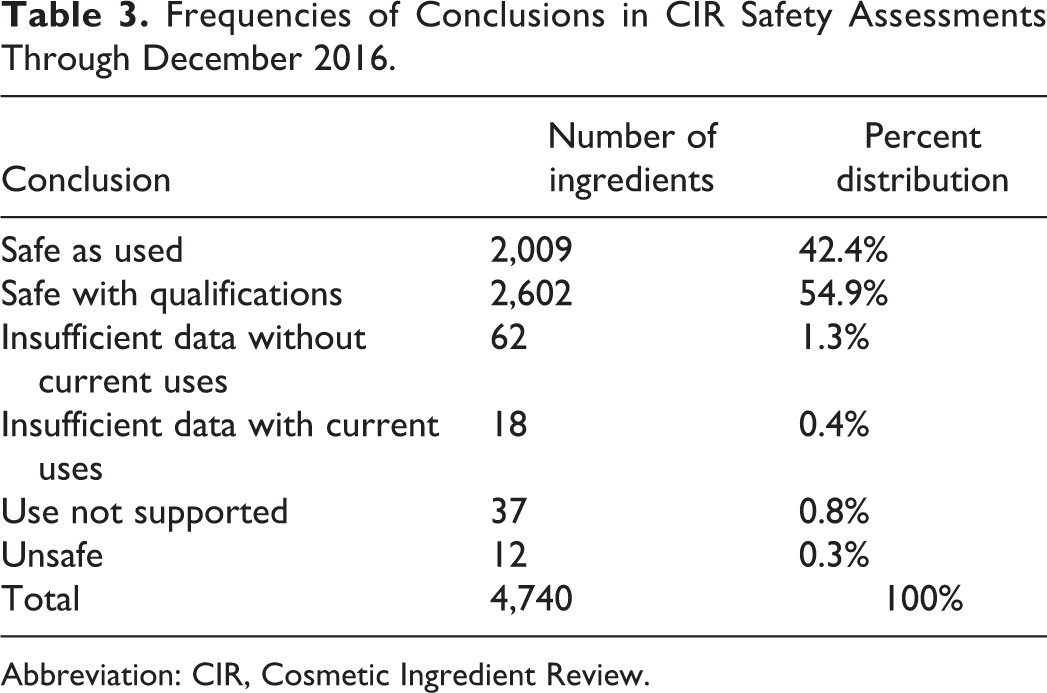
Abbreviation: CIR, Cosmetic Ingredient Review.
A “safe-as-used” conclusion for an ingredient in a CIR safety assessment indicates a negligible risk of chronic and acute health effects after long-term, daily exposures to the ingredient at its greatest reported use concentrations in cosmetic products, when these products are used as intended. In context, a safe-as-used conclusion, “as used” refers to the practices of use and maximum concentrations described in each safety assessment report.
Among qualified safe conclusions, the most common is safe when formulated to be nonirritating. Other qualified conclusions include, for example, safe when formulated to be nonsensitizing, safe with restrictions on the concentrations of the ingredient in cosmetic formulations, and safe with restrictions on the concentration of the impurities in the ingredient.
Unsafe for use in cosmetic products include 4-methoxy-m-phenylenediamine and its hydrochloride and sulfate salts, chloroacetamide, ethoxyethanol and its acetate, and HC Blue No. 1. The Panel developed mixed conclusions for formaldehyde/methylene glycol (unsafe in hair straightening products), hydroquinone, p-hydroxyanisole, and pyrocatechol (unsafe in leave-on products).
Ingredients with insufficient data conclusions and current uses are reclassified from the Insufficient Data category to the Use Not Supported category if CIR does not receive the required data within 2 years. Ingredients with insufficient data conclusions and no current uses are placed in the No Reported Use category.
The current conclusions for all of the ingredients reviewed by the CIR Expert Panel to date, as well as the 14 ingredients prohibited by the USFDA, can be found in the quick reference table and other tables posted on the CIR website (http://www.cir-safety.org/cir-findings). The full safety assessment reports for these ingredients are also available on the CIR website. Further, abbreviated final safety assessments of all ingredients reviewed by the Panel to date are published in the CIR Compendium of Ingredients, which is updated annually.
Challenging Ingredients
Among examples of ongoing scientific challenges are the parabens. These ingredients are the most widely used preservatives in cosmetics. Parabens are on the priority list of ingredients to be addressed in 2017. The Panel will focus on evaluating studies published since they last reviewed parabens in 2008, 26 which include many reports suggesting that these substances may disrupt endocrine function.
Other notable examples of challenging ingredients that CIR has reviewed or rereviewed in recent years include formaldehyde/methylene glycol and hydrolyzed wheat protein/gluten (HWP). In addition, the safety assessment of botanical ingredients (or simply “botanicals”) used in personal care products continues to be challenging. These ingredients are discussed in subsections “Formaldehyde/Methylene Glycol,” “Hydrolyzed Wheat Protein/Gluten,” and “Botanicals” below.
Formaldehyde/Methylene Glycol
Formaldehyde was rereviewed in 2011, with methylene glycol added to the assessment, in response to reports of serious adverse effects in salon workers and their customers using Brazilian-style hair straightening products. 27 These products contain up to 10% and 15% methylene glycol, which is the predominant form of formaldehyde dissolved in water. Substantial amounts of formaldehyde are released into the air during the use of such products, especially after the products are applied to the hair and then heated with a heating iron. The concentrations of formaldehyde in the air in the breathing zones of the stylists and customers sometimes exceed workplace standards for formaldehyde and often exceed other more conservative protective guidelines for formaldehyde exposure, in spite of efforts to improve room ventilation techniques to address this concern. The Panel concluded that the use of formaldehyde and methylene glycol in hair straighteners is unsafe. No additional information has yet been submitted to the Panel to demonstrate that there are effective ventilation methods that could be established or that lower concentrations of methylene glycol could be effective for hair straightening but would not release formaldehyde to yield concentrations of concern in the air. The Panel also reaffirmed its original conclusion that formaldehyde can be used at concentrations up to 0.2% as formalin, as a preservative in cosmetic products, except that it cannot be concluded that formaldehyde is safe for use in products that are intended to be aerosolized.
Hydrolyzed Wheat Protein/Gluten
The Panel assessed the safety of HWP and hydrolyzed wheat gluten in 2014. 28 The safety assessment was complicated by reports of hypersensitivity induced by the topical use of soaps and facial cleansers containing HWP in Japan and similar reports from Europe. The safety assessment was informed by information presented to the Panel by 2 invited speakers. One speaker is a chemist at Croda International, Dr Surrender Chagall. The other speaker was Dr Kiyoko Matsunaga, professor and chair of the Department of Dermatology at the Fujita Health University School of Medicine, Japan, and the chair of the Japanese Society of Allergology Special Committee for the Safety of Protein Hydrolysates in Cosmetics. After critically considering the information presented, the CIR Expert Panel decided to limit the weight-average molecular weight of hydrolyzed wheat proteins to 3,500 Da in cosmetics. The data submitted showed that such polypeptides would be too small to elicit or induce hypersensitivity reactions.
Botanicals
Cosmetic ingredients derived from botanical sources (botanicals) remain a challenge. Botanicals are ingredients derived directly from plants, including extracts, juices, waters, distillates, powders, oils, waxes, saps, tars, gums, unsaponifiables, and resins, which are not chemically modified before addition to cosmetic formulations. 13 The demand for products containing botanicals is growing because many consumers view these products as being more natural, healthy, and environmentally friendly than synthetic ingredients.
However, natural ingredients are not inherently safer than synthetic ingredients. Botanicals are often complex mixtures with compositions that vary with plant species, geographic origin, plant age and season of harvesting, plant part, and other factors. Botanicals are often poorly characterized mixtures of plant-derived constituents, many of which may or may not be present in the extracts that are used as cosmetic ingredients.
The characterization of botanicals is crucial for conducting credible and defensible safety assessments. The plant part and extraction methods used to prepare the ingredient and the levels of naturally occurring toxins in the botanical should be clearly defined to support a credible and scientifically defensible safety assessment.
The general lack of a well-defined and persuasive approach to characterizing botanicals remains a major challenge in efforts to assess the safety of these ingredients. Unspecified and ill-defined extraction methods contribute to the uncertainties about the composition of many of these ingredients. For this reason, many ingredients for which there are insufficient data are botanical extracts.
Initiatives (Meeting the Challenges)
The European Union (EU) banned the marketing of new cosmetic products containing ingredients tested in traditional whole animal studies. The ongoing movement away from testing safety using animals in Europe and in other countries means that safety assessments will increasingly depend on a range of alternative approaches that include in vitro assays, in vivo studies not using mammalian test species, and computational toxicology methods to fill data gaps in the future.
Cosmetic Ingredient Review has launched several initiatives to address this challenge. Cosmetic Ingredient Review is focused especially on developing strategies for using publically available data and tools from programs such as the EU COSMOS Project and US Tox21 Program.29,30
In 2012, CIR conducted a workshop in which key researchers briefed the Panel on the development and regulatory status of methods for exploiting structure–activity relationships in toxicological evaluations. Among the presenters were Dr Chihae Yang, who is working closely with USFDA and COSMOS to develop knowledge bases and computational tools, 29 Dr Andrew Worth of the EU Joint Research Centre in Ispra, Italy, who was a fellow at the USFDA in Washington, DC in 2012, 30 and Dr Kirk Arvidson of the USFDA Office for Food Additive Safety. 31 Dr Karen Blackburn presented a framework for identifying and evaluating analogs for read-across analysis, which she developed in collaboration with her colleagues at Procter and Gamble. 32 Dr Ann Richard from the EPA National Center for Computational Toxicology (NCCT) briefed the Panel on developments of the Tox21 and ToxCast programs, with a discussion of the substantial overlap of the chemical spaces of cosmetic ingredients and the Tox21/ToxCast inventories. 33
The EPA NCCT defines computational toxicology as “the application of mathematical and computer models to predict adverse effects and to better understand the mechanism(s) through which a given chemical induces harm.” Computational tools can be integrated with empirical data to predict physical and chemical properties or potential effects of exposures or facilitate grouping ingredients and identifying likely analogs in read-across assessments, for example. These tools are gaining acceptance for filling data gaps in comprehensive weight-of-evidence (WoE) safety assessments that incorporate data from available in vivo studies and in vitro tests, predictions from in silico calculations, and expert judgment. Cosmetic Ingredient Review is working diligently toward developing capabilities in this area.
Discussion
The CIR Expert Panelists develop safety assessments grounded on all of the relevant scientific information, the WoE, reasonable worst-case exposure scenarios, and their knowledge and experience as leaders in their respective fields of scientific research and professional practice.
Cosmetic Ingredient Review maintains a completely open and transparent process for reviewing the safety of ingredients, as used in personal care products. The safety assessments are performed with no cosmetic industry bias, and the Expert Panelists assess the safety of cosmetic ingredients in a manner that is completely independent of the PCPC and the cosmetics industry. The review process, reports, and all data used in every safety assessment are available for public and scientific scrutiny. Cosmetic Ingredient Review Expert Panelists, staff, and all consultants are separate from the PCPC and the cosmetics industry and meet the same conflict of interest requirements stipulated for special federal government employees.
The CIR program boasts a robust process for evaluating the safety of ingredients in personal care products. The process comprises logical, well-defined, and documented procedures for ingredient prioritization and reviews, including an iterative process for ingredient rereview. The formation of ingredient groups and families to evaluate closely related ingredients together provides substantial efficiencies to the review process. The process involves expansive searches for all publicly available information and queries to manufacturers and other stakeholders for relevant information.
Finally, the CIR program has the cooperation of ingredient manufacturers and other stakeholders that provide data needed to inform CIR’s safety assessments, especially when data gaps become apparent. The commitment of the personal care industry to support CIR remains a key strength of the CIR program, as the program enters the future assured of both continued financial support and independent decision-making.
Footnotes
Authors’ Note
Author email address: I. Boyer:
Acknowledgments
The authors thank Ms. Lillian Becker, Ms. Christina Burnett, Mr. Kevin Fries, Mr. Wilbur Johnson, Ms. Julia Linthicum, and Ms. Laura Scott for their thoughtful comments.
Author Contributions
Boyer contributed to conception and design; acquisition, analysis, and interpretation; drafted the manuscript; and gave final approval. Heldreth, Gill, Bergfeld, Fiume contributed to conception and design; acquisition, analysis, and interpretation; critically revised the manuscript; and gave final approval. All authors agree to be accountable for all aspects of work ensuring integrity and accuracy.
Declaration of Conflicting Interests
The author(s) declared no potential conflicts of interest with respect to the research, authorship, and/or publication of this article.
Funding
The author(s) disclosed receipt of the following financial support for the research, authorship, and/or publication of this article: CIR is funded by the PCPC, but CIR’s scientific review process is completely independent of the PCPC and the personal care industry.