




Abstract
Existing risk assessment data and procedures can be used to address the estimation of cumulative risk, but there are several uncertainties. These are explored in the context of the State of California’s Air Toxic Hot Spots program. Hazard identification for single agents is an established procedure but is much more complex for incompletely characterized or variable mixtures. Hazards from exposure to multiple agents are often only identified by chance. Similar concerns affect dose-response assessment. Although additivity is assumed by default for similar effects at low doses, exceptions are known for specific mixtures and for higher dose rates. Exposure assessment is especially complex for multiple sources, multiple agents from different sources, and target populations or individuals who face cumulative, but not necessarily simultaneous, impacts. With these contributory uncertainties, providing an integrated analysis that can inform risk management and presenting this to a diverse and often already stressed community are challenging.
Cumulative risks are a frequent topic of discussion, especially in the context of groups or individuals in an urban environment exposed to health hazards from multiple sources and media. A first requirement in pursuing this discussion in a meaningful way is to determine whether, and preferably how, the elements of this concept can be quantified. (The radical epistemologist will argue, with some justification, that if something cannot be quantified it does not really exist.) This article reviews the data and methods available to achieve such quantitation for a specific area where some efforts have already been made, by concentrating on cumulative risk issues identified in the context of air pollution stationary source risk assessment in California. Following a description of the regulatory context of this activity, the first objective of this article is to define what is meant by cumulative risk for the purpose of this discussion. Second, methods available for quantitatively assessing this risk are evaluated for relevance and adequacy.
California Air Pollution Programs
Air pollution programs in California consist of 3 main components. The Toxic Air Contaminant (TAC) program requires the identification and assessment of ambient or state-wide hazardous air pollutants as TACs. The Office of Environmental Health Hazard Assessment provides chemical-specific health effects assessments that support the identification of chemicals as TACs and the assessment of dose response to determine health-protective levels or slope factors. The California Air Resources Board (CARB) evaluates emissions and exposures in California and then develops air toxics–control measures that take a variety of forms, including technical requirements for specific sources (eg, vehicles, equipment, and fuels) and limits on emissions or prohibition of polluting activities. In contrast to the TAC program, which emphasizes statewide or regional pollution problems, including mobile sources, the Air Toxics Hot Spots program addresses more localized pollutants from individual stationary sources by providing health-protective levels and guidance for site-specific risk assessment. Appropriate protective measures, public information, and enforcement are undertaken or overseen by the local air districts. The third element is the program establishing the California Ambient Air Quality Standards (AAQS) for criteria pollutants, which are similar to the US Environmental Protection Agency (EPA) standards but have separate authority and sometimes stricter levels. The California AAQSs are promulgated by CARB, based, as for the TAC program, on emission and exposure data and health risk assessment by the Office of Environmental Health Hazard Assessment (OEHHA).
The present discussion deals primarily with methods and data used in the Air Toxics Hot Spots Program (State Assembly Bill 2588, passed in 1987). This uses health risk assessment method and protective values (potencies and reference exposure levels) developed by OEHHA and CARB. Site-specific exposure assessments are undertaken using an emissions inventory estimated for the source and an air dispersion model, usually ISCST3. 1 Most of the sources considered in practice are industrial facilities of some kind, although others, including linear sources such as roadways, can be included. The risk assessment procedures are designed to protect the surrounding community and to consider the risk to receptors in real locations close to the site, although not inside any fenced or enclosed areas from which the general community is excluded. Assessments for pollutants where the air emission can result in multimedia exposures (primarily particulate emissions, which can settle out onto surrounding crops, soil, and water bodies) consider additional exposures by routes such as food, water, and soil contact. OEHHA’s health-protective values (acute and chronic reference exposure levels and cancer potencies) and the standard air model are included in software (Hot Spots Analysis & Reporting Program, or HARP) developed for CARB, which is available to air districts and to facilities or their contractors. Acute reference exposures are designed to address occasional peak exposures and use a 1-hour averaging time, whereas the chronic levels deal with ongoing exposures (up to and including lifetime) and typically consider annual average exposures. Guidelines for compound- and site-specific risk assessments are published in OEHHA’s risk assessment guidelines and technical support documents, for the derivation of noncancer reference exposure levels, 2 for cancer potency factors, 3 and for exposure assessment and stochastic analysis. 4
Recent regulatory developments include the Children’s Environmental Health Protection Act (State Senate Bill 25, 1999). This reflects concerns about the extent to which existing method, which primarily considers data on toxic effects in adult humans or animals, may be insufficient to consider the health impacts on children (and other potentially sensitive subgroups within the general population). SB 25 requires OEHHA to assess whether current air pollution standards are protective of infants and children and to ascertain which TACs differentially affect infants and children. This bill requires risk assessment of TACs and criteria pollutants to specifically account for children, including assessment of exposure, sensitivity, and the impacts of multiple chemical exposures.
Cumulative Risks
In the context of community health risk assessments within the scope of the Air Toxics Hot Spots program, various kinds of cumulative risk may need to be considered: multiple point sources of the same chemical, multiple chemicals from the same source, or the combination of multiple chemicals from multiple sources. For most of the chemical exposures with which the Air Toxics Hot Spots program is concerned, inhalation is the primary route of exposure needing to be considered. However, a subset of these chemicals is specifically identified as requiring “multimedia” assessment that addresses exposures by additional routes such as food and water ingestion and oral or dermal uptake due to contact with settled dust. Also needing consideration are situations where a local point source occurs in addition to regional or statewide background exposures and where air exposure from point or regional sources occurs in addition to body burden from other routes such as food or water.
When considering either multiple sources of the same chemical or sources of different chemicals whose impacts are cumulative, officials must consider the additional factor of temporality. This applies not only to the duration of the emissions but also to the duration of the toxic effects, which often persist after the exposures have ceased. In the extreme case, toxic exposures can result in permanent damage that cumulates over a person’s lifetime.
Multiple Point Sources of the Same Chemical
In considering multiple sources of the same chemical, it is necessary to run emissions models for the various sources, using the same time scale and meteorology. The contributions from these sources to the cumulative exposure experienced by an individual or population group are expected to be strictly additive for the same chemical. Background levels are available for some TACs from the California air toxics monitoring network or from the Multiple Air Toxics Studies (MATES) by the South Coast Air Quality Management District (SCAQMD). Recommended air dispersion models, including ISCST3, can accommodate multiple sources. As noted above, models are available to deal with linear sources (eg, roads) as well as point sources. One issue that needs to be considered in the context of cumulative risk assessments is defining the timing of discontinuous or variable emissions and determining how these emissions might overlap temporally for different sources. A policy decision would be needed as to whether the assessment should consider the worst case or whether some probabilistic approach such as a Monte Carlo analysis should be used. This is primarily an issue that would affect acute (1-hour) or short-term (8 hour) assessments, because hazard assessments based on cancer risk or on OEHHA’s chronic reference exposure levels usually consider annual average exposures.
Multiple Chemicals From the Same Source
The assessment of cumulative risks from multiple chemicals is significantly more difficult, because their interactions must be determined. Significant possible modes include independent/nonadditive, additive, synergistic, or antagonistic. The standard way of addressing this situation is referred to as the hazard index (HI) approach. This approach assumes additivity when multiple toxicants affect the same organ system or biochemical target. The HI is calculated as follows:

The assumption of additivity for similar effects implied by the HI approach has been found to describe the observed effects reasonably well for many combinations of chemicals at relatively low doses. However, at higher doses the interactions may prove to be more complex. This is especially true where the mechanism of the interaction between chemicals includes dose-related alterations in pharmacokinetics. These effects are among the various causes of either synergism or antagonism. 5 The description of cumulative dose response in the presence of synergism or antagonism is more difficult and most likely requires determination of joint dose-response functions on a compound and mixture specific basis. Although these types of effects are frequently posited as a source of substantial and unquantified risk, the number of compounds for which they have been documented is fairly small. It is unclear whether this is because such interactions are genuinely infrequent or because the standard toxicological screens are not designed to identify these effects.
In considering the applicability of the additive HI approach it may be worth considering some examples to illustrate the underlying principle. It is first necessary to define what constitutes the “same” toxicological end point that when affected by multiple toxicants results in effectively cumulative damage. This might variously be identified as the same molecular target, the same physiological process, or perhaps the same anatomical unit. The traditional basis has usually been the anatomical unit (the organ, or perhaps tissue type) by default, because mechanisms and physiological interactions between organs are frequently unknown. The recent interest in mechanistic studies has provoked discussion of both broader and narrower frames of reference. 6 The concept of a single molecular target has an attractive simplicity but may be too narrow when multiple control or functional systems give input to a single critical system or process downstream from the molecular targets of various toxicants. The first specific example considered here, involving thyroid toxicity, may illustrate this point.
Examples
Perchlorate, 7 noncoplanar polychlorinated biphenyls (PCBs), 8 and triclosan 9 all inhibit thyroid hormone action by somewhat different but potentially additive mechanisms. Developmental neurotoxicity results from impaired thyroid hormone levels or function during pregnancy. Concern for public health supports a cautious assumption of additivity if co-exposures to all 3 agents occur. This example also illustrates some of the complexities of exposure assessment when multiple chemical exposures are considered. Perchlorate and PCB exposures are likely documented, but exposure to triclosan (an antibacterial ingredient of many consumer products) is ubiquitous and mostly unreported. The exposure assessment would need to consider multiple routes, because of the 3 agents, only PCBs have a significant likelihood of being inhaled, and even these have important exposures by other routes such as food (fish) or soil contact.
A second example, illustrating the problem of multiple chemicals and the use of regional ambient pollution data rather than point source evaluations, concerns exposure to ambient irritants. This work was undertaken for OEHHA’s Report on Ethanol in Gasoline, 10 which compared health and environmental effects of methyl tertiary butyl ether (MTBE) and ethanol as oxygenate additives to gasoline. Pollutant concentrations for various air toxics and criteria pollutants were based on CARB models and ambient air measurements in the South Coast airshed. Models were run for projected use of 2 model years and 4 different formulations of gasoline (in 1997, CARB standard gasoline with MTBE only; in 2003, CARB standard with MTBE, gasoline with 2% ethanol, gasoline with 3.5% ethanol, and a special gasoline formulation designed to meet the emissions objectives without use of an oxygenate). Maximum acute hazard quotients and cumulative acute hazard indices were estimated for respiratory irritation, as shown in Table 1. Additivity was assumed even though chemicals affect different zones of the respiratory tract, because it was thought possible that sensory irritant responses throughout the system might have a cumulative impact (although the details of this interaction are unknown). This is in contrast to the type of injury visible as necrosis or other histological damage in the respiratory system, which might be supposed to have a more strictly localized impact. This exercise in cumulative risk assessment had a narrow focus: not all pollutants relevant to the end point were included in the analysis, which concentrated on those where emissions measurements and modeling indicated differences between the various fuel use scenarios. Also, there are considerable uncertainties in defining the individual chemical reference levels. However, this approach was, despite its limitations, useful in comparing the potential impacts of the proposed fuel formulations.
Maximum Acute Hazard Quotients (HQ) and Cumulative Acute Hazard Indices (HI) for Respiratory Irritation for Each of the 5 Fuel Scenarios
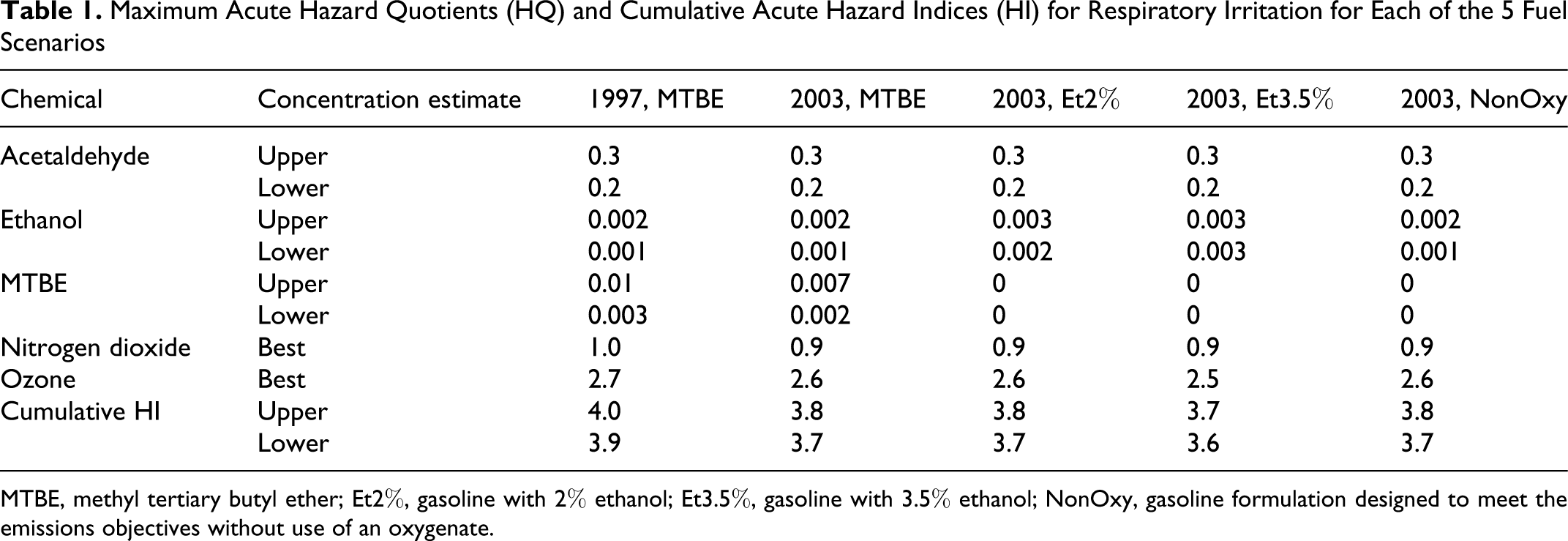
MTBE, methyl tertiary butyl ether; Et2%, gasoline with 2% ethanol; Et3.5%, gasoline with 3.5% ethanol; NonOxy, gasoline formulation designed to meet the emissions objectives without use of an oxygenate.
Perhaps the best-known example of the use of the additivity principle in assessment of multiple chemical exposures is the approach used for dioxin-like compounds. The polychlorinated dioxins are a group of similar compounds (congeners) related by the presence of the basic dioxin structure and varying in the number and position of chlorine substituents. They show structural and toxicological similarity to polychlorinated dibenzofurans (PCDFs) and certain PCBs. All these compounds bind to the Ah receptor, which is part of an intracellular regulatory system responsible for, inter alia, triggering the induction of certain cytochrome P450 isoenzymes in the liver. As a result, they induce a range of dioxin-specific biochemical and toxic responses, including carcinogenesis, developmental toxicity, dermal effects (chloracne), and various interactions with the endocrine system. Most of these compounds, especially the more highly chlorinated compounds, are persistent in the body and in the general environment and accumulate in the food chain. In view of the similar underlying mode of action, the toxicity equivalence factor (TEF) method was developed for risk assessments of exposures to dioxin-like compounds (which generally occur as mixtures of many different dioxin, PCDF, and/or PCB congeners). The TEF is an order-of-magnitude estimate of the toxicity of a compound relative to the toxicity of 2,3,7,8-tetrachloro-dibenzodioxin (TCDD). It is based on measurements of a series of Ah receptor–related toxic and biochemical end points; it is most commonly applied to cancer potency but applies for noncancer dioxin-like effects also. To determine the overall toxicity of a mixed exposure, the concentration of each monitored congener is multiplied by its respective TEF, and all the products are summed to give the total toxicity equivalence (TEQ) as an equivalent concentration of TCDD.
11
This approach is mathematically described as follows:
World Health Organization (WHO) 2005 Toxic Equivalency Factors (TEFs) a
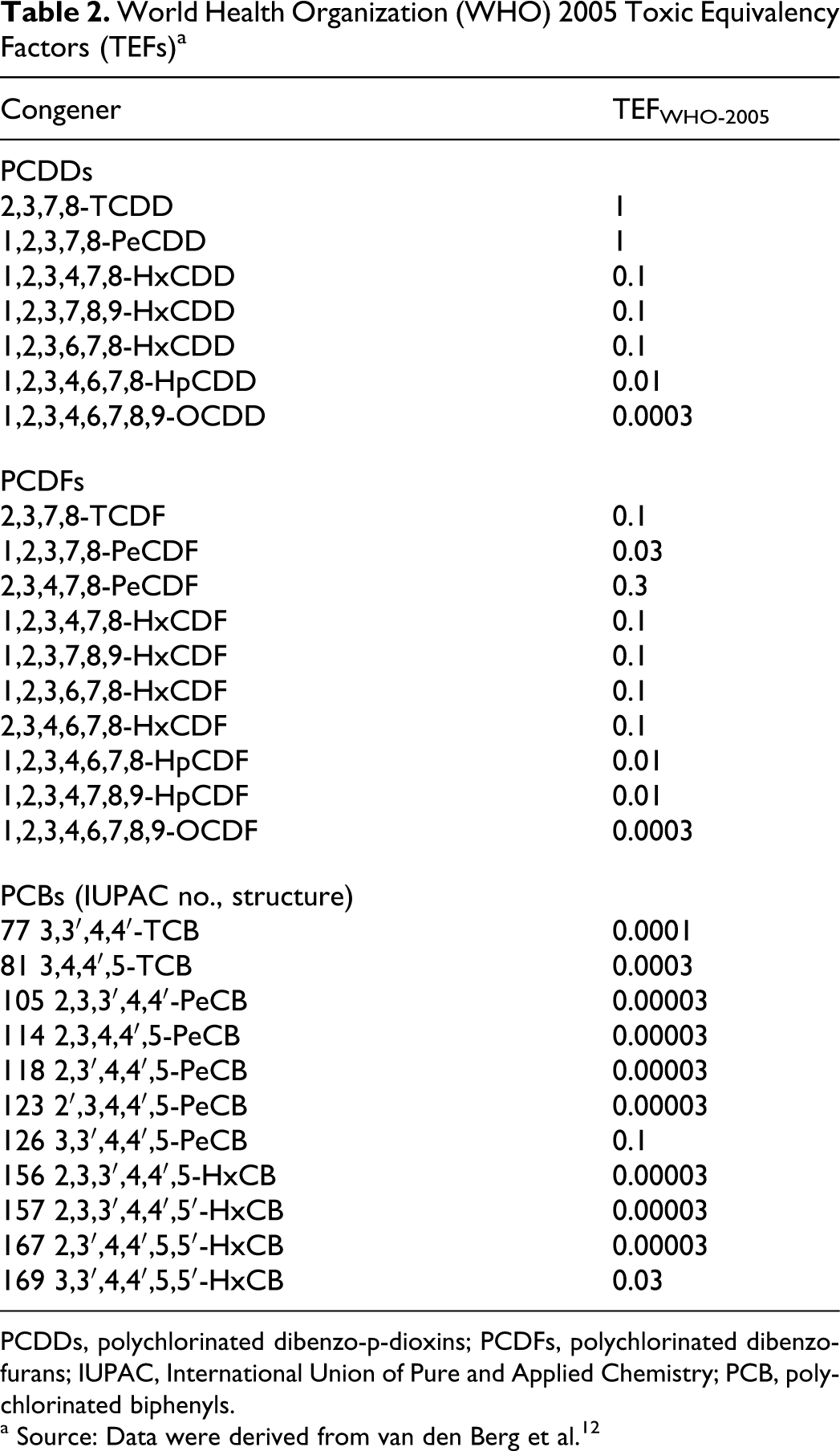
PCDDs, polychlorinated dibenzo-p-dioxins; PCDFs, polychlorinated dibenzofurans; IUPAC, International Union of Pure and Applied Chemistry; PCB, polychlorinated biphenyls.
a Source: Data were derived from van den Berg et al. 12
Additivity for Cancer Effects
Exposure to multiple carcinogens is a common situation and is generally seen as a special case of the multiple compound exposure situation, because most cancers are thought to occur via the same ultimate mechanism (ie, mutation of proto-oncogenes), and any one tumor appearance is likely to have the same ultimate outcome (mortality or tumor-associated morbidity). Cancer risks are therefore usually treated as additive, independent of expected tumor site. In this context the target site in an animal bioassay may not be the target site in humans. For most carcinogenic hazards, one is looking at long-term exposures and lifetime risk, so timing effects are assumed to be minimal.
To calculate overall cancer risks it is usually necessary to determine the exposure to each compound separately and multiply this by a compound-specific cancer potency (slope factor) derived from epidemiological or animal bioassay data. However, in the case of the polycyclic aromatic hydrocarbons (PAHs), a large class of structurally related chemical carcinogens important as combustion-derived pollutants, a generic factor-based approach has been used. This approach is similar in principle to the dioxin TEF method and was used by US EPA and California in developing relative potency factors for dioxins; however, that approach was limited by its reliance on carcinogenicity, which is by no means the only Ah receptor–related effect of dioxins, and the relatively sparse database of bioassays on individual dioxin congeners. OEHHA has developed a table of potency equivalence factors (PEFs), 13 which are used to relate the cancer potency of various environmentally significant PAHs to that of benzo[a]pyrene (Table 3 ).
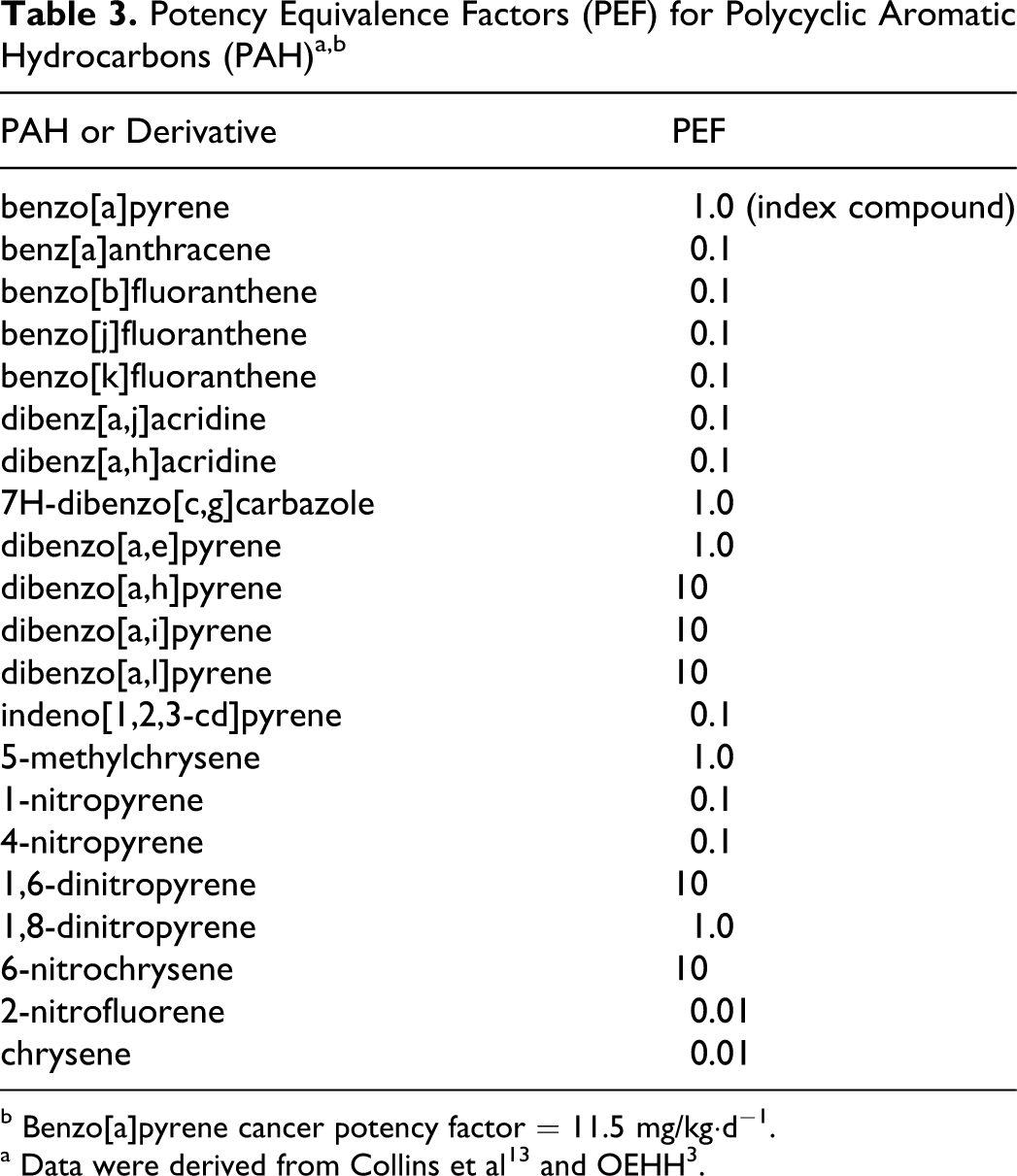
b Benzo[a]pyrene cancer potency factor = 11.5 mg/kg·d−1.
a Data were derived from Collins et al 13 and OEHH3.
Despite this apparently straightforward approach to risk assessment of exposure to multiple carcinogens, some problems remain. We know there are interactions between some carcinogens and promoters but can seldom effectively quantify these. For example, the carcinogenic potency of diesel exhaust particulate matter is approximately 10 times higher than the sum of the potencies (weighted by fractional abundance) for all the measured components. 14,15 This may be due to particle-binding/delivery effects, the role of particles as pro-oxidants and physical promoters, the presence of chemical promoters in the mixture, the presence of unidentified carcinogenic components, or most likely all of the above. Another similar case is tobacco smoke, where the measured total risk is greater than sum of the risks from identified carcinogenic components. 16
Hot Spots—Applications
It appears that various tools are available for dealing with the common types of cumulative risk situations under the Air Toxics Hot Spots program. However, in practice, most site-specific risk assessments deal with only a single source; they typically don’t deal with background or other local sources. They do, however, generally use the additivity assumption for HI and cancer risk in relation to multiple emissions from the single site.
Some efforts to estimate regional background and local concentrations of air toxics have been undertaken by air districts in order to address local issues, in particular the SCAQMD MATES studies (noted earlier) and a study by the (San Francisco) Bay Area Air Quality Management District of oil refineries. Efforts to investigate impacts of multiple sources have also been made by CARB and air districts as part of their environmental justice programs. Given these precedents, multisource studies appear to require direction by the state or air district. The individual facilities do not generally have the information or resources to conduct such assessments, nor are they routinely required to do so.
Further issues arise with the application of cumulative risk methods under the Air Toxics Hot Spots program. Addition of carcinogenic risk is required by risk assessment guidelines, but the most common multiple-source pollutant, diesel exhaust, has not been included in site-specific assessments until recently. It is considered in large-scale assessments under new regulations, but smaller installations are covered by an industry-wide control measure agreement that excludes small and intermittent sources from detailed quantitative assessment. Although this has an admirable result in terms of the efficient control of the individual small sources, it does not necessarily help the cumulative assessment for areas that have multiple such sources in close proximity to one another (or to other large sources, such as freeways). A more detailed assessment may still be needed in such cases. This is an example of a wider constraint; many small sources of common types (eg, dry cleaners, small diesels, gas stations) are covered by industry-wide agreements, so these operators do not do site-specific assessments. Thus, the usual approach to controlling pollutants that come from multiple sources is application of required control measures to all such sources. This works well in general but may not meet the needs of source-intensive neighborhoods.
Conclusion
In the California Air Toxics Hot Spots program, modeling tools are available to assess cumulative risk for the multiple source/single pollutant situation, although these are not as widely applied as one might hope. Tools for dealing with multiple chemicals are also available, such as the HI approach for noncancer effects, the assumption of additivity for carcinogenic risk, and the development of TEFs or PEFs for groups of closely related compounds. However, a number of problems remain, especially for more complex situations where multiple sources and routes of exposure need to be considered. There are some aspects for which systematic solutions do not exist, such as synergisms, for which we have to rely on compound- and mixture-specific dose-response data in the few cases where these are available. As a practical observation, these complexities result in a situation where the cumulative impacts of multiple chemicals from multiple sources are not routinely analyzed.
Footnotes
Acknowledgments
The analyses on which this article is based were supported by the Office of Environmental Health Hazard Assessment of the State of California. However, the views expressed are those of the author alone and do not represent policies of the State of California.