




Abstract
Cumulative risks and impacts have taken on different meanings in different regulatory and programmatic contexts at federal and state government levels. Traditional risk assessment methodologies, with considerable limitations, can provide a framework for the evaluation of cumulative risks from chemicals. Under an environmental justice program in California, cumulative impacts are defined to include exposures, public health effects, or environmental effects in a geographic area from the emission or discharge of environmental pollution from all sources, through all media. Furthermore, the evaluation of these effects should take into account sensitive populations and socioeconomic factors where possible and to the extent data are available. Key aspects to this potential approach include the consideration of exposures (versus risk), socioeconomic factors, the geographic or community-level assessment scale, and the inclusion of not only health effects but also environmental effects as contributors to impact. Assessments of this type extend the boundaries of the types of information that toxicologists generally provide for risk management decisions.
Keywords
The assessment of potential human health and environmental impacts created by exposures to multiple chemical pollutants presents a challenge both to those charged with assessing the magnitude of the impacts and to those charged with making decisions about whether and how to prevent or reduce those impacts. The current regulatory paradigm for assessing health risks posed by environmental pollutants has been formed largely on a set of principles set out in the so-called “Red Book” published in 1983 by the National Research Council. 1 By defining risk assessment as “the characterization of potential adverse health effects of human exposures to environmental hazards,” the process is intended to broadly cover effects that may result from exposure to multiple hazards.1(p18) Since that time, practices have evolved in an attempt to deal with the complex issues surrounding cumulative risk assessment, including the potential for chemicals to interact additively, synergistically, or antagonistically and the implications of different exposure timing and duration scenarios in causing harm. Assessing the risks of cumulative exposures has required numerous assumptions in the face of data gaps and scientific uncertainty regarding the potential for resultant health effects.
The cumulative effects of exposure to multiple chemical pollutants and the current limitations to understanding these effects are issues that have been touched on by regulatory agencies over the years, although the tools to evaluate the potential for such effects with confidence in the myriad circumstances in which it may arise are limited. In different contexts, the subject of cumulative impacts and risks has taken on different meanings. A series of articles in this issue identify some of the areas where risk assessment methods, focusing on threats to human health, are advancing to meet the needs of assessors taking on this complex issue. Some tools that address elements of cumulative impact assessment are already in use in different programs in California. For example, methodologies have been adopted to evaluate combined exposures to multiple chemicals under California’s Air Toxics “Hot Spots” Program 2 (see Salmon et al 3 ), advances have been made in accounting for changing exposures and sensitivity in cumulative risk assessments (see Howd et al 4 ), and community- and neighborhood-scale assessments have been conducted for potential impacts from multiple chemicals from multiple sources.
Background
The US Environmental Protection Agency (EPA) has taken incremental steps toward the development of guidance related to cumulative risk assessment. Guidance and policy developments in this area have included the US EPA’s 1986 Guidelines for the Health Risk Assessment of Chemical Mixtures 5 and its 2000 Supplementary Guidance for Conducting Health Risk Assessment of Chemical Mixtures. 6 The US EPA has also adopted a very specific interpretation of cumulative effects based on the requirement for implementation of 1996’s Food Quality Protection Act, which requires cumulative consideration of chemicals that act by a “common mechanism of toxicity” in the context of setting standards for pesticide residues in foods. 7 This approach is currently applied to organophosphate pesticides, N-methyl carbamates, triazines, and chloracetanilides.
In 1997, the US EPA published more general planning and scoping guidance for cumulative risk assessment that moved to expand the boundaries on the elements that could be considered and identified a need for assessments to transition from single sources, pathways, and exposures to more complete consideration of multiple exposures, pathways, and exposures. 8 Importantly, the US EPA also recognized the significance of moving from centralized to community-based decision making. Most recently, the US EPA’s Framework for Cumulative Risk Assessment provided a more detailed consideration of the subject, exploring aspects of both process and current analytical methods, largely within the prevalent risk assessment paradigm of hazard identification, dose-response assessment, and risk characterization. 9 This guidance did not focus on assessments performed under any specific mandate but focused on the more general issue of how risk assessors could consider the contributions of multiple stressors, multiple pathways, multiple end points, population-based assessments, and a fuller consideration of population vulnerability.
The EPA convened a National Environmental Justice Advisory Council subcommittee, which in 2004, considered the issue of cumulative risk and impacts and which actions should be taken by the US EPA to implement its 2003 framework. 10 This report outlined community-based approaches whereby business and industry in an area can work collaboratively with government and community members to characterize, prioritize, and develop solutions to reduce cumulative burdens. This report underscored the importance of constructing assessment practices that are geared toward action and that use collaborative decision-making processes between community members, business and industry, and government. It further recommended fuller consideration of population vulnerability as an important factor, defining it broadly to include differential exposures, susceptibility, sensitivity, preparedness, and ability to recover from impacts of environmental pollutants.
California Initiative to Develop Guidance
In California, an effort to develop new approaches to the assessment of cumulative impacts has arisen in the environmental justice context, resulting from a state-level mandate requiring the examination of decision-making processes for the degree to which environmental programs, policies, or activities may impede the achievement of environmental justice. Environmental justice is defined in California law as “the fair treatment of people of all races, cultures, and incomes with respect to the development, adoption, implementation, and enforcement of environmental laws and policies” (California Government Code Section 65040.12(e)). California state law also establishes an advisory committee on environmental justice comprosed of stakeholders representing the state’s diversity, including community groups, industry, tribes, and local government, which advises the California Environmental Protection Agency (Cal/EPA). A key part of this committee’s recommendations to the state was to develop guidance on cumulative impact assessment and for the state to develop its own recommendations on how to implement the guidance, whether through changes in environmental policy, regulation, or statutes. 11 The impetus to develop guidance on cumulative impacts assessment arose amid concerns that current risk assessment practices and decision-making processes fail to protect communities from the cumulative burden of environmental pollutants. Recommendations were made to incorporate cumulative impact considerations into land use planning and to locate and permit facilities that might make additional contributions to environmental pollution in communities.
In moving forward in this area, the Cal/EPA adopted a working definition using input from the public, the advisory committee, and the agency’s leadership, which expressed an intent in cumulative impact assessment to consider (1) exposures, public health effects, and environmental effects; (2) all sources of emissions and discharges of environmental pollution in a geographic area; (3) all routes of exposure; (4) routine and accidental releases; (5) sensitive populations; and (6) socioeconomic factors. Defining cumulative impacts with these elements reflects a shift of emphasis and interest in moving from assessments focused on specific agents or sources of environmental pollutants originating from individual facilities to a community- or geography-based assessment that considers all the stressors potentially causing impact. The public process of considering new directions for impact assessment also exposes tensions in perspectives among different stakeholders in the process of developing new practices, including risk assessors and managers, members of impacted communities, and regulated industries. Community members have expressed mistrust of risk assessments because of their perceived shortcomings in accounting for all the hazards communities are exposed to, technical complexity that may obscure meaningful findings, reliance on assumptions that fill data gaps in ways that are not health protective, and cumbersome processes that may allow potentially harmful activities to continue while the assessments are being conducted. These perceived attributes tend to alienate communities and reduce participation in decision making that may ultimately affect their health. Industry groups, on the other hand, express concerns that assessment practices be based firmly on scientific principles and undergo peer review and that decisions that affect regulated industries have a strong evidentiary basis before action is taken. Scientists and others charged with conducting assessments have concerns regarding the limits to what the scientific evidence says about both individual and cumulative impacts and that assessment methods have evolved appropriately as new data develop. The possibility of considering socioeconomic factors in cumulative impact assessment presents a challenge to assessors, because this type of vulnerability has not been traditionally incorporated into assessment practices. The context in which environmental decisions are made has commonly been considered to be under the purview of risk managers, who, according to the NRC’s 1983 definition, must undergo “consideration of political, social, economic, and engineering information with risk-related information.” 1(p19) In this respect, socioeconomic factors have been considered more as modifiers of final decision making rather than as part of the analytic phase.
Making changes to assessment practices will require making decisions regarding what type of assessment may be needed most and what types of tools are most appropriate to develop to meet the assessors' needs. Regardless, cumulative impacts assessments will need to be based on scientific principles and reliable data but also must be transparent, must be understandable, and must engage the public. Potential areas for development include improving tools that (1) help communities understand the combined impact from environmental pollutants in and around their area; (2) are sufficiently substantiated to carry regulatory weight (require decision makers to make certain decisions); (3) improve evaluation of disproportionate exposures to single or multiple pollutants across geography at an appropriate level of resolution; (4) help to establish geographies where thresholds for cumulative impact are exceeded; or (6) help understand the incremental health and environmental impact from a given project to the existing sources of impact in the relevant area.
California Environmental Justice Pilot Projects
Diverse communities within California illustrate the complexity of undertaking cumulative impact assessment on a geographic basis. The State of California has been involved in pilot projects representing diverse geographies and populations in 5 locations across the state: tribal communities along the Klamath River, urban communities in West Oakland and Wilmington, an agricultural community in the Central Valley, and a Mexican border community in southern California.
Parlier
The Central Valley’s agricultural community and city of Parlier, near Fresno, is an area potentially subject to pesticide exposures and drift, contamination of ground water, and poor regional air quality, which is among the worst in the nation, particularly for ozone and particulate pollution. 12 Additionally, the community has significantly lower socioeconomic status than the rest of the state, an overall younger population, and high prevalence of asthma. The State’s Department of Pesticide Regulation (CDPR) has undertaken an ambitious project to monitor pesticides at 3 school locations in the city through the 2006 calendar year, evaluating samples for more than 30 pesticides monitored 3 times weekly and more than 40 volatile organic compounds monitored once a week. The results are to be used to consider opportunities for risk reduction, changes in pest management practices, enforcement against illegal pesticide application practices, and improvements to pesticide labeling.
Wilmington and West Oakland
The cities of Wilmington and Oakland are adjacent to the Port of Long Beach and Port of Oakland, respectively. Communities in these areas suffer from localized impacts related to goods movement, including ships, rail yards, and trucking activities. 13 West Oakland is also characterized by a large number of abandoned industrial sites with hazardous waste contamination, a population with low socioeconomic status, a high number of residents younger than 18 years relative to the rest of the state, and a high prevalence of asthma. California’s Department of Toxic Substances Control established a forum to bring together various stakeholders in this community to consider ways to reduce sources of pollution. 14 Among the goals are to involve the entire community, characterize localized impacts from goods movement, and prioritize brownfield site cleanup. Assessment of the Wilmington community is aimed at identifying potential regional control strategies.
Klamath River
The Klamath River is a major water body in northern California affected by a number of competing interests, including salmon fishery, agriculture, hydroelectric power production, recreation, and increasing urbanization. 15 Indian tribes in the Klamath watershed have a major historical use and reliance on the salmon fishery, and a decline in salmon number with significant die-off events in recent years has coincided with a decline in tribal health, including a high prevalence of diabetes, heart disease, and obesity. The uses of the river are under consideration as part of the development of a plan to attain desired water quality standards as required under the Clean Water Act, with the eventual goal of reducing the die-offs of salmon that have occurred in recent years. The State Water Resources Control Board has undertaken a project to collect data directly from Klamath tribes related to impacts on social and cultural practices that may ultimately affect health. These data are intended to support decision making in the watershed through the Total Maximum Daily Load development process.
Calexico
Wastewater, sewage, and agricultural runoff discharged in and around the large Mexican city of Mexicali produce a body of water called the New River that flows across the US border through the city of Calexico toward the Salton Sea. The river has been shown to contain numerous chemicals and pathogens. 16 The neighboring community has been characterized as low socioeconomic status, with high unemployment and a widespread lack of health insurance. The State Water Resources Control Board has established a regional advisory group to evaluate strategies to reduce farm runoff of contaminants in both the United States and Mexico. The state has also worked with the Mexican government to reduce raw sewage flows. A new wastewater treatment plant in Mexico is expected to result in significant improvement to the river’s water quality.
Scientific Challenges
Numerous community-scale studies have been conducted across the nation in recent years with goals, including the assessment of overall pollutant burden in a given area. Such studies include communities examined in the Boston area, West Oakland, the Chicago area, and other areas by groups receiving cooperative agreement grants under the US EPA’s Community Action for a Renewed Environment Program, which seeks to help communities find ways to reduce important sources of toxic pollution. 17-20 Studies of this type have had a strong reliance on available or existing data on potential sources of environmental pollution, which is unsurprising, given the considerable resources that would be needed to generate new data. Using existing data requires a critical examination of any source of information for its reliability for drawing conclusions as to contribution to impacts. Among the important characteristics of an information source are the degree to which it says something about potential exposures or effects, its ability to provide quantitative information as to the magnitude of effects, whether the information in it is correct and complete, and how well the data resolve differences in potential exposures spatially.
Typical classification schemes for environmental pollutants include point sources (industrial and commercial facilities, hazardous waste sites), area-wide sources (consumer products, dispersed solvent use), mobile sources (cars, trucks, buses, ships, airplanes), agricultural sources (pesticides, dust), domestic sources (drinking water, food, home hazards, indoor air), and natural sources (smoke from wildfires, radon in homes). Numerous federal and state government programs maintain data on pollutant sources in many of these categories (see Table 1 ), and much information is publicly available, although the degree to which these program data are useful for characterizing potential impact varies considerably.
Pollutant Categories and Potential Sources of Relevant Information and Data
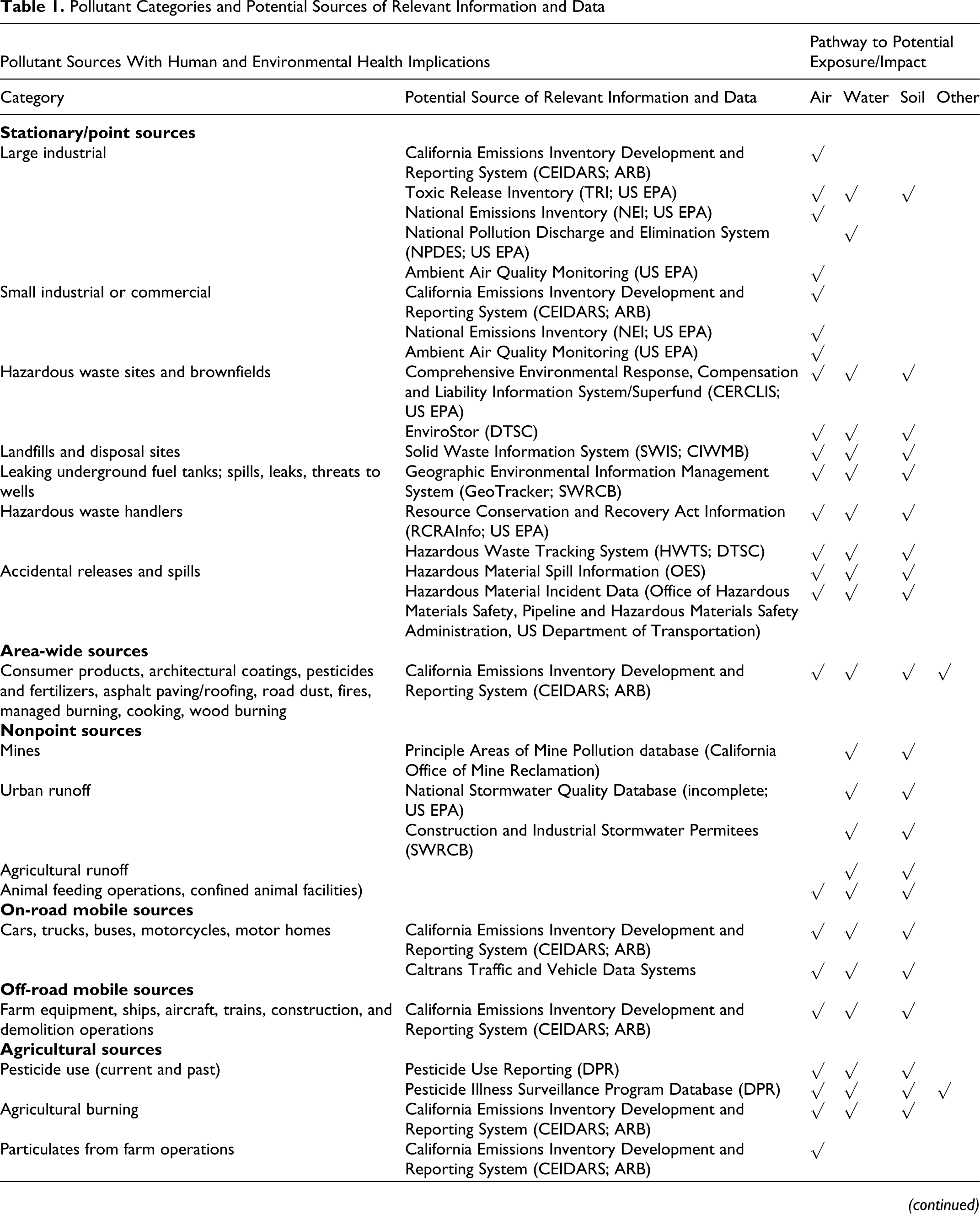
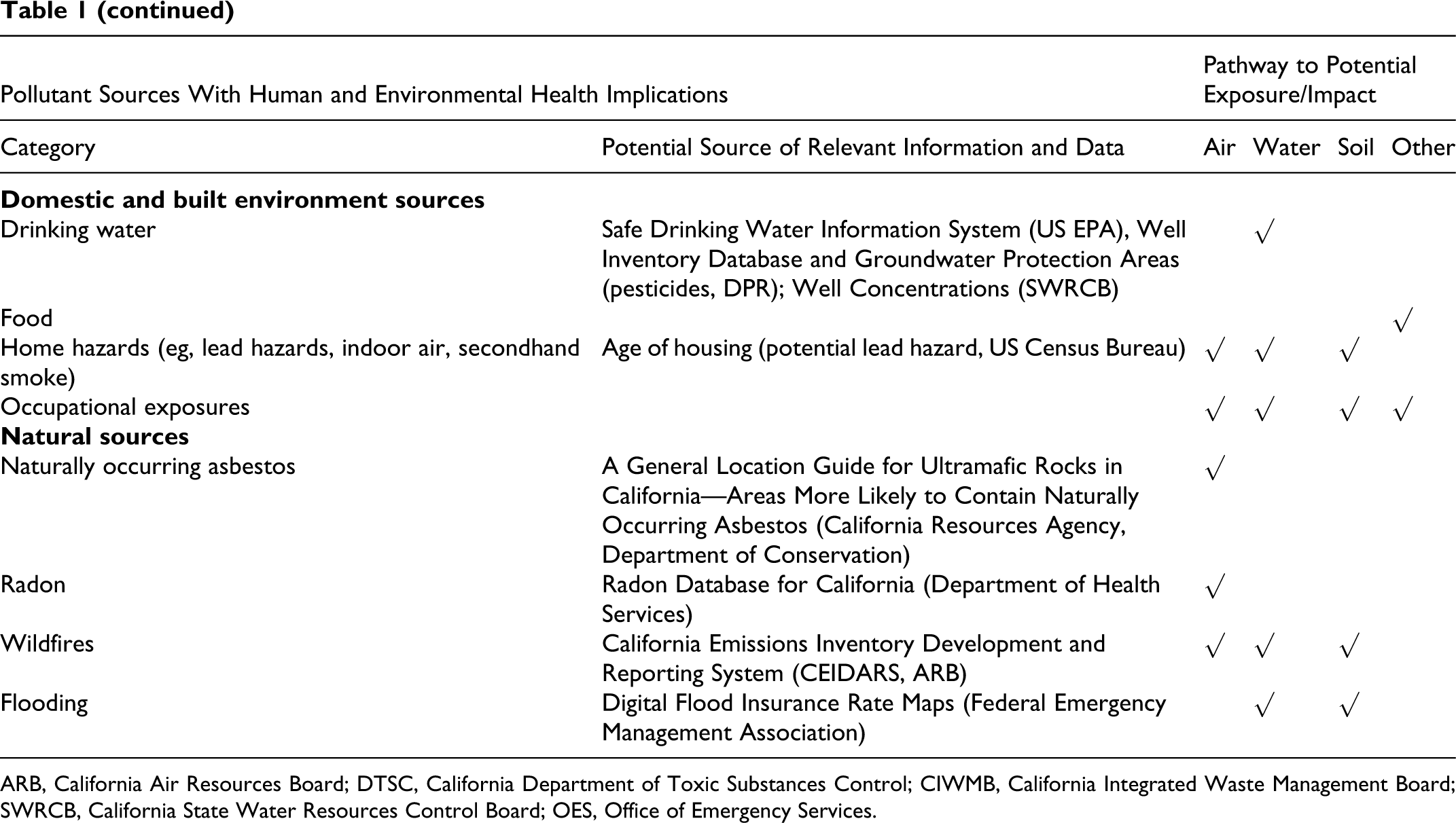
ARB, California Air Resources Board; DTSC, California Department of Toxic Substances Control; CIWMB, California Integrated Waste Management Board; SWRCB, California State Water Resources Control Board; OES, Office of Emergency Services.
The health risk model with the elements of source, concentration, exposure, dose, and effect provides a useful framework to examine how different types of available information on chemical pollutants may fit into an impact assessment (see Figure 1 ). Under this model, sources of pollutants or uses of chemicals result in environmental concentrations through fate and transport processes. Human activity in the presence of these concentrations produces exposures and doses following uptake. Interactions with the body then have the potential to result in adverse health effects. In the absence of health impact data themselves, data that allow estimation of dose are the most useful for characterizing potential health impacts.
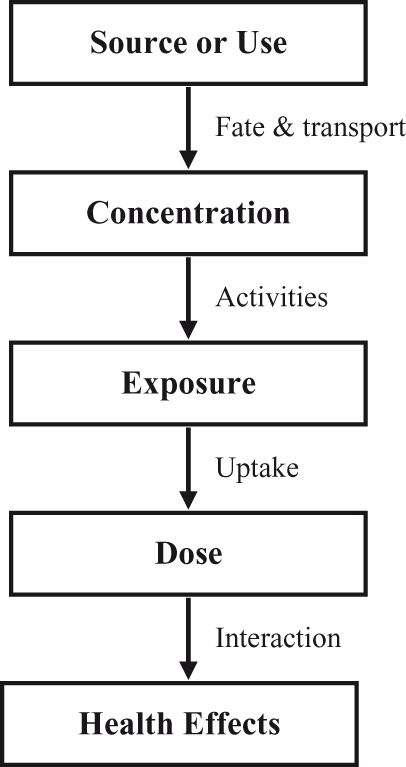
Health risk model.
Source Gaps
A lack of specific information about a category of pollutant source can prevent a clear understanding of cumulative pollutant burden. Examples include the lack of readily available information on exposures in occupational environments and exposures to contaminants in indoor air. Sources of exposure may also be missed because data reporting for specific chemicals may not be required.
Exposure Gaps
Even when some information is available as to a specific source of pollution, there may be limits to the ability to estimate likely exposures. For example, existing hazardous waste sites or brownfields may be characterized for likely contaminants, although the extent of leaching into groundwater or fugitive air emissions may not be readily understood. Food contaminants exposures and indoor air exposures may also be difficult to evaluate in this regard.
Toxicity Gaps
Many chemicals have been evaluated for their potential to harm human health, 21,22 although these assessments rely on the scientific evidence that is available regarding their toxicity. This information may be incomplete or inadequate for specific end points or may be absent entirely for certain chemicals. Chemicals may not also be completely characterized with respect to their ability to cause harm to sensitive or vulnerable populations.
Cumulative Effect Gaps
Most combinations for chemical exposures encountered have not been specifically tested for their potential to interact to cause adverse effects. This includes a lack of knowledge about how to evaluate the impact for toxicants that cause effects at different end points and the challenge of finding common metrics for combining human health impacts and ecological impacts.
Health risk assessors can address some of these data gaps without necessarily requiring the generation of new data. Potential exposures from stationary sources may be estimated by air dispersion models, multimedia transport models may be used to estimate the migration of contaminants in soil, and so forth. For cumulative effects gaps, one of the challenges is to find common terms to express the magnitude of threat from a number of possible exposures. A common assumption is additivity, and the approach to evaluating the potential for effects from combined exposures and hazard quotient and index for noncarcinogens and a summing of risks for carcinogens has been the prevalent approach in risk assessment for assessing exposures to multiple pollutants (see Salmon et al 3 ).
Implementation in Environmental Decision Making
A priority in the development of guidance, tools, and methods related to assessing cumulative impacts is to determine how the guidance will be used in decision making. Environmental regulatory activity commonly occurs by regulators acting within specific mandates and jurisdictions, although cumulative impact assessments are likely to involve both data and authorities that cross jurisdictional boundaries. So an important consideration is how to plan for integration across jurisdictions. The identification of opportunities for implementation requires a review of existing statutes and regulations to identify where relevant agencies have the discretion to make changes, either by adding to current practices or creating new practices. Another important consideration is how current law may already constrain what factors might be included in decision making.
The concept that multiple pollutants or stressors may interact to bring about significant impacts to human and environmental health is not new in the regulatory context. Major environmental laws relevant to the subject of cumulative impacts and risks include the National Environmental Policy Act of 1969 23 (NEPA) and several state-level environmental laws, sometimes referred to as “little NEPAs,” including the California Environmental Quality Act of 1970 24 (CEQA). Both NEPA and CEQA require environmental assessments for projects undertaken, funded, or permitted by public agencies and require assessors to address potentially adverse effects to land, air, water, minerals, plants, and animals, among others. These laws' implementing regulations have also required consideration of cumulative effects or impacts, defined in the case of CEQA as “two or more individual effects which, when considered together, are considerable or which compound or increase other environmental impacts” (California Code of Regulations, Section 15355). Assessments must also consider the “incremental impact of the project when added to other closely related past, present, and reasonably foreseeable probable future projects” and incorporate the concept that “individually minor but collectively significant projects taking place over a period of time” may contribute. Although these requirements have existed for decades, in practice the cumulative impacts analyses of environmental documents have commonly been cursory, particularly with respect to health impact assessment. This has been largely a result of a lack of guidance with standard methodology for evaluating such impacts and their thresholds of significance. Project-based approaches may permit the attribution of any given source of impact from pollutants in a geographic area to the total impact and allow for the consideration of alternatives, should impacts be considered unacceptable.
As an alternative, cumulative impacts assessment may be conducted to increase understanding of the cumulative burden from combined exposures to emissions and discharges of pollutants and to establish priorities for improvement within a given community or geographic area. Subsequent strategies may include determinations as to whether polluting facilities or other sources are operating within the law. Remediation may be a matter of greater enforcement, or it may identify a need to bring additional regulatory action to alleviate significant impacts.
Developing guidance on cumulative impacts requires undertaking numerous interrelated activities. These include finding ways to identify all meaningful contributors to cumulative impact, including those contributors which, when combined with others, become meaningful; finding ways to sufficiently resolve pollutant exposures across geography and populations; and establishing common metrics for combining impacts caused by different stressors. Focusing effort on developing tools and methods to assess cumulative impact clearly will require a collaborative endeavor between all the relevant stakeholders.
Footnotes
The authors declared no conflicts of interest with respect to the authorship and/or publication of this article.
This research received no specific grant from any funding agency in the public, commercial, or not-for-profit sectors.