




Abstract
This study aimed to describe extrafamilial homicide offenders’ confessions in police interrogation. The Quebec Coroner’s office supplied data from 76 homicide files including coroner reports. Pearson’s Chi-squared analyses showed that the offenders were significantly different according to confession type for the method used and the antisocial, borderline, and narcissistic personality disorder traits. A two-step cluster analysis revealed three profiles: Confession—quarreler and sexual; Confession—quarreler and mental illness; No confession—quarreler and criminality. Our findings further our understanding of confessions in police interrogation by adding psychological variables and could allow investigators to refine their interrogation strategies.
Keywords
In Quebec, between 2010 and 2019, there were 839 homicides, or on average 84 homicides per year in the past 10 years (David, 2017). According to the Canadian criminal code (Cournoyer, Ouimet & Dubois, 2005), a person has committed homicide when they cause the death of a human being. When reporting homicides according to the offender/victim relationship, Statistics Canada counted about 35.5% of acquaintances, 10.1% in the criminal relationship category and 15.5% in an unknown relationship. Furthermore, between 2006 and 2015 in Canada, homicide outside of the family sphere or extrafamilial homicide (EH) represented 60.8% of homicides (David, 2017). Some authors have underlined the importance of differentiating between intrafamilial and EH for criminological and psychological variables (Cao et al., 2008; Hedlund et al., 2016; Juillard, 2017).
Over the years, extensive research on homicide has been performed to understand, describe, and prevent this severe crime (Block & Block, 1991; Fox & Allen, 2014; Holmes & Holmes, 2008; Roberts et al., 2007; Salfati & Dupont, 2006). Further studies have allowed researchers to differentiate between homicide offender according to multiple variables and characteristics, but especially according to the motive behind the crime in typologies (Alderden & Lavery, 2007; Block & Block, 1992; Fox & Levin, 2005; Guôjónsson & Pétursson, 1990; Hata et al., 2001; Holmes & Holmes, 2008; Roberts et al., 2007; Salfati, 2001; Salfati & Dupont, 2006). The motive is a variable useful to explain the crime, understand the offender and used in suspect development. In the study of homicide and ever since the FBI studies on serial homicide, a focus on police work and investigation variables has allowed to refine our understanding of offenders, prevent homicides or convict offenders. Out of these variables, the confession of any crime has been the source of many studies. Confession has been widely considered an important element of proof in police investigations to lead to convictions and are considered even more essential for the protection of the public in severe crimes (Oxburgh et al., 2015).
However, only little research has focused on the confession of homicide in police interrogation (Cavanagh et al., 2005; Feliciano et al., 2020; Ferguson & Pooley, 2019; Tomas et al., 2021; Vaillancourt, 2009). These studies define/operationalize confession in various ways and result in varying confession rates for homicide offenders. These differences in definitions make it difficult to compare said confession rates and identify just how homicide offenders confess their crime in police interrogation. Furthermore, most studies have focused on intrafamilial homicide offenders, only one has compared EH and intrafamilial homicide offenders (Cavanagh et al., 2005) and none have focused exclusively on EH offenders in the study of confession. Then, the motive hasn’t been considered as a variable related to confession in the study of homicides. In the perspective to fill that gap in the literature, this study’s objective is, on the one hand, to bring a better understanding of the confession of EH offenders by describing their confessions, and on the other hand, explore the link between psychosocial variable and EH confessions and discriminate between the EH offenders. As such, this article was conducted to answer the following questions:
How do EH offenders confess their crime in police interrogation in Quebec?
Is there a link between confession and motive for homicide offenders?
Can we differentiate EH offender profiles according to their confession type and other psychosocial variables?
For this study, we used data from the Quebec Coroner’s office coroner reports and police investigation files (N = 76). Descriptive statistics are reported to describe the EH offenders and their confession. Chi-squared analyses are conducted to find which sociodemographic, criminological, and psychological variables vary according to confession type. EH offender profiles are built using a two-step cluster analysis to differentiate different types of offenders. Chi-squared analyses are conducted again to measure how the identified profiles differ from one another.
Literature Review
Definition and Scope of the Phenomenon
Homicide and typologies
Multiple studies have aimed to classify homicide perpetrators to determine how perpetrators are similar or different. This has been done according to personality, pathology (Biro et al., 1992; Brad et al., 2014) but also offender/victim relationship (Bijleveld & Smit, 2006; Cao et al., 2008; Hedlund et al., 2016; Juillard, 2017; Salfati & Dupont, 2006). Blends of multiple categories were also used to categorize homicide (Cusson, 2015; Scherr & Langlade, 2014). Classifying offenders not only allows investigators to better understand homicide but can also help in suspect development, homicide prevention, or police interrogation.
Confession: Definition and characteristics
Kassin and Gudjonsson (2004) define confession as a suspects’ admission of guilt through a detailed declaration, either verbal or written. To better describe the different possible outcomes of an interrogation, Leo (1996) offers a four-fold outcome-based definition of confession: 1- No incriminating statement—the suspect declares no incriminating information; 2- Incriminating statement—the suspect declares incriminating information with no admission of responsibility for the crime; 3- Partial admission—the suspect partially admits to the crime but does not recognize all its elements; 4- Full confession—the subject admits to being responsible for the whole crime.
Variables Linked to Confession
Sociodemographic characteristics
Multiple studies have found confession rates (of any crime) of around 50% (Deslauriers-Varin et al., 2011; Phillips et al., 1998). Studies found multiple characteristics linked to confession. Some studies suggest that the interrogated offender’s gender plays a role in their tendency to confess. Indeed, multiple studies found that women confessed more often than men in police interrogation (Cleary & Bull, 2021; Inbau et al., 2011; Phillips et al., 1998; Royal & Schutt, 1976). However, others found no such difference (Moston et al., 1992; Pearse et al., 1998). Studies that considered multiple types of crimes at once have identified that older suspects were less inclined to confess their crimes (Baldwin & McConville, 1980; Pearse et al., 1998; Phillips et al., 1998) while others found no such difference (Evans, 1993; Moston et al., 1992). Gudjonsson (2013) explains the differences found by maturity, temperament, adaptation skills, and a better grasp of their legal rights. Phillips et al. (1998) found that Caucasian suspects were less inclined to confess than Asian or Black suspects. However, they were also more likely to ask legal advice, which could explain the lower confession rates. Others found no such significant difference (Pearse et al., 1998).
Psychological characteristics
Gudjonsson and Petursson (1991) identified that offenders with an introverted personality were more inclined to confess their crime. Some authors suggest that these results could be due to a lack of self-confidence, a feeling of guilt, emotivity and anxiety in individuals with an introverted personality, or an avoidant, dependent or schizoid personality disorder (St-Yves, 2006; St-Yves & Meissner, 2014). Some studies found that the feeling of guilt could facilitate confession in police interrogation (Deslauriers-Varin et al., 2011; St-Yves, 2002). Offenders with narcissistic or antisocial traits, and an extraverted personality were linked to a lack of remorse, collaborated less with police, and were therefore linked to lower confession rates, while the struggle to face an interrogation, emotional instability and impulsivity were linked to higher confessions rates (St-Yves, 2002, 2004). Furthermore, Pearse et al. (1998) have found that suspects who took an illicit drug 24 hours before the interrogation were more likely to confess their crime.
Criminal characteristics
Few studies consider both confession and the victim/offender relationship. Gudjonsson and Sigurdsson (2000) suggested that confession rates could vary according to the type of crime and victim/offender relationship. Some studies found that sex offenders are more likely to confess their crime if they did not know the victim (Beauregard & Mieczkowski, 2012; Beauregard et al., 2010) while others found no such influence on confession rates (Faller et al., 2002). Multiple studies found a statistically negative relationship between severity of a crime and confession (Evans, 1993; Moston et al., 1993; Phillips et al., 1998; St-Yves, 2002). While Phillips et al. (1998) explain this difference as influenced by legal counsel and perception of proof, Gudjonsson (2003) suspects that it’s the legal consequences related to the severity of the crime that would motivate a suspect to stay silent. Deslauriers-Varin et al. (2011) found that the offender was more likely to confess when their crime was severe and explain this result by greater efforts made by the investigators when they interrogate a severe crime offender. Other studies have focused on the relationship between the nature of the crime and confession. Holmberg and Christianson (2002) found that violent offenders were more inclined to confess than non-violent offenders, whereas other studies found no such difference (Deslauriers-Varin & St-Yves, 2006; Moston et al., 1992). Furthermore, prior criminal activities were found to be linked to lower confession rates (Baldwin & McConville, 1980; Deslauriers-Varin et al., 2011; Moston et al., 1992). Deslauriers-Varin et al. (2011) explain the latest result by the fact that experienced offenders were already accustomed to the judicial system.
Contextual characteristics
Multiple studies found a statistically negative relationship between the use of legal counsel and confession (Deslauriers-Varin et al., 2011; Moston et al., 1992; St-Yves, 2004; Verhoeven & Stevens, 2012). Others studied the influence of interrogation techniques on confession: a compassion and relationship-oriented model allows for increased confessions and reduction in false confessions (Jones & Penrod, 2016; May et al., 2021; Oxburgh et al., 2014; Verhoeven, 2018; Vrij et al., 2015; Wachi et al., 2014). Cleary and Bull (2021) underline the influence of the pre-interrogation intentions of confessing or denying the crime on interrogation outcomes. Multiple studies found higher confession rates when suspects considered that the proof against them was strong (Deslauriers-Varin et al., 2011; Gudjonsson & Petursson, 1991; Moston et al., 1992). Some note the perception of proof as a key role in confession, more so than sociodemographic and criminological characteristics, but is influenced by legal counsel and the type of crime (Deslauriers-Varin et al., 2011). 1
Homicide and Confession
While Holmberg and Christianson (2002) found that homicide offenders confessed (49%) more often than sex offenders (28%), Gudjonsson and Sigurdsson (2000) compared violent crime offenders (including homicides) to sexual offenders and found no difference between the two. In a study on police officers’, sexual offenders’, and homicide offenders’ perception of interrogation, Oxburgh et al. (2015) found that homicide offenders reported feeling more respected by the interrogator than sexual offenders did, and the officers saw confessions as a major interrogation goal only in homicide cases. Ferguson and Pooley (2019) found that 39.3% of offenders of no-body homicides confessed to the police. Cavanagh et al. (2005) have found that men who committed an intrafamilial child homicide were more inclined to reveal their crime to the police (38%) than extrafamilial child homicide offender (3%). Multiple authors have studied exclusively intrafamilial homicide and have considered confession. In Québec, Vaillancourt (2009) found high confession rates for intrafamilial homicides: domestic homicide (76.3%), parricide (the homicide of one’s father; 84.6%), and filicide (homicide of one’s own child; 66.7%) but found no significant difference. The author suggests that the feeling of guilt is linked to the close offender/victim relationship and explain these high confession rates. Furthermore, an FBI study (Feliciano et al., 2020) found five types of confessions for intimate partner homicide offenders. They often confessed their crimes to non-law enforcement individuals (mostly acquaintances or friends, 37.1%), made voluntary-spontaneous confessions out of the interrogation room to law-enforcement (28.6%), confessed in police interrogation (22.9%), left a suicide note (10%) or claimed self-defense (1.4%). Some offenders confessed using multiple types. Tomas et al. (2021) reported a confession rate of 98% for intrafamilial homicide offenders. They however included confessions made to law enforcement or to a third party, in or out of police interrogation. They describe that 36.4% confessed after being arrested, and 20.4% confessed after trying to deny or conceal the crime.
Offender’s motive: Studies and typologies
Different authors have tried to define motive. Authors have defined homicide motives as precipitating circumstances or the offender’s primary goal surrounding the crime (Block & Block, 1991; Nielsen et al., 2005). Numerous studies have classified homicides according to the motive behind the crime (Alderden & Lavery, 2007; Block & Block, 1992; Fox & Levin, 2005; Guôjónsson & Pétursson, 1990; Hata et al., 2001; Holmes & Holmes, 2008; Roberts et al., 2007; Salfati, 2001; Salfati & Dupont, 2006). Most typologies used a categories approach and described quarrel related homicides, organized crime related homicides, sexual homicides, familial homicides, among others. Some authors described motive categories for specific types of homicides: filicides (Léveillée & Doyon, 2019; Putkonen et al., 2016; Wilczynski, 1995), sexual homicides (Beauregard & Proulx, 2007; Sewall et al., 2013), intimate partner homicide (Leth, 2009) or serial homicide (Holmes & Holmes, 2008). Other authors described the motive as polarized scales or dichotomies. For instance, some have drawn an expressive (confrontation, unplanned acts of anger) versus instrumental (predatory violence aimed to achieve a goal or gain) continuum for motives of homicides (Block, 1977; Block & Block, 1991, 1992). Others suggested adding a second scale to the original continuum with a planned/spontaneous dimension (Block et al., 2001) or defensive versus offensive (Fox & Allen, 2014). Finally, Santtila et al. (2003) used the dimensional approach to motive and found that out of over 500 homicide offenders, 46% of homicide offenders confessed their crime in police interrogation and another 19.3% surrendered before the interrogation. Expressive homicides, as opposed to instrumental homicides, were linked to more confessions, surrendering to the police, and less denial of the crime. This study was the only one found that considered homicide, confession, and motive.
While many have studied the influence of sociodemographic, criminological, and contextual factors on confession rates, the literature is inconsistent as for the presence or absence of said influence. Little research has been done on the influence of psychological features on confession: introversion, guilt, and drug use could be related to higher confession rates while Antisocial and Narcissistic personality traits to lower confession rates. Furthermore, few have studied confession in homicide cases. This handful of studies often compared homicide offenders to other types of offenders or chose a specific type of homicide. As for the motive, it is rarely defined and often overlapping with other variables (Daly & Wilson, 1988). 2 A gap in the literature was uncovered as we have found no study considering both confession and EH offenders. Those covering both homicide and confession rarely compare different homicide categories and were never compared using the motive as the main variable.
Goals
This study examines the confession of EH offenders in police interrogation. The goal of the present study is threefold. The first is to describe EH perpetrators’ confessions using the sociodemographic, psychological, criminological, and contextual variables known to be linked to confession. A second goal is to verify if the motivation and other psychosocial variables of an EH offender vary according to different types of confession in police interrogation (full confession, partial admission, no confession). A third objective is to evaluate if different EH offender clusters can be distinguished using these variables. To our knowledge, these variables have not been studied together, which calls the need for an exploratory study. As we have found no other study that considered the homicide motive when studying confession, it is difficult to anticipate where said differences will be found. We emit the hypothesis that different kinds of motives will be related to a different prevalence of confession types. However, as we know that criminal history is linked to lower confession rates, criminality and sexual motives could be linked to lower confession rates than mental health and quarrel and dispute motives. Furthermore, it is also expected that different EH offender profiles can be distinguished according to both confession and motive.
Method
Sample (Files)
The study is part of a larger project about psychosocial and criminological characteristics of homicide. The study involved 357 homicide files from Québec’s Public health minister between 2012 and 2019 in the Quebec province (CER-07-121-07-10). Files with victims of the same offender (in the same event), committed outside of Quebec territory, unsolved homicides, files with no information on the offender or on confession, homicides committed by women (only two were documented) and intrafamilial homicides were excluded. As such, the final sample comprised of 76 selected files with information on the offenders (mean age = 35.5 years, SD = 12.2) and their victims (mean age = 44.4 years, SD = 16.6) at the time of the homicide.
Measures
The data was collected using the Grille Multidimensionnelle de l’Homicide Intrafamilial (Léveillée et al., 2003) to identify the offender’s sociodemographic, criminological, and psychological data coherent with the variables predicting confession in the literature. The sociodemographic data consisted of the age, gender, and the victim/offender relationship classified as stranger, acquaintance, or friend. For the criminological data, the criminal record was collected, coded as present or absent. The number of victims, primary accomplice (participated in the murder) or secondary accomplice (helped the offender but did not contribute to the murder) was accounted for. The method used to kill was classified in four categories: firearm, sharp weapon and blunt objects, bare hands and strangulation, other methods. The presence or absence of overkill was coded using to Wolfgang’s (1958) definition: when there were more than five wounds caused by a blunt object, sharp weapon, or firearm, when the victim was severely beaten, or when more than one method was used to kill the victim. The treatment of the body after the murder was classified in three categories: the body was not disposed, the body was moved to temporarily hide it (concealed), the body was moved to indefinitely hide it or to destroy it (disposal of body).
The motive categories were built using the different categories found in the literature (Alderden & Lavery, 2007; Salfati & Dupont, 2006). Four categories were chosen: 1- Quarrel and dispute; 2- Criminality (in the context of organized crime or another crime); 3- Mental illness (when the perpetrator was afflicted with severe mental illness that made him lose touch with reality); 4- Sexual (during the commission of a sexual offense), as used in Léveillée et al. (2021). For all cases with enough information, the presence of Antisocial (APD), Borderline (BPD) and Narcissistic (NPD) personality disorder traits was evaluated with the DSM-V definition of these diagnoses (American Psychiatric Association, 2013). Next, the confessions were coded using Leo’s four-fold typology (1996): 1- No incriminating statement; 2- Incriminating statement; 3- Partial admission; 4- Full confession. Due to our small sample and for more reliable statistical analyses, the categories were collapsed to three: 1- No confession; 2- Partial admission; 3- Full confession. 3 This classification was also used by Cleary and Bull (2021).
Procedures
Each file was taken from Québec’s Public health minister and included medical and psychiatric reports, the medicolegal reports from the pathologist and the police investigation report. The offenders court ledgers were collected from an online access to the Québec Courthouse criminal records. Finally, some missing information was found in journal articles, books, and Court reports. To ensure reliability in the categorization of confession type, motive type and personality disorder traits evaluation, an interrater agreement was performed for all 76 homicide cases included in this study by a Ph.D. student in psychology/psychotherapist and a psychology professor/psychologist. The interrater agreement for the psychological evaluation was performed to determine the presence or absence of all APD, BPD and NPD traits in accordance with the DSM-V definition of these diagnoses. Considering that some of the traits underlined in the DSM-V are near impossible to accurately evaluate for both the BPD and NPD using files, the cut-off to identify the presence of traits of these personality disorder diagnoses was lowered to the presence of three traits instead of the four traits cut-off recommended by the DSM-V and was used to discriminate offenders with personality disorder traits (three or more traits) from those without personality disorder traits (less than three traits) for APD, BPD and NPD. For the BDP, the “identity disturbance,” “affective instability,” and “chronic feelings of emptiness” traits were near impossible to identify. For the NPD, the “grandiose sense of self-importance,” “requires excessive admiration,” “often envious” were difficult to observe through files. Furthermore, some personality disorder traits were discussed more in depth because they were more difficult to evaluate out of a file, like the “lack of remorse” trait of APD, the “impulsivity in two potentially self-damaging areas” or “extremes of idealization and devaluation” of BPD and the “lacks empathy,” “sense of entitlement” or “has a grandiose sense of self-importance” of NPD. Furthermore, when the amount of information wasn’t enough to ascertain the presence of a trait, it was excluded.
Data Analysis
The data was analyzed using the statistics software SPSS 26 (2018). Sociodemographic, criminological, and psychological offender characteristics were extracted with descriptive analyses. The selected variables were then compared according to the different confession categories using crosstabs and Chi-Squared (χ2) analyses. Post-hoc analyses were made using chi-squared analyses residuals. Bonferroni’s correction was applied on the variables that showed a statistically significant difference on the Chi-Squared analysis, following the procedure described by Field (2013). In a second step, a cluster analysis was performed to determine different extrafamilial homicide profiles according to some selected variables: confession in police interrogation, offender/victim relationship, motive, method to commit homicide, personality disorder traits. The selected variables were selected because of their relevance in the literature or because of the significant difference in the Chi-Squared analyses. This cluster analysis’ objective is to identify individuals who share similar patterns of characteristics in the selected variables and regroup them. A Cluster Two-Step analysis was performed following the Bayesian Information Criterion. The number of clusters was determined using the cluster quality measure featured in SPSS. Chi-square analyses were performed to evaluate if the different profiles created by the cluster analysis were significantly different from each other. Post-hoc analyses were made using chi-squared analyses residuals (with Bonferroni’s corrections) on the variables that showed a statistically significant difference at the Chi-Squared analysis, following the procedure described by Field (2013).
Results
Psychosocial Characteristics of the Extrafamilial Homicide Offenders
Sociodemographic characteristics
Results show that homicide offenders were on average 35.5 years old (SD = 12.2) when they committed the crime. The data was however missing for two cases. Most of them (54%) were in an age range of 17 to 35 years and the remaining were mostly between 36 and 55 years of age (39.2%). Only five cases (6.8%) were over 56 years. The offenders age ranged from 17 to 62 years old. For the victim offender relationship, most offenders had an acquaintance relationship with their victim (55.3%), and an equal amount had a stranger (22.4%) or a friend (22.4%) relationship to their victim.
Criminological characteristics
The results indicate that most of the EH offenders had a previous criminal history (76.7%) whereas only a minority hadn’t (23.3%). A vast majority of the EH offenders only had one victim (96.1%), and only three cases (3.9%) had more than one victim. Most did not have a primary accomplice for the homicide (80.3%), whereas some had one (10.5%) or more than one (9.2%) primary accomplice. A vast majority also did not have a secondary accomplice (88.2%) and only a few had only one (11.8%). Half of the EH offenders killed their victim using a bladed or blunt weapon (50%). Over a quarter (27.6%) of them used a firearm, under a fifth (18.4%) killed using their bare hands or by strangulation, and a minority (3.9%) using other means. Overkill was present in almost half cases (47.6%). Most homicide offenders did not dispose of the body (75.4%), while a minority tried to conceal the body (14.9%) or tried to dispose of the body (11%). Over half of EH offenders completely confessed (51.3%) their crime in police interrogation while the others partly confessed (25%) or did not confess at all (23.7%). The distribution of confession types is illustrated in Figure 1.
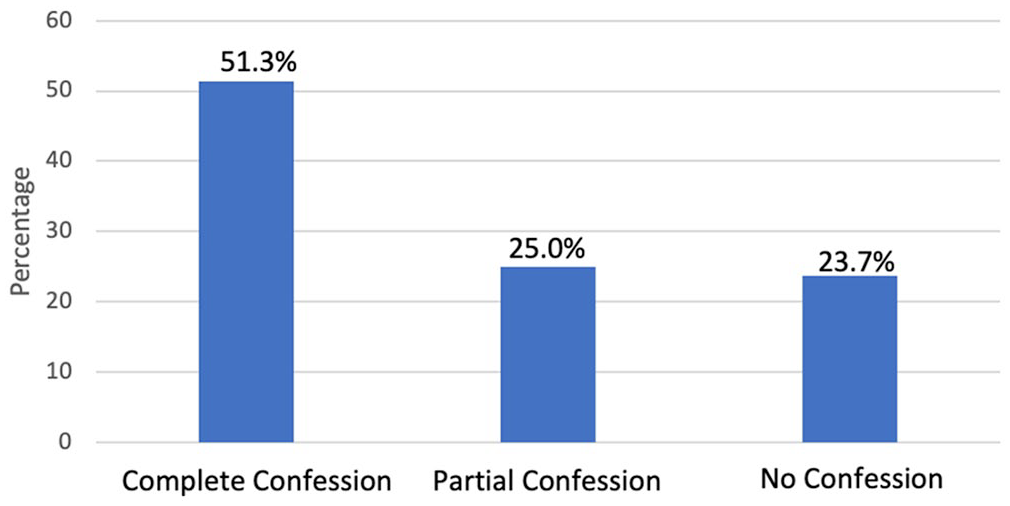
EH offenders’ confession types in police interrogation.
Psychological characteristics
The results indicate that the motive for the homicide was predominantly dispute (60.5%) or criminality (23.7%). Only a handful of cases had a sexual (7.9%) or mental health (7.9%) motive. Over half of the EH offenders had presence of APD traits (68.4%), under half had BPD traits (36.8%), and almost half had NPD traits (46.1%).
Comparing EH Offenders According to the Confession Type
The EH offenders were compared according to their confession type and multiple psychosocial variables. Chi-square analyses indicate no statistically significant difference between the different confession types for the offender/victim relationship, overkill, the disposed body, and the motive. However, a statistically significant difference was found for the homicide method: χ2 (6, 76) = 12.639; p = .49; Cramer’s V = 0.293, for the APD traits: χ2 (2, 76) = 8.246; p = .016; Cramer’s V = 0.329, for the BPD traits: χ2 (2, 76) = 7.451; p = .024; Cramer’s V = 0.313 and for the NPD traits: χ2 (2, 76) = 6.515; p = .038; Cramer’s V = 0.293. Residuals post-hoc analyses using a Bonferroni-Holm correction (Holm, 1979) were used to determine the direction of the significant difference. The results indicate that for the method used, offenders who did not confess were significantly more likely to have used a firearm when compared with offenders who completely or partially confessed (p < .05). Furthermore, for the personality disorder traits, offenders who did not confess were significantly less likely to have traits of BPD (p < .05) but were more likely to have traits of NPD (p < .05) or APD (p < .05) (Table 1).
EH Offenders’ Characteristics According to Confession Type.
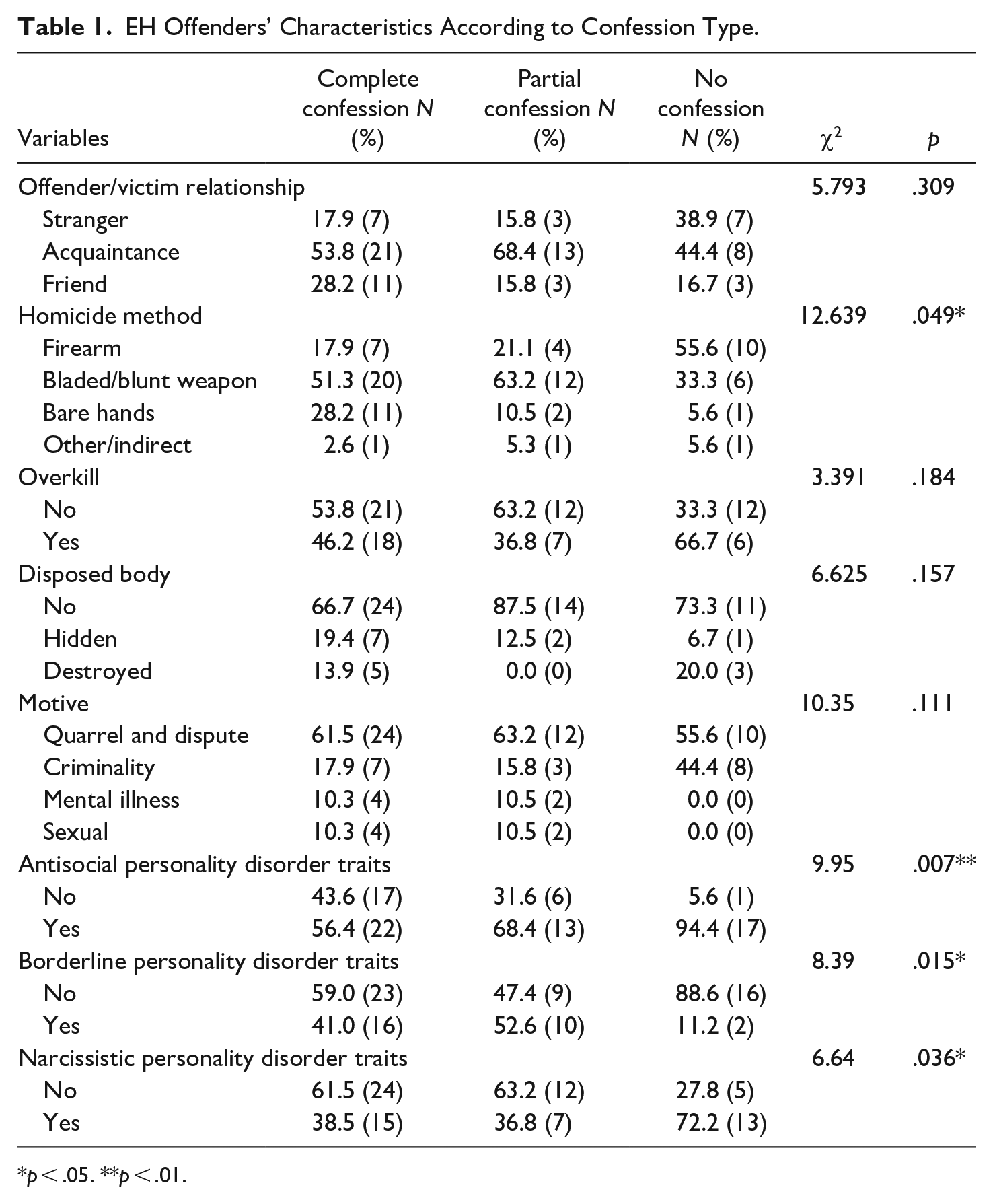
p < .05. **p < .01.
Cluster Analysis
A cluster analysis performed using the Two-Step method has identified three different profiles. The cohesion and separation silhouette is measured at 0.3, which indicates a fair result, as seen on Figure 2A. This measure was higher than for a 2 or 4 profile solution. The index of relative importance of the variables indicates that antisocial personality disorder traits was the variable that was most important to classify the offenders, closely followed by the confession type. The relative importance of the other variables is seen in Figure 2B. The profiles were named according to the main variables of this study and their importance in the clustering of confession and motive: confession type and motive: (1) Confession: quarreler and sexual, (2) Confession: quarreler and mental illness, and (3) No confession: quarreler and criminality.
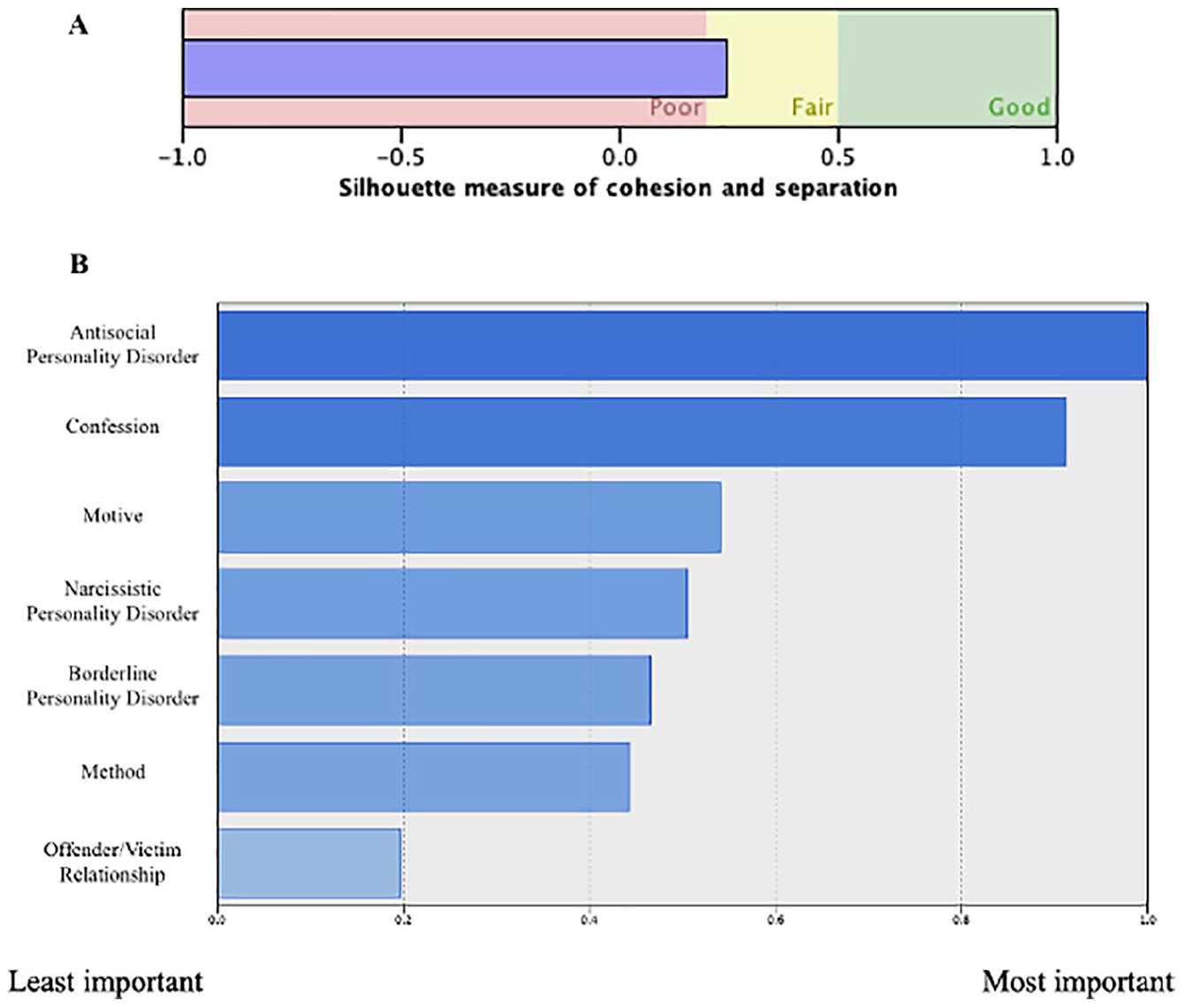
Results from the cluster analyses: (A) Silhouette measure of cohesion and separation and (B) relative importance of variable in the creation of profiles.
In the first profile (impulsive, mixed personality disorder; n = 37), most offenders had APD traits (83.8%). Most of them completely (70.3%) or partially (27.0%) confessed their crime, only a handful did not (2.7%). The motive was mostly dispute/quarrel (64.8%) but also criminality (18.9%) or sexual (16.2%) for some cases. About half of the offenders had traits of NPD (45.9%) or BPD (59.5%). The offenders mostly used a bladed/blunt weapon (56.8%) or their bare hands (32.4%) to kill their victims, which were mostly acquaintances (67.6%) or friends (27.0%). Profile 2 (the impulsive, mental illness; n = 18) had very few cases of APD (5.6%). Most offenders completely (66.7%) or partially (27.6%) confessed. The motive was mostly a dispute (61.1%) or mental illness (33.3%), rarely criminality (5.6%) and never sexual. Most cases did not have traits of NPD (94.4%) or BPD (66.7%). The homicide was more often committed using a weapon, bladed/blunt (66.7%) or a firearm (22.2%). The victim/offender relationship was diverse, comprised of acquaintances (44.4%), strangers (33.3%) and some friends (22.2%). Profile 3 (the criminal; n = 21) had most offenders with features of an APD (68.4%). Most of them did not confess (76.2%) in police interrogation, and very few cases partially confessed (19.0%) or completely confessed (4.8%). The motive was shared between a dispute (52.4%) or criminality (47.5%). Most cases had traits of NPD (81.0%), but none of BPD. Most offenders used a firearm (66.7%) or a bladed/blunt weapon (23.8%). The victim/offender relation was mostly strangers (42.9%) or acquaintances (42.9%).
Chi-Squared analyses to compare the three profiles were made. Results indicate a statistically significant difference for all variables: APD traits, χ2 (2, 76) = 43.995; p < .01; Cramer’s V = 0.760; confession, χ2 (4, 76) = 34.200; p < .01; Cramer’s V = 0.553; motive, χ2 (6, 76) = 33.936; p < .01; Cramer’s V = 0.473, NPD traits, χ2 (2, 76) = 22.178; p < .01; Cramer’s V = 0.540; BPD traits, χ2 (2, 76) = 20.479; p < .01; Cramer’s V = 0.519; homicide method, χ2 (6, 76) = 29.144; p < .01; Cramer’s V = 0.437; offender/victim relationship, χ2 (4, 76) = 13.840; p < .01; Cramer’s V = 0.288 (Table 2) .
EH offenders’ characteristics according to their profile.
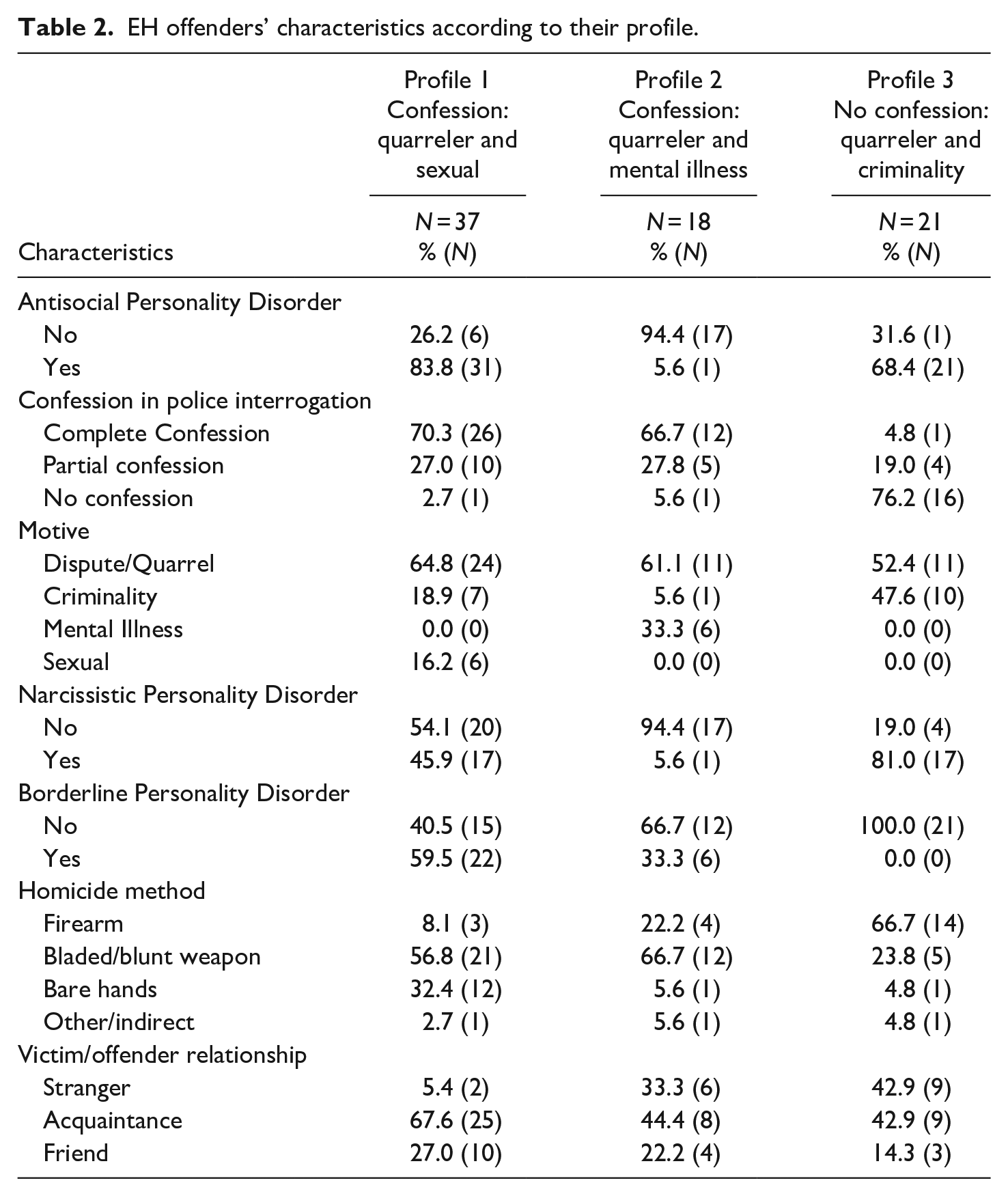
Residuals post-hoc analyses using a Bonferroni-Holm correction (Holm, 1979) were used to determine the direction of the significant difference. The results indicate that offenders from profile 1 and 3 were significantly more likely to have APD traits (p < .05), while offenders from profile 2 were significantly less likely to have APD traits (p < .01). Offenders from profile 1 were significantly more likely to completely confess their crimes (p < .05) and less likely to not confess at all (p < .01) while offenders from profile 3 were significantly less likely to confess their crime (p < .01) and more likely to not confess at all (p < .01). For the motive, an offender from profile 2 was significantly more likely to have killed out of mental illness (p < .01) when compared to the other profiles, whereas an offender from profile 3 was significantly more likely to have killed holding a criminal motive (p < .05). Furthermore, for the personality disorder traits, offenders from profile 2 were significantly less likely to have NPD traits (p < .01), whereas offenders from profile 3 were more likely to have NPD traits (p < .01). Offenders from profile 1 were more likely to have BPD traits (p < .01), whereas offenders from profile 3 were less likely to have BPD traits (p < .01). For the method, offenders from profile 1 were significantly less likely to use a firearm (p < .01) and more likely to use strangulation or their bare hands (p < .05), while offenders from profile 3 were significantly more likely to use a firearm (p < .01). Finally, offenders from profile 1 were significantly less likely to murder a stranger (p < .01) when compared to the other profiles.
Discussion
EH Offenders: Description and Confession in Police Interrogation
This study’s first objective was to document the confession of EH offenders. Results indicate that over half of EH offenders completely confessed, a quarter partially confessed and almost a quarter did not confess at all. These numbers are comparable to some of the studies found in the literature that showed that about half of suspects of any crime (Deslauriers-Varin et al., 2011; Phillips et al., 1998) or homicide or severe crime offenders (Holmberg & Christianson, 2002; Phillips et al., 1998; Santtila et al., 2003; Tomas et al., 2021; Vaillancourt, 2009) confessed. Our results are different to those found by Cavanagh et al. (2005) who found very low confession rates for EH offenders, but could be explained by the fact that he studied homicides of children. In the present study, concerning the offender/victim relationship, just over half of EH offenders had an acquaintance relationship with their victim and almost a quarter of friends or strangers. While mixed results were found in the literature (Cavanagh et al., 2005; Vaillancourt, 2009), our study does not show a significant difference regarding the victim/offender relationship for the confession rates.
The second objective was to compare EH offenders according to the confession type. Our results show that the offenders’ different confession groups were statistically different on the method to commit homicide: a significantly higher percentage of EH offenders who did not confess used a firearm than EH offenders who partially or completely confess. To our knowledge, this result has not been documented in the scientific literature before. Furthermore, our results also indicate that EH offenders using firearms had in vast majority a criminal motive. Our results do not allow us to confirm our hypothesis as they do not show a significant difference for the motive itself. A criminal motive alone may not fully explain the difference in confession rates. Multiple studies show that offenders with a criminal lifestyle were linked to lower confession rates (Baldwin & McConville, 1980; Deslauriers-Varin et al., 2011; Moston et al., 1992) because they were accustomed to the judicial system (Deslauriers-Varin et al., 2011). EH offenders with a criminal motive who used a firearm could be a sub-group of EH offenders who were accustomed to the judicial system. Then, a statistically higher percentage of EH offenders who did not confess had APD or NPD traits, and less had BPD traits. These results are coherent with St-Yves’s (2004) results, showing that APD and NPD traits are related to lower confession rates. Our results add that offenders who did not confess were less likely to have BPD traits. This could be explained by the fact that EH offenders with BPD traits were more impulsive and felt more guilt after the crime, as suggested by other studies (St-Yves, 2002, 2004; Vaillancourt, 2009).
EH Offender Profiles: Cluster analysis
The third objective was to identify EH offender profiles. Three profiles were found and named according to confession type and motive. The first profile (confession: quarreler and sexual) consisted of men who committed EH and had APD traits, completely or partially confessed their crime and had a quarrel or sexual motive. About half of them had NPD or BPD traits. They mostly killed using a bladed or blunt weapon or their bare hands. Their victims were mostly acquaintances, sometimes friends and rarely strangers. This profile resembles multiple profiles or categories described in the literature: altercation, argument, quarrels, vindicative and rage (Boutin & Cusson, 1999; Guôjónsson & Pétursson, 1990; Roberts et al., 2007; Salfati & Dupont, 2006) homicides but also include a sub-category of felony homicides: sexual or rape homicides (Block & Block, 1992; Guôjónsson & Pétursson, 1990; Roberts et al., 2007). According to Boutin and Cusson (1999), men who kill out of quarrel are usually single, intoxicated, criminalized, carry a weapon, quarrel in a public setting and do not try to deescalate a conflict. Studies on extrafamilial sexual homicides describe that these crimes are committed by single men, they use a weapon to kill and have traits of psychopathy and sadism (Chopin & Beauregard, 2019).
The second profile (confession: quarreler and mental illness) consisted of men who rarely had APD traits, completely or partially confessed their crime and had a quarrel or mental illness motive. They seldom had NPD traits, but about 1/3 had BPD traits. They often used a bladed/blunt weapon, followed by firearms. These men killed acquaintances, strangers, and friends. This profile also resembles the same quarrel related categories described in profile 1 (Boutin & Cusson, 1999; Guôjónsson & Pétursson, 1990; Roberts et al., 2007; Salfati & Dupont, 2006), but was also the only cluster with the men who killed due to severe mental illness, another category identified in some typologies (Salfati & Dupont, 2006). Some studies have underlined that for homicides due to mental illness, most perpetrators kill someone that is known to them (Simpson et al., 2004) and using a sharp weapon (Minero et al., 2017). This cluster (quarrels and mental illness) shows a majority of known victims, and most homicides were committed using sharp weapons. Furthermore, our results indicate next to no personality disorder traits other than BPD, which is congruent with other results in the literature (Simpson et al., 2004). While our results describe that most mental illness motivated homicide cases led to a full or partial confession in police interrogation, no significant statistical difference was found when compared to other motives.
Finally, the third profile (no confession: quarreler and criminality) consisted of a high percentage of men with APD traits. Most of them did not confess, a few partially confessed and only one completely confessed. The motive was split between quarrel and criminality. Most had NPD traits, and none had BPD traits. Finally, 2/3 used a firearm and most the rest used a bladed or blunt weapon. The offenders mostly killed strangers or acquaintances, but rarely friends. A large proportion of men in this profile have APD and NPD traits (enough to be statistically different from the two other profiles) but not BPD traits. While we have not evaluated the prevalence of psychopathy in these men, multiple studies underline that the presence of both APD and NPD traits are related to Hare’s (1991) two factors of in his psychopathy checklist (Blackburn et al., 2005; Hildebrand & de Ruiter, 2004; Pham & Saloppé, 2010). The significantly higher presence of both APD and NPD traits could partly explain that a significantly higher percentage of members of this cluster had a criminal motive, did not confess their crime in police interrogation and a lower percentage confessed, when compared to the other clusters. The significant differences between the profiles could suggest the importance of refining interrogation methods according to the offender profile.
Limitations and Future Directions
Using Coroner’s office homicide files was both an advantage and a limit for its impact on our sample. Like any study making use of files, some had missing data (unsolved crime, no information on confession). Widening the study of confession to a larger array of homicide offenders could further our understanding of this population. Further studies could aim to seek complementary information in collaboration with police forces to have better access to interrogation results. A larger sample might allow the cluster analysis to differentiate the sexual homicides from the quarrelers. Furthermore, integrating intrafamilial homicide offenders and EH offenders could permit a second look at the influence of the victim/offender relationship on confession.
Second, even though the evaluation of personality disorder traits was done rigorously with an interrater agreement for all cases used in this study, it was based on the convergence of evidence with information contained in files, the criminal record, and other media. As underlined in the method, the cut-off number was changed because some traits were difficult to assess, and the assessment of APD requires the presence of antisocial behavior during the childhood, an information which wasn’t available to us. Collecting information directly from the offenders in a further study could allow us to refine our psychological assessments, and even evaluate the presence of other interesting disorders, for instance mood disorders and psychopathy. Furthermore, researching in presence of the offenders could allow to explore their life trajectory and investigate its effects on confession in police interrogation.
The literature has underlined the importance of contextual variables (the interrogation technique, the influence of legal counsel and the perceived strength of the evidence by the offender) on confession rates in police interrogation (Deslauriers-Varin et al., 2011; Gudjonsson & Petursson, 1991; St-Yves, 2004; Verhoeven, 2018; Verhoeven & Stevens, 2012; Vrij et al., 2015; Wachi et al., 2014). Contextual variables were missing from the files used and were not part of this study’s aim. As this study’s strength stems from its use of psychological variables, further studies could aim to explore the interaction between these psychological variables and contextual variables and its effects on confession rates to have a wider understanding of police interrogation. These aims could underline the influence of psychological variables like personality disorder traits on the use of legal counsel and the perceived strength of the evidence, which in turn could influence confession.
Conclusion
This study allowed to describe confession rates of extrafamilial homicide offenders in police interrogation and differentiate three different profiles using criminological and psychological variables. Results indicate that for EH offenders, the method used, and personality disorder traits are related to different types of confession. Furthermore, offender profiles were influenced by a few key variables, most notably APD traits, confession in police interrogation and motive. Psychological characteristics are a set of variables that weren’t widely used in the literature to describe confession in police interrogation, and even less so for confession of EH offenders. Our study underlines the importance of these psychological characteristics to understand EH offenders’ confession. Our results invites both researchers and police forces to further their understanding of EH offenders. This could allow them to refine their interrogation strategies according to different EH offender profiles.
Footnotes
Declaration of Conflicting Interests
The author(s) declared no potential conflicts of interest with respect to the research, authorship, and/or publication of this article.
Funding
The author(s) disclosed receipt of the following financial support for the research, authorship, and/or publication of this article: This article is part of a project funded by the Fonds de recherche du Québec in the context of a doctoral research scholarhip (B2Z – 305225).
