




Abstract
Orphaned and abandoned wells are emblematic of the challenges of abandoned infrastructure. With over 2.5 million idle wells in the United States, this is a large problem that requires engagement across the public, private, non-profit, and civic sectors. This article conducts a focused case study on orphaned and abandoned well reclamation in Pennsylvania. Elite interviews, government document review, and scholarly literature reveal the barriers to effective collaboration across the sectors, but also substantial potential. Using the public-private-citizen partnership (PC2) and collaborative governance regime (CGR) frameworks, the article proposes a PC2 CGR that could leverage the influx of federal well plugging funds for greater effectiveness in solving this big problem. The case also holds lessons for other states and other sources of abandoned infrastructure.
Keywords
Across the United States, more than 2 million unproductive oil and gas wells form a complex abandoned infrastructure challenge for all levels of American government. Orphaned wells are those whose owners are no longer identifiable, whereas abandoned wells have a known owner, but are no longer producing. Both have substantial environmental impacts. Foremost, non-producing and unplugged wells leak methane, a potent greenhouse gas. While the effects are hard to firmly quantify, just like the total number of orphaned and abandoned wells, the Environmental Protection Agency (2018) estimates a CO2 equivalent of 7–20 million metric tons of methane are emitted annually. This is equivalent to the annual emissions of 2–5 million cars. The leaked methane and other toxic chemicals also contaminate groundwater and the air. Ground caving and blowouts endanger the public and infrastructure. While responsibility falls to states and the national government for remediating orphaned wells, and to taxpayers to pay for such remediation, states are often ill-equipped to do so. Orphaned wells are therefore emblematic of abandoned infrastructure problems that have intergenerational costs and require a multifaceted and multi-sectoral approach to management. In this article, we focus on the case of Pennsylvania to identify how a public-private-citizen (PC2) collaborative governance regime (CGR) could be used to better solve the complex problem of orphaned wells.
In Pennsylvania alone, estimates of orphaned and abandoned wells range from 100,000 to 500,000, with only roughly 9000 formally documented by the Pennsylvania Department of Environmental Protection (DEP) (Kang et al., 2014). Conventional and unconventional well drilling in the Marcellus Shale has substantially increased the presence of both active and idle wells that are not producing in the Commonwealth. Moreover, Pennsylvania is the home of the first oil well in the entire country and hundreds of thousands of wells have been drilled since the discovery of oil in Titusville in 1859 (Saint-Vincent et al., 2021). Before 1955, there were no regulations and methods to track and classify oil or gas wells that were drilled, and they can be difficult to identify with the naked eye. Many are grown over with vegetation or buried. The median cost for plugging a well has been estimated at $76,000, but the price can reach into the hundreds of thousands of dollars or even $1 million, depending on a well’s condition and location (Raimi et al., 2021). But orphaned wells have no legally responsible owner, so they fall to governments for remediation. In fact, orphaned wells are indicative of how governments often shoulder the responsibility for abandoned infrastructure. Economic activity booms, then collapses, and shuttered companies push responsibility for environmental cleanup to the public. However, a lack of resources makes the state’s job of plugging these wells difficult.
This article focuses on the problem of orphaned and abandoned wells in Pennsylvania to consider how public administration research can contribute to solving this wicked problem. The Commonwealth has long been a host to conventional oil and gas drilling, but wells exploded in number over the last 15 years as unconventional drilling in the Marcellus Shale became financially viable. Drawing from the literatures on collaborative governance and public-private partnerships, interviews with state officials, well pluggers, and the industry, and examples of successful public-private partnerships, we will assess the barriers and possibilities for using a PC2 CGR to address the monumental challenge of plugging orphan wells. While Pennsylvania serves as the focus of this in-depth case analysis, the principles of PC2 can conceivably be applied in the 30 states with orphaned wells. The article offers lessons on how to practically approach developing a PC2 CGR and ways to overcome barriers to cooperation from stakeholders.
Orphaned Wells Nationally and in Pennsylvania
Oil and gas drilling has a long history in the United States and so does the problem of orphaned wells. Due to the lack of adequate regulations in the early years, oil and gas wells that no longer produced sustainable economic benefits were abandoned without proper reclamation. Moreover, those orphaned wells left immeasurable environmental hazards to the communities in which they were located. In 2021, the Interstate Oil and Gas Compact Commission (IOGCC) reported that there were 92,198 documented orphaned conventional and unconventional oil and gas wells across 30 states. Further, there were 231,287 idle wells that are not producing oil or gas (IOGCC, 2021). Estimates of undocumented abandoned and orphaned wells are in the millions (Wright, 2021). Moreover, the abandonment of wells continues with 256 companies receiving 4270 notices of violation (NOV) from 2015 to 2022 in Pennsylvania alone (Hess, 2022). It is notable that many NOVs are resolved before any sanctions are issued.
The governance of onshore oil and gas drilling is a responsibility of the state in which drilling activity occurs. This results in substantial variation across the states in how they approach things like set back requirements, bonding, taxes, and much more. One analysis of state oil and gas regulations found Pennsylvania to be middling in terms of the stringency of its quantifiable regulations (Richardson et al., 2013). It is substantially less stringent than Texas, but more so than West Virginia, Ohio, and Oklahoma, the other four states with the highest number of gas wells. When re-weighting for the number of totally unregulated elements, Pennsylvania is the second-most stringent of the top 5 oil and gas producing states, behind West Virginia.
Policies concerning the reclamation of abandoned wells slowly emerged in the late 1800s alongside evidence of the contamination abandoned wells cause by leaking brine, oil, or methane, which threaten local people and ecosystems (McClure et al., 2022). Available tools for remediation include but are not limited to financial assurance, plugging funds, plugging authorization, well tracking, and well prioritization (Thomas, 2021). The latest report by the IOGCC in 2021 shows increased activity among states to document and plug their orphaned wells. Among the states IOGCC surveyed in 2020, Texas and Wyoming plugged the largest number of orphan wells, with 1473 and 1066, respectively. The expenditures for plugging, however, are most significant in North Dakota and California (IOGCC, 2021). The inconsistent results across states reflect the heterogeneous challenges each state faces in plugging idle wells and the complexity of each plugging project.
As the home of the first commercial oil well in the United States, and in which hundreds of thousands of wells have been drilled since, Pennsylvania has a large orphaned well problem. Researchers estimate that as many as 300,000 to 760,000 oil and gas wells have been drilled in Pennsylvania (Kang et al., 2014, 2016). Most of these wells were drilled prior to modern permitting and plugging requirements, thus causing difficulties in identification and reclamation. However, that fact does not imply the negligence of the state government. Indeed, Pennsylvania was one of the forerunners who introduced a statute that stressed a concern about abandoned wells. In 1881, the state passed legislation requiring non-producing oil wells to be plugged (Joel & Karen, 2015). Those who did not comply would be charged a penalty. A 1921 revision added abandoned wells other than oil wells. The Bureau of Oil and Gas Management was given responsibility for oil and gas regulation in 1955. Meanwhile, an amendment was published including detailed information about registration requirements for all new oil and gas wells.
The 1984 Oil and Gas Act updated plugging requirements to include environmental considerations. It also required bonding and allowed for a specific period of approved non-production before the well must be plugged. Bonding is an important financial tool to buffer the risks from unplugged abandoned wells. It can be regarded as the operators’ deposit, which shall only be released after they fulfill the requirements of proper reclamation. Pennsylvania’s bonding requirements are notoriously low, however. Under the 1984 Act, a $2500 bond was required for conventional wells and $10,000 for unconventional. Further, a $25,000 bond blanket could be purchased for unlimited conventional well drilling. The bond requirements were increased by Act 13 of 2012, but are still a fraction of the $76,000 median cost required to plug wells, though the cost can exceed $1 million depending on the context (Raimi et al., 2021). The 1984 Act defines an orphan well as being abandoned prior to April 18, 1985, that has not been affected or operated by the present owner or operator and from which the present owner, operator, or leaser has received no economic benefit other than as a landowner or recipient of a royalty interest from the well (58 Pa.C.S. §§ 3203, 3213, 3214, 3220 and 3271).
DEP has the primary regulatory authority over oil and gas exploration, development, and extraction in Pennsylvania, including addressing abandoned wells. This is a substantial burden on one agency, but that is not necessarily different than other states. DEP not only has environmental oversight, including addressing abandoned wells, but it reviews drilling permits, inspects drilling operations, and responds to any complaints lodged against drillers. DEP manages the Abandoned and Orphaned Well Plugging Program, which is financed by an abandoned well surcharge of $50 for all wells and an orphaned well surcharge or $100 for oil wells and $200 for natural gas wells. Though, the Public Utility Commission was given the responsibility under Act 13 for collecting the impact fee from unconventional wells and dispersing those monies. Act 13 also created the Marcellus Legacy Fund, which feeds the Orphaned or Abandoned Well Plugging (OAWP) grant program that is managed by the Department of Community and Economic Development (DCED). Additionally, the Department of Conservation and Natural Resources (DCNR) has jurisdiction over well drilling that occurs on state forest land. In sum, however, DEP bears the brunt of the administrative burden for oil and gas drilling in the Commonwealth.
The general procedures for orphan well plugging are as follows in Pennsylvania. First, Pennsylvania’s statute requires orphan wells to be reported to DEP. The location and condition of those wells are investigated by third parties and later filed as reports to DEP. DEP enters this data into its well plugging database and prioritizes those wells based on its scoring system that considers environmental, health and safety factors. Finally, the restoration is carried out according to the order of urgency determined by scoring.
Based on the reports from the IOGCC and DEP, there are several problems with the current orphan well plugging program. While a state like California charges drillers an annual fee and an idle well fee, seeks civil penalties, makes well plugging appropriations, and assesses production as funding sources for plugging orphan wells, Pennsylvania solely relies on a permit fee for funding well plugging, which explains the significant gap between the growth of plugging expenditures and available plugging funds. Besides, the number of plugged orphaned wells each year is small (6 for 2018; 9 for 2019; 18 for 2020), but the average plugging expenditures are high ($79,018.5 for 2018; $160,731.1 for 2019; $83,381.9 for 2020). DEP was able to spend more on well plugging from 2000 to 2011 when it had access to Growing Greener funds. DCED manages OAWP, which provides grants of up to $1 million to local governments, non-profits, or private companies to plug wells. These monies come from the Marcellus Legacy Fund, which also funds a host of other programs. However, OAWP has plugged a fraction of the wells that have been remediated by DEP.
The Infrastructure Investment and Jobs Act of 2021 (IIJA) presents a significant opportunity for plugging orphaned and abandoned wells across the United States. It included $4.7 billion for well plugging, of which Pennsylvania is expected to receive nearly $400 million over 15 years. This far exceeds the roughly $1 million DEP spends each year currently. Though, even with this investment, DEP has estimated a total cost of $1.8 billion for remediating the state’s abandoned and orphaned wells (Testimony of Deputy Secretary Scott Perry, 2022). Having set the larger stage for this case, we now turn to identifying the key barriers to effective well plugging in the Commonwealth.
Barriers to Well Plugging in Pennsylvania
To identify the key barriers to effective well plugging in Pennsylvania, we conducted interviews with four important actors in the process: DEP, a well plugging company, the Well Done Foundation, and the Marcellus Shale Coalition (MSC). This research received an exempt status from the Penn State University Institutional Review Board in January 2022 and interviews were conducted in March 2022. The primary aims of these interviews were to understand the roles of the actors, how they collaborate with others, and the barriers they perceive to solving the orphaned and abandoned well problem in Pennsylvania. While individual actors may not always be able to identify problems with their own operations (e.g., DEP), interviewing a diverse set of actors paints a more complete picture of the collaboration challenges. We in turn discuss each of the following challenges: funding, bond requirements and responsibility, regulatory capacity, legal definitions and record keeping, lack of information, lack of coordination, and contextual problems.
Funding, Bond Requirements, and Responsibility
Funding is always a concern for well site reclamation. Ideally, oil and gas companies would take responsibility to plug their wells and restore drilling sites after the end of each well’s economic activity. Bonding requirements amount to a pre-drilling financial commitment to restore a well site after production. If a company fails to restore the site, the bond should be sufficient for doing so. Pennsylvania required a bond of $2500 or a blanket bond of $25,000 from well operators under its 1984 Oil and Gas Act. This was increased in 2012 to $4000 or $10,000 per well up to 50 or 25 wells shallower or deeper than 6000 feet, respectively. Blanket coverage scales up to no more than $250,000 for over 250 shallow wells and $600,000 for more than 150 deep wells. Even the increased bonding requirements are not sufficient to cover associated decommission costs. This leads to moral hazard where operators have incentives to lie about their promises and evade their reclamation responsibilities. One criticism from a well plugger was the fact that larger companies will sell wells near the end of their life to companies that do not have the resources to properly remediate the sites once the well is dry. This results in insolvency if reclamation liabilities far exceed a company’s financial guarantees.
The bonding regulatory scheme is also rigid. Bonding requirements are fixed, not increasing as the costs to plug wells increase. Thus, Pennsylvania’s requirements lag significantly behind the rise in variable costs, such as equipment transportation and labor costs, increasing the financial gap. The lack of flexibility is also reflected in the uniform requirements of different plugging companies. Large companies that have more stable balance sheets can manage their future liabilities, whereas small operators would need a more flexible scheme to accommodate their risk-taking capacity. Ultimately, if companies cannot be held liable for well plugging, the problem falls on the state and the cost on taxpayers.
Regulatory Capacity
Another barrier is a noted deficiency in regulatory capacity. Although most well decommissioning is contracted out to private companies, it is still DEP’s responsibility to inspect compliance in the field. DEP does not always have the available resources for inspections and the problems caused by inadequate staffing will only grow with the infusion of federal grants (Legere, 2022). DEP needs more staff to manage projects, maintain databases, and oversee plugging operations. This is even more pressing as the short-term nature of federal infrastructure funding will require DEP to quickly scale up its operations. Plugging contractors also face difficulties in the deficiency of labor supply. Their concerns arise from the bidding and vetting process. If DEP only provides a small number of well plugging projects each year, it is hard for companies to guarantee a consistent cash flow and secure enough labor. Further, one-time federal support is unlikely to solve these systemic problems. The sustainability of abandoned well plugging program requires supplementary policies that support stable funding and labor.
A lingering skills gap will affect both DEP and the industry. A combination of rapid development, an aging workforce, and less interest among younger workers for oil and gas jobs has created a skills shortage in the industry (GETI, 2019). Further, there has been a significant lag in higher education support for the industry, with both sides placing blame on the other for being unwilling to partner (Bozick et al., 2017). These gaps will have to be closed to enable the scaling up of regulatory capacity by DEP and effective regulatory compliance on the part of industry.
Legal Definitions and Record Keeping
There are differences in the legal definitions of abandoned wells and orphaned wells. While wells are defined as abandoned after not having economic productivity within the preceding 12 months, orphaned wells are those that have not produced since before 1985. When researching an idled well in practice, it is challenging for DEP to determine when a well stopped producing and whether it was drilled before 1985. Available records are inconsistent, and nonexistent before 1955. In the early years, regulatory requirements neither mapped the location of drilled wells nor recorded their liable operators. The lack of clearly divided property rights accounts for the difficulties in identifying accurate records about those improperly decommissioned wells. Representatives from the plugging company and the Well Done Foundation both mentioned the importance of record keeping. Without detailed information, they are unable to assess the technical requirements in advance for a well, which increases both the risk and cost of plugging.
Lack of Information
Those engaged in well plugging cited a lack of information about wells as a major barrier to their activities. One noted that DEP has different internal and external databases. They held up Ohio as a model of information sharing that makes well plugging cheaper and more effective. Ohio allocates $18-20 million annually for plugging orphaned and abandoned wells. It has established exploration parties which help in estimating the correct costs of work to be outsourced to private contractors. In Pennsylvania, little is often known by contractors about wells before they make their bids and begin working. This necessitates building significant risk into their bids, driving up the bid price of well plugging. Alternatively, some companies underbid to obtain a contract and then cannot complete the work when they face significant obstacles. The Well Done Foundation does its own site surveillance work, but that can be touchy with landowners. Ohio ameliorates much of this risk by doing site work first and making the data available to bidders.
Lack of Coordination
Coordination of necessary actors is a substantial challenge in well plugging. DEP, DCED, DCNR, and even PennDOT are involved in proper plugging. PennDOT was initially an unexpected actor, but one interviewee pointed out the fact that most wells are in rural areas where roads and bridges may not be able to bear the heavy equipment necessary to plug wells. Beyond working with industry and non-profits, DEP officials face several sociological problems in their efforts to identify and plug wells, including a lack of cooperation by the property owners who refuse them the right to enter the property. Many wells are located under houses, churches, or parking lots. Property owners thus have an important role in locating an unplugged well and requesting to plug it. Moreover, wells have been found in utility rights of way, which increase the hazard of plugging and need for coordination with electric companies. A great deal of coordination is necessary to effectively solve the problem of orphaned and abandoned wells. Moreover, one interviewee discussed the influx of inexperienced well pluggers and the challenges of DEP oversight of those pluggers as a significant coordination challenge. In some cases, wells had to be plugged twice because of ineffective plugging the first time.
Context
Finally, there are myriad contextual challenges, some of which are specific to Pennsylvania and its climate and topography. For example, the climate makes only June, July, and August suitable for well plugging. Spring is too wet for the heavy equipment and fall and winter are too cold and potentially snowy. Pennsylvania’s 150-year history of drilling also corresponds with several cycles of de- and re-forestation in the state. This is pertinent as thousands of orphaned wells are grown over with forest and are difficult to identify and access. Wells have also been found too close to buildings, or even underneath them, which makes it impossible to position large plugging equipment. Very old wells also tend to look simply like holes in the ground, especially if wooden pipes have rotted away. Therefore, onsite monitoring of methane emissions is important to determining whether such a hole needs to be properly sealed. Finally, many wells are on private property. A strong sense of property rights and distrust of government can make DEP’s job of accessing orphaned wells more difficult. DEP can issue an order to access private property for well plugging, but it typically does not do so.
The question we ask is whether there is a more effective, and collaborative, approach to identifying and plugging the hundreds of thousands of orphaned and abandoned wells in Pennsylvania. We argue that public-private-citizen collaboration (PC2) is a potentially fruitful tool for maximizing the impact of the nation’s current investment in well plugging. Before outlining such a program in Pennsylvania, we first review the research on PC2.
PC2
Addressing wicked problems in public administration brings on the unique challenges of collaboration amongst the multiple stakeholders (Weber & Khademian, 2008). Wicked problems are unstructured, cross-cutting, and relentless, entailing complexity and uncertainty involving multiple overlapping problems with no single solution (Weber & Khademian, 2008). These problems demand that public managers extend their boundaries and accept market-driven competitive solutions to solve them. Among the options for addressing wicked problems, including many environmental challenges, is stakeholder collaboration (Head, 2022). Wicked problems are not so much solved, as stakeholders arrive at a shared understanding of the problem and the solutions they will pursue (Conklin, 2006).
Emphasizing the need for collaboration in the public sector, Emerson et al. (2011) defined collaborative governance as a decision-making and management process engaging people from public, private, and civic spheres to develop a consensus for solving a governance issue when the parties have conflicting goals. Ansell and Gash (2018) suggested creating formal platforms which provide a structure and stability to otherwise volatile governance mechanisms. These platforms would coordinate inter-organizational communication and expectations while lessening the control of public managers. Collaborative governance is based on trust, information exchange, and horizontal hierarchy. Therefore, platforms are necessary to facilitate multiple collaborations and frame new policies without friction.
Public-private partnerships (PPP) are an extension of collaborative and network governance (Casady et al., 2020). Mature partnerships have three characteristics: legitimacy, trust, and capacity. Legitimacy is driven by a “socially constructed system of norms, values, beliefs, and definitions” (Casady et al., 2020, p. 167). Trust is maintained through the sharing of vulnerable information between the parties. While capacity means the ability of the actors to run a long-term contractual project. These long-term relational projects engage interdependent public and private actors. They come together to benefit from each other’s domain of expertise and to increase the financial efficiency of those projects. As investments in public infrastructure have become more difficult for governments, due to budget constraints and the high cost of debt, governments have shifted from being providers and owners of infrastructure to increasingly regulators and moderators of projects undertaken by the private sector (Roumboutsos & Pantelias, 2015).
Governments are attracted to PPP for four main reasons: service delivery on time and within budget along with access to private finance and off-balance sheet accounting. Governments have time to pay back investments through user fees and utilize its annual budget for social services. The assumption is that the private sector devises efficient and economical means of service delivery due to risk sharing and task division with the public sector (Carpintero & Petersen, 2015). Though, the private sector is necessarily concerned about mitigating their risks (Roumboutsos & Pantelias, 2015), and thus, it is the responsibility of the government to protect the investment of the private sector by ensuring a demand in the public for the services provided (Ojha & Pandey, 2014), otherwise private partners may not take on the risk of the partnerships or the service may ultimately fail (Ameyaw & Chan, 2015). PPPs have become quite common in transportation infrastructure, but have also been proposed by the United Nations for meeting international sustainability goals (Wang & Ma, 2021).
Accountability, transparency, responsiveness, responsibility, and quality are public values that government must consider with respect to any public service provision, but not all these values are easily obtained in PPPs (Reynaers, 2014). The transfer of decision-making authority from the public to private sector can lessen accountability and transparency. While accountability can be increased through performance monitoring, transparency is more difficult to maintain. Responsiveness can be compromised if contracts cannot be changed easily as circumstances evolve in the partnership. Further, a “blame game” can emerge between public and private actors if the service provision is of poor quality. Thus, goal conflicts can threaten the efficacy of PPP agreements.
The PC2 framework (PC2) aims to make PPPs more responsive to public demands (Hui & Hayllar, 2010). A PC2 collaboration incorporates data that is collected from the public and uses it in the provision of public services. Though, the framework envisions citizen involvement to be restricted to project planning and such involvement can delay or stymie public projects (Klijn & Teisman, 2003). We argue, however, that citizens can be engaged in collaborative governance developed to address the problem of orphaned wells. Communities and landowners have a stake throughout the collaboration, not just at its outset. There are important considerations for environmental regulators, however, in developing such a regime and effectively engaging not only private and non-profit actors, but also citizens. We turn now to discussing what a PC2 CGR could look like for orphaned wells.
Constructing a PC2 CGR to Plug Orphaned and Abandoned Wells
Our interviews with actors working on the problem of orphaned and abandoned wells in Pennsylvania revealed not only barriers to effectiveness, but also glimmers of collaboration. Our aim in this section is to use the concept of a CGR, though one that incorporates community and civic involvement, to lay out the components present and still necessary for greater collaboration. Collaborative governance is defined as “the processes and structures of public policy decision making and management that engage people constructively across the boundaries of public agencies, levels of government, and/or the public, private and civic spheres in order to carry out a public purpose that could not otherwise be accomplished” (Emerson et al., 2011, p. 2). As outlined above, the problem of orphaned and abandoned wells is massive. In the words of one interviewee, it was “a dirty little secret” for many years among governments and industry that is no longer a secret. Effectively addressing the problem requires a response crossing the boundaries of public, private, non-profit, and civic. Otherwise, it will be near impossible to effectively remediate this abandoned infrastructure.
Collaborative governance does not need to be a formalized legal arrangement. It also does not need to be initiated by a government. In fact, collaborative platforms can at times be best led by non-profits organizations that are created for the purpose of solving a complex public problem (Ansell & Gash, 2018). A CGR can include participatory governance and civic engagement, which we argue is essential for this problem. Emerson and Nabatchi have laid out a framework for broad CGRs (Emerson & Nabatchi, 2015; Emerson et al., 2011), which we will use to discuss the promise of collaboration in this space, as well as what will be needed to make collaboration effective. The specific concepts that we will discuss include the system context, drivers of collaboration, principled engagement, shared motivation, capacity for joint action, outputs, impacts, and regime adaptation.
The Collaborators
Who are the potential collaborators in an orphaned wells CGR in Pennsylvania? In terms of government entities, DEP and DCED must be present given their direct involvement in orphaned and abandoned well certification and plugging. From the interviews, DCNR and PennDOT are also important. DCNR because of the large tracts of public land throughout the state, including 2.2 million acres of state forest, of which 1.5 million acres lies over the Marcellus Shale. PennDOT was identified by well pluggers as important because of the poor state of roads and bridges in rural Pennsylvania. Plugging equipment is heavy and cannot always be transported due to limitations in the infrastructure. Oil and gas companies, independent well plugging companies, non-profits like the Well Done Foundation, higher education institutions, communities, and citizens are all existing or potential collaborators. Figure 1 illustrates the constellation of actors relevant for this CGR. Actors in the orphaned and abandoned wells collaborative governance regime.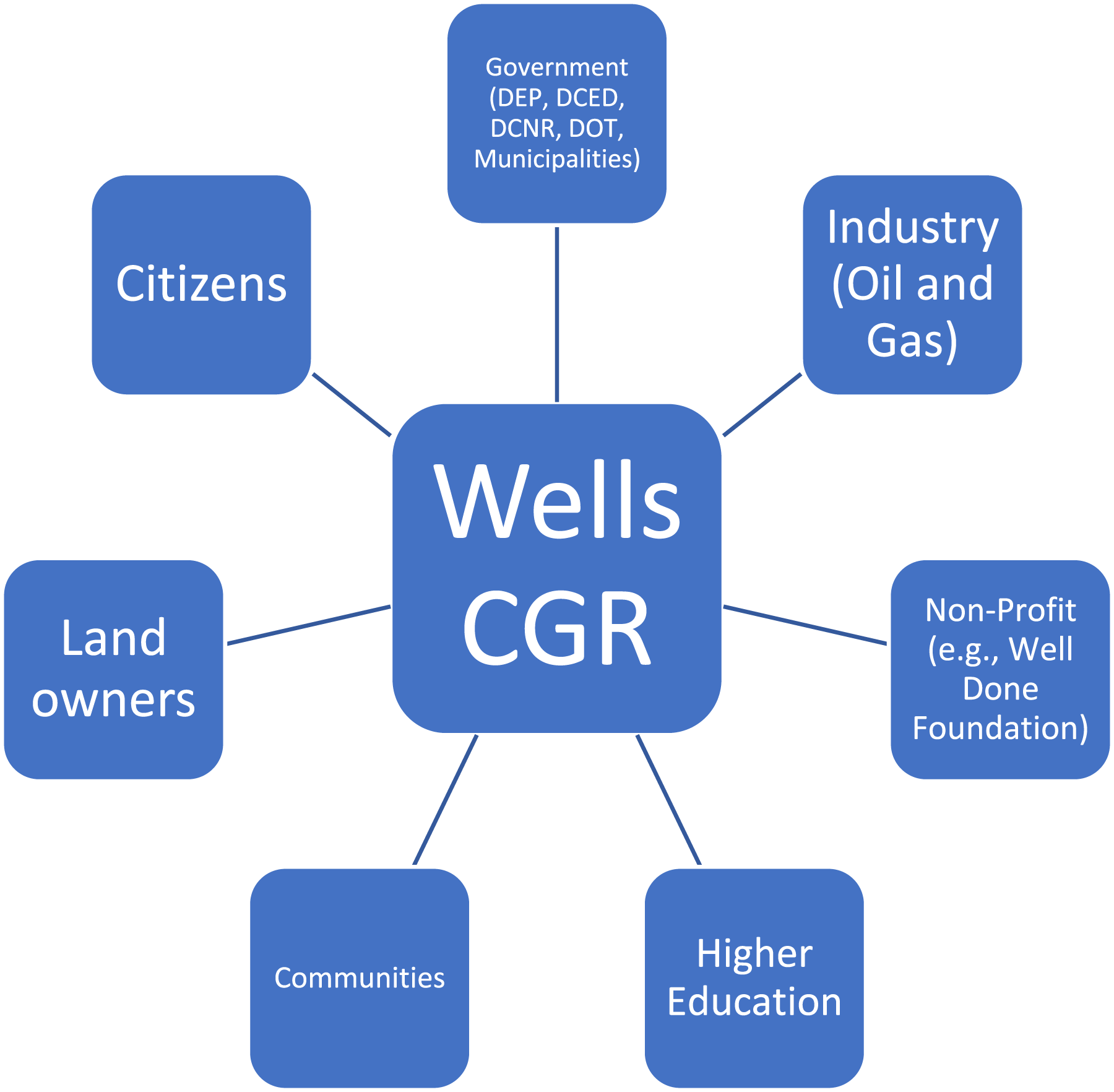
System Context
The system context refers to the socioeconomic, cultural, political, legal, and environmental conditions within which the collaboration is built (Emerson et al., 2011). Pennsylvania is a diverse state. It has two major metropolitan areas – Pittsburgh and Philadelphia, with substantial rural and small urban areas covering the rest of the state. Fracking has been controversial in the state, but, unlike neighboring New York, it has not been restrained. Even media coverage that has focused more on environmental harms tends to downplay conflict (Hedding, 2017). Rural residents have many grievances but have not mobilized against the onslaught of drilling over the last decade (Eaton & Kinchy, 2016). Interest group and inter-branch politics have affected both the governance of natural gas extraction under Act 13 and even the conduct of the Abandoned and Orphan Well Plugging Program (Bang & Hollibaugh, 2021; Mallinson, 2014). Natural gas extraction has been a boon to parts of the state with previously depressed economies, but the environmental impacts of over 150 years of oil and gas extraction are without doubt. One notable looming factor in the system context that will be meaningful for gas well plugging is the 2022 gubernatorial election. One of our interviewees directly cited the coming election when pointing out that turnover in gubernatorial administrations bring changes in statutory and regulatory interpretation and behavior. Finally, there appears to be a fair level of trust among many of the actors that we interviewed. We heard both praise and criticism for DEP, but even an industry that has been at political odds with regulators in the Commonwealth expressed a positive working relationship with the state. Further, every interview cited the Well Done Foundation as a unique and positive player in the plugging landscape. The Foundation is a non-profit, so it is not subject to the same market forces as other actors in this space. Both public and private actors noted the Foundation as a positive partner. It also has a successful track record of activity in 11 states. Such deep trust makes the Foundation a strong candidate for leading a CGR.
Drivers of Collaboration
There are four drivers of collaboration in the CGR framework: leadership, consequential incentives, interdependence, and uncertainty. It is notable that each of these are already present in Pennsylvania. Federal well plugging dollars create a consequential incentive for DEP to increase well plugging and for private companies to move into the plugging market. Of course, such opportunism can backfire if less reputable or experienced companies bid for well plugging projects. Interdependence is evident as the problem of orphaned and abandoned wells cannot be solved by a single actor and coordination between at least some of the actors in Figure 1 are present in every plugging operation. Uncertainty is rife in this problem. Take the fact that there is no settled estimate of the number of wells in Pennsylvania, let alone the nation. Further, our interviews revealed several information breakdowns in Pennsylvania. Finally, leadership is perhaps the least clear, though there are different actors leading on different fronts. DEP has a clear leadership role in identifying and bidding well projects, but they currently have a small portfolio. The Well Done Foundation also provides leadership is identifying and plugging wells. DCED has a leadership role in managing OAWP funds. One of the challenges with formalizing a collaboration will be deciding who should take the lead.
Principled Engagement
Collaborators need to engage with each other in an iterative process of learning about each other and their values. The goal is to develop a shared vision and roadmap for achieving that vision. This is achieved through a process of discovery, definition, deliberation, and joint determinations (both procedural and substantial). In discovery, actors share their interests, values, and concerns about the problem. They then need to define a common purpose and objectives. Doing so requires “candid and reasoned” deliberation among the parties (Emerson et al., 2011, p. 12). Trust is a vital element of a strong collaboration and it cannot be built without candid discussion. Finally, joint determinations are made about both procedures for conducting the collaboration and substantive questions that arise.
Shared Motivation
As mentioned, the development of trust is vital to effective collaboration and developing a shared motivation to act. Trust is built through principled engagement of the actors. In our interviews, there appeared to be fairly high levels of trust between DEP, well pluggers, and the Well Done Foundation. There even appeared to be strong trust of DEP by the industry. That said, there are ongoing political disagreements over the issuance of licenses, appropriate bonding requirements, setback rules, and more in Pennsylvania and the cleavages tend to be between DEP and industry. There is, at times, substantial distrust between land owners and community members affected by fracking and DEP and the industry (Marusic, 2021). If deeper trust can be built between the collaborators, then mutual understanding can form which confers legitimacy on the CGR. Again, such trust building can take time and requires principled engagement by all actors. Finally, the actors will develop a commitment to carrying out the collaboration.
Capacity for Joint Action
There are five elements to the capacity for the CGR to act: procedural and institutional arrangements, leadership, knowledge, and resources. An orphaned well CGR will need a lead agency to bring the parties together (Milward & Provan, 2006). The institutional structure of CGRs, however, tends to be “less hierarchical and stable, and more complex and fluid, than those found in traditional bureaucracies” (Emerson et al., 2011, p. 15). With the infusion of substantial federal funds, DEP could be a natural choice for taking the lead, but there are important concerns. As noted above, there are already criticisms of DEP’s staffing and procedural capacity (Legere, 2022). Thus, DEP will need to build its own capacity if it serves in this lead role. Another option would be to build a collaborative platform on a non-profit, like the Well Done Foundation (Ansell & Gash, 2018). Doing so would make the CGR feel less hierarchical, as the body with regulatory power is not at the center. Regardless of what actor is positioned as the lead, it will be important for the collaborative structure to not be hierarchical. A command-and-control approach is less likely to build trust and principled engagement.
Both knowledge and resources are in good supply for an orphaned and abandoned well CGR. The state, nonprofits, industry, and institutions of higher education like Penn State and Carnegie Mellon have ample technical knowledge on oil and gas drilling, their environmental impacts, and well plugging. Further, each has different resources to offer the collaboration beyond the large infusion of federal infrastructure dollars. Knowledge and experience are two of those resources. Though, knowledge sharing was criticized by several interviewees. DEP will need to make more information available to well pluggers and there remains substantial uncertainty about where many of the wells are even located. The distribution of campuses throughout the state is a resource that Penn State brings to bear. Well plugging companies that have experience in Pennsylvania know its difficult context. MSC has already been surveying its members and identifying potential plugging companies for DEP, though the agency will need to vet them thoroughly. Communities and volunteer organizations have person power that can be useful both for identification and drilling. Finally, landowners hold the key to identifying and accessing many wells that are on their property.
Collaborative Actions
A fundamental question for any CGR surrounds the specific collaborative actions that will be undertaken. There are two obvious ones for an orphaned well CGR and a third that links the first two. Wells must first be found and cataloged, then they must be plugged. Substantial collaboration is required for both activities. In terms of location, wells are strewn throughout the Commonwealth. Some are more easily identifiable, as metal pumping or wellhead material remains on the site. Others are simply holes in the ground. Presently, well drillers are required to use records, maps, the state’s database, and landowner’s memories to locate any abandoned wells within 1000 feet of a newly proposed well. Alas, this only captures roughly 40% of possible wells, given that well records only date to 1955 (Hammack et al., 2018). Light Detection and Ranging (LiDAR) technology holds promise for locating abandoned wells from drones (Hammack et al., 2018). DEP could invest funds in such technology and operate it in conjunction with experienced collaborators. This could be particularly useful for locating orphaned wells on state land. Private landowners would need to cooperate to expand the use of the technology. Though, citizens groups could also be engaged to provide volunteers to survey tracts of land for obvious abandoned well heads.
Well plugging is the second major collaborative action. Not only must traditional actors like DEP, well plugging companies, oil and gas companies, and even non-profits like the Well Done Foundation collaborate, but there is a significant role for communities and landowners (Hodder, 2016). While DEP has authority to identify and plug abandoned wells on private property, it chooses not to force its authority. A significant education campaign could be part of DEP’s use of abundant well plugging funds. Many property owners are not aware that abandoned wells are even on their property. Owners are both an important source of location information and valuable partners in allowing pluggers to access wells. The Well Done Foundation can monitor methane emissions from a site for as little as 12 hours to gauge whether a well should be a priority for plugging. This means minimal intrusiveness for property owners, but they must be aware of the presence of a well on their property and willing to provide access. Hence why the “citizen” component of a PC2 CGR is so important in this case.
This leads to a third major collaborative action that is acutely tied to each of the above: information sharing. Several interviews highlighted the fact that DEP maintains different databases of orphaned and abandoned wells with different levels of detail. One interview offered Ohio as an example of a state that makes substantial well site data available, thus reducing the risk (and, thus, cost) for entities that plug wells. Optimally, the growth of trust in the CGR should foster a willingness to share information. Better information allows all actors to make better decisions that can expedite the effective sealing of orphaned and abandoned wells.
Adaptation
Finally, CGRs need to be adaptive. The more flexible the arrangement, the greater its sustainability (Ansell & Gash, 2018). This means that actors can come and go and that goals of the collaboration are subject to change. In this case, the goals for an orphaned and abandoned well CGR are narrow and specific, with a specific end (i.e., plugging all necessary wells). Thus, the collaboration is most likely to mature and professionalize without expanding its vision (Ansell & Gash, 2018). But it is well possible that new actors will emerge, both private and non-profit, with the flood of federal plugging funds. The CGR will thus need to be flexible, but also an important gatekeeper in preventing sheer opportunism by inexperienced or ineffective well pluggers.
Conclusions
Orphaned and abandoned wells are a scourge in over 30 states. This case study digs more deeply into the situation in Pennsylvania and proposes a PC2 CGR for addressing the wicked problem. It is a problem that crosses the public, private, non-profit, and civic sectors and cannot be solved without collaboration among them all. The infusion of federal funds is an opportunity to re-think how the Commonwealth, and other states, approach what was formerly a “dirty little secret” of the industry and regulators. While we focus on the Pennsylvania case in developing this model, it could be applied to any other state. Granted, there are the obvious caveats that each state’s specific problem and systems contexts must be considered. Further, this approach could be extended to other types of wells. Legacy oil and gas wells are not the only types of abandoned resource extraction infrastructure (Hodder, 2016).
It is also necessary to note the limitations of this approach. While we outline the potential for a PC2 CGR, there are many specific decisions that will need to be made to fill in the practical gaps. Further, the scholarly literature on CGR has not yet tested all the components of this theoretical framework. There is an opportunity, however, to build a CGR in a way that could help academic collaborators better understand how collaborations function and what parts of the framework needs to be added, changed, or discarded. Additionally, it must be noted that involving citizens in solving environmental problems does not automatically achieve benefits (Wamsler et al., 2020). There can also be structural limitations, especially when governments are new to taking a collaborative governance approach. Citizen engagement can be regarded as secondary, which limits its value. Traditionally hierarchical organizations like DEP can fall back on command-and-control approaches that may turn off collaborators. Organizations need to be particularly flexible if including citizen engagement. Doing so requires civil servants and decision makers to be better trained in human relations (Wamsler et al., 2020). They also need to consider what motivates residents to help in the identification and plugging of wells. Citizens have different individual capacities and values. Further, localities can have unique interpersonal dynamics that have to be navigated by public officials. This is most certainly the case in Pennsylvania’s extensive local governance and likewise a concern for other states.
Footnotes
Declaration of Conflicting Interests
The author(s) declared no potential conflicts of interest with respect to the research, authorship, and/or publication of this article.
Funding
The author(s) received no financial support for the research, authorship, and/or publication of this article.
