




Abstract
Most research on Public–Private Partnerships (PPPs) in infrastructure development focuses on phases prior to construction. The implementation phase itself has received less attention. However, sound public–private agreements and project preparations can fail during project implementation because of, for example, unforeseen events and ineffective responses to them. We conducted case studies on two infrastructure projects to examine which management responses to events during implementation produce (un)satisfactory outcomes. We found that externally oriented responses or a cooperative stance between the public and private partners produce satisfactory outcomes in responding to events. In practice, however, management responses are often internally oriented and non-cooperative, resulting in unsatisfactory outcomes. We identified three explanations for this, related to time pressure in implementation, the organization of the involvement of external stakeholders, and project culture in the PPP. The article concludes with implications for management and policy of infrastructure PPPs.
Keywords
Introduction
Public–Private Partnerships (PPPs) concern cooperation between governments and businesses (Selsky & Parker, 2005). Despite their debatable performance (Hodge & Greve, 2007, 2009), PPPs are becoming a prevalent practice (Bovaird, 2004; for example, Organisation for Economic Co-Operation and Development [OECD], 2012). This is also the case for infrastructure development (Brown, 2007; Kwak, Chih, & Ibbs, 2009; Little, 2011). For instance, this journal has recently published a range of not only scholarly articles on how partnerships can operate effectively but also articles that critically discuss the merits and demerits of partnerships (e.g., Leavitt & Morris, 2007). PPPs are expected to result in efficiency and quality gains, value-for-money, reduced pressure on government budgets (Kwak et al., 2009), and less delays and cost overruns in project delivery (Flyvbjerg, Bruzelius, & Rothengatter, 2003; Little, 2011). However, these expectations are not always met (Kettl, 2006, in Leavitt & Morris, 2007). Therefore, Hodge and Greve (2007) argued that “despite their continuing popularity with governments” PPPs have to be studied and assessed “away from the policy cheerleaders” (p. 545). This article fits in that line of argumentation.
Acknowledging the conceptual variegation of the PPP concept (Hodge & Greve, 2013; Klijn, 2010; Weihe, 2008a), we define a PPP as an enduring contractual relationship between two or more partners of which at least one is a public body, in which both public and private partners bring some kind of resources (e.g., money, property, authority, knowledge) to the partnership, and in which responsibilities and risks (e.g., financial, economic, social) are shared for the purpose of delivering public infrastructure-based products and/or services (cf. Grimsey & Lewis, 2004). There is much research on PPPs, but the management of their implementation phase, that is, the phase of “infrastructure construction and/or service delivery” (Jones & Noble, 2008, p. 109), is a relatively little researched topic (Hueskes, Koppenjan, & Verweij, 2016; Jones & Noble, 2008; Mistarihi, Hutchings, & Shacklock, 2013; Weihe, 2008b, 2009). Reviews of PPP literature (Ke, Wang, Chan, & Cheung, 2009; Kwak et al., 2009; Tang, Shen, & Cheng, 2010) show that among the main researched issues are the formation of PPPs (e.g., Koppenjan, 2005), procurement, tendering, PPP finance, and risk allocation. These are mainly pre-implementation phase issues. As Weihe (2008b), among others, found, “what happens after contracts have been signed . . . has received [less] scholarly attention” (p. 154). PPP implementation is an important phase, though, because sound public–private agreements and project preparations can fail during implementation, thus negatively affecting the anticipated benefits of PPPs.
As part of a larger study (Verweij, 2015b), we conducted two case studies on two infrastructure projects to examine how PPP project implementation can be effectively managed, so that satisfactory outcomes in projects are achieved (Verweij, 2015a; Verweij & Gerrits, 2015). Our study focused in particular on management responses to “unforeseen events” in “inherently unpredictable worlds” (March, 1994, p. 36). These events constitute obstacles for reaching satisfactory outcomes in project implementation because they challenge predefined agreements and planned preparations (cf. Müller-Seitz & Schüßler, 2013; Söderholm, 2008; Van Gils, Gerrits, & Teisman, 2009). Public and private managers are confronted with a variety of unforeseen events, originating from the dynamic socio-physical context of the PPP project (Mistarihi et al., 2013; Söderholm, 2008). Scholars on PPP management argue that literature is yet ambiguous about what kinds of management responses produce better outcomes (Edelenbos & Klijn, 2009; Klijn, Edelenbos, Kort, & Van Twist, 2008). The first question of this article hence is: how do public and private managers respond to unforeseen events during implementation and which management responses produce satisfactory outcomes?
We will compare the results of the two case studies of implementing Dutch transportation infrastructure PPP projects—the A15 Maasvlakte-Vaanplein (from here on referred to as “A15 MaVa”) and the A2 Maastricht—to answer this question. In these two projects, we identified a total of 38 events, with management responses and outcomes (see Table 1). We analyzed the 38 “event-management-outcome” combinations using the method of qualitative comparative analysis (QCA). The results indicate six different patterns of management responses to events in the two infrastructure projects. Two patterns are leading to unsatisfactory outcomes, and four patterns produce satisfactory outcomes (see Table 1). The patterns are reported in the “Patterns for Achieving (Un)Satisfactory Outcomes” section.
Summary of the patterns found in the two studies.
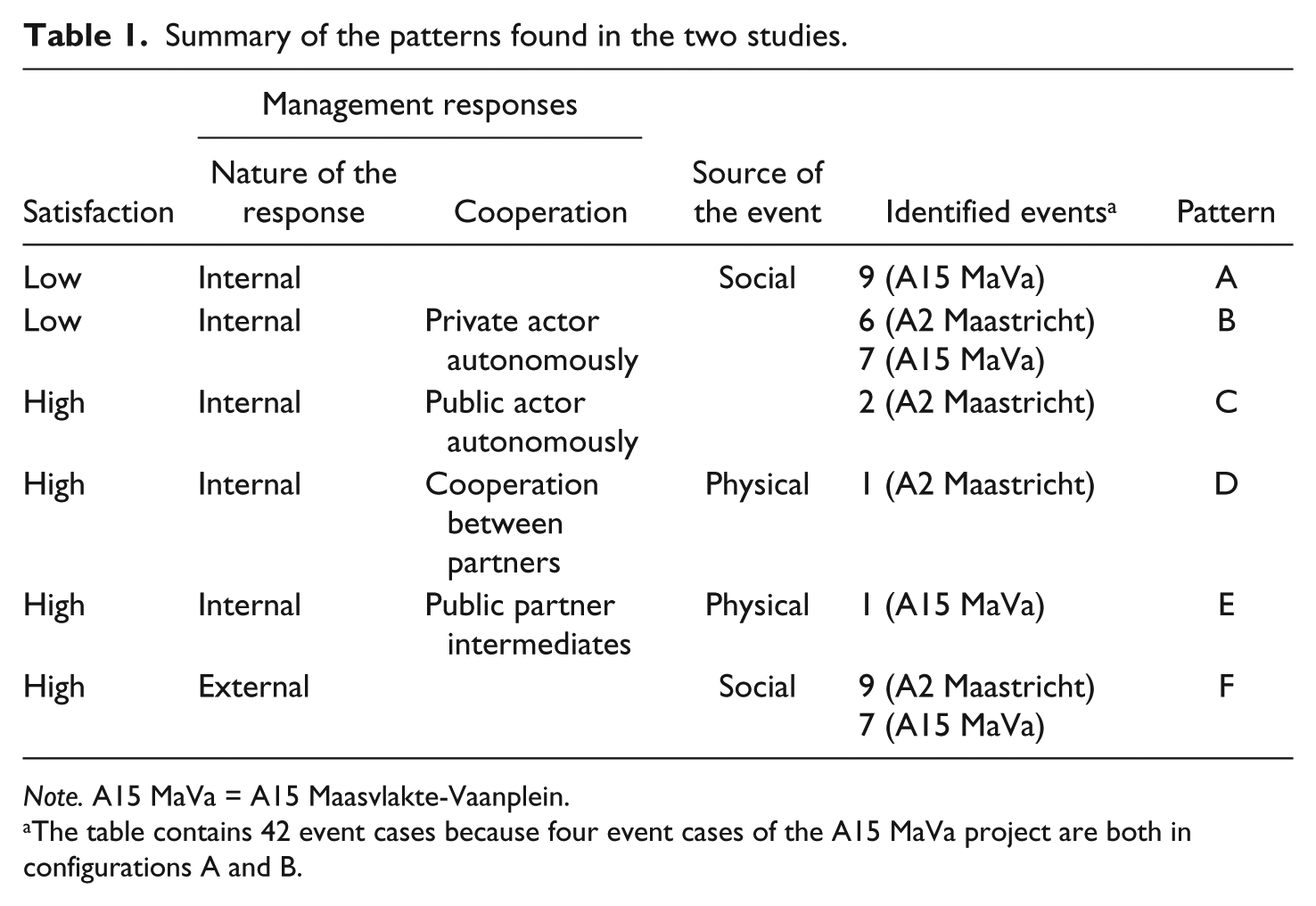
Note. A15 MaVa = A15 Maasvlakte-Vaanplein.
The table contains 42 event cases because four event cases of the A15 MaVa project are both in configurations A and B.
The second part of the research concerned finding explanations for the patterns. The patterns show that “externally oriented responses” to events, that is, responses whereby the implementation managers involve the societal environment in dealing with the issue at hand, or a cooperative stance between the public and private partners, produce satisfactory outcomes. These findings are in line with previous studies (e.g., Edelenbos & Klijn, 2006, 2009; Jacobson & Choi, 2008; Mistarihi et al., 2013), and with current project management ideas moving away from the traditional “project management as closed system” thinking (De Bruijn, Ten Heuvelhof, & In ’t Veld, 2010; Edelenbos, Klijn, & Kort, 2009). They are in support of previous work, stressing the importance of cooperation and the development of personal relationships between partners for the success of partnerships (Heilman & Johnson, 1992, in Leavitt & Morris, 2007). Interestingly, however, management responses in the two transportation infrastructure PPP project implementations are often still internally oriented and non-cooperative, resulting in unsatisfactory outcomes. The second question in this article hence is: how can it be explained that unforeseen events are often not managed with externally oriented and cooperative strategies thereby producing unsatisfactory outcomes? This question is answered in the “Explanations for Achieving (Un)Satisfactory Outcomes” section.
The next two sections will provide the background of the research. We will introduce the empirical setting of the research in the “Infrastructure PPPs in the Netherlands” section. Then, in “The Complexity of PPP Implementation” section, the concepts of unforeseen events, management, and (un)satisfactory outcomes are elaborated. After explaining the “Data and Method,” the results are presented. The article concludes with conclusions and implications for the management and policy of infrastructure PPPs in the final “Conclusion and Discussion” section.
Infrastructure PPPs in the Netherlands
PPPs in infrastructure emerge in various shapes and sizes (e.g., Kwak et al., 2009). Within the general definition presented above, scholars differentiate between concession and alliance models (e.g., Edelenbos & Klijn, 2009; Koppenjan, 2005). In the concessional model, there is a hierarchical client–contractor relationship. The private contractor is primarily involved in implementation; he designs, finances, and builds a public sector project. Responsibilities are divided between the partners and laid down in a contract (Leendertse, 2015). There are multiple forms of concessional models, but especially the concessional form of the Design, Build, Finance, and Maintain (DBFM) contract is promoted in the Netherlands (e.g., Committee PFI, 2008), resembling contracts in the U.K. Private Finance Initiative (PFI; Klijn, Edelenbos, & Hughes, 2007). Other concessional forms are, for example, DBFO or DBFMO, where the operation of the infrastructure is also included in the contract between the partners (Grimsey & Lewis, 2004). A recent example of a Dutch DBFM is the A15 MaVa project (see below). The number of projects with this form is increasing. However, to date, not many of them have been realized (see Committee PFI, 2008; Klijn, 2009; Ministerie van Financiën, 2012). In 2012, the Ministry of Finance reported just nine DBFM transportation infrastructure projects that were in the procurement, realization, or exploitation phase.
In contrast to concessional models, alliance models highlight horizontal relationships between public and private partners. Whereas concessions seem to be based on the idea of dividing risks between the partners, alliance models pursue the idea of sharing risks. The partners pursue a common goal, and certain responsibilities and tasks in implementation are taken on jointly by the project partners. In some alliance forms, a new organization is established where the partners share the clientship (e.g., a joint venture). However, most forms of alliances have a contractual relationship between public and private partners, where the clientship remains with the public partner (Leendertse, 2015). The A2 Maastricht project is an example of this (see below). Thus, although both models involve contracts between public and private organizations and the monitoring of compliance, the alliance model is said to put less emphasis on contracts and more on informal cooperation and trust (Edelenbos & Teisman, 2008). Currently, in line with recent trends toward privatization and “smaller governments,” the alliance model is less promoted by the Dutch national government than the concession model.
Two Infrastructure Projects
The A15 MaVa project has a concessional model with a DBFM contract. It involves the extension of the 37-km highway corridor from the Rotterdam port area “Maasvlakte” to the “Vaanplein” crossing in the Rotterdam highway ring. Its scope encompasses the application of a traffic management system, 85-km highway lanes, a new Botlekbridge, and the renovation and reconstruction of civil works (e.g., flyovers, tunnels, and bridges) on the corridor. The implementation partners are Rijkswaterstaat and the construction consortium A-Lanes A15, consisting of Strukton, Ballast Nedam, John Laing, and Strabag. The DBFM contract was signed in 2010. The construction is to be finished in 2015; the maintenance contract will last until 2035. 1 The budget is nearly €2,000 million (Ministerie van Infrastructuur en Milieu, Ministerie van Economische Zaken, Landbouw en Innovatie, & Ministerie van Binnenlandse Zaken en Koninkrijksrelaties, 2012); the construction costs are about €1,400 million (Lenferink, Tillema, & Arts, 2013). The opportunities for a viable business case are in the financial constructions between A-Lanes A15 and its funders and in life cycle optimization, which should gain the concessionaire some profits. Contrary to the A2 Maastricht project, the relation between A-Lanes A15 and Rijkswaterstaat is purely concessional. A-Lanes A15 is responsible for the design, construction, partly financing, and maintenance of the project, and the emphasis of Rijkswaterstaat is on monitoring the performance of A-Lanes A15 with regard to availability, quality, and stakeholder satisfaction. Based on this, A-Lanes A15 receives availability fees that co-finance the project.
The A2 Maastricht project has an alliance-like model. It involves the construction of a 2.3-km tunnel underneath the city of Maastricht on the A2 highway corridor, combined with real estate development and landscaping, and the rearrangement of adjacent highway junctions. Partners are the Dutch highway authority Rijkswaterstaat, the Province of Limburg, the Municipalities of Maastricht and Meerssen, and the private consortium Avenue2 wherein the companies Strukton and Ballast Nedam participate. The implementation started with a Design and Construct (D&C) contract, which was concluded in 2009. The execution is planned to be finished in 2017. 2 Rijkswaterstaat sponsors € 564 million; the other three public partners contribute €144 million, including plots for real estate development (Ministerie van Infrastructuur en Milieu, Ministerie van Economische Zaken, & Ministerie van Binnenlandse Zaken en Koninkrijksrelaties, 2013). The development of real estate is expected to cover 10% of the execution costs (about €70 million; Lenferink et al., 2013). The private partners have to recoup a substantial part of their investments from selling this real estate. Consortium Avenue2 is responsible for the design and construction of the project, and the alliance approach is prominently visible in that the public and private project organizations are housed in the same building and that they run a joint department responsible for the communication with various local stakeholders (Projectbureau A2 Maastricht, 2012).
The Complexity of PPP Implementation
Unforeseen Events
Project implementation takes place in dynamic socio-physical contexts in which unforeseen events will occur (Gerrits, 2012; Van Gils et al., 2009; see also Müller-Seitz & Schüßler, 2013). Unforeseen events often have an impact on implementation (Söderholm, 2008). PPP projects are no context-independent “islands” (Engwall, 2003) but rather open instead (e.g., Papadopoulos, 2012; cf. Dimitriou, Ward, & Wright, 2013). Naturally, contingency plans are drafted to deal with dynamical contexts. These plans are “repositories of expectations on which managers build their daily activities” (Söderholm, 2008, p. 81). They help managers to focus and they guide their actions. By the same token, plans also neglect expectations as they cannot foresee all possible future eventualities. There are real limits to prediction and planning capacities, no matter how much information is processed (Gerrits, 2012). Consequently, some events will be unforeseen (cf. Söderholm, 2008), which challenges implementation.
The extent to which an event is unforeseen depends on the position of the people involved. Events even can be unforeseen by one person and expected by someone else (cf. Rescher, 1995). This does not diminish their potential disruptive effect on implementation, as long as those working in project implementations did not recognize its coming. Unforeseen events are non-stochastic and out of reach of contingency planning, because—contrary to planning for stochastic events in terms of risks—the likelihood of their occurrence is unknown and undetermined.
It is useful to distinguish between two categories of unforeseen events (Van Gils et al., 2009). Events can originate from physical sources, like unstable ground conditions. They can also originate from social sources, such as dissatisfied stakeholders (e.g., citizens, municipalities, or other governmental organizations) or changing laws and regulations. Aaltonen and Sivonen (2009) argued that “stakeholder related conflicts and incidents are among the most significant unforeseen risks in projects implemented in challenging environments” (p. 131). During implementation, stakeholders are mostly concerned with “the influence of construction activities on their daily routine activities and life style” (El-Gohary, Osman, & El-Diraby, 2006, p. 596). It may be expected that the source of the unforeseen events requires specific managerial responses (cf. Allison, 1983; Ring & Perry, 1985).
Management Responses to Unforeseen Events
Managers often respond to the events by trying to control them, aiming to nullify their effect on the implementation process (Van Gils et al., 2009). This response is one type we are going to elaborate. Drawing on the PPP management literature (e.g., Edelenbos & Klijn, 2009; Edelenbos & Teisman, 2008; Klijn et al., 2008), this response is identified as an internally oriented focus on the project. It is rooted in traditional management models focusing on “structure, administrative systems and the execution of plans” (Söderholm, 2008, p. 81). The general thrust is on speeding up implementation, mainly by explaining and promoting the project interest. The management persists on achieving predetermined goals despite unforeseen events. Communication follows a DAD strategy (decide, announce, and defend).
Alternatively, an externally oriented response can be followed, emphasizing interaction with the societal environment (cf. O’Toole, Meier, & Nicholson-Crotty, 2005). This response relates to “process management” approaches (De Bruijn et al., 2010). It is characterized by an outward orientation, aiming to create or maintain support for project implementation. Possible solutions are sought together with stakeholders. The management is receptive toward unforeseen events, and communication takes a DDD strategy (dialogue, decide, and deliver). Because of its stakeholder-oriented nature, this response can be applied in response to social events (Edelenbos et al., 2009).
Another dimension of the management response concerns the way public and private partners are involved in the response. We discern three possibilities. Some events are responded to by the public partner; others are responded to by the private partner. This depends on how risks and responsibilities are perceived and allocated in the PPP. A third option is that the partners develop a joint response (Jones & Noble, 2008; Verweij & Gerrits, 2015).
Satisfactory Outcomes
Management responses to events produce outcomes. The most common variables for measuring project outcomes are efficiency and value-for-money. These, however, can hardly be used in situations wherein projects have not yet been delivered. Nevertheless, the quality of the implementation process needs to be assessed. This can be done by inquiring whether and to what extent actors are satisfied with the implementation process. As suggested by Koppenjan and Klijn (2004), this was done by interviewing actors and by letting them reflect on the achieved outcomes (cf. Kärnä, Junnonen, Manninen, & Julin, 2013; Lehtiranta, Kärnä, Junnonen, & Julin, 2012). These outcomes can be different things: stakeholder satisfaction, incurred costs, time schedule, partner’s behavior, and the perceived quality of mutual relations are the main outcomes during implementation processes (cf. Atkinson, 1999; Jeffares, Sullivan, & Bovaird, 2013; Verweij, 2015c). Which of these indicators is (most) important for a manager’s satisfaction depends on the position of the specific manager(s) in the project that is/are involved in the event (e.g., a stakeholder manager will be more concerned with stakeholder satisfaction), as well as the specific event at hand (e.g., some events in implementation have no effect on costs or the time schedule). We thus used self-reported “managers satisfaction” to assess the quality of the implementation process (cf. Dimitriou, 2014; Kärnä et al., 2013; Lehtiranta et al., 2012). We distinguished between low and high satisfaction.
Data and Method
Data Collection
The main data come from open qualitative interviews conducted with public and private senior project managers and directors. These managers occupy leading management positions in the public procurers’ project organizations and the private contractors’ project organizations, respectively. Eighteen interviews with 14 respondents were conducted for the A2 project from September to December 2011. Twenty interviews with 17 respondents were conducted for the A15 project from May 2012 to January 2013. All interviews were recorded and fully transcribed. The transcripts were coded for the events, including management responses and satisfaction, as reported by the respondents.
Data Analysis
The interviews were cross-compared per identified event. This was facilitated by coding in ATLASti. This resulted in eighteen “event-management-outcome” combinations for the A2 Maastricht project and twenty for the A15 MaVa project. A qualitative reconstruction of each of the 38 events was made. 3 Next, the 38 events were comparatively analyzed. This allowed us to find (a) patterns across the events for each of the two projects, as reported in the “Patterns for Achieving (Un)Satisfactory Outcomes” section; and to find (b) differences between the two projects, resulting in the explanations that are reported in the “Explanations for Achieving (Un)Satisfactory Outcomes” section.
The comparative analysis of the events was performed with the method multi-value QCA (Cronqvist, 2011; Cronqvist & Berg-Schlosser, 2009), often abbreviated as QCA. First, the method analyzes the events as configurations of aspects (i.e., the source of the event, the nature of the management response, and the public–private cooperation), and then compares configurations that agree on the outcome (i.e., satisfaction) and differ in just one of the aspects. This was done separately for each of the two infrastructure projects. The aspect in which two configurations were different could be considered redundant for explaining the outcome. For instance, if two events have high satisfaction, and one concerns a social event with an internally oriented management response where the private partner acted autonomously, and the other also concerns a social event where the private partner acted autonomously but with an externally oriented management response, then we infer that the response (internally or externally oriented) is not needed for explaining satisfaction: private actors’ autonomous responses to social events produce low satisfaction. This comparative process resulted in six patterns (next section), which are shown in Table 1 and Figure 1. These patterns are explained by comparing the two infrastructure projects with each other (subsequent section).
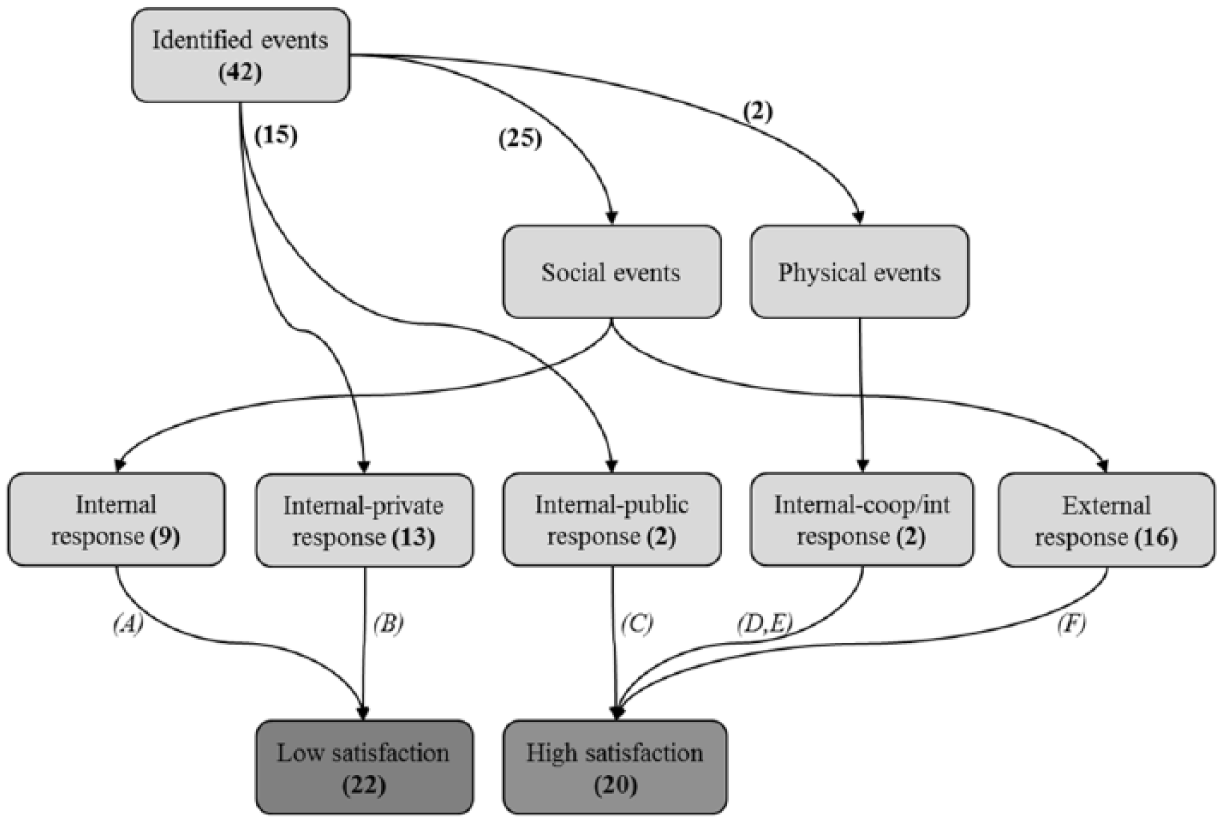
Visualization of the patterns found in the two studies.
Patterns For Achieving (Un)Satisfactory Outcomes
The results of the multi-value QCA’s of the two infrastructure project case studies are reported in Table 1 and visualized in Figure 1. We will give two examples of the patterns summarized in Table 1. In one case, the Municipality of Rotterdam (a local stakeholder) disapproved the construction of the Botlekbridge pillars. A-Lanes A15 responded by searching for technical solutions to maintain project speed (internal response) by itself (private actor acts autonomously). The municipality disapproved again, resulting in delays and extra costs. The managers were dissatisfied with these costs and delays (low satisfaction). In another case, A-Lanes A15 also responded internally and autonomously, also resulting in low satisfaction, but this concerned a situation where the ground conditions nearby an underground pipeline street were worse than expected. Because the first case concerned an event from a social source and the second case an event from a physical source, the source of the event can be considered redundant for explaining satisfaction; both cases thus represent Pattern B in the table and figure. 4
The table and figure show that there are two patterns associated with low satisfaction (Patterns A and B) and four with high satisfaction (Patterns C, D, E, and F). The table also shows that events are more often satisfactorily responded to in the A2 (12 event cases) than in the A15 project implementation (eight event cases). Furthermore, the internally oriented management response is more often applied (in 26 event cases) than the externally oriented strategy (16 event cases), and internally oriented responses are more often applied in the A15 MaVa project than in the A2 Maastricht project.
Explanations For Achieving (Un)Satisfactory Outcomes
Patterns that complement each other are presented and discussed together (see Table 1). The first subsection compares Patterns A and F with each other, so as to focus on explanations related to the nature of the management response. The second sub-section discusses Patterns B to E, focusing on the public–private cooperation.
Internally- and Externally Oriented Management in Responding to Social Events
Whereas Pattern F indicates the strong relation between social events, externally oriented management, and higher outcome satisfaction, Pattern A indicates the strong relation between internally oriented management of social events and lower satisfaction. The two patterns are opposites, indicating externally oriented management as the effective response to social events. This finding corroborates research by, for example, Edelenbos and Klijn (2006, 2009), who found that management approaches that emphasize openness and interaction with the societal environment result in more satisfactory outcomes than approaches that stress the execution of projects according to plans, specified goals, and contractual relations, and that tend to develop a more internal orientation. The A2 project management responses were more often externally oriented than the A15 responses (see Pattern F in Table 1): In nine out of 18 events in the A2 project, the management responses were externally oriented, and in the A15 project, seven out of 20 responses were externally oriented. Our comparison of the projects resulted in two explanations.
Explanation 1: Time pressure
The first explanation for this difference between the two projects concerns the difference in time pressure experienced. Several managers in the A15 experienced time pressure in the implementation. Instead of “being in control,” they regularly felt “lived by” the project’s dynamics. The private A15 project director talked about impending budget overruns. Under conditions of (perceived) time pressure, engaging in interactive processes with stakeholders (externally oriented management responses) feels as time-consuming. Under these conditions, managers aimed for quick solutions within their reach (internally oriented). An example is the social event “Municipality of Rotterdam does not approve the construction design of the Botlekbridge pillars, being unconvinced of the pillars’ strength for carrying the bridge decks.” A-Lanes A15’s management response aimed to minimize the effect(s) of this social event on the project planning by finding a technical solution to the problem and ordering steel for the bridge although the municipality had not yet approved the design (internally oriented response). This response generated financial risks and low satisfaction. In another event, A-Lanes A15 constructed a temporary road for transporting hazardous substances without coordinating the road design (internally oriented) with the Port of Rotterdam Authority (another local stakeholder). Later, the Authority disapproved the road, which generated low mutual satisfaction.
The A2 Maastricht project provides a contrasting picture. In interviews, the private project director showed confidence in the progress toward completion. The interviewed managers exhibited less signs of stress and time pressure. At the same time, quite a lot of time was spent in engaging with stakeholders, after a social event occurred. For instance, when a local vocational school objected to the phasing of a road bypass during construction (social event), an elaborate informal negotiation process with the school was started (externally oriented response), resulting in the cancelation of the school’s objection and the maintaining of good rapport between school and project organization (high satisfaction). The responses to unforeseen social events in the A2 project were often externally oriented. The managers recognized the importance of stakeholders and invested in the relationships with them. This comparison of the two projects indicates that the experience of time pressure reinforces internally oriented responses which, in the occurrence of social events, often results in dissatisfactory outcomes.
The time pressure explanation can also be found in the literature. Owens, Ahn, Shane, Strong, and Gransberg (2012) found that tight timelines for project delivery add to the complexity of the project. When managers experience time pressure, they draw boundaries in attempts to reduce the complexity of implementation. Information is filtered and ignored (Edland & Svenson, 1993), which allows managers to “ration attention” (March, 1994) so as to get (back) “in control.” This simplification is inherent to coping with unforeseen events (Gerrits, 2012; Van Gils et al., 2009). When time pressure increases, focused approaches aiming to get control over implementation become attractive. However, when the societal environment is excluded in responding to an unforeseen event, stakeholders’ interests and influence can be overlooked, resulting in opposition to the project implementation later on. If so, the internally oriented management response is actually becoming ineffective.
Explanation 2: Organization of stakeholder involvement
A second explanation for more externally oriented responses in the A2 project concerns the organization of stakeholder involvement. This can be explained from the different project scopes. The A2 is about local inner-city infrastructure development. It benefits the citizens of Maastricht regarding traffic safety, environmental quality, and traffic congestion. Local actors such as the municipalities, citizens, and businesses were facing not only the negative externalities during implementation (e.g., noise nuisance and limited accessibility during construction) but also the possibilities of prospective revenues, for example, more safety and environmental quality, and less traffic congestion. The project was not only about connecting point A to point B; it was about regaining city qualities. This seemed to be crucial. It also meant that the local Municipality of Maastricht was partner in the PPP, and that the municipality was committed to involving local stakeholders in planning, procurement, and implementation. Local stakeholder platforms and citizens had a say in deciding on which project bid would win, and during implementation, stakeholders were actively informed about and involved in the project.
In contrast, the A15 MaVa project is not intended nor presented as regional development. It is “just” an improved connection between points A and B. This created no support among local stakeholders. This also tended to reinforce internally oriented approaches in which stakeholders are external to the project. Nearby residents and municipalities experienced negative externalities during implementation, with less positive effects in the future compared with the A2 project. In addition to this, the applied concession model created an indirect relation between the private management and the stakeholders. Stakeholders do have implementation agreements, but with the procurer Rijkswaterstaat. These agreements were included in the contract between Rijkswaterstaat and A-Lanes A15. Rijkswaterstaat assumed that they had transferred their relationships with stakeholders to A-Lanes A15, who was responsible for implementation. The indirect relationships meant that, inter alia, local municipal authorities were at arm’s length of the implementation. They were not able to translate stakeholder issues into the project. The issues only found a way out through external events. After citizens complained (to their own municipality) about noise nuisance, the municipality forced A-Lanes A15 to stop pile driving works. In the A2 project, it seemed that internalizing local stakeholder interests into the partnership allowed for proactive and attuned joint actions.
This comparison suggests that in projects with a broader scope of transportation and urban development, where multiple stakeholders are involved in implementation, stakeholder interests are better served, creating also satisfactory outcomes for the implementation managers themselves. The effectiveness of stakeholder involvement can also be found in the literature, where it is emphasized that involvement is important because actors who’s interests are harmed can easily block or hinder implementation (Edelenbos & Klijn, 2006; Koppenjan & Klijn, 2004). Whereas that literature implies that less unforeseen social events may occur when stakeholders are effectively involved, recent research (Verweij, Klijn, Edelenbos, & Van Buuren, 2013) additionally shows that stakeholder involvement combined with an externally oriented management results in satisfactory outcomes.
Public–Private Cooperation in Responding to Events
Table 1 and Figure 1 show four patterns that indicate some form of public–private cooperation in response to events: Patterns B, C, D, and E. Pattern B states that internally oriented responses by a private partner result in low satisfaction. Patterns C, D, and E, however, indicate that internally oriented management can result in high satisfaction; satisfaction requires that the public partner is also involved in responding to the event. 5 Public actors can compensate a private internal orientation. These findings indicate that joint public–private actions in response to unforeseen events result in higher satisfaction. Joint action may mitigate the internally oriented response of one of the partners (cf. Jacobson & Choi, 2008; Mistarihi et al., 2013).
Explanation 3: Project culture in the PPP
The two infrastructure projects show a quite different relationship between the public and private partners. In the A2, signing the contract was perceived as the start of actually working together. In the A15, signing the contract was perceived as the moment of transferring responsibilities and risks from the public to the private partner. The public actor was only prepared to play a partnership role as intermediary between A-Lanes A15 and stakeholders in the environment (Pattern E in Table 1), and only after the tension between project and stakeholders got high (Verweij, 2015a). In both projects, the public partner Rijkswaterstaat followed a businesslike, formal approach. This was reflected in Rijkswaterstaat’s role perception in the PPPs, which mainly concerned contract monitoring and project control. The difference is that in the A2 project, however, the managers from the municipality applied another approach and were able to compensate the Rijkswaterstaat way of working. These managers were much more socio-politically orientated and not only focused on contract monitoring and project control. The A2 project director had a long-standing career as manager and director of urban development projects in Maastricht, and the project’s stakeholder manager was in close contact with the Maastricht alderman. The municipal managers brought to the partnership local ways of working, characterized by open and informal relationships with private partners. The cooperation of local (municipal) and national (Rijkswaterstaat) public managers created a project culture with a unique and joint set of norms, values, and principles tending toward partnership. According to respondents, the open and informal PPP culture in the A2 project was also instigated by the proximity of the public and private management: they were housed in the same building. Whereas the informal relationship and the proximity were regularly stated in the A2 Maastricht interviews as success factors for implementation, in the A15 MaVa interviews, in contrast, the businesslike (formal), tense, and remote nature of the relationship was stressed (see also KING, 2009).
This partnership culture explanation is also found in the PPP literature, often by reference to the two PPP models that underlie projects. The PPP model can condition the project culture that is allowed to emerge. Scholars argue that the concessional model (found in the A15 project) “is not a real partnership because co-production is limited, risk-sharing is absent, and relationships are purely contractual” (Weihe, 2008b, p. 157). The argument is that the strict demarcation between public and private actors, anchored in contracts, discourages cooperation. So, the advantages of not blurring different value systems (Jacobs, 1992) by which public and private sector actors are governed (cf. Ring & Perry, 1985) can easily become a hindrance for stakeholder involvement and externally oriented approaches. In the alliance model, the demarcation between the partners is less strict, not only generating fears about the possibility of corruption by some but also facilitating satisfactory cooperation in implementation. Governments are more intensively involved, taking care of public interests after unforeseen events emerge (Edelenbos & Teisman, 2008).
Conclusion and Discussion
Conclusion
How do public and private managers respond to unforeseen events in implementation? Which management responses produce more or less satisfactory outcomes? Moreover, what can explain these patterns? These were the questions we set out to answer in the introduction of this article. Based on our study, we can draw four conclusions.
Externally oriented management responses to social events result in satisfaction.
Internally oriented management responses to social events do not result in satisfaction.
Managers, however, often apply internally oriented and autonomy-seeking responses to events.
Internally oriented management responses can also result in satisfaction, but this requires a public partner to be involved, acting as an intermediary between the project management and its environment. This insight emphasizes the importance of cooperative management in PPP implementation.
By subsequently comparing the two projects, we found three explanations for the patterns we identified.
A combination of local and national management cultures in the A2 Maastricht project resulted in a unique externally oriented and cooperative PPP approach, different from the normal way of working of Rijkswaterstaat. Such a combination of cultures was absent in the A15 project. Cooperation was restricted there by the concessional DBFM contract. Consequently, cooperative action only happened reactively at moments when tensions were already high, resulting in an implementation that is experienced as stressful.
The experience of time pressure. A characteristic of PPP implementation, that is, the project construction and delivery, is the increasing time pressure. After contracting, when the project “starts rolling,” time is experienced as more pressurized. This pressure is felt by managers, who react by seeking to make their project reality less complex. This explains their inclination toward internally oriented and autonomy-seeking responses (see further the previous section).
Although excluding local stakeholders from the implementation scheme seems attractive in advance because it seems to simplify implementation, in practice, however, this may generate a project-inward orientation and (hence) unforeseen social events. Internalizing local stakeholders as partners in the partnership seems to pay off.
Discussion
The patterns and explanations for achieving satisfactory outcomes in PPP project implementation are based on two case studies from the Netherlands. Although more comparative research is needed to further corroborate the conclusions, our research points to several implications for PPP project implementation.
Because events mostly have social sources and because they are best responded to with externally oriented management responses and public–private cooperation, allocating sufficient resources (e.g., time, attention, money, personnel) to stakeholder management, and to managing the PPP itself, is important (El-Gohary et al., 2006; Jones & Noble, 2008; Mistarihi et al., 2013) in avoiding bigger problems and greater costs later on. The importance of these aspects is easily overlooked or underestimated. Staying in control of planning and budget during PPP project implementation requires managers’ full attention. Keeping the project “under control” is strived for through different monitoring mechanisms deployed by public principals. Although these mechanisms are indisputably important—inter alia for safeguarding public values as quality, accountability, and transparency (Reynaers, 2014), and the prevention of ambiguous relationships between the partners—the danger in implementation is that monitoring becomes the sole focus. Consequently, stakeholders and their interests and influence on the project may be missed (Dimitriou et al., 2013). The clear division of tasks, risks, roles, and responsibilities is stressed, but our study shows that investment in cooperation, and the closer involvement of local stakeholders (such as municipalities) in the partnership, so as to achieve mutual satisfactory results, is, however, equally important (see also Leavitt & Morris, 2007).
It would be worthwhile researching flexible contract structures. Our interviewees suggested that the integrated area development approach of the A2 Maastricht project generated fewer stress-sensitive incentives. It also allowed a higher level of flexibility because the profits are in the development of real estate, and private contractor Avenue2 was given some degree of flexibility in planning the exact construction of the real estate, that is, to build real estate when there is a favorable market for it. Perhaps incorporating such characteristics in concessional PPP models can create more flexibility in project implementation.
Public agencies are increasingly looking to DBFM for the delivery of public works and services (e.g., Rijkswaterstaat, 2011). We understand the attractiveness of the concessional model. It promises the advantages of partnership and simultaneously the separation of the public and private domains to prevent a lack of transparency. We understand and support these values. At the same time, our research suggests that there are other PPP models than DBFM that are more prone to externally oriented management and public–private cooperation, resulting in more satisfactory outcomes during implementation. The alliance model seems more flexible in the sense that it facilitates externally oriented management and public–private cooperation. Of course, it remains to be seen whether the more contractual and non-cooperative approach that characterized the concessional model in project implementation also explains poor project performance (in terms of, for example, quality, cost overruns, and time delays) at the delivery of the full project. More research is needed for this. However, our broader message here is that policy-makers may do well tempering their enthusiasm for DBFM a bit and to take a critical attitude toward it (cf. Hodge & Greve, 2007), or to at least bear in mind that the concessional DBFM model is not the only way to advance in infrastructure project realization. Other PPP formats may have certain advantages over DBFM.
Footnotes
Declaration of Conflicting Interests
The author(s) declared no potential conflicts of interest with respect to the research, authorship, and/or publication of this article
Funding
The author(s) disclosed receipt of the following financial support for the research, authorship, and/or publication of this article: This work was supported by Next Generation Infrastructures [Grant 03.24EUR].