Parasitic infections caused by Entamoeba histolytica are still major threats against public health, especially in developing countries. Although current therapies exist, the problems associated with parasite resistance and negative side effects make it imperative to search for new therapeutic agents. A systematic scaffold analysis reported herein of a public database containing 474 antiamoebic compounds reveals that benzimidazole is the most active scaffold reported thus far. To gain insights into the antiamoebic activity of novel compounds, the authors report herein the biological activity of 12 compounds, including benzotriazole and indazole derivatives, scaffolds not previously tested against E. histolytica. Compounds with the benzotriazole and indazole scaffolds showed low micromolar activity (IC50 = 0.304 and 0.339 µM) and are more active than metronidazole, which is the drug of choice used for the treatment of amebiosis. The novel compounds have similar properties to approved drugs. Compounds with novel scaffolds represent promising starting points of an optimization program against E. histolytica.
Parasitic and bacterial infections affecting the gastrointestinal tract represent a significant cause of morbidity and mortality worldwide and are still major threats against public health. Amebiosis is caused by the protozoan parasite Entamoeba histolytica; it is very common in young adults and the middle-aged population. Infection can be intestinal or extraintestinal amebiosis.1 The World Health Organization (WHO) estimates that at least 500 million people are infected with E. histolytica, but still 90% of them remain asymptomatic while carrying the infection for many years. Amebiosis is responsible for approximately 70 000 deaths worldwide in developing countries. The range of prevalence is from 1% to 40% of the population in Central and South America, Africa, and Asia and 0.2% to 10.8% in endemic areas of developed countries such as the United States.2,3
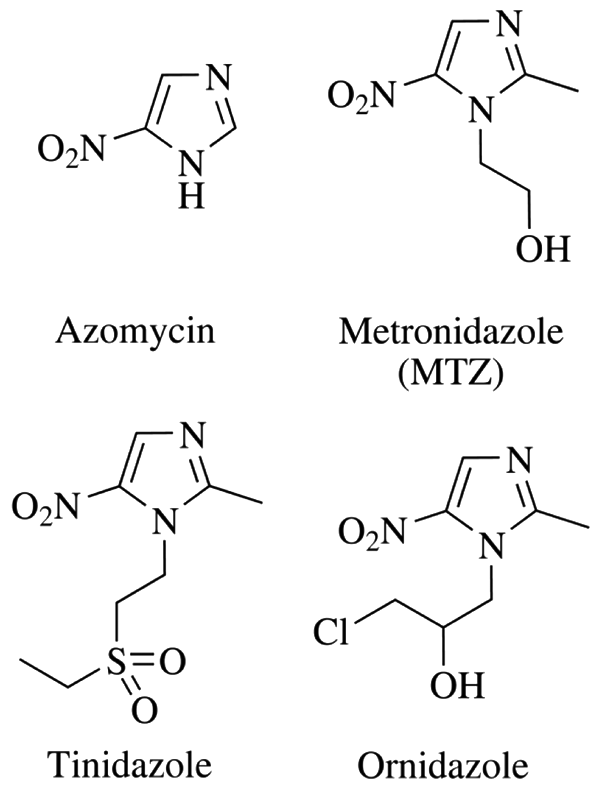
Nitroheterocycles are currently used for the treatment of parasitic infections (Fig. 1). Antiprotozoal nitroheterocyclic compounds were introduced in the 1960s; azomycin was the first active nitroimidazole discovered. The antibacterial activity of metronidazole (MTZ), a 5-nitroimidazole derivative, was accidentally discovered later after a successful treatment of a patient infected with Trichomonas vaginalis and bacterial gingivitis.4 Other antiparasitic 5-nitroimidazole drugs are tinidazole and ornidazole (Fig. 1). At present, MTZ is the most widely used drug for the treatment of amebiosis and other parasitic infections. Although there is no evidence that MTZ causes carcinogenity or mutagenicity in humans, the former has been reported in rodents and the latter in bacteria.4,5 MTZ produces serious side effects such as appetite loss, constipation, diarrhea, severe or persistent dizziness or headache, metallic taste, nausea, genital itching, urinary tract infection, stomach upset, and vomiting, among others.6 MTZ resistance by protozoa parasites has also been reported.7 Consequently, the search for new therapeutic agents is of utmost importance.
Representative antiparasitic compounds approved for human use. Active 5-nitroimidazole derivatives against anaerobic protozoa parasites.
Compounds with a benzimidazole scaffold have shown promising antiparasitic activity against E. histolytica. It has been reported that some simple 1H-benzimidazole derivatives have in vitro activity in the low micromolar range with an IC50 of 3.8 to 0.005 µM.8–12 Recently a 3D quantitative structure–activity relationship (SAR) study of benzimidazole analogues with antiamoebic activity was performed, and a comparative molecular field analysis (CoMFA) model has been proposed to select the most probable bioactive tautomeric forms.13
As part of our efforts to investigate the antiprotozoan activity of novel compounds, in this work, we report the in vitro activity of 12 compounds against E. histolytica. Compounds include not only benzimidazole derivatives but also benzotriazole and indazole derivatives, similar scaffolds to the benzimidazole ring but not previously tested against this parasite.
Materials And Methods
Biological assays
Compounds 1 to 12 were purchased from Sigma-Aldrich (Toluca, Mexico). The biological assay was performed with E. histolytica strain HM1-IMSS. E. histolytica trophozoites were maintained in TYI-S-33 medium supplemented with 10% bovine serum. In vitro susceptibility assays were performed using the method previously described.14 In brief, 6 × 10³ trophozoites were incubated for 48 h at 37 °C with different concentrations of compounds 1 to 12, MTZ, and albendazole, each added as a solution in DMSO. As the negative control, trophozoites were incubated with DMSO. At the end of the treatment period, the cells were washed and subcultured for another 48 h in fresh medium to which no drug was added. The trophozoites were then counted with a hemocytometer, and the 50% (IC50) inhibitory concentrations, together with the respective 95% confidence limits, were calculated by probit analysis. Experiments were carried out using triplicate tubes and were repeated twice.
Computational work
A database with 630 structures was retrieved from ChEMBL (downloaded October 2010, from http://www.ebi.ac.uk/chembldb/index.php), entering Entamoeba histolytica as a search criterion, and was submitted by the option assays. Duplicate structures were removed, and the resulting 474 unique structures were “washed” with the Molecular Operating Environment program (MOE 2009.10; Chemical Computing Group, Inc., Montreal, Quebec, Canada) by disconnecting any group I metals in simple salts and keeping the largest fragment. The scaffold analysis was conducted with the Molecular Equivalence Index (MEQI). Data visualization was conducted with Spotfire 9.1.1. software (TIBCO Software, Inc., Somerville, MA). In this approach, the scaffolds are defined as the cyclic systems that result from iteratively removing all vertices of degree one, in other words, by iteratively removing the side chains of the molecule. A chemotype code or chemotype identifier (a code of five characters) is assigned to each cyclic system using a unique naming algorithm.
To map the novel antiamoebic compounds and the antiamoebic ones from the ChEMBL database into the property space of drugs (1490 compounds obtained from DrugBank15 and implemented in the ZINC16 database, downloaded July 2008), the property space representation was built by principal components analysis (PCA) using Spotfire. PCA was carried out considering the six scaled molecular properties—molecular weight (MW), number of rotatable bonds (RB), the octanol/water partition coefficient (SlogP), topological polar surface area (TPSA), hydrogen bond acceptors (HBA), and hydrogen bond donors (HBD)—and plotting the first three principal components.
Results
Chemoinformatic and systematic scaffold analysis of antiamoebic agents in the ChEMBL database
The nine most frequent cyclic systems from the ChEMBL database with activity against E. histolytica are presented in Table 1. Cyclic systems are identified by a chemotype code; scaffold frequency, percentage, and micromolar range activity are also shown. The nine cyclic systems in Table 1 account for 40.3% of the entire antiamoebic database. The most frequent cyclic system is benzimidazole (chemotype identifier BT7BR) with 47 (9.9%) compounds, from which our group has been reported 39 compounds. The second most frequent cyclic system is the 3,5-dibenzene-1,4,2-dioxazole (chemotype identifier CP2TP) with 35 (7.4%) compounds. The third and fourth more common cyclic systems are pyridine and benzene, containing 27 (5.7%) and 19 (4.0%) derivatives per cyclic system, respectively. The cyclic system with the chemotype code GY801 has 13 (2.7%) compounds. Based on the activity ranges of the compounds with different cyclic systems (Table 1), it turns out that the most active compounds have a benzimidazole cyclic system (BT7BR) with IC50 values of 3.8 to 0.005 µM. The second most active compounds have the cyclic system 3-(3-bromophenyl)-5-phenyl-1-(thiazolo [4,5-b] quinoxaline-2-yl)-2-pyrazoline (FJ0L9) with IC50 values ranging from 3.2 to 0.100 µM,17 followed by the benzimidazole–pentamidine hybrids (4ZQNH) with IC50 values ranging from 12.053 to 0.109 µM.18 Others interesting active chemotypes are CP2TP and GY801 with IC50 value ranges of 1.800 to 0.480 µM6 and 9.560 to 0.510 µM,19 respectively.
The Most Frequent Cyclic Systems of Antiamoebic Compounds Found in ChEMBL
Antiamoebic activity of novel benzimidazole, indazole, and benzotriazole compounds
Table 2 shows the structures and biological activity of the newly tested compounds 1 to 12. Compounds 1 to 4, 6, and 9 to 11 showed antiamoebic activity in the submicromolar range (0.740–0.276 µM). The benzimidazole derivative 2 was the most active compound with an IC50 of 0.276 µM. The benzotriazole derivative 8 was the less active compound but still showed a notable IC50 of 3.248 µM. In contrast, the benzotriazole derivative 9 was 10 times more active than 8 with an IC50 of 0.339 µM. Notably, a small change in structure (a methyl group in 9 by a chlorine atom at position C5 in 8) is associated with a significant change in activity. Therefore, the pair of compounds 8, 9 is an example of a deep activity cliff.20 A similar observation was made for indazole derivatives; the change of a hydrogen atom at position C3 in compound 10, by a chlorine atom in compound 11, is associated with a significant increase (four times) in activity and can be considered a shallow activity cliff.20 It is not straightforward to derive pairwise SAR for the indazole derivatives 10 to 12 because compound 12 can exist as a mixture of tautomers. The biological activity of the benzimidazole derivatives 1 to 7 is comparable with the previous benzimidazole derivatives we previously reported.8–12 In general, all 12 compounds showed activity against E. histolytica. It is worth noticing that the benzimidazoles 1, 2, and 6; the benzotriazole 9; and the indazole 11 were more active than MTZ (IC50 of 0.355 µM). Noteworthy, all the newly tested compounds 1 to 12 were more active than albendazole, which is also a benzimidazole derivative with an IC50 of 56.6 µM. Taken together, these results suggest that benzotriazole and indazoles are active scaffolds and can be regarded as examples of scaffold hopping or bioisosteric replacement; these twin concepts can be defined generally as the replacement of a part of a bioactive molecule with a substructure that is similar in size and exhibits similar properties.21 This concept has been widely used in drug discovery programs, and there are several reported examples demonstrating that chemical structures with different scaffolds can bind to the same target.22
Chemical Structures of the Novel Active Benzimidazole, Benzotriazole, and Indazole Compounds Tested against Entamoeba histolytica
Drug-like and property space characterization
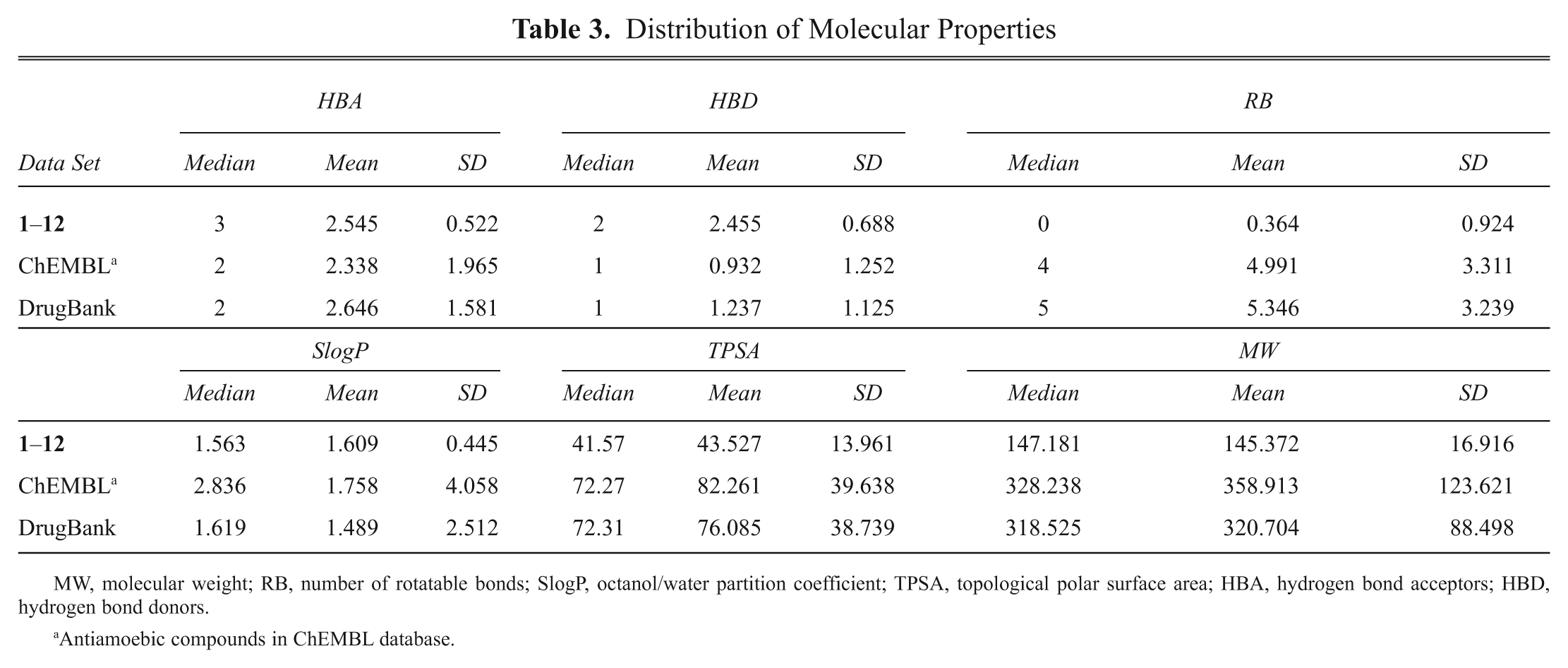
To evaluate the drug-like properties of the novel antiamoebic compounds 1 to 12 and the ones in the ChEMBL database, six molecular properties related to size, flexibility, and molecular polarity were calculated using the MOE program. Calculated properties were described by MW, RB, SlogP, TPSA, HBA, and HBD. Results are summarized in Table 3. Results of this analysis revealed that compounds 1 to 12 are comparable to drugs in terms of HBA, HBD, and SlogP (Table 3). However, 1 to 12 showed, in general, lower RB, TPSA, and MW than drugs (DrugBank), which are molecular properties related to the molecular size. Similar conclusions can be obtained from the antiamoebic compounds in the ChEMBL database (Table 3). Therefore, these novel structures represent ideal lead-like molecules, and it is expected that new designed derivatives, with different substitutions, could increase RB, TPSA, and MW properties while maintaining acceptable drug-like properties throughout the optimization phase.
MW, molecular weight; RB, number of rotatable bonds; SlogP, octanol/water partition coefficient; TPSA, topological polar surface area; HBA, hydrogen bond acceptors; HBD, hydrogen bond donors.
Antiamoebic compounds in ChEMBL database.
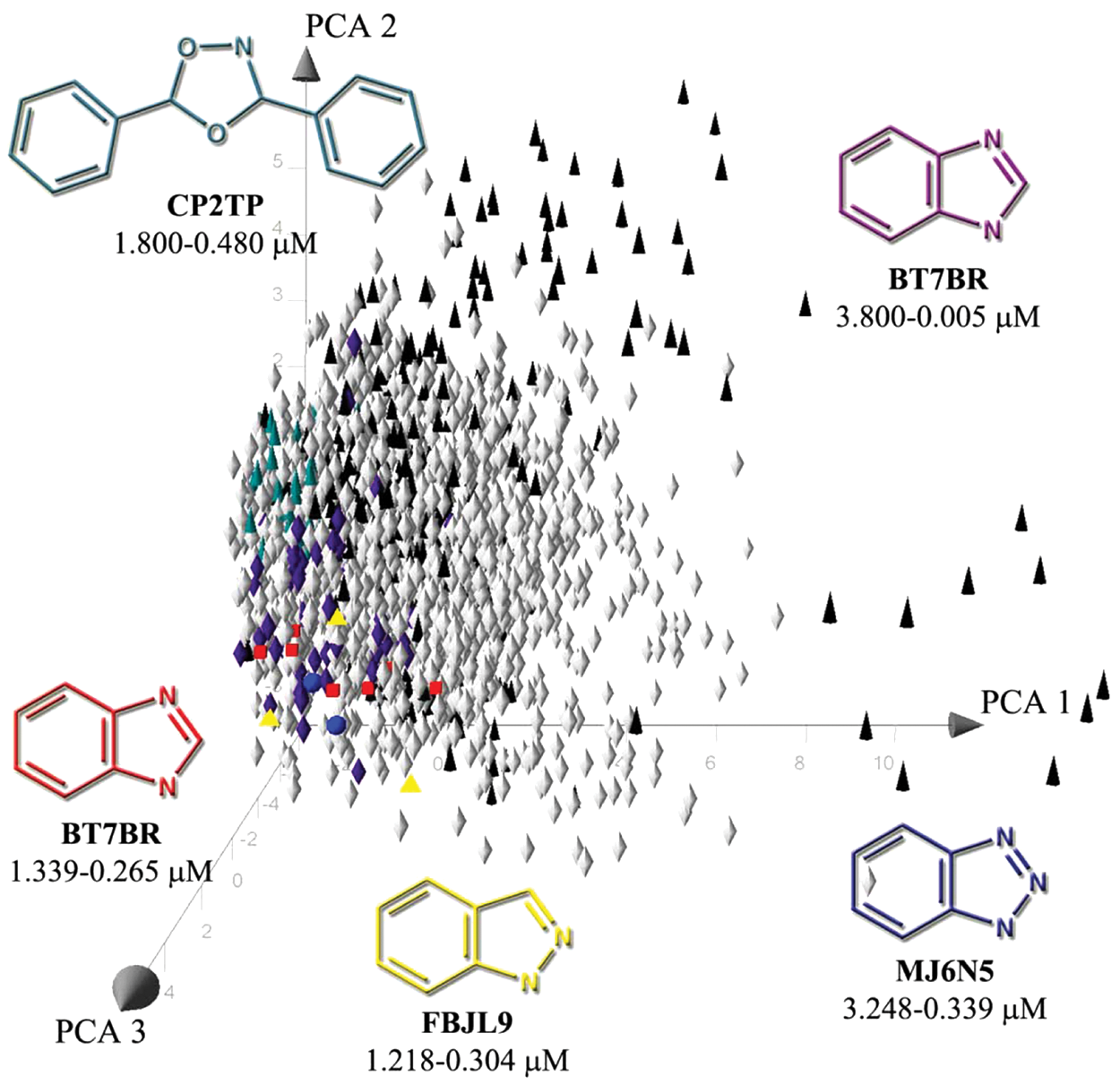
Figure 2 depicts a representation of the property space for drugs, antiamoebic compounds in ChEMBL, and compounds 1 to 12. According to this representation, compounds 1 to 12 and most of the antiamoebic compounds currently deposited in ChEMBL are located within the property space of drugs. Compounds 1 to 12 with the chemotype codes BT7BR (benzimidazole, in red), FBJL9 (indazole, in yellow), and MJ6N5 (benzotriazole, in blue) cover a small portion of the property space of drugs. It is noteworthy to mention that in the collection of drugs analyzed here, there are no compounds with the benzotriazole or indazole scaffolds. Figure 2 also shows the compounds with the two most frequent scaffolds with antiamoebic activity in the ChEMBL database—namely, benzimidazole (BT7BR, in purple) and 3,5-dibenzene-1,4,2-dioxazole (CP2TP, in cyan). It can be easily deduced from the figure that all active compounds belonging to these two scaffolds are contained in the property space of drugs.
Property space of novel compounds 1 to 12 (benzimidazole in red cubes, benzotriazole in blue spheres, and indazole in yellow pyramids), ChEMBL antiamoebic compounds (black triangles), and drugs (gray diamonds). The first two most frequent scaffolds in the ChEMBL antiamoebic compounds are also shown: benzimidazole (purple diamonds) and 3,5-dibenzene-1,4,2-dioxazole (cyan triangles). The first three principal components (PC) account for 86.7% of the variance.
Discussion
We conducted a systematic scaffold diversity analysis of antiamoebic compounds included in the public ChEMBL database. There are different ways to computationally derive the scaffold of a molecule in a systematic and consistent way. In this work, we used the MEQI approach, where a chemotype code is assigned to each cyclic system using a unique naming algorithm (Fig. 3).23 This approach has been successfully used to classify collections of combinatorial libraries, drugs, natural products, and other compound databases annotated with biological activity.24–27
Definition of scaffold used in this study. In the Molecular Equivalence Index (MEQI), the scaffold or cyclic system is obtained after iteratively removing the side chains from the entire molecule. The cyclic system is identified by a code of five characters or chemotype identifier. Hydrogen atoms attached to heteroatoms of the cyclic system were considered side chains.
Interestingly, the benzimidazole scaffold was the most active chemotype against E. histolytica in the ChEMBL database. This observation was confirmed by performing a search in SciFinder (Web version, Chemical Abstracts Service, accessed November 2010), which did not retrieve any other very active scaffolds. Moreover, benzotriazole and indazole scaffolds were not detected in drugs or ChEMBL databases as the main scaffold of the compound.
As part of our efforts to identify novel and more potent active molecules against E. histolytica, we evaluated the antiparasitic activity of 12 novel compounds (Table 2). The novel structures include benzimidazole analogues not previously tested (compounds 1–7). We also report for the first time the antiamoebic activity of novel compounds with scaffolds chemically related to benzimidazole—namely, benzotriazoles (compounds 8 and 9) and indazoles (compounds 10–12). The biological activity of the most active benzotriazoles and indazoles reported in this work (see below) suggests that these novel scaffolds represent an excellent starting point for an optimization program. Of note, alizapride and granisetron are approved drugs containing benzotriazole and indazole rings as part of their main scaffold (i.e., cyclic system). Both drugs are used as antiemetic and antinauseant agents. Side effects of these drugs include restlessness and headache.15
In summary, we report here a systematic scaffold analysis of antiamoebic compounds contained in a comprehensive public compound database. The analysis revealed that the benzimidazole scaffold is, overall, the most active scaffold with antiamoebic activity. We also report the biological activity of 12 novel compounds with benzimidazole, indazole, and benzotriazole scaffolds. The new compounds are contained within the property space of drugs. As far as we know, this is the first report of benzotriazole and indazole compounds with biological activity against E. histolytica in the low micromolar range (IC50 = 0.339 and 0.304 µM, respectively). Compounds with these scaffolds are more active than MTZ, which is the drug most commonly used in the treatment of anaerobic protozoan parasitic infections. The new active indazole and benzotriazole scaffolds are very promising as new antiamoebic compounds. A drug optimization program with these scaffolds is ongoing in our laboratory.
Footnotes
Acknowledgements
We thank Dr. Mark Johnson, Pannanugget Consulting, L.L.C., for providing the program MEQI. This work was partially supported by the state of Florida and by CONACyT, Mexico, grants V43629M, 80093, and 34851-M. F. L-V thanks PAEP-UNAM and DGAPA-UNAM for the Ph.D. scholarship.
References
1.
SinghA.HouptE.PetriW. A.Rapid Diagnosis of Intestinal Parasitic Protozoa, with a Focus on Entamoeba histolytica. Interdiscip. Perspect. Infect. Dis. 2009, 2009, 1–8.
2.
RiveraW. L.TachibanaH.KanbaraH.Field Study on the Distribution of Entamoeba histolytica and Entamoeba dispar in the Northern Philippines as Detected by the Polymerase Chain Reaction. Am. J. Trop. Med. Hyg. 1998, 59, 916–921.
3.
BragaL. L.MendoncaY.PaivaC. A.SalesA.CavalcanteA. L. M.MannB. J.Seropositivity for and Intestinal Colonization with Entamoeba histolytica and Entamoeba dispar in Individuals in Northeastern Brazil. J. Clin. Microbiol. 1998, 36, 3044–3045.
LegatorM. S.ConnorT. H.StoeckelM.Detection of Mutagenicity Activity of Metronidazole and Niridazole in Body Fluids of Humans and Mice. Science. 1975, 188, 1118–1119.
6.
BhatA. R.AtharF.AzamA.New Derivatives of 3,5-Substituted-1,4,2-Dioxazoles: Synthesis and Activity against Entamoeba histolytica. Eur. J. Med. Chem. 2009, 44, 926–936.
7.
ByingtonC. L.DunbrackR. L.WhitbyF. G.CohenF. E.AgabianN.Entamoeba histolytica: Computer-Assisted Modeling of Phosphofructokinase for the Prediction of Broad-Spectrum Antiparasitic Agents. Exp. Parasitol. 1997, 87, 194–202.
8.
ValdezJ.CedilloR.Hernández-CamposA.YépezL.Hernández-LuisF.Navarrete-VázquezG.TapiaA.CortésR.HernándezM.CastilloR.Synthesis and Antiparasitic Activity of 1H-Benzimidazole Derivatives. Bioorg. Med. Chem. Lett. 2002, 12, 2221–2224.
9.
Navarrete-VázquezG.CedilloR.Hernández-CamposA.YépezL.Hernández-LuisF.ValdezJ.MoralesR.CortésR.HernándezM.CastilloR.Synthesis and Antiparasitic Activity of 2-(Trifluoromethyl)-Benzimidazole Derivatives. Bioorg. Med. Chem. Lett. 2001, 11, 187–190.
10.
Navarrete-VázquezG.YépezL.Hernández-CamposA.TapiaA.Hernández-LuisF.CedilloR.GonzálezJ.Martínez-FernándezA.Martínez-GrueiroM.CastilloR.Synthesis and Antiparasitic Activity of Albendazole and Mebendazole Analogues. Bioorg. Med. Chem. 2003, 11, 4615–4622.
11.
Navarrete-VázquezG.Rojano-VilchisM. D.Yépez-MuliaL.MeléndezV.GerenaL.Hernández-CamposA.CastilloR.Hernández-LuisF.Synthesis and Antiprotozoal Activity of Some 2-(Trifluoromethyl)-1H-Benzimidazole Bioisosteres. Eur. J. Med. Chem. 2006, 41, 135–141.
12.
Hernández-LuisF.Hernández-CamposA.CastilloR.Navarrete-VázquezG.Soria-ArtecheO.Hernández-HernándezM.Yépez-MuliaL.Synthesis and Biological Activity of 2-(Trifluoromethyl)-1H-Benzimidazole Derivatives against Some Protozoa and Trichinella spiralis. Eur. J. Med. Chem. 2010, 45, 3135–3141.
13.
López-VallejoF.Medina-FrancoJ. L.Hernández-CamposA.Rodríguez-MoralesS.YépezL.CedilloR.CastilloR.Molecular Modeling of Some 1H-Benzimidazole Derivatives with Biological Activity against Entamoeba histolytica: A Comparative Molecular Field Analysis Study. Bioorg. Med. Chem. 2007, 15, 1117–1126.
14.
Cedillo-RiveraR.ChávezB.González-RoblesA.TapiaA.Yépez-MuliaL.In Vitro Effect of Nitazoxanide against Entamoeba histolytica, Giardia intestinalis and Trichomonas vaginalis Trophozoites. J. Eukaryot. Microbiol. 2002, 49, 201–208.
15.
WishartD. S.KnoxC.GuoA. C.ChengD.ShrivastavaS.TzurD.GautamB.HassanaliM.DrugBank: A Knowledge Base for Drugs, Drug Actions and Drug Targets. Nucleic Acids Res. 2008, 36, D901–D906.
16.
IrwinJ. J.ShoichetB.K. ZINC—A Free Database of Commercially Available Compounds for Virtual Screening. J. Chem. Inf. Model. 2005, 45, 177–182.
17.
BudakotiA.BhatA. R.AtharF.AzamA.Syntheses and Evaluation of 3-(3-Bromo Phenyl)-5-Phenyl-1-(Thiazolo [4,5-b] Quinoxaline-2-yl)-2-Pyrazoline Derivatives. Eur. J. Med. Chem. 2008, 43, 1749–1757.
18.
Torres-GómezH.Hernández-NunezE.León-RiveraI.Guerrero-ÁlvarezJ.Cedillo-RiveraR.Moo-PucR.Argotte-RamosR.Rodríguez-GutierrezM. D.Chan-BacabM. J.Navarrete-VázquezG.Design, Synthesis and In Vitro Antiprotozoal Activity of Benzimidazole-Pentamidine Hybrids. Bioorg. Med. Chem. Lett. 2008, 18, 3147–3151.
19.
AbidM.BhatA. R.AtharF.AzamA.Synthesis, Spectral Studies and Antiamoebic Activity of New 1-N-Substituted Thiocarbamoyl-3-Phenyl-2-Pyrazolines. Eur. J. Med. Chem. 2009, 44, 417–425.
20.
MaggioraG. M.On Outliers and Activity Cliffs: Why QSAR Often Disappoints. J. Chem. Inf. Model. 2006, 46, 1535–1535.
21.
LangdonS. R.ErtlP.BrownN.Bioisosteric Replacement and Scaffold Hopping in Lead Generation and Optimization. Mol. Info. 2010, 29, 366–385.
22.
SchneiderG.SchneiderP.RennerS.Scaffold-Hopping: How Far Can You Jump?QSAR Comb. Sci. 2006, 25, 1162–1171.
23.
XuY. J.JohnsonM.Using Molecular Equivalence Numbers to Visually Explore Structural Features That Distinguish Chemical Libraries. J. Chem. Info. Comp. Sci. 2002, 42, 912–926.
24.
Medina-FrancoJ. L.López-VallejoF.KuckD.LykoF.Natural Products as DNA Methyltransferase Inhibitors: A Computer-Aided Discovery Approach. Mol. Diversity. 2011, 15, 293–304.
25.
SinghN.GuhaR.GiulianottiM. A.PinillaC.HoughtenR. A.Medina-FrancoJ. L.Chemoinformatic Analysis of Combinatorial Libraries, Drugs, Natural Products, and Molecular Libraries Small Molecule Repository. J. Chem. Inf. Model. 2009, 49, 1010–1024.
26.
Medina-FrancoJ. L.Martínez-MayorgaK.BenderA.SciorT.Scaffold Diversity Analysis of Compound Daft Sets Using an Entropy-Based Measure. QSAR Comb. Sci. 2009, 28, 1551–1560.
27.
Medina-FrancoJ. L.PetitJ.MaggioraG. M.Hierarchical Strategy for Identifying Active Chemotype Classes in Compound Databases. Chem. Biol. Drug Des. 2006, 67, 395–408.