




Abstract
Contemporary children are growing up in a post-typographic era, where mobile electronic devices and digital texts are increasingly present. For parents and educators, shifts into new digital practices and new text forms can create a sense of uncertainty. In response to parent and teacher interest, popular media have frequently focused on topics relating to young children and shifting digital practices. This study addresses popular media accounts of children and digital technologies over five years (2013–2018), looking in particular at the emergence of mobile devices and their impact on children’s changing literacy practices. The authors collected popular media articles over this time period and analysed them for the ways in which children and digital technologies were represented and these media called on teachers and parents to respond. The authors provide an overview of their findings and address key themes from the articles, sharing influential examples and addressing the implications and influences of media perspectives. Finally, the authors examine the implications of popular media accounts in relation to informing parent beliefs and approaches, and curriculum responses.
Tracing change in the digital era
Children’s access to mobile digital devices has increased rapidly in recent years, with large-scale surveys documenting growing uptake for ever younger children (Hoechsmann and DeWaard, 2015; Holloway et al., 2013; Rideout, 2013). From preschool years and earlier, children are engaging with digital texts as a part of their daily lives, as a part of play and within contexts of schooling, in what Merchant (2015: 3) suggests are representations of the ‘post-typographic era’. Very young children now use digital tools and practices, and move ‘seamlessly across online and offline spaces, such as playing with toys that are connected to the internet’ (Marsh et al., 2017: 3). With rapid changes in communication forms underway, parents and educators of young children are immersed in a context that is unfamiliar, more unruly, and requiring new everyday practices and adult decisions to address technologies which are easily accessible and mobile, and offer affordances that make them particularly appealing and accessible to young children.
Riding the tide of public interest, topics focused on children’s usage of digital devices have been frequently represented in the popular media. In the initial years of smartphone and tablet usage, 1 the available guidelines, research and other resources were relatively scant due to the novelty and rapid rise of such technologies. Media representations, in providing a swift and fluid response to public interest, have thus played a role in addressing these rapidly emerging new technologies. The rise of parent and teacher social media platforms as locations for sharing and discussing current trends has created additional opportunities for media stories to ‘go viral’ in new ways.
In our experiences as graduate and undergraduate instructors in early literacy and literacy education, and in presentations of our digital media research projects, we are frequently confronted with examples of popular media publications presented as ‘evidence’ to support particular perspectives and practices. We have witnessed such media materials being shared in academic conferences and teacher professional development settings, and even referred to by stakeholders in ministries of education, 2 as evidence to support perspectives such as the position that devices should be ‘banned’ or restricted for all children under two, or the importance of avoiding (digital) ‘screens’ as much as possible in early years classrooms.
While mobile technologies are emerging rapidly, the pace of publication for research results tends to operate more slowly, with the time trajectory from an initial study to publication typically traversing a year or more, and funded research resulting in even longer trajectories. Over the past several years, published research studies of mobile technologies have been increasing, and now include a much larger range of different types of studies. However, in the early years of iPad and tablet/touch-screen use for children, few studies were available that addressed how children were taking up these devices. We have been using Google Scholar alerts to monitor new articles in this area, using ‘iPads’ as the search term since 2011. In the early days, these alerts were sparse and we might have received one or two a month, listing several articles and with very few that addressed educational research. Currently, the number and frequency of these alerts and publishing in this area is increasing.
Early research relating to young children and digital technologies focused on descriptive data and survey results – reporting on, for example, the time spent on specific technologies or devices categorized by age, the number of devices in the home and so forth – and often relied on parent reports (e.g. Holloway et al., 2013; Rideout, 2013). While these studies are informative and useful in providing research snapshots of children’s digital experiences and contexts, it has not been until recently that studies addressing more significant impacts and implications of children’s usage of mobile technologies have been published (e.g. Burnett and Daniels, 2015; Dooley and Gattenhof, 2015; Flewitt et al., 2015; Marsh et al., 2016; Merchant, 2015).
Within this complex and evolving context, popular media have played an important role in highlighting and responding to the concerns and questions of parents and educators as they navigate unfamiliar and disruptive digital literacy practices and devices. Since 2012, we have been following accounts from the media as they have focused on young children and mobile digital technologies. In this article, we address the themes we have uncovered and some shifts we have documented as mobile technologies have become more commonplace and familiar. Additionally, we examine the implications of and responses to popular media accounts for teachers and parents.
The study
Our study of popular media addressing children and technology was designed around the framework of a systematic review of popular media articles. Our data set comprises 565 articles gathered from popular media sources such as news articles, parent and teacher blogs, and articles prominent in social media posts (see Table 1). Acknowledging the rapid shifts in digital technologies, we have been interested in tracing any patterns that might emerge over time. We began formally gathering media articles in September 2013, reviewing a small collection of recent articles that had piqued our interest or that were being referred to by the parents or teachers of young children we were interviewing in another project. Thus, the earliest articles are dated from 2012 and we have continued gathering examples into 2018, using February 2018 as our end point for this phase of our review. Using qualitative approaches to inquiry, and informed by complexity thinking (e.g. Davis and Sumara, 2006; Doll, 1993; Gough, 2012) and critical literacy perspectives (Comber, 2003; Janks, 2010), the study reflects our understanding of popular media as an integrated network of communication and semiotic systems with the potential to influence parent and educator actions and attitudes.
Popular media articles addressing children and digital technologies
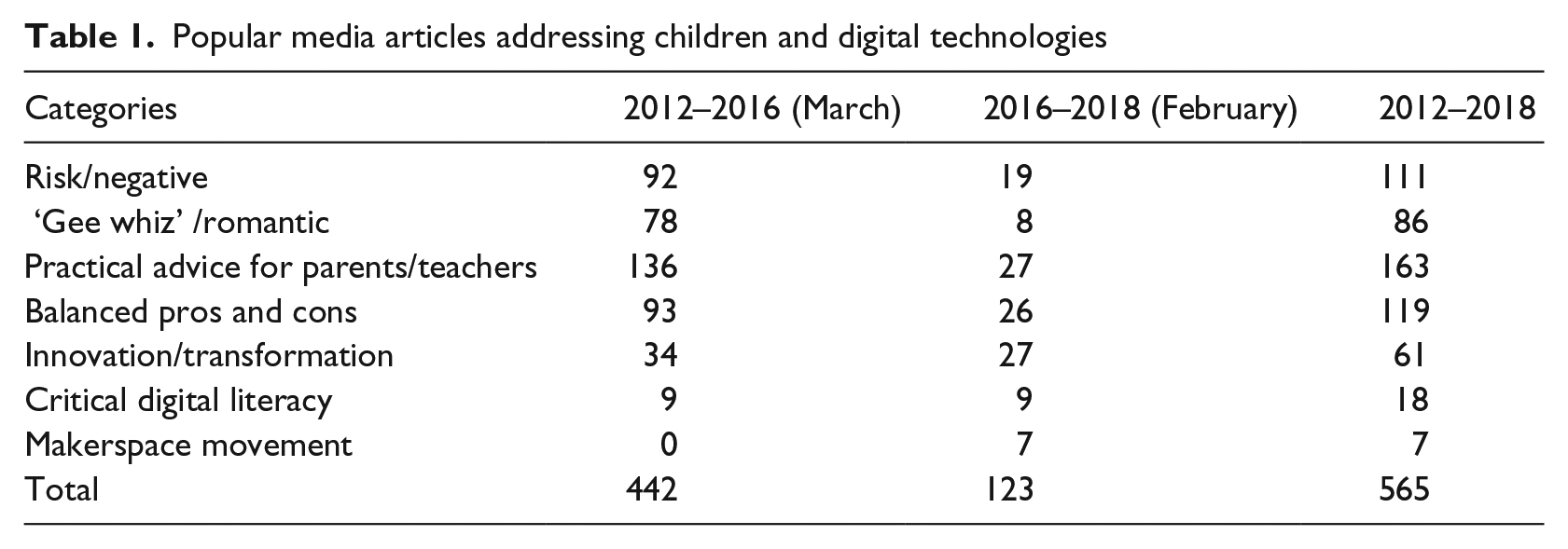
The questions which drove our inquiry were: (a) How are the popular media representing the rise of mobile digital devices in relation to children? (b) What perspectives and influences appear to be particularly influential in the media? (c) What may be the implications of such popular media representations for teachers and parents?
Following from complexity thinking and drawing from constructs which explore changes in networked systems (Goldstein, 1999; Gough, 2012), this first phase of our study traces mobile digital practices using the notion of emergence. Emergence is a complexity phenomenon whereby lower-level and/or smaller-scale components of a system self-organize into larger-scale patterns of sophistication (Johnson, 2001). As we have examined the corpus of articles arising from social and proprietary media, we have noted their organization into distinctive patterns as these have emerged over the time of our review. As well, we have noted further influences of particular media publications as ideas have ‘gone viral’ across popular media networks. For example, ideas from particular articles posted in a newsfeed were subsequently taken up in parent blogs and spread on social media, and seemed to generate a larger public interest. Within this article, we frame our discussion around some of the dominant pattern elements that developed over the time of the project, addressing the perspectives they have represented, and note how these have emerged and changed over the period we have been tracing media accounts addressing children and technology. Finally, we address some implications and possible impacts of such popular media stories.
Data collection and analysis
Over a time frame of five years, and in addition to our own work in gathering articles, four graduate assistants were involved in the data collection. These research assistants employed innovative approaches to uncovering articles, using social media platforms such as Twitter, Facebook, Pinterest and Google Hangout groups as sources of information, in addition to more typical online search methods, to find articles that had high ‘traffic’ and had been ‘shared’ or ‘liked’ frequently. We sought out articles to represent a range of local and national (according to our two countries – Laidlaw is located in Alberta, Canada, O’Mara is situated in Victoria, Australia, and Wong lives in British Columbia, Canada) as well as many wider international popular media examples. The research assistants were encouraged to ‘cast a wide net’ to collect articles that represented a diverse range of geographical areas, as well as a variety of different media sources, including newsfeeds, parent and teacher blogs, and online magazines.
Early in the project, we adopted the Flipboard platform (flipboard.com) as a method we could use to collect online media articles in a way that would present them visually and facilitate further organization and analyses as themes developed, and where we could easily view the growing collections from our own different geographical locations. Flipboard is a social media and news aggregator, where articles or media can be added and curated in the form of an online magazine. This platform enabled the news and media articles to be easily ‘flipped’ into categories as these developed, and provided a visible snapshot and easily accessible link for each article. As a backup, we also created print copies to avoid losing articles in cases where links might no longer be available, and to allow us to sort the data manually as new categories emerged. We selected articles that had a particular focus on mobile devices such as iPads, android tablets, smartphones and digital games and toys, and addressed children’s engagements and/or parent and teacher perspectives.
In the early phase of collecting media articles, in 2013, we noted that many of the articles reflected a binary (good/evil) technology perspective, focusing on the risks of new technologies for children. To a lesser degree, we also noticed articles presenting a highly optimistic perspective, emphasizing the promise of mobile technologies. We note that such binaries echo the observations of a number of media theorists writing about emerging technologies (Gee and Hayes, 2011; Nixon and Hateley, 2013), with these divisions being also consistent with historical responses to the development of new literacy technologies. As Plato’s (1961) dialogue Phaedrus demonstrated, even the invention of writing (and reading) was originally viewed with suspicion as contributing to the ruin of memory, and the evolution of literacy technologies has been interrogated critically ever since (Ong, 1982). Thus, our initial article-sorting began with the consideration of whether the article reflected a positive or negative stance on digital media use for children, with other categories noted and refined as they emerged in the articles we gathered. We tracked particular patterns and trends as reflected in the focus and tone of the articles, and created new categories as these emerged across multiple documents.
While our approach to the thematic coding of the articles aimed to be data-driven and inductive, we acknowledge that our data was ‘not coded in an epistemological vacuum’ (Braun and Clarke, 2006: 84). For finer-grained analyses, we also drew on literacy theorists and perspectives, examining the popular media documents using the repertoire of practices model (Luke and Freebody, 1999), which focuses on the capabilities required to participate in contemporary literate society (Ludwig, 2003), looking at ‘code-breaking’ and literacy conventions, as well as semantic, pragmatic and critical practice; moreover, we drew on Green’s (1988, 2012) three dimensions of literacy model, which addresses operational, cultural and critical literacy dimensions. Our own perspectives were influenced by Dyson’s (1997) work, arguing that young children are not passive viewers of television and popular media but select materials from popular culture critically. As Comber (2003: 364) reminds us, even young children ‘can appreciate how relations of power are produced through textual practices. We know they can deal with questions of fairness and justice’. However, within the articles we traced, it became clear that our beliefs about children’s own agency were not necessarily shared by many of the articles.
Shifting perspectives on young children and mobile technologies
In our analysis of the 565 articles comprising the collected data, six themes emerged over the duration of this first phase of our study: (1) articles that presented perspectives focused on fear and emphasizing the risks of technologies for children; (2) articles that presented perspectives which focused on the promise and benefits of technologies for children; (3) articles that presented a mix of both benefits and challenges, or more balanced ‘pros and cons’; (4) articles that provided practical advice and ‘how to’ suggestions for parents and teachers; (5) articles that focused on pedagogical innovation and transformation of learning; and (6) articles that focused on the impact on children’s digital literacy learning and the need for critical digital literacy awareness. In presenting our findings and analyses, we follow a somewhat chronological analysis of the articles, highlighting the trends as they occurred over time and the ways in which various articles were framed to speak to parents and teachers of young children.
Fear-based perspectives
When we initially began to gather popular media articles, these frequently emphasized the negative consequences of children using digital devices, with children’s ‘screen time’ on new mobile devices often portrayed as an issue of moral panic, with cautionary warnings for parents and educators as a focus of many of the publications. The headlines for such articles often included addiction or crime-themed vocabulary and metaphors, such as ‘The screens that are stealing childhood’ (Stevenson, 2012), ‘My little future iPad addicts’ (Ashton, 2013) or ‘“Addiction” to tablet computers is leading to poor performance in the classroom’ (Exley, 2014), among myriad others (e.g. Rock, nd; E Strauss, 2016; V Strauss, 2014). The article which inspired our own title – ‘Your iPhone addiction will rot your kid’s brain: Put your devices away, moms and dads’ (Scribner, 2014) – also addresses these themes, presenting an image of a fried egg and ‘This is your brain on devices’ overlaying the photograph, representing the classic public service announcement image used in drug awareness campaigns. Such articles often resulted in high levels of online ‘traffic’ or hits to links or sites through social media ‘shares’, ‘likes’ and links in other articles. However, in the later years of our article-gathering, we have observed that while risk-themed articles seem to have diminished proportionally in frequency and number, this perspective remains robust. For example, ‘It’s “digital heroin”: How screens turn kids into psychotic junkies’ was a headline of a 2016 New York Post article (Kardaras, 2016), and keeping young children ‘safe from harm’ is the focus of a 2017 Popular Science feature on ‘How to kid-proof any phone or tablet’ (Nield, 2017). We note that the ‘research’ cited in such articles, if present, tends to refer to loosely related correlation studies or the opinions of various book authors and academics, rather than having any more substantive research connections. 3
The promise of technology
A second theme we uncovered focused on the promise of technology. Such articles presented the possibilities and benefits of new mobile technologies for children’s learning at home and in school. This category, particularly in the initial years of the project, addressed the flip side of the articles that were focused on risks, with mobile technologies described in glowing and ‘romantic’ terms, reminding us of Luke and Luke’s (2001) ‘gee whiz’ explanations of new technologies and new literacies. These articles presented a positive perspective on the technological future, with the writers taking the position that the new digital devices and practices might solve existing problems in relation to children’s learning and experiences, and often presented an uncritical examination. One example of an early Australian article is ‘Let the kids play their video games, it’s good for them!’ (McNeilage, 2014), which makes positive recommendations about the value of digital games for both home and school for young learners. Other articles, such as ‘Learn with Homer app may help close school-readiness gap among low-income preschoolers’ (Rivas, 2015) and ‘How a dyslexic neuroscientist’s iPad app will boost your kid’s math scores’ (Martin, 2014), provide elaborate various benefits of using apps to enhance children’s early literacy learning at home and improve mathematics skills in early years classrooms. Other articles examined the ways in which the affordances of touch-screen mobile devices could provide new assistive technology supports for children with special needs. 4 The possibilities of using Siri, the digital personal assistant on iOS devices, are explored in ‘A love letter to Siri: How a boy with autism became best friends with Apple’s personal assistant’ (Newman, 2014). Overall, however, the articles in the ‘optimistic’ category were shared less frequently by viewers/readers on popular media sites as compared to the articles presenting technology as something more dangerous. Additionally, the positive articles were most frequently found in our searches at the beginning of our study until the end of 2014, with fewer articles taking this ‘romantic’ position in our collection after 2015. 5
‘Balanced’ views
Early in 2015, we observed a noticeable shift in the perspectives presented in popular media articles, with increasing numbers of stories that carefully weighed the ‘pros and cons’ of technology usage for children, referring to both benefits and problems, and often acknowledging the implications for parents and educators. For example, ‘Parents: Reject technology shame’ (Samuel, 2015) pointed out the advantages of helping children learn to navigate the digital world, rather than shielding them from it, but also emphasized the importance of parental guidance in relation to children’s online activities in connection to safety concerns. The articles in this category typically acknowledge the ubiquitous nature of tablets in children’s daily lives and at home, and communicate an increasing acceptance of this change, yet also consider the need for parents or teachers to provide some constraints or address particular problems connected to increased technology access or use. The inclusion of both the benefits and challenges of digital media in popular media articles appears to be sustaining, and perhaps is an indication that teachers, parents and media writers are recognizing that children are taking up technologies such as iPads and digital media as a more ‘normalized’ part of their daily lives; these articles do seem to reflect direct observation of children and technologies, rather than sensationalized conjecture of ‘what might happen’. The following category we noted seems to add further evidence of acceptance of digital changes in children’s experiences.
Practical advice
Around the same time (2015) that we noted more balance in ‘pros and cons’ being represented in the popular media, we noted an increase in the number of articles offering practical advice for teachers and parents. Such articles provided various suggestions for use, and information about how children might be engaging in digital experiences or what they might be viewing when using specific applications, and included various instructions and compilations of resources. Examples in this category range from ‘What kids are really watching on YouTube’ (Knorr, 2016), an article from Common Sense Media which shares reviews of particular YouTube channels that are popular for children, to ‘How to protect kids online’ (Joyce, 2016), which provides a myriad of resources and application suggestions for teachers and parents. Although we note that the article headline still ‘pushes the button’ of parental fears, the content of the article was more practical than fear-provoking and presented a perspective accepting of the notion that children will be engaging in a range of digital media experiences.
Within these articles, acknowledgement that young children often hold as much or more digital media knowledge and expertise than their parents and teachers was common, and we observed a shift from attempting to prevent children’s access to technology – a theme present in many of the risk/fear-themed articles – to attempting to guide or harness children’s skills. In this category, as well as the ‘balanced’ articles addressed previously, we also noted regular acknowledgement of the shifting perspectives of the American Academy of Pediatrics (AAP, 2010), which had, for years, told parents to limit digital exposure for children and recommended no ‘screen time’ at all for children under two years of age. The AAP’s guidelines were frequently cited in the risk-focused popular media articles we gathered in the first two years of this study. As we noticed more articles addressing ‘balanced’ technology use emerging in our searches, the AAP (2015) was changing its recommendations, with a 2016 recommendation document eventually referring to the need for families to ‘maintain a healthy media diet’ and launching an online Family Media Use Plan tool in October 2016 (American Academy of Pediatrics, 2016). Recognition of the AAP’s influential change was also the focus of some popular articles (e.g. Shapiro, 2015), and practical-advice-focused articles often echoed ideas from AAP recommendations, such as suggesting that parents and teachers maintain active involvement with children when they engage in online activities.
Innovation
Within the category of articles addressing innovation, we gathered articles, blog posts and social media links that presented new pedagogical approaches or strategies taking up digital technologies or media. While many of the articles in this category were located in education blogs and online magazines focusing on education, some were found in business media such as Fortune’s online magazine (see Hackett, 2017) or featured in more general news stories aimed at parents. These articles focused on specific platforms, media or approaches, often featuring innovative or transformative ways to teach children new skills using technology or media or the use of ‘not so new’ technologies, such as videoconferencing or creating ‘selfies’, taken up in new ways (e.g. Rosenstein, 2017). For instance, Shapiro (2014) presents the platform of video games as an innovative way to teach collaborative problem-solving with other game players and develop critical thinking skills, suggesting that using video games might transform the culture of learning in classrooms. This category also addressed emerging technologies or approaches gaining popularity in schools, with articles on coding appearing frequently after 2015 (e.g. Hamilton-Smith, 2016; Nakhavoly, 2017), as well as other sorts of innovative approaches. While the articles in the innovation category might appear to have good potential for impacting teaching and learning, these at times have a ‘getting ahead’ and ‘keeping up’ tone, where innovation and new and improved usage are linked to potential success (or employment), as addressed by Sefton-Green et al. (2009) a decade ago in their review of approaches and perspectives on digital literacy. However, articles that address new approaches to pedagogical framing present opportunities to examine, more critically, the ways in which digital technologies and new literacy and media practices may be taken up in classrooms, and for teachers and parents of young children to consider new ways of working with young learners and technology.
Critical literacy, technology and the rise of ‘fake news’
Until mid 2016, we found relatively few articles that focused on critical literacy. The articles in this category typically discussed notions of digital citizenship and tended to address critical literacy in relation to promoting ‘cyber safety’ online at home and in school. For example, Hertz’s (2015) blog post, ‘Social media at school: Teaching safety on the virtual playground’, pointed out that we let children go to the playground knowing that they may encounter some risks, and need to take care. She described social media as the playground of the current generation and argued that children need to be critical of what they view and accept in the digital realm, for their own safety.
From late 2016 through to the time we began writing this article, we observed a new surge of media pieces promoting what we would classify as ‘critical literacy’ (see Green, 2012; Luke and Freebody, 1999) or others might classify as ‘media literacy’. Perhaps spurred on by the global phenomenon of ‘fake news’ following the 2016 US election media stories and presidential ‘tweets’, these articles invited teachers and parents to encourage even young children to be critical and analytical in their technology and social media usage, particularly with respect to news reporting, and to work towards a more dialogic approach. One example from Common Sense Media (2017), ‘How can kids figure out what’s credible news and what’s fake news?’, advises parents on how to help their children determine fake news from a credible news source, and how to help their preschoolers tell the difference between fact and fiction. Even Andreas Schleicher, the Director of Education and Skills for the Organisation for Economic Co-operation Development, was reported as calling for teachers to help children ‘spot fake news’ to sidestep the ‘echo chamber’ of social media (Siddique, 2017) and to ‘stop them becoming extremists’ (Turner, 2017). Simultaneously, a range of resources, tips and strategies for critical literacy was published and publicized online to help teachers ‘fight fake news’ and ‘battle’ fake news in the classroom (e.g. Boyd, 2017), and consider the need for media literacy instruction (Buckingham, 2017).
In our tracing of popular media articles over the past five years, we also note the impact of ‘fake news’ for younger learners as one that helps to transform the fear-based conversations which have remained a constant in the popular media. Concerns with the need for more critical approaches to media and technological engagements for children are leading to more nuanced discussions aimed at preparing even the youngest learners for what they may be viewing, reading, listening to and interacting with online. Like Buckingham (2017), we are interested in the ways in which the edu-media is responding to the trend towards ‘fake news’ and providing teachers and parents with resources.
Inching towards a more critical and dialogic approach for children and technology
In this article, we have traced media accounts of young children’s use of digital technologies and the implications for parents and teachers over a five-year period. We have sorted this collection of articles into themes and noted how these have shifted over specific junctures. While our collection is not a complete one and we are working in qualitative frames, it has been revealing to note the changes over time and try to trace the sources and paths of such shifts. Digital media use for children is ubiquitous (from baby photographs or even initial ultrasounds posted on social media sites to self-produced videos posted by ever younger children online), and children are, as Merchant (2015) suggests, growing up in a ‘post-typographic’ age, existing in a digital society – something that is now increasingly acknowledged in the popular media. In our prior and ongoing research projects (Laidlaw et al., 2015; O’Mara and Laidlaw, 2011; Wong, 2015), we have noted parents and teachers expressing concern in relation to young children’s technology usage and often engaging in conversations where they have asked us for advice and information. These participants often acknowledged the influence of media accounts as contributing to a sense of uncertainty as to what ‘good’ parents or teachers should be doing – ‘no screens’, ‘some access’ or ‘parental controls’? As well, the parents and teachers in our study often stated that they were torn between their worries about online safety and risks and the need for their children to have good digital competencies for school and their future lives. This sort of emotional uncertainty was also present in the articles we collected, as individuals (reporters, bloggers, social media posters) and society as a whole seem to struggle with the implications of being born into and living in a digital world, and what this might mean for children, parents and teachers.
We have also noted what we recognize as a significant shift in what is being recommended for children and their digital technology usage over the five-year duration of our popular media literature review. More value and importance appear to be given, in relation to the frequency of article focus and topics, to the context of how children access and use these technologies, and the roles of teachers and parents, beyond simply imposing authoritarian restrictions and bans. For instance, as previously mentioned, the new AAP-published guidelines (AAP, 2015) recommend that parents of children aged 18 to 24 months who want to introduce digital media should choose high-quality programming and watch it alongside their children in order to help them understand what they are viewing. While, as noted earlier, we still see the earlier AAP recommendations occasionally cited in current articles, and more frequently by parent and teacher participants in our research projects (i.e. these adults are unaware of changes from the ‘no screens for the under twos’ set), we do note a shift of focus for parents and teachers to the contexts of children’s usage of digital media and more nuanced examinations.
As noted in our popular media examples, the mediascape (Appadurai, 1990) tends at times (with more frequency five years ago but still present) to describe children’s use of digital devices in terms of vices such as addiction and criminal activity. The ‘fake news’ concerns have become heightened in recent times, with a new focus on the need for children to gain more critical media and technology awareness, and for the adults around them to provide guidance and work alongside children as they learn about digital worlds, rather than simply restricting or banning access.
Despite the range of perspectives presented in social media, our recommendations for early years educators are the following:
Consider the use of mobile digital technologies in programmes alongside sound pedagogical approaches; digital practices should not be used as an ‘add-on’ or a silo in relation to other activities and learning.
‘Just-in-time’ online professional learning communities and ongoing professional development for teachers in early childhood education settings are crucial. As we have learned through our teacher interviews, often a lack of professional support is connected to anxiety about children’s practices, which in practice can mean ‘setting the iPads aside’. While teachers may find helpful resources online, attempts to sort this out independently can be challenging for busy teachers, who must also evaluate resources often without a sense of their own digital competence.
Teacher educators must include opportunities in their programmes for pre-service teachers to work with mobile digital technologies and develop strong pedagogical frameworks and a repertoire of teaching practices. For example, early childhood education programmes can encourage pre-service teachers to use mobile digital technologies as a part of their own learning, to develop confidence and expertise in creating, collaborating and critically using and assessing digital activities, practices and devices.
As language and literacy education academics who work with teachers and young learners, we feel hopeful about more public calls for critical literacy and the implications of this for parents and teachers of young children. Critical literacy requires a dialogic approach to education (Freire, 1974) – an opening up of conversations. We are experiencing this moment as a time when the tide might be turning towards a more dialogic push – an inching back of the pendulum towards more open and inclusive classrooms, and a focus on the relationship between language and power and the social effects of texts (Janks, 2010; Janks et al., 2014). We hope too that, while such conversations have emerged alongside the rise of digital media, the implications of an increased emphasis on critical literacy for children, parents and teachers might be a call to evaluate ‘what is truth’ in the media representations of all things. This might include a closer examination of ourselves and our relationship to new technologies, and a careful consideration of the key questions of critical literacy, posed so well by Janks: ‘Whose interests are served, who benefits, who is disadvantaged; who is included and who is excluded?’ (Janks et al., 2014: 1). As literacy educators, the call for awareness of how media can manipulate viewers and readers is not new (although it is sometimes neglected by literacy curricula), with Luke and Freebody (1999: 5) reminding us three decades ago that ‘texts are not ideologically natural or neutral – that they represent particular points of views while silencing others and influence people’s idea – and that their designs and discourses can be critiqued and redesigned in novel and hybrid ways’.
Of course, we also hope that critical literacy is not taken up to the exclusion of other aspects of children’s textual engagements, including the pleasures of engaging with digital technologies, a location where we began in our initial study, wondering how the rise of mobile digital devices might impact children and youth. As we end this phase of our popular media literature review, we note the increasing presence of an interesting ‘messiness’ within the continually emerging mediascape, with shifts from good/bad binaries towards more active engagement in accepting digital practices for children and, currently, increased considerations of influence and power that require a critical response. The role for educators and parents is important, with no ‘app’ or ‘bot’ able to replace the guidance of adults in children’s digital interactions – something that has become more clearly evident in today’s complex times.
Footnotes
Acknowledgements
Our thanks go to Jennifer Jones, Eliza Pinnegar, Lorna Sutherland and Hongliang Fu for their contributions to the data gathered in this project, as graduate research assistants.
Funding
The authors disclosed receipt of the following financial support for the research, authorship and/or publication of this article: We acknowledge the funding support of the Social Sciences and Humanities Research Council for the project ‘A Comparative Investigation of Pedagogical Possibilities of Digital Tools for Family and School Early Literacy Education’, which supported the work of this article.
