




Abstract
In this study, we explore discussions of literature in a high school English Language Arts (ELA) classroom, examining how students read rhetorically. Reading rhetorically considers the ethical effects of narrative content as it is mediated through character dialogue and action, narrator discourse, and the author's organization: a narrative as a story told to someone for some rhetorical purpose. Drawing from rhetorical narratology, we analyzed data collected in a 12th-Grade ELA classroom during student-driven Socratic seminars to ask: how did students address the ethics of various narrative situations as they talked about literature? We found that youth engaged in interpretive discussions that grappled with the complexities of ethical positioning in narrative. We argue that ELA classrooms are key spaces to help students examine how narratives act on readers, how readers act on narratives, and the ethical dimensions of such interpretive work.
Narrative texts have always played a central role in English Language Arts (ELA). Educators actively help young people consider how they feel, respond, align, disaffiliate, love, and interact with literature as raced, classed, sexed, languaged, and gendered beings. Such a contemporary focus on reader response represents an intentional departure from previous formalist approaches to teaching literature that centered on textual structure (Frye, 1964) or the mastery of masterpieces (Hirsch, 1983), instead emphasizing how the content of a story resonates with and extends the thinking of different readers. Educators in this vein use writing and discussion to help students consider what happened in a narrative text as a way to think through the lives of imagined others as well as their own, developing deeper personal understanding and engaging in social action through textual engagement—a core task for contemporary ELA classrooms (Beach et al., 2016; Campano et al., 2013; Toliver, 2020).
These interests raise pressing ethical questions. In this study, we drew from a growing field in contemporary literary theory—a collection of scholars, texts, and institutions gathered under the banner of “rhetorical narratology” (Kearns, 1999; Phelan, 2018; Shen, 2005)—to explore students discussing the ethics not only of what happened (the told) in literary fiction but also the telling (Phelan, 2017). Where reader response orientations have evolved in high school ELA classrooms to center the thoughts, emotions, and connections of adolescent readers, rhetorical narratology extends this approach to reauthorize the (implied) author and their textually mediated communication with the reader by way of the narrator: in other words, how a story is told. Reading rhetorically is a way of reading critically that involves a careful accounting for both one's position in relation to a text and the world and how such positioning is situated and accomplished in and through multi-layered communication of the text, providing teachers an alternative way to approach literature (Fletcher, 2018; LeBlanc, 2022; McCann & Knapp, 2021). By engaging critically with both the telling (the how of a story) and the told (what happens in the story), such an approach to reading opens space for critical consideration of how narrative acts on us as readers and for exercising agency in taking up or resisting textual positioning.
The urgent need for rhetorically reading narrative is made evident by our pluralized, hypermediated textual landscape, wherein narrative is one of the predominant modes of persuasion in our time and huge volumes of online content appear in narrative form. While rhetoric has been dismissed by some as sophistry or deception, in its classical conception rhetoric simply means the study of persuasion's power (Yunis, 2017). To draw on such conceptions in relation to reading narrative, we have rooted our framing in rhetorical narratology (Phelan, 2022), a discipline that deploys the structural insights of formalist narratology (Prince, 2003) into the realm of readerly and writerly activities to describe narrative as a communicative act. Phelan (2007, p. 4) describes this as “somebody telling somebody else on some occasion and for some purpose(s) that something happened.” Narrative is a critical form of communication in modern life; it offers not a set of demonstrable logical truth claims, but rather a window into the complexity of human experience to create “good stories, gripping dramas, believable (though not necessarily ‘true’) historical accounts” (Bruner, 1986, p. 13). We suggest that in the midst of a contemporary “storytelling boom” (Mäkelä & Meretoja, 2022)—where narratives have been advanced, instrumentalized, and commercialized across platforms by individuals, corporations, politicians, and consultants for a range of projects—that tools drawn from literary analysis offer a critical means for students to unpack the power, effects, and forms of stories. In particular, we consider the importance of rhetorical frameworks for thinking about the ethics of storytelling.
In this study, we examined high school students discussing, debating, and ethically framing a collection of short stories during classroom talk. There is an extensive literature that has examined literature discussions amongst secondary students (cf., Murphy et al., 2018; Nystrand, 2006; Thomas, 2015), highlighting their analysis, creativity, and perception as “embryonic critics” (Rosenblatt, 1978, p. 138). In the discussions analyzed here, students provided incisive critiques of the narrative content of the short story, its characters, setting, plot, and so forth. This dimension of literary discussions, often referred to as the told of the narrative (Phelan, 2017), is a staple of high school classrooms, recognizable to anyone who has witnessed or participated in ethical debates, for example, about whether Dr. Frankenstein should play God to animate and eventually destroy his creation. While less frequent, students also discussed the critical telling dimension of narrative, the narrative presentation of that content through the text by way of the teller's choices (Phelan, 2017). This dimension of literary discussion involves ethical issues of how tellers in the text (e.g., authors and narrators) and narrative style (e.g., short chapters, choices in prose, and tone) have shaped the reading experience and positioned the reader. Consider, for example, how the unreliable narrator in Aravind Adiga's The White Tiger (2008) or the chorus of narrative voices written in verse in Jason Reynolds’ The Long Way Down (2017) orient the reader's understanding and ethical perspective of the text.
In approaching these discussions, we drew from the ethics of narrative form (Phelan, 2004) to argue that teachers, researchers, and students can productively engage with rhetorical reading to interrogate reader experience and textual construction in classroom literature discussions. This article orients teachers and students to the ethical claims of literature by acknowledging its synthetic nature and its multi-layered stances, suggesting that ELA classrooms are prime spaces for helping students examine how narratives act on readers and how readers act on narratives—and the ethical dimensions of such interpretive work.
Theoretical Framing
Rhetorical Narratology
Rhetorical narratology emerged in the mid-twentieth century from the University of Chicago's English department and their reconsideration of Aristotle's Poetics. 1 The crystallization of rhetorical narratology arose during a time of significant theoretical foment in literature departments across the country (Segal, 2011). This turmoil reflected dissatisfaction with the limits of New Criticism, the uptake of various reader response theories and practices (Louise Rosenblatt, Stanley Fish, and Wolfgang Iser), and proclamations of the death of the author leading to the birth of the reader (Roland Barthes). Where the general movement in English literature departments was to recenter the reader's unique responses to texts, the turn in rhetorical narratology was to conceptualize narrative as an act of communication between authors and readers. Because all texts are designed by authors to affect readers in particular ways (Booth, 1982), all narratives are rhetorical. Rhetoric, Booth (2004) clarified, is simply “the entire range of resources that humans share for producing effects on one another” (p. xi, emphasis ours), effects which can be ethical, practical, emotional, and intellectual.
Working against New Criticism's narrowed concern for the four corners of the text (typically focused on a small set of literary features) and revising reader response's interest in readerly contributions, rhetorical narratology instead framed narrative as rhetorical action, understood as “an author's attempt to harness all the resources of storytelling for the purpose of evoking a set of effects (cognitive, emotional, ethical) in an audience” (Phelan, 2010, p. 243). Rhetorical narratology, consequently, has significant resonance with literary traditions such as reader-response theory (Beach, 1993; Iser, 1978; Rosenblatt, 1978)—more familiar in educational circles—but grounds those responses in the complex narrative architecture offered by narratology (Genette, 1983; Kearns, 1999). Unlike their more structuralist predecessors (Propp, Todorov, and Frye), who sought to organize narratives into minimal units and repeating tropes, scholars who draw on rhetorical narratology have regarded narrative as a dynamic process whereby the reader engages the text through the communication of the author, the text, and their own unique responses to them. In narrative, this purposeful communication between the author and audience operates in a “feedback loop” (Phelan & Rabinowitz, 2012a, 2012b, p. 5), which Wilhelm (2008) described as a “partnership with a text—and therefore with the author who constructed it” (p. 116). Such a partnership means that while authors may design texts with audiences in mind, readers are agentive actors in the text–author–reader relationship, with their own beliefs, histories, and identities that shape how they take up, engage, or resist the text.
While all texts (descriptive, informational, argumentative, etc.) are designed to act on readers in particular ways (Booth, 1982), scholars of rhetorical narratology have drawn on this rhetorical insight about texts to specifically describe narrative as communication between authors and readers, narrators and narratees, and characters and each other (Phelan & Rabinowitz, 2012a, 2012b). Outlining what narrative resources authors might use to accomplish this through narrative requires a descriptive grammar (drawn here from the structuralist side of the equation). This grammar includes elements such as paratexts, narrators and their narration, dialogue, free indirect discourse, gaps, genre, intertextual references, gaps, narratee/narrative audiences and a seemingly inexhaustible litany of other forms and techniques (Phelan, 2017). Such a description was constructed explicitly against New Criticism (rhetorical narratology's great mid-twentieth century theoretical rival) and its obsession with literary language as both the means and the ends of literature. Rhetorical narratology's pivot was to “subordinate” claims about the various structural elements within concerns about “how somebody uses that element in the service of accomplishing some purpose(s) in relation to somebody else” (Phelan, 2018, p. 32).
Where this framework has clarified and animated the academic study of literature, it also has significant implications for the concrete work of reading, in the classroom and beyond in considering how texts are oriented to readers to produce effects, and how those effects work on different audiences depending on what kind of reading (i.e., audience) they enact. Texts position readers in particular ways through their design, making assumptions about audiences, such as their background, knowledge, identities, and ethical positions around issues of race, gender, and sexuality (Donahue et al., 2017; Rabinowitz, 1998). While readers have authority and agency to take up, resist, and challenge this textual positioning (e.g., Thomas & Stornaiuolo, 2016), critical literary scholars have illuminated the challenges of asking students to enter a text's authorial audience that deliberately excludes or dehumanizes them (e.g., Chadwick, 2016; Thomas, 2016). Given that readers, texts, and authors are always embedded in particular cultural histories and existing power structures, which shape not only what stories get told and how but also how they circulate, are taken up, and become intertwined with broader social and cultural practices (e.g., Donahue, 2019; Warhol & Lanser, 2015; Young, 2018), teachers’ approaches to reading in the classroom have important implications for the ways students make sense of texts, and the ethical dimensions of that engagement. As Levine et al. (2021) demonstrated, approaches to literary discussions in U.S. classrooms often focus on known-answer discourses rather than on rich, expansive literary interpretations that center students’ affective responses to literary texts. Rhetorical reading offers one approach for expanding interpretative possibilities in the classroom by emphasizing how the communication from author to audience is fundamentally rhetorical.
Rhetorical Narrative Ethics
What does it mean to think about the ethics of narrative form? And what are some critical dimensions of a narrative form that might present ethical quandaries for readers and authors? English classrooms are no strangers to conversations about ethics. In reading, discussing, and interpreting literature, teachers have foregrounded questions of character, choice, virtue, fairness, and justice—in the text and in the real world—and asked their students to wrestle with their own answers. Despite postmodern anxieties about ethical claims, English education has always embedded some form of ethical criticism into its lessons, both explicitly and tacitly (Collin, 2020, 2021). This criticism has ranged from classical mandates for Christian moral formation (Graff, 1987) to mid-twentieth-century interests in democratic dispositions (Seubert, 1941), to contemporary concerns with representation and social justice in the literature and media (Toliver, 2021). And where narrative ethics has been framed using the classical language of virtue formation (Nussbaum, 1992), moral thought experiments (Morson, 2013), or Levinasian-inspired encounters with alterity and the “Other” (Newton, 1995), scholars in rhetorical narratology have explicitly avoided extensive a priori theoretical commitments (Phelan, 2014) and instead regarded the framework as a flexible toolkit for examining narrative resources, available for a range of ethical literary criticism (consider, e.g., the recent rise of critical race and queer narratologies; see Sohn, 2014 and Warhol & Lanser, 2015).
An important dimension of classroom practice involved expanding students’ interpretive capacities with texts, particularly in resisting easy moralizing and instead embracing the complexity of stories (Levine, 2019). We found Phelan's approach to thinking through the ethical implications of the various narrative layers in the literature (see Figure 1) to be helpful in this regard as he outlined a “dynamic interaction of four ethical situations” (p. 632):
that of the characters within the story world; how they behave toward each other, including how they judge each other, is inescapably tied up with ethics; that of the narrator in relation to the telling, the told, and the multiple audiences of the narration; that of the implied author
2
in relation to the narrator, the telling, the told, and the authorial audience; the implied author's choices to adopt one narrative strategy rather than another will affect the audience's ethical response to the characters; each choice will also convey the author's attitudes toward the audience; that of the flesh and blood reader in relation to the set of values, beliefs, and locations operating in situations 1–3. (pp. 632–633)
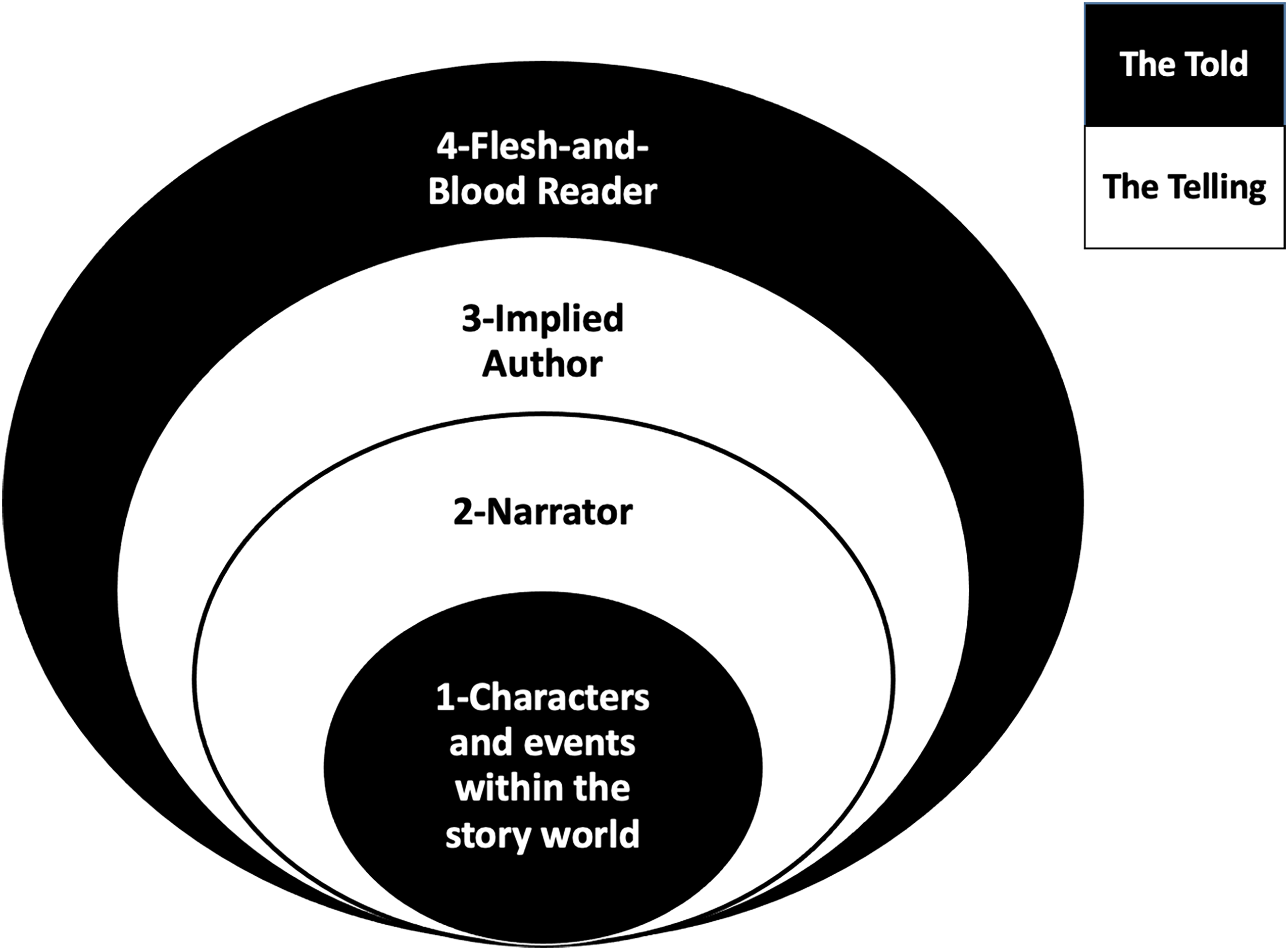
Phelan’s four ethical situations.
Each situation has potential for a unique ethical stance. Ethical stances in one layer (1–4) can comment on and change our understanding of the ethics of another. For example, where characters in the story world (1) may perform some ethically monstrous action, it may be clear that the narrator's (2) arrangement and description of those actions indicate their moral judgment on the activity (e.g., describing the acts of Nazis in a Holocaust narrative like Night by Elie Wiesel). In other cases, the characters and the narrator may be in alignment (1 and 2) with one another about the ethics of the actions described to the narrative audience, but through textual design, it is apparent that the implied author (3) finds these actions morally repugnant. For example, in Martin Amis’ novel of excess, Money (1984), the narrator John Self approvingly described an unrelenting series of self-destructive behaviors, but the novel itself is transparently a criticism of unbridled consumption and greed, implied by the narrative construction (notably the overindulgent style of narration). Or, the characters, the narrator, and the implied author (1–3) may each present a unified ethical stance—for example, Mark Twain's crafting of the narrator Huck Finn and his attitude toward his African American companion Jim—but the contemporary flesh-and-blood reader (4) may reject this ethical position in their own engagement with the text as learned through a community of readers (Thomas, 2016).
Phelan's framework of the ethics of the telling and the told is particularly helpful for sifting narrative claims about texts because it enables us to see the complex narrative layers of any story and their communication with each other. Concerns with the ethics of the telling, consequently, require a sense of the potential ethical quandaries of specific narrative forms. Booth (1982), for example, explored the morality of particular types of narration, arguing that techniques such as character narration, which center narrator consciousness, can generate sympathy for that character, even when they are performing ethically deficient acts (as in, for a contemporary iteration, the power of first-person heterodiegetic narrator Patrick Bateman in American Psycho). Matzner-Gore (2020), in another example, applied rhetorical ethics to Dostoevsky's scandalous novel Demons, which satirized community violence, brutality, and gossip. Even in stories that seek to critique or disrupt society's fascination with “tales of suffering and scandal” (p. 103), Matzner-Gore wondered whether narrative form simply enables our desire to take satisfaction in the darkest parts of humanity and do so at a comfortable distance. (Consider how supposedly anti-war films such as 1917 or Hacksaw Ridge inevitably glorify the violence they seek to condemn). These questions help us see the potential of the ethical criticism of narrative form in a range of literature, in which all narrative choices have ethical implications because they have the potential to create ethical effects on audiences. And where rhetorical narratology limits its criticisms to texts and narrative action, educators can use these frameworks for supporting students as they think and act in the world for social change (Simon & Campano, 2013), demonstrating a story's power and potential in both contents and its necessary form.
Methodology
To explore and demonstrate students discussing narrative ethics, we analyzed audio data collected by Robert during a multi-week ELA unit exploring short stories and literary theory. Data were originally collected for an interactional sociolinguistic study (Rampton, 2017), which examined intertextual traces of thematic, structural, and lexical resources across instructional sequences (for a full description of the unit's unfolding, see LeBlanc, 2021). We returned to that data corpus here with an explicit interest in student conversations about ethics in and through their talk about narrative.
Context
This study took place in a large high school in a western Canadian city, in the 12th grade English class of Ms. Penny (all names are pseudonyms). The school operated on a quarter system, and classes were scheduled each day for intensive three-hour blocks. Thirty-three students were enrolled in the course, 15 of whom agreed to participate in the study. All the student participants were born in Canada and represented a variety of racial and ethnic backgrounds.
The focus of this study was a three-week unit centered on the discussion of short stories and the application of a literary theory as a lens to interpret that story (see Appleman, 2015). Students were placed in small groups to discuss a focal short story which was paired with a specific literary theory: Marxist literary theory, archetypal literary theory, formalist literary theory, and reader response theory. Ms. Penny conceptualized literary theory as “an interpretive lens” and “a pair of glasses you see the world through,” and suggested that this unit, composed of 13 linked instructional days, was an opportunity to “try on” these different glasses in order to differently understand several short stories:
Albert Camus, “The Guest” (1958)—Marxist literary theory Ernest Hemingway, “Hills Like White Elephants” (1927/1987)—reader response theory Flannery O’Connor, “A Good Man is Hard to Find” (1993)—archetypal literary theory Willa Cather, “Paul's Case” (1905)—Marxist literary theory James Joyce, “Araby” (1916)—formalist literary theory
As a former English major in university, Ms. Penny believed these stories represented key literary theories that students might encounter in university and crafted the unit to highlight theory's interpretive capacity and foreground students’ interpretive talk. All texts were chosen by the teacher to match the literary theory under scrutiny, and none were mandated by the provincial curriculum. The unit culminated in student-led Socratic seminars. Ms. Penny began the unit with short lectures on the fundamentals of the literary theories, the basic plot points of the short stories (just a few short utterances), and an overview of Socratic seminar procedures. In self-organized groups of 3 to 4, students spent the following day reading their stories and preparing materials and presentations for their Socratic seminars. Groups then took turns during consecutive instructional days leading the class in a discussion, which entailed a brief overview lecture of the literary theory and then a lengthy whole-class discussion of the short story. The teacher rarely played any role in these one-hour discussions, instead quietly observing.
Certainly, the choice of these canonical short stories raised questions about text selection, particularly in terms of the texts’ cultural relevance to the students’ lives and how students might make sense of the ethical dilemma or confrontation at the heart of each short story. In Camus’ spare existentialist story (1958), for example, an Algerian school teacher decided if he would comply with colonial rule and take his ward to prison or set him free. In Hemingway's narrative (1927/1987), a couple discussed whether the woman should undergo a “simple operation,” a thin code for abortion in Catholic Spain. In O’Connor's story (1993), a family of morally questionable travelers encountered The Misfit, a murderous criminal whose violence exposed the limits of their own ethics. Cather's narrative (1905) tells the story of a young man driven to suicide by his failed pursuit of wealth in an unforgiving capitalist America. Finally, in Joyce's story (1916), the narrator confronted his own vanity in light of his romantic frustration. These stories, while rich in potential for inquiry into narrative ethics in classroom discussion, in some cases were written more than a century earlier, often with markedly different imagined audiences than the Canadian youth who were grappling over the ethical dilemmas from their contemporary reading positions.
We were interested in exploring these tensions over narrative interpretation and positioning in our analysis, especially given the prominent position of canonical literature in high schools, which—despite strong criticisms (e.g., Gallagher, 2009)—have remained the de facto curriculum in North American classrooms. In light of this reality, contemporary education scholars have offered critical frameworks for advancing students’ reading and thinking about and against (often mandatory) canonical literature (Borsheim-Black et al., 2014; Dyches, 2018). Rhetorical narrative ethics, we have offered here, provides an additional and productive vision for advancing critical orientations to reading and literature, helping students think about the ethical implications of narrative by merging concerns of power with those of form and aesthetics.
Data Collection and Analysis
Audio data were collected for the duration of each class period of the unit. Ms. Penny and the participating students were outfitted with portable audio recorders with lavalier microphones which allowed the research team to capture both official classroom talk and more phatic and fleeting talk to desk partners or to themselves. During the course of the unit, which covered 13 instructional periods (each of which lasted approximately three hours), over 390 total hours of audio data were collected. For this study, we focused on five of the three-hour instructional periods during the unit centered on the Socratic seminars, in which the students took turns leading whole-class conversations about five different short stories and accompanying literary theories. We chose these five sessions for closer analysis because we were interested in foregrounding students’ talk as they had free rein for the bulk of the period, which allowed for in-depth analysis of their literary sensemaking. A research assistant and Robert produced ethnographic fieldnotes focused on participation frameworks during the whole class talk.
We approached this analysis comparatively (Saldaña, 2016), looking at different interactional turns (Erickson, 1992) within the Socratic seminars. Following a transcription of the entire audio corpus, the first step was to identify every interactional sequence and utterance that explicitly took up issues of ethics, defined broadly here as concerns with the pursuit of the good and human flourishing, often captured by students in terms such as “right” and “wrong” and “good” and “bad” (Booth, 1998; Phelan, 2004). Examining excerpts (some of them single utterances, some longer back-and-forths between multiple students over several minutes), we looked for salience features and potential patterns, coding specifically for Phelan's (2004) four ethical situations in a narrative: (1) flesh-and-blood readers; (2) implied author; (3) narrator; and (4) characters within the story world (see Table 1). These codes proved relatively porous and overlapping, as ethical concerns crossed between layers by virtue of their construction. Narrative communication with the flesh-and-blood reader, for example, can be a concern both for narrator action and for reader response. While talk about ethics did not constitute the majority of the interactional turns in the dataset, we coded 40 separate instances across the corpus.
Codes for Narrative Ethics.
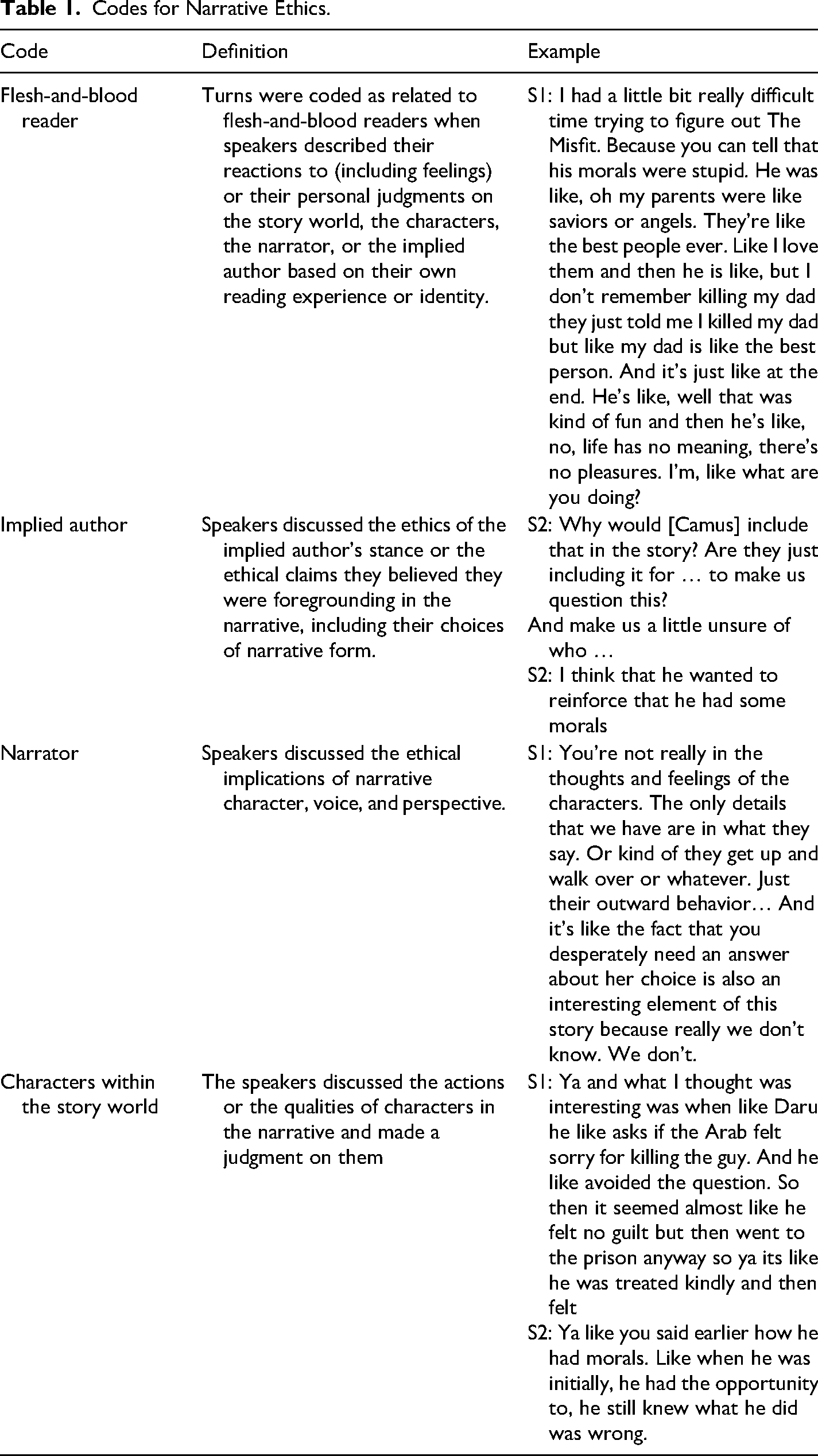
Once we coded for these ethical situations, we clustered responses in two categories: Phelan's telling (layers 2 and 3) and told (layers 1 and 4). This clustering enabled us to see how different ethical concerns played out across narrative layers, and we saw patterns that revealed a fairly equal distribution of ethical debate across both the telling (how students addressed author and narrator communication through narrative form) and the told (how readers responded to character actions or qualities within the story world). To see how this mapped out across the five stories, we color-coded excerpts for each story. We identified excerpts to include from both categories (telling/told), focusing primarily on the two short stories that had the most uptake across both categories in terms of ethical debate. Finally, grounding our analysis in rhetorical narratology's approach to narrative ethics, as a last step we wrote an analytic memo for each instance of talk to consider the question, What specifically is the student's ethical concern? Answering this question allowed us to more concretely address each ethical quandary in the literature, beyond more broad coding for ethical layers.
Findings
We begin by briefly exploring students discussing the ethics of the told. This approach, wherein students discuss their ethical reactions to characters or the ethical choices of characters within the narrative (layers 1 and 4), is largely familiar to teachers and common in much classroom talk. We then analyze moments of the students discussing the ethics of the telling (layers 2 and 3), where students considered the narrative act and its ethical implications. Across both sections, we illustrate how students pushed one another to engage in interpretive discussions that expanded beyond known-answer discourses (Levine et al., 2022) to grapple with the complexities of ethical positioning in narrative—an important dimension of rhetorical reading.
The Ethics of the Told: Characters in the Story World and Flesh-and-Blood Readers
Students in this class were not afraid to take a strong ethical stand on characters within the story world—indeed, the most explosive moments in these classroom interactions were often between students making candid or evocative ethical claims about characters’ inner qualities or about the nature of their actions in the stories (Phelan's layer 4). These moments represented common responses to the ethics of the told, repeated in and familiar to ELA classrooms across North America. Phelan has described these sorts of reactions as those of the flesh-and-blood reader responding to the “mimetic” component of the narrative, where characters are regarded as “possible people” who exist in the “narrative world as like our own” (Phelan & Rabinowitz, 2012a, p. 7).
For example, students frequently commented on the quality of the central characters in Hemingway's spare short story (1927/1987), “Hills Like White Elephants.” In this narrative, a man and a woman sit in a café discussing whether to go through with a “simple operation.” The students openly questioned the unspoken motivations of the man. Emma remarked, I think he's he doesn’t actually like really care. I think he's just a master manipulator, by trying to make it seem like it's actually her choice, when it's really him like tilting, like tipping the scales just to know what the outcome's gonna be.
A number of students, including Astrid, echoed Emma's framing, describing the male character as a person worthy of their judgment, a “master manipulator” using his words to achieve his own selfish ends: I also think he's kind of like using a reverse way of getting what he wants. Like he's always, he's like “Oh, don’t do it, don’t do it.” And then he’ll change. “Oh I really love you. Like, you don’t need to do this. We can have everything.” Kind of like, instead of just saying “Don’t do it.” He's kind of saying “Oh I really love you. We should do this together” and kind of like almost putting pressure on her. Like making her feel bad for not getting the abortion.
Astrid and Emma interpreted the male protagonist's actions as ethically suspect, rendering judgment about his motives based on the actions of the character in the text (layer 1).
Other students grounded these types of ethical claims about character action in their own confusion and response as flesh-and-blood readers (layer 4), finding themselves baffled by the choices and decisions of key figures in the narrative. Such an approach still regarded characters as “possible people,” but demonstrated how ethical claims fall differently on different audiences—flesh-and-readers who are unable to completely understand the moral actions of others, particularly those set in a far distant time and place. Many students articulated these kinds of reactions in reading the Flannery O’Connor short story (1993), where the moral code of the character The Misfit included a willingness to commit acts of shocking violence. Felix articulated his interpretive process as a reader struggling to understand a character's motivations: I had a little bit really difficult time trying to figure out The Misfit. Because you can tell that his morals were stupid. He was like, oh my parents were like saviors or angels. They’re like the best people ever. Like I love them and then he is like, but I don’t remember killing my dad. They just told me I killed my dad but like my dad is like the best person. And it's just like at the end. He's like, well that was kind of fun and then he's like, no, life has no meaning, there's no pleasures. I’m like, what are you doing?
These efforts of Felix, like other students, to bring his own moral understandings to bear in making sense of a character's motivations and the narrative action was a key way students centered the ethical claims in the short stories and grappled with the interpretive challenges of making sense of characters with motivations and identities distant from their own.
Such an approach to reading literature is both common and critical. Thinking of characters as possible people and considering our own ethical responses to their actions is often the grounding for rich and productive conversations about the ethics of literature in the secondary classroom. However, such an approach is not without limitations. Eagleton (2013) noted that should an outsider listen in on these types of discussions, They would find nothing to suggest that it was about a novel [or any form of literature] … Nothing is said about the techniques by which the novel builds up its characters. Nobody raises the question of what attitudes the book itself takes towards these figures. (p. 1)
The Ethics of the Telling
In this section, we explore how students discussed the Hemingway and Joyce short stories, the two narratives that engendered the most ethical debate in the corpus. Notably, Joyce's “Araby” (1916) was the only short story across the seminars that was written in first person narration by a character (homodiegetic or in the story) narrator, marking it as ripe for conversation about narrator voice and perspective. And while conversation about the ethics of the telling made an appearance across all five seminars in some capacity, Hemingway's spare style—what would come to be known as “the iceberg method” (2021) in large and small group discussions—became a point of serious attention in this classroom and the subject of a good deal of ethical scrutiny.
Implied Author
Discussion and analysis of Hemingway's literary style began in the early moments of the Socratic seminar. Students in the lead group had conducted initial research on Wikipedia regarding Hemingway's (1927/1987) “Hills Like White Elephants” in anticipation of the conversation. The iceberg method was Hemingway's own nomenclature for his minimalist approach to narrative, conceived of as a prose of subtraction, where omitted details strengthen the symbolic meaning of the story. This framing would prove a potent entrée point for discussing the ethics of the telling. In this framing, Trina conceptualized the relationship between the spare form of the implied author (Hemingway) and its impact on the central ethical quandary of the short story: Trina: We’re kind of gonna combine the next two questions kind of talking more to Ernest Hemingway writing style. So the first one is like how does Hemingway or he kind of talks matter-of-fact, very short. More fragmented sentences and he doesn’t explain a lot of things. He kind of like beats around the bush. Like kind of how does that, kind of make the operation more or less significant? And then he also uses something called an iceberg technique Holly: Uh ya ok So basically, we're just asking, where are there points in the story where his writing style makes the topics that he is talking about more significant. And especially you can tell by the way that he talks about the simple operation as a simple operation in this story. He used something called the iceberg writing method. Where you only see the tip of the iceberg in what he's saying. But there's a whole lot of meaning underneath of his stories if you dig deeper. Which is interesting. Ya like basically what Trina was saying with his really short sentences and stuff. You could take it word for word or if you look deeper. You could see that there's a lot more there. So basically, we’re just asking, where are there points in the story where his: writing style makes (.) the topics that he is talking about more significant?
In Holly and Trina's framing, the reference to the implied author was student-driven, motivated by their own inquiry into the story, and summarized for their fellow students. And where Holly described Hemingway's prose as presenting just “the tip of the iceberg,” this insight set up her second point about the impact of style with reference to significance, which asked, “Where are there points in the story where his writing style makes the topics he is talking about more significant?” She explicitly linked this issue of significance (the author's signal to the reader; Rabinowitz, 1998) to the “simple operation,” by which Hemingway signaled something larger but did so obliquely, and that signal offered something about the significance of the action.
During the seminar, a classmate, Taylor, took up Holly's point about the implied author's iceberg method and its potential to signal significance in the text, reframing it as positioning the flesh-and-blood reader in a writerly position: I feel like the style of writing or at least like the reader response kind of allows the person to have much more room to kind of have their own ideas and find like their own meaning to it, along with like the deeper meaning, just giving the whole topic.
In discussing the implied author's orientation to the ethics at the center of “Hills Like White Elephants,” Taylor described this as a “reader response” style which allowed the reader to have “much more room,” “their own ideas,” and “find their own meaning.” Another student, Clara, echoed this link between the form and content of the story: I feel like the story is like a really good reader response story, just because the way he writes it. Like using the iceberg method. Plus, he doesn’t actually go into, you know, like first person point of view of either of the characters. It leaves you like almost kind of really disconnected from them. But at the same time, it's like you’re able to form like your own ideas by just like seeing what's going on. So I think that's really good.
Where tidy narrative closure and obvious authorial commentary were once familiar features in fiction (Booth, 1982), theorists from Bakhtin to Barthes to contemporary postmodernists, have heralded instead the “open” text which refuses to provide satisfying or morally clear closure to stories. This unwillingness to narrate closure (at the conclusion of “Hills” (Hemingway, 1927/1987), the man and the women get on a train, leaving the reader to wonder their decision as to the simple operation) is not the abandonment of a moral stance, but rather is itself an ethics of telling, in which the ethical burden is on the reader to find the deeper meaning themselves. Taylor and Clara's point was that the implied author's spare prose mirrored the ambiguity of the morally complex question of the simple operation, leaving the flesh-and-blood reader a choice as to their response.
Other students focused on their response as readers to the spare form Hemingway offers in the story, in which the ethics of the telling is rooted in the demand to “re-read” the text to search explicitly for a moral stance. As Luke observed, I think that it does a couple things in this kind of manner. When you write like this, it makes almost when you discover the subject, it makes it more significant because they’re almost trying to cover it up a bit. Like, what's more, what seems more significant. Oh another thing it does is it kind of adds to the re-readability of the story because you start to catch on to things that previously like through the first read through you wouldn’t be able to catch. Like maybe the elephant kind of thing. Like the elephant in the room. Like you wouldn’t been able to catch that the first time. The second time you catch that and you’re like woah!
Luke argued that Hemingway's iceberg method made the significance of the simple operation that much more meaningful, once the pieces fall into place for the reader. For instance, when the central image comes to take on meaning (the “elephant in the room” being the procedure both characters refuse to explicitly discuss), the reader is compelled to go back through the story to find further evidence of Hemingway's moral stance, and in doing so receives something of a moral shock (“you’re like woah!”).
Rather than narrowing conversation or limiting it to some outside authority, discussion of the implied author was enabling for the students. By taking a kernel of author biographical and stylistic details about Hemingway, many students were keen to chime in and share their take on the relationship between the cool, exterior description of the implied author and the potential moral effects it has on the reader. Where the implied author's moral stance on the simple operation was unclear from the narration, that indeterminacy represented a moral stance, and the students were intrigued to re-examine the text for hints as to the outcome of the character's decision.
Narrator
Authors must make key choices about how to narrate because the narrator’s position becomes the “information-conveying pipe” (Genette, 1988, p. 74) to which the author delegates the narrative task. Consequently, “One of the most important choices an author makes is about the kind of narrator to employ” (Phelan & Rabinowitz, 2012b, p. 33), since this decision has ripple effects throughout the story (notably if the narrative is mimetic and plays by conventional narrative rules). Can the narrator sense and convey the inner feelings of others? Can the narrator move freely from one space to another in their description, unbound by a concretized narrative space? Can the narrator speak for others (as in plural second-person narration)? These are simultaneously rhetorical and ethical questions, since the choice to narrate other minds, other voices, and other perspectives is both a matter of narrative effect and a moral quandary.
Joyce's “Araby” (1916), discussed during the final Socratic seminar of the unit, was told from the perspective of an unnamed boy, who is infatuated with his friend Mangan's sister (who is also unnamed by the boy narrator) and wishes to purchase something for her from the local Araby bazaar. Foiled by his family from making his way to the market before it closes, the story ends with the narrator confronting his own vanity as night sets on the bazaar. The narrative of “Araby” is a form of “character narration” (Phelan, 2005), where the teller is himself a dramatized character in the story (classic examples include Scout in To Kill a Mockingbird and Nick Carraway in The Great Gatsby). Phelan (2001) described character narration as simultaneously proceeding on two tracks: the “narrator–narratee track” (p. 213), where the narrator in the narrative situation (perhaps unknown to us) tells their tale to the recipient (perhaps unknown to us or the narrator), and the “narrator–authorial audience track” (p. 213), where the narrator unwittingly provides key information to the reader (who the narrator theoretically does not know exists). Consequently, readers can judge both the act of the narration from the narrator to the narratee in the narrative situation (their reliability, their willingness to share lurid details, their manipulation of the narratee, etc.) and the act of narration from an author to a reader through the information-conveying pipe of the narrator voice.
Several students raised the point early in the discussion that while “Araby” is an act of character narration, the narrator went unnamed throughout. Serena began by stating this point: The fact that the boy is never given a name, kind of like as his character … He is kinda of mysterious and we don’t fully understand. He's not really there because he's like never once mentioned by name. He's always nameless throughout the story.
Students, including Lottie and Brad, respectively, responded to Serena's point by considering the author's purpose in this narrative choice and thus explored the narrator-authorial track. Lottie asked, “What is the significance of the story being written in the point of view that it is? As in the point of view is first person and what is the significance of that?” Brad replied, “I guess it makes it easier for the author to avoid saying the guy's name.”
When students pushed each other to think about why avoiding the narrator's name might be important, the responses varied. Early discussion focused on the ability of a generic unnamed narrator (though still a character) to convey the author's intended themes by acting as a transparent cipher. When narrators are unnamed, they can more easily work as a stand-in for anyone who may wish to adopt their stance. The effect is that the reader takes on the narrator's perspective, which students discussed as a potential rationale for this narrative decision. Winter said, I think it makes it like easier for readers to understand the universal truth within the short story. You put yourself like—oh this is the perspective of this person, this character who is anonymous to you, which makes it easier for like readers to like understand the universal truth of like what what's the author's—Joyce—is trying to convey. I feel that it's easier to relate to that thought, right? Because when you give him a name and you’re giving him like all this character. Because the reason he's anonymous is just so you can place yourself in his shoes easier … So if we’re trying to learn a universal truth from it, and keeping him as blank a slate as possible to put yourself into those shoes.
As Winter and Devon discussed, the effect of the implied author's decision to leave the narrator unnamed functioned to create interpretive space, helping readers access the moral of the story.
Other students, however, argued that the narrator's unwillingness to name themselves was indicative of the narrator's distanced ethical stance—from themselves and from others. This choice by the narrator in “Araby”—which was described by students in the seminar as “surface level”—became a point of much conversation. Luke expressed this insight: I think that the whole first-person thing—it adds to the shallowness that we were talking about before. Because in first-person you don’t really get to see as much as you would see in like third-person, where you get to see more people's perspectives. When you only see it from one person's perspective it's much more surface level.
Students built on this claim of “surface level” description from the narrator, suggesting it reflected the narrator's lack of empathy for others. For example, the character narrator of “Araby” was unable to see into the minds of others, which represented his own unwillingness to empathize with other characters. In an extended dialogue, the students explored the impact of this distanced narrative stance on them as readers. Clara offered, I feel like it just, like kind of like represents almost like his selfishness right. ‘Cause like it shows like how he's feeling and like what he thinks but like it doesn’t play into anything anyone else is ever thinking or says. I feel like it's all surface level just because he's young, and doesn’t see a purpose in looking past his desire; he's just kinda of going back between what he sees and what he thinks initially. But he doesn’t dig deeper into it. And then in the last scene when he finally realizes like kinda what he's been doing, that's kinda like his end innocent moment where he realizes that there is more to life than what he's just like seeing initially and like he thinks further into things then.
Felix then asked, So is he angry with himself then or is he angry with the situation? Yeah I think he is. I think he's a little bit angry with himself for only ever seeing surface level things. It's like throughout the entire story it's all super, super descriptive. But most of it is about, like, random things. Like the street or the street lights, or like the way that the room looks like that he's in, or like the way the door knob is turning. Like, it's all about really random stuff. But then when it comes to that girl, it's like about her appearance. Like none of it is like deeper than the surface level kind of thing. And you never even learn that much about her appearance. It's just like he just likes her.
In these back-and-forths, the form of narration itself became the subject of ethical debate. Where critics of internal narration—notably the more excessive forms, such as stream-of-consciousness found in the works of James Joyce—have accused authors of a kind of narrative narcissism, students pivoted this critique to the narrator. Internal narrative, they argued here, foregrounds self-involvement, and self-involvement was demonstrated through the narrator's choices of thin description. Serena's final point about the nature of the narrator's description—rich for things and objects and surface-level for others, including his supposed love interest—was both a strong critique of the character narrator himself as an ethical being, but also of the ethics of homodiegetic narration as a literary form. In a narrative world, where the minds of others are potentially open to listening in (e.g., should the narrative focalization pass to Mangan's sister, allowing her to provide the “information-conveying pipe” for a time and a window into her perspective), the students saw this narrative choice as a limitation and a point of ethical criticism.
Discussion: Implications for Educators
Where much recent scholarship has focused on reading, engaging, and discussing literature as a platform for reader response, social activism, and deeper personal understanding—all of which are central to the work of ELA—this article argues that missing in much of the conversation has been an ethical concern for narrative craft of the telling, constituted of narrative layers, narrative perspectives, and the ethically complicated relationship between characters, narrators, authors, and readers. Any ethical adjudication of characters, actions, and their consequences must by necessity pass through the narrative layers of author and narrator; in other words, the told must always pass through the telling. While standards are increasingly concerned with students being able to identify the author's craft, these directives to think about form often sit divorced from concerns about content and are missing any rhetorical awareness of the multi-layered nature of narrative and its ethical import.
The classroom discussions featured in this article highlighted young people's capacity for critical conversations about the ethics of textual positioning and form, complex interpretive work that youth may be engaged in through their everyday encounters with texts (see Levine, 2019). There is considerable space for educators to intervene to offer conceptual tools to help deepen students’ critical ethical engagement with the texts and provide explicit framing about narrative layering, how texts position readers, and the power negotiations involved in the reader-text-author relationship—in short, to explore the telling in narrative. Serena's questioning, for example, about how the text positioned her as a young woman to empathize with the selfish male narrator, represented an opportunity for the teacher to push on and make space for such critical readings in future discussions. These readings could perhaps explore whose perspectives were focalized and left out in the text, and how those authorial choices were tied to gender, race, and other identities of the author, narrator, and readers. In other examples, discussions about the ethical dimensions of textual positioning, including how a text is situated in relation to particular social, cultural, and political histories, would have offered students opportunities to explore how the text positioned the authorial audience and made assumptions about shared knowledge.
In all these discussions, critical conversations about the telling and the told could open space for students to contest the text's ethical positioning, something students did not do in these discussions. There was no discussion of the fact that these were canonical texts written by white, male authors in particular historical and cultural circumstances that assumed authorial audiences with identities and knowledge not reflected by individuals in that classroom. Educational critics of canonical literature (cf. Macaluso & Macaluso, 2018) have suggested that in addition to pluralizing the texts that students encounter—disrupting the hegemony of the Western canon by foregrounding marginalized voices and diverse contemporary authors—classrooms need to take critical orientations with and against traditional (and often mandatory) literature such as To Kill a Mockingbird, Huckleberry Finn, and Othello. One value of rhetorical reading is that it allows readers to fuse pressing concerns with power, representation, and action (typically played out in the told of the narrative) with questions for form and aesthetics: asking how characters, action, and moral decision making are mediated for the reader in the telling.
Opening interpretive space for considering the telling in discussions could invite students to bring their emotions as flesh-and-blood readers to the reading experience and provide conceptual tools for understanding and articulating their reading experiences and exercising agency in taking up or resisting the text's positioning. Teachers can intentionally connect the texts to the worlds that students inhabit, including a focus on the injustices and systems of inequity that surround them, through discussing a narrative's telling dimensions. This could include designing writing activities that invite students to experiment with these dimensions, for example, writing from the perspective of Mangan's sister, or composing a modern version of Hemingway's story, written in the same style but centered on an ethical dilemma about which a contemporary couple might argue. These kinds of restorying activities (Thomas & Stornaiuolo, 2016) make explicit how meaning is a communicative act that is always being negotiated between authors and readers.
Reading rhetorically emphasizes the role of power in classroom discussions, including how reading and interpretation in classrooms are always performed and co-constructed in relation to the audience of the class and teacher. Making those power dimensions in the text–author–reader relationship explicit can help students exercise agency in that relationship, making decisions about how vulnerable they want to be in revealing how a text's narrative positioning intersects with their identities or affects their reading experience. It offers a shared vocabulary and conceptual approach for critically discussing textual positioning, by identifying whose perspectives are being focalized, what audiences are being addressed, and how authors, narrators, and readers are negotiating race, identity, culture, language, and power in the telling and the told. Careful readers, as Phelan (2017) outlined, experience a double consciousness in their responses; they respond to characters as though real people (making moral judgments about them and their actions), while also recognizing they are artificial constructions of authors and narrators. Teachers can foster such double consciousness by providing students with choices about how they enter the authorial audience, how they take up the text's positioning, and how they respond in the context of the ELA classroom.
Conclusion
Ethics are inescapably part of literature. While ELA classrooms have often located ethical criticisms and activities supporting ethical engagement in the realm of the told, students are more than capable of considering the ethics of the telling. Going forward, more research is needed that examines the potential for instruction explicitly focused on rhetorical choices in literature and their impact on students reading, discussion, writing, and thinking, including how such ethical positioning might help young people interrogate people's ethical responsibilities to one another in a globalized world (Stornaiuolo & Garg, 2023). How might we tap into students’ knowledge of narrative power through its organization? How might we organize instruction to carefully (and judiciously) provide theoretical framing that clarifies and deepens that understanding? Considering the ethics of the telling not only re-establishes the link between the content of a narrative and its narration, but it also returns ELA to a vital focus on form, craft, style, and power. And in a media landscape where narrative has become a dominant form—not just in film and television but the barrage of narrative tales on TikTok, Youtube, and Twitter—attention to the ethics of the telling and the ways authorial design positions readers in and across space and time is urgently needed.
Supplemental Material
sj-docx-1-jlr-10.1177_1086296X231215326 - Supplemental material for Reading Rhetorically: Discussing the Ethics of Narrative Form
Supplemental material, sj-docx-1-jlr-10.1177_1086296X231215326 for Reading Rhetorically: Discussing the Ethics of Narrative Form by Robert Jean LeBlanc and Amy Stornaiuolo in Journal of Literacy Research
Supplemental Material
sj-docx-2-jlr-10.1177_1086296X231215326 - Supplemental material for Reading Rhetorically: Discussing the Ethics of Narrative Form
Supplemental material, sj-docx-2-jlr-10.1177_1086296X231215326 for Reading Rhetorically: Discussing the Ethics of Narrative Form by Robert Jean LeBlanc and Amy Stornaiuolo in Journal of Literacy Research
Supplemental Material
sj-docx-3-jlr-10.1177_1086296X231215326 - Supplemental material for Reading Rhetorically: Discussing the Ethics of Narrative Form
Supplemental material, sj-docx-3-jlr-10.1177_1086296X231215326 for Reading Rhetorically: Discussing the Ethics of Narrative Form by Robert Jean LeBlanc and Amy Stornaiuolo in Journal of Literacy Research
Supplemental Material
sj-docx-4-jlr-10.1177_1086296X231215326 - Supplemental material for Reading Rhetorically: Discussing the Ethics of Narrative Form
Supplemental material, sj-docx-4-jlr-10.1177_1086296X231215326 for Reading Rhetorically: Discussing the Ethics of Narrative Form by Robert Jean LeBlanc and Amy Stornaiuolo in Journal of Literacy Research
Supplemental Material
sj-docx-5-jlr-10.1177_1086296X231215326 - Supplemental material for Reading Rhetorically: Discussing the Ethics of Narrative Form
Supplemental material, sj-docx-5-jlr-10.1177_1086296X231215326 for Reading Rhetorically: Discussing the Ethics of Narrative Form by Robert Jean LeBlanc and Amy Stornaiuolo in Journal of Literacy Research
Footnotes
Declaration of Conflicting Interests
The authors declared no potential conflicts of interest with respect to the research, authorship, and/or publication of this article.
Funding
The authors received no financial support for the research, authorship, and/or publication of this article.

Notes
References
Supplementary Material
Please find the following supplemental material available below.
For Open Access articles published under a Creative Commons License, all supplemental material carries the same license as the article it is associated with.
For non-Open Access articles published, all supplemental material carries a non-exclusive license, and permission requests for re-use of supplemental material or any part of supplemental material shall be sent directly to the copyright owner as specified in the copyright notice associated with the article.
