



Abstract
Novice teachers experience language about literacy instruction from a variety of sources. This longitudinal case study uses Bakhtin’s notions of authoritative and internally persuasive discourse to consider how four novice teachers negotiated messages regarding literacy instruction from the conclusion of preservice education through their first 2 years of teaching. Although the challenges of the initial years of teaching have been studied, limited attention has been given to the ways in which novice teachers negotiate and take up language about literacy instruction within their school contexts. Interviews and email journals were used as data sources. Findings reveal that novice teachers perceived authoritative discourse from curricula, programs and assessments, and instructional expectations of administrators or senior colleagues. Participants accessed internally persuasive literacy discourses through questioning, supplementing, and changing literacy programs they perceived as required by authorities. Implications for teacher educators, researchers, and school personnel are discussed.
This longitudinal case study followed four novice teachers from the conclusion of teacher education programs through the second year of teaching, analyzing their perceptions during this critical time frame. Through a series of seven substantive interviews and ongoing email correspondence with each participant, we considered the ways these novice teachers made sense of language around literacy instruction early in their careers. This article surfaces the thinking of novice teachers, which may be unlike the thinking of experienced educators.
Data were drawn from a larger study of novice teachers’ transition from teacher education programs to the classroom (Adams-Budde et al., 2021; Howard et al., 2021; Myers et al., 2022). While previous publications considered new elementary teacher development more broadly or presented cases from secondary teachers, in this analysis, Bakhtin's (1981) notion of authoritative and internally persuasive discourse guides the analysis of language through which four novice elementary teachers mediated their literacy experiences. In an essay entitled “Discourse in the Novel,” Bakhtin (1981) described discourse as multivoiced language, or heteroglossia. When a writer or speaker communicates, they incorporate into their discourse multiple voices that draw upon a diversity of social speech types and languages they have encountered, including national languages, dialects, group or professional discourses, generational ways of speaking, languages of authority, sociopolitical language, and even the language of trends and fashions. In this way, the meaning of language exceeds a word's denotation, instead absorbing the social, political, historical, and cultural flavors of the speakers and of their audiences. We applied this conceptualization of discourse to the analysis of novice teachers’ statements about literacy teaching.
We asked: How do novice teachers perceive authoritative and internally persuasive discourse related to literacy teaching and learning over time from the conclusion of preservice education through the first 2 years of teaching? It is our belief that, with a clearer understanding of how novice teachers perceive and engage with literacy discourse as they enter a school community, teacher educators and school-based mentors can work to better support new teachers. Teacher educators can question their own assumptions about literacy, invite dialogic learning opportunities, and attend to the ways they both interpret authoritative literacy discourse and reify that discourse as authorities in their courses. Consideration of the ways novice teachers entering professional communities perceive literacy discourse may open productive spaces for dialogue and reflection among teacher educators, researchers, school personnel, and novice teachers.
The Researchers
We, the researchers and authors, were literacy teacher educators at four universities in the mid-Atlantic and Southeastern United States at the time of the study and are former classroom literacy teachers: Claire and Christy in middle grades and Joy and Melissa in elementary grades. Claire, Joy, and Melissa identify as White women and Christy as an African-American woman. We undertook this research to better understand how novice teachers experienced the transition from preservice education to the teaching profession. We wanted to foreground participants’ voices and perceptions as they made sense of their professional journeys, acknowledging that the vantage point of novice teachers was dissimilar from that of more experienced classroom teachers, teacher educators, researchers, or school-based mentors.
Literature Review
Entering the Teaching Profession
Novice teachers need time to develop effective instructional practices and may experience dissonance between personal beliefs, concepts learned in teacher education programs, and the realities of their new teaching contexts (Levin & He, 2008). Beginning literacy teachers face challenges with learning curricula, planning, finding resources, and meeting new expectations (Broemmel & Swaggerty, 2017). However, this first year of teaching is also a time of learning, change, and development for literacy teachers (Broemmel & Swaggerty, 2017; Hopkins & Spillane, 2014).
Novice teachers may have gaps in knowledge of effective reading-process instruction, especially when compared to experienced teachers (Hikida et al., 2019). Teaching is complex and asks relatively inexperienced professionals to apply complicated skills effectively in dynamic environments. Becoming a strong literacy teacher takes time, and novice teachers sometimes struggle to enact their visions for teaching (Scales, 2013).
Literacy teachers experience external pressures that shape their teaching. They must decide whether to operate within perceived boundaries or to engage in “teaching against the grain” (Maloch et al., 2003). Parsons et al. (2014) discovered that novice literacy teachers struggled with constraints on time and lack of experience; they also were impacted by school mandates, such as prescribed curricula and standardized testing, and expectations of administration. Participants coped with obstacles by adapting instruction and, for some, by “going rogue” (p. 144) or prioritizing their vision and students’ needs over mandates.
Schmidt and Whitmore (2010) described tensions of teaching within the contemporary accountability movement: Teachers struggle daily with imposed limits on who they can be in their classrooms. Simultaneously, teachers are pushed into opposite subject positions: on the one hand as knowledgeable professionals educating youngsters with potential and on the other as teachers with little freedom to make decisions about how best to educate. (p. 414)
Many teacher educators see teaching as a practice of continuous learning and inquiry, rather than a profession where teachers are trained to implement programs (Vaughn & Parsons, 2013). Worthy et al. (2018) noted that “literacy is too complex to be taught with prescriptive programs that minimize the need for teacher expertise” (p. 365). Yet novice teachers face learning to teach effectively, without oversimplifying instruction by relying on prescriptive programs, while also finding their place within school communities. This transition is nuanced, and novice teachers may lack experience navigating these tensions.
New Teachers Changing Over Time
Teacher development does not happen in the confines of the first year. This process of change and development takes time (Broemmel et al., 2020; Myers et al., 2022). A Broemmel et al. (2020) study of seven beginning literacy teachers revealed that major influences on positive change over time included seeking knowledge from others, being knowledgeable of students, and finding autonomy. Researchers agree that teacher development is influenced by beliefs and experiences over time (Broemmel et al., 2020; Levin & He, 2008; Levin et al., 2013). It is important to explore the ways in which novice teachers experience their beginning years of teaching and how they perceive the contextual factors that might influence their growth.
Theoretical Framework
Bakhtin (1981) posited that “verbal discourse is a social phenomenon” (p. 259), and as such, the language through which teachers narrate their classroom experiences is shaped by the social dynamics of their professional settings and by their prior experiences. Language is not a “neutral signification” but is “understood against the background of other concrete utterances on the same theme, a background made up of contradictory opinions, points of view and value judgments” (Bakhtin, 1981, p. 281). Indeed, “every conversation is full of transmissions and interpretations of other people's words” (Bakhtin, 1981, p. 338). Thus, as novice teachers develop their understanding of literacy teaching and learning, they intermingle, integrate, and draw upon the many messages about literacy they have heard. As teachers enter the profession, they encounter unfamiliar language around literacy instruction; that language “lies on the borderline between oneself and the other” (Bakhtin, 1981, p. 293). Over time, teachers may take up some professional discourse, making it “one's own,” while other words of the profession “stubbornly resist, others remain alien, sound foreign in the mouth of the one who appropriated them and who now speaks them; they cannot be assimilated into his context and fall out of it” (Bakhtin, 1981, p. 294).
Bakhtin's Authoritative and Internally Persuasive Discourse
Bakhtin's (1981) notions of authoritative and internally persuasive discourse guided data analysis. Bakhtin described “authoritative discourse” as an official language or doctrine that is handed down from inaccessible sources of authority and that is closed to interpretation or modification. He noted that “it is not a free appropriation and assimilation of the word itself that authoritative discourse seeks to elicit from us; rather, it demands our unconditional allegiance” (p. 343). Authoritative discourse is “indissolubly fused with its authority—with political power, an institution, a person—and it stands and falls together with that authority” (p. 343).
In contrast to authoritative discourse, Bakhtin (1981) described “internally persuasive discourse” as the language of another that is compelling and relevant, and that becomes personally meaningful. Internally persuasive discourse is willingly taken up by the listener from accessible experts, others within a community, everyday people, and popular sources. Internally persuasive discourse is “affirmed through assimilation, tightly interwoven with ‘one's own word’” (p. 345). In other words, language that becomes internally persuasive is derived over time from many sources and becomes one's synthesized personal lexicon. It is the language through which people narrate their beliefs, intentions, and actions.
When discourse is accessible and open to questioning, interpretation, multiple perspectives, and response, it may be drawn into the “zone of contact” (Bakhtin, 1981, p. 345). Unlike authoritative discourse, which remains intact and untouchable, internally persuasive discourse brought into the zone of contact is “freely developed, applied to new material, new conditions; it enters into inter-animating relationships with new contexts” (Bakhtin, 1981, p. 346). Thus, internally persuasive language is not echoed from an authority; it is synthesized as an individual draws discourse into the zone of contact, integrates multiple sources, and uses language for their own purposes. We drew upon this dialogic conceptualization of discourse, focusing on how individuals are exposed to ideas through language from a variety of sources, how they negotiate and synthesize language to develop meaning, and how they remix that language to express their own ideas and intentions.
Connecting Bakhtin's Discourses to Contemporary Research
A framework of authoritative and internally persuasive discourse has been used in the field of education to analyze how official language flows from authorities to practitioners. Worthy et al. (2018) considered how language about dyslexia functioned as durable authoritative discourse when reified in policy, legislation, and instructional programs. Researchers found that participants, who were dyslexia instructional specialists, replicated dominant medical, neurobiological, or scientific authoritative discourse of dyslexia when discussing literacy instructional practices. Gadanidis and Kotsopoulos (2009) found a linguistic interplay when they studied mathematics teachers negotiating a textbook as an authority to which they deferred, versus their internal synthesis of language and ideas from multiple instructional resources that were responsive to students’ needs. Secondary English teachers in Stewart (2012) pushed back against the authoritative discourse of district policies about language arts instruction. These studies informed our thinking as we considered complex ways teachers might engage with the language they perceived as authoritative.
The lens of authoritative and internally persuasive discourse has been used to position teachers as agentic meaning-makers. In a study with social studies preservice teachers, Ranschaert (2020) investigated participants’ perceptions of media sources and politicians’ claims about media trustworthiness. The theoretical framework was used to interpret not only preservice teachers’ media literacy as consumers of authoritative discourse but also their complicated roles as producers of authoritative discourse in the classroom. Maddamsetti (2020) paired Bakhtin's notions of authoritative and internally persuasive discourse with theories of culturally relevant and sustaining pedagogy (CR/SP) to analyze the discourse of teachers of color as they navigated fieldwork in urban high schools. Maddamsetti found that they took up CR/SP language but struggled when implementing CR/SP practices. Converting internally persuasive discourse to observable shifts in teachers’ practices was complicated by power differentials between student teachers and mentor teachers. These studies helped us understand that discourse moves may start as a ripple in the early years in the profession, and that talking through thoughts and beliefs over time may precede observable change in practices.
Additional studies considered how teachers developed internally persuasive discourse, particularly by engaging in conversation and reflection. For example, Gomez et al. (2014) presented a case study of a White, rural, middle-class preservice teacher recognizing authoritative discourse that shaped her negative assumptions about her urban students of color. Reflecting on her field experiences with diverse students alongside course readings about deficit thinking, she reconsidered her perspectives. Similarly, preservice teachers in Rogers et al. (2006) brought authoritative discourses, conversation with peers, input from teacher educators, and language from clinical experiences into Bakhtin's zone of contact to negotiate beliefs and discourse used to describe their teaching in diverse settings. Participants in each study came to recognize authoritative discourse and took up internally persuasive discourse. Informed by these studies, we looked for ways participants brought authoritative discourse into the zone of contact, actively working through dissonance and tension. Throughout, contemporary research raised our awareness that teachers’ negotiation and meaning-making was complicated, slow, nonlinear work.
Methods
The purpose of this longitudinal case study was to trace the perceptions of novice elementary teachers transitioning from the university to classroom teaching and to investigate the discourse they used to narrate their experiences over a 2-year period. We closely examined the bounded system of each teacher (Rossman & Rallis, 2003), and the structure of a longitudinal case study allowed the researchers to consider teacher change over time.
Participants
This study followed four teachers from the conclusion of preservice education through the second year of teaching. The two universities they attended were in the mid-Atlantic region of the United States. Both teacher education programs shared similar orientations toward practice, holding that good literacy teaching should (a) position literacy instruction as comprising reading, writing, speaking and listening, and language development; (b) range from teacher-directed to independent student work; (c) discern and respond to students’ needs, funds of knowledge, and interests; (d) promote access to authentic learning experiences using real texts, purposes, and audiences; and (e) offer opportunities to critique and implement literacy curricula and to design, implement, and evaluate evidence-based literacy instruction for all learners. These principles of literacy instruction guided both programs and reflect the programs’ interpretation and application of the International Reading Association (2010) (now International Literacy Association) Standards for Reading Professionals.
Joy, Christy, and Melissa recruited participants graduating from their institutions. They invited a total of 62 candidates, across three universities, to participate. Those invited had successfully completed their coursework in education and met student teaching requirements to qualify for licensure. Twenty candidates initially agreed to participate and were interviewed at the conclusion of their preservice programs. Participants from Christy's and Melissa's institutions were traditional-aged students completing an undergraduate teacher education program. Participants from Joy's institution were approximately 1 year older, having completed a 4-year undergraduate and fifth-year continuation master of arts in teaching teacher education program.
No incentives were provided to participants to continue with the study, which may have impacted the participation rate over time, particularly as participants moved away from university towns, began new jobs, and experienced life transitions. Only data from those participants who engaged throughout all seven interviews and all email correspondence comprising this longitudinal study across 2 years—that is, those who have complete data sets—are presented in this article. Margo, Samantha, Ellen, and Cate (all names are pseudonyms) identified as female and were native English speakers.
Accounting for potential bias
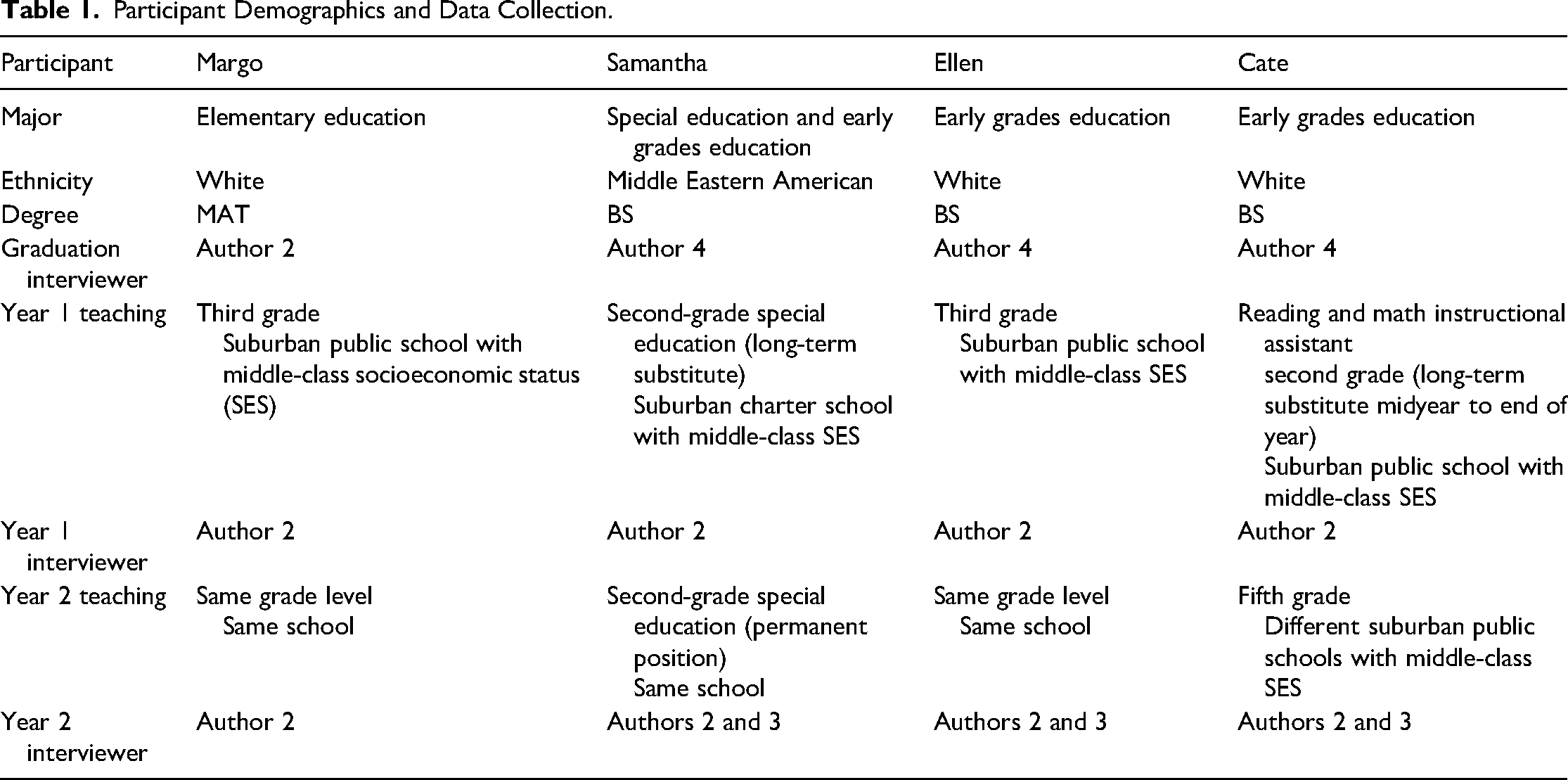
We recognized that if participants spoke to former professors, they might perceive the interviewer as a source of authority or feel pressure to echo concepts from coursework. Therefore, we attempted to mediate this potential bias by having members of the research team who had never served as participants’ literacy instructors conduct interviews whenever feasible. At the time of the interviews, no participants were enrolled in courses or under the supervision of any researcher. Melissa was a former instructor of three participants (Ellen, Cate, and Samantha) and conducted their initial interviews at the time of graduation, with Joy and Christy conducting the six subsequent interviews. Joy worked at Margo's university and conducted her interviews but had never served as her instructor. Claire and Christy worked at other universities and had no connection to these participants beyond this study. See Table 1 in the online, supplementary archive for additional participant details, including teacher education program information and self-reported demographic and school setting information.
Participant Demographics and Data Collection.
Data Collection
This longitudinal case study consisted of in-depth, semi-structured, one-on-one interviews (Creswell et al., 2007) resulting in a total of 28 interviews across the four participants. Like other longitudinal researchers, we wanted participants to “think, rethink, and articulate reasons for how and why they teach as they do” (Levin, 2001, p. 31). The study sought insights into the perceptions of new teachers; therefore, teachers’ verbal and written impressions of their experiences were relevant sources of data.
Initial interviews, conducted at the conclusion of preservice education, elicited participants’ experiences, beliefs, and perceptions of their preparation to teach literacy. Interviews at the beginning, middle, and end of their first and second years of teaching included interview questions (online Supplementary Appendix A) regarding participants’ perceptions of their experiences, challenges, successes, and shifts in thinking. To check our understanding of participants’ earlier statements and to consider shifts in thinking, we reviewed previous transcripts and notes prior to each interview, asked targeted follow-up questions based on earlier responses, and posed some of the questions across multiple interviews to compare responses. The interview protocol for Year 2 included prompts focusing on emerging themes from the analysis of Year 1 data (online Supplementary Appendix A). Telephone interviews were approximately 60 to 90 minutes each and were audio-recorded and transcribed. In the interval between each interview round, participants engaged in reflective email correspondence with researchers to document their experiences and to provide contextual information about their classroom and students. Email topics were determined by the participants in response to open-ended check-ins (online Supplementary Appendix B).
Transcribed data for each participant were transferred to a shared spreadsheet, with each utterance or narrative turn represented on a separate row and labeled by the participant's pseudonym and the data source (interview or email correspondence number and date).
Data Analysis
Coding process
Given the open-ended nature of the data collection tools, participants often discussed things unrelated to literacy. Therefore, we reduced the data by eliminating utterances unrelated to literacy. For example, we retained comments regarding planning, curriculum, assessment, materials, professional development, mentoring, supervision, student achievement, or work processes that related to literacy instruction. We set aside data related to other content areas, personal activities, classroom management, or general reflections on teaching or students.
Next, we used open coding to analyze each interview and email response; specifically, we were “coding the data for its major categories of information” (Creswell & Poth, 2018, p. 85). Two researchers coded each item independently. Following independent coding of each round of data collection, we met virtually to discuss initial codes and to create tables to document common statements, sentences, and quotes (Creswell et al., 2007). The goal was to identify patterns within and across data sources with the aim of thoroughly understanding each participant (Stake, 1995). We met bimonthly via video conference and committed to meeting as a group of four for all analysis conversations. In these conversations, we reviewed, compared, discussed, and reconciled codes. We recorded, added to, and modified research memo summaries in a shared document at each meeting.
Coding procedures
After first reducing the data set to include only utterances regarding literacy, we then let Bakhtin's (1981) seminal theory of authoritative and internally persuasive discourse guide coding procedures. This means that we open coded each literacy utterance to consider the language participants used as they narrated literacy teaching and learning in their classrooms in response to questions and prompts. For example, consider this transcript excerpt of Ellen's narration at the midpoint of her first year of teaching as open-coded by one researcher. Initial codes are presented in italics alongside the quotation in plain text: After hearing, like, the things about the reading and writing program, it stresses me out—we use Journeys (literacy program issued; literacy program referenced by name rather than instructional purpose; no reference to teacher autonomy/choice/input) and [students] do that for reading, spelling, and then they do a completely different thing for writing (literacy program performed). They just started a new program this year called Write Steps (literacy program issued; no reference to teacher autonomy/choice/input; literacy program referenced by name rather than instructional purpose)—they have to fit all four of those things into two hours—and it's not enough time for all of it (literacy schedule issued; literacy program not responsive to students; no reference to teacher autonomy/choice/input). I think for phonics it's called Five Minute Phonics or something like that (literacy program referenced by name rather than instructional purpose)…. When I was student teaching, we took the Storytown curriculum and used novels (teacher makes instructional decision)—and the kids loved it because it was real reading (connects instruction to student outcome) and not just like an anthology, and that's what they do here, they use the anthology, and all the tests with the book (literacy program and assessment issued)—and I don’t like that (teacher response to requirements). I want them to enjoy it (statement of purpose/intention). I don’t think here they would give me that freedom (instruction constrained).
Coding authoritative discourse: When participants described instructional decision making or actions as dictated, required, constrained, condoned, mandatory, or hindered by a person or thing they described as an authority or source of rules, we coded that data as authoritative discourse. For example, when teachers described literacy curricula that were required by the school and for which the teacher did not articulate having input into how, when, or why the program was implemented, we coded those statements as authoritative discourse. When teachers described implementing literacy programs by product name only, without reference to instructional purpose, we grouped those utterances as authoritative discourse. Statements were coded as authoritative discourse when they were framed as required, handed down, approved by authorities, nonnegotiable, or performed by teachers and students without input. We grouped individual codes under the umbrella of authoritative discourse when teachers used language that foregrounded compliance with authority.
Coding internally persuasive discourse: In contrast, when participants took up language to describe, explain, characterize, and justify their beliefs, intentions, or responsiveness to students through literacy instruction, we coded these utterances as internally persuasive discourse. For example, when participants explained instructional choices drawing on knowledge of literacy, teaching, or students’ interests, strengths, or needs, we coded those comments as internally persuasive. These statements were framed as being choices, a balance of priorities, based on multiple sources or perspectives, anchored in professional knowledge, or at the discretion of teachers. Statements coded as internally persuasive discourse contained explanations of why the participant made a particular instructional decision. We grouped individual codes into the category of internally persuasive discourse when teachers exhibited agency, choice, responsiveness, or active engagement in literacy instruction.
Analyzing the Data Set
After all data sources were coded, the researchers worked to develop an understanding of the case as a whole, looking across all interviews and email correspondence. We considered the four participants together as a longitudinal case, thus collecting multiple data points across participants to contribute to a robust data set of participants’ perceptions of the shared experience of becoming a literacy teacher across 2 years.
To identify themes, we grouped statements into “broader units of information…called themes which provide the foundation for interpretation” (Creswell & Poth, 2018, p. 201). In developing these themes, researchers analyzed the statements that represented the individual experiences of participants to create categories for common experiences. For example, participants mentioned mandatory or nonnegotiable books, materials, or curricula, and we coded this as authoritative discourse. We saw these examples across participants and grouped them under the theme of commercial and school-based literacy programs, described below. We considered reaching a consensus when the majority, three of the four researchers, agreed that coded statements aligned with a theme. Through this process, dominant themes emerged to represent participants’ perceptions of authoritative and internally persuasive discourse regarding literacy instruction (Creswell et al., 2007).
Findings
We first share participants’ perceptions of literacy discourse prior to teaching. The teachers’ perceptions at preservice program completion incorporated knowledge, experiences, beliefs, and language encountered during their teacher education programs, their student teaching experiences, and their own K–12 schooling.
Next, we trace participants’ narrations of their literacy experiences in the first 2 years of teaching. Within data coded as authoritative discourse, we discerned three key themes: commercial and school-based literacy programs, administrative and senior teacher expectations, and testing and accountability procedures. Within data coded as internally persuasive, we identified small moves teachers made as they resisted or took up language around literacy instruction. Three central themes emerged: questioning expectations about literacy instruction, supplementing literacy instruction, and making subtle changes to literacy instruction.
Literacy Discourse Prior to Teaching
As Bakhtin (1981) suggested, people do not join a conversation as purely neutral. Instead, they bring relevant backgrounds, ideas, and language based on previous experiences. Therefore, it was important to initiate the study at the time of participants’ graduation from a teacher education program to establish a baseline for their literacy discourse. Initial interviews captured participants’ experiences as K–12 students, as university students, and as student teachers, and provided insights into their perceptions of literacy discourse before their first teaching jobs.
The initial interview for Samantha, Cate, and Ellen was conducted by Melissa, who had taught these participants in a literacy course in a previous semester. This decision was made both for convenience and for the comfort of the participants, but they may have perceived the researcher as an authority and that may have shaped the comments they made. As teachers enter the profession, they necessarily engage with and navigate authority or power dynamics around those who facilitate their learning. Teachers must learn from authorities to build content and pedagogy knowledge, and, according to Bakhtin's notion of internally persuasive discourse, they will take up, synthesize, or remix professional language from those they encounter whose language and ideas they find personally meaningful.
We found that participants did use language that reflected the five literacy principles above that had been central in coursework. However, we did not find that they foregrounded compliance with those principles. Instead, they took up the language of the principles to describe, explain, and justify literacy practices they intended to implement and to articulate their instructional reasoning. Thus, we found evidence of participants’ use of internally persuasive discourse in the initial interview because participants’ comments were multivoiced and drew connections between instructional intentions and literacy activities. They drew language from coursework and student teaching experiences, but they took up and used the language to articulate their beliefs and intended practices for literacy instruction.
Samantha and Margo shared a range of literacy instructional activities they hoped to implement across a spectrum from teacher-directed to student-led literacy learning formats. Samantha explained her reasoning for instructional practices: I would definitely give students a chance to interact with literacy in a variety of ways, read-alouds, guided reading, shared reading, writing activities, and opportunities where they are able to speak and listen to their classmates…so that way the students can have a chance to learn and then have a chance to take what they learned and practice it. I’ll be strong at going from the “I do, we do, you do” model, modeling it, then letting [students] go a little bit. Then, after time and repetition, allowing them to go on their own and seeing what they can do and assessing them that way. Just letting them go slowly so that their confidence gets built, and they don’t get frustrated.
Ellen articulated a vision for literacy instruction informed by the principles of her teacher education program, accompanied by her beliefs about what is important for literacy instruction. She described her future literacy instruction noting: I like using contextualized instruction…implementing everything into an actual book that the kids are reading.… I also think it is really important for them to have independent reading time.
We coded these comments as internally persuasive because the participants did not frame literacy practices as mandated or required by someone else; instead, they used language taken up through literacy experiences to explain and justify their beliefs and choices. For example, Samantha noted that she would “definitely” use certain practices and offered the explanation that by doing so, students would engage in a cycle of learning and practice. Margo commented that she would “be strong” at her chosen instructional model and noted her purpose for using this model to enhance students’ confidence and reduce frustration. In this way, participants engaged in internally persuasive discourse that drew on multiple sources (e.g., languages of coursework, student teaching settings, expectations for students, and anticipation of future school settings) to discuss, explain, and justify instructional intentions.
Shifting Literacy Discourse
The novice teachers entered their teaching contexts midstream, joining communities already in progress. Naturally, they encountered new ideas, materials, purposes, and literacy language. Particularly in the first year, participants rarely made statements aligned with internally persuasive discourse. Instead, they focused on compliance and performance of programs and assessments that they perceived as required by authorities in the school, thus yielding authoritative discourse codes.
As participants learned school and district expectations for their literacy work, they identified three authorities that they perceived to issue requirements for literacy instruction: (a) commercial and school literacy programs, (b) administrators and senior teachers, and (c) testing and accountability procedures. According to participants, these authorities sanctioned certain literacy activities that were valued or allowed in the school, communicated expectations for literacy instruction, and provided official classroom materials such as texts, instructional materials, and assessments.
Authoritative discourse
In keeping with Bakhtin's (1981) characterization of authoritative discourse as issuing from sources of authority, demanding compliance, and offering little space for interpretation, participants recounted the ways they experienced literacy echoing authoritative discourse. Data considered in this study were derived from interviews and email correspondence; therefore, we investigated the teachers’ perceptions of discourse they deemed authoritative and make no claims about their colleagues’ or literacy materials’ intentions to communicate authority. Indeed, it is the perceptions of novice teachers that we were most interested in, specifically the ways they made meaning of language as inexperienced participants in a community.
Commercial and school-based literacy programs: In their first year, all participants discussed commercial and school-based literacy programs they believed were required. Samantha stated, Every week [students] have a story they read. They have the vocabulary words that go with the story. They also have spelling words that relate directly to the story…. [T]here is a manual that says, okay this is what you are supposed to do.
Samantha did not link implementation of the reading program to her own instructional intentions or the needs of her students. As her first year progressed, Samantha expressed some reservations about the curriculum, noting, “I used the teacher's guide a lot at first and it was pretty straightforward, just, this is what you do every day. It began to feel stale after a while because it was like repeat, repeat.” Samantha framed this repetition as a drawback but prioritized following the manual.
Margo explained that deviation from the scripted literacy curriculum was not allowed, noting that “the teachers here do not, like, they do not want to be robot teachers.” Margo framed the curriculum using the metaphor of the robot, programmed to carry out the task of curriculum implementation.
Cate described literacy instruction at her school as regimented, with the required materials: You have to strictly follow [the curriculum product].… Just because it is such an explicit program, that I think that is the expectation for that… [And] with the second grade it is more to the textbook, to the workbook, and we need to address certain things.
Cate listed multiple programs by product name that she was tasked with implementing, but she did not explain the components of these programs in terms of their instructional purposes, the types of literacy learning they promoted, or the ways they responded to students’ needs or interests. Instead, she stated, “There are just certain things we have to do.” Thus, we understood her descriptions to be illustrative of authoritative discourse. Although Cate wished to include shared reading, read-aloud, literature circles, and independent reading, she explained, “That does not happen.”
Like Cate, Ellen described literacy instruction by referencing a series of curriculum products. Ellen felt overwhelmed by the demands of implementing multiple literacy programs on a prescribed schedule. She reflected: When I was student teaching, we took the Storytown curriculum and used novels—and the kids loved it because it was real reading and not just like an anthology, and that's what they do here, they use the anthology, and all the tests with the book—and I don’t like that. I want them to enjoy it. I don’t think here they would give me that freedom.
In this way, Ellen recalled a previous use of texts she found purposeful and responsive but lamented that she now implemented programs disconnected from texts she deemed meaningful.
In the first year of teaching, participants responded to questions about literacy instruction using language of compliance and program implementation, which was different from the language used in their initial interviews. For example, Ellen described reading instruction as “doing Journeys.” Other participants similarly reoriented their talk away from instructional intention, beliefs, or response to student needs and instead toward compliance with curricula.
Administrative and senior teacher expectations: Participants perceived administrators and senior teachers as authorities who set the norms for literacy teaching. For example, Samantha noted: We start off with guided reading groups and then we have whole-group after it…. I think the students would benefit so much more if we started off with whole-group reading and then we did reading groups. And I feel like that is something that I really wish was flipped.
Samantha felt constrained by the standardized schedule laid out by administrators but perceived following the schedule to be required, even when it interfered with what she thought would be best for students.
Ellen relied heavily in her early months on the authoritative discourse of her senior colleagues, seeking out sanctioned resources rather than drawing on her knowledge base. She questioned, “What do we teach, what do we not teach? I felt like I was constantly going to my colleagues and asking them, ‘Hey, what are you doing? Can I have the materials that you used to teach it?’” Uncertain about which literacy activities were allowed in her school, Ellen explained, “I went and talked with [the reading specialist] and said, ‘I’m not really sure what to do with this time, because [administrators] haven’t really told us anything.’” Ellen rarely discussed her own instructional repertoire but seemed reassured when she mirrored what others were doing.
Margo explained that while she valued the knowledge and experience of veteran colleagues, she was “feeling forced to use others’ activities in order to stay on the same pace.” Despite her knowledge of literacy instructional resources, Margo privileged materials provided by more senior colleagues.
Cate shared several instances across her first year illustrating how perceptions of her principal's beliefs shaped instruction. For example, Cate stated that her principal “just does not like to see kids reading [independently] because he thinks, not that it is lazy on our part, but that it is not something meaningful.” She reflected that while student teaching, she enjoyed teaching reading comprehension strategies, but “that does not really happen where I am teaching.” Cate narrowed her literacy instruction despite misgivings.
Testing and accountability procedures: Participants perceived authoritative discourse related to testing and accountability procedures. In her initial interview, Margo shared her hope that she would not prioritize testing over learning. However, once in the school, the expectations and pressures of testing shifted her thinking and practices. Early in her first year, Margo said: I’m the teacher I told myself I wouldn’t be when I was in college…. I always thought testing wouldn’t get in the way; the reality of teaching is, testing, at the end of the day, determines the status of the teacher in the school.
Margo later explained that her primary focus was on teaching her third graders testing strategies. She reflected, “I came to the conclusion after analyzing the data that the kids just don’t know how to take a test.” Thus, she recast literacy instruction as test preparation rather than explaining her instructional purposes or literacy goals.
Ellen felt pressure to prepare students for state tests despite wanting “them to have real learning experiences and not just like…regurgitate all the information I gave.” She said that a senior teammate encouraged her to make “a huge packet” of sample test items. Ellen did this so her students could “be exposed to the more tedious problems. I [also] have had them do bubbling practice.” Toward the end of the school year, Ellen explained: It is just very stressful because [the state reading tests] are next week and this morning we had a faculty meeting that was like our training, and I felt sick to my stomach when I left because it was just, like, so much getting thrown at me.
Trying to comply with the test administration rules and possible violations she perceived led Ellen to describe herself as feeling physically ill. This official authoritative discourse around testing was understood as completely nonnegotiable; as Bakhtin (1981) might explain, “it is indissolubly fused with its authority…one cannot divide it up—agree with one part, accept but not completely another part, reject a third part” (p. 343). Perceived pressure to meet testing and accountability requirements had a deep impact not only on what the novice teachers taught but also on how they taught.
Although participants sometimes recognized the disconnect between authoritative discourse and their beliefs about teaching literacy, they found it difficult to resolve these tensions. All participants reported, at least initially, complying with the literacy expectations and requirements they perceived.
Internally persuasive discourse
In contrast to authoritative discourse, internally persuasive discourse synthesized participants’ beliefs and rationales about teaching literacy with the literacy discourses they took up. Participants explained how they questioned the expectations they believed were imposed by authoritative discourse, supplemented literacy instruction with other sources, and made subtle but unauthorized changes based on what they believed was best for their students’ literacy learning.
Questioning expectations imposed by authoritative discourse: As novice teachers gained experience, they began to question the authoritative discourse they perceived. Discussing her principal's observation feedback, Cate revoiced, “He's like, ‘Very quiet learning environment!’… But I mean, it's not always good to be quiet, in my opinion…. Why am I trying to please him? I don’t know, it is kind of silly.” She seemed to draw the principal's language into what Bakhtin (1981) would describe as “the zone of contact,” a liminal space where she could push back against the expectation for a quiet classroom. Ultimately, Cate took a position in another school for her second year, explaining that she could not reconcile her beliefs about effective instructional practices with those she understood to be required by the principal.
Participants questioned administrative requirements at times. Samantha shared: I also wish we had more time for writing…[because] there is just barely any time the way the schedule works out. I know that a lot of the teachers struggle with finding the time to teach and have set times for writing.
Samantha's comment signaled a turn in thinking, a small move from putting pressure on herself to bend to the schedule to questioning the utility of the schedule itself.
Ellen gave required assessments but pushed back on how student data were used to label learners. During her second year, Ellen explained that she was “standing up more for my kids, like my ESLs with learning support, I’m standing up for them more, whereas last year I would’ve just did, like, what I was told.” She reflected on her growth, positioning herself as an active student advocate rather than someone who always deferred to others. As Bakhtin (1981) stated, “One's own discourse and one's own voice…will sooner or later begin to liberate themselves from the authority of the other's discourse” (p. 348). These narrations illustrate novice teachers’ struggles to negotiate the authoritative discourse they perceived regarding literacy instruction and to develop their own ways of talking about literacy instruction.
Supplementing literacy instruction with outside or original sources: Over time, the novice teachers moved beyond questioning authoritative discourse to taking action, doing what Maloch et al. (2003) might describe as “teaching against the grain” or Parsons et al. (2014) might call “going rogue,” by supplementing what they perceived as required literacy instruction with additional learning activities. When teaching about informational texts, Cate chose to focus on text structure, which was not part of her curriculum. She shared: That is not something that is in the teacher's guide, but I make sure that one day we spend talking about the text structure: Is it cause and effect, is it sequence, is it compare and contrast? I try to focus on that, but that's just me using my judgment. I think that it is important for kids to know how the text is built.
Cate completed the required activities but added instruction when she believed the curriculum fell short.
Similarly, Margo explained, “I started developing guided reading packets, which is extra work on me but…I look forward to it every day.” Margo found that supplementing mandated materials was beneficial for her students’ learning. Later, she explained, “When I’m planning for literacy, I take from the curriculum, but I also take from their interests…and I integrate it all to make it the most fluid and substantial lesson that it can be.” We understood this to be internally persuasive discourse because Margo orchestrated multiple voices and perspectives to narrate her literacy instruction.
Similarly, Samantha supplemented the required instruction with elements she deemed meaningful to her students. She reflected: We’re in the process of making a class book.… It's becoming one of those textbook moments I’ve read about where students are engaging in inquiry and making a dent in their learning but exploring and talking on their own. It's really amazing and inspiring to see it happening in my own classroom.
By supplementing sanctioned curriculum, participants demonstrated their emerging capacity to synthesize multiple sources of discourse around literacy instruction and to assemble a model that matched their students’ needs as they perceived them. We understood their shifts in the description of their practices to be internally persuasive discourse because teachers took up the language of their school settings but played with the borders and possibilities. In this way, participants began to, as Bakhtin (1981) described, “populate [language] with his own intention, his own accent, when he appropriates the word, adapting it to his own semantic and expressive intention” (p. 293).
Making subtle, but unauthorized, changes: At times, participants decided to make unauthorized changes by omitting something the curriculum seemed to require. They cut activities or created their own replacements based on what they believed was best for their students’ literacy learning.
Samantha reimagined some phonics instruction in her classroom. She explained, “I found these cell phone printables…. [W]e practice our phonics pattern every day for a couple of minutes…[and] my kids loved it. They were all pretending to send messages with their spelling words.” Whereas Samantha often described herself as “too timid” to push back on what she perceived as required curricula, she was enthusiastic when she could increase student engagement by changing the delivery.
Margo felt some of the expectations were too prescriptive; therefore, she made subtle, unauthorized changes to the curriculum. She explained: We’re supposed to follow the curriculum…and we are supposed to follow it rigidly.… I base my discussions and read-alouds and test-taking tips based on what the curriculum is about. Then I make my own graphic organizers and I make it my own.… I take what it says and I interpret it. I use it as a guide instead of the Bible.
Margo pushed back against the curriculum as nonnegotiable doctrine, comparing its authority to that of a religious text. In this way, she drew the language of the curriculum and of school leaders’ requirements into the Bakhtinian “contact zone” to reinterpret possibilities.
Ellen explained how she taught fluency using Readers’ Theater, a practice that was not part of the approved curriculum. She commented: I thought that was powerful for the tiered kids, because when they’re going to reading clinic they’re literally just reading nonsense words and sounding things out…so it was really cool to see how excited they were to be able to just read and have fun. I would love to do that again.… I tailored the parts to their needs…[and] I saved the scripts so I can use them next year.
As Ellen gained experience, she seemed more comfortable incorporating practices that differed from prescribed programs.
Although these novice teachers’ moves were not radical, they suggest teachers’ growing agency. Over the first 2 years of teaching, all participants worked to make meaning around their literacy teaching and learning experiences and to negotiate authoritative and internally persuasive discourse regarding literacy instruction.
Discussion
This study contributes to the literature on experiences of novice teachers as they navigate complex instructional environments (Hamilton & Clandinin, 2011; Le Maistre & Paré, 2010). This analysis, through the lens of Bakhtin's (1981) notion of authoritative and internally persuasive discourse and informed by contemporary research building on this theoretical tradition, highlights language transactions that mediate novice teachers’ perceptions and through which they narrate their experiences.
Novice teachers enter professional conversations already in progress, and the language they encounter is not neutral, neither at the university nor in the K–12 setting. Professional discourse “tastes of the context and contexts in which it has lived its socially charged life; all words and forms are populated by intentions” (Bakhtin, 1981, p. 293). Over time, teachers may take on some professional discourse, making it their own, while other words of the profession fall away. We saw this negotiation as Margo, Cate, Ellen, and Samantha entered their teaching contexts and took up, resisted, or remixed literacy discourses.
Participants reported experiencing messages about literacy from several sources of authority within school settings. Some participants complied, at least initially, with authoritative discourse and echoed that language in their comments. However, during their first 2 years of teaching, these novice teachers made small moves, in varying degrees, to navigate authoritative discourse around literacy teaching and to take up internally persuasive discourse to explain their instructional decisions. Although these small moves might not appear revolutionary, they signaled key shifts in teachers’ thinking and the ways in which they interacted with the messaging they perceived from authorities.
These novice teachers seemed to experience authoritative discourse around literacy instruction that foregrounded compliance rather than evaluating and selecting resources to meet student needs. Although participants exited their teacher education programs with burgeoning language to describe literacy principles, they seemed to struggle to maintain this discourse when they began their teaching careers.
Sources of Authoritative Discourse
Our findings corroborated extant research (Maloch et al., 2003; Parsons et al., 2014) regarding who or what constitutes authority for new teachers. As in these previous studies, our participants also identified prescriptive curricula, administrators and senior colleagues, and testing and accountability as sources of authority.
Participants perceived curriculum as a sanctioned artifact given by authorities that must be implemented unchanged. Teacher talk was dominated by discussion of “doing” the curriculum, keeping up, using provided materials, and following directions. Teachers rarely discussed the underlying principles behind the curricula or the ways in which materials were responsive to student needs even when we, as experienced educators, noticed that many programs likely were research-based. Leaders may have had sound rationales for literacy initiatives, but participants did not seem familiar with their reasoning. We view curriculum as dynamic, negotiated between teacher and students, and encompassing instructional resources and values and needs of students and teachers (Edwards, 2011). Although the word “curriculum” was exchanged by teacher educators, school leaders, and novice teachers, all parties brought to the conversation differing histories and connotations around the deeper meaning of the term. Participants seemed to interpret curriculum not as a set of tools that could be useful or that could provide a scaffold for novices honing their craft but as a required script or set of rules.
We wondered if these sources of authority intended to be as heavy-handed as the new teachers perceived. For example, when Ellen received training about standardized testing procedures, perhaps the facilitator was quickly covering the required material but not intending to mandate rules that left Ellen feeling ill. This possible disconnect between the intentions of the message producer and the interpretation of the message recipient surfaces ways language mediates transactions between authorities and new teachers. We understood participants not to be incurious, meek, or inept—after all, they voiced tensions to the researchers, asked for support from colleagues, and discussed administrators’ policies with peers—but instead to perceive themselves as low-status newcomers in contexts where compliance and mandates permeated professional discourse.
Language use
When participants gained traction with the language of literacy instruction, they often did so by discussing the ways they drew from multiple sources. This is a key feature of Bakhtin's (1981) notion of internally persuasive discourse—the capacity to synthesize multiple perspectives and to amalgamate this heteroglossia into one's own words.
Dialogic practices may have been more commonplace during university coursework and student teaching when guided reflection, journaling, class discussion, and co-planning with mentor teachers was more common. Through these activities, participants would have heard and considered multiple voices and been prompted to ask questions and explain their intentions. However, once novice teachers entered schools, they did not report opportunities to ask questions about the curriculum or to reflect upon instructional choices with peers or coaches, which may have impacted the degree to which they perceived administrators, colleagues, and prescriptive curricula as authoritative. Whereas teachers’ discussion of commercial curricula or testing tended to focus on “doing” the program, when teachers discussed literacy instruction that fell, even modestly, outside of the prescribed programs, they often took up language that acknowledged the intent or purpose of instructional practices.
Limitations
Although the study spanned 2 years and comprised multiple interviews with participants, it is limited by the small sample size due to attrition throughout the study. Participants self-reported their contexts and interactions, which means the events and words of others were represented through their recollections and interpretations. The interview protocols and email writing prompts may have influenced the content of the participants’ responses, and biases are possible because some researchers were affiliated with participants’ universities. Future research could employ classroom observations and include both novice teachers and school personnel as data sources to further elaborate the complexity of novice teachers’ perceptions of authoritative discourse.
Implications
As teacher educators, we wanted to explore the perceptions of novice literacy teachers as they made sense of their professional worlds. Findings from this study offer teacher educators, researchers, and school personnel insights into the ways novices in a community perceive discourse around literacy instruction. This can help us consider and shape our exchanges to support novice literacy teachers entering the profession.
Teacher Education
As young people enter any profession, they naturally engage with more experienced practitioners in the field. This study helped us to consider how we as teacher educators might be sources of authoritative discourse for preservice literacy teachers and how our own lived experiences, beliefs, and teaching practices might flavor the language of literacy we use with students. Literacy teacher educators can be more purposeful in explaining their theoretical orientations, offering students access to a variety of viewpoints, and engaging preservice teachers in dialogic practices.
Helping preservice teachers understand and articulate the underlying research and theory that aligns with high-quality literacy practices may better equip them to notice similar practices they find in commercial curricula, to question conflicts or gaps in curricula, and to justify their literacy instructional practices confidently despite their novice status. Unpacking literacy curricula could help preservice teachers reframe curriculum as a set of resources and tools, notice theoretical orientations to literacy, and understand how historical changes in literacy research and practice have influenced materials. Teachers who become school leaders need the language and analytical skills to evaluate and select curricular resources aligned with research and theory. In these ways, teacher educators can stretch beyond preparing competent practitioners (Fairbanks et al., 2010) to fostering informed curriculum consumers.
Induction and Mentoring
New literacy teachers may receive some training in curriculum and assessment implementation, but they likely need more support to understand why those programs are in place, identify underlying principles of research and theory, and deploy programs purposefully within the unique context of the school. When mentor teachers share resources, they could think aloud about when and why to use them so novice teachers understand their evaluation and selection of literacy tools. New literacy teachers need low-stakes opportunities to ask questions and to talk through instructional decisions. They need support to distinguish truly nonnegotiable elements from those that allow some flexibility. When preparing for testing administration, school leaders could reduce new teachers’ anxiety by slowing the pace or presenting testing procedures in small groups where questions are welcomed.
School leaders should reflect on the language through which they communicate expectations to ensure that they are acknowledging the complexity of literacy teaching and the vital role of informed, agentic teachers in growing students’ literacy skills. This study suggests that teacher educators and mentor teachers and administrators can leverage language to facilitate effective literacy instructional practices in novice teachers’ classrooms by employing dialogic practices.
Future Research
While this was a longitudinal study, further research is needed in exploring how these perceptions continue to shift over time. Along with further research, more in-depth research that utilizes observations to provide data related to the context of classrooms and schools is needed. Literacy teachers face different challenges and concerns in the early years of teaching, so examining how their perceptions of discourse continue to develop is important. Specifically, researchers should consider what contextual elements might cause these greater shifts and how these shifts might lead to more agentic teaching.
Additional research that focuses on not only novice teachers but also mentors and administrators may be beneficial as well. Gaining an understanding of how their experiences and perceptions of literacy practices and policies influence the discourse they provide to novice teachers is vital. Researching the interplay between novice teachers and their more experienced professors or colleagues could extend our understanding beyond the narrow scope of this study.
Conclusion
Bakhtin (1981) noted that “the process of distinguishing between one's own and another's discourse, between one's own and another's thought, is activated rather late in development” (p. 345). Like Ranschaert (2020) and Maddamsetti (2020), whose preservice teacher participants struggled to parse authoritative discourse, orchestrate their beliefs and the other voices they heard, and access internally persuasive discourse to drive action, participants in this study also experienced slow, nonlinear work over multiple years.
However, when participants took up the professional language of others and incorporated that language into their own words, “another's discourse performs here no longer as information, directions, rules, models and so forth—but strives rather to determine the very bases of our ideological interrelations with the world” (Bakhtin, 1981, p. 342). As such, language and practices are tightly interwoven. When participants echoed authoritative discourse, they positioned themselves as passive implementers. However, when they exercised their own teaching ideologies and expressed them through internally persuasive discourse, their reported behaviors began to shift in small but meaningful ways.
Supplemental Material
sj-docx-1-jlr-10.1177_1086296X231163122 - Supplemental material for Small Moves: New Teachers’ Perceptions of Authoritative Discourse
Supplemental material, sj-docx-1-jlr-10.1177_1086296X231163122 for Small Moves: New Teachers’ Perceptions of Authoritative Discourse by Claire Lambert, Joy Myers, Christy Howard and Melissa Adams-Budde in Journal of Literacy Research
Supplemental Material
sj-docx-2-jlr-10.1177_1086296X231163122 - Supplemental material for Small Moves: New Teachers’ Perceptions of Authoritative Discourse
Supplemental material, sj-docx-2-jlr-10.1177_1086296X231163122 for Small Moves: New Teachers’ Perceptions of Authoritative Discourse by Claire Lambert, Joy Myers, Christy Howard and Melissa Adams-Budde in Journal of Literacy Research
Supplemental Material
sj-docx-3-jlr-10.1177_1086296X231163122 - Supplemental material for Small Moves: New Teachers’ Perceptions of Authoritative Discourse
Supplemental material, sj-docx-3-jlr-10.1177_1086296X231163122 for Small Moves: New Teachers’ Perceptions of Authoritative Discourse by Claire Lambert, Joy Myers, Christy Howard and Melissa Adams-Budde in Journal of Literacy Research
Supplemental Material
sj-docx-4-jlr-10.1177_1086296X231163122 - Supplemental material for Small Moves: New Teachers’ Perceptions of Authoritative Discourse
Supplemental material, sj-docx-4-jlr-10.1177_1086296X231163122 for Small Moves: New Teachers’ Perceptions of Authoritative Discourse by Claire Lambert, Joy Myers, Christy Howard and Melissa Adams-Budde in Journal of Literacy Research
Supplemental Material
sj-docx-5-jlr-10.1177_1086296X231163122 - Supplemental material for Small Moves: New Teachers’ Perceptions of Authoritative Discourse
Supplemental material, sj-docx-5-jlr-10.1177_1086296X231163122 for Small Moves: New Teachers’ Perceptions of Authoritative Discourse by Claire Lambert, Joy Myers, Christy Howard and Melissa Adams-Budde in Journal of Literacy Research
Supplemental Material
sj-docx-6-jlr-10.1177_1086296X231163122 - Supplemental material for Small Moves: New Teachers’ Perceptions of Authoritative Discourse
Supplemental material, sj-docx-6-jlr-10.1177_1086296X231163122 for Small Moves: New Teachers’ Perceptions of Authoritative Discourse by Claire Lambert, Joy Myers, Christy Howard and Melissa Adams-Budde in Journal of Literacy Research
Footnotes
Declaration of Conflicting Interests
The author(s) declared no potential conflicts of interest with respect to the research, authorship, and/or publication of this article.
Funding
The author(s) received no financial support for the research, authorship, and/or publication of this article.

Supplemental Material
The online supplementary materials and abstracts in languages other than English are available at http://journals.sagepub.com/doi/suppl/10.1177/1086296X231163122
References
Supplementary Material
Please find the following supplemental material available below.
For Open Access articles published under a Creative Commons License, all supplemental material carries the same license as the article it is associated with.
For non-Open Access articles published, all supplemental material carries a non-exclusive license, and permission requests for re-use of supplemental material or any part of supplemental material shall be sent directly to the copyright owner as specified in the copyright notice associated with the article.
