




Abstract
Building on youth literacies in formal learning spaces is a promising direction for asset-based literacy learning designs. However, in response to ways that academic spaces can deaden passionate literacy study, it is important to attend to the resulting affective flows of such practices. This study traces how affect was sustained and dampened in a high school English classroom that intentionally brought together academic and fandom practices. We listened to how affective encounters with the popular text Grey's Anatomy unfolded across the class, with a particular focus on Black, Indigenous, and People of Color (BIPOC) focal students’ experiences. We found derision and dismissal of certain texts and experiences by peers (undergirded by dominant narratives about fandom and literary taste) dampened affective resonance. All the same, collective intensities were sustained through respectful discourse between fans and potential fans as well as BIPOC women's fugitive literacy practices resisting dampening practices of White students.
What does it mean to be a fan? For some, fandom evokes the idea of participation in a community, with groups of fans getting hyped up for new releases, discussing theories, and reimagining what counts as canon if the creators do not live up to fans’ expectations and imaginings (Thomas, 2019). For others, fandom may bring to mind toxic masculinity and rage, like the Sonic the Hedgehog franchise fandom, which is known for vocal complaints, infighting about gameplay, and cringy pornographic fan content. Others may think of fandom as simply binge-watching season upon season of a Netflix show and scrolling through memes on Instagram. In any case, being a fan evokes the idea of passion.
Unfortunately, schools often explicitly or implicitly bar students’ fan passions from classrooms. Educators worry about the appropriateness of fandom content, about their own unfamiliarity with fan texts, and about perceptions of rigor in bringing film, song lyrics, comics, or other modalities into the curriculum. Additionally, some researchers worry that even if youth were invited to bring fandom practices into the classroom, compliance-based discourses prevalent in schools might dampen youth passions (Jenkins, 2006; Skerrett & Bomer, 2011). As teachers and teacher educators, we have wondered how classrooms can critically engage youth's fandom practices without dampening youth passion.
Magnifico et al. (2018) have called for researchers to design and study classroom spaces that center hybrid literacies. Our study, a social design experiment, strengthens the theorizing of and design for learning ecologies that bring together fandom practices with literacy classrooms. This article contributes to possibilities and challenges for creating spaces that support academic and fandom identities in formal schooling contexts. Because student passion is central to the research problem, this article operationalizes methods for centering youth passion and tracing youth affect in classroom spaces, adding understandings of how researchers can design for educational change and—through affect—understand literacy practices beyond traditional linguistic forms, like social media and memes. We recognize that school spaces have harmed Black, Indigenous, and people of color (BIPOC) youth through deficit views of their cultural literacies (Butler, 2017). We set out to intentionally center the already-present literacy practices that youth brought with them to this shared space as a way to critically speak against these deficit views in educational practice and research.
Theoretical Framework
To design classroom spaces that center youth literacies, we build on Jenkins’s (1992) definition of fandom as “an institution of theory and criticism, a semi-structured space where competing interpretations and evaluations of common texts are proposed, debated, and negotiated and where readers speculate about the nature of the mass media and their own relationship to [them]” (p. 86). We extend this understanding by theorizing a fandom as a “complex human/nonhuman [entanglement]” centering affect (Burnett & Merchant, 2020). We define affective entanglements in fandoms as how texts, fans, and fan-produced discourse are inextricably connected by emotions expressed through linguistic, bodily, material, and other semiotic means. Literacy practices in these discursive spaces are laced with affect and relationality (Ehret et al., 2016). Though Jenkins’s (1992) definition implies that fandoms only form around mass media texts, we resist a division between supposed highbrow and lowbrow art, joining with Alvermann and Hagood (2000) to label this kind of “dichotomous thinking” (p. 443) as problematic for discounting certain groups’ passions. In fact, fandoms form around many types of texts, including books, graphic novels, (web)comics, movies, TV shows, cartoons, video games, podcasts, bands, sports teams, literary works—and even fan-created texts like memes, blogs, and fanfictions.
Additionally, we see fandoms as a type of community of practice (Lave & Wenger, 1991) where youth positioned themselves in along the socially constructed and fluid continuum from fandom “old-timers” to “newcomers” (p. 56). Fandom old-timers are youth who have extensive knowledge of the content and texts of the fandom and what other fans say about them, while newcomers may be just starting to engage with the texts and community. This framework facilitates understanding classroom spaces where learners may be considering their positionality across multiple overlapping fandoms. This concept of newcomers and old-timers operationalizes a more nuanced understanding of participation than focusing on individual learners. Students may see themselves as active participants of a particular fandom, while in discussions of other fandoms they may be newcomers. We emphasize that communities of practice do not have a clear “center” or a linear trajectory, and that what it means to fully participate is constantly being co-constructed within communities. To describe spaces that draw on both school-based and fandom-based practices, we take up Jenkins’s (2011) concept of an “acafandom.” Jenkins's portmanteau of “academic” and “fandom” rejects the ideology that these practices are contradictory, and fits well to describe our hybrid classroom design.
Studying learning spaces prioritizing passionate love for certain texts, we resist seeing literacies as merely control over linguistic symbols for communication. Instead, we recognize how literacy practices are charged with affect (Leander & Boldt, 2013). Differing from approaches that only consider readers’ individually voiced emotions to particular texts (Levine et al., 2021), we instead understand affect as socioculturally shared emotions that are constituted not only through linguistic forms but also on the body, around material artifacts, and in physical space. This understanding of affect is shared within sociocultural space and can be observed not only through what participants verbally report but also through how their bodies move and how they interact with artifacts in the space.
To trace fandom passions in the classroom space we employ affective resonance (Phillips & Lund, 2019) as an analytic tool. Tracing affective resonance of passionate fandom intensities means examining how participants’ use of language, bodies, and artifacts may imply shared feelings at similar levels of intensity. For example, an affective resonance approach has researchers interpret words such as “love” as more intense than “like”; typing in all caps as more intense than typing in sentence case; wide-toothed smiles as more intense than closed mouths; and drawing multiple underlines with a marker as more intense than drawing no lines. Affective resonance describes instances where these shared intensities co-occur across uses of language, body, and artifacts. Ehret (2018) added tools for understanding how such intensities develop over time. Specifically, Ehret looked at how relationships between actors in a space shift from moment to moment, how certain relational rhythms are established between these actors over time, and what kinds of configurations sustain the production of written compositions.
Importantly, using these analytic tools to understand affect affords ways to acknowledge and account for how the desires of marginalized people—particularly women of color—do not conform with dominant ways of expressing affect (Garcia-Rojas, 2017). We highlight this aspect in our acafandom context because of the way that groups with power may divisively cast fan passions as either normative or excessive, with these divisions often structured by race, class, gender, sexual orientation, and their intersectionalities (Busse, 2017; Cavicchi, 2017; Johnson, 2019). These systems position BIPOC women characters in popular media—as well as fans—in derogatory ways, including stereotypes of being loud and overly dramatic (Muhammad & McArthur, 2015). For instance, BIPOC women fans who admit to loving certain genres or crying when watching particular scenes may be criticized by other fans for being less sophisticated in their tastes or overly emotional, while female characters of color portrayed as expressing intense emotions like anger or passion may be described by fans as annoying or unrelatable (Romano, 2022). In our analysis, we were especially attentive to ways that the passions of young women of color might be positioned by others as abnormal, viewed through the intersecting systems of racism and sexism (Crenshaw, 1989, 1991).
Literature Review
Scholars have long advocated for the relevance of engaging in affectively charged youth-based literacies such as hip-hop literacies (Kelly, 2020; Love, 2017; Morrell & Duncan-Andrade, 2002). For example, Morrell and Duncan-Andrade (2002) argued for a type of acafandom classroom as they demonstrated how teachers could promote academic literacy and hip-hop literacies together in classroom spaces. Recent scholars have extended understandings by not only bringing youth literacies into classrooms but also using youth-based platforms such as TikTok and Instagram to bring critical classroom compositions to wider audiences that youth care about (Jocson, 2013; Mirra et al., 2018).
Continuing to investigate youth and school literacies, researchers have leveraged fandom practices in classroom spaces (Lammers & Van Alstyne, 2018; Magnifico et al., 2018). Chandler-Olcott and Mahar (2003) proposed bringing fan literacies to school spaces to reframe students perceived as struggling as “capable literacy learners” (p. 565). Skerrett and Bomer (2011) showed how intentionally centering Latinx youth's out-of-school literacies in the classroom can support reading processes and literary analysis skills. Lammers and Van Alstyne (2018) argued that teachers supporting students with entering and participating in fanfiction spaces allows for increased learner autonomy to choose the medium and context for writing.
However, it is important to recognize the differing affective experiences of fans across ethnic and racial identities, as fans “[bring] their experiences, prejudiced, and ideological lenses to the fan experience” (Hornsby, 2020, p. 19), leading to conflicts about the casting, storylines, and fan desires regarding characters of color in popular media franchises (Thomas, 2019). Particularly, literacies in fan spaces can perpetuate harmful conceptions of race, class, and language hierarchies. For instance, Johnson (2019) pointed to the histories of anti-Blackness imbricated in the memification of Antoine Dodson in 2010, critiquing how fans rewrote a serious interview about attempted rape into a performance of blackface that gained millions of views, furthering “violent participatory culture[s] in which the images of the black body are used either as a justification to terrorize or as the terror itself” (para. 5.3).
To leverage fandom spaces’ affective draw and to center the need for critical tools, recent scholarship has urged educators to consider how the navigation of metadiscursive practices, “begin[ning] with students’ interests, knowledge, and practice as a way to teach them content knowledge” (Moje, 2007, p. 27), can be a social justice pedagogy, allowing youth space to produce and critique knowledge that they care about. Such approaches empower historically marginalized youth to examine how discourses are constructed so they can—as Moje (2007) termed it—“navigate” across cultural boundaries, transforming discourses without reproducing them. Though these approaches seem promising, educators and scholars struggle with implementing these pedagogies equitably. Not only can affectively charged fandom practices cause harm such as “perpetrat[ing] and participat[ing] in the violent appropriation of Black bodies” (Miller, 2020), scholars have raised concerns that school spaces already have problems with co-opting (Skerrett & Bomer, 2011) or deadening (Jenkins, 2006) youth literacies, especially when adults try to bring youth literacies into school spaces to serve pedagogical goals. This is particularly salient for historically marginalized youth with intersectional identities (race, gender, and disability status) whose vibrant literacy practices are often rejected or silenced by institutional definitions of academic literacy (Paris, 2012).
In contrast, scholars like Ohito and The Fugitive Literacies Collective (2020) have submitted that educators can disrupt inequitable classroom paradigms through multimodal fugitive literacy practices, meaning “creative uses of reading, writing, and oral language” that act as “strategic tools for the curricular and pedagogic refusal of the hegemony of whiteness and anti-Blackness” (p. 198). These concerns and possibilities show the need for closer examination of the consequences for learners when inviting their affectively charged fandom discourses into academic spaces, including how to include, honor, study, and sustain BIPOC youth affect in classrooms.
This article takes up this line of research by tracing how affect—defined as intensities registered on the body more expansively than linguistically voiced emotion—was sustained and dampened (Phillips & Lund, 2019) through youth engagement with fandoms in an “acafandom” (Jenkins, 2011) classroom. Particularly, we examine the affective experiences of historically vulnerable focal students and at the classroom level as students worked to reconceptualize fandom and scholarship surrounding the TV show Grey's Anatomy. Our research question was this: How did BIPOC youth cultivate affective resonance (Phillips & Lund, 2019) as they pursued their fandom passions and meaning-making in this acafandom space designed to support such practices, and what barriers interrupted this resonance?
Methods
This study, part of a larger social design experiment (Gutiérrez, 2018), took place in an iteratively designed course around fandoms and fan discourses taking place in an urban public school classroom, with particular attention to the experiences of BIPOC youth. Gutiérrez's justice-focused method foregrounds commitments to partnerships with vulnerable communities, focusing on how the consequences of codesigned spaces lead to social change and transformation in a way that is consequential for the communities the design is intended to serve. This design adhered to the key social design principles of historicity, diversity, and equity by involving both teachers and youth in designing goals and following the co-constructed equity trails (Gutiérrez & Vossoughi, 2010) and taking an expansive, multisited, and historicized view of BIPOC youth learning. Designed in collaboration with the researcher and the teachers of record with multiple cycles of feedback from youth participants, each unit included ways for youth to bring texts they loved and practices that were meaningful to them.
Context and Participants
The 12th-grade English language arts (ELA) course took place in a public high school in a large city in the northeastern United States. At this school, ELA is taught through semester-long themed courses inspired by students’ interests, meaning the nontraditional nature of this course, titled “Fandom Kingdom,” was typical in the larger school context. The school has an explicit focus on equity and serves several historically vulnerable populations: The student population is approximately 45% Latinx, 25% Black, 20% White, and 10% Asian. Additionally, 75% of students are eligible for free/reduced-price lunch and 30% receive special education services. Several students in this classroom had been identified as having special needs, meaning the course had a special education teacher as well as the coresearching English teacher (Scott) and the participant-observer researcher (Karis). Karis conducted recruitment protocols in alignment with institutional review board standards. All students were invited to participate, and 12 participants returned their consent and permission forms, with two focal students who consented to more in-depth interviewing about their learning. All participating youth were invited to participate in focal group conversations at the end of the semester.
Grey's Anatomy was the student-selected text surfacing the most often over the course of the semester. Winning the most votes in a Shark Tank-like competition against other fandoms such as the TV show Breaking Bad and the McDonald's franchise, it became the central text that the whole class studied during the first unit. Several teacher-led activities featured the show and its fandom, including a guided analysis of memes and clips from the show and a homework assignment for finding a Grey's Anatomy artifact to analyze. Several students also chose Grey's Anatomy as the topic of their fandom blog posts, their group discourse analysis, their first performance assessment (including one student dressing up as protagonist Meredith Grey), and youth-guided seminars in subsequent units. Finally, Fabienne—a Latinx young woman identifying as a “stan,” or very zealous fan, of the show—presented a critical analysis of the Grey's Anatomy fandom and a fanfiction that she had written about the show for her final performance task.
Positionality
The ELA teacher, a queer White man from a working-class background, had designed and taught ELA-themed literature courses focused on social justice for 13 years, including 9 years at this high school. The special education teacher, Hailey, was a Black woman with 7 years of teaching experience who also had extensive knowledge of Grey's Anatomy, a text emerging as important to the class community. (The special education teacher was invited to be a coauthor on this article but declined due to time constraints.) The researcher, a White woman, was a graduate student and had collaborated in the past with Scott to study student literacies in this school context. Scott and his co-teacher invited Karis to participate in designing this course together based on their shared interests in collaborative and equitable research methods and shared commitments to centering fandom practices in literacy spaces. (The special education teacher's name and all student names are pseudonyms.)
Data
To inform our iterative design and answer our research question, we collected data on two levels: data from focal students purposely sampled with historically marginalized identities (intersections of race, gender, and disability labels; see Table 1) and data at the classroom level. At the classroom level, Karis took audio recordings and detailed fieldnotes of classroom interactions, with attention to embodied affective responses that would not be captured in the recordings. Specifically, Karis's fieldnotes include detailed descriptions of facial expressions, gestures, and bodily movements. She also made daily analytic memos around the research questions, design goals, and youth and adult positionalities in the classroom and larger fandom discourses. She also collected classroom artifacts of written works such as student blogs and online discussions and recorded video and audio data of whole-group conversations and performance assessments. At the individual level, we invited two groups of student participants into focus group conversations to gain a deeper understanding of their experiences in the course. Though the first focus group session featured all female-identifying participants and the second focus group session featured all male-identifying participants, this was not intentional, and both male- and female-identifying participants were invited to both sessions.
Identities of Focus Group Participants.
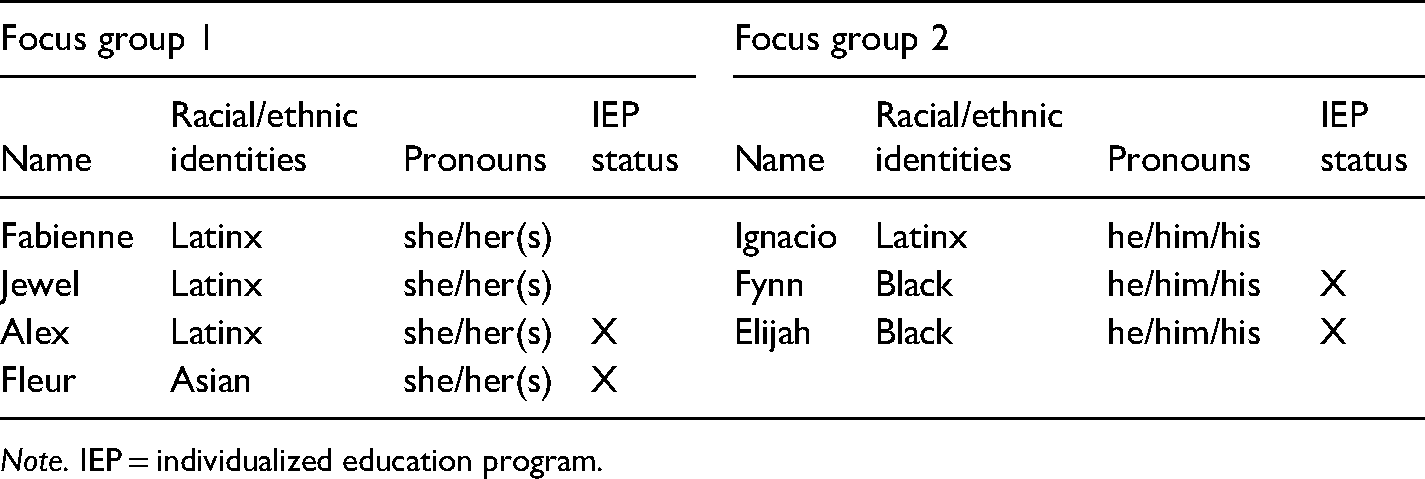
Note. IEP = individualized education program.
Data were collected and preliminarily analyzed in 5-week “microcycles” (Reinking & Bradley, 2007, p. 20), or units. In line with the social design experiment commitments, the researchers’ positionality was continually recognized and interrogated throughout the redesign process. This positionality was built into the fabric of the design itself to center all participants’ voices and perspectives. Karis, Scott, and the special education teacher, Hailey, checked in informally on a day-to-day basis, and Karis and Scott debriefed formally at the end of each microcycle to analyze our positionality and emerging tensions between youth and adults, including monitoring student progress with the guiding pedagogical goals and making necessary changes to determine what was working and what needed to be improved. We also privileged youth voices in the design and redesigning process, collecting survey responses and focal group conversations about the design of the course in the redesigning process.
Data Analysis
Following the procedures detailed by Phillips and Lund's (2019) study, we picked the end-of-class focus group conversations as a point of entry, focusing on questions around what moments were exciting for the class versus what moments were disappointing or deadening. Drawing from recalled moments of passion or disappointment during the focus group conversations (see the appendix for the focus group question protocol), we chose a youth-selected fandom that emerged in both focus group conversations: Grey's Anatomy. Taking up Phillips and Lund's (2019) metaphor of sound, in order to listen to how affective encounters with these texts were sustained or dampened across the course, we systematically surveyed every class reference to this text, rereading fieldnotes and daily analytic memos to “experience and re-experience the flow of those intensities” (p. 1535). We triangulated verbal emphases in audio transcripts, embodied descriptions of embodied reactions in fieldnotes, and moments in Karis's analytic memos regarding her perception of the affective experiences in the classroom as well as perceptions shared from the teaching team debriefs or mention of affective experiences shared by youth. In addition, we integrated Ehret's (2018) literacy-specific concepts of relational transformations, affective tonalities stretching across event times, and desires to produce as we analyzed data. We followed Ehret et al. (2016) in surfacing felt focal moments, defined as moments of observable bodily movements that triangulated with other expressions of affect. We analyzed across focus group conversations (e.g., multiple participants describing similar remembered emotions expressed at similar levels of intensity); fieldnotes that attended to embodied reactions (e.g., descriptions of who laughed after certain comments, noting the gaze of focal students, attending to seated position of students—such as sitting up and looking at classmates during a discussion or slouching down and scrolling through an app); and interpretive memos (e.g., noting that a focal student used the word “love” when describing something, the researcher describing how a moment “felt” and her interpretation of why). We traced these records and interpretations of embodied affective moments back to classroom interactional data to tell the story of the ways that the class as a collective experienced affective resonance being sustained or dampened.
Recognizing that affect is shaped in larger sociopolitical contexts and that dominant dialogues in affect studies have often centered whiteness while erasing the work of women of color feminists (Garcia-Rojas, 2017), we attend to the intersectional embodied identities of participants. We recognized that our historically marginalized participants expressed affect in some ways that “counter dominant structures of emotion [and] systems of power” (p. 254). Thus, we prioritized analysis of places in the data where focal youth had expressed frustration in the focal interviews and searched the data for ways that they had expressed their embodied affective experiences in the acafandom context.
Findings and Discussion
Across focal groups, participants identified Grey's Anatomy as important to the class's shared experience. These next sections detail how affect was sustained and dampened across the class, focusing on the experiences of focal youth. We trace a relational transformation supported by the course design as fans of Grey's Anatomy acted on their collective desire to teach about this show. This desire sustained shared affective resonance around the text, even for some who did not identify as fans. Despite dampening effects—as some youth, primarily White male students, refused to engage as willing newcomers to the show—the class shifted from being starkly divided about the show to developing understandings that many old-timers and newcomers found satisfying.
“Is It Really That Sad?”: Affective Conflicts Between Gray's Anatomy Old-Timers and Newcomers
Divisions about the quality of Grey's Anatomy surfaced at the beginning of the course, as some students (particularly young women of color) felt invested, while others (primarily young men) were dismissive. Recognizing the conflict, the teaching team designed a class contract using the community of practice terminologies “newcomers” and “old-timers” (Lave & Wenger, 1991). Students collaboratively brainstormed expectations in this classroom space for both dedicated fans (“old-timers”) and people with little knowledge of the fandom (“newcomers”). During this activity, one student, Fabienne, offered a goal for the newcomer and old-timer roles: She wanted “everyone to figure out why they love Grey's Anatomy.” This comment points to a desired relational transformation: Many of the old-timers wanted the newcomers to have an open mind when engaging with the show and to grow to love it as fans. The classroom contract reflected this desire, asking newcomers to “be open” and “commit to learning,” and asking old-timers to “explain clearly” and not “discourage others” or “spoil plot points.”
The class struggled to align with the contract and let go of exclusionary practices. For instance, when Karis mentioned that she and Scott were newcomers to the show, Fabienne called, “I’m judging you for the first time,” implying that she lowered her opinion of people who were not already fans of Grey's Anatomy. Additionally, the first activity exploring the Grey's Anatomy fandom surfaced some conflicts between the two groups. For this activity, students were asked to identify on the spectrum of newcomers to old-timers and grouped accordingly. Notably, the old-timer group consisted of only BIPOC women, while the newcomers included all the male students and also White female students. During this first activity, the instructors scrolled through four different memes relating to the show and groups were asked to fill out a chart with the categories “What we notice,” “What questions we have,” and “What to share with other groups.” While reading the memes, it was clear to the class that old-timers and newcomers had different embodied reactions, as old-timers laughed together as they read, while newcomers read in silence. On their charts, one of the newcomer groups noted, “The group experts laugh and understand the memes better than group newbies,” while the old-timers asked, “Are the memes funny to ppl who haven’t watched the show?” These two statements explicitly reflecting on different embodied emotional reactions show students’ growing awareness throughout the activity that there were different affective experiences of the two groups.
At first, old-timers—all BIPOC young women sitting together—expressed incredulity about the newcomers’ lack of knowledge. When newcomers shared questions such as “Who is Grey?” (the protagonist), many old-timers gasped and looked at each other instead of answering, signaling alignment among the group of BIPOC women. On the other hand, the newcomers—who were grouped on the other side of the room—expressed confusion about old-timers’ emotions, writing questions like “Is it really that sad?” Both newcomer groups also explicitly noted the gender of the targeted audience, with questions including “Is the fandom dominantly more women?” and “Is the show targeted more to women?” These questions reflected the gender divisions clearly evident in the room between newcomers and old-timers.
Though we see here BIPOC women fans establishing passionate intensities around the show as normative, we noticed that White and male newcomers’ questions seemed to instead be positioning these young women's reactions as excessive. Such comments point toward the presence of dominant ideologies around racial stereotyping and gender policing in fandom spaces (Busse, 2017; Muhammad & McArthur, 2015; Romano, 2022). Many newcomers were feeling at best confused and at worst skeptical, beginning a trajectory of reproducing sexist and racist ideologies about the old-timers’ intense reactions.
“I Loved It, It was Amazing”: Holding Classroom Space for Affective Experiences and Accumulating Moments of Fan Intensities
Positioning the show this way had the potential to dampen engagement of newcomers who resisted identifying with female-centric fandom spaces. In response, both teachers and old-timers held open space for affective responses across the class. Old-timers, supported by the special education teacher, who was also a fan of the show, shared advice for newcomers to manage their emotional reactions as they were watching the show with statements such as “Plot thickens very quickly,” “Don’t get too attached to characters,” “You feel like a surgeon,” and “Shonda Rhimes kills off characters” (clarifying for newcomers that Shonda Rhimes was the “creator of [the] show”). Hailey also helped to support the old-timers’ arguments by providing more background information about the show, its creator, and its popularity on ABC. When the newcomer group asked if the old-timers actually cried when watching the show, the old-timers gestured affirmatively and shouted in unison, “Yes we do!” Using the pronoun “we” and speaking loudly in unison, this performance of passionate fandom intensity emerged as an example of alignment and affective resonance between the BIPOC women in the class about the show. Again, we saw the emerging dynamic of (White and male) skepticism pitted against an unyielding avowal of passion by young BIPOC women. In response to these divides, Karis commented, “We’ll have to watch an emotional episode,” promising a chance for everyone to experience the emotional nature of the show. The next day the class watched a clip from the show selected by Hailey.
This collective viewing was an important moment for establishing the affective rhythm of the class. Ignacio, a Latinx young man who had previously positioned himself as a newcomer, started the post-viewing discussion by saying, “First of all, I thought the show was good. I loved it, it was amazing, it's actually intriguing.” As he shared his reflection—particularly after he said the last phrase, “actually intriguing,” implying that he did not expect it to be so interesting—a few people in the class whooped, someone shouted, “Wow, good work!,” and Jewel, a Latinx old-timer, looked up from the paper she was writing on with a wide grin. Several of the old-timers, including Fabienne, one of the most vocal fans of the show, looked across the room to connect eyes with each other, and Niesha, a South Asian old-timer, smiled, nodded, and clapped her hands in delight. This began a discussion where old-timers and newcomers alike shared their emotional reactions to the show, commenting on the literary devices that structured their reactions to this text. For instance, in response to one male newcomer musing about whether the show seemed real or not real, Fabienne brought up the term “dramatic”: I feel like everything is made way more dramatic than it is. Which I understand because it's a TV show and they need to make it dramatic, but they also need to make it dramatic enough for you to feel like “damn” like you’re feeling it. When the thing with the family and the daughter, I thought like that, I started tearing up.
Fabienne noted that the effect of the drama was to make the viewer really “feel” what is going on. She acknowledged that though the show may exaggerate at points, the effects were poignant for her: “I started tearing up.” Though she is clearly a passionate old-timer, her response made space for newcomers to think about—and even critique—what decisions were being made by the show's creators and why.
Not only were there moments where newcomers’ passions for the show delighted old-timers, but old-timers’ knowledge of the show was also impressive to newcomers. For instance, during one group share-out, Karis brought in an article commenting on the realism of Grey's Anatomy's portrayal of teaching hospitals. As Jewel shared her knowledge of medical career trajectories from the show with an Asian male newcomer, they shared an affective moment when they realized they both were planning to go to medical school. While talking about becoming a doctor, this newcomer tried to contradict what Jewel was teaching him about the show. She countered by listing each step of the process of becoming a doctor, including answering questions about the required exams. By the end of the exchange, he admitted that he was impressed by how much Jewel knew about medical school from this show. This moment reflected a relational change in the affective tonality between old-timers and newcomers. At first, the newcomers had insinuated that the show was too emotional to be of interest to them and might be geared toward women. However, Jewel impressed this newcomer with the cultural capital she had gained from watching this show. He seemed to recognize something valuable about the show that caused him excitement, creating a unique shared affective tonality between the two of them. Shared positive reactions—such as Ignatio's comment after watching the clip and this youth's reaction to learning about medical school through the show—were important in the slow process of shifting relationships between old-timers and newcomers. This was especially felt in group settings when the class watched more clips from the show together—such as collective gasping at a relationship reveal and communal “aww”ing at a small child. In a different unit when the class returned to the show after studying other fandom texts, Scott announced to the class, “We’re going to get to watch a small clip from our favorite Grey's Anatomy” and multiple youth cheered.
“You Don’t Get It”: Emergence of Tensions Through White Newcomers’ Refusal to Engage
However, there was a portion of the class that was not open to enjoying the text, particularly in relation to their perception of the show as “too emotional” or “not realistic.” Throughout the semester, there was an ongoing debate around whether Grey's Anatomy was a realistic portrayal of hospital life, as Jewel explained in the focus group interview: In that Grey's Anatomy topic, it's like us females saw it differently from the guys. It's like the guys were like, “Oh but that's so dramatic.” Or, “It's too much blood but it looks fake.” And then the females are like, “Oh but you have to understand it from this point of view.” It was just going to go whole debate… It's like, we all went deep into the Grey's Anatomy topic, but our opinions were different and the way we saw it.
Jewel described that this dynamic surfaced across event times over the course of the first unit. For instance, at one point in the class when Fabienne was reflecting on her Grey's Anatomy meme-reading practices, a male newcomer said “Eww,” which she responded to by flipping him off. In the focus group interview, Fabienne clarified that while some of the young men made an effort to understand the affective pull of Grey's Anatomy, some were continually dismissive: I want to say [White male newcomer] was like, “Oh my God, why are you crying?” And like, “Oh, it's not that serious.” And it's like you don’t get it. I tried, when we were watching anime, I tried to keep an open mind. Maybe most people didn’t do that. Most boys didn’t do that with Grey's Anatomy, but I did see [Black male newcomer], he was like, “Oh, okay. I see why you guys like this.” And why we find it addicting.
Though Jewel and Fabienne paint these tensions as arguments between the men and women in the class, both male-identifying and female-identifying students challenged the realism of the show, while the class was often split with White students critiquing the show and students of color defending it. Here is an illustrative example: Though the first youth-led seminar began with shared delight between old-timers at Ignacio's reaction, two White students took a hard position against the show, saying that it was awkward to watch and that the characters spoke in a monotone and seemed unprofessional—a claim that could be seen as racially charged in light of the diverse casting of the show. The old-timers—Jewel, Niesha, Fabienne, Fleur, and Esmaily—stared across the room as these students talked, their expressions blank. At one point, Jewel and Esmaily, both Latinx women, exchanged a sustained look with each other. The back-and-forth escalated as more old-timers and newcomers weighed in, contributing toward an affective wedge between groups.
Considering which dominant narratives dampened affective resonance at the class level, we point out how race factored into White newcomers’ unwillingness to engage. We consider the continued questioning of White newcomers about whether the Grey's Anatomy fans (in our class, primarily Black, Latinx, and Asian women) should feel passionate about the show as policing around what counted as “appropriate” displays of passion. The way that race and fandom intersected—including the dismissiveness of many White youth toward the show—was not explicitly recognized by students. However, we see these moments of blank expressions and sustained glances as fugitive literacy practices (Ohito & The Fugitive Literacies Collective, 2020) as the BIPOC young women refused to engage with White students’ dismissive responses to the show that they loved.
Scott addressed the emerging tensions about realism by shifting the class's focus. Halfway through the tense seminar conversation mentioned before, he stopped the students to reframe their thoughts through disciplinary lenses. Taking up Fabienne's use of the word “dramatic,” he introduced the class to the contrasting word “verisimilitude”: So verisimilitude is the quality of realism. Write that down. The quality of realism, how realistic something is. So some of you were saying like this show has a lot of verisimilitude because they are using sort of like today's big ideas around immigration and relationships and all these things. But others of you said that this show feels unrealistic and that there's a lot of drama that is like over the top. It's overdone. Right?… So this is another conversation you’re having.
This moved the class away from arguments about whose emotional reactions were correct and instead turned the discussion toward how the show is put together, in a way that led to multiple valid affective reactions. In other words, deciding whether a show is realistic or not requires a debate. Noting different readers’ perceptions of the effect of drama and verisimilitude in the show validates all students’ affective intensities.
This tension resurfaced later in the semester when Niesha brought one of her favorite clips from Grey's Anatomy back for another youth-led seminar. Several of the same White newcomers brought up parts of the show that they called cliché, like scenes happening in the rain or the bus blowing up. Scott pushed on some of these comments, bringing race and gender into the analysis. For instance, when one of the students talked about the cliché of a guy going in to save a little girl, Scott clarified, “It's the archetype of the hero [pause] white man, that we’ve seen before, right?,” noting how the race and gender of the characters played into the literary effect. He also held these students accountable to using nuanced disciplinary terminology like “trope” instead of more reductive words like “cliché” that could signal less literary merit.
No old-timers attempted to engage with the newcomers who continually found things to critique about the show. However, when Ignacio spoke up to make an inference, the old-timers responded quickly. As he talked, several of the old-timer young women shook their heads and Jewel raised her hand while he was speaking. As soon as he finished, she said, “I understand that he's never watched the show and he doesn’t really understand. So, like, it makes different things. But, I do want to answer one question…” She then clarified her interpretation of the show based on her background knowledge, with Ignacio shaking his head while she spoke. Scott stepped in to weave together these two responses through literary terminology: Yeah. So, we’re seeing how the inner play of backstory, right, expositional knowledge and diction work, right? When we have both of those together, we have even stronger analysis, right? We needed both of you for that. That was beautiful.
Though it might seem tense that Ignacio was immediately shot down by Jewel saying “he doesn’t really understand,” we see that the fans in the group cannot wait to engage with him. Jewel validated that Ignacio was making an attempt to productively engage with the show, recognizing that he might see “different things” than an old-timer. Scott affirmed this back-and-forth around their different readings, labeling the interpretive dynamic between them as “beautiful.” Indeed, both parties discussed the importance of this kind of interpretive back-and-forth between fans and newcomers in their respective final focus group interviews.
“I Could Kind of Relate”: Ongoing Rhythms and Relational Desirings Between Old-Timers and Engaged Newcomers
The old-timers’ endeavor to welcome the class into their shared emotional experience of the show created an ongoing rhythm between old-timers and newcomers that shaped the affective tonality of the class. These interactions, not always positive but not toxic, developed into a known rhythm that was valued by both old-timers and newcomers and discussed in both focus group conversations with BIPOC youth. In these interviews, youth were asked their opinions on the texts chosen by the class, as one concern about the design of the class had been the feasibility of engaging students in fandom texts chosen by other students. In response to this question, Fabienne shared: I remember when we first started and we watched Grey's Anatomy videos and episodes and memes and stuff. I thought it was very cool because I watched Grey's Anatomy and most of the people in our class was really excited about it. And even those who didn’t watch Grey's Anatomy, they were interested. I just loved the idea of asking, answering their questions and trying not to spoil it. Like I felt like I was trying to put someone on, like an expert or something.
In this response, we see her first describing a shared class perception of the show as exciting or interesting. However, by the end of this statement, she is talking about more than just investment in Grey's Anatomy for its own sake. She described a relational dynamic between those who are excited about the show and those who are just “interested,” with the latter asking questions about the show and those who are excited answering questions in an enticing way (“I felt like I was trying to put someone on”). Her emphasis on not spoiling the show implied that not only did she see her role as helping others to access the show in the moment during class discussion, but that she envisioned future possibilities of them getting invested enough in the show that they would not want to hear spoilers.
Though it may seem like Fabienne was overexaggerating the newcomers’ investment in the show, Grey's Anatomy was also the first fandom text that the second focus group mentioned, even though none of them identified as fans of the show. When Elijah said he found the show interesting because of the “Fandom Kingdom” surrounding Grey's Anatomy, Ignacio elaborated on his impression of what made the experience interesting: Adding onto that, [outside of class] we never talk about the fans, we always talked about the show itself, and the reason why I thought it was the subject or this uh class was very interesting because we dived into the lives that have been affected. For example, I remember reading one piece about a Nicki Minaj fan, she got like destroyed by like the rest of the fans ’cause how she didn’t like the direction that Nicki Minaj was going to ’cause she was actually [a] hardcore fan and we started like, I guess, going to these terms so like you know, newcomers, the old, like you know.
We see that there was something compelling to Ignacio about not just studying fandom content but about studying—and as Fabienne described, experiencing—charged relationship dynamics between fans. Even though he might not have become a fan of Grey's Anatomy, interacting with the fans was interesting. Later in the conversation, in response to a comment about passionate fans lashing out at others, Ignacio explained how much he enjoyed “expressing my ideas,” even if other fans “hate it because they obviously disagree with me.” He described why this conflict felt productive to him: It's not because I disagree. I could disagree, but like, I think it's mainly because I wanted them to question what you’re thinking and like to see it from someone else's perspective and although it may look like I’m a bad guy or whatever, but it's like, if they’re learning things, like, it's okay.
Ignacio described a strong desire to engage with the fans and for the fans to understand his different perspective. Similarly, when asked if the divide around Grey's Anatomy could have been handled better by the teachers at the class level, Jewel said: “It's not necessarily that it's bad. I feel like just people see it differently.” These unfolding relational dynamics point to what Ehret (2018) described as relational transformations—“the transformations of human relationships, their tone, textures, and trajectories,” and “[producing] relational desirings” (p. 571)—that led to affective resonance in their encounters with Grey's Anatomy for these youth, regardless of their positionality in the larger fandom.
In fact, even some youth who staunchly held to not liking the show shifted in how they approached the fandom by the end of the class. Alex, one of the few female Latinx newcomers, explained her perspective: I’m not a fan of Grey's Anatomy. No offense. I mean, I saw people getting really into it, didn’t really understand it. I only saw one episode and after that one episode I said I didn’t like it, so. I guess I see the dedication and the fandom itself. For me, I’m more into cartoonish stuff. Yeah. Disney movies and superhero movies, all that stuff. I’m into that. So I guess I could kind of relate on the feeling of getting really into it.
Though Alex sometimes expressed frustration about watching Grey's Anatomy in class (at one point during a dramatic explosion scene, she said to Karis, “I want to throw my keys at the board”), we see her claiming her positionality in a very respectful way, telling the fans “no offense” and attributing her lack of enthusiasm to her own individual taste instead of the quality of the show. However, we also see her describe a shift in her affective stance toward the fandom. Over the course of the semester, she noted that even though she did not feel the same way as the other fans about the show, she has developed an affective attunement with the dedication of the Grey's Anatomy fans, relating to “the feeling of getting really into it.” This move—drawing an affective connection between herself and the Grey's Anatomy fans based on sharing a similar level of passion, not loving the same text—was tangibly different than the interactions between fans of different fandoms at the beginning, where content was vigorously defended. Even more notably, neither Fabienne nor Jewel responded negatively to this assertion, giving Alex space to have her own opinion.
In Fabienne's final presentation—a critical race analysis of Grey's Anatomy and an accompanying fanfiction—she explicitly addressed the tension between the old-timers and the newcomers while studying Grey's Anatomy by saying: “And some argue that it's too dramatic, but I can argue that it is because they don’t let themselves get attached or feel emotions.” Instead of buying into the division between normal and excessive fan passion, Fabienne suggested that (White and male) newcomers resisting the show may in fact have been excessively distanced from their own emotions. In other words, Fabienne noted that her (White) peers were self-dampening, aligning so much with dominant conceptions of (White) affect that they did not allow themselves to feel the emotions that the show had the potential to evoke. However, the self-dampening of those students did not stop the BIPOC focal students from making space for sustaining affective resonance together around this text.
Discussion
In answer to the research question “How did BIPOC youth cultivate affective resonance (Phillips & Lund, 2019) as they pursued their fandom passions and meaning-making in this acafandom space designed to support such practices, and what barriers interrupted this resonance?,” we saw certain patterns emerging in ways that affect was sustained or dampened through the class's study of the fandom Grey's Anatomy. Collective intensities were sustained by centering texts and discourses that youth knew well and felt passionate about, supporting respectful back-and-forth between fans and potential fans, and even a tacit group consensus not to engage with the self-dampening practices of White students. Barriers included derision and dismissal of certain texts and experiences, especially by White youth, undergirded by problematic dominant narratives about fandom and literary taste.
This brings up some considerations about the agency of BIPOC youth as it relates to the theorization of dampening. In Phillips and Lund's (2019) use of affective resonance, they focus on how adult mentors “[removed] barriers that would halt vibration” (p. 1536). Identified barriers were school structures, such as teachers’ goals for use of student time or institutional expectations around using or being present in certain spaces. It was clear how tangible dampening forces—like security team members attempting to detain students from physically entering the room—could be stopped or removed by adults’ intentional efforts. However, some structural barriers are more difficult to remove, like internalized hierarchies of taste shaped by the intersecting forces of racism and sexism (Crenshaw, 1991). We suggest considering the way that resonance can be sustained despite barriers that might temporarily mute them. Though using a mute might make the resonating strings harder to hear, the strings can still be vibrating—and if we listen closely and critically enough, we will be able to hear them. In our class, though certain barriers were not wholly removed, focal youth engaged in fugitive literacy practices (Ohito & The Fugitive Literacies Collective, 2020) to resist and circumvent barriers relating to whiteness. We also see fugitive literacy practices in how Grey's Anatomy fans refused to engage with the White students critiquing their passions, only engaging or arguing with those in the class who showed a willingness to sustain mutually satisfactory affective rhythms.
Though Phillips and Lund implied that there must be both active sustaining of affective resonance with simultaneous removal of dampening barriers, we cannot say that such barriers mean that BIPOC youth are unable to sustain affective resonance together. In some cases, it might just mean their affective resonance is muted when those barriers are present but then intensify again in moments when barriers are mitigated or lifted. Educators must be listening for muting and intensifying of affective literacy practices and consciously design both for the ways that educational spaces attempt to silence historically marginalized youth literacies (Paris, 2012) as well as the way other youth may perpetuate such silencing ideologies. Further research around ways that educators can recognize racialized and gendered self-dampening practices, intervene, and redesign to “unmute” affective resonance of BIPOC youth in classroom spaces is needed.
The next section will consider the implications for researchers and educators desiring to sustain affective resonances in diverse classrooms.
Conclusions and Implications
Listening carefully to BIPOC youth about what sustains their passionate intensities gives us directions forward toward equity in literacy classrooms and educational structures. Though these methods attend to the minor instead of the major (Ehret, 2018) and are not intended to be generalizable, they center what focal group participants said was consequential for them even after the course finished. Lifting up what emerges as consequential for marginalized communities through learning experiences is an important goal of social design methodologies (Gutiérrez, 2018), which is why we used methods that stemmed from students’ feedback about the course. The description of these felt intensities points toward important relational transformations, including Ignacio's growing engagement with Grey's Anatomy and Alex learning to respect intensities around this show despite disliking it. There were other aspects of the course design, however, that were less transformational. Though many youth engaged across cultural boundaries as they (re)positioned themselves as fans in various communities of practice (Lave & Wenger, 1991), several White youth were unwilling to take on the role of curious newcomer for the Grey's Anatomy fandom so beloved by the young BIPOC women in the class. Future iterations of courses centering diverse youth's fandom interests ought to make space to interrogate affective divisions in the class, particularly those relating to gender and race. Though there has been a historical evasion of race and its contribution to intersectional experiences of fans in the field of fandom studies (De Kosnik & Carrington, 2019), there is growing scholarship examining sociopolitical divisions in affect among diverse fan populations (Hornsby, 2020; Johnson, 2019; Miller, 2020; Thomas, 2019) that could be useful as tools for meta reflection on divisions around taste and engagement in text-centered learning communities.
We also must resist subtractive structures and policies that separate literacy practices seen as more “logical,” like discussion and interpretation, from other affective intensities that make up literacy as “a phenomenon of always moving bodies-materials and the living intensities of meaning-making” (Ehret et al., 2016, p. 372). Indeed, using more holistic conceptions of literacy allows us to see how this design allowed for diverse youth to create affective resonance across newcomer–old-timer positionalities or even across texts and fandoms. This has implications for instruction, such as how Scott pivoted away from class arguments about whose perception of the text was correct toward explorations of how different ways of affective meaning-making could lead to multiple perceptions of literary effect—adding to calls for finding practical ways to move beyond convergent thinking in textual interpretation (Levine et al., 2022).
Confronting Hierarchies Around Affect to Teach More Justly
Bacon et al. (2022) have demonstrated the power of socioculturally investigating affect as a way to work against the social and human consequences of difficult experiences with schooling. Our study brings this work with affect to classrooms, demonstrating how literacy educators can restructure classrooms so that they are not deadening or silencing, but instead building on skills, knowledge, and identities that youth are passionate about. Sustaining the affective resonance of acafandom literacies is one possibility for facilitating such meaningful identity-linked scholarship.
We end by pointing readers back to the moment where Alex explained how she learned to appreciate the passions of her peers even when she did not feel the same way herself. As we learn about texts that others love and the fandom conversations that they care about, their passion often helps us to learn to appreciate the texts they love and overcome socially constructed hierarchies of taste that we had not realized we had internalized. We put this moment in stark contrast with problematic ideologies in the larger society that frame some people's passions as more legitimate than others based on the power of dominant groups to assert this legitimacy, whether that be through alignment with White upper-class male expressions of taste (Cavicchi, 2017) or the policing of some expressions of fandom—particularly female, queer, and nonwhite—as “too obsessive, too fanatic, and too invested” (Busse, 2017, p. 177). We urge and invite all educators and academics to reconsider beliefs that uphold passion for canonical works as more legitimate than passions for more diverse texts—such as the recent backlash on Twitter and in the Wall Street Journal Opinion column to the #DisruptTexts movement (Gurdon, 2020)—or alternatively to only engage fandom literacies as bridges to more canonical works. This kind of instruction has great potential to be “deadening,” especially for historically marginalized students, since the implication that fandom texts and practices are less valuable can keep students from sharing these practices in the classroom at all. Even in this acafandom space that specifically studied and legitimized fandom practices, we struggled with dominant ideologies about the worth of these discourses. Without explicit focus on navigating across cultural borders and transforming discourses—including toxic fandom discourses and culturally destructive academic curricula—we may very well be dampening affective resonances instead of sustaining them. We as educators and English teachers must seriously confront these hierarchies around affect and learn ways to sustain affective resonances of BIPOC youth if we want to teach English in more socially just ways.
Supplemental Material
sj-pdf-1-jlr-10.1177_1086296X221141393 - Supplemental material for Sustaining Textual Passions: Teaching With Texts Youth Love
Supplemental material, sj-pdf-1-jlr-10.1177_1086296X221141393 for Sustaining Textual Passions: Teaching With Texts Youth Love by Karis Jones and Scott Storm in Journal of Literacy Research
Supplemental Material
sj-pdf-2-jlr-10.1177_1086296X221141393 - Supplemental material for Sustaining Textual Passions: Teaching With Texts Youth Love
Supplemental material, sj-pdf-2-jlr-10.1177_1086296X221141393 for Sustaining Textual Passions: Teaching With Texts Youth Love by Karis Jones and Scott Storm in Journal of Literacy Research
Supplemental Material
sj-pdf-3-jlr-10.1177_1086296X221141393 - Supplemental material for Sustaining Textual Passions: Teaching With Texts Youth Love
Supplemental material, sj-pdf-3-jlr-10.1177_1086296X221141393 for Sustaining Textual Passions: Teaching With Texts Youth Love by Karis Jones and Scott Storm in Journal of Literacy Research
Supplemental Material
sj-pdf-4-jlr-10.1177_1086296X221141393 - Supplemental material for Sustaining Textual Passions: Teaching With Texts Youth Love
Supplemental material, sj-pdf-4-jlr-10.1177_1086296X221141393 for Sustaining Textual Passions: Teaching With Texts Youth Love by Karis Jones and Scott Storm in Journal of Literacy Research
Supplemental Material
sj-pdf-5-jlr-10.1177_1086296X221141393 - Supplemental material for Sustaining Textual Passions: Teaching With Texts Youth Love
Supplemental material, sj-pdf-5-jlr-10.1177_1086296X221141393 for Sustaining Textual Passions: Teaching With Texts Youth Love by Karis Jones and Scott Storm in Journal of Literacy Research
Supplemental Material
sj-docx-6-jlr-10.1177_1086296X221141393 - Supplemental material for Sustaining Textual Passions: Teaching With Texts Youth Love
Supplemental material, sj-docx-6-jlr-10.1177_1086296X221141393 for Sustaining Textual Passions: Teaching With Texts Youth Love by Karis Jones and Scott Storm in Journal of Literacy Research
Footnotes
Acknowledgments
The authors would like to acknowledge Dr. Sarah Beck, Dr. Jasmine Ma, Dr. David Kirkland, Dr. Jayne Lammers, and Dr. Nicole Mirra as well as the Interaction, Analysis, & Learning (IAL) Group at the New York University founded by Dr. Jasmine Ma for their support on data analysis and reading preliminary drafts of this work.
Author Note
Karis Jones is now at the School for Graduate Studies at SUNY Empire State College.
Declaration of Conflicting Interests
The author(s) declared no potential conflicts of interest with respect to the research, authorship, and/or publication of this article.
Funding
The author(s) disclosed receipt of the following financial support for the research, authorship, and/or publication of this article: This work was supported by the International Literacy Association (grant number A20-0776-001).

References
Supplementary Material
Please find the following supplemental material available below.
For Open Access articles published under a Creative Commons License, all supplemental material carries the same license as the article it is associated with.
For non-Open Access articles published, all supplemental material carries a non-exclusive license, and permission requests for re-use of supplemental material or any part of supplemental material shall be sent directly to the copyright owner as specified in the copyright notice associated with the article.
