




Abstract
We charted how one educator's use of proleptic language—or language that invoked students’ imagined future identities as if they are fully realized in the present—situated students in communities of academic and professional practice, both within the tangible community of the classroom and within those intangible communities consisting of college students, litigators, music producers, and activists which her students aspired to join. Students demonstrated transformative agency in aligning, resisting, and reinterpreting these proleptic bids, which appeared to create opportunities for students to engage in authentic uses of academic discourse as well as to develop critical rhetorical flexibility—or skill in using all language resources flexibly and critically as a part of participation in an array of social contexts. We suggest that the use of proleptic talk transforms the tenor of academic language instruction by centering students’—rather than teachers’—goals for language learning and by recognizing learners’ past, present, and future selves.
In Ms. Potter's social studies classroom, we observed 14-year-old Leticia (all names are pseudonyms) inhabiting the role of a litigator—a profession identity to which she aspired—to advocate for undocumented youth, or Dreamers.
In particular, we examine one understudied instructional practice notable in Ms. Potter's interaction with Leticia above: her use of what is known as proleptic language (e.g., “well,
We were motivated to focus on this aspect of Ms. Potter's instruction because sociopolitical histories permeate all language, including academic language, taught in classrooms and used beyond them (Janks, 2010). In so doing, we address a gap in the literature: while instructional frameworks advocate for teaching students to question and resist these histories (Alim, 2010; Flores, 2020; Jensen & Thompson, 2020; Uccelli et al., 2020), studies are needed that chart the specific instructional practices used by educators in moment-to-moment interactions with learners—such as proleptic positioning—that make possible this more expansive vision for classroom academic language instruction. In charting these proleptic bids through the lens of positioning theory (Davies & Harré, 1999; Harré & van Langenhove, 1999), we aimed to examine the concrete instructional moves used by Ms. Potter to engage her students simultaneously in language learning and in resisting dominant identity narratives engrained within academic and professional communities that have historically excluded language-minoritized youth, like Leticia, Kareem, and Carlos. In addition, because language learning involves learning to navigate these sociopolitical histories to inform linguistic choices, we also examine whether Ms. Potter's proleptic pedagogy fostered students’ critical rhetorical flexibility, or the skills to consciously, reflectively, and critically select language resources to achieve one's own social and communicative purposes (see Phillips Galloway et al., 2019, 2020; Uccelli et al., 2020). That is, we were interested in detailing not only whether her proleptic instruction supported students to use academic language, but also whether it prepared them to become flexible and critical language users able to participate in an ever-expanding array of inside- and outside-of-school communities, both immediate and aspirational. Here, we make visible this underexamined proleptic pedagogy with the goal of informing the work of educators grappling with how to more equitably teach language in school settings.
Literature Review
In the sections that follow, we discuss key constructs that informed our study, including various conceptions of academic language and its teaching. We also review prior studies that highlight the consequential ways in which academic language-learning opportunities might be shaped by learners’ aspirations to participate in various academic and professional communities and by educators’ proleptic language that serves to position students as full members of these still intangible social groups. Finally, we frame our analysis within the context of positioning theory and prior studies focused on micro-identities.
Conceptualizing Academic Language and Its Instruction
Academic language is historically defined as a set of registers consisting of word-, sentence-, and discourse-level discursive resources that enable precise, logically connected, and reflective communication in texts and certain types of oral argumentation produced by members of academic and professional communities (Nagy & Townsend, 2012; Snow & Uccelli, 2009). As a cultural tool, or what Gee (2015) called a “big D discourse,” academic language is used to achieve social action. For example, academic language, in combination with language resources acquired in other settings, is used for learning in university classes and for positioning oneself as a “knower” in these communities; for negotiating contracts in communities of music producers; and for arguing persuasively for the rights of, for example, Latine peoples in broader political spheres. It also plays a critical role in text comprehension: substantial evidence connects middle graders’ academic language knowledge with reading comprehension and writing outcomes (Heppt & Stanat, 2020; Jones et al., 2019; Phillips Galloway & Uccelli, 2019).
However, not all social action achieved through language is benign, and academic language—like all language—can be used as a resource for marginalization and exclusion. Indeed, despite its utility, the teaching of academic language remains controversial, and some have called for a moratorium on its instruction (Baker-Bell, 2020; Flores & Rosa, 2015). In part, this is because racism, sexism, classism, and linguicism simultaneously constrain teachers’ and learners’ individual and collective agencies, as they make meaning and participate in classroom settings using academic language (Alim, 2010; Jensen & Thompson, 2020; Razfar et al., 2020). Specifically, scholarship makes visible the ways in which some academic language instruction devalues learners’ out-of-school language practices through a misguided focus on “appropriate,” “correct,” or standardized language, often reifying the teaching of idealized, white, mainstream “standardized English” (Baker-Bell, 2020; Flores & Rosa, 2015). This, in turn, can reify linguistic hierarchies by situating academic language as entirely distinct from outside-of-school language, which is a view frequently internalized by students (Corella, 2021; Lewis, 2021; Phillips Galloway et al., 2015). These approaches make synonymous academic language and standardized language and define its learning narrowly as mastery of conventions with little regard for fostering flexible or critical language use.
In contrast, aligned with our definition of critical rhetorical flexibility above, we conceptualize academic language learning as ideally involving both acquiring new language that enables greater participation in the work of academic and professional communities as well as developing greater reflectivity, agency, and criticality around its use. While academic language is often viewed as static (Lewis, 2021), following Heller and Morek (2015), we conceive of academic language as a dynamic resource that can be refashioned by youth to meet their own communicative needs, desires, and social purposes, including participating in communities beyond the classroom. In other words, although academic language teaching often centers educators’ goals or those of schools as institutions, sometimes naturalizing racist and classist ideologies as linguistic ones through assimilationist instruction focused on replacing students’ existing language resources (Alim, 2010; Baker-Bell, 2020), we explore here whether it can also be a tool for problematizing and resisting inequality when students are supported to enact emerging identities of their own choosing, for example, as activists and litigators.
Links Between Academic Language Learning and Proleptic Positioning
Language learning is the result of participation in communities, both tangible and imagined (Kanno & Norton, 2003; Wenger, 1998). Participation in imagined communities is both an individual and a social process, which allows us to structure current ways of being and using language around imagined future identities (see Nasir & Cooks, 2009; Polman & Miller, 2010). This act of prolepsis, of using one's past history to create an imagined future identity, appears to shape current goals, practices, and engagement in academic language learning. In one example, Polman and Miller (2010) followed the trajectories of identification of African American youth in an outside-of-school program, Youthscience. The Youthscience students drew upon both professional and academic language, as well as language developed via past experiences in their communities, to design science learning experiences that resonated with groups of people ranging from young children to seniors, from wealthy donors to working-class youth. This work shaped current goals and actions, as participants envisaged and prepared for futures as scientists, medical professionals, and engineers. And, while this may involve assimilation into these imagined communities, learners may also be invested in academic language learning in order to change these communities of practice from the inside out and to resist dominant identity narratives that have historically excluded language-minoritized youth (Janks, 2010; Moje, 2007; Pacheco, 2012).
Studies of multilingual youth also reveal how proleptic engagement in imagined communities serves to structure language learning as a process of becoming, of shifting and growing into new identities (Glick & Walqui, 2020; Gutiérrez et al., 2019). For example, Kanno's (2003b) case study centers on Rui, a Japanese youth who spent the majority of his life in English-speaking countries. Although he was culturally similar to his peers in Canada, Rui's membership in an imagined Japan led him to continue refining his Japanese. While academic language is not another language per se, we can imagine that similar processes of identity formation are at work.
Teachers’ proleptic language: Bridging students to imagined communities’ language practices
Teachers likely play a significant role in students’ proleptic imagining. In fact, the extant literature increasingly calls for teachers to imagine more expansive futures for minoritized youth as a part of addressing deficit narratives (Hoffman-Kipp et al., 2003; Lewis et al., 2020). As scholars who focus on developing teachers’ proleptic pedagogies demonstrate, teachers who speak to learners, especially those from historically minoritized groups, as if they are already members of a cultural community, such as that represented by the community of scientists or writers that have historically made unwelcome particular groups, speak to their conceptions of students as potential future members (Crafter & de Abreu, 2010; Glick & Walqui, 2020; Gutiérrez, 2018; Gutiérrez et al., 2019; Hoffman-Kipp et al., 2003). They create a gateway to that imagined society—a gateway that students may exercise agency to enter or not. As one example, Enyedy et al. (2008) examined how a high school math educator through the revoicing of students’ contributions positioned students as co-contributors and mathematicians although students were still developing academic English (also see Pinnow & Chval, 2015).
Here, we argue that in the teaching of academic language, skilled educators draw not just from students’ pasts and on their own visions for students’ futures, but also from their knowledge of the imagined potential futures that students have fashioned for themselves, in order to build learners’ present identities as agentive users of language (Gutiérrez, 2018). Student-centered proleptic pedagogies are not without precedent, of course. Vetter (2010) illustrated how an English teacher was able to leverage high schoolers’ aspirational identities as writers to engage previously reluctant learners in mastering new language. Similarly, in the context of second-language learning, research has demonstrated that invoking students’ ideal linguistic future selves provides learners with a meaningful potential direction for their language learning (Dörnyei, 2005).
Educators must be concerned, however, with leveraging students’ acts of imagination in ways that are expansive. In his work on prolepsis, Cole (1996) detailed the ways in which perceptions of a student's cultural past, and its continuity into the future, create the conditions for our present treatment of learners. When assuming cultural continuity, prolepsis can be used to reinforce hegemonic ways of thinking, languaging, and engaging in the classroom (Vossoughi & Gutiérrez, 2016; Yoon, 2008). Martin-Beltrán's (2010) study shows how among fifth-grade dual immersion learners, perceptions of proficiency held by classmates and the teacher sometimes positioned some learners still mastering English as unskilled language users, limiting opportunities to learn. One mechanism for subverting this hegemonic version of proleptic teaching may be to foster students’ critical rhetorical flexibility, thus supporting students’ flexible and critical use of varied linguistic and cultural resources, including and perhaps especially those which students bring from outside of school.
At the center of this instruction is a focus on fostering students’ agency; as Canagarajah (1999) argued, English and home languages (and, presumably, English used across communities) can exist in mutually productive harmony, as individuals are capable of possessing agency to engage with multiple linguistic resources in ways that reflect critical stances. However, research documents the unequal access provided in schools to experiences that develop youths’ agency as language users (Glick & Walqui, 2020; Lewis et al., 2020). For example, Kanno (2003a) detailed the process by which underserved students in Japan are socialized into imagined communities that emphasize monolingual ways of engaging, while more economically privileged students are granted access to imagined communities rich in linguistic fluidity. Indeed, creating classroom spaces that foster critical rhetorical flexibility—as a form of linguistic agency—is an essential element of equitable academic language teaching. Yet, to date, too few studies focus on how teachers engage in this work in classroom settings.
Identifying Moments of Proleptic Positioning: Micro-Identities, Positioning Theory, and Storylines
To identify moments of proleptic positioning to situate students as skilled language users within aspirational communities, we focus on the construct of identity. In this study, we conceptualize identities enacted in classrooms as dynamic and fluid, as well as mediated by both a learner's own and an educator's perceptions (Holland & Leander, 2004). Drawing on positioning theory, we are particularly interested in how learners engaged one educator's proleptic “storylines,” or acts of social positioning in which students were cast as social activists, litigators, or teachers, among other roles (Davies & Harré, 1999; Harré & van Langenhove, 1999). Storylines are, in essence, familiar socially constructed narratives embedded in broader ideologies that aid participants in explaining their own and others’ identities and ways of acting (Anderson, 2009; Leander, 2004). We examine students’ responses to this proleptic positioning, or performed storylines (Davies & Harré, 1999), noting how youth adopted, resisted, or reinterpreted these identity positions by electing to take up or resist the ways of using language and of being associated with these identities.
While some studies focus on macro-identities and seek to identify how identities are recurrently imposed or instantiated across moments, eventually sedimenting into a “type of student,” this study focuses on micro-identities (Kayi-Aydar & Miller, 2018). Following Wood (2013), Anderson (2009), and Davies and Hunt (1994), we examine how students flexibly and dynamically vary the micro-identities they take up—or narrate the self differently—in episodes of classroom interaction involving an educator's proleptic bids. Wood (2013) argued that like macro-identities, micro-identities are constructed in the moment and in interaction with others, and so a focus on single episodes is warranted. For example, within a single moment, a student may take up a teacher's proleptic bid to adopt the identity of a political activist, potentially demonstrating critical rhetorical flexibility by moving between the academic language used for making arguments in this community as well as the outside-of-the-classroom language used for making personal appeals. In turn, this student is engaging with the storyline that all students are authentic participants in the work of political action in the present. This storyline may be shared by other students, or they may perform different ones, such as rejecting the teacher's proleptic bids and expressing disinterest in political action as part of a storyline that views teens as having little say in the body politic. That is, learners may enact multiple micro-identities: in another moment, that same student may align with a proleptic bid to adopt the identity of a college student, signaling alignment with a storyline that they have developed the requisite knowledge and skills to attend university. In the analysis below, we track these micro-identities.
Method
This analysis drew on a subset of data collected during the latter part of the school year in Ms. Potter's social studies classroom. Drawing on a range of data sources, we asked the following:
Study Design
We make use of a case study approach (Dyson & Genishi, 2007) with the classroom as the unit of analysis, which afforded deeper examination of how three learners and their teacher engaged micro-identities in the classroom. Following in an interpretive tradition (Erickson, 2002), we examine a range of social practices used by students to respond to micro-identity positions and associated storylines, attempting to make visible the meaning that Carlos, Leticia, and Kareem generated from these experiences in Ms. Potter's classroom.
Context
Ms. Potter's middle-grade classroom was situated within a middle school serving students in Grades 5 through 8 in a large metro located in the southeastern United States. During our data collection, students engaged with a 10-week teacher-designed unit that linked state-mandated study of the U.S. Civil War (1865–1865) and the Reconstruction period (1865–1877) to current events via the use of multimodal texts produced in the past and present. The unit had been designed by Ms. Potter with the goal of positioning her majority Latine students as world-builders of the New Latine South, and made use of language and literacy practices in the classroom as part of forging connections between their contemporary lived realities within the sociohistorical context of the southern United States.
Ms. Potter had connected with Author 1 (Emily) in a professional development session in the district. Ms. Potter invited Emily into her classroom with the purpose of exploring their shared interest in how to position youth as agentive learners of language in school settings. The research questions explored here emerged from this broader inquiry and through collaborative discussion with Ms. Potter and Emily, who forged a close professional relationship.
All parents and guardians were notified in writing that a researcher would be observing teaching in the classroom and were asked to return a permission form if they did not want their student to be observed. No forms were returned. As a condition of internal review board approval, students’ likenesses could not be captured through video, and pseudonyms were used to obscure students’ identities in all handwritten field notes. In order to interview students, we obtained active consent. Parents or guardians and student participants were asked to sign and return additional permission forms.
Of the 22 students in the class, nine returned permission forms required for interviewing, and three (Leticia, Kareem, and Carlos) who were frequently grouped together by Ms. Potter were selected as focal students. Given our interest in learner agency and its relation to language learning, Leticia, Kareem, and Carlos were ideal focal participants because they brought a diversity of positionalities and linguistic experiences potentially impactful to how they positioned the self and others during moments of prolepsis. Students provided all sociodemographic and personal information to Emily, and information about academic performance was provided by the classroom teacher.
Focal Participants
Leticia was a 14-year-old who identified as a Latine female. She spoke Spanish and English fluidly at home and in the classroom. She was the child of parents who had immigrated from Mexico to the United States, settling in the southern United States to secure work opportunities. Her mother and father were employed as custodial staff, and her uncle who lived with the family was seeking employment. Leticia was the oldest of three children and cared frequently for her younger sisters, who attended a local elementary school. The entire family attended English classes together each week at a local church-run program. It was through contact with this organization that Leticia first encountered community members involved in advocating for the rights of Latine peoples. Early in the school year, she voiced her interest in becoming an advocate herself, and in an interview with Emily commented: “I’d like to, maybe, work as like a community organizer or advocate, like, you know, making sure people get their rights.” Popular among her peers, Leticia was known for offering sage advice and was frequently sought out by other girls in the classroom as a confidant. Leticia consistently completed assignments in Ms. Potter's class but did not consistently complete assignments in other classes. During the study year, Leticia entered the classroom reading at about a middle-of-seventh-grade level, according to the results of a standardized measure.
Kareem was a 15-year-old African American who identified as male and who spoke English at home. He lived with his father and older brother (high school age) in an apartment complex within walking distance of the school. Kareem described himself as a “southerner” and believed his family to have lived in the southern United States for multiple generations, tracing his roots to enslaved peoples. His father worked for the Department of Public Works and participated in the growing gig economy as an Uber driver. Kareem spent a significant portion of his outside-of-school time at a local teen space located within a public library. In the teen space, he composed music using the freely available recording equipment provided for youth. It was in this context that he first met musical artists and producers who volunteered to mentor youth interested in pursuing careers in music. Through these interactions, Kareem became an advocate for intellectual property rights of musical artists and developed an interest in pursuing a career as a music producer. In an interview with Emily, when asked what he hoped to do in the future, Kareem stated, “Make music! That's what I do.” Kareem was a skilled debater and a vocal participant in classroom activities in all of his classes. He struggled, however, with homework completion. Kareem was reading at a beginning-of-fourth-grade level at the start of the school year, according to standardized measures.
Carlos was a 14-year-old who identified as a Latine male. He spoke Spanish at home, but primarily used English in the classroom. Carlos lived with his mother, father, grandmother, and older sister. His mother and father had immigrated from Mexico before Carlos's birth. The family had settled in the New Latine South region because they had a large extended family that had already found employment in the area. Carlos was a self-professed “book guy” and was frequently observed reading books shared with him by his previous year's ELA teacher. He had read the entire Harry Potter series. Carlos was relatively quiet in the classroom, only sharing when called on by Ms. Potter. However, he was respected by peers, as made visible through the careful attention they paid when he did speak. Carlos was viewed at home and in the Pentecostal church where his family worshipped as a future college graduate, as evidenced by his matching through the church with a local college student as a mentor. In an interview with Emily, Carlos voiced his hopes: “I’d like to go to the college, like R. from my church. I think I can do it too, like him.” Carlos would be the first in his family to attend college and he was invested in the idea, often asking Emily during her research visits particular questions about the university culture (e.g., What were classes like? What happened if you couldn’t pay for it? Were there any Mexicans there?). Carlos was reading at a sixth-grade level at the start of the school year, according to standardized measures.
All students in the classroom were classified as having reduced access to material resources (free and reduced-price meal eligible), and of the 22 in the classroom, 16 identified as Latine, four as Black/African American, and two as white. Eleven students were identified as English learners.
Ms. Potter, the teacher, was a white woman with 11 years of teaching experience. She was in the process of completing her master's degree online and hoped to pursue national board certification. Ms. Potter had grown up in the southeastern United States and identified as a speaker of Southern American English; she also noted that she has acquired “some” Spanish-language knowledge during her years in the classroom. Ms. Potter had attended an undergraduate institution in the Midwest, which she explained had led to her temporary abandonment of Southern American English because of classmates’ gentle teasing (“for a bit, I never said ‘y’all,’ but it's back, full force.”). When asked how she developed her understandings about what language to highlight in instruction, she cited participation in a training provided by the National Writing Project as well as professional learning focused on the WIDA assessment. In an interview, Ms. Potter expressed her interest in supporting her students to achieve their own professional and personal goals: “I want them to do, like, whatever it is they want in the future, be a mechanic, advocate, college kid, or all these things at once. I feel like I’m helping them get there.”
Data Collection
Two types of data were collected across a 10-week instructional unit in Ms. Potter's social studies classroom.
Field notes
Emily served as a participant-observer in Ms. Potter's classroom on 21 occasions, with each session spanning about 45 min. When not engaged with students, Emily took field notes focused on Ms. Potter's instructional activities. Audio recordings of 18 segments of class sessions that featured episodes of prolepsis were transcribed to build out the thick description in the field notes. In addition, Emily added to field notes in the form of post-observation memos.
Interviews
Three semi-structured reflective interviews with Ms. Potter (at the start, in the middle, and at the end of the unit) conducted by Emily provided additional information about her instructional aims and her experiences in teaching the unit. In addition, on five occasions, Emily met with Ms. Potter to debrief moments from particular lessons. Emily also conducted three informal semi-structured interviews with each of the focal students (see the interview protocols in Appendix A). Interview 1 focused on gathering information about participants’ ways of using language in inside- and outside-of-school contexts as well as general biographical information. In two subsequent interviews midway through and at the end of the unit, we asked youth to reflect on their perspectives on the unit, including their understanding of how the language they were learning at school was related (or not) to the futures they imagined for themselves. When possible, we grounded these questions in moments from field notes in which focal students had assumed a particular micro-identity.
Data Analysis
To inform this analysis, we made use of positioning theory (described above) to conceptualize how micro-identities are instantiated from moment to moment through enacted storylines among participants (Davies & Harré, 1999; Harré & van Langenhove, 1999; Wood, 2013). This perspective helps to acknowledge how within short episodes or across episodes, identities are taken up, cast aside, or further developed as students are positioned and as they position themselves through actions within a social space (Holland & Leander, 2004).
To address Research Question 1, Emily and a research assistant listened to or read all data sources three times and followed a process of progressively focusing (Glaser, 2001; Saldaña, 2015) to identify moments in which Ms. Potter and her students engaged imagined communities and selves. Initially, 18 instances of proleptic practice were identified in the data by reviewing field notes and listening to about 16 h of recordings (Saldaña, 2015). To identify these instances, Emily and a research assistant sought examples of participant language that invoked a community or identity outside of the classroom (e.g., Ms. Potter: “You’re a teacher, how can you help M. say that?”; Ms. Potter: “So, that's like something you need to write a contract—sentence structures that help convey complex relationships—like, it's called legalese. Imagine you’re a lawyer”; Kareem: “So I’m the lawyer writing a contract…”). In contrast to studies that infer identities, we sought moments of explicit naming of micro-identities. Boundaries between instances were determined based on the topic and participant shifts noted in the field notes. Each proleptic instance was fully transcribed.
Focal students were participants in 11 of the 18 instances. For each moment, Emily and a research assistant initially coded transcripts by answering the questions: what micro-identities and associated storylines are instantiated through Ms. Potter's proleptic bids? Are these micro-identities and associated storylines connected with students’ own goals for language learning? Through this analysis, we identified eight micro-identities: litigator/lawyer, civil rights activist, music producer, college student, community activist, lawmaker/government official, community organizer, and high school teacher. These micro-identities were often explicitly articulated by Ms. Potter (“You’re a litigator…”), but at times were implied (“You’re writing an essay for a college professor…”). Following positioning theory, we view these micro-identities as part of an emerging storyline used by Ms. Potter and her students to position themselves and others. Next, we constructed what we call “storyline statements,” or brief, interpretive summaries of the positions assumed by Ms. Potter and her students in order to understand the social significance of these micro-identities (for examples, see Table 1). Data from interviews with students and teachers served to inform our interpretations of whether the storylines introduced by Ms. Potter were connected with students’ own goals for language learning. For example, it was through our interviews that we gained insight into students’ own imagined future identities, which, in turn, informed our understandings of students’ responses to the positions and micro-identities offered through proleptic bids.
Micro-Identities (Underlined) Introduced by Ms. Potter in her Proleptic Bids and Examples of Social Practices Used by Students to Align with, Resist, and Reinterpret These Storylines and Associated Micro-Identities.
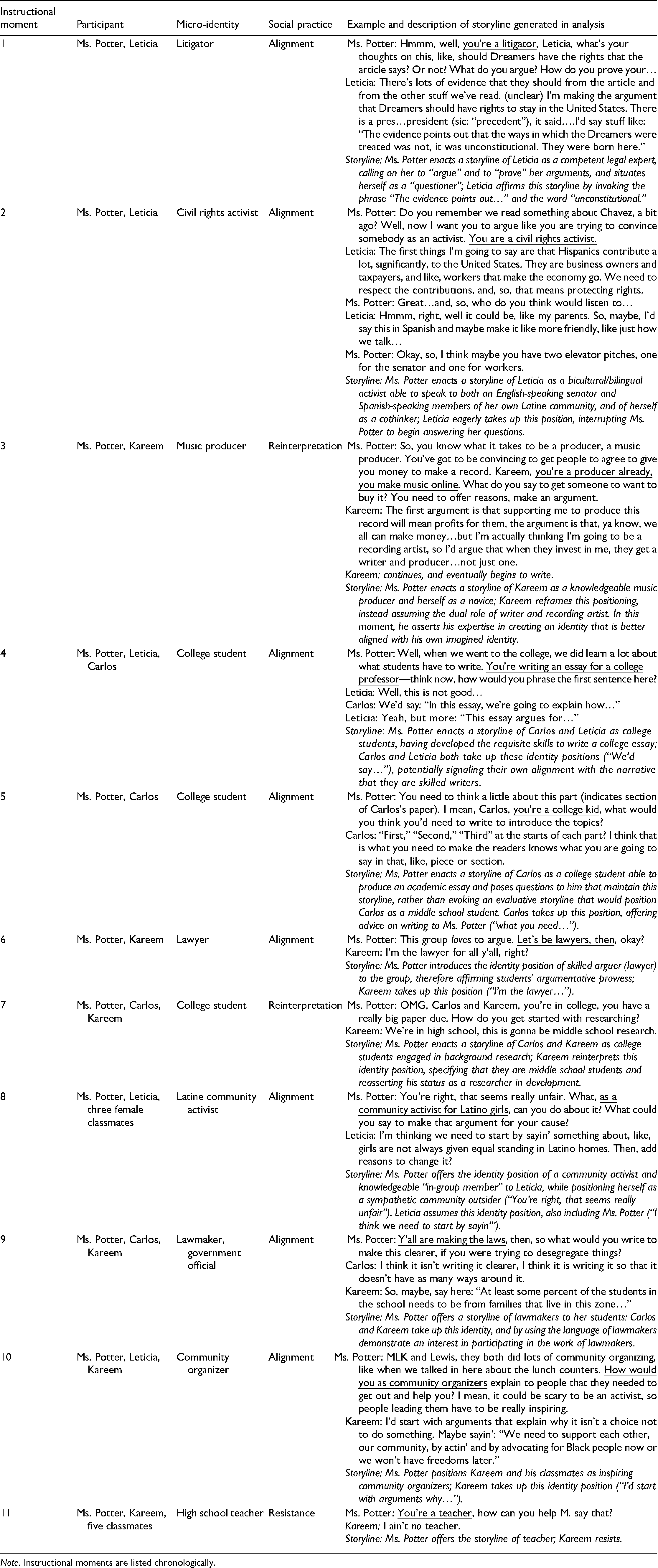
Note. Instructional moments are listed chronologically.
To address Research Question 2, these 11 instances of proleptic practice were submitted to a second round of open coding to identify social practices used by students in response to Ms. Potter's proleptic bids and associated storylines. We developed case-based propositions and then moved to more general propositions across cases (Dyson & Genishi, 2007). This led us to identify three social practices used by students to signal alignment: (a) “responding in role” by adopting language associated with the ascribed identity or context; (b) engaging in ways of reasoning, problem-solving, or refutation associated with these identities; and (c) making a bid to engage classmates in identity enactment. We also coded for two social practices that signaled resistance to ascribed identities: (d) not adopting the language or reasoning practices associated with an ascribed identity and (e) offering an alternative identity. From this coding, one theme came to focus on focal participants’ alignment with storylines expressed in Ms. Potter's proleptic bids, defined as entering into and taking up the imagined future selves offered by Ms. Potter's storyline. The second focused on students’ resistance to and reinterpretation of these identity narratives.
Across both themes we explored the opportunities for academic language use and learning afforded or foreclosed. We operationalized opportunities for academic language learning and use as instances in which, through implicature, certain academic language forms were called for. For example, with the proleptic bid, “You’re a teacher, how can you help M. say that?” Ms. Potter was calling on Kareem to produce academic language, and potentially to toggle between language more familiar to his classmate. Throughout, we paid particular attention to how aspects of academic registers—disciplinary and precise words, phrases used to connect ideas, and more intricate sentence structures—were used to complete particular activities, like explaining, communicating related concepts, and making arguments supported by evidence. We considered what the presence of these features indicated about the storylines and positions offered by Ms. Potter, and connected these to particular micro-identities. We also examined how these moments afforded students opportunities to develop critical rhetorical flexibility, signaled by movement between language use in nonschool settings and academic registers.
Frequent conversations between Emily and the research assistant offered opportunities to raise questions about the initial coding and to revisit the storylines as well as revise the coding subcategories. Once the coding table was finalized (Appendix B), Emily, working with a research assistant, recoded all 18 instances and calculated inter-coder consistency across codes (97% consistency in application of codes for “micro-identities”; 88% in codes related to social practices of alignment, resistance, or reframing; 90% for codes related to academic language use; and 73% overlap in identification of opportunities for critical rhetorical flexibility). In instances where coding differed, we discussed these differences and resolved all disagreements.
Debriefing between Emily and Author 2 (Heather), served as a form of peer debriefing and as a way to establish the credibility of the findings. Ms. Potter was asked to review the final manuscript as a form of member checking. Focal students were asked to review field notes and storylines recorded in these field notes in the final interview, but they could not be located to review the final manuscript.
Our Positionalities and Reflexivities
We acknowledge that we come to this work not only as former middle-grade educators bringing a long history of participation in classroom spaces, but also as white women. These factors shaped our analysis both in what we attended to and what we did not. In particular, our own academic histories of pursuing academic language learning as a component of realizing our own (once imagined, now realized) identities positions us to be drawn to this phenomenon. For each of us, academic language has operated as a tool for self-expression and, in our professional lives, as a medium for making visible what we view as inequitably distributed opportunities to learn the language used for participation in academic communities of practice. Both authors believe in the usefulness of teaching academic language. Yet, we are aware of the tensions that arise in the teaching of school discourses that are frequently used for normative functions. With this in mind, we sought in this analysis to also seek instances in which academic language was used for normative functions and to highlight this in our analysis. We believe this even-handed depiction of academic language is essential to addressing unproductive dichotomies that are discordant with the lived realities of educators, who are faced with teaching academic language and hope to do so in ways that are equitable and oriented toward social justice, and of students, who bring to the classroom hopes for participation in broader academic and professional communities. We triangulated data across multiple sources by comparing events recorded in field notes over time and through follow-up conversations with participants to confirm that our interpretations of events were accurate.
Limitations
A central limitation relates to Emily being the researcher who collected the data as well as taking a primary role in its analysis. Despite efforts to document and legitimize lived experiences of participants, Emily's worldview is unavoidably present in the findings. We also focus on a single educator and her students in this analysis. We acknowledge that this may limit our understanding of how proleptic language figured in our focal students’ overall education or in other classroom settings.
Findings
Two primary findings emerged from this study that address our research questions. The first is that students’ goals for language learning associated with their own aspirational imagined future identities can be centered in instruction through an educator's proleptic language. The second is that these micro-identity positions, which students aligned with, resisted, or reinterpreted, appeared to create a meaningful context for students to engage in academic language learning, which we define as developing both the skills to use academic discourses and the critical rhetorical flexibility to select among all language resources to achieve communicative objectives. Below, we illustrate each finding with examples from classroom interactions.
Finding 1: Micro-Identities and Storylines
Our first research question explored whether students’ own goals for language learning were centered through Ms. Potter's invocation of micro-identities and associated storylines. Across the 11 instructional moments, Ms. Potter introduced nine distinct micro-identities and storylines (see Table 1) rooted in students’ own goals for academic language learning. This diverse range of micro-identities included litigator, activist, music producer, college student, government official, community organizer, and educator. Below, we discuss two, demonstrating how Ms. Potter leveraged these micro-identities and associated storylines to cast her students as skilled language users.
Music producer
In a class session in which students were tasked with writing reasoned arguments on a topic of their choosing, Kareem—an aspiring music producer—seemed to be struggling with the task. He sat staring at his paper and laying his head on the desk or balancing on the back legs of his chair. To support and engage Kareem, Ms. Potter made a proleptic bid (Table 1, Instructional Moment 3) in which she cast him in his imagined future identity of music producer. In this instance, Ms. Potter's storyline framed Kareem as having already attained the status of a music producer.
Kareem responded by laying out his argument orally. Halfway through his explanation, Ms. Potter stopped Kareem and said, “These are great arguments, let's get these written down!” Aligning with this micro-identity, Kareem invested in the language and practices of this imagined community—of producing arguments, framed in the professional language of the music production community, backed up by reasons and evidence. Ms. Potter's proleptic bid and the associated storyline it introduced served as a bridge between the work of her classroom and an identity in which Kareem was already invested. By valuing Kareem's chosen identity, Ms. Potter's storyline positioned him as an agent with unique resources to contribute both to the imagined world of music producers and the more immediate and tangible world of her classroom.
College student
In other instances (Table 1, Instructional Moments 4, 5, and 7), Ms. Potter cast students as college ready, which was a common goal for language learning expressed by all three focal students in our interviews. The storyline of her students as college students that Ms. Potter invoked was often linked to particular academic writing practices. For example, in Instructional Moment 4, Ms. Potter invites Leticia and Carlos into this storyline by posing a question:
Finding 2: Aligning, Reinterpreting, and Resisting Micro-Identity Positions and Storylines as Acts of Language Learning
Our second research question explored how students engaged Ms. Potter's offered micro-identity positions as part of language learning. In our coding, we identified three social practices commonly used by students to respond to Ms. Potter's proleptic bids: aligning, reinterpreting, and resisting her storylines and associated micro-identity positions (Table 1). Below we discuss each social practice in detail, making visible the ways in which each allowed for engagement with academic discourse practices as well as for the development of critical rhetorical flexibility.
Aligning
In the majority of instances (i.e., in eight of the 11 coded instructional moments; Table 1), students engaged by aligning with the associated storyline and micro-identity by, for example, participating in the role and adopting the language generally associated with that micro-identity. In one instance, in a discussion of rights afforded to Latine immigrants, Ms. Potter called on Leticia to argue from the perspective of a civil rights activist, which was an aspirational identity for Leticia: “Do you remember we read something about Chavez, a bit ago? Well, now I want you to argue like you are trying to convince somebody as an activist.
In assuming this identity position, she adopted markers of academic discourse, and thus assumed the discourse patterns of the imagined community of litigators. This included using precise and explicit vocabulary, such as the terms “contribute” and the nominalized form of this word, “contributions.” Also salient was Leticia's movement to morphologically more complex language (revising “a lot” to “significantly”). Furthermore, alignment with this micro-identity led Leticia to adopt a common structure used for logic argument in academic discourse communities: “we need to respect the contributions, and, so, that means protecting rights.” In this moment, Leticia used academic language and discourse practices as a resource for resisting the unequal treatment of Latine people in the U.S. economy, which was an issue that impacted her own community.
Ms. Potter also urged Leticia to reflect on linguistic choices as part of fostering Leticia's critical and reflective use of language, or critical rhetorical flexibility:
In this interaction, Ms. Potter was focused not only on engaging Leticia in using academic language, but also in using her outside-of-school language resources to increase her rhetoric's impact on listeners. This move to engage Leticia in the very activities associated with critical rhetorical flexibility signaled Ms. Potter's goal of supporting her students to develop linguistic flexibility, rather than encouraging prescriptive adherence to using academic language in the classroom. Later, when interviewed, Leticia reflected on this moment and acknowledged the value of her growing linguistic repertoire and skill to critically and flexibly use language: “The thing is, like, I want to be able to talk to the most people I can, so like, yeah, having lots of language is better, I think.”
Like Leticia, Carlos also articulated an imagined future identity in our interviews: that of college student. This was a micro-identity frequently invoked by Ms. Potter in her interactions with students. In one interaction, Carlos aligned with this micro-identity and with Ms. Potter's storyline that he had developed the requisite skills to produce an essay by noting a series of academic language features that he might use in his writing:
Carlos, when inhabiting the college student identity position, identified a series of academic discourse markers—“First,” “Second,” “Third”—commonly used to mark reasons or arguments in academic texts. Furthermore, he made the link between the use of these discourse markers and their function: “I think that is what you need to make the readers knows what you are going to say in that, like, piece or section.”
Both these students, in aligning with Ms. Potter's proleptic bids, indicated a willingness to enter the imagined communities her storyline evoked, taking on the identities and associated discourse patterns of those worlds. Each used academic language as a marker of their alignment with these imagined identities, indicating investment in using and developing these language practices. Of importance, though, was that neither student imagined assimilating to these communities, and, instead, hoped to change them from within. Leticia noted in an interview with Emily that not many advocates for Latine people were actually members of her community, with the majority being monolingual and affiliated with local faith-based nonprofits. She hoped to change this as well as create space in this advocacy work for incorporating both Spanish and English languages and registers. Aligned with her vision for a new type of fully multilingual community activist, Leticia, when interviewed, voiced her interest in learning academic language in Spanish as well to afford her entry to law school in Latin America. For Carlos, he envisioned being a fully bilingual college student, although the college students he had previously met through a local university tutoring program were solely monolingual English speakers. He noted when interviewed that he hoped to take Spanish and English in college, becoming able to write for an academic readership in both languages. Far from imagining assimilating to a monolingual identity in the university setting, Carlos envisioned an identity in this imagined community that would speak back to and resist monolingual and monocultural norms. For this reason, we interpret both Leticia's and Carlos's claiming of these identities to be a form of resistance to dominant identity narratives and storylines that excluded them from these imagined academic and professional communities (Pacheco, 2012). In aligning with students’ own ambitions for academic language learning, Ms. Potter made these moments possible.
Reinterpretation
In other instances, Ms. Potter's bid was subject to reinterpretation (i.e., in two of the 11 instructional moments; Table 1). This was evident in one interaction with Kareem in which he reframed Ms. Potter's offered micro-identity of record producer to also include that of writer:
In expanding the identities made available to include writer, Kareem forged a set of identities that held meaning for him within Ms. Potter's storyline of Kareem as a skilled producer of music. Kareem's reframing of Ms. Potter's proleptic bid expanded the range of imagined communities to which he had access, affording new opportunities for academic language use. Notably, he produced a written letter—what he termed a “proposal to investors.” In his proposal, he wrote, “Among the many reasons that investing in me as a writer/producer is valuable to you is that I am able to write and set to music experiences that I think young people will like, which will result in profits for you.” In this example, we see how for Kareem academic language use was tied to argumentation. In particular, Kareem adopted a common academic formula, “Among the many reasons…,” which served the rhetorical function of hedging or qualifying. This was one of the phrases taught by Ms. Potter to the class for inclusion in their argumentative essays. Like Leticia, Kareem also adopted morphologically complex language (e.g., “investing,” “valuable,” “experiences”). The multiclause structure of his argument is also common in academic discourse.
In subsequent interactions, Ms. Potter encouraged Kareem's revision of this letter for the purposes of a pitch competition for an audience of local DJs. In doing so, she supported his development of critical rhetorical flexibility—or the conscious and reflective selection of language to use in order to best achieve his own social purpose. In contrast to a formal letter to investors, she urged Kareem to make it “convincing” to others who were well versed in hip-hop language by using his language resources honed through participation in this outside-of-school community. When interviewed, Kareem commented, “I’m getting pretty good at the talking to different people thing ‘cause we do it lots in here [Ms. Potter's classroom].’” We interpret Ms. Potter's invitation to Kareem to use language not traditionally sanctioned in school spaces, and Kareem's subsequent acceptance of this invitation, to be an act of resistance to hegemonic norms that serve to exclude students’ broader language resources in school spaces. In addition, we view this movement between registers to open space for students to develop the skills to critically and reflectively use language to achieve their own social purposes.
Resisting
Across the coded instances, students rarely resisted the storylines and associated micro-identities offered by Ms. Potter (Table 1). However, in one instance involving our focal students, this did occur:
In this moment, Kareem exercised agency in determining which storylines were incorporated into his set of identities and which were excluded. Though Kareem was willing to inhabit the roles of music producer and writer, adopting the academic language of each identity, he agentically defined the boundaries of his identity as exclusive of the role of teacher. Ms. Potter accepted Kareem's resistance of the identity of teacher, opening the door for him to offer a new storyline and associated micro-identity: coach. He commented, “I can coach you, though, M.” He then proceeded to demonstrate his critical rhetorical flexibility as a language user and awareness of how to support M.'s comprehension by moving between the language used to discuss voting rights in the text and the language that he and M. used routinely for discussing their shared interest in music production. An alternative interpretation of Kareem's response is that he perceived the dictate to assume the role of teacher to be normative and calling for assimilationist uses of the academic register. Indeed, in our interview with him, he wondered aloud why a male Black teacher in a neighboring classroom who also lived in Kareem's neighborhood only spoke “like a teacher,” never using in the classroom the Black language common in their shared community. For Kareem, given his experiences with the only male teacher of color in the middle school, this micro-identity may have seemed to limit the possibilities for fluid use of his language resources. By allowing students to enact identities that differed from those established in her own storylines, Ms. Potter created the opportunity for Kareem to demonstrate his critical rhetorical flexibility in ways that pushed back against normative uses of language in school settings.
Discussion and Implications
Our analysis was guided by two research questions: what micro-identities and associated storylines connected with students’ own goals for language learning are instantiated through Ms. Potter's proleptic bids? Does students’ alignment with, resistance to, or reinterpretation of the micro-identity positions and associated storylines invoked by Ms. Potter's proleptic bids create a meaningful context for students to engage in acts of academic language learning? In examining student and teacher interactions, our findings reveal the potential of proleptic bids that center youths’ aspirational identities for creating both authentic contexts for academic language use and for fostering youth's critical rhetorical flexibility. In the sections that follow, we reflect on the implications of these findings for practitioners and researchers.
Implications for Instruction
Three main implications relevant to pre- and in-service educators emerged from this analysis that inform the design of academic language instruction that has the potential to transform, rather than reify, language hierarchies in classrooms.
1. Under certain conditions, proleptic positioning centers youths’ imagined future selves as well as current and historical identities to create a meaningful context for academic language learning. A central learning from this study that can inform the design of instruction is that academic language instruction need not focus on manufacturing the selves we, as educators, imagine for learners. Classroom educators typically establish the linguistic boundaries of the classroom by offering circumscribed identity positions to students (Glick & Walqui, 2020; Yoon, 2008). In contrast, in Ms. Potter's classroom, the identities invoked through her proleptic bids were overwhelmingly those to which her students themselves aspired. Ms. Potter, in joint activity with her students, invoked students’ imagined future identities to imbue classroom-based academic language learning with purpose. Drawing on Hoffman-Kipp et al. (2003), proleptic praxis is also rooted in educators’ knowledge of students’ collective and individual pasts. For example, in interactions with Leticia, Ms. Potter drew on her deep knowledge of Leticia's own past experience as a child of Central American immigrants and her interest in serving as a community activist as well as their shared knowledge of the sociopolitical context of the Latine southern United States. When making a proleptic bid that ascribed the micro-identity of activist to Leticia, Ms. Potter not only centered Leticia's vision for who she might become, but also acknowledged the value of her prior lived experiences.
2. In some classrooms, academic language instruction privileges students’ own goals for language learning, rather than educators’ or schools’. Drawing on students’ resources, experiences, and hopes as the grounds for and the goal of academic language learning emerged in this study as a powerful component of academic language teaching. Ms. Potter placed students’ purposes, rather than her own or the curriculum's, at the center of learning and interaction in her classroom. Echoing Vossoughi et al. (2021), this centering of student goals moved the learning occurring beyond typical learner- or teacher-centered models to one of partnership, or joint language-learning activity. Indeed, while studies document the worrisome ways in which academic language instruction may devalue the language—and identities—that students bring to the classroom, we use this analysis to problematize the assumption that academic language instruction can only serve normative functions (Baker-Bell, 2020; Corella, 2021; Flores & Rosa, 2015).
Academic language instruction can be used to reinscribe raciolinguistic ideologies that serve to position speakers of minoritized languages or language varieties as outsiders to the academic community (Alim, 2010). In contrast, in centering youths’ imagined future selves, Ms. Potter enabled students to use academic language as well as additional language resources to engage in day-to-day resistance of dominant identity narratives that often excluded them from the intellectual work of the classroom and discounted their eventual participation in broader academic communities (Pacheco, 2012). Indeed, Leticia and Carlos, both language-minoritized students, made use of academic language in tandem with their other language resources to adopt identities associated with the communities of academics and advocates that they aspired to join—communities in the United States that have tended to exclude speakers of languages other than English. Notably, neither student envisioned assimilating to the monolingual identities common in these communities, and, instead, imagined forging a new type of multilingual and multicultural college student or advocate as they changed these communities from within. Perhaps foundational to this instruction is a view of academic language as a dynamic tool and youth as capable builders in whose hands this linguistic tool kit can be transformed.
3. Academic language learning is cast not as an end goal, but as a component of developing youths’ critical rhetorical flexibility in some classrooms. Finally, of note for literacy educators was Ms. Potter's use of proleptic bids to move beyond teaching of language forms to also foster students’ critical rhetorical flexibility (Phillips Galloway et al., 2020; Uccelli et al., 2020). Key to creating instruction that avoids a narrow focus on simply teaching academic language forms is fostering opportunities for youth to reflectively and flexibly choose among all of their available language resources as a component of asserting their legitimate membership in imagined communities. This creates opportunities for students to use and develop academic language—and to hone their critical rhetorical flexibility—in ways meaningful to their identities as members of both the tangible communities of the classroom and imagined communities. This study underscores what the field has long known: educators play a pivotal role in mediating the development of students’ agentic identities within the classroom, crafting the conditions by which students’ cultural, linguistic, knowledge, and experiential resources are valued or marginalized (Razfar & Rumenapp, 2013). Educators, like Ms. Potter, who facilitate learners’ meaningful use of their full repertoire of resources create space for students to foster inside-of-school and school-centric identities that are harmonious.
For educators, both preservice and in-service, instruction that uses proleptic positioning to create opportunities for language learning begins with the humanizing work of coming to know students’ hopes and aspirations. Indeed, Ms. Potter's knowledge of her students was foundational to her success in using proleptic positioning. This may suggest the need for the design of opportunities for educators to gain these insights and that foster in these educators the counterculture orientation to partner with young people in accomplishing the language-learning goals that learners have for themselves.
Implications for Future Research
Though we observed that Ms. Potter's proleptic work shaped meaningful opportunities for learners to engage in the discourse practices of academic and professional communities, this research is limited in scope. Larger-scale endeavors might explore how this proleptic pedagogy takes differing shapes in various contexts—for example, how might invoking micro-identities and imagined communities look different in an elementary setting than a secondary one or in a science versus a social studies classroom? Furthermore, these endeavors might more explicitly investigate the role of this pedagogical practice in supporting learners’ development of academic language and critical rhetorical flexibility, drawing on quantitative or mixed methodologies to measure student investment and learning. In other words, do students in classrooms where storylines of linguistic competence and associated micro-identities are frequently invoked in support of language learning exhibit more significant investment in and learning of academic discourse practices and critical rhetorical flexibility?
There may also be value in examining the role of professional learning in supporting educators’ use of proleptic positioning. Indeed, we can imagine that proleptic language of this sort, explicitly tied to academic discourse practices and critical rhetorical flexibility, represents a high-level form of classroom interaction that may not come naturally to many educators. Therefore, further research is needed to delineate approaches to support educators’ pedagogical knowledge of this practice in ways that translate to meaningful pedagogical action.
Conclusion
In conclusion, we argue that there is much to be learned from examining how one educator's use of proleptic talk seemed to transform the tenor of academic language instruction in her classroom by centering students’—rather than her own—goals for language learning and by recognizing learners’ past, present, and future selves.
Supplemental Material
sj-docx-1-jlr-10.1177_1086296X221140863 - Supplemental material for Pedagogy of Possibility: Proleptic Teaching and Language Learning
Supplemental material, sj-docx-1-jlr-10.1177_1086296X221140863 for Pedagogy of Possibility: Proleptic Teaching and Language Learning by Emily Phillips Galloway and Heather M. Meston in Journal of Literacy Research
Footnotes
Acknowledgments
The research reported here was supported by a small grant made to Emily Phillips Galloway by Vanderbilt University's Peabody College. The opinions expressed are those of the authors and do not represent the views of the University. We express our gratitude to the students and teacher who shared their valuable time and insights with us and to our numerous colleagues and the reviewers of this article for their helpful comments as we conducted this work. We also thank Chloe Madigan for her support in data gathering and analysis.
Declaration of Conflicting Interests
The author(s) declared no potential conflicts of interest with respect to the research, authorship, and/or publication of this article.
Funding
The author(s) disclosed receipt of the following financial support for the research, authorship, and/or publication of this article: This work was supported by the Peabody College (internal grant to Emily Phillips Galloway).

Supplemental Material
The abstracts in languages other than English are available at http://journals.sagepub.com/doi/suppl/10.1177/1086296X221140863
Appendix A
Let's start by just talking about you. What are some things I should know about you?
What do you like to do?
What makes you unique?
Tell me about the schools you’ve attended.
What are you hoping students will learn in this unit in terms of content? Language?
What about academic language? What elements of academic language do you intend to teach to support students as readers and writers?
What are some ways that you support students to develop agency as language users? What should I anticipate in terms of instructional approaches used in this unit to support language development?
Do you have any concerns about teaching this unit? Do you have any hopes?
I recognize that your students will participate in state testing and the WIDA. Does that shape what you teach?
What's surprised you so far about the unit?
What has gone well from your perspective? What's been challenging for you as an instructor?
How do you assess whether students are learning content and language?
How do you tap into students’ own hopes and dreams for themselves? How do you know what students hope to become in the future? Does that shape how you teach?
I want to take you back to a moment in the transcripts (share selected moment, allowing time to read). Can you tell me what your instructional objective was?
If relevant: I see that you invoked an identity of (lawyer, teacher, litigator, etc.). What was your purpose?
Can you tell me about all the languages that you know?
Additional prompts: Do you use the same language/speak the same way with friends? Family? Grandparents? Do you ever have to change your language to help others understand your meaning? What about at school: When you write, do you use different language?
Tell me a little about what you hope to do in the future (or: What do you want to become?)
Do you think what you are learning at school will help you?
If relevant: Can you give an example of what you learning now that you might use in this role?
What sorts of things did you learn that you think you might use in the future?
Did you learn any language that seemed useful?
Tell me a little about what you hope to do in the future (or: What do you want to become?)
Do you think what you are learning at school will help you?
If relevant: Can you give an example of what you learning now that you might use in this role?
I want to remind you of a time when (read from transcript). Can you tell me what you were thinking then?
Appendix B
References
Supplementary Material
Please find the following supplemental material available below.
For Open Access articles published under a Creative Commons License, all supplemental material carries the same license as the article it is associated with.
For non-Open Access articles published, all supplemental material carries a non-exclusive license, and permission requests for re-use of supplemental material or any part of supplemental material shall be sent directly to the copyright owner as specified in the copyright notice associated with the article.
