




Abstract
There is growing interest in foregrounding bodies in literacy research and pedagogy. Drawing across multiple conceptualizations of bodies as tools, mediums, and social texts, this qualitative case study examines the multifaceted nature of embodiment in two adolescent girls’ school writing. Situated in a research-practice partnership that included researchers, the teacher, adolescent youth, and their parents, this analysis explores the ways writing acted with/on bodies throughout a poetry-writing unit in an urban middle school English language arts classroom. Data collected over 11 weeks included student and teacher interviews, observations and field notes, and artifacts. Through inductive coding processes, coupled with member-check interviews with participants and their parents, four themes were identified: (a) embodied knowing as inspiration for writing, (b) bodies as a mode of multimodal representation, (c) writing as a way to counternarrate against/with other bodies, and (d) bodies responding to writing.
There’s this . . . [idea in English class] of “[staying] in the four corners of the book,” it’s like what you write, you just write that. There’s not much focus on the writers themselves because I guess [English teachers] don’t see that as their job. They’re just here to grade us on what we write and . . . [if we get] it correct.
Introduction
The focus in the Common Core State Standards on “close reading” emphasizes attending to “what lies within the four corners of the text” (Coleman & Pimentel, 2012, p. 4). Brooklyn, one of the focal middle school students in this examination of a poetry unit in an urban middle school classroom, aptly applies this idea to school writing, too, where pedagogies tend to separate texts from bodies and the “contextual doing/being/feeling” (Zapata et al., 2018, p. 478) of writing. This text orientation results in a primary focus on surface aspects of writing and “getting it correct,” rather than on the personal development of “writers themselves” or cultivating understandings of how writing acts with/on people (e.g., VanDerHeide, 2018). As a result, for most youth, meaningful engagements with writing happen “outside of, and often in opposition to, school” (Prior, 2017, p. 216).
Richer theorizations of writing that extend beyond a primary text orientation are a necessary corrective to this limited pedagogical stance. Drawing from theories of embodiment, this analysis is interested in making visible the ways school writing is “produced in bodies and by bodies to try and elucidate what people do with bodies” (Thiel, 2016, p. 91). Although a growing body of contemporary literacy research explores embodiment and bodies (e.g., Enriquez et al., 2016; Leander & Boldt, 2013), with some centered on adolescents’ experiences in school (e.g., Lewis & Dockter Tierney, 2013) or writing outside of school (e.g., Hughes, 2016; Woodcock, 2010), few examine the multifaceted nature of embodiment in adolescents’ school writing—the focus of this analysis. This work articulates some of the ways bodies are always already involved in writing, which has the potential to expand valued writing practices in schools beyond typical text orientations.
We explore the experiences of two adolescent girls in an urban middle school English language arts (ELA) classroom as they wrote beyond the four corners of their texts during a poetry unit, asking two questions:
How are the focal students’ writing practices produced by and from their bodies?
How do the focal students’ writing practices inform what they and others do with bodies?
First, we locate this work in theories of embodiment and writing, linking key analytic concepts, including multimodality, emotion, embodied knowing, and counternarration. Then, we describe the poetry unit and analyze the nature of embodiment in the focal students’ writing. We conclude with implications for addressing the body in writing pedagogy and research, as well as for engaging in humanizing methods when engaging in research that foregrounds youths’ bodies.
Theoretical Framework: Embodiment and Writing
The body is involved in all aspects of writing. For example, when an adolescent writes a piece of fan fiction, the writer uses their body as a tool to compose, experiencing physical and emotional sensations (e.g., fatigue, a surge of energy, anxiety). This young author also draws from their embodied knowing, or ways of knowing formed by experiencing the world in a particular body (Woodcock, 2010), perhaps by reflecting on their own experiences of marginalization in school to write a scene involving a negative interaction between the main character and a teacher. When they post the writing online, identities and relationships are formed, and social constructs like race and gender are (re)produced through a performativity of words and actions (Butler, 2016). Ultimately, the writer may come to see themselves or the world in new ways. Clearly, writing is not just about idea-making and idea-sharing; it is also about identity- and world-making, and involves the body in many ways.
Enriquez et al. (2016) describe the resonance of different theorizations of embodiment in literacy studies: for example, social semiotic perspectives that explore meaning-making through multiple sign systems like talk, gesture, and movement (see Prior, 2017); arts- and performance-based pedagogies utilizing social constructivist theories to explore how development occurs in interaction (e.g., Perry & Medina, 2011); and new materialism, phenomenological, and posthuman theories that extend beyond a discursive focus to consider material, affective, and sensory experiences (e.g., Leander & Ehret, 2019; Zapata et al., 2018).
Furthermore, examinations of embodied literacies demonstrate different conceptual interests, focusing alternatively on (a) the ways literacies discipline the body, (b) the body as a medium through which we experience literacies, (c) the body as a social text that is read and (re)presented, and (d) the body and literacies as indeterminate and mobile (Johnson & Kontovourki, 2016, p. 5). Other research also focuses on (e) the body as a tool, or a mode for creating literacies (Perry & Medina, 2011). Drawing in particular from theories of social semiotics and social constructivism, and positionings of the body as a tool, medium, and social text, we find utility in “layering . . . different theorizations of embodiment” (Enriquez et al., 2016, p. x) to make visible a breadth of ways that adolescents’ school writing are embodied.
Conceptual Framing and Literature Review
This review of adolescent writing research links across key concepts that inform the analysis, including multimodality, emotion, embodied knowing, and counternarration. We describe how writing is multimodally produced by the body (positioning bodies as tools); how writing happens in the body, involving emotions and affect; how writing draws from the body and embodied knowing (positioning bodies as mediums); and how writing can be used for a variety of reasons to act with/on other bodies, including counternarration (positioning bodies—and writing—as social texts).
Writing Is Produced By, In, and From Bodies
Bodies as tools that produce writing
Research drawing from both social semiotic and social constructivist perspectives showcases how writing is produced by bodies, which act as tools to manipulate texts, discuss ideas with others, and structure environments. Adolescents compose across modes in profoundly social and collaborative ways (Smith, 2017), and the extension of composing processes beyond print modalities in schools—to include sound, images, video, and more—supports adolescents’ participation, engagement, and identity work (Vasudevan et al., 2010).
Bodies as mediums that experience writing
Writing is also experienced and felt in bodies, meaning it is “saturated with affect and emotion” (Leander & Boldt, 2013, p. 22). Affect theorists tend to consider the “energy of contact as things come together . . . raw flows of undifferentiated energies or intensities” (Leander & Ehret, 2019, p. 5), whereas researchers interested in emotion tend to focus on “action that involves social actors and mediating signs or tools such as language, texts, bodies (gestures), objects, and space” (Lewis & Crampton, 2016, p. 105). Like Lewis and Crampton (2016), we employ the term emotion rather than affect to primarily “emphasize action rather than bodily sensation” (p. 106).
Some research examines emotions in adolescents’ composing processes and in their experiences reading and responding to writing. For example, in a cross-case analysis of three adolescent girls, Woodcock (2010) attended to participants’ journal writing, noting that all three journaled to safely explore the complex emotions of adolescence. In an analysis of discussion in a high school English/history classroom, Lewis and Dockter Tierney (2013) examined youths’ responses to writing (and each other) to suggest that learning was limited in an English classroom when emotions were regulated.
Bodies as inspiration for writing
Writing is produced from the body, too, because our embodied knowing inspires writing foci and informs authorial perspectives. In their sensory ethnography study of Indigenous adolescents’ filmmaking about the effect of a cyclone on Western Australia, Mills et al. (2013) found that youths’ embodied experiences of place helped them to make their films and more deeply understand the places they were representing (p. 23). In Muhammad’s (2015) 4-week summer literacy collaborative with eight African American adolescent girls, in 37 of 48 pieces of writing, the girls wrote about or against power “related to issues they found important in their lives and the lives of other groups with which they identified (e.g., African Americans, women)” (p. 235). Hamzeh’s (2011) collaborative study with four adolescent Muslim girls documented participants using writing to question and challenge the multiple ways their parents enforced veiling in their lives—of their “dress, mobility in public places, and physical behavior around boys” (p. 481). These studies demonstrate multiple ways that adolescents’ embodied knowing informs their writing: inspiring topics for writing, helping them to understand their topics more deeply, and giving them credibility and authority to speak out.
Writing Is For Bodies
Writing is/as social action
Researchers interested in how writing does personal and political work in the world—working with and for bodies—sometimes focus on the ways literacies (and literacy pedagogy) are involved in controlling and regulating youths’ bodies. For example, Lewis and Dockter Tierney (2013) examined how students’ emotional reactions to texts were sometimes controlled and monitored by teachers and peers who viewed emotionally laden responses to writing as off-task.
Other research interested in how literacies act in the world positions bodies as texts that are read. In performative pedagogies, the body is a tangible, physical “representation of self (a ‘text’)” (Perry & Medina, 2011, p. 63). Authors’ bodies (e.g., their race, gender, dress) extend or complicate the meanings of their written texts. For example, in Scarbrough and Allen’s (2015) case study of a spoken word poetry unit in a high school classroom, they describe how a Black student and Black teaching artist responded to one White American male student’s poem critiquing misogynistic violence within Islam and Saudi Arabian society by suggesting that he may have “overstepped his perspectival bounds” (p. 496). The poet’s embodied, racialized identities impacted the way his work was taken up by his poetic community.
Writing can counternarrate
One particular form of social action through writing that is relevant to this case is counternarration, or the telling of stories against what has come to be expected (Carney, 2004). For example, Vasudevan (2006) examined how one African American adolescent boy counterstoried the ways his life was often represented by others by self-authoring his multiple identities through the production of visual texts. In a summer literacy program with 12 Black Muslim girls, McArthur and Muhammad (2017) documented how half of these adolescents wrote letters that pushed back against stereotypes or encouraged other Black Muslims to “speak up and fight for our rights” (p. 69). Similarly, Winn (2019) found that through writing and performance of spoken word poetry, adolescents involved in poetry communities across a multisited ethnography were able to name and “speak back to systems of inequality” (p. 117), such as the school-to-prison pipeline. In other examinations of adolescents’ spoken word poetry writing in school, researchers have documented how youth compose “to make sense of their lives” (Jocson, 2006, p. 700) and to “break silence and amplify their voices while examining and challenging their worlds” (Flores, 2018, p. 2).
Summary
We bring together various stances on embodiment and literacy (e.g., bodies as tools, mediums, and social texts) to make visible a breadth of ways that adolescents’ school writing involves bodies. Although literature on multimodal composing, emotion, embodied knowing, and writing as social action/counternarration all emphasize the body in some way, bringing them together supports a richer theorization of how school writing is produced from and by bodies, is experienced in bodies, and does work with and for bodies.
Method
This analysis is drawn from a larger project: A 3-year research-practice partnership (RPP) focused on cultivating culturally sustaining writing instruction to perpetuate “linguistic, literate, and cultural pluralism” (Paris, 2012, p. 93). RPPs are long-term, mutualistic collaborations that bring together relevant stakeholders to produce and use research evidence in ways that promote systemic change; they are intentionally organized in ways that attend to the values of stakeholders, power, and the history of local settings (Coburn & Penuel, 2016). This study reflects an RPP, in that an alliance of committed individuals including researchers, teachers, students, and their parents came together over the course of multiple years to address a problem of practice: cultivating school-based spaces where students could safely explore a fuller breadth and depth of their lived experiences through writing.
Evolution of the RPP
In spring 2016, Rebecca and Andrea (Authors 1 and 2), along with another graduate student, interviewed nine teachers—including Mr. C/Rick (Author 3)—about their experiences implementing culturally sustaining writing pedagogies (see Woodard et al., 2017). Simultaneously, Rick invited them into his seventh-grade classroom to observe his enactment of a poetry unit. The following spring, all three of us participated in a collaborative inquiry with five other educator-scholars to design culturally sustaining instructional units, which involved biweekly meetings. Rick requested that Rebecca and Andrea continue observing but enlisted them as thought partners in the second iteration of the poetry unit, which he had revised based on feedback from his previous students and inquiry group members, and his own evolving understandings.
This examination focuses on this 11-week qualitative case study of the unit in 2017. From spring 2018 through spring 2019, we also engaged in multiple rounds of member checking with the focal students and their parents to embrace our ethical responsibility as educational researchers working with youth as “worthy witnesses” (Paris & Winn, 2014, p. xiv). This process was particularly important given this study’s analytic attention to embodiment and our focus on youths’ bodies, which arose during data collection.
Qualitative Case Study
Although situated in this long-term partnership, qualitative case study methods were utilized because they allowed us to bound our focus, examine understudied phenomena, and engage in theory-building (Dyson & Genishi, 2005). Although both writing pedagogy and research tend to assume rather than address bodies (see Wager & Perry, 2016, p. 256), this analysis focuses explicitly on the varied roles of bodies in two adolescents’ classroom writing.
Context
The context for this study was an urban elementary school in a gentrifying neighborhood of a large Midwestern city in the United States. The school’s population was considered atypically diverse for the district, with 41% Black, 29% White, 10% Latino, 15% Asian Pacific Islander, and 5% identifying as multiracial. The participants of this study were students in Mr. C’s “gifted” class, with students being offered a seat in the school’s program as the result of standardized test scores taken prior to their kindergarten year. Of the total students (n = 28), 25% (n = 7) had transferred during the current school year. These seats became available as former sixth-grade students gained entry into academic centers, or pipelines to the city’s coveted selective-enrollment high schools. Although Mr. C taught the same content to all students, whether they were in the gifted or general education sections, he did adjust the level of scaffolding. Recognizing that student mobility might affect the development of a nurturing classroom community, which he felt was requisite for his goal to shift instruction toward a transformative activist stance that pivots from student participation to contribution (Stetsenko, 2017), Rick enlisted Rebecca and Andrea to observe and support the unit. This was consistent with the long-term collaborative nature and focus on problems of practice in RPPs.
The unit
The poetry unit centered the documentary Louder Than a Bomb (LTAB; Siskel & Jacobs, 2011), which tells the story of four Chicagoland high schoolers competing in a youth poetry festival. Initially, students engaged in reading and analyzing poems they selected from the LTAB curriculum (adapted from Coval, n.d.), which were coupled with canonical poems that fit the theme of a given module (e.g., “A Place Called Home,” “Language as Portrait,” “Ego Trippin’”). Students also composed and performed original poetry organized around these themes. Later, students examined poetic forms reflecting their cultures (e.g., ghazal, tanka, contrapuntal) and performed an original spoken word piece exploring aspects of their culture or identity, which included a multimodal component to support multiple forms of meaning-making. Mr. C intentionally chose spoken word poetry as the culminating task for the way it foregrounds identities and advocacy. Its explicit demand for writers to use their bodies to share makes it important context for the analysis.
Mr. C generated a list of aspects of culture and identity with his students that could inform topic selection (e.g., race, age, languages spoken, sexual orientation), but he did not specify what they should write about nor require that they disclose personal information. A former student from the previous year’s implementation, Alex, accepted Mr. C’s invitation to model her spoken word performance and facilitate a question-and-answer session. Making herself available through email and social media, Alex became a mentor to Mr. C’s students, supporting them in generating and refining their ideas during two separate writing workshops and also attending a 2-hr session of student performances.
Although some students selected very personal or controversial topics, others did not (e.g., describing their hobbies). On their own, multiple students chose to write about their bodies in direct or indirect ways. After students performed their spoken word poems, all audience members (including students, the teacher, and the researchers) wrote feedback on a private blog. Students could record their poems or present privately if they felt uncomfortable.
Participants
During initial analysis, we noted that eight students wrote about their bodies, with several describing how their bodies had been marked as disabled (e.g., with labels of autism, attention deficit hyperactivity disorder [ADHD], or mild cerebral palsy; see Coppola et al., 2019); one referencing racialized experiences with violence; one writing about embodied experiences playing hockey; and two focused on their experiences as adolescent girls. From these cases, we selected Aminah and Brooklyn as the focal cases for several reasons. First, each of their multimodal components stood out because of the ways their bodies were centrally featured and added depth to their compositions. Second, they both leveraged writing to counternarrate against dominant stories about women, which felt particularly timely and relevant.
Focal students
Aminah self-identifies as Asian and Indian, and her Muslim faith was central to her identity, despite the fact that her father identifies as Christian. In fact, she indicated that she had been learning Arabic and Urdu “in order to read my religious text.” Outside of school, she danced competitively 5 days a week. Her mom works as an aesthetic nurse/practice manager and holds a master’s in health administration; her father, a former banker, manages a range of entrepreneurial investments.
Brooklyn identifies as a Christian and White female, although her experience has been shaped by growing up with an adopted sister who is Black. Like Aminah, Brooklyn competitively danced. She initially expressed reservations about revealing aspects of her culture and identity to her peers. Her mom works as a consultant; her dad owns and operates a technology installation business.
For their spoken word pieces, both Aminah and Brooklyn composed poems as responses to incidents that occurred with peers in school. Aminah’s poem, titled “The Face Beneath,” details her experience as a young Muslim woman to directly address the racist comment of a peer, while Brooklyn’s poem, called “Beauty Is Pain,” interrogates messages she had received from her peers about her body. Aminah’s and Brooklyn’s writing felt especially timely in spring 2017— a few months after Donald Trump shared numerous anti-Muslim tweets, and right before the #MeToo movement went viral.
Positionality of the researchers
All three authors identify as White, native English speakers, cisgender, and able-bodied, and share commitments to transformative, humanizing writing pedagogies and research. As such, we make persistent and ongoing efforts to be aware of our power, and the ways our positions as researchers can reify (or interrupt) the White gaze.
Rebecca is a former elementary and middle school teacher and current university researcher and teacher whose family is bicultural. During data collection and analysis, she found herself reflecting on her own bodily experiences as an adolescent girl (e.g., experiencing significant weight loss as an adolescent). Andrea is a former out-of-school educator at a writing and tutoring nonprofit. Her work with students who enjoyed writing but were not necessarily successful in school prompted her to think expansively about what writing could be, especially for students who are marginalized in traditional school contexts. Rick is a 14-year veteran of the classroom. His previous work with African American students, current work with diverse populations, and identity as a father of two Mexican American children have sensitized him to issues related to race, language, identity, and power and the need to legitimize classroom space for students to explore, celebrate, and grapple with who they are and who they wish to become.
In the classroom, the researchers interacted with the teacher and the students, contributing to class discussions; talking informally with them before, during, and after class; and posting appreciative feedback to the student poets on the class blog.
Data Collection
Consistent with qualitative case study methodology, we drew on a variety of tools, methods, and representations to illuminate the complexities of the classroom (Dyson & Genishi, 2005). Data collection included observational field notes; audio recording sand photos of lessons; interest inventories, reflective surveys, and interviews with students; and the collection of various artifacts, including student writing. Rebecca and Andrea conducted thirteen 1- to 2-hr observations over the course of 11 weeks. Field notes were drafted during the observations and revised immediately after each observation by listening to the audio tape, refining notes taken during observations, and seeking clarification with Rick when questions emerged.
All students (n = 28) completed a preunit, online interest inventory created by Rick in consultation with Rebecca (asking, for example, “What aspects of your identity and culture are important to you?” and “What are your hobbies/interests outside of school?”), and Rick had follow-up conversations with the class to engage students in contributing to the unit design. In addition, all students completed reflective surveys designed by all three authors about their experiences in the unit, with questions about their learning; experience writing, giving and receiving feedback, and performing; and suggestions for improving the unit.
All 28 students were asked by Mr. C if they were interested in participating in postunit interviews. Fourteen expressed interest (seven boys, seven girls), and time permitted us to talk with all of them. These interviews provided insight into the student authors’ composing processes (e.g., “Can you describe your writing process?” “How did you decide on your multimodal component?”), topic choice (e.g., “Why did you choose to focus on this aspect of your culture and/or identity?”), and shifts in their identities as writers (e.g., “How has your relationship with writing changed over the unit?”). Interviews were semi-structured; we clarified questions, asking probes and follow-ups that differed depending on students’ answers.
Finally, we collected numerous artifacts, including photographs of the classroom and instruction (n = 72); blog posts of students’ final spoken word poems and tanka poems (n = 59); comment threads for each poem posted to the blog (n = 59); worksheets to support students’ development of their poems (two per student); and rubrics related to the spoken word poem (two per student—one filled out by the student, and one by Rick).
Data Analysis
We began by analyzing and inductively coding writing produced by all students in the unit. With interests in exploring what, why, and how students wrote their poems, we looked across the poems and observational field notes about the performances to identify their topics (the focus of their poem) and rhetorical moves (the kinds of writing strategies used) (see VanDerHeide, 2018). For the 14 interviewed students, we also referred to questions such as “Can you talk about your spoken word poem, and how you decided to write it?” to determine their audiences (who the piece was directed to) and purposes (why they wrote the piece). For example, one student’s poem, “Moving On,” was written to deal with his feelings (self as audience) about many of his friends recently moving to new schools while he stayed behind (purpose); within the poem, he used strategies such as repetition and metaphor (rhetorical moves). Each researcher initially coded one third of the data set, and then we met together to review, refine, and come to consensus.
Once we identified an analytic focus on bodies and Aminah and Brooklyn as focal students, we conducted a second-round analysis in which we reread through all the data they produced multiple times. The field notes documented our initial encounter with each student’s poem and multimodal performance; we then examined the poems themselves and the feedback they prompted. Important foci for our data analysis were the interviews and surveys, in which students told us in their own words about the inspiration for, process of writing, and experience performing and reflecting on their poems. Using inductive processes (Maxwell, 2013), Rebecca wrote an analytic memo about each student focused on all references to bodies. Collaboratively, all authors corroborated and compared the memos, and then revised and extended them with attention to the following topics: any mention of bodies, specifically; props, gestures, languages, and other multimodal tools used in performances; how bodies were positioned in the written poems, and to what ends; any mention of feelings or embodied reactions to writing, from the authors or their readers; and descriptions of embodied knowing that inspired the poems from interviews. We read across these reconstructed memos to describe the similar ways these students’ writing were embodied, generating the following themes: (a) embodied knowing as inspiration for writing, (b) bodies as a mode of multimodal representation, (c) writing as a way to counternarrate against/with other bodies, and (d) bodies responding to writing. Using deductive analytic processes that draw from our theoretical and conceptual frameworks (Maxwell, 2013), we use these themes to structure the findings, situating them in claims that school writing is by and from bodies (Themes 1 and 2), and for and in bodies (Themes 3 and 4).
Efforts to Support Ethical and Participatory Research Methods
As part of this study’s stance toward humanizing pedagogy and research, and because of Mr. C’s commitment to sustaining relationships with students and their parents, we were positioned to develop the analysis with students and their families through ongoing and iterative cycles of member checking. Approximately 1 year after data collection, in advance of a conference presentation, we emailed preliminary analyses to the focal students and they communicated written feedback to Mr. C. Later, Mr. C and Rebecca met with Brooklyn and Aminah for an hour-long conversation, and Mr. C also reached out via email with questions for the girls’ parents, who sent back responses. Questions included a focus on reactions to the analysis (e.g., “How does it feel to read an analysis that talks about your/your child’s body?”), ideas about theory (e.g., “What did you think about the article’s focus on bodies and writing?”), representation (e.g., “What are your thoughts about the study, analysis or representation of you/your child?”), and opinions about the long-term impact of the unit. Although the girls did not express any concerns about the representation of their bodies, their comments—which are woven in to the findings and discussion—did convey the power of attending to bodies and how experiences in school manifest over time, specifically in relation to writing. This iterative process facilitated robust conversations about embodiment and school writing in ways that reverberated across collaborators over time.
Findings
We share the poems written by each adolescent girl (see Figure 1), and then elaborate on the ways their writing involved bodies.
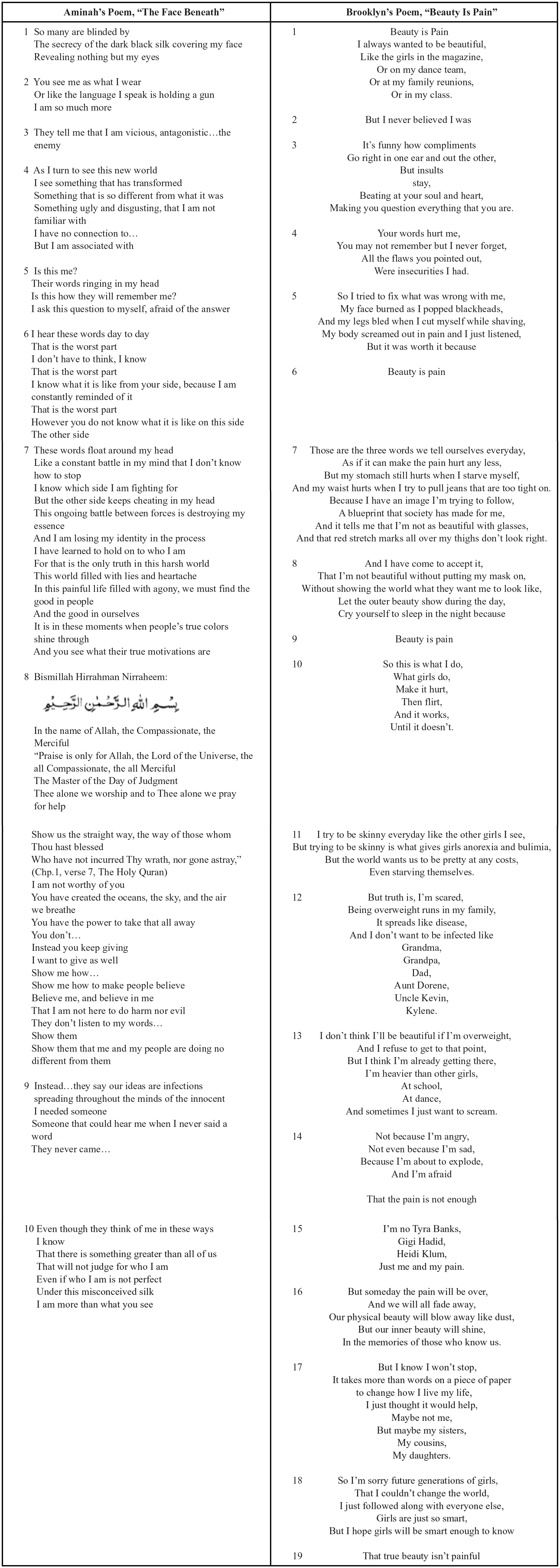
Aminah and Brooklyn’s poems.
Writing By and From Bodies
Both Aminah and Brooklyn drew from their embodied knowing as inspiration for their poems. In their performances, they also used their bodies as a mode of representation, extending the meanings of their written texts.
Writing that is inspired by embodied knowing
Aminah wrote her poem in reaction to a classmate who had characterized an Arabic greeting in a negative way earlier in the school year. In an interview, she recounted: [We] had a model UN and we were Egypt . . . My classmate . . . was speaking Arabic [while] he was reading off [his closing statement] and another classmate made a comment that really hurt my feelings . . . He said, “Are you gonna bomb a place or something?” . . . I took it personally, because I’m the only [Muslim] in our class . . . I feel like sometimes people don’t understand how what they said is actually really affecting me and it’s really hurting me . . . I started crying and . . . [Mr. C] helped me out.
Later in the interview, Aminah described how she wanted her writing to speak back to anti-Muslim sentiments, including those in her own classroom: A lot of people, especially now in our age and day—there’s controversy about our religion . . . [so] I decided to do this poem to say that not all Muslims are terrorists . . . I just want to share my side of the story.
As Aminah shared her “side of the story” in response to a moment of emotional pain, she explicitly drew from her own experiences as a young Muslim woman. In the poem, she counters simplistic narratives that position speakers of Arabic as communicating threats, those who wear hijabs as hiding secrets (Stanza 1), and Muslims as terrorists (Stanzas 2–3).
Aminah’s classmate Brooklyn also drew inspiration for her poetry writing from an embodied moment of pain: I was struggling to find which topic to write about . . . Then one night . . . I was popping blackheads . . . and my face was hurting . . . I went to bed and I was thinking about how much it hurts, and then I told myself, well, beauty is pain . . . [That] led to me wanting to write the poem.
This physically painful moment—and others like it—were represented in Brooklyn’s final draft with lines such as these (see Stanza 5, Figure 1): So I tried to fix what was wrong with me My face burned as I popped blackheads And my legs bled when I cut myself shaving My body screamed out in pain and I just listened
In an interview, Brooklyn described how she wanted to create this poem as a message for young girls that they do not need to internalize the idea that “beauty is pain”: [My poem is about] trying to make yourself look the way everybody else in the world wants you to look, and going through those hassles to just be considered beautiful . . . [like] the things that I would do . . . At the end I . . . [wrote] that “true beauty isn’t painful,” because that’s the message I was trying to get across.
Reminiscent of Muhammad’s (2015) research with adolescent girls who participated in an out-of-school writing group, both Brooklyn and Aminah engaged in writing that was inspired by and honored the lived experiences of [their] bodies—an atypical opportunity in school.
Bodies as a mode of representation
Particularly noticeable were the unique ways Aminah and Brooklyn used their bodies to represent and share their writing. Students in the class created or utilized a variety of multimodal tools to support their performances, including movies, artifacts, or PowerPoint slides with images, quotes, or memes that corresponded to their poem.
Aminah employed multiple multimodal representations to counter negative perceptions of Islam during her performance—her dress (wearing a scarf on her head, which was atypical for her in school), language (incorporation of Arabic into the poem; see Figure 1), and props (showing and reading aloud from the Qur’an). In an interview, Aminah described why she decided to wear a hijab and bring the Qur’an: I know that’s a typical thing you think of when you think of Muslims, like the hijab they wear. That’s often why people don’t trust them. It’s because, “Oh, the secrecy of what they’re wearing around . . . are they hiding something? What is that for?” . . . I also had the Qur’an, because I had a quote from it . . . I feel like that brought my poem together and gave people more of a feeling of what the poem was about.
The dissonance between her dress for her performance and the way her peers usually saw her at school was meant to encourage them to understand that with or without a scarf, “the face beneath,” her face, was the same. Although some research has documented the ways adolescents question or resist their parents’ enforcement of visual, spatial, and ethical veiling (Hamzeh, 2011), Aminah chose to wear a hijab to reclaim an aspect of her identity that, for her, was decentered in school. Indeed, “veiling is a lived experience full of contradictions and multiple meanings” (Hoodfar, 1992, p. 5).
Numerous peers commented on these effective rhetorical tools in their written responses to Aminah. For example, one noted that “the way you used the scarf to say that you are the same person even behind the scarf was awesome.” Another said, “The hijab really added to [your] performance and symbolized how you are still the same without it. It was very unique how you added text from the Qur’an to give the audience a piece of your culture.”
Brooklyn, like Aminah, drew from the affordances of multimodal means—including her body—to enhance the meaning of her piece of writing. For her performance, she created a black-and-white video that played in the background while she performed (see Figure 2). In the video, Brooklyn appears—a young White woman in a baggy T-shirt and wearing large hoop earrings. She stands in front of a white closet, and no sounds can be heard. The first sign Brooklyn picks up is written in large capital letters on a white sheet of computer paper. It tells the audience, “THESE ARE SOME COMMENTS FROM PEOPLE ABOUT SOME OF MY PHYSICAL FEATURES.” Every 10 to 15 seconds, Brooklyn puts down the sign and picks up another. The comments she shared included a variety of hurtful remarks, such as “YOUR TEETH ARE SO YELLOW” and “YOU HAVE A PIMPLE ON YOUR FACE.”
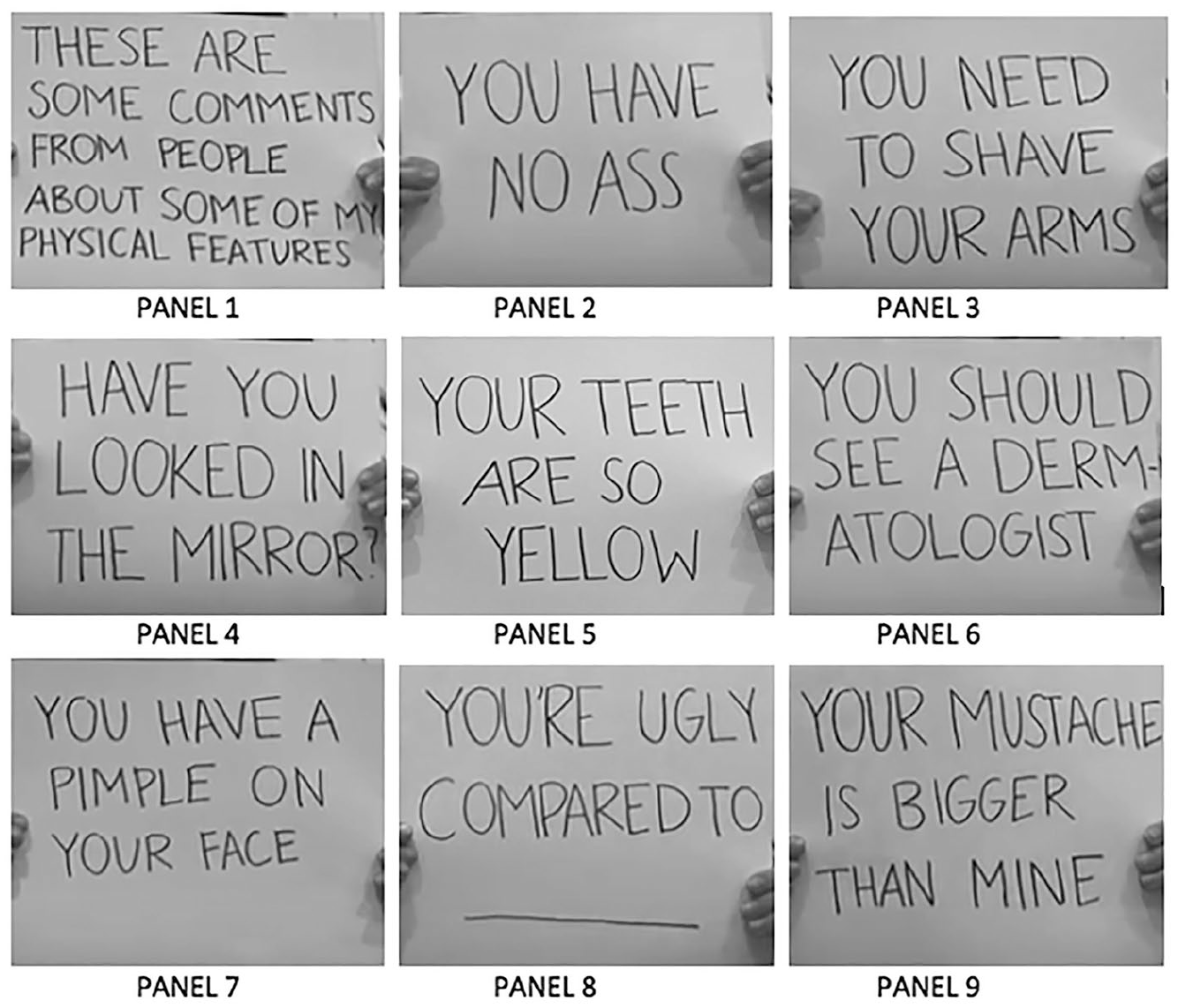
Still images from Brooklyn’s multimodal video.
As with Aminah’s poem, numerous peers commented on the effect of Brooklyn’s multimodal text in their written responses to her. One peer wrote, “I thought your multi-modal component was amazing. Every girl has gone through that and it was really brave of you to go up there and talk about it.” Another similarly responded, “Brooklyn, i [sic] am speechless after hearing your poem and seeing your video. You are so brave, you stood up there confidently and recited your poem as you pointed out what people say about you.”
Like Aminah, Brooklyn used her body as a mode of representation, particularly in her video. The words she shared in the video gave the audience insights into her history as a young woman experiencing what Hughes (2016) refers to as “bodily-not-enoughness—those moments when someone or something tells girls and women we are not enough of something in our lived or physical bodies” (p. 122).
Both Aminah and Brooklyn used their bodies as modes of representation to communicate their ideas, albeit in different ways. Their bodies and embodied knowing were important and ever-present—in what they wrote, and in how they shared their writing.
Writing For and In Bodies
Both adolescent girls intended to write for particular purposes and audiences. As we and their peers experienced these texts, we also responded emotionally and viscerally with/in our bodies.
Writing to counternarrate
Aminah and Brooklyn wrote and performed their poems with desires to counternarrate against pervasive stories told about women. Aminah counternarrated through her multimodal performance—wearing a hijab that she did not normally wear—and through her words. Hamzeh’s (2011) research demonstrates how adolescent Muslim girls someteimes question and resist their parents’ enforcement of veiling. Although making a temporary and strategic choice to physically veil herself, Aminah questioned and resisted schools’ veiling of identities. Like the girls in McArthur and Muhammad’s (2017) research, Aminah used her writing to push back against stereotypes about Muslim women, and to push back on schools’ disembodied emphasis.
Aminah’s final lines of her poem identify her argument: “Under this misconceived silk, I am more than what you see” (Stanza 10, Figure 1). She uses two techniques across the poem: describing how others see Muslim women as veiled, gun-holding, “vicious enemies,” “ugly and disgusting,” “an infection” (e.g., Stanzas 1, 2, 3, 4, 5, 9), versus asking the audience to imagine “the other side,” her side as someone who is “not here to do harm or evil,” is “no different from them,” and also is “not perfect” (e.g., Stanzas 5, 6, 7, 10). In an interview, she shared how she sought to “educate everyone, because no one [in the class] truly knows what Islam is about because they don’t study it like I do. They just see the news, how it’s represented badly.” Her words and performance worked to disrupt the pervasive societal stereotypes that had been perpetuated by her own classmates by humanizing Muslim girls.
Brooklyn’s words and multimodal performance also counternarrated against pernicious societal ideologies. Her primary claim was visible at the end of her poem, that “true beauty isn’t painful” (Stanza 19, Figure 1). She alternated between generalized experiences that are relatable to many adolescent girls (e.g., hanging onto insults and not compliments, pursuing pain in the name of beauty; Stanzas 3, 10, 15–20) and moments reflective of her own experiences (e.g., being on her dance team, cutting her legs when she shaved, being insulted; Stanzas 1, 4, 5, 7, 12, 13). Her poem humanized girls, making the emotional and physical impacts of societal pressures and personal insults visible and felt for her audience.
With their poems, both adolescent girls foregrounded their embodied knowing—powerfully informed by the historical constructions of race, gender, sexuality, ability, and religion—as worthy topics for school writing.
Bodies responding to texts
Over the course of the unit, bodies also responded to texts. Both Aminah and Brooklyn recounted finding inspiration from moments that were initially sources of pain, grappling with their anxiety before and during performing, and ultimately feeling a sense of accomplishment and empowerment afterward. In interviews, they each described their feelings around performing. Aminah said: I was really, really nervous . . . [M]y multimodal component was a hijab, so I was wearing it . . . I know we had a really positive environment, but I know there’s still gonna be some people that would be judgmental . . . It was hard, but I feel like once it was over I was like, wow, I just did that . . . I was happy I did it to share that with the class.
Brooklyn similarly described her feelings around performing and sharing: Right before I presented, I was really nervous. I had to leave the room for a minute and jump around in the hallway just for a minute . . . Then I came back in and just took a deep breath and did my poem . . . I was having trouble throughout the year . . . making friends and . . . dealing with . . . drama, and my mom knew about it. [Afterward, when] . . . I came home . . . [I] read all the comments to my mom and she was almost crying because she’s heard everything that everyone had said . . . When I went home and read them over again, it really resonated with me, almost making me cry . . . I wasn’t expecting that kind of emotion from it.
In addition to the writers, readers (like Brooklyn’s mom) also responded to the texts with their bodies. When Brooklyn performed, a few of the adolescent girls cried, and in their comments many shared similar experiences, such as I can relate to what you were writing about and I understand the conflict that you face everyday . . . I never really saw you as somebody with insecurities but . . . you shared a new part of yourself.
Rebecca and Andrea, as women, felt for and with Brooklyn; particularly watching the video, they thought about their own lifetime accumulations of negative comments toward their bodies.
Although some of the boys in the class acknowledged that they could not identify as clearly with Brooklyn’s experiences, her performance gave them insights into women’s “gruesome but . . . very true” experiences, as one classmate put it. Another peer wrote, “I feel like this really represents how it feels for girls to try to be in this society. I can obviously not presume that I know how this feels, but I feel like this poem helped me see that.” Mr. C described Brooklyn’s performance as moving; he felt proud of Brooklyn’s agentive stance in confronting those who had ridiculed her but anguished that Brooklyn’s experience was commonly echoed by nearly every female student in the room. He also described the gravity of being a father of a young girl, and his realization that he could not protect her from this potential stream of damaging comments from others.
These responses demonstrate numerous ways that the classroom audience responded to writing with our own bodies—with tears, memories of personal experience, and empathy—as we came to see Brooklyn and Aminah, and the experiences of women, in new ways. Two years later, Brooklyn’s reengagement with her poem again surfaced complex emotional responses, for example, when she said, Wow, that is very sad [placing her right hand over her heart] . . . I can’t believe I said some of that stuff . . . [I’m] just thinking of two years [ago] . . . where I’ve come from that.
She later added, “I think there isn’t a lot of space for seeing the impact of things [like school writing] because . . . things take time to have an impact and that isn’t really talked about a lot in school.” In schools, circulations of emotions do not end when a piece of writing is shared or a unit ends. Rather, the writing—and feelings associated with it—has the potential to reverberate over time.
Discussion
The contributions of this analysis are twofold. First, it weaves together multiple theoretical and conceptual positions to understand the multifaceted nature of school writing and the ways it is produced from and by bodies, is experienced in bodies, and does work with and for bodies. Second, it offers methodological insights to support ethical engagements with youth in research that foregrounds bodies.
To examine how writing is produced by and in bodies, we draw from literature on multimodal composing and emotion. Consistent with research exploring the “diverse semiotic activity [that] necessarily shapes all textual artifacts and acts of inscription” (Prior, 2017, p. 211), Aminah and Brooklyn used their bodies—talking, typing, gesturing, and moving—to compose and share their writing. They also both utilized multiple multimodal means (dress, multiple languages, props, and/or video) to deepen their meanings and enhance the impact of their performances. Brooklyn’s and Aminah’s experiences in this unit align with research that suggests that extending composing processes beyond print modalities supports participation and engagement (Vasudevan et al., 2010). As Brooklyn told us in a member-check interview, “Reading the poem you can . . . imagine how someone is saying it. But . . . actually speaking the poem and hearing it, I . . . took more ownership of it.”
Across the unit, Brooklyn and Aminah experienced a variety of emotions, particularly related to performing. We examined emotions during composing processes (Woodcock, 2010) and in the sharing of written texts (Lewis & Dockter Tierney, 2013), with attention to writers and their audiences. Although it is clear that literacies are indeed “saturated with affect and emotion” (Leander & Boldt, 2013, p. 22), more research on the emotional aspects of composing and sharing writing, including long after the unit is over, can help explicate how youth act and react to/through school writing over time.
We situate our understandings of how the focal students’ writing draws from bodies in literature on embodied knowing. When tasked to write about their cultures or identities, Aminah and Brooklyn drew from their experiences of the world in particular bodies (Woodcock, 2010) as inspiration for topics to write about, and as an area of knowledge from which to advocate for change. Like the adolescent girls in Muhammad’s (2015) summer literacy collaborative, Aminah and Brooklyn wrote about “issues they found important in their lives and the lives of other groups with which they identified” (p. 235). They both felt that although their embodied knowing was not typically valued in school, Mr. C made space for it before, during, and after the unit.
Mr. C’s encouragement of writing that honored youths’ cultures and identities supported Aminah and Brooklyn to make their bodily experiences visible in school. When we asked Brooklyn’s mom what she would say to Brooklyn after reading the poem, she suggested that opportunities for girls to acknowledge their embodied knowing in school writing matter, saying, “A woman’s journey with beauty is life-long and pervasive in every aspect of society, and you are worthy to speak your truth and to have a voice on this (and any) subject about your life and experiences.” Particularly for those whose bodies are marked as “other” in some way (e.g., women, people of color, dis/abled people, lesbian, gay, bisexual, transgender, and queer/questioning [LGBTQ] people), cultivating these opportunities in school matters. They provide youth the chance to write authoritatively about their own experiences and issues that touch their lives, and help position writing as a resource for accomplishing social and political purposes in the world. Mr. C’s epistemological commitments were well suited to meaningfully engage his students (and parents) in such pedagogically lofty and robust instruction. However, teachers need infrastructural support to be empowered to do this work effectively. Furthermore, although Mr. C’s students performed at high levels on standardized tests, we acknowledge that this instructional approach is not necessarily correlated with traditional measures of achievement.
Finally, this analysis showcases how school writing can be used for accomplishing things with other bodies. Literature that recognizes writing as social action highlights the myriad ways youths’ writing—even in schools—acts with/on themselves and others (e.g., VanDerHeide, 2018), including for the purpose of counternarration (Vasudevan, 2006; Winn, 2019). This was true for Aminah, Brooklyn, and many of their peers, who used their writing to speak back to societal norms. By examining what youth intend and accomplish with their writing, as well as how the writing impacts audience members, it is possible to consider how writing acts with and on bodies. The performative pedagogy also allowed us to consider how the authors’ bodies (e.g., their race, gender, dress) acted as social texts, extending or complicating the meanings of their written texts (see Scarbrough & Allen, 2015).
To understand the multifaceted nature of school writing, it was helpful to weave together multiple theoretical and conceptual positions. Considering bodies as tools, mediums, and texts in school writing is important, we argue, to move toward richer theorizations of writing in school and complementary transformative pedagogies.
Although not the primary focus, this analysis also offers methodological insights to support ethical engagements with youth that foreground examinations of their bodies. Researchers’ turning of their gaze toward youths’ bodies is fraught with issues of power and ethics, particularly for White researchers engaging with youth of color. To that end, our RPP has sought to work with (not on or for) youth and families (see Paris & Winn, 2014) as long-term partners. In our multiple conversations, we centered youths’ and their families’ feelings about the analysis and their ideas about bodies, writing, and school. Although space prohibits its discussion, we also shared our own embodied experiences with Brooklyn, Aminah, and each other (e.g., how we felt when we watched them perform, how we experienced our own bodies in schools). Brooklyn’s reflective comments on how she saw herself through her writing in new ways 2 years later, coupled with her mom’s comment that “the assignment created an ‘echo’ in my own life as I reflected deeply about my own journey and experiences,” have also encouraged us to think about the importance of time in pedagogical research. For us, this ethical stance is ever evolving, and we are interested in going further to center youths’ interests in what data are collected and how and why they are analyzed, and exploring these echoes in all participants’ lives—including our own—over time.
Implications
This study recognizes that bodies are central to how we experience school, to how we write and read, and to the work happening in all writing classrooms. For writing theory, it suggests the importance of attention to the multifaceted nature of embodiment and writing: how the body is a tool for writing, a medium that experiences writing, and a social text that works with/through writing. Bridging across multiple conceptual stances on embodiment to support this rich theorization has the potential to transform “the dominant discourse surrounding the teaching of writing [that] focuses on texts and thoughts, words and ideas, as though these entities existed apart from the bodies of teachers, writers, audiences, and communities” (Dolmage, 2012, p. 110).
For writing pedagogy, moving beyond a text orientation to acknowledge the relationships between writing, bodies, being, and feeling has the potential to expand valued meaning-making practices in schools. Although this unit’s focus on a performative pedagogy might have provided a natural fit for foregrounding bodies, bodies can be centered in various ways across writing genres. For example, in a unit at the beginning of the year that builds foundations of argument through mock crime scene investigations, Mr. C has students act out the scenarios and details stated in the supporting documents to determine if their logic and reasoning are plausible. In so doing, students engage in a form of body-centered research and begin to acknowledge embodied knowing as a form of valid evidence. In personal narrative units, Mr. C foregrounds sensorial and felt experiences, asking students to move beyond logical, matter-of-fact recounting to evoke what moments felt like and what was happening in their bodies.
Educators can center embodiment and bodies in writing instruction in various ways. For example, interest inventories similar to the one Mr. C used can prompt students’ thinking about their embodied experiences and identities as resources for writing. Instructional time and culminating unit reflections can include explicit attention to the emotions brought up through writing. Teachers can also work together with students to develop opportunities for sharing writing within and beyond the classroom community, such as a poetry slam, reader’s theater, or debate. Central to these pedagogical moves is the recognition that all writing is profoundly embodied—bodies produce writing, experience text, and are read and (re)presented through writing. As Perry and Medina (2011) put it, “embodiment isn’t simply an interesting possibility for education, nor is it an alternative practice or method: embodiment is” (p. 63).
Finally, for writing research, this study offers an example of humanizing methods, particularly collaborative analysis procedures, to foreground bodies in collaborative studies with youth over time, which is particularly important for literacy researchers interested in foregrounding youths’ bodies. Our own focus on bodies became relevant primarily during analyses, and we are interested in the possibilities for more strategic data collection to support a focus on embodiment (e.g., attention to in-the-moment affective experiences; see Leander & Ehret, 2019).
Recognizing the ways that adolescents’ writing is embodied can provide insight into how writing is composed, why it is composed, and most important—what kinds of work it accomplishes. Asking how we might address rather than assume the body in writing pedagogy and research, and recognizing the importance of foregrounding the body in school writing pedagogies, can help disrupt the predominant understandings of school writing as limited to “the four corners” of the page. Education can be more than the pursuit of acquiring skills for the sake of building one’s knowledge set. It can be “an active project of becoming human, inclusive of efforts to answer . . . ‘Who am I?’ . . . and . . . ‘Who do I want to become?’” (Stetsenko, 2017, p. 336). This imagined future becomes a reality as all stakeholders in education—including teachers, students, parents, and researchers—work in tandem to transform society by imagining what it can be, rather than accommodating or adapting to it by accepting what is (Stetsenko, 2017).
Supplemental Material
Trnaslated_Abstracts_Woodard – Supplemental material for Writing Beyond “the Four Corners”: Adolescent Girls Writing By, In, From, and For Bodies in School
Supplemental material, Trnaslated_Abstracts_Woodard for Writing Beyond “the Four Corners”: Adolescent Girls Writing By, In, From, and For Bodies in School by Rebecca Woodard, Andrea Vaughan and Rick Coppola in Journal of Literacy Research
Footnotes
Declaration of Conflicting Interests
The author(s) declared no potential conflicts of interest with respect to the research, authorship, and/or publication of this article.
Funding
The author(s) received no financial support for the research, authorship, and/or publication of this article.

References
Supplementary Material
Please find the following supplemental material available below.
For Open Access articles published under a Creative Commons License, all supplemental material carries the same license as the article it is associated with.
For non-Open Access articles published, all supplemental material carries a non-exclusive license, and permission requests for re-use of supplemental material or any part of supplemental material shall be sent directly to the copyright owner as specified in the copyright notice associated with the article.
