




Abstract
In response to anti-Black policing in 2020 that led to the deaths of George Floyd and Breonna Taylor, Black children and teens turned to poetry as a means to channel their self-described terror, rage, pain, horror, tiredness, and need for change. Reminiscent of the poetry of the Black Arts Movement and works published in The Black Panther newspaper, these poems, many of which call for a “revolution,” are reflective of young people’s critical engagements with the world and the word. With critical literacy as a framework, I engage in critical discourse analysis to determine how the young poets reimagine literacy as they protest anti-Black policing and racism. By focusing on young people’s own grassroots literacy initiatives, which call for the reimagination of blackness and whiteness, and demand truth, justice, and reimagined futures, I demonstrate how educators can reimagine literacy practices to center students’ criticalities and prioritize racial justice.
Black boy, Black boy, what do you see?
I see a White police officer looking at me.
White police officer, White police officer, what did you do?
I shot a man in the back seven times and kneeled on the neck of George Floyd.
My son, age 9, restorying Bill Martin, Jr.’s Brown Bear, Brown Bear, What Do You See? for his 1-year-old brother (Figure 1)
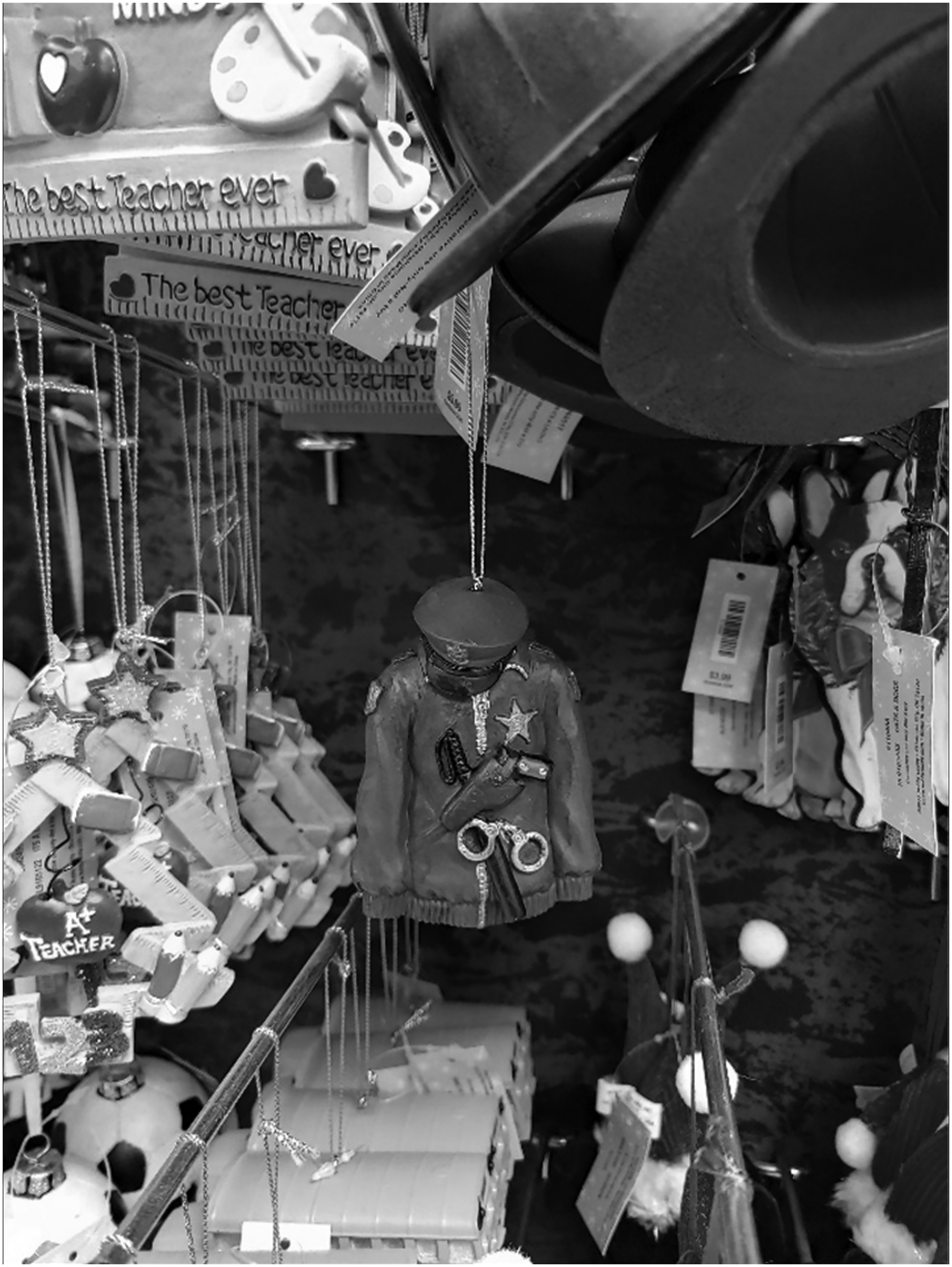
Photo of a nearly sold-out police officer Christmas ornament, surrounded by other “civil servant”–themed ornaments, taken by the author at a local Hobby Lobby on October 30, 2020.
During the same week as the August 2020 Republican National Convention, children (like my own three sons) had undoubtedly heard about—and possibly seen—the horrific shooting of Jacob Blake, a 29-year-old Black father who was paralyzed after a White police officer fired seven bullets into his back. Abby Johnson, an antiabortion celebrity who spoke at the Republican convention, was revealed during this time by Vice News (Sherman, 2020) to have come out previously, during the nationwide protests that followed police officer Derek Chauvin’s murder of George Floyd, in support of racial profiling by police—against Black males like her own adopted “biracial” son, no less.
In a vlog Johnson posted in June 2020, which was made private after receiving negative backlash, she begins by identifying herself as a “White, conservative, nonwoke person” who “can’t be quiet about” the protests inspired by Black Lives Matter (BLM). (The Vice News article includes an edited version of Johnson’s June 2020 video; however, it omits her reference to herself as a “White, conservative, nonwoke person.” I transcribed this quote while viewing the video on Vice.com’s original page on August 29, 2020.) Making unspecified references to false “stats,” Johnson asserts that a police officer would be “smart” to profile her “brown” child since he is “more likely to commit a violent offence over [her] White sons.” She launches into a series of additional racist statements, arguing that Black “fatherlessness” and “bad dads,” not “bad cops,” were to blame for our country’s high levels of civil unrest. (Richardson, 2019 and Levs, 2016 have countered the myth that “70% of Black children are fatherless.”) Johnson’s steadfast investment in whiteness and privilege is shared by many Americans—including some teachers. A Florida teacher, for example, recently told her Black students she had “as much right as anyone else to dislike Blacks” because of one negative experience when she was a teenager; she also stated that BLM implies “that Black lives matter more than anyone else” (Miller, 2020). In addition to not giving credit to anti-Black policing where credit is due, such mentality is anti-Black and threatens to perpetuate the cycle of criminalization–profiling–policing–violence–death that harms Black children, inside and outside of school. Johnson’s assertions embodied Bettina Love’s reflection on the year 2020, noted in the foreword of Picower (2020), that it “will be recorded as a year of disdain for Black life” (p. ix).
In sharp contrast to such antiblackness, Black children and teens across and beyond the United States turned to poetry as a means to channel their self-described terror, rage, pain, horror, tiredness, and need for change following the fatal police violence against George Floyd, Breonna Taylor, Jacob Blake, and others. Reminiscent of poetry from the Black Arts Movement, which “exposed and blasted American racism” (Jennings, 1998, p. 106), and poems published in The Black Panther newspaper that “slammed home revolutionary messages” about police brutality and White hate (p. 110), the work of these youth poets demonstrates exactly how much is at stake if influential figures within our public schools subscribe to racist belief systems cloaked in law-enforcement-apologist discourse like Abby Johnson’s or refuse to engage young people in resistant literacies. As Baxley and Sealey-Ruiz (2021) have made clear, poetry in the Black Radical Tradition has the potential to serve as “social commentary, resistance, and a form of healing”; they also noted, “Black people’s lives are poetry” (p. 314). Yet, this literary/literacy art is “underexamined” as a pedagogical tool for “exploring trauma and developing one’s sense of self” (p. 314).
As the United States grapples with heightened calls for justice and retribution, radical healing (Desai, 2020; Ginwright, 2010), and reckoning with the “wrongness of whiteness” (Sciurba, 2020), we have a pressing need as a literacy community to rise against individuals who try to nullify messages supportive of Black life. As noted in the poem at the beginning of this article, which my middle son—who identifies as a “Black boy”—sang to my youngest son, Black children are already reading the word and the world in critical ways (Freire & Macedo, 1987) and teaching each other to do the same. They deserve formalized reading, viewing, analyzing, composing, discussing, and other literacy experiences that are similarly meaningful, transformational, and uncompromisingly fixed on social justice.
By turning to poems written by Black children in response to incidents of police violence and the protests of 2020, I discuss the urgency of critical literacy practices that provide avenues for young people “to shape the world they live in and to help to turn it into the world they imagine” (Morrell et al., 2013, p. 3). Although teachers across the country have undoubtedly facilitated literacy activities to amplify Black students’ voices, I was particularly interested in finding out more about Black children’s own grassroots initiatives where poetry serves as a protest. As Flowers (2020) noted, regarding grassroots reading projects: As many literacy teachers look for resources, people, strategies, and advice on what to do when they encounter K–12 African American students who struggle with either reading or aliteracy, it is important to learn about existing grassroots initiatives. This will empower teachers to either emulate these efforts or reach out to these initiatives for assistance.
In the spirit of this call, I completed a content analysis (Saldaña, 2011) informed by critical discourse analysis (Rogers & Wetzel, 2014) and framed by Freire and Macedo’s (1987) understanding of “reading the world” and Morrell’s (2008) conceptualization of critical literacy, to address the following research question: How is literacy reimagined within and by Black children’s outside-of-school poems about anti-Black policing and the protests of 2020? Drawing from Dumas and Nelson’s (2016) advocacy for a “(re)imagining” of Black boyhood, I understand a reimagining of literacy as one that “create[s] and nurture[s] spaces for Black” children “so that they can self-determine and shape their own worldviews” (p. 38). Additionally, my understanding of reimagining is influenced by Thomas and Stornaiuolo’s (2016) “restorying,” whereby young people “inscribe themselves into existence in response to efforts to silence, erase, consume, or ventriloquize them” (p. 314). To address my research question, I analyze six poems featured in various online venues.
In what follows, I provide an overview of anti-Black policing and conflicting views of law enforcement in (and beyond) the United States. I also discuss the tradition of Black poems “as persuasive and effective weapons in the campaign to liberate a black nation” (Gates & McKay, 2004, p. 1838), beginning largely during the Black Arts Movement and observable in this small collection of Black youth poetry. Influenced by G. Muhammad’s (2020) work on historically responsive literacies, I demonstrate how young people’s outside-of-school literacy and “criticality”—as manifested through their own contemporary grassroots poetry initiatives—call for reimagined literacy classroom practices that honor and fight for Black lives, while creating and nurturing spaces for young Black people to restory themselves and the world around them.
Anti-Black Policing and Black Poetry as Resistance
Police in the United States typically fall into the same category as firefighters, doctors, and teachers—civil servants—as demonstrated in the photograph of Hobby Lobby Christmas ornaments presented above. Nationally and globally, many people engage in “mythmaking” practices related to police officers’ roles as heroes, especially in moments of crisis (Krause & Smith, 2014; Sciurba, 2009). Children are particularly susceptible to the “hero” tale of the police, as state standard after state standard emphasizes that all police should be treated as “community helpers,” particularly in the early grades (Kolluri & Young, 2021). Far fewer citizens are likely to dispel this “un-telling,” or “the process of (willfully or unintentionally) neglecting, omitting, revising, or recasting key elements of” history (Sciurba & Jenkins, 2019, p. 4), by linking uniformed officers to slave patrols (K.G. Muhammad, 2020). Yet, the fact remains that law enforcement in the United States has anti-Black roots that have stretched from slavery to reconstruction to Jim Crow to what we see today, at the beginning of the 2020s.
Many of our current injustices can be linked to the century-old “myth that Black people belong to a criminal race” (Muhammad, 2019, p. 13). Black criminality or the crime of being Black, and daring to live a free life, was enforced in the United States by slave patrols known “for their extreme cruelty and mercilessness” (Durr, 2015, p. 3). The Ku Klux Klan formed during reconstruction, in part from disbanded slave patrols, and these same White men ultimately formed the earliest police departments in the United States (Durr, 2015, p. 3). The racist and factual link between (White) police and Black citizens is rejected by Americans who “exclaim Blue Lives Matter in utter defiance of Black Lives Matter activism. And they falsely equate doing a job, even if at times a dangerous one, with living in one’s own skin,” as Muhammad (2019) wrote.
Havercroft and Owen (2016) explained that “white obliviousness” to the BLM movement is “a case of soul blindness” (p. 740). People who reject BLM are unable to see that “Black lives have not or have only exceptionally” mattered “in the same way as White lives” (p. 751). Blue Lives Matter and All Lives Matter retorts suggest that our justice system is functional and simply needs to revert to some righteous foundation (p. 752). Red states and Republican-identified White Americans are most likely to oppose the BLM movement (Updegrove et al., 2020, p. 86), failing ultimately to recognize the humanity and suffering of Black people in this country (Desai, 2020; Havercroft & Owen, 2016; Muhammad, 2019). These tensions and historical omissions are ubiquitous in literacy curricula, as noted by Borsheim-Black and Sarigianides’s (2019) discussion of the centering of “White ways of knowing and being in the classroom” (p. 5).
In their call for “woke pedagogies in English,” Storm and Rainey (2018) expressed the need to set classroom “goals of critical consciousness and civic engagement” (p. 95). While conservative teachers, like the candidates in Journell’s (2017) research who struggled with “diversity” discussions, certainly have their own approach to civic engagement, centering Black students’ experiences must involve awareness of the role that anti-Black policing plays in their own, their families’, and their communities’ lives (Desai, 2020). Although my focus here is on badge-holding officers, it is equally important to recognize the anti-Black policing of security guards and other authority figures in public schools (see Love, 2019). The National Police Association suggests that BLM-supportive educators are involved with “poisonous indoctrinations” and “antilaw enforcement messaging” (Owsinski, 2020); however, the high level of race-based injustice among police continues to make reform necessary. As I have argued previously in a critique of picture books, “ ‘ALL’ police officers may not be bad, but not all of them are good, either” (Sciurba, 2020). Literacy education cannot ignore this reality.
As former Black Panther Party member Jennings (1998) showed, poetry that emerged during the Black Arts Movement or was published in The Black Panther, written by such artists such as Amiri Baraka (Leroi Jones) and Sonia Sanchez, “challenged the assault and affront of police and other whites who with impunity murdered Black men for centuries” (p. 108). Jennings addressed many critiques of Black Arts Movement poetry (e.g., its seeming rejection of previous Black poetry, misconceptions of Africa, and what many identify as misogyny) but noted that, nevertheless, it projected “urgent messages geared to teach and to encourage transformation” (p. 110). Black poetry of this era was “fierce” and “slammed home revolutionary messages” aimed directly at anti-Black policing and other racism embedded in U.S. life (p. 110). This (literary) history, as G. Muhammad (2020) suggested, is key to understanding literacy as connected to “acts of self-empowerment, self-determination, and self-liberation,” which should guide (Black) students’ literacy education experiences today (p. 22).
Contemporary Black youth poetry and other creative literacies, much like the poetry of the Black Arts Movement, can serve as vehicles for students to champion social justice or activist causes (Baxley & Sealey-Ruiz, 2021; Burr, 2017; Davis, 2018; Jocson, 2006; Morrell, 2008; Tullos, 2019). Just as Kirkland (2013) demonstrated through a group of young Black men’s hip-hop writing and as Desai (2020) revealed through Youth Participatory Action Research centered on Día de los Muertos and BLM, creative literacies can enhance students’ abilities to counter-narrate, restory (Thomas & Stornaiuolo, 2016), and reimagine misconceptions about their lives and identities. Poetry, as a critical literacy practice, can also enable Black youth to engage in “self-healing and self-definition” (Morrell, 2008, p. 167). Such a practice is vital because, as Proctor et al. (2020) wrote: Black students may not have the opportunity at school to process their feelings and thoughts about police violence against Black people because some educators, including school psychologists, may not be willing to discuss the issue, while others may not feel equipped to support Black students…. [M]ulticultural and social justice training are important to engage if school psychologists are to effectively serve Black children and youth who may be impacted— proximally or distally—by police violence against Black people.
The inability of Black students (and other students) to process anti-Black policing can have serious consequences on their mental health. Creative literacies, like poetry, can offer young people a means of expression to challenge the structures that try to convince them that their lives do not matter. As such, young people can assert their power against racist, anti-Black ideologies that work oppressively to grant them “the right to remain silent.”
Critical Framings
In their discussion of the interconnectedness of “the word” and “the world” in literacy practices, Freire and Macedo (1987) stated that literacy programs should be built around “the ‘word universe’ of people who are learning, expressing their actual language, their anxieties, fears, demands, and dreams” (p. 35). Delpit (2006) made evident that these “word universe[s]” compose young people’s “language fluency” (p. 17), yet the fluencies of Black children are not always recognized, heard, or valued in classroom spaces. G. Muhammad (2020) similarly made it clear that “power and genius is already within them,” but Black children’s power and genius are not sufficiently cultivated in classroom spaces (p. 13). For this reason, Muhammad joins a legacy of scholars (e.g., Bishop, 1990; Gay, 2010; Ladson-Billings, 1995, 2014; Paris, 2012; Thomas & Stornaiuolo, 2016) who advocate for (literacy) education practices that affirm the identities, lives, experiences, and criticalities of young Black people as well as other people of color. The amalgamation of these theories serves as a guide for my present study, which focuses on the ways in which young Black poets represent themselves, through their writing, in relationship to the events of 2020, and these theories drive my concluding suggestions for youth-informed literacy practices.
While considering the “rich forms of innovation” in Black poetry—which according to Shockley (2011), includes “uncommon or unconventional ways of negotiating or engaging black history, cultures, and politics” (p. 15)—I also draw upon Morrell’s (2008) conceptualization of critical literacy. Specifically, my work is inspired by his understanding of “critical writing that is not just about coming to a critical understanding of the world, but that plays an explicit and self-referential role in changing the world” (p. 167), and as such, my analysis of the young people’s poetry links to their readings of the world as well as to their positioning of themselves in agentive roles in reimagined futures. Blending literary and sociological theories provided me with a path for considering how Black youth poets engage with history, culture, and politics as they rise to transform systems that do not permit them to be, as children, in their worlds (Dumas & Nelson, 2016). Thus, I focus on reimagined literacies embedded in and stemming from the young people’s poems.
Methods
I searched for poems published in public online venues by Black youth (age 18 or under or in a K–12 grade) that referenced at least one of the incidents related to the BLM-inspired protests of the summer of 2020. While a large number of poems about police violence by adult writers, including poets from the Black Arts Movement and contemporary spoken-word artists, appear online in written or video format, my search for poems by young writers appearing in their entirety online yielded far fewer results. After completing Internet searches with terms such as “Black children’s poems AND police,” “young people’s poems AND Black Lives Matter,” or “Black youth poetry AND 2020,” I identified a series of newspaper articles about poets like 22-year-old National Youth Poet Laureate Amanda Gorman, whose stunning performance at the 2021 inauguration of President Joseph R. Biden has since garnered her international fame. However, I was looking specifically for matches to each of the following search criteria among the sites I examined:
Features a Black youth poet (age 18 or under or in a K–12 grade) Features poems that reference the police Features poems that reference the events of 2020 Includes poems in their entirety, in written form
From this initial search, I located five poems—written by a 9-year-old girl, an 11-year-old boy, a ninth-grader, and two eleventh graders—appearing again in news articles (Booth, 2020; McCarthy, 2020) or the online journal CHARM: Voices of Baltimore Youth (“Poems for Black Lives Matter,” n.d.).
After this initial search, I looked up the following (youth) poetry organizations:
Black Youth Project Book Riot Community Word Project Get Up Stand Up Now Louder Than a Bomb Poetry Foundation Poetry Out Loud Poets.org Power Poetry Project Voice Urban Word Youth Speaks
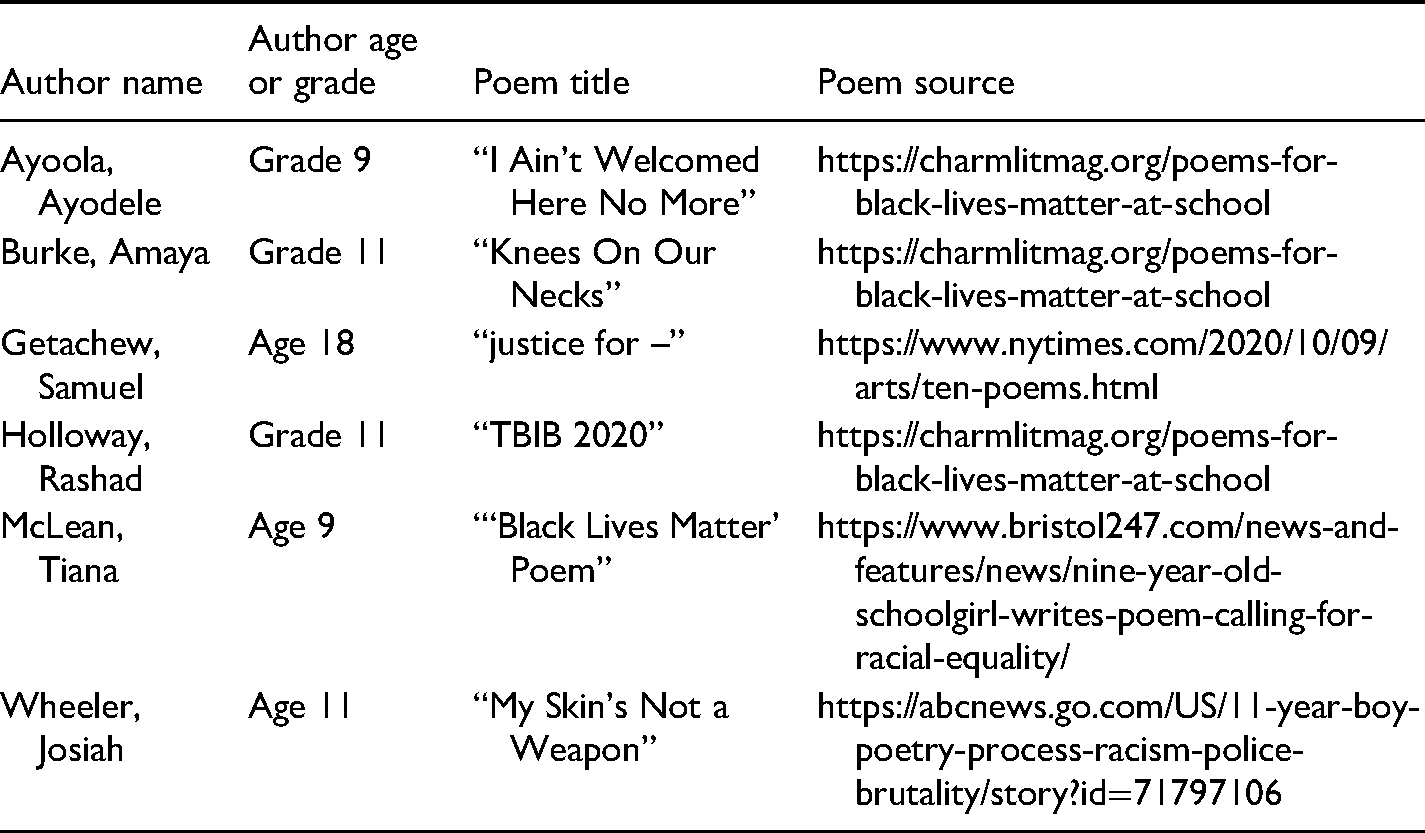
Additionally, I looked up poetry lessons featured on Learning for Justice (formerly Teaching Tolerance). I searched each of these organizations’ websites for poems that met my criteria. Although these organizations support and promote Black (youth) poets and Black poetry, most of their sites do not feature original youth poems in their entirety or do not identify the poets’ names, ages, or grades. However, I found and included an additional poem written by an 18-year-old poet published in the New York Times’s “The Future of Poetry, in 10 Poems” (2020). (I eliminated an equally powerful poem from this article entitled “Choke” by William Lohier, as he was 19 years old at the time of publication.) My search resulted in six poems. Their titles, sources (links to where the texts or authors’ poetry performances can be found in their entirety online), and authors’ names are listed in Table 1.
Poems Examined.
I completed a content analysis (Saldaña, 2011) informed by critical discourse analysis (CDA), analyzing the young people’s poetry similarly to how I might analyze an interview transcript, with the added consideration of the compositional choices each young person made. Focusing primarily on what Rogers and Wetzel (2014) adapted from Fairclough’s (1993) “ways of representing,” I examined how each poem “constructs ideas about the world within the interactional space” (p. 129). I considered the “interactional space” to be the moments leading up to and resulting in the protests of 2020, such as incidents of anti-Black police violence referenced in the young people’s poems. I was most interested in learning about “the ideas about the world present in each line” of each poem (p. 129). Specifically, I examined the poets’ ideas about whiteness, blackness, (in)justice, and power and strength. Additionally, I examined the poets’ “ways of being” (also adapted from Fairclough by Rogers and Wetzel, 2014) by identifying the “verbs, modality, and syntactical construction” (p. 129) they used to position themselves in relation to the events of the summer of 2020. As such, my CDA process, for which Haddix’s (2016) serves as a model, “moved beyond notions of dividedness and marginality and toward a third space” (p. 83). Haddix, in her work on teacher identity development and hybridity, drew upon Soja (1996) and other scholars of color to describe the third space as a symbolic “move beyond stagnant binaries” (p. 83). In this case, I considered how the poets configured a literacy space for themselves that contests an empowered/disempowered binary.
For my analysis, I drew heavily from Shockley’s (2011, 2017) work on Black poetry published amidst “colorblindness,” which tends to “suppress black experience and subjectivity, as discursive matters” (Shockley, 2017, p. 40). Shockley (2017) conceptualized colorblindness as “one of white supremacy’s key strategies for managing race,” which denies the impact of racism (p. 39), and argues that Black poetry, like that written by each of the young poets in this examination, “requires us to think and act in ways that reveal our awareness and investments in racial categories” (p. 44). Though Shockley (2017) referenced poetic works set within the context of slavery, I used CDA to determine how Black youth poets, writing within what she described as the “unavoidably racialized context” of the protests of 2020, guide us to “encounter the artists’ black subjectivities—and our own racial subjectivity—without any instructions on how to manage them” (p. 45).
Coding and Analysis
To complement a CDA approach centering young people’s voices, I completed in vivo coding “based on the actual language used by the participant[s]” (Saldaña, 2011, p. 99), recording a list of quoted words or phrases the poets (the “participants”) used to describe the incidents of 2020, the police, their or their community’s response to the incidents, ideas for obtaining justice, and their hopes and imagined futures following the events of 2020. For instance, I coded terms they used to describe the police (e.g., “popo,” “boys in blue”), feelings they identified having in response to the deaths of Breonna Taylor or George Floyd, or the protests (e.g., “rage,” “tired”), descriptions associated with Black people (“innocent,” “threat”), descriptions associated with White people (“privilege,” “nonsense”), and suggestions they make for obtaining justice, if any (e.g., “revolution”).
Additionally, I examined the “verbs, modality, and syntactical construction” (Rogers & Wetzel, 2014, p. 129) the poets used, noting to whom each poem is addressed; how the lines are broken up; what phrases or words are emphasized with capitalization, italics, or repetition; and which quotes the poets included (from themselves, the victims of police violence, their communities, or outsiders like White people who adhere to “All Lives Matter”–type ideologies).
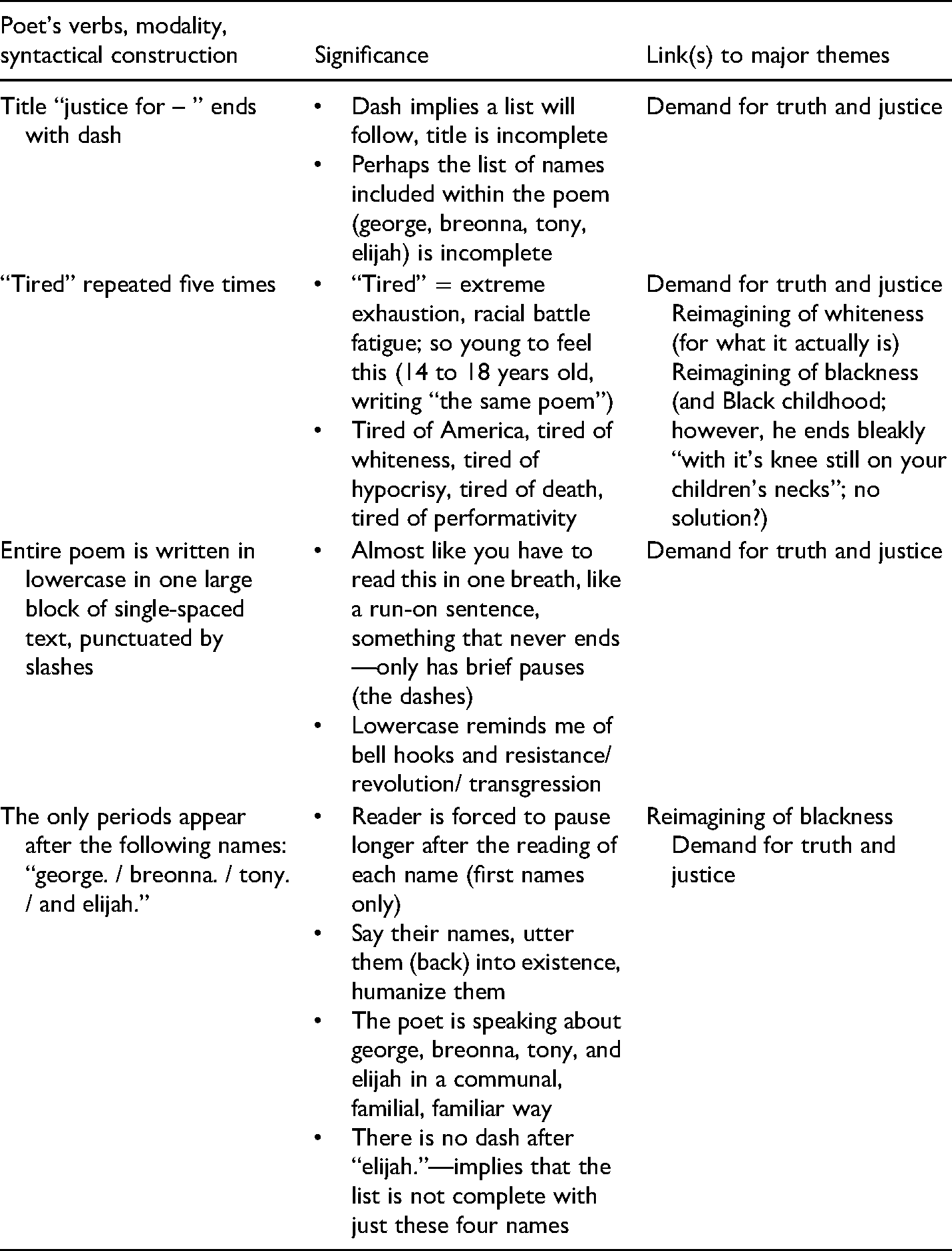
Ultimately, I sorted the in vivo codes into larger categories, stemming from patterns I observed in the young poets’ ways of representing and ways of being. In response to my research question focused on the poets’ reimagined literacies, I identified two major themes among the poems: a call for the reimagining of blackness (and whiteness), and the demand for truth, justice, and change. (See Table 2 for sample coding.) I utilize these themes as a guide in my conclusion for reimagining literacy practices in ways that align with Morrell’s (2008) argument that reading and writing “can assist us in transcending difficult moments in movement toward brighter ones” (p. 169), thereby “constituting and reconstituting the self” (p. 167).
Sample Verbs, Modality, and Syntactical Construction Coding for Samuel Getachew’s “justice for – ”.
Positionality Statement
Like Abby Johnson, I am a White woman with children who identify themselves as “Black,” as “mixed,” and in reference to their specific ethnic backgrounds. For the last 20 years, beginning before I had my own children, my research and professional experiences have centered on my concerns about how young Black people (and other youth of color) are seen and treated in educational and literacy contexts (e.g., Sciurba, 2014, 2017), and I have critically examined how race-based hate is intertwined with policing (Sciurba, 2020).
This being said, I also acknowledge Fuller’s 1968 discussion of the intersection of “Black revolt” and “Black aesthetic,” wherein he argued, “In order to look at Negro life unflinchingly, the white viewer either must relegate it to the realm of the subhuman, thereby justifying an attitude of indifference, or else the white viewer must confront the imputation of guilt against him” (Gates & McKay, 2004, p. 1856). While the civil rights era in which Fuller was writing is markedly different in many ways from the context of BLM and the protests of 2020, and he was writing specifically of literary critics who denied the value of Black poetry that dealt with “suffering,” the tension he identified remains and is something I must contend with as a White reader of Black children’s poetry. Understanding that this group of young people’s words also implicate me and force me to reckon with my own “culture of power” (Delpit, 2006), hearing “children’s existing voices” (p. 19) and observing their “fluency” (p. 16) constantly teaches me how to do better.
Young Black Poets Rising Against Injustice
Similar to poems about police brutality against Black children written by Audre Lorde, Jayne Cortez, and June Jordan, as discussed by Betts (2012), the young poets in my examination engage in literacies that scream for an end to the normalization of Black pain at the hands of White police and “white obliviousness” (Havercroft & Owen, 2016, p. 740). In the findings that follow, I discuss how their writing rescripts or reimagines blackness (and whiteness) and demands truth, justice, and change, thereby reimagining the worlds in which they currently live.
Reimagining Blackness (and Whiteness)
With the support of news outlets (ABC News, Bristol247.com, the New York Times) and a student-curated literary magazine (CHARM: Voices of Baltimore Youth), the young Black poets featured in this project, much like the Black Arts Movement poets discussed by Jennings (1998), “created poetry inspired by the concept of revolution” (p. 106). Specifically, their grassroots writing fights back against the racist system in the United States that presumes Black criminalization and White innocence (Muhammad, 2019), reclaiming their identities as Black youth in a “third space” (Soja, 1996), where such dichotomies are exposed as lies. Seeking to present their truths to an audience who may or may not understand their experiences or support their protests, they each confront “white obliviousness,” “soul blindness” (Havercroft & Owen, 2016), and the direct (in)actions of White people that have caused so much Black pain. As 11-year-old Josiah Wheeler stated in the ABC News article that published his poem: “The change I want to see happen is so everyone understands everyone else’s pain. Just because some others might not experience police brutality, doesn’t mean it’s not a real thing” (McCarthy, 2020).
As Shockley (2017) argued in relation to poetry about slavery, the young poets writing about the events of 2020 implore readers to acknowledge, and if they do not already possess it, develop consciousness related to “black experience and black subjectivity” (p. 40). That these poems seem to be written as messages to (White) adults from young Black people emphasizes 11th-grader Amaya Burke’s call to hear “THE VOICES OF THE UNHEARD.”
All of the young poets emphasize the innocence and humanity of Black people, often by forcing the reader to imagine them, as living, breathing children, in situations similar to what have led to brutal events like those of 2020. (I presume the first-person poetic “speaker” is the poet’s self.) For instance, in “TBIB 2020,” 11th-grader Rashad Holloway writes in all caps: MY PIGMENT MAKES A WHITE WOMAN CLUTCH HER PURSE WHEN I GO BY ALL I TRIED TO SAY WAS HI SHE CAN TURN MY GREETING [ACKNOWLEDGEMENT] INTO AN ALLEGATION
In this poem, Rashad demonstrates how being friendly to a White stranger can be risky, given that a White woman might find him and his blackness threatening. In contrast, this White woman and the police she might call upon to protect her are the real threats, fabricating allegations and committing brutal acts—even murder—against Black people. His bracketing of “[ACKNOWLEDGEMENT]” emphasizes the contrast between his approach to this White woman and her approach to him; she refuses to acknowledge his humanity or to see him as anything but a negative myth of blackness.
Whether simply walking “DOWN THE STREET,” as 11th-grader Ayodele Ayoola begins their poem “I AIN’T WELCOMED HERE NO MORE,” or just being “a Black man, innocent as anything” as 9-year-old Tiana writes in her “‘Black Lives Matter’ poem,” the young poets—like the adults in Dottolo and Stewart’s (2008) work on Black people’s experiences with the police—repeatedly “establish innocence with special force” (p. 355). In other words, none of the Black individuals in the poems have done anything to deserve a “world” that is, as Tiana writes, “not safe for us Black people.” As 11th-grader Amaya Burke states in her poem, which also is written in all caps, “NO MATTER WHAT WE DO / WE’RE A TARGET.” The culprit in each of these poems is White people, which reimagines whiteness as harmful and oppressive.
Rashad writes, “YOU SHOOT ME IN MY FRONT YARD / AND CLAIM THAT MY MELANIN WAS A SIN WORTHY OF DEATH.” Similarly, 9-year-old Tiana states that “he’s Black; therefore, he is bad, that’s what the police seem to claim” and questions, “So why is it white people are angels and black people are a sin?” Using religious discourse related to conceptualizations of good/evil and moral/immoral, the young poets—Rashad and Tiana most explicitly—demonstrate the ways in which their blackness has been used to separate them from virtue and righteousness. White people, however, are treated as righteous irrespective of their (evil, violent, sadistic, murderous) actions. Each of the poets reimagines race, racialized hierarchies, and racialized dichotomies, flipping the narrative prescribed to them and placing it rightfully upon those who enact “the wrongness of whiteness” (Sciurba, 2020). They, therefore, reimagine racial literacy in ways aligned with Skerrett’s (2011) understanding of antiracist literacy that goes beyond classroom walls to “devise powerful strategies to redress racism” (p. 329).
In his poem “justice for -, “ which is written in all lowercase in one block of text punctuated with slashes, 18-year-old Samuel Getachew reimagines White “america” and “white moderates” in ways that implicate whiteness and White people for their engagement with sadistic voyeurism and false progressivism. He writes: i am so tired / of explaining why i’m tired / of viral videos / and an america that says / that if she does not get to watch a dying man’s last breath / that if she does not get an open casket funeral / a published photograph of the corpse / she cannot say for certain if he lived / or died / so tired
Using the word “tired” five times in this 13-line poem, Samuel emphasizes his frustration with the White gaze on Black bodies in pain (King, 2008), through which Black lives are obscured by trauma and death. Additionally, this poet, the oldest writer featured in my examination, critiques the culture of voyeurism that permits “viral videos” that serve as sadistic evidence (or not) that a crime against a Black individual has taken place. Likewise, he is tired “of mlk quotes out of the white moderates he fought against.” In addition to reimagining whiteness as dehumanizing, Samuel’s poem reimagines whiteness as a contradiction. White people murdered Martin Luther King, Jr., yet honor his life by repackaging his words for their own purposes. This poem makes clear that it is not just White police who are detrimental to the Black community, but White individuals who maintain and benefit from their own false imaginings of blackness and whiteness.
Demanding Truth, Justice, and Change
In addition to demanding truth about blackness and whiteness, the young poets demand a true, rescripted narrative of the police—one that does not celebrate law enforcement officers as “institutional protectors” (Durr, 2015, p. 1) or “helpers” (Kolluri & Young, 2021), given the threats they pose to Black citizens. All six of the poets reference police officers, who are named as “MEN IN BLUE,” “THE POPO,” “THE PROTECTORS,” “THOSE BOYS IN BLUE,” “A PIG,” “MENACE 2 SOCIETY,” “officers,” “MURDERERS,” “cops,” or simply “the police.” The youngest two poets, Josiah and Tiana, while just as critical of the police as the older poets, use direct language (“the cops,” “police officer”), whereas ninth-grader Ayodele and 11th-graders Rashad and Amaya refer to the police with colloquial nicknames that demonstrate negative perceptions of them (e.g., “MENACE 2 SOCIETY,” “PIG”) or nicknames, used ironically, that typically call to mind police officers’ uniforms and “heroic” service to the community (e.g., “MEN IN BLUE,” “PROTECTORS”). Whether or not the language they use to describe the police reflects their positions on how the police should be reimagined, each poet makes it clear that the “un-tellings” consistently told about the police (Sciurba & Jenkins, 2019) are illusions that prevent most White Americans from recognizing the truth. Again, as Josiah stressed in his interview, “Just because some others might not experience police brutality, doesn’t mean it’s not a real thing” (McCarthy, 2020).
The young poets stand up against the ways officers of the law acted with insidious and hateful brutality in 2020 alone. Out of the six poems I examined, five explicitly mention knees on necks or throats, in reference to the death of George Floyd. Rashad, for example, writes, “YOU STEP ON MY BROTHERS NECKS WHILE GUNNING DOWN MY SISTERS.” Amaya, also referring to George Floyd and putting her poem in all caps, writes: WE ALL WATCH AS HIS LIFE SLIPS AWAY FROM HIM 8 MINS OF HORROR ANOTHER LIFE TO MOURN
Although 9-year-old Tiana does not weave the brutal “knee” imagery into her poem, she does reference “George” twice, by just his first name. Like Rashad, 18-year-old Samuel also pays tribute to Breonna Taylor. He begins his poem, “justice for – ”: i tried to write a poem for george. / and breonna. / and tony. / and elijah. and none of them made it past a scribble / past a draft / past the passing thought / that i could leave the name and the details blank / and this would be the same poem / that i’ve been writing since i was 14 years old / and i am so tired
The list of first names, followed by periods and slashes, compels the reader to pause and consider each Black individual named: George Floyd, Breonna Taylor, Tony McDade, and Elijah McClain. While this poem is a call for “justice for” each of these people who were killed by police, the dash after “for” suggests that these are not the only names Samuel could have included, linking to his inability to write a poem that differed from the one he has been writing for years. He, like the other poets, is “tired” of injustice, angered, saddened, and afraid after the events of 2020, and calling for real change—such that those who are paid to defend and protect society are not permitted to create its “HORROR,” as Amaya describes the bloodshed of this year.
The young poets, like the poets of the Black Arts Movement, use literacy prowess to demand social transformation and self-liberation (Jennings, 1998). Tiana suggests that transformation and liberation will come, with the help of God: Go down to hell police officer Go down there Down Down D o w n
Engaging in religious discourse for a second time, Tiana relegates anti-Black police officers to the realm of evil, with a sentence to “hell”—an imagined punishment in place of the punishment officers usually do not receive on earth after deaths like those of George Floyd or Breonna Taylor. Along with references to getting shot, being choked, having knees placed on their necks, or gasping for breath, which recall the incidents of 2020, the young people address more general anti-Black police brutality with mentions of being slapped, punched, beaten, stepped on, left “black and blue” or bleeding, all of which are rooted in true stories of anti-Black police brutality, racial profiling, and complete disregard for Black humanity and life. Even in their references to Black suffering and pain, the poets make it evident that change is destined to come and that they will do their parts to ensure that it will—in part by putting these words on the page, just as Morrell (2008) suggested.
The young people express, in many instances, that they and their communities are now fueled by anger and “RAGE.” Amaya addresses this most directly, citing quotes from what appear to be White people who do not understand her community’s trauma: “WELL DON’T RESIST” “JUST STAY CALM” “JUST COMPLY” NO MATTER WHAT WE DO WE’RE A TARGET OUR SKIN WILL STILL BE SEEN AS A THREAT THEIR KNEES WILL STILL BE ON OUR NECKS MY PEOPLE ARE TIRED AND NUMB “RIOTING WON’T HELP ANYWAY” “LOOTING WON’T BRING HIM BACK” THEY DON’T NOT UNDERSTAND THAT OUR NUMBNESS HAS TURNED INTO RAGE OUR RAGE KEEPS US GOING OUR RAGE IS NOW OUR STRENGTH
Amaya’s poem is a call to recognize why “RAGE” is the only way to achieve change. Deeply embedded in each of the children’s poems is the sentiment that they “COULD BE NEXT,” as Rashad writes. If anger does not propel them toward what Rashad calls a “REVOLUTION,” they run the risk of this cycle of anti-Black policing repeating itself. He writes, “CHANGE MUST COME / OUR REVOLUTION MUST BE WON.”
Nine-year-old Josiah insightfully writes, “My skin’s not a weapon.” Through poetry, his Black skin and the Black skin of his fellow poets is rescripted. Each of the young writers, irrespective of the way they imagine transformation occurring (through revolution, through riots, or by being “friends,” as Tiana suggests) or not occurring (as in the case of Samuel, whose poem concludes “with it’s knee still on your children’s necks”), demonstrates the way that writing can encourage critical examinations of the world and play “an explicit and self-referential role in changing the world” (Morrell, 2008, p. 167). The young people’s poems push us to reimagine a literacy centered on Black advocacy and justice-oriented discussions that go beyond “oversaturation of the teaching of enslavement or the Civil Rights Movement” noted by surface-level discussions of Martin Luther King, Jr. or Rosa Parks (G. Muhammad, 2020, p. 20).
Study Limitations
This study was limited to a small selection of youth poetry, curated by adult and student journalists, and in no way intends to represent the rich panorama of young Black people’s responses to the incidents of 2020. I was unable to speak directly with the poets, and while I believe in the tremendous value of examining the content produced and shared publicly by Josiah, Tiana, Ayodele, Rashad, Amaya, and Samuel, the field of literacy research would also benefit from continuously inviting young Black poets to share how they imagine their writing contributing to social change.
“Black Boy, Black Boy, What Do You See?”: Cultivating Black Children’s Literacy-Based Criticalities
Like many parents, I have regular access to my own children’s outside-of-school literacies, which repeatedly teach me how to cultivate their criticalities in meaningful ways, as G. Muhammad (2020) implored educators to do. In restorying Bill Martin’s (1996) Brown Bear, Brown Bear, What Do You See?, my 9-year-old son made very clear what he “see[s]”—and also wishes not to see—as a Black boy. The fear of White police “looking at me” as a criminal or as someone “bad” was evident in his words, recited for a baby brother who has no idea yet what blackness or whiteness means. After observing my own child’s painfully real transaction with a popular children’s book, as well as his use of poetry to process the police violence committed against Jacob Blake and George Floyd, I wanted to learn from “other people’s children,” too (Delpit, 2006). I wanted to know how other young Black poets engaged in grassroots literacy practices to challenge the injustices they witnessed in 2020. I wanted to learn how they were using poetry to “read the world” (Freire & Macedo, 1987) but also to reimagine it (Baxley & Sealey-Ruiz, 2021; Morrell, 2008).
Just as Betts (2012) pointed out in her analysis of poems about police brutality against Black children written by Black women, the poems I found by Black children seek “forms of healing and redemption in the aftermath of tragic deaths,” “embody testimonies that document what happened,” and “stand as poetry of witness” (p. 71). (Betts’s analysis, which centers on Black women’s poetry of the 1970s, is framed by King (2008) in African Americans and the Culture of Pain, Griffith’s (2009) work on “testimony” and the “racialized body,” and Henderson’s (2002) discussion of the African American literary tradition of “protest” against “dehumanizing conditions” [p. 6].) Whereas anti-Black responses to the events of 2020 fixated on “support” for the police (e.g., Blue Lives Matter) or the supposed criminality of the Black people involved in recent incidents, this group of young Black poets demonstrates the urgent need to disrupt their countries’ collective mindsets about the police and put a stop to the violence that repeatedly claims Black lives. The young people’s words are protests against a system that is rigged against them—a system that prevents them from being seen and treated as children simply because they are Black (Dumas & Nelson, 2016).
By raising their own voices as youth, to demand attention to how they are forced to “merely survive” (Love, 2019) in a world composed of racist police practices, the poets reclaim their lives and urge their readers to reckon with acts of racial injustice committed by individuals who make commitments “to protect and to serve.” As their poetry reimagines racial literacy, blackness and whiteness, and a narrative of the police focused on truth, justice, and revolution, their poetry is literacy, reimagined. Their words, centering their own identities, perspectives, and experiences, demonstrate their own “pursuit of criticality,” which when cultivated by educators, gives “students the tools to respond to injustice in and around schools” (G. Muhammad, 2020, p. 119). In the wake of the 2020 election, as more and more Blue Lives Matter and Confederate flags have gone on display, it is vital to acknowledge the “soul blindness” (Havercroft & Owen, 2016) that is leading people to ignore—or dismiss—the “screams” rising from Black children. (Betts, 2012, likewise, referred to the “screams” transmitted by Black women’s poetry about Black children who were slain at the hands of White police.) Literacy educators and scholars are uniquely positioned to harness the ugliness of this world, to help young people see and respond to it for what it is, and to use the combined power of their own words and imaginations to transform it into something different.
Returning to Flowers’s (2020) call to draw from the power of grassroots literacy initiatives to transform classroom practices, educators should think about how young Black poets’ works can be incorporated into the classroom as contemporary literature or as models for designing writing and other creative literacy (e.g., poster, advocacy campaign, video, and other multimodal) activities that enable students to “articulate, embrace, and analyze their own lived experiences as part of their development as writers, intellectuals, artists, and potential agents of change” (Morrell, 2008, p. 181). As the young poets demonstrate in this article, freedom is the ability to live and breathe, to feel safe, and to thrive in their own skin (Love, 2019). No one should have to fight for that freedom—children especially. And they certainly should not have to fight for that freedom in the classroom.
If educators cannot create spaces for Black students “to process their feelings and thoughts about police violence against Black people” because they are not “willing to discuss the issue” (Proctor et al., 2020), they are stagnating young people’s criticality and fostering the exact kind of (il)literacy that leads individuals like Abby Johnson to believe in anti-Black “statistics” (Sherman, 2020). Educators can and should go beyond isolated literacy “skills” instruction to ensure that students’ identities, lives, and well-being are centered, and G.Muhammad (2020) provided a concrete framework for taking this work to a new height, for reimagining a literacy “defined as liberation and power” (p. 22).
As I searched for poems for this study, I came across this one by Antwon Rose, written for his 10th-grade honors English class in 2016: I AM NOT WHAT YOU THINK! I am confused and afraid I wonder what path I will take I hear there’s only two ways out I see mothers bury their sons I want my mom to never feel that pain I am confused and afraid I pretend all is fine I feel like I am suffocating I touch nothing so I believe all is fine I worry that it isn’t, though I cry no more I am confused and afraid I understand people believe I’m just a statistic I say to them I’m different I dream of life getting easier I try my best to make my dream come true I hope that it does I am confused and afraid
On June 19, 2018, Antwon was shot and killed by a White police officer. He was 17 years old. His teacher, Laura Arthrell, found this poem and presented it to his mother, Michelle Kenney. Kenney “wanted everybody to hear the poem,” Arthrell told PBS News Hour: Antwon “may have been speaking for himself, Arthrell said, but he was also writing for a lot of the kids that were growing up around him” (Barajas, 2018).
In his discussion of writings stemming from marginalization and oppression, Morrell (2008) turned to Gates’s (2002) work on slave narratives to explain that these texts exist “as a way for the authors to write themselves into being.” These texts also give being to “the others implicated in these narratives” (p. 180). By naming the issues that arise in Black youth poetry, educators can create reimagined classrooms that honor “the fluency the kids already possess” (Delpit, 2006, p. 17). Turning to young people’s outside-of-school, grassroots literacies can teach educators more about the fluencies that matter most, the fluencies upon which our students’ hopes, dreams, and fears, like Antwon’s are based. Becoming conversant with young people’s fluencies has the potential to revolutionize education and affect social transformation. The first step is to welcome their fluencies into classroom spaces, even when these fluencies push (some of) us to unsettling or uncomfortable places.
We, as an education community, owe it to young people like Josiah, Tiana, Ayodele, Rashad, Amaya, and Samuel to mobilize to the full extent that we can—within literacy spaces—so they never have to “beg for [their] lives” or watch their “brothers and sisters die” at the hands or under the knees of whiteness, a badge, and power. If we insulate our literacy classrooms from discussions of anti-Black policing and its effects on Black children, we prevent young people from enacting change. We block their abilities to write themselves into being.
And as Antwon’s posthumously published poem screams to us, no child should ever have to write their self into being from the grave.
Footnotes
Declaration of Conflicting Interests
The author(s) declared no potential conflicts of interest with respect to the research, authorship, and/or publication of this article.
Funding
The author(s) received no financial support for the research, authorship, and/or publication of this article.

References
Supplementary Material
Please find the following supplemental material available below.
For Open Access articles published under a Creative Commons License, all supplemental material carries the same license as the article it is associated with.
For non-Open Access articles published, all supplemental material carries a non-exclusive license, and permission requests for re-use of supplemental material or any part of supplemental material shall be sent directly to the copyright owner as specified in the copyright notice associated with the article.
