




Abstract
Given the persistence of anti-Blackness, the author demonstrates what can happen when Blackness takes precedence over anti-Blackness in an 11th-grade English classroom. This study uses critical autoethnography to explore a collaborative approach to teaching and learning that sustains Blackness. The author uses storying to amplify the significance of relationship building between a Black teacher and a Black teacher-researcher. This research further provides tools for transforming classrooms into sites of hope, healing, and resistance in a time when Black lives matter more than ever. In closing, the author offers the framework of justice-oriented solidarity (JOS) and highlights the power of cocollaboration to create an antiracist learning environment that sustains Blackness.
Introduction
Flesh. Flesh that needs to be loved. Bones. Skin. Sinew. Say her name: Renisha McBride. Renisha McBride. Renisha McBride.
I begin this article with six lines from Rae Paris’s (2017, p. 110) harrowing poem, The Forgetting Tree: A Rememory, which she wrote in remembrance of the heinous killing of Renisha McBride, a Black woman, who after crashing her car walked to a stranger’s house in a White suburb in Michigan seeking help for her wounded body. Paris’s poem poignantly asserts that Black flesh—Black humanity—needs to be loved. However, paradoxically, Paris acknowledged, “The assault on our bodies, minds, and hearts has always been” (p. 110). Just as Renisha was assaulted and killed, some Black youth experience similar assaults—literally and metaphorically, through the killing of their souls resulting from anti-Black racism and White supremacy in classrooms across the country. For example, a disproportionate number of Black students are punished, suspended, and expelled compared with their White peers who exhibit similar behaviors (Coles & Powell, 2020; Gilliam et al., 2016). Thus, carving out a Black Space1 in schools is critical for Black students.
In The Forgetting Tree: A Rememory, R. Paris (2017) defines a “Black Space” as a place where stories of the past and present, relative to traumas, resistance, and healing, can be shared. Building on R. Paris’s (2017) notion of a Black Space, in this study, a Black woman English teacher and I came together to carve out a Black Space to help Black students make sense of their Black histories and personal traumas by engaging in resistance and healing. We supported students in understanding the complexities and impact of White supremacy, illuminating how it underpins anti-Blackness and contributes to Black people’s suffering.
As partners, we cultivated a Black Space where curricular content was designed around our students’ lived experiences. At the same time, we provided Black students opportunities to imagine their Black lives without the haunting presence of anti-Black racism, which is “a pervasive and mutable construct in U.S. society” and in the school curriculum (Brown & Brown, in press, p. 72). Anti-Black racism exemplifies Black suffering and describes the system of oppression linked to institutional practices, policies, and cultural messages as well as the beliefs and actions held by those who seek to oppress Black people (Brown & Brown, in press; Dumas, 2018; Tatum, 2017). A Black Space in a literacy classroom is a departure from anti-Black racism. In this space, educators center Black students’ Blackness by accepting the multiple identities of Black students’ humanity through love and affirmation (Johnson, Jackson, et al., 2017). Finally, it is a space where Black students have opportunities to celebrate Black pride, achievement, histories, and language.
As a Black woman, teacher-researcher, and mother of two Black boys, I am impassioned to capture this collaboration to encourage other mutual partnerships between scholars and literacy teachers and among educators. The call to understand why there is an urgency to affirm Black students’ humanity and to show how to best meet their needs warrants focused attention on an approach that foregrounds Blackness.
This article details our shared commitments and my own reflective experience in teaching with and learning alongside a Black woman English teacher and former colleague. The partnership helped us arrive at a mutual understanding of what is needed to cultivate a Black Space. To provide critical support for Black students and their teachers, I developed a justice-oriented framework for teachers who want to collaborate with researchers and educators to foster an environment that supports Black students. Thus, in this study, I share the stories of our relationship, stories that reflect how our collaboration, grounded in love and a shared vision, fostered and sustained what I name justice-oriented solidarity (JOS). To illustrate JOS, I asked the following research questions:
Framing the Context of Literacy Education
In the United States, schools have historically been built upon White supremacy, which has marginalized Black people since slavery (Rickford & Rickford, 2000). Although the United States is the context for my argument, anti-Blackness is a global structure that produces a series of phenomena (e.g., police shootings—resulting in racial unrest, school closure, and Black people disproportionately dying from COVID-19). During slavery, White slave masters denied enslaved Black people the right to obtain literacy. They knew that “being able to read and to write would have provided the slaves the opportunity to learn about what was happening around them, [which is why] white people disallowed opportunities for the [slaves’] becoming literate” (Williams, 2005, p. 12). Perhaps the ability to read and write might have lessened White people’s power and contributed to Black people’s liberation from their masters. This dichotomy created the “containment and repression of a literate culture among its enslaved population as it did on the diffusion of a literate culture among its free population” (Anderson, 1988, p. 1). Hence, learning environments that prevented literacy among Black people were encouraged. Noticeably, the kinds of literacy Black people had access to were limited.
The early schooling of Black people was organized around the assumption that they were subordinate to the dominant group and deserved adverse treatment, which led to the dehumanization of Black people (Anderson, 1988; Douglas, 2005; Massey & Denton, 1993). However, despite the dominant group’s attempts to structure schooling to promulgate their power, Black people fought for better treatment by breaking down the structures that had oppressed them since they were captured from their homeland (Anderson, 1988; Douglas, 2005; Massey & Denton, 1993). Anderson (1988) argued that “schooling has been about democratic citizenship,” just as much as it has involved “schooling for second-class citizenship” (p. 1). Schooling intended to “school” Black people, who were considered, at best, second-class citizens. As a result of long-standing dominant assumptions and White supremacist thinking, Black people’s lower literacy rates have emerged from deep-rooted power structures that are simultaneously visible and invisible.
Ladson-Billings (2005) argued, “Literacy is deeply embedded in our conceptions of humanity and citizenship; that is, one must be human to be literate and one must be literate to be a citizen” (p. 135). However, due to a long history of exclusion in the United States, Black students “struggle to acquire the kind of literacy that leads to liberation” (Ladson-Billings, 1995, p. 135). White people’s positioning of Black people as subhuman contributed to Black people’s difficulty acquiring the literacy practices that they needed to function as citizens in a purportedly democratic society. Because literacy is essential to societal functioning, its absence served “as a continual reinscribing of the nonhumanness of the Black, a legitimization of the very anti-Blackness that has motivated centuries of violence against black bodies” (Dumas & ross, 2016, p. 429). Moreover, it is worth noting what kinds of literacy one is given access to because engaging in criticality (e.g., the opportunity to name, interrogate, and dismantle anti-Blackness) with literacy and with Black students is most often absent from schools serving Black students (Collins & Blot, 2003). Today’s literacy classrooms, then, must be careful not to reify anti-Blackness and contribute to Black students’ suffering.
Implications of Anti-Blackness in Literacy Education
Anti-Blackness has lifelong implications on Black people’s lives and education (Baker-Bell, 2020; Coles, 2018; Love, 2019). Therefore, in this study, I used Dumas and ross’s (2016) theory of anti-Blackness to illuminate how it underpins the racial injustices incurred by Black students. Dumas and ross describe the Black condition in relation to the trauma, suffering, pain, and disdain of and violence toward Black people. Thus, in taking up their conceptualization in my work to affirm Blackness in literacy education, I acknowledge how anti-Blackness can be used as a weapon in the literacy classroom to mentally and physically harm students over time (Jeffries, 2014). A century of Black scholarship highlights how the internalization of White supremacy and anti-Blackness has historically affected Black people and prevented Black students’ education (Du Bois, 1996; Dumas, 2014; Fanon, 1963; Kendi, 2017; Woodson, 1972). Moreover, to address anti-Black experiences, which many Black students continue to face in literacy classrooms (Baker-Bell, 2019; Haddix, 2009), I offer a JOS conceptual framework to inform how researchers and teachers who seek to center Blackness might work together to support their Black students.
Teaching in Solidarity to Disrupt Anti-Blackness
JOS
A collaborative and reciprocal relationship between Ms. Thomas (all names are pseudonyms) and me fostered the development of what I define as JOS, a collective effort to support and sustain our students culturally, linguistically, and racially. This study acknowledges the importance of working in solidarity with teachers, researchers, and students (Garcia et al., 2020; Love, 2019; Martinez, 2017; Razfar & Rumenapp, 2013). By solidarity, I mean having shared commitments, collaborating, and sharing the responsibility to address anti-Blackness with Black and White students. As Razfar and Rumenapp (2013) argued, working in solidarity is strategic conscious synergy with those we share identity affiliations with and those we do not. It also means fostering a reciprocal relationship built on collaboration. Teaching and learning in a Black Space is about working with and learning from each other—and this includes, most importantly, the students. In learning and growing together, teachers, researchers, and students are accountable to each other. The mutual learning and accountability create solidarity, a necessary component of justice-oriented teaching and learning in a Black Space. In our Black Space, we jointly elected not to engage in furthering our Black students’ suffering. Finally, it is important to acknowledge that “literacy education remains a battlefield for justice” (Sealy-Ruiz, 2020, p. x). Thus, taking a justice-oriented approach to teaching and learning is vital when choosing to work in solidarity to reverse injustices imposed on Black students by affirming their minds, lives, and bodies (Blackburn & Smith, 2010; Kinloch, 2010; Kinloch et al., 2017).
JOS (Figure 1) builds on Alim and Paris’s (2017) culturally sustaining pedagogy (CSP) and Johnson’s (2018) critical race English education (CREE). CSP (Alim & Paris, 2017), an asset-based approach to teaching and learning, helped us to think about how to cultivate a Black Space that supported “sustaining the cultural ways of being of communities of color” (p. 5). In this study’s context, we looked for ways to affirm students’ Black humanity. In doing so, we began with an asset-based approach to teaching and learning that repositioned Black students as a resource and an asset to support them. While an asset-based approach was necessary, it was not sufficient. As a result, we moved toward a sustaining-based approach whereby naming, interrogating, and dismantling anti-Black racism were essential components of longitudinally sustaining and perpetuating student cultures and identities (Alim & Paris, 2017).
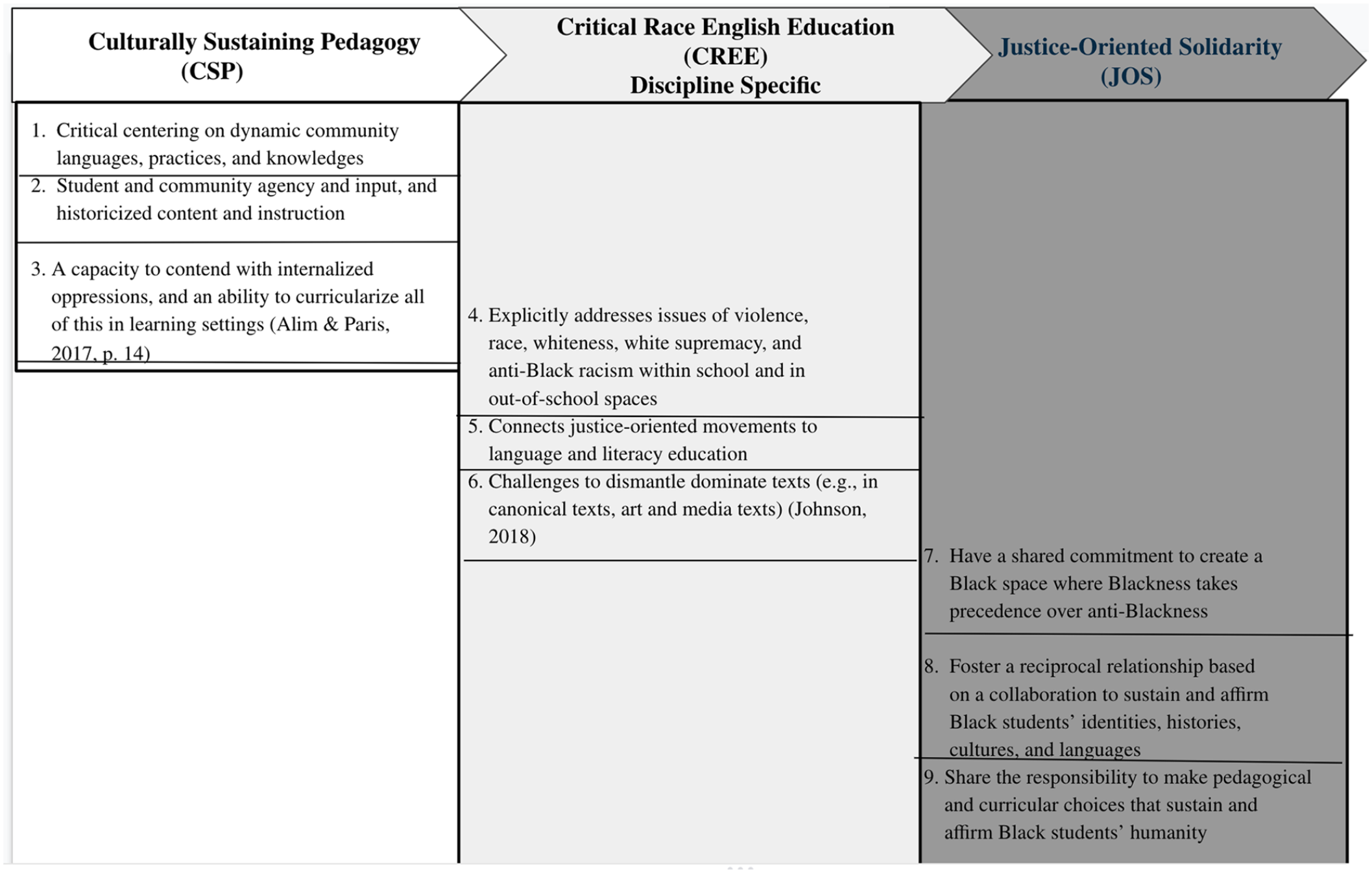
Key Features of CSP, CREE, and JOS.
To engage CSP and the discipline-specific concerns of English classrooms, I built on Johnson’s (2018) theory of CREE to conceptualize JOS. CREE, “as a movement of solidarity” (Johnson, 2018, p. 120), supported the possibility of Ms. Thomas and me focusing “on the ways in which anti-blackness and violence, historically and currently, permeate English classrooms, [and] are deeply embedded within curriculum, standards, and routine pedagogies” (p. 109). CREE, then, offered a way of thinking about antiracist teaching and learning that specifically names and dismantles White supremacy and anti-Black racism in English classrooms. For example, Ms. Thomas and I provided opportunities for students to draw on their lived experiences and to name, interrogate, and dismantle anti-Blackness in Wright’s (1945) Black Boy and Thomas’s (2017) The Hate U Give. Most importantly, given the history of literacy in the United States, CREE supports a justice-oriented approach to English teaching and learning.
JOS is critical because it is a framework that moves from the singularity of teachers to the collective. Ms. Thomas and I shared the same accord, so carving out a Black Space aligned with our commitments. I learned from Ms. Thomas that the antiracist work we engaged in was not pervasive within her English department. JOS is about multiple people working together and learning from each other to create a more just English teaching and learning environment where Blackness is centered. It expands on CSP and CREE (see Figure 1, pp. 7–9) in three distinct ways. First, it foregrounds sharing a commitment to create a Black Space where Blackness takes precedence over anti-Blackness. Second, it fosters a reciprocal relationship based on a collaboration to sustain and affirm Black students’ identities, histories, cultures, and languages. Third, it requires the shared responsibility to make pedagogical and curricular choices that sustain and affirm Black students’ humanity.
Method
Practitioner inquiry served as inspiration for this study (Cochran-Smith & Lytle, 2009). Cochran-Smith and Lytle (2009) defined practitioner inquiry as a systematic, intentional inquiry by teachers about their work. This type of exploration is based on teachers not only knowing their practice but also making discoveries that can improve their practice. This collaboration was built on our shared commitments, grounded in antiracist approaches to teaching and learning to build work in solidarity and build community in a Black Space (Baker-Bell, Paris, & Jackson, 2017; Bauer et al., 2020).
In addition to the use of practitioner inquiry, I continue the tradition of Black women writers (e.g., Audre Lorde, Anna Julia Cooper) and Black women scholars (e.g., Baker-Bell, 2017; Baszile, 2006) who explore issues of White supremacy and anti-Blackness in their narratives. In doing so, I used critical autoethnography to call attention to relationship building and students’ critical consciousness raising in a Black Space where Blackness is affirmed. Critical autoethnography helped me to explore and to highlight the interweaving of our personal stories so that I could examine closely how Ms. Thomas and I came to cultivate a Black Space (Baszile, 2006; Johnson, 2018). I foreground four stories of our partnership to describe our commitments, choices, and experiences to make connections to the importance of centering Blackness (Baker-Bell, 2017; Johnson, 2018; Johnson, Gibbs Grey, & Baker-Bell, 2017; Johnson, Jackson, et al., 2017). In using a critical lens, Ms. Thomas and I modeled our own reflexivity in critiquing anti-Blackness to support students centering Blackness (Baker-Bell, 2017; Baszile, 2006; Griffin, 2012; Johnson, Jackson, et al., 2017). Thus, like Johnson (2018), I drew on Ms. Thomas’s and my personal experiences, which helped us contextualize our teaching around the students’ personal experiences. Furthermore, I situate our stories within the broad cultural experiences of anti-Blackness.
Teacher-Partner
My partnership with Ms. Thomas, the classroom teacher, was central to my inquiry. Ms. Thomas is a Black woman who has taught for 10 years overall, with 5 of them at Sutton Academy, where the study took place. My relationship with Ms. Thomas began many years before starting the study because we were both born and raised, albeit in different generations, in Midwestern communities permeated by anti-Blackness. I was born in Detroit, a city that recently experienced race riots motivated by ongoing racial discrimination and Black people’s social and economic marginalization (Sugrue, 2014). Ms. Thomas was born 20 years after me, in a nearby racially mixed suburban community dealing with anti-Blackness as Black people migrated into a suburban community for what they thought would be better schools and housing (Sugrue, 2014). Ms. Thomas and I eventually chose to return to teach in the communities where we were born and raised. Out of these experiences, we shared a commitment to our communities and a vested interest in the betterment of Black students’ lives. Ms. Thomas affirmed my sentiments during our first interview: It’s important for me to not have an anti-Black classroom because I do try to put the kids first. And I think about them as a whole person. And in this day and age, I think it’s so important for them to accept who they are—whoever that is. Know certain things about history or society and understand who they are and maybe how they’re viewed. (February 15, 2018)
My teaching relationship began with Ms. Thomas when I was an adjunct instructor at a large university in the Midwest more than 15 years before the study began. Ms. Thomas, a student in my adolescent literature course, appeared eager to learn about critical pedagogies with which she could engage her students. Later, our paths crossed when she applied for a teaching position at the school where she had graduated high school and where I taught and was the department chair. As a department chair, I was impressed with the myriad opportunities that she created for her Black students, including their engagement with literature by and about Black people. Even more, she engaged students in critical discussions about what they had read and learned. I viewed our relationship as an asset to the study because we were two Black women who elected to affirm our students’ Black humanity. Undoubtedly, I hold personal biases about Ms. Thomas that affect my interpretation of the data. However, I contend that our previous working relationship and respect for each other allowed me to collaborate with her using a coteaching and a coplanning model where we shared responsibilities that might not have been possible without an established relationship before the study.
School Context
The study took place at Sutton Academy, a public high school located in a metropolitan area in the Midwestern United States. During the time of the study, the academy served students from Grades 9 through 12, with a total student body population of 399. Overall, 97% of the student population was African American, 2% White, and 1% Asian. As reported on March 4, 2019, the school is one of the state’s highest ranked schools in the state. Ms. Thomas taught five 11th-grade English sections. We chose a classroom with 17 students as the focal class, which comprised 16 Black students and 1 White student.
Methods of Data Collection
Throughout the study, I went back and forth between participant and observer (D. Paris, 2011) because I taught alongside Ms. Thomas, and I examined how her positioning and pedagogical practices worked to sustain a classroom environment where Blackness took precedence over anti-Blackness. Centering Blackness meant that we accepted and honored the multiplicity of voices and varied identities of our Black students, and we focused on Black people’s lived experiences (Johnson, Jackson, et al., 2017). Our disdain for anti-Blackness foregrounded our providing a Black Space where Black students could conceptualize the possibilities of their Black humanity and not just see themselves as limited in an anti-Black world (Dumas & ross, 2016; ross, in press). Simply put, in a Black Space, Blackness and anti-Blackness could not simultaneously exist. Therefore, Blackness took precedence over anti-Blackness.
Before actual observations began, I met with Ms. Thomas three times during her prep hour to begin planning a CREE curriculum (Johnson, 2018). We discussed what she wanted to cover and where we could implement a unit that focused on Blackness. I took notes and collected the textbook and other materials. To see what an asset-based approach to teaching and learning looked like, I made classroom visits two or three times a week, for 50 minutes each visit, over a span of 6 months. Each visit was either video or audio recorded. I transcribed parts of the audio and video recordings. I wrote detailed memos about my observations, and the memos were organized under the following headings: dialogic culture (i.e., what is happening in action), cultural norms (i.e., what the typical or unexpected social behavior is), cultural dynamics (i.e., how the students interacted with each other and the teacher), the implications (i.e., significance to research goals), and moving forward (i.e., what did Ms. Thomas and I need to do as far as future planning to affect instruction; Emerson et al., 2011). In doing so, I was able to organize my thinking about the classroom.
Teacher interviews and classroom observations served as the primary sources for this article. This article draws on four focused interviews with Ms. Thomas about her teaching and my observations of her classroom literacy practices. During the first phase of the study, I met with Ms. Thomas to better understand her teacher positioning toward the importance of affirming and sustaining Black students’ lives, and how she thought she met her students’ needs. Hence, I attempted to determine if we held similar commitments around Blackness taking precedence in an English classroom. Also, I built relationships with students by sitting in on group discussions in class and during lunch time. I mostly listened, but I occasionally engaged in discussion when a student asked for my opinion. I peripherally participated in Ms. Thomas’s classrooms to see what was happening and build trust with students, mainly because I anticipated their engagement in discussions about race, racism, Blackness, and anti-Blackness, and perhaps sharing their experiences with anti-Black racism.
I observed her classes 3 days a week for a month to determine how Ms. Thomas’s positioning and teaching aligned with how she articulated her commitment to an antiracist classroom. Moreover, I sought to identify elements of her practice that could lead to a justice-oriented classroom. In the next phase, Ms. Thomas and I chose the class in which we would partner to engage in justice-oriented work. Together, we decided that her fifth-hour class served as the best choice because many of the students seemed open to sharing their experiences with anti-Blackness and working collaboratively on some of our planned projects (e.g., creating digital stories). Once I decided that Ms. Thomas and I had shared commitments to dismantle anti-Blackness in practice, our partnership evolved. The 6-month partnership included in-person meetings and my observations of her fifth-hour English class 2 to 3 days a week.
I examined the data by using two cycles of qualitative coding (Miles et al., 2014). There were two phases of the qualitative analysis process. I began with a data set, which included four transcribed interviews, 28 observations, and three planning meetings. Before coding, I read through the transcripts and field notes from Ms. Thomas and me. I did not include student data in this analysis because I was focused on the relationship and shared commitments between Ms. Thomas and me as teacher-researcher partners. The coding of the data was a continuous iterative process (Miles et al., 2014). In the first cycle of coding, I created individual codes related to our relationship, the teacher–student relationship, and the curriculum. For example, because Ms. Thomas’s asset-based approach to teaching was important to CSP, I coded for her care toward students’ lives and languages. I also coded for the literature in the curriculum and for any examples of CREE that were referenced in our conversations. To make sense of how these individual codes related to each other, I organized them under larger codes (Table 1) critical to describing our shared commitments: personal stories, teacher partnership relationship building, student relationship building, centering Blackness, an asset-based approach, and curricular choices. After identifying the six significant codes, I looked for frequency, defined the codes, and provided examples. It is important to point out that these codes overlapped and informed each other, though I have made them appear distinct for the sake of clarity.
Coding of Data.
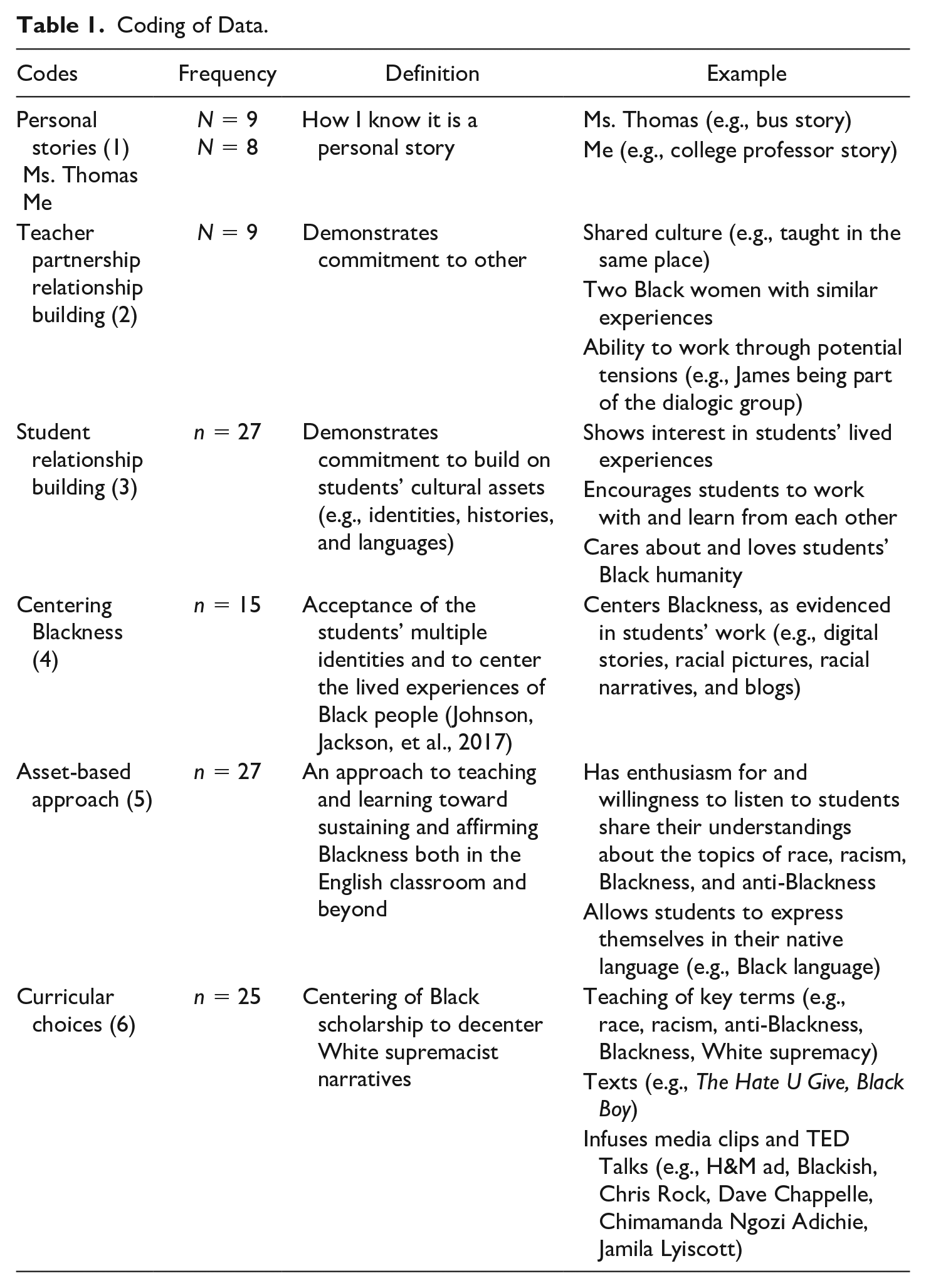
I used these six codes to construct the four stories (see Table 2) that describe the collaboration between Ms. Thomas and me. Using critical autoethnography, I came to narrate the following four stories based on our critical understanding of and shared commitment to Black students’ humanity. In centering our voices, critical autoethnography was vital because I sought to illuminate Black women’s consciousness and commitment to focusing on Blackness and justice. In each of the stories that follow, I describe how our conversations and positioning evolved into JOS.
Coding of Stories.
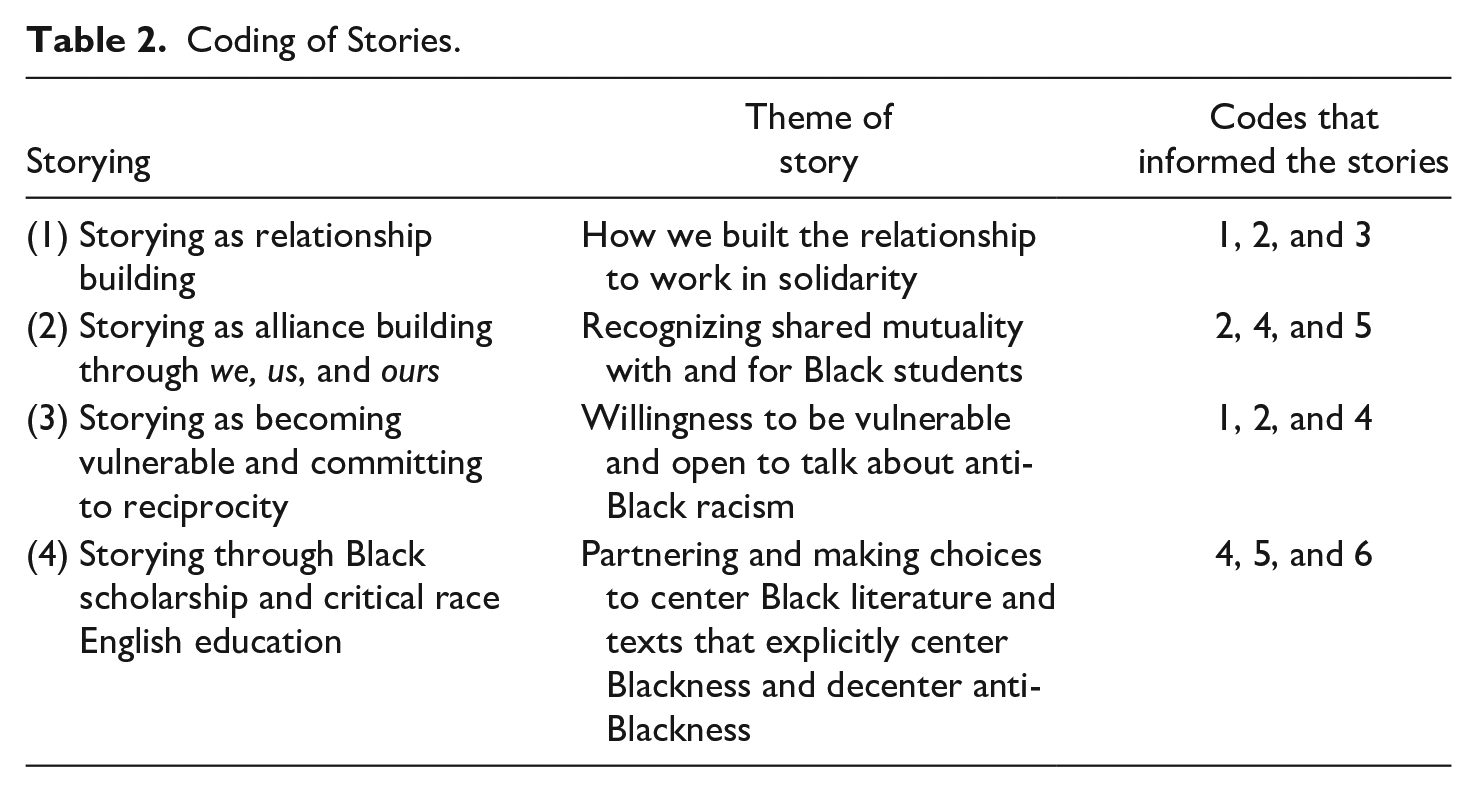
Storying as Relationship Building
In partnering with Ms. Thomas, I believed our partnering could show how “schooling is not merely a site of suffering” (Dumas, 2014, p. 2). For example, in the context of pervasive anti-Blackness in schools, the partnering of two Black teachers with similar mindsets of nurturing and caring for Black students’ lives contributed to our JOS. Just as hooks (1994) maintained in the chapter about Engaged Pedagogy in Teaching to Transgress: Education as the Practice of Freedom, we agreed that, To educate as the practice of freedom is a way of teaching that anyone can learn. That learning process comes easiest to those of us who teach who also believe that there is an aspect to our vocation that is sacred; who believe that our work is not merely to share information but to share in the intellectual and spiritual growth of our students. To teach in a manner that respects and cares for the souls of our students is essential if we are to provide the necessary condition where learning can most deeply and intimately begin. (p. 13)
As engaged pedagogy demands teachers and researchers to collaborate and work to situate Black students’ literacy learning critically, so that they disrupt “systems of domination,” such as as anti-Black racism (hooks, 1994, p. 10). In an interview in the first month of our work together, Ms. Thomas shared the following: As a Black woman, I am personally attached to the Black students. We share a culture, language, history—the same discrimination. I am obligated to ensure that they are reading Black literature, aware of current events (e.g., issues that affect Black and Brown lives on racial discrimination, police brutality, and immigration); most importantly, pushing them to reach their full potential. They need to know that despite inequalities existing for us that they are capable. (February 15, 2018)
Ms. Thomas and I had kindred pedagogical stances, grounded in our prior relationship and our lives as Black women born and raised within an anti-Black society. During our initial talks, I shared my positioning with Ms. Thomas. I knew from working with her that we shared similar beliefs about the teaching and learning of Black students. Her willingness to sustain Black students contributed from the beginning to my transparency about my feelings on race and racism and how my experiences with White supremacy played a vital role in my desire to partner with her and her students. We both desired to cultivate an antiracist classroom where students would have opportunities to make meaningful connections to their own lives. It was not about the project or activity on its own, but being committed to dismantling anti-Blackness and learning from one another and our students in a justice-oriented classroom that affirmed Black students’ humanity. Toward this end, we focused on our classroom as a space that would allow for the “freedom of language, representation, and expression of culture, and the telling of stories that matter to Black” students (Sealy-Ruiz, 2020, p. xi). Thus, we both acknowledged that Black students should have agentic experiences in which they could openly share their struggles with White supremacy and anti-Blackness. During our last formal semistructured interview, Ms. Thomas said, “I want them to be well-rounded. And I want them to be not only confident in what they learned—you know, school terminology and curriculum—but in themselves as people, in their demographics as young, Black people.”
Later, she added, I would allow them to speak about police brutality, and—not just speak about it but know . . . certain terms like microaggression, or systemic racism, or white supremacy, and perhaps they can make meaning about how those terms actually affect them. (June 20, 2018)
I believed that our collaborative efforts and commitment to disrupting the status quo united and helped us challenge systems of domination to foster a learning environment built on the love and care of our students. When Ms. Thomas shared, “It’s important to me to teach not only curriculum lessons but also life lessons,” I recognized that her expression of love for and commitment to her students was more visceral than anything else.
Storying as Alliance Building Through We, Us, and Ours
In reviewing the discursive threads between Ms. Thomas and me, I noticed that we both used the pronouns we, us, and ours throughout our conversations. We never characterized the students as outsiders—we always saw our work as a relational commitment. Our sentiments are similar to those reported by Kohli and Pizarro (2016). They studied 218 teachers of color who identified themselves as being advocates of racial justice and racial literacy from across the nation; the teachers shared in their narratives “a deep relational commitment to teach along with, and as part of communities of Color” (p. 73). Ms. Thomas’s relational commitment was evidenced when she conveyed during an interview that I felt it was my duty—and this might be because I am a Black woman—I felt the need to nurture them and let them know that they were important and that they could excel. And you can really do whatever you want to do. (May 3, 2018)
On this occasion, Ms. Thomas made it clear that she had a strong commitment to her Black students, especially as a Black woman. Thus, she acknowledged their shared Blackness. Ms. Thomas’s positioning reminds me of Walker’s (1996) research focused on Black teachers’ dedication and commitment to Black students at the Caswell County Training School, which existed in rural North Carolina from 1934 to 1969. Walker argued that “teaching was more than the imparting of subject matter; it was the task of molding children to be successful. Theirs was a job of collective racial uplift” (p. 149). I understand “racial uplift” to mean the social, political, and economic empowerment of Black people. As with Caswell County Training School, Ms. Thomas and I equally recognized the mutuality of our Blackness and supported the students’ racial uplift and Blackness. I do not believe that Ms. Thomas and I were different from the committed Black teachers who have always centered Blackness (hooks, 1994; Walker, 1996). We endeavored, however, to continue the legacy.
Ms. Thomas and I saw our racial stories as connected because of our shared Blackness and the ever-present effects of anti-Blackness within our schools and communities. Having attended schools in the district from Grades K through 12, Ms. Thomas said she desired to return to the community to teach. She said she could not remember having the opportunity to talk about justice-oriented issues, but her ties to the community made her feel comfortable doing that. Her connectedness echoed Kohli and Pizarro’s (2016) community-oriented teachers of Color. As community-oriented teachers of Color, they expressed that the teachers not only had “deep ties and connections to their communities” but also desired to return to the community in which they were taught “to provide opportunities for intellectual engagement that they felt was lacking in their schooling” (p. 75).
Ms. Thomas, a community-oriented teacher, recognized the need to instruct her Black students about racial justice issues she cared about and that would benefit her students. Again, in the same interview, Ms. Thomas shared how to best meet the needs of her students, and she passionately stated, And I know—I guess being Black, I know what the future can hold for these young kids and how society can make a mark on them. I guess what I want to say, like it can be something positive, or it can be something very negative. So, I felt it was my duty to help them succeed at whatever it was they wanted to do. It was up to me to make sure that they knew that they could be whatever they wanted to be. (May 3, 2018)
Essential in developing our JOS and providing a supportive environment that called for students to talk about racial injustice and violence was our dedication to the students and our communities.
Storying as Becoming Vulnerable and Committing to Reciprocity
In our journey toward fostering a Black Space, we acknowledged that our commitment to each other and our work must be transparent. We encouraged a classroom space that could be “a site of resistance” (hooks, 1994, p. 21). In fostering a site for resistance, we openly talked about White supremacy and how it underpins anti-Black racism. To help students feel comfortable sharing how they experienced anti-Black racism meant that we had to be open and honest about the ways we experienced or witnessed anti-Blackness. Thus, central to our ability to create a Black Space was our willingness to become vulnerable and commit to reciprocity.
Ms. Thomas and I shared confessional narratives (hooks, 1994) to disrupt narratives rooted in White supremacy. hooks’s notion of confessional narratives is a way for teachers to become vulnerable by sharing their personal stories with students, which could help students to process any experiences with or knowledge of racial violence and deficit positioning toward Black lives that can affect them emotionally, physically, and spiritually. During our last interview about her feelings of our partnership, Ms. Thomas observed, Power is shared, and I’m not trying to dominate. I open up about my own personal experiences, and that has really shaped my teaching over the last 10 years. I am open with my students because it’s not just [that] I’m having them speak, but I speak and share, too. (June 20, 2018)
In having a conversation with Ms. Thomas about shared power in her classroom, I recall how she made connections to The Hate U Give and the effects of White supremacy. Ms. Thomas shared a story about having attended a predominantly White institution (PWI) in the Midwest. She discussed how she had traveled on a campus bus and felt that a group of Black girls were acting “ghetto.” She expressed her judgment of the Black students. Ms. Thomas elaborated that the girls were loud and were using Black language.2 She expressed that she was annoyed because she felt embarrassed. Admittedly, upon reflecting on that bus ride, Ms. Thomas expressed to her students that she was disappointed with herself because she had internalized White supremacy, which was being operationalized in her sentiments about the girls. She shared her complicity in engaging in anti-Blackness because she had called the girls “ghetto” in her mind. In having this conversation with the students, Ms. Thomas opened the door for the students to share similar confessional narratives. Many of them pointed out how they had misjudged a Black person because of anti-Black sentiments. We discussed how their positioning could have resulted from their overexposure to White supremacist narratives, which could have contributed to their having a myopic view of Blackness.
The pervasiveness of negative images and messages about Black people continues to contribute to the harmful perceptions that many Black students retain about themselves and others (Johnson, 2018; Muhammad & McArthur, 2015; Shujaa, 1994; Tatum, 2017). For example, I shared with Ms. Thomas and the students how one of my college professors had admonished me about my use of Black Language in my papers and went on to question how I had gotten so far. The professor criticized me for my inability to use White Mainstream English (WME) to write my essays. Baker-Bell (2020) cited Alim and Smitherman (2012) in using this term in place of Standard English to highlight how “white ways of speaking become [an] invisible—or better, inaudible—norm” (p. 3). My professor engaged in anti-Black linguistic racism. Baker-Bell described anti-Black linguistic racism as the “linguistic violence, persecution, dehumanization and marginalization that Black Language-speakers experience in schools and in everyday life” (p. 11). To this day, I am haunted by my professor’s remarks and spent years feeling inadequate about my capabilities as a Black student. Based on Ms. Thomas’s and my personal experiences, we agreed that we needed to further interrogate our students on how we are affected by anti-Black racism and White supremacy. Also, we spent time explaining to the students the historical, social, and political underpinnings of Black language (Baker-Bell, 2013).
Throughout our talks, Ms. Thomas opened up about her willingness to share and be vulnerable right alongside her students. She was the same with me. For example, Ms. Thomas and I had a conversation about my creating a group of students to interview for my project. During our work together, I repeatedly told Ms. Thomas that I valued her opinion and choices. Ms. Thomas advocated for James, a White student, to be part of the dialogic group. Dialogic groups were designed to be a safe space where students could share their perspectives and attitudes about their classroom environment. I had not considered James a participant because he was the one student in the class who was not Black, and I was most interested in how Black students have opportunities to take up Blackness. I was unsure if I should concede, but I was willing to listen and reconsider my position. Ms. Thomas said the following: I decided to add James to the dialogic group because I wanted the perspective of a white student, who is the minority in our high school. This was especially important to me after deciding to read The Hate U Give. I felt like James would be able to relate to a character who was also white in the novel and because [James] also had a Black girlfriend and could also offer his personal insight. (January 25, 2018)
At first, I was resistant when Ms. Thomas suggested that I add James. Immediately, I thought that Ms. Thomas’s decision to add James to the dialogic group was due to the influence of the White gaze (Morrison, 1993). I remembered from my own Grades 6 to 12 teaching experiences how difficult it can be to feel as though every move a teacher makes must be in alignment with and connected to a district, state, and national mandate or the feelings of not being able to disrupt the status quo. Teaching to the canon, being test driven, and not affirming students’ languages are examples of the White gaze’s impact in everyday classroom teaching and learning. However, in having more conversations with Ms. Thomas, I learned she could disrupt the status quo. For instance, while in one of our curriculum meetings, Ms. Thomas shared information about her current teaching position and curricular choices: So, here I would say that my principal is receptive, and I still make time to teach the anchor texts that they want me to teach, and then I add to them. I’m still going to talk about the same things and let [the students know] about the Black experience whenever I can because I think that’s important. (May 3, 2018)
Ms. Thomas also felt it was important for James to tell his story about dating a Black girl in the class, just like Chris, Starr’s boyfriend from The Hate U Give. I pointed out to Ms. Thomas that the story is told by Starr, the novel’s protagonist, who must exist in two worlds—one that is Black and the other White. She, however, did not want James to feel left out. Of course, I did not either. Our partnership was built on our mutual contributions to each other’s critical consciousness. Thus, I decided to include James. James’s situation is an example of how radical praxis toward centering Blackness is difficult, complicated, and messy.
Storying Through Black Scholarship and CREE
To achieve JOS in a Black Space, we centered Black scholarship (Baszile, 2006). For us, the curriculum served as a passageway to lead the students in a way that they reflected on deficit ideologies. When I met with Ms. Thomas for our initial meeting in the early fall of 2017, I shared my research focus and defined key frameworks, CSP and CREE. In explaining my research focus, I told Ms. Thomas that we would coconstruct the curriculum and pedagogy.
We assigned each other work. My task was to familiarize myself with the district curriculum; read over her unit plan, which mapped out curricular dates; and consider racial work (e.g., specific assignments that would center Blackness) that we might assign. I suggested that she read Thomas’s The Hate U Give, a fictional text written by a Black woman author about the lives of Black youth and their dealings with anti-Blackness and racial violence, as well as several articles written about CSP and CREE and excerpts from Smitherman’s (2006) Word From the Mother: Language and African Americans. Ms. Thomas was excited about teaching Wright’s Black Boy and selected texts from the 11th-grade Collections textbook. Based on our initial conversations, we recognized that our curricular choices should provide opportunities for the students to build on and make connections to their lives. During our first interview, Ms. Thomas expressed why she agreed that it was vital for us to talk about race-related issues fueled by White supremacy. She said, “Talking about issues of race, racism, and anti-Blackness would make [the students] excited because they would have the opportunity to come to class and talk about things that they’re not used to talking about in a classroom setting.”
In the weeks preceding our coteaching, we negotiated back and forth about the readings and classroom activities. We discussed the importance of incorporating multiliteracies, so I suggested that students create blogs, visual representations, and digital stories that helped them conceptualize their understanding of race, racism, Blackness, and anti-Blackness. Ms. Thomas desired to incorporate other media platforms (e.g., YouTube, music, commercials, videos, and other media available through the internet). I left the initial meeting feeling excited about uniting with Ms. Thomas and looked forward to subsequent meetings, where we would discuss what, how, and when we would plan together to discuss the possibilities to center Black students’ lives.
Ms. Thomas and I saw the opportunity to provide a curriculum that centered the students’ Black history, including present realities in which Black people experience racial violence and brutality (Baker-Bell, Butler, & Johnson, 2017; Baszile, 2006; Butler, 2017; Johnson, 2018; Johnson, Jackson, et al., 2017). We chose to center Blackness. We acknowledged what Baszile (2006) witnessed. Having worked in a school where the demographics were primarily African American and children of color, Baszile (2006) recognized the students’ miseducation. She argued from the beginning that children were being educated outside of their “cultural context.” For example, she expressed that one teacher took the stance that “Black children didn’t need to know of their Blackness” (p. 93). Ms. Thomas and I, however, aspired to help our students (re)envision their future selves in ways that counter dominant narratives that harm them by “incorporating a critical race curriculum that dismantled the conventional curriculum standards, objectives and instructional practices that permeate ELA classrooms” (Johnson, 2018, p. 118).
We had many planning meetings about our curricular choices before we began teaching the students. To center Black scholarship, I introduced Ms. Thomas to Johnson’s (2018) theory of CREE, and we talked of how we might explicitly address anti-Black racism. For example, we discussed what terminology the students would need to know to understand The Hate U Give deeply. We created shared definitions for these terms and cotaught them. We helped the students grapple with terms such as race, racism, anti-Blackness, Blackness, microaggressions, white supremacy, oppression, and Black Language. We further explained how power is a mechanism that operationalizes racism. Another time, Ms. Thomas discussed how she desired to share an advertisement by the clothing retailer H&M, which featured a young Black boy wearing a hoodie that said “coolest monkey in the jungle.” Many, especially Black people, criticized the image because comparing monkeys to Black people has a long historical connection to anti-Blackness. Ms. Thomas and I both agreed that offering students an opportunity to critique and dismantle the blatant media representation of anti-Black racism would be arduous but necessary. Providing opportunities like this with the students could help them to begin to heal from the effects of anti-Black racism.
There were also moments during our curriculum planning when we pushed each other to think about what texts would best suit our needs to disrupt dominant, White supremacist narratives. Johnson (2018) argued that “traditional ELA curriculum mirrors westernized perspectives” and “does not provide us with the resources to discuss race and racial disparities in manners that are beneficial and liberating to those who are oppressed by racism” (p. 118). To encourage an environment that affirmed our students’ lives, Ms. Thomas and I wished to educate our students in ways that did not continue to promulgate ideas and beliefs that maintained society’s racial disparities and structures that marginalize Black students. Instead, we chose to teach in ways that rejected and dismantled the cycle of racial pain and trauma.
For example, one of our first lessons before beginning Thomas’s The Hate U Give required that the students create drawings of the social and cultural constructions of race, racism, Blackness, and anti-Blackness. Before providing the students with definitions or context for the new vocabulary words, we wanted them to explore their attitudes and beliefs about these words so that we could draw on their prior knowledge to help them understand how race and other categories that focus on difference (e.g., language and culture) affect their schooling and their lived experiences (Lee, 2007). Ms. Thomas said, “It’s important for students to have agentic opportunities so that you allow them to become learners who feel a sense of confidence to share their thinking because that’s, a lot of times, not the norm.” Simply put, Ms. Thomas recognized the need to allow students to conceptualize, explore, and make meaning of the terms and how they related to their lives and Black people.
Finally, before we began reading The Hate U Give and Black Boy for the unit on race, racism, Blackness, and anti-Blackness, we introduced the students to a multiplicity of Black voices, which included poetry, songs, videos, and media. On one occasion, we discussed Chimamanda Ngozi Adichie’s (2009) The Danger of a Single Story. We made connections to portions of Thomas’s (2017) text, where Starr, the main character, is angered by pictures of her neighborhood that have only shown the “worst parts” (p. 245) rather than highlighting Black people and the community where she lived positively. We pointed out how the dominant narrative of Black people is that they live in poverty, are riotous, and are uneducated and in jail. In juxtaposing Adichie’s story and a section from Thomas’s text, we explored the problems with stereotypes and how they maintain anti-Black racism. This activity and others like it supported us to explicitly address anti-Blackness and Blackness. Ms. Thomas emphasized that “the curriculum that we have laid out for our students lends itself to talk about [these issues].” Our planning and culminating work together underscored our love for Blackness and our love and care for Black students’ lives through our JOS. The process of coconstructing a curriculum to center Blackness together also highlights our mutual respect, love, and care for each other—two Black women educators.
Implications
This study has implications for educators and researchers committed to working in solidarity to create a culture of learning that sustains the lives of Black students in a Black Space. I urge future and current researchers and teacher educators to consider the following notions that emerged from JOS. First, the study suggests that when teachers embrace Blackness, they can provide an antiracist classroom experience. For example, to sustain a classroom where Blackness takes precedence over anti-Blackness, educators must support and affirm Black students’ humanity.
Next, the study suggests that teachers commit to being vulnerable by discussing personal experiences because a goal is to be transparent about their experiences with anti-Black racism. In turn, teachers should provide opportunities for students to examine the mechanisms that operationalize anti-Blackness so that they have the tools to dismantle anti-Black racism and White supremacy. Furthermore, the study advocates that teachers should make a connection between school and students’ lives through multimodal texts (e.g., literature, textbooks, media, songs). It is imperative that teachers and students draw on contemporary texts to disrupt dominant narratives of anti-Blackness. In doing so, students, Black and White, will have more meaningful literacy experiences in the classroom, where they are encouraged to address explicitly racial violence, race, Whiteness, White supremacy, and anti-Black racism in and beyond classroom spaces (Johnson, 2018).
The evidence from the study suggests that teacher education programs should provide a space for literacy teachers to understand how anti-Blackness operates so that they can, in turn, help their future students to name, critique, and dismantle it. At the nexus of the relationship between Ms. Thomas and me was our commitment to center Blackness. We strived to provide opportunities for Black students to encounter the English curriculum in ways that would expose them to their histories and Black people’s contributions (Brown & Brown, in press). Thus, preservice teachers may need support to examine how literacy instruction has been and continues to operate as a tool that mechanizes anti-Blackness, and how they might become “cultural workers striving to enact equity, justice, and collectivity” (Patel, 2020).
Finally, this study also suggests that the partnership between Ms. Thomas and me could serve as a model for teacher-researcher and teacher-to-teacher collaborations. The collaboration emphasizes that when researchers take a methodological approach that affirms Black lives while researching with a Black teacher and Black students, the approach must be justice oriented. Just as this study highlights the possibilities of working in solidarity with one teacher to affirm Black students’ lives, it offers what is needed to make JOS pervasive in school spaces more broadly, across grade levels in all English disciplines, in working with and learning from the experiences of other minoritized students (e.g., Latinx and Indigenous groups). Thus, professional development opportunities should be offered to teachers who seek to work in solidarity to explore all the possibilities for providing Black students opportunities “to see their humanity accepted and appreciated equal to any humanity” (Grant, 2020). Most notably, JOS is a transformative approach to teaching and learning and a way for researchers, teachers, and educators to work alongside each other with whom they wish to collaborate.
Concluding Thoughts
I came to understand that the partnership between Ms. Thomas and me represented what I have termed JOS. JOS is a collaborative and reciprocal relationship. Throughout the article, I discuss the importance of working in solidarity with a Black teacher to affirm Black students’ humanity. Through our coconstructing the curriculum and our pedagogy, Ms. Thomas and I conceptualized the possibilities of foregrounding Blackness in the classroom. JOS has three distinguishing elements:
Have a shared commitment to create a Black Space where Blackness takes precedence over anti-Blackness (Stories 2 and 4, Table 2).
Foster a reciprocal relationship based on a collaboration to sustain and affirm Black students’ identities, histories, cultures, and languages (Stories 2 and 3, Table 2).
Share the responsibility to make pedagogical and curricular choices that sustain and affirm Black students’ humanity (Stories 4 and 6, Table 2).
JOS comes out of a tradition of critical scholars who “approach their work with reverence for the youth they encounter” (Winn & Ubiles, 2011). As Black women educators, Ms. Thomas and I remained committed to providing our students opportunities to name, critique, and dismantle anti-Blackness. We held on to the belief that the power of our relationship came from our commitment to sustain students’ Blackness. As Johnson (2018) argued, justice-oriented pedagogies (e.g., Gay, 2018; Ladson-Billings, 1995) do not have road maps that direct teachers in how to work in solidarity or work toward building a collective. Ms. Thomas and I devised our own road map, working in solidarity with love and respect for each other and our students to create a Black Space. In sum, I offer evidence of what can happen when two Black women adopt JOS to provide a culture of resistance where Blackness takes precedence over anti-Blackness.
Supplemental Material
966358__Davena_Jackson – Supplemental material for Relationship Building in a Black Space: Partnering in Solidarity
Supplemental material, 966358__Davena_Jackson for Relationship Building in a Black Space: Partnering in Solidarity by Davena Jackson in Journal of Literacy Research
Footnotes
Acknowledgements
Many thanks to Ms. Thomas for the opportunity to work in solidarity and to cultivate a Black Space and Ashley Johnson and Carmen Kynard, Cultivating New Voices (CNV) mentor for the conversations that helped in pushing my thinking, and to my writing group Cassie Brownell and Kristen White for reading and offering suggestions for various versions of this manuscript.
Declaration of Conflicting Interests
The author declared no potential conflicts of interest with respect to the research, authorship, and/or publication of this article.
Funding
The author received no financial support for the research, authorship, and/or publication of this article.

Supplemental Material
Notes
References
Supplementary Material
Please find the following supplemental material available below.
For Open Access articles published under a Creative Commons License, all supplemental material carries the same license as the article it is associated with.
For non-Open Access articles published, all supplemental material carries a non-exclusive license, and permission requests for re-use of supplemental material or any part of supplemental material shall be sent directly to the copyright owner as specified in the copyright notice associated with the article.
