




Abstract
Although research suggests that teachers turn to their state departments of education for curricular resources, little is known about the resources teachers find on state websites and the recommendations these resources make, especially for teaching writing. We analyze state-provided resources focused on writing (n = 123) for their type, standard(s), and sponsor(s). We also analyze a subset of 40 resources to describe the epistemologies about writing instruction reflected in these resources. We find that just over half of states provide writing resources, that literacy and policy organizations are named about the same number of times as resource sponsors, and that resources tend to foreground structural and ideational epistemologies over social practice. This work helps identify the extent to which states focus on writing instruction, the types of resources states are providing, and the visions of writing instruction communicated through state-provided curricular resources.
The Common Core State Standards (CCSS) were an effort spearheaded by the National Governors Association (NGA) and the Council of Chief State School Officers (CCSSO) in 2008 to develop shared standards across state lines (Rothman, 2011). Although the CCSS are no longer a new standards policy, they serve as one example of an external policy that must be interpreted for classroom instruction. Studying CCSS implementation offers lessons for the policy–practice relationship between large-scale initiatives and the classroom.
State educational agencies (SEAs) are one type of organizations that play a key role in translating standards into classroom practice by providing technical assistance, curricular resources, and professional development (PD; Massell, 1998). A large-scale survey found that teachers turn to SEA websites for CCSS tools and resources (Kane et al., 2016). However, little is known about the types of tools SEAs provide for teachers and the recommendations these tools make about teaching writing. To offer insight into the resources states provide and their stances on writing instruction, we analyze a sample of SEA resources focused on writing and writing instruction to understand not only what types of tools teachers may find but also the implicit beliefs that those resources reflect about the nature of writing instruction.
Review of Literature
The CCSS and Writing Instruction
The CCSS are a set of K–12 standards for English language arts (ELA)/literacy and mathematics that most states adopted in 2010 (LaVenia et al., 2015). Consensus subsequently splintered, as many states went through public feedback processes to revise their standards. Participation in the two assessment consortia (Partnership for Assessment of Readiness for College and Careers [PARCC] and Smarter Balanced) dwindled from 44 to 16 states and Washington, DC (Slover & Muldoon, 2018). However, one analysis of state standards found that the majority of states either preserved the standards verbatim (20) or made minor changes (21; Korn et al., 2016).
CCSS writing standards
In ELA, the CCSS include standards for reading (including literature, informational text, and foundational skills), writing, speaking and listening, and language. In secondary writing (Grades 6–12), there are 10 “anchor standards” that are broken into four subgroups. The first subgroup focuses on “text types and purposes” (NGA & CCSSO, 2010a, p. 41) with three standards representing different genres: argument, informative, and narrative. The next subgroup contains three standards about the “production and distribution of writing” (p. 41). The third subgroup contains three standards focusing on using “research to build and present knowledge” (p. 41). The last standard emphasizes a “range of writing” and writing over extended lengths of time for a variety of purposes and audiences (p. 41).
CCSS and writing instruction
Although only one standard specifically references argument writing, discussion about CCSS implementation emphasized the genre of argument (Calkins et al., 2012, p. 127). Indeed, CCSS lead author David Coleman claimed, “It is rare in a working environment that someone says, ‘Johnson, I need a market analysis by Friday, but before that I need a compelling account of your childhood’” (Layton, 2012, para. 25). Calkins et al. (2012) called argument writing a “big deal” in the CCSS (p. 127), explaining that argument writing’s emphasis on evidence, sources, and counterarguments represents a departure from teachers’ familiarity with opinion-based or persuasive writing. Taylor and Brockman (2015) highlighted the reading–writing connection as a critical area for college-ready writing and for the CCSS, both of which emphasize “entering a conversation” with others “through close reading and analysis” (p. 4).
Whereas some scholars were concerned that this focus on argument means that narrative writing is less emphasized in the standards, others view the CCSS as an opportunity for teachers to highlight writing across genres. In his overview of the “promise and peril” (p. 27) of the CCSS, Applebee (2013) argued that the CCSS “elevates writing to a central place, not only giving it the same number of individual standards as reading, but also making writing the central way in which content knowledge is developed and shared” (p. 27). However, he argues these promises may be difficult to realize due to “issues of implementation” (p. 28), such as the impact of new assessments on curriculum and instruction, and teachers may feel pressured to focus instruction on rigid, formula-based writing like the kind tests often require.
Studies of writing instruction in the context of CCSS suggest that writing may not yet be central in the ELA classroom. At the beginning of the transition toward CCSS, Applebee and Langer (2011) found that students were writing more than in prior decades, but seldom in ways that allowed them to “think through the issues, to show the depth or breadth of their knowledge or to go beyond what they know in making connections and raising new issues” (p. 16). Similarly, Wilcox and Jeffery (2014) examined student writing across disciplines in the CCSS context, finding that secondary students were rarely asked to write more than a paragraph.
In addition, teachers have reported that they do not feel prepared to meet the writing demands of the CCSS. In a random sample of nearly 500 elementary and middle school teachers, Troia and Graham (2016) found that the majority of respondents found their PD for the CCSS writing and language standards insufficient, and nearly one in five respondents reported not being very familiar with the CCSS writing standards. Similarly, Hall et al.’s (2015) teacher survey reported a lack of materials (47%) and PD (37%) needed for implementing the CCSS writing standards. Taken together, this literature suggests that the CCSS may have shifted some foci for writing instruction, and some evidence indicates teachers do not feel prepared to make these shifts; thus, it is important to understand tools, such as PD and curricular materials, to support writing standards.
Tools That Support Teachers’ Understanding of New Standards
Resources, curricular materials, and PD help translate educational policy into practice by providing examples of how the CCSS might look in a classroom. Indeed, such tools have long been seen as having potential to mediate teacher learning (Vygotsky, 1978). Grossman et al. (1999) defined tools as items that “teachers use to guide and implement their classroom practice” (p. 13) and argued that tools can be practical or conceptual. A practical tool is immediately usable within a classroom, such as a task or handout, or, at a larger scale, a lesson or unit plan. Practical tools can deeply influence teacher learning, especially for new teachers. Kauffman et al. (2002) found that many early career teachers, overwhelmed by daily instructional demands, craved the specificity of practical tools. Similarly, Grossman et al. (2000) explained that novice writing teachers adopted a wide range of practical tools, from rubrics to more structured writing programs. A conceptual tool is more abstract and applicable to many circumstances, such as teaching about instructional scaffolding. Conceptual tools help build teachers’ understandings about content and pedagogical practice in ways that can transfer to multiple classroom situations. For example, a conceptual tool might be an article about what standards mean for narrative writing or a PD webinar on evaluating text complexity.
When it comes to learning about the CCSS, we posit that both conceptual and practical tools can support teacher learning when written and presented as “educative” (Davis & Krajcik, 2005), providing opportunities for teachers to learn “in and from their work . . . to become more thoughtful professionals with more choices” (Ball & Cohen, 1996, p. 8). In these cases, tools are a place for teachers to learn and interact with knowledge, rather than regurgitate knowledge or mindlessly follow curriculum guides (Remillard, 2000). In this study, we examine SEA-provided practical and conceptual tools—resources provided to help teachers understand new standards. We do not follow these tools into the classroom; thus, our study is distinct from other studies using similar frameworks that treat resources as tools. Instead, we consider these resources as tools providing teacher-learning opportunities.
States and State-Provided Documents as Supports for Teacher Learning
Since the 1990s, states have experimented with establishing grade-level standards for student learning. As state standards became institutionalized, SEAs’ roles have included (a) building instructional capacity by providing curriculum materials and PD resources and (b) creating infrastructures to disseminate information to teachers through in-person PD, websites, regional networks, newsletters, and state conferences (Massell, 1998). As related to the CCSS, two surveys found that SEAs are a source teachers commonly turn to for information about new standards (Kane et al., 2016; Opfer et al., 2016).
While many factors contribute to teacher learning about state policy (Coburn, 2001, 2005), state documents also signal particular policy messages and serve as potential sites for teacher learning. To support the transition to CCSS, states provided resources, including resources created within states and by a variety of other disciplinary and policy organizations (Hodge et al., 2016). For example, on the topic of text complexity, materials provided included practical resources, such as lists of texts organized by Lexile or recommended grade level, and conceptual resources, such as articles meant to help teachers understand how they might assess a text’s complexity (Hodge et al., 2016). However, states are not the only source of messages about instruction; a constellation of organizations are involved in school improvement and provide a variety of curriculum materials and PD (Hodge et al., 2019; Rowan, 2002). Given this variety of resource types and providers, studying the content, emphasis, and underlying beliefs in the resources states endorse is a key part of understanding at least some of the policy messages states prioritize in materials that may lead to teacher learning.
Theoretical Framework
This work focuses on curricular resources as tools that may influence teacher learning about new standards. Vygotsky (1978) and others have argued that tools are important for their potential as agents to influence learning. We do not take up how these tools mediate learning in a Vygotskian sense by studying how teachers use tools. Instead, we ground our work in the role of state documents as potential spaces for teacher learning, as described above, and thus, examine the messages tools such as curricular resources communicate to teachers to highlight how tools can reflect beliefs about instruction.
Tools as Expressions of Beliefs
Prior research on theories of writing instruction has categorized beliefs about teaching writing in different ways. For example, Ivanic (2004) developed a framework outlining “discourses of writing,” defined as “constellations of beliefs about writing . . . and the sorts of approaches to teaching and assessments which are likely to be associated with those beliefs” (p. 224). She identified six discourses—skills, creativity, process, genre, social practice, and sociopolitical contexts—and argued that writing teachers should understand each discourse’s implicit beliefs so they can use multiple discourses to support a well-rounded approach to writing. Similarly, Behizadeh and Engelhard (2011) identified three basic epistemological stances to categorize different eras’ overall writing theory and assessment emphasis in the 20th century. These stances emphasized (a) structure/form or isolated skills, (b) advancing or developing ideas, and (c) social practice via a focus on context and audience. Behizadeh and Engelhard argue that writing assessments have privileged a structural epistemology and, to the extent that assessment can drive instruction, they suggest assessments should be more in line with contemporary writing theories and a social practice epistemology, emphasizing language as part of social relationships and contexts.
Other researchers have operationalized these frameworks for analyzing instruction or instructional materials. For example, Newell et al. (2014) applied Behizadeh and Engelhard’s (2011) three epistemologies to 31 ELA teachers’ argument-writing units. The researchers provided “identifying features” for each argument-writing epistemology, including the primary instructional focus, priorities for learning to argue, and the basis for assessment (p. 97). Out of 31 teachers, 18 teachers foregrounded structure, three foregrounded ideas, and 10 foregrounded a social practice approach to teaching argument writing.
We, too, draw on Behizadeh and Engelhard’s (2011) epistemologies—structural, ideational, and social practice views of writing—and, like the authors, we apply these epistemologies in a non-genre-specific way to SEA-provided curricular and professional resources to understand how these types of tools may serve as catalysts for teachers’ understanding of writing instruction under the CCSS. Adoption of common standards has provided an opportunity for states to share materials, yet little is known about the materials created or shared, or how writing instruction is positioned in this policy context. Thus, this work examines the availability of state-provided writing resources, including the types of writing those resources address and the organizations that created them. In addition, we analyze the resources’ underlying epistemologies to understand how they represent beliefs about the teaching of writing in the era of college- and career-ready standards.
Method
We focus on tools—specifically, on resources—as symbolic artifacts that convey ideas about writing instruction. State-provided resources also signal types of writing that states and organizations creating resources value in the CCSS policy context. In this study, we define resources as any type of media (document, video, website, presentation, etc.) provided by SEAs to support teachers’ understandings or enactments of the CCSS. Under this definition, resources might include plans for a CCSS-related writing lesson, a rubric for assessing a writing assignment, or an article or policy document explaining an aspect of the CCSS to teachers. Importantly, our definition of resources includes both resources that are meant to inform teacher learning and resources that may be used with students. We also examine the states and organizations that created the resources—in other words, the entities given credit for creating the resources via trademarks, logos, or author information; we call these resource sponsors. To this end, we investigate the following questions:
This study uses quantitative descriptive analysis and qualitative document analysis to categorize and describe SEA-endorsed secondary ELA resources emphasizing writing. The writing resources are a subset of data from a larger project analyzing all state-provided secondary ELA resources from 50 states and Washington, DC (Hodge et al., 2016).
Identifying and Coding State-Provided Resources for ELA and for Writing Only
Our first research question focused on the proportion of state-provided resources for writing and writing instruction. To address this question, we visited each SEA website and identified the web pages with secondary ELA standards resources. We collected and coded 2,000 resources between October 2015 and March 2016, using a set of inclusion/exclusion rules focused on the web page’s purpose, audience, and organization (see Appendix A in this article’s online supplement).
To test the coding scheme for the full resource set described below, the authors independently coded resources from three states, with 87.9% agreement. To improve efficiency, we increased the size of our rater team to include three additional coders, who completed two sets of training exercises, as well as a norming exercise, in which they were asked to code a state’s resources that had already been coded by expert raters. The additional coders had 85.2% agreement across all three rating categories when matching to expert raters on these exercises.
As our data were primarily written documents collected from websites, we used document analysis, which requires an iterative process of skimming, thoroughly reading, and interpreting (Bowen, 2009). For our initial analysis of all 2,000 resources, we scanned each document to identify three broad content features that could be quantitatively summarized. We first coded each resource for its category. Drawing on Grossman et al. (1999), practical resources, such as lesson plans or worksheets, could be implemented in classrooms immediately. Conceptual resources, such as an article about CCSS shifts in instruction, provided information to teachers about standards and implications for teaching. Resources could also be coded as both or neither of these codes. We also coded resources for their type, such as standards documents, instructional aids (e.g., lesson or unit plan), or curriculum guidelines (e.g., Publisher’s Criteria). (Appendix B in the online supplement contains more information and examples of codes.) Finally, we coded for subject-area emphasis within ELA, categorizing each resource as primarily concerned with writing, reading, listening/speaking, general ELA, or a resource without a clear focus on ELA (e.g., a resource focused on literacy across the content areas). An example of a resource emphasizing writing is the CCSS Appendix C, which provided annotated samples of student writing. To answer our first research question, we identified the proportion of state-provided resources in our data set focused on writing only and the number of writing-only resources provided by each state (N = 160).
Our second research question focused on standards included in writing resources and those resources’ organizational sponsors. To identify these items, resources had to have a functioning web link; 123 of the 160 writing-focused resources had functional web links and were therefore codable. Next, we nested related resources within single cases so that related items could be coded together. For example, in Rhode Island, six individual resources were used in the same PD session, including a facilitator’s guide and ancillary resources; we coded those materials as one case. Together, these decisions reduced our sample to 90 cases. We coded any standard(s) that resources explicitly referred to or identified, as well as documented the state(s) and organization(s) that sponsored the resources.
Identifying and Coding Epistemologies of Writing Resources
Our third research question involved identifying a set of resources with clear instructional messages and using document analysis to code the epistemologies reflected in the resources. Bowen (2009) explained that document analysis involves both content analysis and thematic coding, describing content analysis as “a first-pass document review, in which meaningful and relevant passages of text or other data are identified” (p. 32). We carefully reread the 90 cases of writing resources, looking for clear messages about writing instruction. Epistemologies are inherently implicit and inferential; thus, it was important that resources included clear messages about writing instruction. However, many resources did not have such explicit guidance. For example, Nebraska included a list of student winners from a statewide poetry competition, but these student work samples did not provide clear messages about teaching. While one could perhaps infer that Nebraska meant to imply that poetry was an important genre or that student work should be celebrated, in the absence of clear messages, we decided to remove such items from our sample for the third research question.
A resource with clearer instructional messages is an argument-writing unit from Hawaii. Unit writers noted, “Whenever possible, teachers should attend to the process that students might follow to produce texts—and not only specify criteria for evaluating finished products, in form or content” (Naguwa & Naungayan, n.d., p. 5). The phrase “teachers should” explicitly directed teacher action. Such normative language was helpful in identifying resources with explicit instructional messages. With the focus on explicit messages, our data set was further reduced to 40 resources represented by 16 cases. The only resource that appeared multiple times (n = 11) in the data set was the CCSS Appendix C, which was treated as one case.
To analyze epistemologies reflected in resources, we carefully reread these resources to identify and examine relevant passages for themes, patterns, codes, and categories (Miles et al., 2014). We then categorized these resources as reflecting one or more of Behizadeh and Engelhard’s (2011) three epistemologies: structural, ideational, and social practice. Behizadeh and Engelhard described a structural epistemology as one “privileging form, including mechanics, grammar, and isolated skills” (p. 193). An ideational viewpoint emphasizes “ideas and content, including creative solutions, applied skills to authentic situations, and poetic, new, or thought-provoking content” (p. 193). Finally, social practice highlights “the social and cultural settings in which writing occurs” (p. 193).
Two authors with the greatest expertise in ELA and writing instruction collaboratively coded (Saldaña, 2013) all resources for epistemological foci. We read each resource independently and discussed our impressions of the evidence within each resource until we came to agreement. We summarized the epistemologies reflected in each resource in a matrix (Miles et al., 2014), accounting for resources reflecting more than one epistemology by recording primary, secondary, and tertiary emphases. Coding in this way provided an avenue to represent alternative interpretations of the data. This matrix is included as an online supplement (Appendix D). Resources were coded with a secondary emphasis when the resource contained multiple references to an epistemology, but the resource overall had a different emphasis. Tertiary emphases typically referred to brief mentions of items that could be coded with that emphasis but did not seem to be included in a substantial way within the resource.
We acknowledge the interpretative nature of qualitative data, and we used several strategies to ensure the trustworthiness of our data set and the plausibility of our interpretations. In addition to the coding procedures and examples described above, we have included appendices (as online supplements) that provide additional examples of our inclusion/exclusion criteria, resource coding, and epistemology coding to ensure transparency about our data and analysis procedures (Maxwell, 2013; Miles et al., 2014).
Findings
Writing Resources Within the Landscape of State-Provided Resources
Recall that the initial data set of state-sponsored CCSS ELA resources included 2,000 codable resources. Only 160 resources—from 28 states—focused solely on writing (8%), meaning nearly half of the states did not provide any writing-only resources. Of states that included writing resources, the average number posted was 5.7. Rhode Island had the highest number of writing resources (n = 24), while eight states included only one writing resource. Only 11 states provided more than five writing-only resources.
Resource types
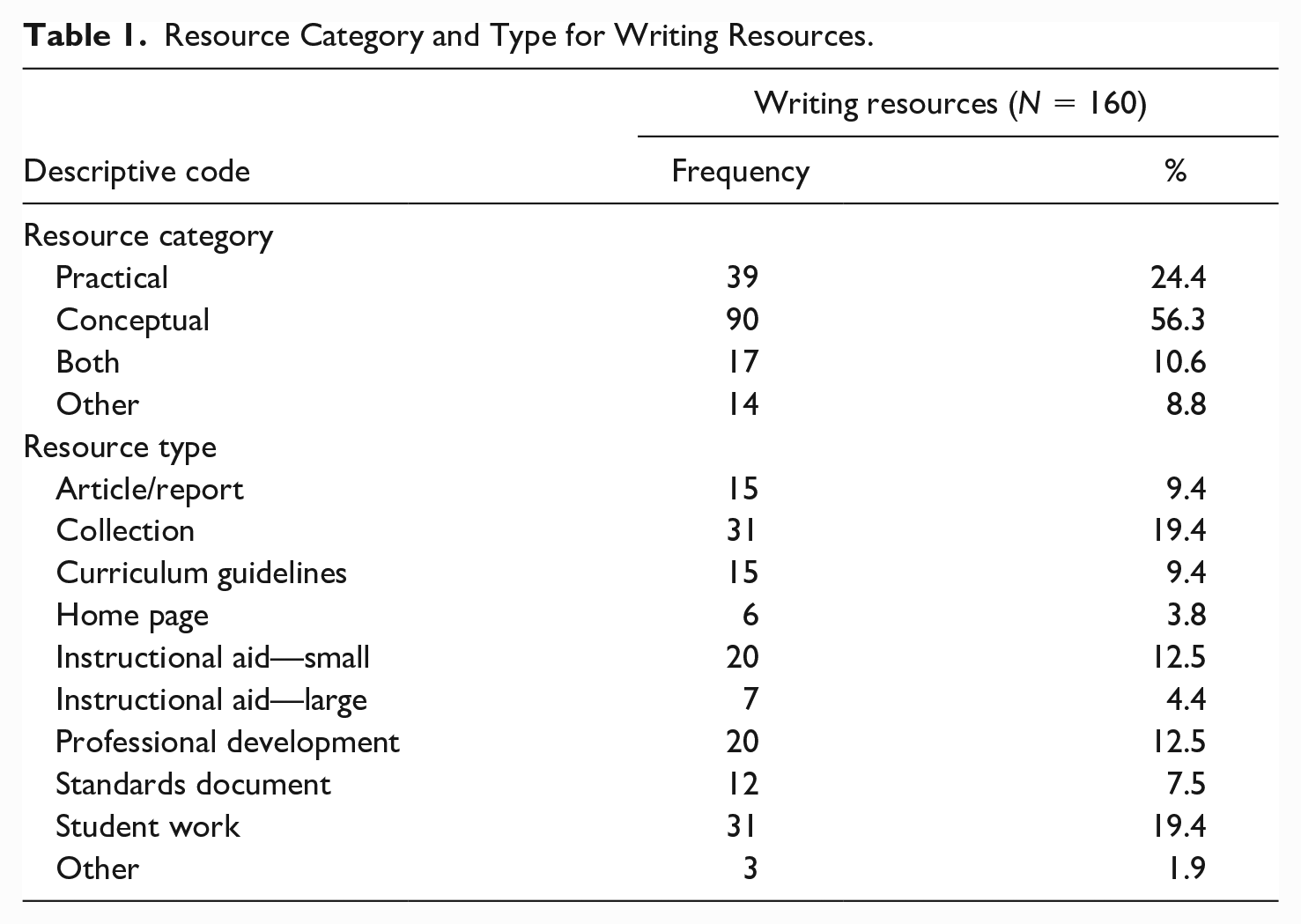
Table 1 describes the results of coding the writing-only resources for category and type. About a quarter (24.4%) were practical resources, and 56.3% were conceptual. As far as resource type, collections (19.4%) and student work (19.4%) each composed about a fifth of the sample of writing-only resources, including multiple links to the CCSS Appendix C, which provides samples of student writing across genres and grade levels.
Resource Category and Type for Writing Resources.
Standards and sponsors of writing resources
Coding resources for standard(s) and sponsor(s) provided a sense of the genres and topics emphasized and the states and organizations sponsoring writing-only resources. Table 2 demonstrates that resources are reasonably divided across the standards focused on the three main genres of writing. In addition, 25 cases (27.8%) did not reference any standard, writing or otherwise. A variety of groups sponsored writing-only resources, including SEAs and state, local, policy, research, and literacy organizations (see Appendix C in the online supplement for further details). We tracked the number of times resources mentioned an organization as a resource sponsor; we use the term number of mentions because resources may have mentioned more than one group as a sponsor. Nineteen states created their own resources, accounting for 112 mentions (49%). The majority of remaining resource sponsors are split across 12 organizations with an explicit focus on writing or literacy, with 43 mentions (19%), and eight policy/research organizations, with 48 mentions (21%).
Frequency of College and Career Readiness Anchor (CCRA) Standards for Writing in Secondary ELA Resources.
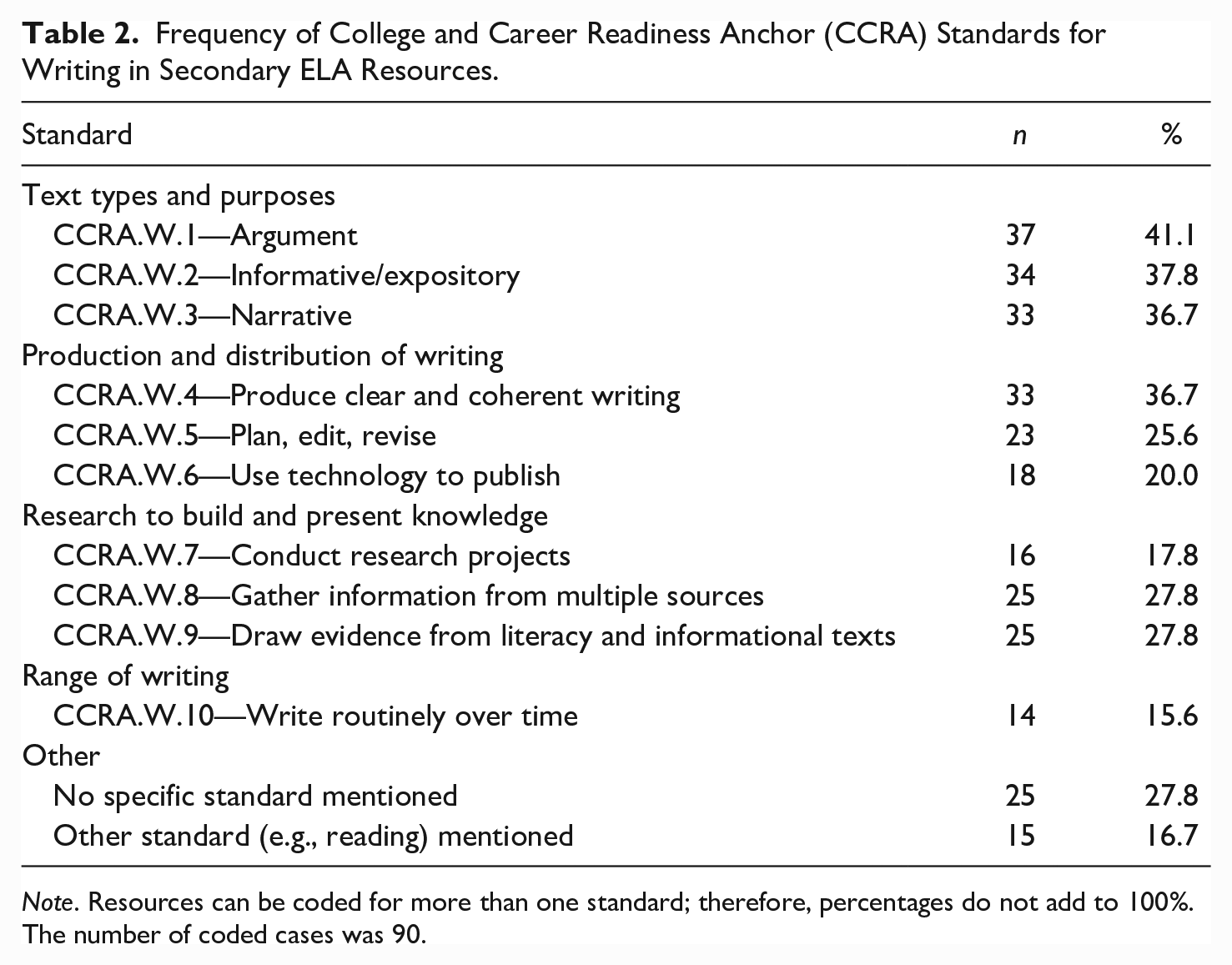
Note. Resources can be coded for more than one standard; therefore, percentages do not add to 100%. The number of coded cases was 90.
Writing Resources and Epistemologies: Tools Reflecting Beliefs About Writing
To analyze epistemologies reflected in writing-only resources, we returned to a subset of resources with clear implications for instruction, looking specifically for language that indicated structural, ideational, or social practice–oriented views of writing instruction. Table 3 defines each epistemology as applied to this data set and shows the coding frequency of these epistemologies at the primary, secondary, and tertiary levels.
Definitions of Epistemologies and Frequency of Codes for Writing-Only Cases.
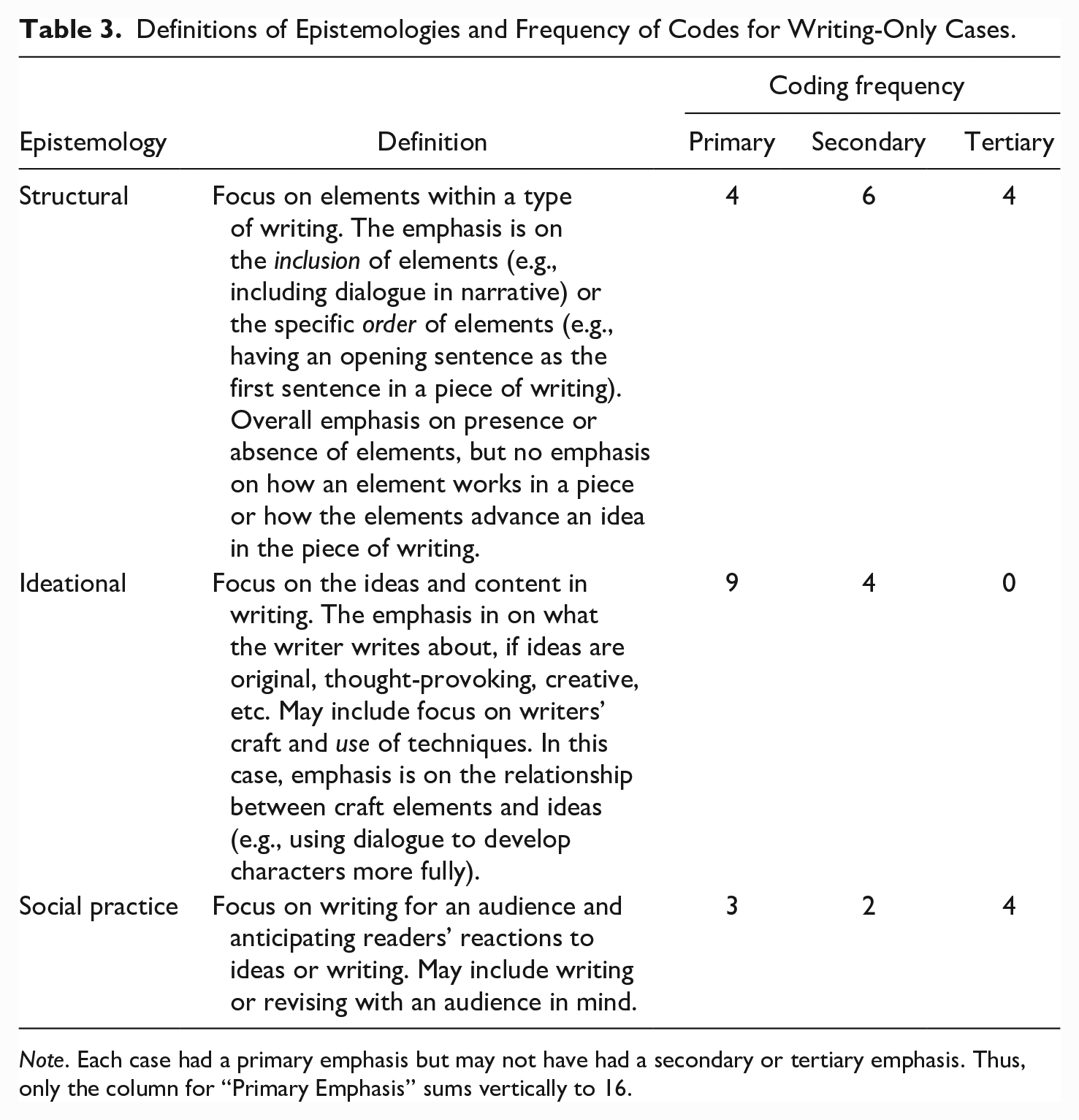
Note. Each case had a primary emphasis but may not have had a secondary or tertiary emphasis. Thus, only the column for “Primary Emphasis” sums vertically to 16.
In the following section, we describe resources that represent the various epistemologies.
Resources featuring ideational epistemologies
First, we provide examples of resources with a primary emphasis on ideational features of writing, focusing on content and ideas. One unit plan (HI01.38), written by Hawaii teachers and university faculty, asks students to compose a reflective essay in the form of a personal anecdote with lessons learned. This unit defines the “reflective writing” genre as one that “employs memories of a past event to make a statement about human experience” (Lyons & Grande-Misaki, n.d., p. 1). The unit was coded as having a primary ideational emphasis because of features like use of mentor texts, recommended activities such as brainstorming or journaling, and generally asking students to think critically about their own lives—elements that overall emphasized the ideas within the writing.
For example, one mentor text suggested was “On Dumpster Diving,” by Lars Eighner. The unit’s authors annotated the mentor texts for teachers. One annotation highlights how Eighner uses a life story to connect to a universal truth, suggesting that students do the same. In this annotation and others, we observed an overall emphasis on each essay’s content. In addition, this unit, and all Hawaii units, explicitly reference the National Council of English Teachers (NCTE) beliefs about ELA instruction, including that writing is a process, reading and writing are interrelated, and writing is a tool for thinking.
The unit emphasized some structural elements. Although most annotated features of mentor texts focused on content, annotations also occasionally focused on “key features” of a reflective essay such as attention to detail (Lyons & Grande-Misaki, n.d., p. 2). In addition to structural elements, one of the “key features” provided limited evidence of social practice as a tertiary emphasis: A reflective essay, according to the unit, “provides closure” for the reader, highlighting consideration of one’s audience (Lyons & Grande-Misaki, n.d., p. 2).
A second example of an ideational resource is a Rhode Island PD session focused on argument writing (RI01.93–99). The PD provided a rationale for focusing on the genre of argument, unpacked its components (e.g., claim, reason, evidence), and asked teachers to study the CCSS Appendix A, an argument for the CCSS, as an example of the genre. The PD facilitation guide directed attention to the content of arguments, especially the claims and evidence present in the CCSS Appendix A. In one activity titled “Tracing the Argument,” teachers were guided to examine the CCSS Appendix A and “identify the claim, reasons, and evidence that authors give to support this emphasis on writing argument” (Rhode Island Department of Education, 2012, p. 2). This activity’s overall goal was not to identify parts of an argument but to trace the argument in the CCSS Appendix A after studying the claims, reasons, and evidence provided (thus, a primary ideational focus).
Other activities in the PD session displayed a structural focus, such as an activity asking teachers to read definitions of an argument’s features, identify the genre’s elements, and compare argument writing with persuasive writing. This activity was not focused on how writers use argument to advance ideas but on understanding the components of a written argument, indicating a secondary structural emphasis. No activities focused specifically on social practice features of writing; however, there was a brief mention of audience awareness in a section providing a definition for counterclaim, so we coded this as a tertiary emphasis.
Resources featuring structural epistemologies
Because many resources reflected structural epistemology in some way, focusing on form or particular elements in writing, we describe below four resources that solely emphasized structure (without any secondary or tertiary emphases) to illustrate this epistemology in practice.
States linked 11 times to the CCSS Appendix C, which provides annotated samples of student writing. The annotations primarily emphasize features of student work and their alignment to standards or indicators with a structural focus. As an example, the CCSS Appendix C provides an eighth-grade informative/explanatory essay about football. After the essay, the annotation uses the direct language of an indicator (W8.2.a), saying that the writer “organizes ideas, concepts, and information into broader categories” (NGA & CCSSO, 2010b, p. 47). Then, the annotation explains how the student essay met the criteria of the indicator: “Information is organized into three components of the mental aspect of football: discipline, concentration, and instinct” (p. 47). Another annotation highlights the use of “appropriate transitions to create cohesion and clarify the relationship among ideas and concepts” (p. 48) and provides examples from student writing such as “At times . . . The first time . . . After a while . . . During the game . . . ” (p. 48). In the second case, this standard has potential to take on an ideational stance, if the emphasis is on how writers use these transitions to illuminate their ideas. But the annotations simply list transitions that are used, with no emphasis on how these transitions function in relationship to the ideas in the writing.
The Hawaii unit (HI01.33) on argument writing also emphasized structure. The unit offered different task options, such as an academic essay, a letter of complaint, or an op-ed. However, the focus of the unit’s lesson plans was on how to structure claims and counterclaims and on terms associated with argument writing, like opinions versus claims and counterclaims. For example, one activity directs teachers to “use descriptive outlining to identify argument elements . . . in mentor/student texts. Weaker texts can be analyzed for missing elements and for suggested revision purposes” (Naguwa & Naungayan, n.d., p. 9). The core assignment was to identify a controversial issue and make a claim about it. However, the unit directions did not foreground either the ideas presented in the claims, evidence, and counterclaims or anticipating a reader’s reaction to particular claims, but rather emphasized the importance of including those elements in a well-structured argument.
Like other Hawaii units, this unit provides mentor texts and includes annotated versions of these texts. However, unlike the ideational focus in the unit on narrative, this unit uses mentor texts to “show the parts of the argument essay” (Naguwa & Naungayan, n.d., p. 2). One annotation focuses on locating and recognizing an opposing claim but does not provide insight into how acknowledging this claim helps advance the writer’s own position. Another example highlights a sentence and says, “This is the THESIS STATEMENT for the article” (Naguwa & Naungayan, n.d., p. 3). This annotation clearly identifies a thesis but provides no information about why this statement is a thesis; thus, this resource was coded with a structural focus.
Resources featuring social practice epistemologies
Overall, a social practice epistemology, or writing for external audiences or authentic situations, was the least emphasized in writing resources; it was most often a tertiary emphasis or not present. However, three resources had social practice as a primary emphasis. One example is a Hawaii expository writing unit (HI01.35) on a “definition essay,” asking students to select a word and consider “the social construction of language, how specific words work in specific situations, how certain words are contested, how words operate differently according to cultural context, how they are co-opted, and how they might shift in meaning with each generation” (Nishimura & Roitman, n.d., p. 1). This focus on social construction and an external audience carries over to several activities that focus on audience. For example, one invites students to read a short piece from Peter Elbow’s Writing With Power and then asks students to brainstorm lists of different audiences or to think about questions like, “What is a ‘safe’ audience and why?” (p. 11). Later, students work with groups of peers to “discuss the social, political, religious and/or cultural use of your words” and respond to their group discussion in writing (p. 16). Because the unit’s emphasis is on how a word’s definition is socially constructed and how particular audiences make meaning of particular words, this unit was coded with a primary social practice emphasis (without any secondary or tertiary emphases).
Finally, North Carolina (NC03.02) provided a two-page PDF advocating for writing conferences in high schools. The article describes five kinds of writing conferences and offers recommendations for successful conferences. For all conferences, the document frames the teacher’s role as that of a “reader” rather than a “proofreader,” directing teachers to focus on content and organization rather than “just correcting errors” (North Carolina Department of Public Instruction, n.d., p. 2). To be sure, a teacher could use a writing conference to point out structural or grammatical issues; however, the guidance provided in this particular document focused on language that centers the teacher as a reader rather than an evaluator. The prompts for teachers asked them to focus on their impressions, confusion, or reactions. Thus, this resource was coded as social practice.
Discussion
Describing State-Sponsored Writing Resources
This study describes state-provided tools meant to support teachers’ understandings of writing instruction. These documents are only one way that SEAs communicate with teachers, often in addition to regional or online PD, newsletters, or social media. However, these resources, openly available on SEA websites, provide public signals of a SEA’s values around curriculum and instruction. Viewed that way, one interpretation of the relatively few resources focused only on writing is that writing may be less valued than other elements of ELA, and that the lack of writing resources in many states reflects reduced potential for the SEA to positively influence writing instruction.
If one of the CCSS’s purposes is to address writing as a threshold skill and improve U.S. students’ writing, these data suggest there is not enough focus solely on writing instruction in state-provided resources to achieve this goal. Twenty-three states offered no resources explicitly focused on writing, and only 11 states provided more than five writing-only resources, implying that writing continues to be underrepresented at the national level (National Commission on Writing in America’s Schools and Colleges, 2003). Similarly, about a quarter of cases analyzed did not reference specific standards, challenging the potential for resources to be supportive tools for teachers implementing standards. This is in line with other findings suggesting that teachers feel they need more PD and tools related to the CCSS (Hall et al., 2015; Troia & Graham, 2016).
Conceptual tools for writing were more prevalent than practical tools, indicating SEAs may be more focused on supporting teachers’ overall understanding of the writing standards or that SEAs may purposefully avoid providing instructional recommendations because of local control traditions. This approach may not allow teachers to build complete understandings of what college- and career-ready writing looks like. For example, samples of “student work” were coded as conceptual resources because they depicted the end result of instruction; they did not provide concrete details or practical resources about instruction that would allow students to produce such work. Concepts are hard to build, and practical tools are important to build conceptual understandings (Smagorinsky et al., 2003).
The three standards representing the three genres of writing were roughly equally emphasized across available resources, in contrast to the message in the CCSS Appendix A about “the special place of argument” (Calkins et al., 2012, p. 127). One interpretation of this finding may be that states are working to preserve the importance of narrative writing. However, while we do not see evidence that states are generally emphasizing argument writing over other types of writing, we do see the influence of Appendix A in resources. For example, PD modules from Rhode Island and Pennsylvania use materials closely connected to the CCSS lead authors. Appendix A is a document connected to CCSS, but it is not a direct part of the standards; such documents may be standards authors’ attempts to direct conversations about implementation.
Both states and a variety of organizations are involved in shaping teachers’ learning opportunities about the standards–instruction relationship through materials and other guidance they provide (Rowan, 2002). Our data show a larger number of literacy organizations sponsoring writing-only resources than policy organizations, but both groups are roughly equally represented as resource sponsors. Although we cannot know why or how SEA coordinators select these resources, or the extent to which these organizations influence SEA coordinators’ decision-making, one possible interpretation of this finding is that literacy and policy organizations have roughly equal opportunities to shape teacher learning through SEA-provided resources.
Resources’ Epistemological Stances on Writing Instruction
The most common emphasis pattern in writing-only resources was a primary emphasis on ideational epistemology, with a secondary emphasis on structure. The interplay of multiple epistemologies within many of the resources illustrates that writing resources can value more than one epistemology. Prior research on ELA curricula has noted the primacy of structural epistemology in writing instruction (Hillocks, 2005); it seems positive that this set of resources displays a more balanced view. The small number of resources featuring social practice demonstrates that the resource emphases are not in line with the sociocultural turn evident in academic literacy research (Behizadeh & Engelhard, 2011; Juzwik et al., 2006) and the statements of professional organizations involved in secondary and postsecondary writing instruction, such as the Council of Writing Program Administrators (2014) and the National Council of Teachers of English (2013). The lack of available resources with a strong social practice emphasis echoes Applebee’s (2013) concern with the CCSS. He noted that the combination of the progression, coupled with “a specific set of emphases on curriculum and instruction at each grade,” may foreground “the formulaic and perfunctory rather than supporting the development of a flexible array of strategies for addressing a wide variety of specific audiences and purpose” (p. 29). In general, a social practice epistemology was a tertiary emphasis; the idea of writing for a wide variety of audiences and purposes seemed deemphasized in favor of structure and ideas.
One factor that may explain the resources’ lack of emphasis on social practice is that writing assessments have not privileged a sociocultural perspective on writing instruction (Behizadeh & Pang, 2016). Writing assessments pre-CCSS tended to emphasize structure, as students were responding to opinion-based prompts. Instead, CCSS-era assessments are meant to assess how students can marshal ideas from text-based sources. Therefore, these resources can be seen as in line with CCSS assessments, supporting the idea of alignment within systemic reform (Smith & O’Day, 1991). However, this may also mean that areas that literacy researchers value, like the sociocultural nature of writing, may continue to be underrepresented in practice.
Implications
These data provide an overview of available writing resources in the era of CCSS and present a picture in which writing may still be somewhat underemphasized, but where narrative writing is valued alongside argument. These resources reflect a combination of beliefs about writing instruction but underemphasize social practices such as writing for authentic audiences.
This work has implications for SEA officials, literacy coaches, school and district leaders, and others who recommend or select resources for use by teachers. First, these groups should ensure that writing resources are represented in the ELA resources they recommend. Moreover, when resources are meant to help teachers understand policies such as new standards, the resources should be clearly connected to specific standards. Beyond thinking about the quantity and content of resources, these groups must think flexibly and critically about the quality of resources selected for teachers’ professional learning and for use with students, especially in how recommendations are positioned relative to teacher expertise. Remillard (2000) made the distinction between resources that speak “to” teachers, providing information that empowers teachers to make their own choices, and resources that speak “through” teachers, positioning teachers as implementers of curriculum as given. Our data include examples of both types of resources. The Hawaii units offer flexible suggestions for how to enact the unit plans, with helpful resources that teachers could choose to incorporate. In contrast, the PD resources from Pennsylvania have strong messages about exactly what teachers should do to teach in line with the standards. Pearson (2013) has argued the standards should be seen as a “living document” (p. 244), in that the standards as written in 2010 may not always reflect consensus about what students should learn. However, we argue for a different idea of standards as a living document: Teachers can and should be encouraged to participate in decision-making around instructional resources. They should be involved in the process of resource selection and have the opportunity to make thoughtful decisions about resources that meet learning goals and the needs of their students.
We also see implications for teachers, broadly, as the primary users of these resources. This close examination of resources suggests worthwhile questions for a teacher to ask of any resource, such as, “What is this resource asking me to prioritize? What does it include? What does it leave out? How does this resource align with other ideas and disciplinary norms?” By drawing resource authors’ implicit beliefs to the surface, teachers are better positioned to make decisions about resources that will support their students. Thinking about these questions adds complexity to resource selection for teachers; for example, a teacher can think about whether a model is used to foreground the study of ideas, structure, or audience. In addition, while research suggests that teachers go to SEAs, among other sources, for resources (Kane et al., 2016), there are many places where teachers can get resources. Because they may be competing with other resource providers, SEAs should work to ensure their resources are helpful and relevant. For future curriculum or standards initiatives, SEAs should work directly with teacher advisory boards to vet recommended resources. Resources posted on a SEA website are one type of SEA outreach; state ELA coordinators support teachers in other ways, including through in-person regional PD, podcasts, and social media outreach (Hodge et al., 2016). In an ideal world, we believe the relationship between SEAs and ELA teachers should be bidirectional, with the SEA providing collaborative opportunities for teacher leadership around resource creation, curation, and PD.
This work also has implications for literacy organizations, policy organizations, SEAs, and other groups that create resources. We urge these groups to think carefully about the extent to which they represent writing instruction and to be cognizant of the epistemologies reflected in the resources they create. We are concerned about the lack of resources emphasizing opportunities for students to write for authentic audiences; despite the strong social turn within the discipline of English, such resources were noticeably underrepresented in this sample. With technological advancements (Hodge et al., 2019), there are many opportunities for students to write for authentic situations and audiences; we urge all groups involved in resource creation to keep such opportunities in mind.
We also encourage SEAs and literacy organizations to collaboratively create resources to widely disseminate research-based literacy practices. Professional literacy organizations are historically rooted in research-based practices and traditions; these practices transcend policy shifts. One path for collaboration is through the State Coordinators of English Language Arts (SCELA), an NCTE-sponsored organization for state-level literacy leaders. SEAs have limited capacity to support teachers across an entire state (Massell, 1998); more purposeful, direct partnerships may help address this difficulty. Many states have affiliate chapters of the NCTE, the International Literacy Association (ILA), or the National Writing Project (NWP); these affiliates are typically composed of local teachers who are well suited to support instruction in their states. States could also work internally with local authors to create writing resources relevant to local contexts, such as the Wisconsin Writes series (Wisconsin Department of Public Instruction, 2018).
Limitations and Future Research
A primary aim for this study was to use a descriptive approach to provide a snapshot of state-provided writing resources and to highlight the types of resources available across the United States in the policy era of the CCSS. Descriptive work helps researchers understand “the landscape of needs and opportunities . . . [and] identifies phenomena or patterns in data that have not previously been recognized” (Loeb et al., 2017, p. 1). This work draws on the advantages of document analysis and the availability of web-based data to provide a national sample (Bowen, 2009) and is an important first step for deeper work with state-sponsored resources.
We acknowledge the limitations of this work, including the possibility that states may provide resources through other avenues with messages distinct from those provided on SEA websites. In addition, our data collection included only resources directed toward secondary ELA teachers; resources targeted toward elementary literacy or content-area literacy would likely have provided insight into different debates in literacy instruction, such as the role of leveled text in CCSS implementation. In analyzing epistemologies, we had to make our best, collaborative judgments about implicit beliefs about writing instruction in each document. While studying curricular and PD resources provides a window into the types of practices resource authors see as important, tools alone do not provide information about classroom instruction. A teacher can put a tool into practice in a variety of ways that may change the cognitive demand, add scaffolding, or modify the audience (Benko, 2016). To understand how educational policy is translated into classroom practice, future research could follow state-provided tools to their classroom-level enactment. Newell et al. (2014) provided an excellent model of examining epistemologies in practice for argument writing; other studies could use similar methods to identify curricular modifications teachers make to understand how teacher beliefs may shape instructional decisions.
We also encourage researchers to consider the SEAs’ role in supporting high-quality literacy instruction. This work examines the type of resources SEAs provide, but it cannot explain why SEAs provide some resources rather than others, or why some provided no writing-only resources. In our sample, nearly half of resource sponsors were SEAs. It would be helpful to understand SEAs’ thought processes around the resources they endorse or create, why they do so, and how they feel such resources will support literacy instruction for teachers in their states.
This work provides macro and micro views of state-provided writing resources under the CCSS, showing that writing-only resources are a small part of the national sample, that these resources are sponsored by a variety of individuals and organizations, and that these resources represent a range of epistemological beliefs about writing instruction. Although this study cannot elucidate what CCSS writing instruction looks like, it does provide insight into curricular tools that translate the CCSS into practical advice for teachers. In addition, this study identifies the extent to which state-provided resources focus on writing and illuminates how different individuals and organizations interpret the CCSS for secondary writing instruction. We see this work as an opportunity to understand how resources portray a snapshot of instructional recommendations in a new policy context; from these tools, we learn what state officials and organizations value about writing instruction.
Supplemental Material
0013.Hodges.WritingResourcePaper_Appendices_011319_CCL_RSB.AMM_sb – Supplemental material for Policy Into Practice: Understanding State Writing Resources
Supplemental material, 0013.Hodges.WritingResourcePaper_Appendices_011319_CCL_RSB.AMM_sb for Policy Into Practice: Understanding State Writing Resources by Susanna L. Benko, Emily M. Hodge and Serena J. Salloum in Journal of Literacy Research
Supplemental Material
915538_Trnaslated_Abstracts_Hodge – Supplemental material for Policy Into Practice: Understanding State Writing Resources
Supplemental material, 915538_Trnaslated_Abstracts_Hodge for Policy Into Practice: Understanding State Writing Resources by Susanna L. Benko, Emily M. Hodge and Serena J. Salloum in Journal of Literacy Research
Footnotes
Declaration of Conflicting Interests
The author(s) declared no potential conflicts of interest with respect to the research, authorship, and/or publication of this article.
Funding
The author(s) received no financial support for the research, authorship, and/or publication of this article.

References
Supplementary Material
Please find the following supplemental material available below.
For Open Access articles published under a Creative Commons License, all supplemental material carries the same license as the article it is associated with.
For non-Open Access articles published, all supplemental material carries a non-exclusive license, and permission requests for re-use of supplemental material or any part of supplemental material shall be sent directly to the copyright owner as specified in the copyright notice associated with the article.
